

|
시장보고서
상품코드
2121712
심장 보조 장치 : 시장 점유율 분석, 업계 동향과 통계, 성장 예측(2026-2031년)Cardiac Assist Devices - Market Share Analysis, Industry Trends & Statistics, Growth Forecasts (2026 - 2031) |
||||||
 Mordor Intelligence
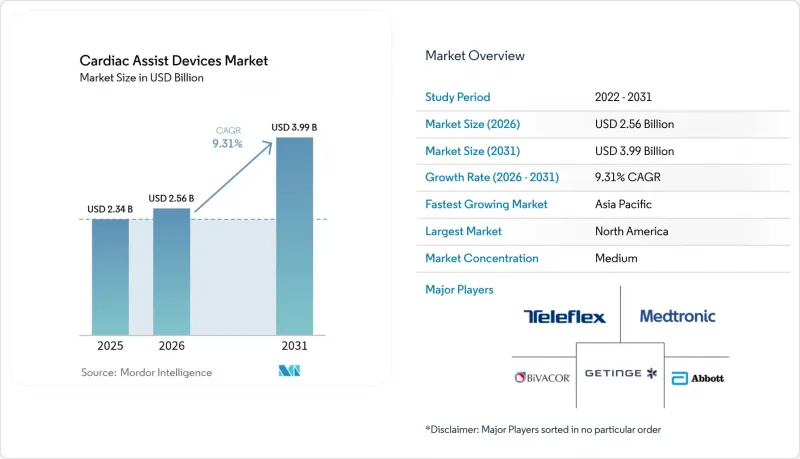
Mordor Intelligence에 의하면, 심장 보조 장치 시장 규모는 2025년 23억 4,000만 달러에서 2026년에는 25억 6,000만 달러에 이르고, 2026-2031년 CAGR 9.31%로 성장을 지속하여 2031년에는 39억 9,000만 달러에 달할 것으로 예측됩니다.
본 보고서에서는 산업을 기기 유형별(좌심실 보조 장치(LVAD), 우심실 보조 장치(RVAD), 기타), 용도별(이식 전 가교 치료, 최종 치료, 기타), 최종 사용자별(병원, 심장·이식 센터, 기타), 지역별(북미, 유럽, 아시아태평양, 기타)로 분류하고 있습니다. 시장 예측은 금액(달러) 기준으로 제시되어 있습니다.
전 세계 심장 보조 장치 시장 동향 및 인사이트
기증자 심장 부족으로 인한 기계적 순환 보조 장치에 대한 의존도 증가
중국에서는 매년 4만 명의 소아가 심부전으로 입원하고 있음에도 불구하고, 소아 심장 이식 시행 건수는 연간 100건 미만에 그치고 있습니다. 그로 인해 심장 보조 장치 시장에서는 의료 시스템이 기계적 순환 보조를 ‘이식 전 가교 치료’가 아닌, 제1선택 치료법으로 채택하는 경향이 나타나고 있습니다. 현재, 데스티네이션 테라피 프로그램에서는 Aeson 인공심장 등의 장치가 사용되고 있으며, 지금까지 30건의 ‘이식 전 가교 치료’ 사례에서 중앙값 156일간의 보조 실적이 있습니다. 새로 승인된 소아용 임펠라(Impella) 시스템을 통해 체중 30kg 이상의 소아에게도 경피적 지원이 가능해지면서 적응증이 확대되고 있습니다. HeartMate 3를 통한 생존 기간은 5년을 초과하여 심장 이식의 벤치마크에 필적합니다. 이러한 지속적인 유효성 덕분에 기계적 순환 보조는 확고한 치료법으로서의 위치를 확립했으며, 심장 보조 장치 시장의 장기적인 성장을 뒷받침하고 있습니다.
기존 시스템에 비해 합병증을 줄여주는 연속 유동식 경피적 장치
HeartMate 3에 채택된 풀 MagLev(완전 자기 부상) 기술로 인해 기계적 마모 부위가 제거되었으며, 한편 임펠러의 축류식 설계는 혈관에 가해지는 외상을 경감시킵니다. ARIES-HM3 임상시험에서는 아스피린을 복용하지 않는 환자에서 출혈 사건이 40% 감소한 것으로 나타났으며, DanGer Shock 임상시험에서는 STEMI에 따른 심원성 쇼크 환자에서 임펠러 CP 사용으로 절대 사망률이 12.7% 감소한 것으로 보고되었습니다(jnjmedtech.com). 당일 퇴원 프로토콜과 쇄골하 정맥 접근을 통해 외래에서 회복이 가능해졌으며, 이는 입원 비용 절감과 심장 보조 장치 시장의 확대로 이어지고 있습니다. 합병증 발생률 감소와 뛰어난 휴대성이 결합되어, 이러한 시스템은 이식 전까지의 가교 요법과 최종 치료 양쪽 영역에서 매력적인 선택지가 되고 있습니다.
일본·한국에서의 ‘데스티네이션 테라피’ 보험 적용 확대
일본과 한국에서는 현재 목적지 치료로서의 이식 비용이 보험 적용 대상이며, 반복적인 입원과 비교했을 때 내구성이 뛰어난 VAD의 비용 대비 효과가 인정되고 있습니다. 이러한 결정으로 환자의 본인 부담이 경감되고, 병원의 전문 프로그램에 대한 투자가 촉진됩니다. 연속 유동식 장치의 내구성이 향상되고 뇌졸중 발생률이 감소함에 따라, 보험사들은 질 조정 생존년(QALY)의 개선을 기대하고 있습니다. 아시아태평양의 조기 보험 적용 추진이 심장 보조 장치 시장에서 해당 지역의 두 자릿수 연평균 성장률(CAGR)을 뒷받침하고 있습니다.
부문 분석
2025년, 좌심실 보조 장치(LVAD)는 심장 보조 장치 시장 점유율의 76.85%를 차지했습니다. 이는 확고한 증거와 수술에서의 폭넓은 보급도를 반영한 것입니다. LVAD에 기인한 심장 보조 장치 시장 규모는 HeartMate 3의 5년 생존율이라는 벤치마크에 힘입어, 영구 치료법으로서의 채택 확대에 따라 성장할 것으로 예측됩니다. BiVACOR의 티타늄 유닛과 같은 인공 심장은 복잡한 증례에 대해 양심실 지원을 제공하며, 연평균 성장률(CAGR) 10.07%로 확대될 것으로 예측됩니다. 경피적 임펠라(Impella) 시스템은 급성 심원성 쇼크나 고위험 PCI(경피적 관상동맥 성형술) 치료에서 내구성이 뛰어난 기기를 보완하는 역할을 하고 있으며, 지금까지 33만 명 이상의 환자가 이 치료를 받았습니다(jnjmedtech.com). 우심실 및 양심실 보조 장치는 틈새 시장의 요구를 충족시키는 한편, 대동맥 내 풍선 펌프는 단기적인 혈역학적 안정화에 여전히 중요한 역할을 하고 있습니다. 이러한 모든 치료법이 결합되어 심장 보조 장치 시장을 다각화하고, 전체 환자 집단의 임상적 위험을 경감시키고 있습니다.
연속 유동 기술, 소형화, 자기 부상 기술은 차세대 플랫폼의 상당 부분을 뒷받침하는 기반이 되고 있습니다. BrioVAD의 완전 부상형 로터는 더 조용한 작동과 용혈 감소를 목표로 하는 반면, 자기 부상식 경피적 마이크로펌프는 혈관 손상을 줄일 것으로 기대됩니다. FDA의 ‘획기적 치료법(Breakthrough)’ 지정은 개발 일정을 가속화하고, 신생 기업과 기존 기업 간의 경쟁 조건을 평준화하고 있습니다. 초기 실현 가능성을 검증하는 이식 수술의 성공은 성능을 입증하고, 투자자의 신뢰를 강화하며, 심장 보조 장치 산업 내 연구 개발의 추진력을 유지합니다.
지역별 분석
북미는 2025년에 전 세계 매출의 41.08%를 차지할 것으로 예상되며, 이는 FDA의 조기 승인, 전문적인 수술 체계, 그리고 충실한 민간 보험 급여에 힘입은 결과입니다. 텍사스 하트 인스티튜트(Texas Heart Institute)와 같은 주요 기관들이 전인조 심장의 첫 인간 대상 임상시험을 추진하고 있어, 심장 보조 장치 시장을 혁신의 최전선에 계속 위치시키고 있습니다. 캐나다와 멕시코는 국경을 넘는 환자 유치 및 공적 보험 프로그램을 통해 수요를 더욱 확대되고 있습니다.
유럽은 두 번째로 큰 점유율을 차지하고 있으며, 독일, 프랑스, 영국이 CE 조화 승인 및 통합 이식 프로그램을 통해 도입을 주도하고 있습니다. 심장 보조 장치 시장은 국민 건강보험, 안정적인 보험 급여 제도, 성숙한 외과 수술 훈련 체계의 혜택을 받고 있습니다. 남유럽 국가들은 의료 관광을 활용하는 반면, 북유럽 국가들은 외래 진료 형태의 LVAD(좌심실 보조 장치) 치료 채널을 도입하여 이용률을 더욱 높이고 있습니다.
아시아태평양은 연평균 성장률(CAGR) 11.74%로 가장 빠르게 성장하는 지역이며, 국내 혁신을 장려하는 2024년 이후 중국의 개혁이 원동력이 되고 있습니다. 그 결과, 세계 최소 무게인 45그램의 인공 심장이 개발되었습니다. 일본과 한국에서 ‘데스티네이션 테라피’에 대한 보험 적용 범위가 확대되면서 연속 유동식 기기에 유리한 여건이 조성되고 있는 반면, 인도와 호주에서는 카테터식 펌프 프로그램이 확대되고 있습니다. 지역별 공중보건 투자와 심혈관 질환 유병률의 가속화된 증가가 심장 보조 장치 시장의 장기적인 성장을 뒷받침하고 있습니다.
기타 혜택
- 엑셀 형식 시장 예측(ME) 시트
- 3개월간의 애널리스트 지원
자주 묻는 질문
목차
제1장 서론
제2장 조사 방법
제3장 주요 요약
제4장 시장 구도
제5장 시장 규모와 성장 예측
제6장 경쟁 구도
제7장 시장 기회와 향후 전망
LSH 26.09.02According to Mordor Intelligence, the cardiac assist devices market size is expected to grow from USD 2.34 billion in 2025 to USD 2.56 billion in 2026 and is forecast to reach USD 3.99 billion by 2031 at 9.31% CAGR over 2026-2031.
This report Segments the Industry Into by Device Type (Left Ventricular Assist Devices (LVAD), Right Ventricular Assist Devices (RVAD) and More ), by Application (Bridge-To-Transplant, Destination Therapy and More), by End User (Hospitals, Cardiac & Transplant Centres and More), and Geography (North America, Europe, Asia-Pacific and More). The Market Forecasts are Provided in Terms of Value (USD).
Global Cardiac Assist Devices Market Trends and Insights
Donor-Heart Shortage Intensifying Reliance on Mechanical Circulatory Support
Fewer than 100 pediatric heart transplants occur annually in China despite 40,000 children hospitalised for heart failure each year. The cardiac assist devices market therefore sees healthcare systems adopting mechanical circulatory support as first-line therapy rather than bridge solutions. Destination-therapy programmes now use devices such as the Aeson artificial heart, which has supported 30 bridge-to-transplant cases with median 156 days of assistance. Newly approved pediatric Impella systems extend percutaneous support to children weighing >=30 kg, broadening the candidate pool. Survival outcomes with HeartMate 3 exceed five years, rivaling transplant benchmarks. This sustained efficacy repositions mechanical circulatory support as a definitive modality and underpins long-term growth of the cardiac assist devices market.
Continuous-Flow and Percutaneous Devices Lowering Complications Versus Legacy Systems
Full MagLev technology in HeartMate 3 eliminates mechanical wear points, while Impella's axial-flow design reduces vascular trauma. The ARIES-HM3 study showed patients off aspirin experienced 40% fewer bleeding events, and the DanGer Shock trial reported a 12.7% absolute mortality reduction with Impella CP in STEMI cardiogenic shock jnjmedtech.com. Same-day discharge protocols and subclavian access enable outpatient recovery, lowering inpatient costs and enlarging the cardiac assist devices market. Reduced complication rates, combined with portability, make these systems attractive for both bridge-to-transplant and destination therapy pathways.
Reimbursement Expansion in Japan & South Korea for Destination Therapy
Japan and South Korea now reimburse destination-therapy implantation costs, acknowledging durable VADs' cost-effectiveness versus repeated hospitalisation. These decisions reduce out-of-pocket expenses and stimulate hospital investment in specialised programmes. With continuous-flow devices achieving longer durability and lower stroke rates, payers foresee improved quality-adjusted life years. Early reimbursement momentum in Asia-Pacific underpins the region's double-digit CAGR within the cardiac assist devices market.
Other drivers and restraints analyzed in the detailed report include:
- Expanded Indications for TAVR/MCS and Percutaneous Support in Moderate HF
- Class-I Recalls and Safety Concerns Across Device Categories
- Anticoagulation-Related Bleeding & Stroke Risk Still>20% for Implantable Devices
For complete list of drivers and restraints, kindly check the Table Of Contents.
Segment Analysis
Left ventricular assist devices captured 76.85% of cardiac assist devices market share in 2025, reflecting robust evidence and broad surgical familiarity. The cardiac assist devices market size attributed to LVADs is forecast to grow alongside destination-therapy uptake, buoyed by HeartMate 3's five-year survival benchmark. Total artificial hearts, such as BiVACOR's titanium unit, are projected to advance at 10.07% CAGR, offering biventricular support for complex cases. Percutaneous Impella systems complement durable devices by treating acute cardiogenic shock and high-risk PCI, with more than 330,000 patients treated to date jnjmedtech.com. Right ventricular and biventricular assist devices fulfil niche needs, while intra-aortic balloon pumps retain relevance for short-term hemodynamic stabilisation. Collectively these modalities diversify the cardiac assist devices market and mitigate clinical risk across patient cohorts.
Continuous-flow engineering, miniaturisation, and magnetic levitation underpin most next-generation platforms. BrioVAD's fully levitated rotor aims for quieter operation and reduced hemolysis, whereas magnetically levitated percutaneous micro-pumps promise lower vascular trauma. FDA breakthrough designations accelerate timelines, enabling competitive parity between emerging firms and incumbents. Successful early-feasibility implants validate performance and strengthen investor confidence, sustaining R&D momentum within the cardiac assist devices industry.
Complete Report Scope:
- By Device Type (Value)
- Left Ventricular Assist Devices (LVAD)
- Right Ventricular Assist Devices (RVAD)
- Bi-ventricular Assist Devices (BiVAD)
- Intra-aortic Balloon Pump (IABP)
- Total Artificial Heart (TAH)
- Other Circulatory Support Devices
- By Application (Value)
- Bridge-to-Transplant
- Destination Therapy
- Bridge-to-Recovery
- Other Applications
- By End-User (Value)
- Hospitals
- Cardiac & Transplant Centres
- Ambulatory / Specialty Clinics
- By Geography (Value)
- North America
- United States
- Canada
- Mexico
- Europe
- Germany
- United Kingdom
- France
- Italy
- Spain
- Rest of Europe
- Asia-Pacific
- China
- India
- Japan
- South Korea
- Australia
- Rest of Asia-Pacific
- South America
- Brazil
- Argentina
- Rest of South America
- Middle East and Africa
- GCC
- South Africa
- Rest of Middle East and Africa
- North America
Geography Analysis
North America contributed 41.08% of global revenue in 2025, supported by early FDA approvals, specialised surgical capacity, and robust private-payer coverage. Leading institutions such as the Texas Heart Institute propel first-in-human trials for total artificial hearts, keeping the cardiac assist devices market at the forefront of innovation. Canada and Mexico add incremental demand through cross-border referrals and public-payer programmes.
Europe holds the second-largest share, with Germany, France, and the United Kingdom spearheading adoption through CE-harmonised approvals and integrated transplant programmes. The cardiac assist devices market benefits from universal health coverage, stable reimbursement, and mature surgical training pipelines. Southern European nations leverage medical tourism, while Nordic countries adopt outpatient LVAD pathways, further enhancing utilisation.
Asia-Pacific is the fastest-growing region at 11.74% CAGR, catalysed by China's post-2024 reforms that incentivise domestic innovation, resulting in the world's smallest 45-gram artificial heart implant. Japan's and South Korea's reimbursement expansions for destination therapy create fertile ground for continuous-flow devices, whereas India and Australia expand catheter-based pump programmes. Regional public-health investment and accelerating cardiovascular disease prevalence sustain long-term growth for the cardiac assist devices market.
- Abbott Laboratories
- Johnson & Johnson MedTech (Abiomed)
- Berlin Heart
- SynCardia Systems
- Medtronic
- Jarvik Heart
- Carmat
- BiVACOR
- EvaHeart Inc.
- LivaNova
- Calon Cardio-Technology
- Terumo
- Getinge (Maquet Cardiopulmonary)
- Fresenius Medical Care (Novalung)
- Boston Scientific
- Edward Lifesciences
- Magenta Medical
- Leviticus Cardio
- Windmill Cardiovascular Systems
- ReliantHeart Inc.
Additional Benefits:
- The market estimate (ME) sheet in Excel format
- 3 months of analyst support
TABLE OF CONTENTS
1 Introduction
- 1.1 Study Assumptions & Market Definition
- 1.2 Scope of the Study
2 Research Methodology
3 Executive Summary
4 Market Landscape
- 4.1 Market Overview
- 4.2 Market Drivers
- 4.2.1 Donor-heart shortage intensifying reliance on LVAD & TAH
- 4.2.2 Continuous-flow LVADs lowering rehospitalisation versus pulsatile pumps
- 4.2.3 Expanded indications for TAVR / MCS in moderate HF (FDA & EMA)
- 4.2.4 Reimbursement expansion in Japan & South Korea for destination therapy
- 4.2.5 Magnetically-levitated micro-pumps enabling full out-of-hospital support (under-reported)
- 4.2.6 Surge in China's domestic VAD clinical trials after 2024 tender reforms (under-reported)
- 4.3 Market Restraints
- 4.3.1 Class-I recalls (HeartMate 3 EOGO, Medtronic HVAD withdrawal)
- 4.3.2 Anticoagulation-related bleeding & stroke risk still >20 %
- 4.3.3 Limited paediatric-sized fully implantable pumps (capacity bottleneck) (under-reported)
- 4.3.4 Supply-chain dependence on rare-earth magnets for MagLev rotors (under-reported)
- 4.4 Value / Supply-Chain Analysis
- 4.5 Regulatory Landscape
- 4.6 Technological Outlook
- 4.7 Porter's Five Forces
- 4.7.1 Bargaining Power of Suppliers
- 4.7.2 Bargaining Power of Buyers
- 4.7.3 Threat of New Entrants
- 4.7.4 Threat of Substitutes
- 4.7.5 Competitive Rivalry
5 Market Size & Growth Forecasts
- 5.1 By Device Type (Value)
- 5.1.1 Left Ventricular Assist Devices (LVAD)
- 5.1.2 Right Ventricular Assist Devices (RVAD)
- 5.1.3 Bi-ventricular Assist Devices (BiVAD)
- 5.1.4 Intra-aortic Balloon Pump (IABP)
- 5.1.5 Total Artificial Heart (TAH)
- 5.1.6 Other Circulatory Support Devices
- 5.2 By Application (Value)
- 5.2.1 Bridge-to-Transplant
- 5.2.2 Destination Therapy
- 5.2.3 Bridge-to-Recovery
- 5.2.4 Other Applications
- 5.3 By End-User (Value)
- 5.3.1 Hospitals
- 5.3.2 Cardiac & Transplant Centres
- 5.3.3 Ambulatory / Specialty Clinics
- 5.4 By Geography (Value)
- 5.4.1 North America
- 5.4.1.1 United States
- 5.4.1.2 Canada
- 5.4.1.3 Mexico
- 5.4.2 Europe
- 5.4.2.1 Germany
- 5.4.2.2 United Kingdom
- 5.4.2.3 France
- 5.4.2.4 Italy
- 5.4.2.5 Spain
- 5.4.2.6 Rest of Europe
- 5.4.3 Asia-Pacific
- 5.4.3.1 China
- 5.4.3.2 India
- 5.4.3.3 Japan
- 5.4.3.4 South Korea
- 5.4.3.5 Australia
- 5.4.3.6 Rest of Asia-Pacific
- 5.4.4 South America
- 5.4.4.1 Brazil
- 5.4.4.2 Argentina
- 5.4.4.3 Rest of South America
- 5.4.5 Middle East and Africa
- 5.4.5.1 GCC
- 5.4.5.2 South Africa
- 5.4.5.3 Rest of Middle East and Africa
- 5.4.1 North America
6 Competitive Landscape
- 6.1 Market Concentration
- 6.2 Market Share Analysis
- 6.3 Company Profiles {(includes Global level Overview, Market level overview, Core Segments, Financials as available, Strategic Information, Market Rank/Share for key companies, Products & Services, and Recent Developments)}
- 6.3.1 Abbott Laboratories
- 6.3.2 Johnson & Johnson MedTech (Abiomed)
- 6.3.3 Berlin Heart GmbH
- 6.3.4 SynCardia Systems LLC
- 6.3.5 Medtronic plc
- 6.3.6 Jarvik Heart Inc.
- 6.3.7 Carmat SA
- 6.3.8 BiVACOR Inc.
- 6.3.9 EvaHeart Inc.
- 6.3.10 LivaNova PLC
- 6.3.11 Calon Cardio-Technology Ltd
- 6.3.12 Terumo Corporation
- 6.3.13 Getinge (Maquet Cardiopulmonary)
- 6.3.14 Fresenius Medical Care (Novalung)
- 6.3.15 Boston Scientific Corporation
- 6.3.16 Edwards Lifesciences
- 6.3.17 Magenta Medical Ltd
- 6.3.18 Leviticus Cardio
- 6.3.19 Windmill Cardiovascular Systems
- 6.3.20 ReliantHeart Inc.
7 Market Opportunities & Future Outlook
- 7.1 White-space & Unmet-Need Assessment


