

|
시장보고서
상품코드
2121718
무선 메시 네트워킹 : 시장 점유율 분석, 업계 동향과 통계, 성장 예측(2026-2031년)Wireless Mesh Networking - Market Share Analysis, Industry Trends & Statistics, Growth Forecasts (2026 - 2031) |
||||||
 Mordor Intelligence
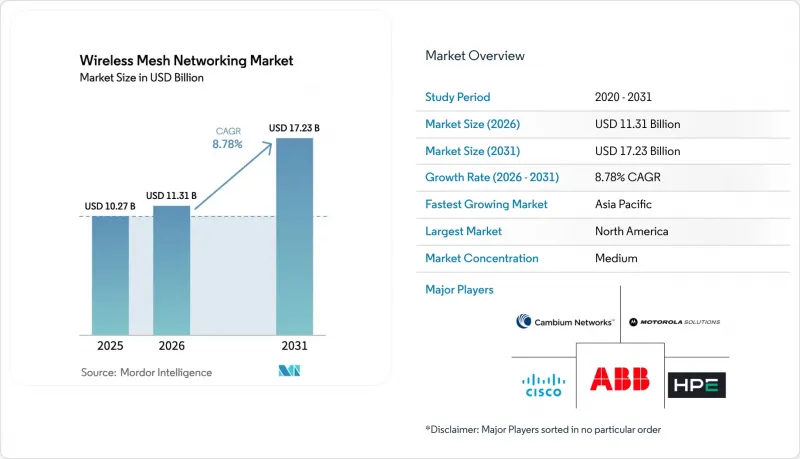
Mordor Intelligence에 의하면, 무선 메시 네트워킹 시장 규모는 2025년에 102억 7,000만 달러로 평가되었고, 2026년 113억 1,000만 달러에서 2031년까지 172억 3,000만 달러에 이를 것으로 예측되며, 예측 기간(2026-2031년) CAGR은 8.78%를 기록할 전망입니다.
본 보고서는 아키텍처(하이브리드 무선 메시 네트워크, 클라이언트 무선 메시 네트워크, 기타), 무선 주파수(2.4GHz 대역, 5GHz 대역, 기타), 용도(실내, 실외), 최종 사용자(정부, 헬스케어, 운송 및 물류, 석유 및 가스,광업, 교육, 호텔·관광, 기타), 지역별로 분류되어 있습니다. 시장 전망은 금액(달러) 기준으로 제시되어 있습니다.
세계 무선 메쉬 네트워킹 시장 동향 및 인사이트
스마트 시티 인프라 도입 확대
현재 도시 계획 담당자들은 모니터링 카메라, 대기질 센서, 공공 Wi-Fi 포털의 백홀을 위해 가로등, 교통 신호등, 공공 설비 캐비닛에 메쉬 무선 장비를 통합하고 있습니다. 멜버른에서는 현장 출장 횟수를 줄이고 쓰레기 수거 경로를 최적화함으로써 18개월 이내에 투자 회수를 달성했습니다. 캘거리시는 Cisco Ultra-Reliable Wireless Backhaul을 통해 공원과 대중교통 정류장에 기가비트 연결을 확대함으로써, 메시가 광섬유를 대체하는 것이 아니라 이를 보완할 수 있음을 입증했습니다. 그러나 미국 국립표준기술연구소(NIST)가 42건의 시범 프로젝트를 대상으로 실시한 조사에 따르면, 독자적인 사양의 API가 공급업체 간의 상호 운용성을 저해하고 있는 것으로 밝혀졌습니다.
산업용 IoT 도입 확대
제조업체들은 이동형 로봇 및 위치 정보 시스템을 지원하기 위해 이더넷 회선을 Wi-Fi 6 메시로 대체하고 있습니다. 독일의 한 자동차 공장에서는 시간 민감형 네트워킹 확장 기능을 갖춘 200대의 액세스 포인트를 도입한 결과, 예기치 못한 가동 중단 시간을 30% 줄였습니다. WirelessHART의 채널 호핑 기능 덕분에 간섭이 심한 환경에서도 99.9%의 신뢰성을 확보하고 있습니다. Wirepas Mesh와 같은 분산형 프로토콜을 통해 유럽 전역의 물류 허브에서 5만 대의 팔레트 트래커가 직선 시야가 필요 없는 인프라 환경에서 가동될 수 있게 되었습니다.
멀티홉 토폴로지의 보안 취약점
각 노드는 라우터의 역할도 겸하기 때문에 공격 대상이 확대됩니다. NIST는 침입당한 중계 노드가 감지되지 않은 채 패킷을 가로채거나 폐기할 가능성이 있으므로 경계 방어만으로는 불충분하다고 경고하고 있습니다. 2024년에 공개된 Zyxel 펌웨어의 결함은 10만 대의 소비자용 메시 키트에 영향을 미쳐 원격 코드 실행을 가능하게 했습니다. 또한, 학술 연구자들은 WPA2와 WPA3 클라이언트가 혼재된 경우 다운그레이드 공격이 가능해져 노드가 더 취약한 암호화 방식을 강제로 사용하게 된다는 사실을 입증했습니다. 현재 구매자들은 FIPS 140-3 인증을 받은 암호화 모듈을 요구하고 있으며, 이로 인해 도입 비용이 상승하고 있습니다.
부문 분석
2025년, 인프라 노드는 무선 메쉬 네트워킹 시장의 48.56% 점유율을 차지할 것으로 예상되며, 고객들이 중앙 집중식 관리, RADIUS 인증, SNMP 기반 성능 모니터링을 선호하는 경향이 두드러지게 나타났습니다. 이 아키텍처는 제로 터치 설정과 인공지능을 통한 무선 최적화를 통해 프로비저닝 주기를 단축합니다. 대규모 지자체는 비디오 백홀 및 공공 Wi-Fi용 서비스 품질(QoS) 조치를 적용하기 위해 컨트롤러를 채택하는 경향이 있는 반면, 국방 기관은 미션 크리티컬 트래픽에서 결정론적 지연을 중시합니다.
하이브리드 토폴로지는 게이트웨이 라우팅과 피어 투 피어 라우팅을 융합하여 장애 발생 시 현장 장치가 혼잡한 게이트웨이를 우회할 수 있도록 함으로써 연평균 성장률(CAGR) 9.34%로 확대되고 있습니다. Rajant Kinetic Mesh가 탑재된 광산용 트럭은 주행 속도를 유지한 채 세션을 핸드오프하며, 항만 운영 사업자는 전망 내 인프라가 없어도 크레인, 운반차, 유도 차량 간의 연결성을 유지하고 있습니다. 공장들이 엔터프라이즈 WLAN과 피어 투 피어를 모두 지원하는 엣지 게이트웨이로 구형 인프라를 개조함에 따라, 하이브리드 배포 분야의 무선 메쉬 네트워킹 시장 규모는 확대될 전망입니다.
2.4GHz 대역은 높은 보급률, 기존 센서 기반, 전 세계적으로 면허가 필요 없는 상태 덕분에 2025년 매출의 42.38%를 차지했습니다. 공공 서비스 사업자는 배전 자동화를 위한 원격 계측을 위해 전신주에 2.4GHz 노드를 설치하고 있으며, 농업 협동조합은 울창한 수목을 관통하는 2.4GHz 센서를 과수원 전체에 설치하고 있습니다. 그러나 대부분의 지역에서 중복되지 않는 채널이 3개밖에 없기 때문에 채널 혼잡은 여전히 심각한 문제입니다.
Wi-Fi 6E 및 Wi-Fi 7로의 업그레이드로 인해 5GHz 대역은 연평균 성장률(CAGR) 9.56%로 성장을 지속하고, 있습니다. 창고에서는 10밀리초 이하의 지연 시간이 필요한 자율 주행 로봇을 위해 80MHz 및 160MHz 채널이 채택되고 있습니다. 대조적으로, 1GHz 이하의 LoRaWAN 메쉬는 밀리와트 단위의 전력 소비로 10킬로미터 범위에 걸쳐 계량기나 관개용 밸브를 연결하고 있습니다. 산업용 자동화를 위한 실외용 액세스 포인트가 10기가비트 이더넷 및 GPS를 통한 시간 동기화를 채택함에 따라, 5GHz 대역 무선 메시 네트워킹 시장은 급속히 확대되고 있습니다.
지역별 분석
북미는 2025년 매출의 36.92%를 차지하며, 서비스가 제공되지 않는 인구 조사 구역을 위한 메쉬 네트워크에 자금을 지원하는 BEAD 보조금(424억 5,000만 달러)에 힘입고 있습니다. 현재 30개 이상의 주에서 광대역 RFP(제안 요청서)에 무선 메시를 인정하고 있으며, 농촌 평원 및 애팔래치아 산맥 기슭에서의 구축이 가속화되고 있습니다. 캐나다의 17억 5,000만 캐나다 달러(12억 9,000만 달러) 규모의 ‘유니버설 브로드밴드 기금’도 마찬가지로 원주민 커뮤니티에 하이브리드 광섬유 메쉬 네트워크 구축을 지원하고 있습니다.
아시아태평양에서는 2031년까지 연평균 성장률(CAGR)이 9.82%를 나타낼 것으로 전망됩니다. 중국에서는 신규 산업단지에 메쉬 네트워크 도입이 의무화되어 있으며, 선전시 전역 네트워크에서는 6GHz 및 5GHz 주파수 대역을 활용하여 교통 모니터링 카메라, 대기질 측정 센서, 공공 Wi-Fi를 통합하고 있습니다. 인도의 ‘스마트 시티 미션’에서는 버스 전용 도로, 디지털 리터러시 센터, 도시 공원을 위해 100개의 실외 메시 네트워크에 자금을 지원하고 있습니다. 일본의 ‘소사이어티 5.0’ 프로그램과 한국의 1,500억 원(1억 1,300만 달러) 예산은 스마트 팩토리와 재해에 강한 지역사회를 지원하고 있으며, 한편,호주의 ‘지역 연결 프로그램’은 농업 협동조합을 광섬유 백본에 연결하는 지방 메쉬 네트워크에 보조금을 지급하고 있습니다.
유럽은 독일과 프랑스의 ‘인더스트리 4.0’ 시범 사업을 통해 그 점유율을 유지하고 있으며, 이들 국가의 제조업체들은 로봇 셀을 위해 시간적 제약이 엄격한 Wi-Fi 6 메쉬 네트워크를 운영하고 있습니다. 영국의 2억 파운드(2억 5,400만 달러) 규모의 ‘기가비트 프로그램’에서는 메쉬 기술을 활용하여 황야나 산악 지대의 라스트 마일 통신 격차를 해소하고 있습니다. 중동에서는 유전 지역에 방폭형 메시 네트워크가 도입되어 있으며, 사우디아라비아의 ‘비전 2030’에서는 네옴(NEOM)과 리야드의 스마트 시티에 대한 투자가 예정되어 있습니다. 남미의 칠레와 브라질에서는 광산 업체들이 지하 터널에 메시 네트워크를 도입하여 자율 주행 운반 트럭의 원격 측정 기능을 구현하고 있습니다. 한편, 아르헨티나에서는 고정 무선 및 메시 광대역용 5GHz 대역 주파수를 경매에 부치고 있습니다.
기타 혜택
- 엑셀 형식 시장 예측(ME) 시트
- 3개월간의 애널리스트 지원
자주 묻는 질문
목차
제1장 서론
제2장 조사 방법
제3장 주요 요약
제4장 시장 구도
제5장 시장 규모와 성장 예측
제6장 경쟁 구도
제7장 시장 기회와 향후 전망
LSH 26.09.02According to Mordor Intelligence, the wireless mesh networking market size was valued at USD 10.27 billion in 2025 and is estimated to grow from USD 11.31 billion in 2026 to reach USD 17.23 billion by 2031, at a CAGR of 8.78% during the forecast period (2026-2031).
This report is Segmented by Architecture (Hybrid Wireless Mesh Networks, Client Wireless Mesh Networks, and More), Radio Frequency (2. 4 GHz Band, 5 GHz Band, and More), Application (Indoor, and Outdoor), End-User (Government, Healthcare, Transportation and Logistics, Oil and Gas, Mining, Education, Hospitality, and More), and Geography. The Market Forecasts are Provided in Terms of Value (USD).
Global Wireless Mesh Networking Market Trends and Insights
Increasing Adoption of Smart City Infrastructure
City planners now embed mesh radios in streetlights, traffic signals, and utility cabinets to backhaul surveillance cameras, air-quality sensors, and public Wi-Fi portals. Melbourne demonstrated payback within 18 months by lowering truck rolls and optimizing refuse collection routes. Calgary extended gigabit connectivity to parks and transit shelters through Cisco Ultra-Reliable Wireless Backhaul, proving that mesh can complement rather than replace fiber. However, a National Institute of Standards and Technology survey of 42 pilots found that proprietary APIs hinder cross-vendor interoperability.
Growth of Industrial IoT Deployments
Manufacturers are swapping Ethernet drops for Wi-Fi 6 mesh to support mobile robots and location systems. A German automotive plant cut unplanned downtime by 30% after installing 200 access points with time-sensitive networking extensions. WirelessHART's channel hopping secures 99.9% reliability in heavy-interference settings. Decentralized protocols such as Wirepas Mesh have enabled 50,000 pallet trackers to operate without line-of-sight infrastructure across European logistics hubs.
Security Vulnerabilities in Multi-Hop Topologies
Each node doubles as a router, enlarging the attack surface. NIST warns that perimeter defenses are insufficient because an infiltrated relay can intercept or drop packets undetected. A Zyxel firmware flaw disclosed in 2024 affected 100,000 consumer mesh kits and allowed remote code execution. Academic researchers also showed that mixed WPA2 and WPA3 clients enable downgrade attacks, forcing nodes to weaker encryption. Buyers now demand FIPS 140-3-validated cryptographic modules, which are raising deployment costs.
Other drivers and restraints analyzed in the detailed report include:
- Rising Demand for Reliable Public Safety Communications
- Rapid Evolution of Wi-Fi 6 and Wi-Fi 7 Standards
- Lack of Interoperability Across Vendor Protocols
For complete list of drivers and restraints, kindly check the Table Of Contents.
Segment Analysis
Infrastructure nodes captured 48.56% of the Wireless Mesh Networking market share in 2025, underscoring customer preference for centralized control, RADIUS authentication, and SNMP-based performance monitoring. This architecture shortens provisioning cycles through zero-touch configuration and artificial-intelligence radio optimization. Large municipalities gravitate toward controllers to enforce quality-of-service policies for video backhaul and public Wi-Fi, while defense agencies value deterministic latency for mission-critical traffic.
Hybrid topologies are growing at a 9.34% CAGR because they blend gateway and peer-to-peer routing, allowing field devices to detour around congested gateways during outages. Mining trucks equipped with Rajant Kinetic Mesh hand off sessions at vehicular speeds, and port operators maintain connectivity across cranes, carriers, and guided vehicles without line-of-sight infrastructure. The Wireless Mesh Networking market size for hybrid deployments is set to widen as factories retrofit older infrastructure with edge gateways that speak both Enterprise WLAN and peer-to-peer.
The 2.4 GHz band accounted for 42.38% of 2025 revenue, thanks to deep penetration, a legacy sensor base, and global license-exempt status. Utilities string 2.4 GHz nodes on power poles for distribution-automation telemetry, and agricultural cooperatives blanket orchards with 2.4 GHz sensors that punch through dense foliage. However, channel congestion remains acute because only three non-overlapping channels exist in most regions.
Wi-Fi 6E and Wi-Fi 7 upgrades are pushing the 5 GHz band toward a 9.56% CAGR. Warehouses adopt 80 MHz and 160 MHz channels for autonomous robots that need sub-10 millisecond latency. In contrast, sub-1 GHz LoRaWAN mesh connects meters and irrigation valves across 10-kilometer ranges with milliwatt power budgets. The Wireless Mesh Networking market in the 5 GHz band is expanding rapidly as outdoor access points adopt 10-gigabit Ethernet and GPS-timed synchronization for industrial automation.
Complete Report Scope:
- By Architecture
- Infrastructure Wireless Mesh Networks
- Hybrid Wireless Mesh Networks
- Client Wireless Mesh Networks
- By Radio Frequency
- Sub-1 GHz Band
- 2.4 GHz Band
- 4.9 GHz Band
- 5 GHz Band
- By Application
- Indoor
- Outdoor
- By End-User
- Government
- Smart Cities and Smart Warehouses
- Healthcare
- Transportation and Logistics
- Oil and Gas
- Mining
- Education
- Hospitality
- By Geography
- North America
- United States
- Canada
- Mexico
- Europe
- Germany
- United Kingdom
- France
- Russia
- Rest of Europe
- Asia-Pacific
- China
- Japan
- India
- South Korea
- Australia
- Rest of Asia-Pacific
- Middle East and Africa
- Middle East
- Saudi Arabia
- United Arab Emirates
- Rest of Middle East
- Africa
- South Africa
- Egypt
- Rest of Africa
- Middle East
- South America
- Brazil
- Argentina
- Rest of South America
- North America
Geography Analysis
North America accounted for 36.92% of revenue in 2025, buoyed by USD 42.45 billion in BEAD grants that fund mesh for unserved census blocks. Over 30 states now allow wireless mesh in their broadband RFPs, accelerating rollouts in rural plains and Appalachian foothills. Canada's CAD 1.75 billion (USD 1.29 billion) Universal Broadband Fund similarly backs hybrid fiber-mesh builds to First Nations communities.
Asia-Pacific is set for a 9.82% CAGR through 2031. China mandates mesh in new industrial parks, and Shenzhen's citywide network integrates traffic cameras, air-quality probes, and public Wi-Fi across 6 GHz and 5 GHz spectrum. India's Smart Cities Mission is financing 100 outdoor mesh networks for bus corridors, digital-literacy centers, and city parks. Japan's Society 5.0 program and South Korea's KRW 150 billion (USD 113 million) budget support smart factories and disaster-resilient communities, while Australia's Regional Connectivity Program subsidizes rural mesh networks that connect agricultural co-ops to fiber backbones.
Europe sustains its share through Industry 4.0 pilots in Germany and France, where manufacturers run time-sensitive Wi-Fi 6 mesh networks for robotic cells. The United Kingdom's GBP 200 million (USD 254 million) Gigabit program taps mesh to bridge last-mile gaps in moors and fells. The Middle East deploys explosion-proof mesh in oilfields, and Saudi Arabia's Vision 2030 earmarks smart-city spend in NEOM and Riyadh. South American miners in Chile and Brazil outfit underground tunnels with mesh to telemeter autonomous haul trucks, while Argentina auctions 5 GHz for fixed-wireless and mesh broadband.
- Cisco Systems, Inc
- Hewlett Packard Enterprise
- Motorola Solutions
- ABB Ltd
- Cambium Networks
- Rajant Corporation
- Ruckus Networks (CommScope)
- Synapse Wireless
- Strix Systems
- Firetide Inc.
- BelAir Networks
- Wirepas Oy
- Fluidmesh Networks
- Zebra Technologies
- Digi International
- Qorvo, Inc.
- Qualcomm Technologies
- Ubiquiti Inc.
- Unicom Systems
- General Dynamics Mission Systems
- SCAN RF Projects
Additional Benefits:
- The market estimate (ME) sheet in Excel format
- 3 months of analyst support
TABLE OF CONTENTS
1 INTRODUCTION
- 1.1 Study Assumptions and Market Definition
- 1.2 Scope of the Study
2 RESEARCH METHODOLOGY
3 EXECUTIVE SUMMARY
4 MARKET LANDSCAPE
- 4.1 Market Overview
- 4.2 Market Drivers
- 4.2.1 Increasing Adoption of Smart City Infrastructure
- 4.2.2 Growth of Industrial IoT Deployments
- 4.2.3 Rising Demand for Reliable Public Safety Communications
- 4.2.4 Rapid Evolution of Wi-Fi 6 and Wi-Fi 7 Standards
- 4.2.5 Emergence of Battery-Free, Energy-Harvesting Mesh Nodes
- 4.2.6 Municipal Broadband Stimulus Grants in Secondary Cities
- 4.3 Market Restraints
- 4.3.1 Security Vulnerabilities in Multi-Hop Topologies
- 4.3.2 Lack of Interoperability Across Vendor Protocols
- 4.3.3 Tightening Municipal Aesthetic Regulations on Pole-Mounted Nodes
- 4.3.4 Spectrum Re-Farming Pressures from 6 GHz Indoor-Only Policies
- 4.4 Impact of Macroeconomic Factors on the Market
- 4.5 Industry Value Chain Analysis
- 4.6 Regulatory Landscape
- 4.7 Technological Outlook
- 4.8 Porter's Five Forces Analysis
- 4.8.1 Threat of New Entrants
- 4.8.2 Bargaining Power of Buyers
- 4.8.3 Bargaining Power of Suppliers
- 4.8.4 Threat of Substitutes
- 4.8.5 Intensity of Competitive Rivalry
5 MARKET SIZE AND GROWTH FORECASTS (VALUE)
- 5.1 By Architecture
- 5.1.1 Infrastructure Wireless Mesh Networks
- 5.1.2 Hybrid Wireless Mesh Networks
- 5.1.3 Client Wireless Mesh Networks
- 5.2 By Radio Frequency
- 5.2.1 Sub-1 GHz Band
- 5.2.2 2.4 GHz Band
- 5.2.3 4.9 GHz Band
- 5.2.4 5 GHz Band
- 5.3 By Application
- 5.3.1 Indoor
- 5.3.2 Outdoor
- 5.4 By End-User
- 5.4.1 Government
- 5.4.2 Smart Cities and Smart Warehouses
- 5.4.3 Healthcare
- 5.4.4 Transportation and Logistics
- 5.4.5 Oil and Gas
- 5.4.6 Mining
- 5.4.7 Education
- 5.4.8 Hospitality
- 5.5 By Geography
- 5.5.1 North America
- 5.5.1.1 United States
- 5.5.1.2 Canada
- 5.5.1.3 Mexico
- 5.5.2 Europe
- 5.5.2.1 Germany
- 5.5.2.2 United Kingdom
- 5.5.2.3 France
- 5.5.2.4 Russia
- 5.5.2.5 Rest of Europe
- 5.5.3 Asia-Pacific
- 5.5.3.1 China
- 5.5.3.2 Japan
- 5.5.3.3 India
- 5.5.3.4 South Korea
- 5.5.3.5 Australia
- 5.5.3.6 Rest of Asia-Pacific
- 5.5.4 Middle East and Africa
- 5.5.4.1 Middle East
- 5.5.4.1.1 Saudi Arabia
- 5.5.4.1.2 United Arab Emirates
- 5.5.4.1.3 Rest of Middle East
- 5.5.4.2 Africa
- 5.5.4.2.1 South Africa
- 5.5.4.2.2 Egypt
- 5.5.4.2.3 Rest of Africa
- 5.5.4.1 Middle East
- 5.5.5 South America
- 5.5.5.1 Brazil
- 5.5.5.2 Argentina
- 5.5.5.3 Rest of South America
- 5.5.1 North America
6 COMPETITIVE LANDSCAPE
- 6.1 Market Concentration
- 6.2 Strategic Moves
- 6.3 Market Share Analysis
- 6.4 Company Profiles {(includes Global Level Overview, Market Level Overview, Core Segments, Financials as available, Strategic Information, Market Rank/Share for key companies, Products and Services, and Recent Developments)}
- 6.4.1 Cisco Systems, Inc
- 6.4.2 Hewlett Packard Enterprise
- 6.4.3 Motorola Solutions
- 6.4.4 ABB Ltd
- 6.4.5 Cambium Networks
- 6.4.6 Rajant Corporation
- 6.4.7 Ruckus Networks (CommScope)
- 6.4.8 Synapse Wireless
- 6.4.9 Strix Systems
- 6.4.10 Firetide Inc.
- 6.4.11 BelAir Networks
- 6.4.12 Wirepas Oy
- 6.4.13 Fluidmesh Networks
- 6.4.14 Zebra Technologies
- 6.4.15 Digi International
- 6.4.16 Qorvo, Inc.
- 6.4.17 Qualcomm Technologies
- 6.4.18 Ubiquiti Inc.
- 6.4.19 Unicom Systems
- 6.4.20 General Dynamics Mission Systems
- 6.4.21 SCAN RF Projects
7 MARKET OPPORTUNITIES AND FUTURE OUTLOOK
- 7.1 White-Space and Unmet-Need Assessment


