|
시장보고서
상품코드
2121731
유방암 검진 검사 : 시장 점유율 분석, 업계 동향과 통계, 성장 예측(2026-2031년)Breast Cancer Screening Tests - Market Share Analysis, Industry Trends & Statistics, Growth Forecasts (2026 - 2031) |
||||||
 Mordor Intelligence
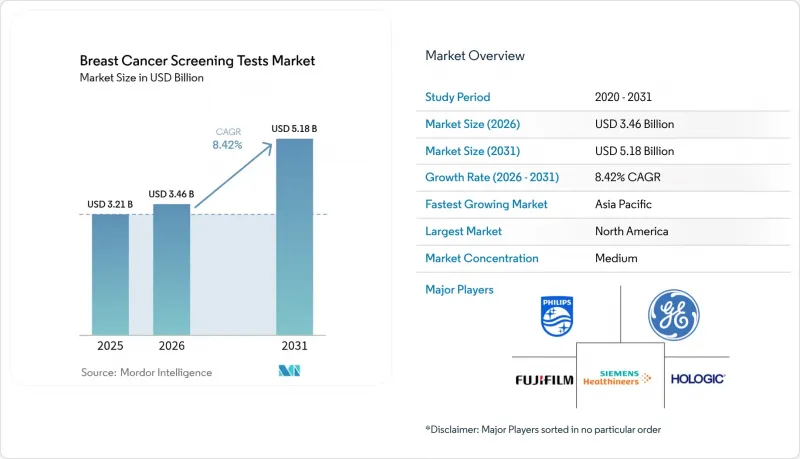
Mordor Intelligence에 따르면 유방암 검진 검사 시장 규모는 2025년에 32억 1,000만 달러, 2026년에 34억 6,000만 달러에 달하며, 2031년까지 51억 8,000만 달러에 달할 것으로 예측되고 있으며, 2026-2031년에 CAGR 8.42%로 성장할 것으로 전망되고 있습니다.
이 보고서는 선별 검사 방법(영상 검사, 혈액 유래 바이오마커 검사, 유전자·게놈 검사, 웨어러블·AI 탑재형 선별 검사), 최종사용자(병원, 암 전문 치료 센터, 영상 센터, 기타),지역(북미, 유럽, 아시아태평양, 중동 및 아프리카, 남미)별로 분류되어 있습니다. 시장 전망은 금액(달러) 기준으로 제시되어 있습니다.
전 세계 유방암 검진 시장의 동향 및 인사이트
유방암 유병률의 증가
전 세계 유방암 발병 건수는 2024년에 230만 건에 달하며, 2030년까지 290만 건에 달할 것으로 예측됩니다. 이러한 추세는 인구 고령화, 도시형 생활 방식으로의 전환, 진단 기술의 보급 확대에 의해 주도되고 있습니다. 2025년에는 미국에서 31만 건, 중국에서 42만 건의 신규 진단 사례가 보고되어, 시장 규모 확대와 도시화라는 이중적인 압박이 부각되었습니다. 서구 국가에서는 50세 이하에서 발생하는 사례가 전체의 12%를 차지하게 되었으며, 이에 따라 지침 제정 기관은 검진 시작 연령을 50세에서 40세로 낮추기로 결정했습니다. 이 정책 변경만으로도 유방암 검진 시장의 대상 여성 인구가 약 2,500만 명 확대될 것으로 예상됩니다. 조기 발견 덕분에 고소득 지역에서는 사망률이 연간 1.3%씩 감소하고 있지만, 검진 수진율이 20% 이하에 머무르는 자원이 부족한 국가들에서는 정체 상태가 지속되고 있으며, 이동형 및 현장 진단(Point-of-Care) 방식의 검사 기법에 큰 기회가 있음을 보여주고 있습니다.
정부의 적극적인 검진 권장
2024년에 시행된 ‘40세부터 2년마다 유방촬영술’로의 전환으로 인해 40-49세 여성의 사망률은 19% 감소했으며, 이는 보험 환급 절차를 통한 검사 건수 증가로 이어지고 있습니다. 영국에서는 47-73세 여성이 대상에 포함되었으며, 이동식 검진 차량과 교육에 1억 2,000만 파운드의 자금이 투입되었습니다. 일본에서는 고밀도 유방 조직을 가진 여성(대상 집단의 40%)을 대상으로 연 1회 초음파 검사가 의무화되어 장비 수요가 확대되고 있습니다. 중국에서는 5,000만 명의 여성을 대상으로 농촌 지역의 검사 비용의 70%를 지원하고 있으며, 군립 병원에서 AI를 활용한 분류와 지원금을 결합하고 있습니다. FDA의 MQSA(유방촬영술 품질 보증 기준)와 같은 규정 준수 체계를 통해 검사 건수와 엄격한 품질 지표가 조화를 이루고 있습니다.
환자의 방사선 피폭에 대한 우려
최신 유방촬영술에서는 1장당 0.4밀리그레이의 방사선량이 조사되지만, 조사 대상 여성의 22-28%가 여전히 방사선에 대한 불안을 호소하고 있으며, CT의 피폭량과 검진 수준의 피폭량을 혼동하는 경우가 적지 않습니다. 유방 밀도에 관한 안내는 임상적으로 유용하지만, 의도치 않게 불안을 조장하여 일부 여성들이 비용이 더 많이 드는 MRI 검사로 향하게 하는 요인이 되고 있습니다. 공급업체 측의 대책으로는 광자 계수형 검출기나 조영제를 활용한 기술 등이 있으며, 이를 통해 피폭량을 최대 40%까지 줄일 수 있습니다.
부문 분석
2025년에는 영상 검사가 매출의 66.02%를 차지했으나, 유방암 검진 시장에서 혈액 바이오마커 검사의 성장세가 가장 빠르며, 2031년까지 연평균 성장률(CAGR) 9.06%로 확대되고 있습니다. 유방촬영술 검사 건수는 12억 건에 달했으며, 미국에서는 디지털 유방 토모신테시스가 2D 유방촬영술을 추월했고, 유럽에서도 거의 비슷한 수준에 근접하고 있습니다. 휴대용 초음파 장치는 아시아태평양에서 1,500만 건의 검사를 추가로 수행했습니다. 한편, 고속 MRI 프로토콜로 인해 스캔 시간이 절반으로 단축되고 비용이 600달러까지 절감됨에 따라 이 검사법은 고위험군 이외의 계층으로도 보급이 확대되고 있습니다. Guardant의 ‘Shield’와 Exact Sciences의 ‘CancerSEEK’와 같은 다중 암 검사 키트(가격 약 995달러)는 현재 고위험군 여성을 대상으로 MRI와 경쟁하고 있으며, 사망률 평가 지표가 확립되면 이용이 확대될 가능성이 있는 보험사의 시범 프로그램을 확보하고 있습니다. 단백질, 마이크로RNA, ctDNA를 통합한 멀티 애널라이트 패널은 조기 도입자들 사이에서 점차 보급되고 있지만, 궁극적으로는 규제의 명확성이 보급의 열쇠를 쥐게 될 것으로 보입니다.
지역별 분석
북미는 2025년에 매출의 41.08%를 차지했습니다. 이는 메디케어가 검사 1회당 150-200달러를 환급해 주는 데 더해, 2024년 지침 변경으로 인해 대상 여성이 2,000만 명 증가한 것이 배경입니다. 3개의 대규모 주에서는 본인 부담금 없이 고밀도 유방 초음파 검사에 대한 보험 적용이 의무화되어 있으며, 이것이 검사 건수 증가를 지원하고 있습니다. 캐나다는 DBT(디지털 유방촬영술) 업그레이드에 1억 8,000만 캐나다 달러(1억 3,300만 달러)를 투자하여, 1년 만에 보급률을 22%에서 38%로 끌어올렸습니다. 멕시코에서 이동식 검진 차량을 도입함으로써, 고정 시설에서의 검진에 비해 조기 발견률이 50% 향상되었습니다. 2028년까지 2,000명에 달할 것으로 예상되는 방사선과 전문의의 만성적인 부족으로 인해 AI를 활용한 분류 및 국경을 초월한 원격 방사선 진단에 대한 수요가 증가하고 있습니다.
아시아태평양은 가장 성장세가 두드러진 지역으로, 2031년 연평균 성장률(CAGR)은 10.27%에 달합니다. 중국의 ‘건강 중국 2030’ 계획에서는 도시 지역의 검진 대상 비율을 70%로 확대하기 위해 500억 위안(70억 달러)이 배정되었습니다. 인도의 ‘아유슈만 바라트’ 정책에서는 5,000곳의 보건 센터에서 검진을 추가로 실시하여, 202년까지 3,000만 명의 여성을 대상으로 하는 것을 목표로 하고 있습니다. 일본에서는 이미 검진률이 50%에 달하며, 고밀도 유방의 경우 유방촬영술과 초음파 병용 검사를 도입하고 있습니다. 한편, 한국에서는 200곳의 시립 클리닉에서 AI 검사 도입이 진행되고 있습니다. 방사선과 의사의 밀도는 인도 10만 명당 0.8명에서 일본 8명까지 큰 편차를 보이며, 업무 분담과 클라우드 AI 솔루션 도입이 필요시되고 있습니다.
일원화된 검진 안내 시스템과 무료 검진 프로토콜을 통해 참여율은 75% 전후를 유지하고 있습니다. 독일에서는 현재 평생 발병 위험이 20% 이상인 여성에게 MRI 검사에 대한 보험 적용을 시행하고 있으며, 이로 인해 MRI 검사 건수가 18% 증가했습니다. 영국에서는 AI 도입으로 영상 판독 시간이 4분의 1로 단축됨에 따라 COVID-19로 인한 검사 지연을 해소했습니다. 프랑스에서는 고밀도 유방에 대한 알림 검사 도입으로 진단 검출률이 12% 향상된 반면, 위양성률도 8% 상승하여 프로토콜 재검토가 진행되고 있습니다. 스페인에서는 BRCA 보균자를 대상으로 액체생검 도입을 시작하여, 검진 간격 중에 발견된 암을 15% 증가시켰습니다. 기타 중동 및 아프리카에서는 기부자 자금으로 운영되는 이동형 프로그램이 나이지리아, 케냐, 남아프리카공화국, 브라질, 아르헨티나에서 인프라 구축의 기반을 마련하고 있으나, 대상 인구의 40-50%가 본인 부담금이라는 장벽에 직면해 있습니다.
기타 혜택
- 엑셀 형식의 시장 예측(ME) 시트
- 3개월간의 애널리스트 지원
목차
제1장 서론
제2장 조사 방법
제3장 개요
제4장 시장 구도
제5장 시장 규모와 성장 예측
제6장 경쟁 구도
제7장 시장 기회와 향후 전망
KSAAccording to Mordor Intelligence, the breast cancer screening tests market size is projected to be USD 3.21 billion in 2025, USD 3.46 billion in 2026, and reach USD 5.18 billion by 2031, growing at a CAGR of 8.42% from 2026 to 2031.
This report is Segmented by Screening Modality (Imaging-Based Tests, Blood-Based Biomarker Tests, Genetic & Genomic Tests, Wearable & AI-Enabled Screening), End User (Hospitals, Specialty Cancer Centers, Diagnostic Imaging Centers, and More), and Geography (North America, Europe, Asia-Pacific, Middle East & Africa, South America). Market Forecasts are Provided in Terms of Value (USD).
Global Breast Cancer Screening Tests Market Trends and Insights
Rising Prevalence of Breast Cancer
Global incidence climbed to 2.3 million cases in 2024 and is projected to reach 2.9 million by 2030, a trajectory driven by aging demographics, urban lifestyle shifts, and broader diagnostic reach. The United States logged 310,000 new diagnoses in 2025, while China reported 420,000, underscoring the dual pressure of scale and urbanization. Disease onset before 50 now accounts for 12% of Western cases, prompting guideline bodies to lower the screening start age from 50 to 40 years. This policy change alone expands the breast cancer screening tests market by an estimated 25 million women. Mortality is falling by 1.3% annually in high-income regions thanks to earlier detection, yet stagnates in low-resource countries, where coverage remains below 20%, highlighting the opportunity for mobile and point-of-care modalities.
Favorable Government Screening Recommendations
The 2024 U.S. shift to age-40 biennial mammography lowers mortality 19% in women 40-49, pushing volume through the reimbursement pipeline. The U.K. added women 47-73, funding GBP 120 million for mobile vans and training. Japan mandated annual ultrasound for dense breast tissue, affecting 40% of its cohort, and swelling equipment demand. China is subsidizing 70% of rural exam costs for 50 million women, pairing subsidies with AI triage in county hospitals. Compliance frameworks such as the FDA's MQSA align volume with strict quality metrics.
Radiation-Exposure Concerns Among Patients
Modern mammography delivers 0.4 milligrays per view, yet 22-28% of surveyed women still cite radiation fear, often conflating CT doses with screening levels. Density notifications, while clinically useful, inadvertently raise anxiety and push some women toward costlier MRI. Vendor countermeasures include photon-counting detectors and contrast-enhanced techniques that can reduce dose by up to 40%.
Other drivers and restraints analyzed in the detailed report include:
- Technological Advances In 3-D Mammography
- Intensifying Public-Private Awareness Campaigns
- High Cost of Advanced Imaging Equipment
For complete list of drivers and restraints, kindly check the Table Of Contents.
Segment Analysis
Imaging-based Tests retained 66.02% of the revenue in 2025, yet the breast cancer screening tests market for Blood-based Biomarker Tests is expanding the fastest at a 9.06% CAGR through 2031. Mammography generated 1.2 billion exams, with Digital Breast Tomosynthesis overtaking 2-D in the United States and nearing parity in Europe. Handheld ultrasound devices added 15 million Asia-Pacific screens, while fast MRI protocols halved scan time and reduced costs to USD 600, pushing the modality beyond high-risk cohorts. Guardant's Shield and Exact Sciences' CancerSEEK multi-cancer assays, priced around USD 995, now compete with MRI for high-risk women, securing payer pilots that could widen use once mortality endpoints mature. Multi-analyte panels integrating proteins, microRNAs, and ctDNA are lining up behind early adopters, though regulatory clarity will ultimately dictate uptake.
Complete Report Scope:
- By Screening Modality
- Imaging-based Tests
- Mammography
- Digital Breast Tomosynthesis
- Ultrasound
- Magnetic Resonance Imaging
- PET & Molecular Imaging
- Blood-based Biomarker Tests
- Liquid Biopsy (ctDNA)
- Multi-analyte Protein Panels
- microRNA Panels
- Genetic & Genomic Tests
- BRCA 1/2 Mutation Tests
- Multi-gene Panels
- Polygenic Risk Scores
- Wearable & AI-enabled Screening
- Smart-bra Sensors
- Hand-held AI Ultrasound
- Imaging-based Tests
- By End User
- Hospitals
- Specialty Cancer Centers
- Diagnostic Imaging Centers
- Ambulatory Care Centers
- Other End Users
- By Geography
- North America
- United States
- Canada
- Mexico
- Europe
- Germany
- United Kingdom
- France
- Italy
- Spain
- Rest of Europe
- Asia-Pacific
- China
- Japan
- India
- Australia
- South Korea
- Rest of Asia-Pacific
- Middle East & Africa
- GCC
- South Africa
- Rest of Middle East & Africa
- South America
- Brazil
- Argentina
- Rest of South America
- North America
Geography Analysis
North America generated 41.08% revenue in 2025, backed by Medicare's USD 150-200 reimbursement per exam and a 2024 guideline shift that added 20 million eligible women. Three large states require dense-breast ultrasound coverage without cost-sharing, pushing supplemental volume. Canada invested CAD 180 million (USD 133 million) in DBT upgrades, boosting penetration from 22% to 38% in one year. Mexico's mobile-unit rollout achieved 50% higher early-detection rates than fixed-site screening. Persistent radiologist shortages of 2,000 by 2028 are keeping AI triage and cross-border teleradiology in demand.
Asia-Pacific is the fastest-growing region, with a 10.27% CAGR to 2031. China's Healthy China 2030 allocates CNY 50 billion (USD 7 billion) for screening expansion to 70% urban coverage. India's Ayushman Bharat added screening at 5,000 health centers, targeting 30 million women by 202. Japan, already at 50% participation, deploys combined mammography-ultrasound for dense tissue, while South Korea's program pilots AI in 200 municipal clinics. Radiologist density varies sharply from 0.8 per 100,000 in India to 8 in Japan, necessitating task shifting and cloud AI solutions.
Centralized invitation systems and free-of-charge protocols keep participation near 75%. Germany now reimburses MRI for women with >=20% lifetime risk, lifting MRI screens by 18%. The U.K. cleared a COVID backlog after AI cut read times by a quarter. France's dense-breast notification pilot raised diagnostic yield by 12% but also false positives by 8%, prompting protocol review. Spain began integrating liquid biopsy for BRCA carriers, detecting 15% more interval cancers. Elsewhere, donor-funded mobile programs seed infrastructure in Nigeria, Kenya, South Africa, Brazil, and Argentina, but still face out-of-pocket hurdles for 40-50% of target populations.
- Agilent Technologies
- Beckton Dickinson
- Canon
- Danaher Corp. (Cepheid & Leica)
- Delphinus Medical Technologies Inc.
- Exact Sciences Corp.
- Roche
- FUJIFILM Holdings Corp.
- GE HealthCare Technologies Inc.
- Guardant Health
- Hologic
- iCAD Inc.
- Illumina
- Kheiron Medical Technologies Ltd.
- Konica Minolta
- Koninklijke Philips
- Myriad Genetics
- Siemens Healthineers
- Thermo Fisher Scientific
- Volpara Health Technologies Ltd.
Additional Benefits:
- The market estimate (ME) sheet in Excel format
- 3 months of analyst support
TABLE OF CONTENTS
1 Introduction
- 1.1 Study Assumptions & Market Definition
- 1.2 Scope of the Study
2 Research Methodology
3 Executive Summary
4 Market Landscape
- 4.1 Market Overview
- 4.2 Market Drivers
- 4.2.1 Rising Prevalence of Breast Cancer
- 4.2.2 Favorable Government Screening Recommendations
- 4.2.3 Technological Advances In 3-D Mammography
- 4.2.4 Intensifying Public-Private Awareness Campaigns
- 4.2.5 AI Triage Tools Lowering Image-Reading Cost
- 4.2.6 Employer-Funded Mobile Screening In Emerging Markets
- 4.3 Market Restraints
- 4.3.1 Radiation-Exposure Concerns Among Patients
- 4.3.2 High Cost of Advanced Imaging Equipment
- 4.3.3 False Positives Leading to Overdiagnosis
- 4.3.4 Regulatory Uncertainty for Liquid-Biopsy Tests
- 4.4 Regulatory Landscape
- 4.5 Technological Outlook
- 4.6 Porter's Five Forces Analysis
- 4.6.1 Threat of New Entrants
- 4.6.2 Bargaining Power of Buyers
- 4.6.3 Bargaining Power of Suppliers
- 4.6.4 Threat of Substitute Products
- 4.6.5 Intensity of Competitive Rivalry
5 Market Size & Growth Forecasts
- 5.1 By Screening Modality
- 5.1.1 Imaging-based Tests
- 5.1.1.1 Mammography
- 5.1.1.2 Digital Breast Tomosynthesis
- 5.1.1.3 Ultrasound
- 5.1.1.4 Magnetic Resonance Imaging
- 5.1.1.5 PET & Molecular Imaging
- 5.1.2 Blood-based Biomarker Tests
- 5.1.2.1 Liquid Biopsy (ctDNA)
- 5.1.2.2 Multi-analyte Protein Panels
- 5.1.2.3 microRNA Panels
- 5.1.3 Genetic & Genomic Tests
- 5.1.3.1 BRCA 1/2 Mutation Tests
- 5.1.3.2 Multi-gene Panels
- 5.1.3.3 Polygenic Risk Scores
- 5.1.4 Wearable & AI-enabled Screening
- 5.1.4.1 Smart-bra Sensors
- 5.1.4.2 Hand-held AI Ultrasound
- 5.1.1 Imaging-based Tests
- 5.2 By End User
- 5.2.1 Hospitals
- 5.2.2 Specialty Cancer Centers
- 5.2.3 Diagnostic Imaging Centers
- 5.2.4 Ambulatory Care Centers
- 5.2.5 Other End Users
- 5.3 By Geography
- 5.3.1 North America
- 5.3.1.1 United States
- 5.3.1.2 Canada
- 5.3.1.3 Mexico
- 5.3.2 Europe
- 5.3.2.1 Germany
- 5.3.2.2 United Kingdom
- 5.3.2.3 France
- 5.3.2.4 Italy
- 5.3.2.5 Spain
- 5.3.2.6 Rest of Europe
- 5.3.3 Asia-Pacific
- 5.3.3.1 China
- 5.3.3.2 Japan
- 5.3.3.3 India
- 5.3.3.4 Australia
- 5.3.3.5 South Korea
- 5.3.3.6 Rest of Asia-Pacific
- 5.3.4 Middle East & Africa
- 5.3.4.1 GCC
- 5.3.4.2 South Africa
- 5.3.4.3 Rest of Middle East & Africa
- 5.3.5 South America
- 5.3.5.1 Brazil
- 5.3.5.2 Argentina
- 5.3.5.3 Rest of South America
- 5.3.1 North America
6 Competitive Landscape
- 6.1 Market Concentration
- 6.2 Market Share Analysis
- 6.3 Company Profiles (includes Global Level Overview, Market Level Overview, Core Segments, Financials as Available, Strategic Information, Market Rank/Share for Key Companies, Products & Services, and Recent Developments)
- 6.3.1 Agilent Technologies Inc.
- 6.3.2 Becton, Dickinson and Co.
- 6.3.3 Canon Medical Systems Corp.
- 6.3.4 Danaher Corp. (Cepheid & Leica)
- 6.3.5 Delphinus Medical Technologies Inc.
- 6.3.6 Exact Sciences Corp.
- 6.3.7 F. Hoffmann-La Roche AG
- 6.3.8 FUJIFILM Holdings Corp.
- 6.3.9 GE HealthCare Technologies Inc.
- 6.3.10 Guardant Health Inc.
- 6.3.11 Hologic Inc.
- 6.3.12 iCAD Inc.
- 6.3.13 Illumina Inc.
- 6.3.14 Kheiron Medical Technologies Ltd.
- 6.3.15 Konica Minolta Inc.
- 6.3.16 Koninklijke Philips N.V.
- 6.3.17 Myriad Genetics Inc.
- 6.3.18 Siemens Healthineers AG
- 6.3.19 Thermo Fisher Scientific Inc.
- 6.3.20 Volpara Health Technologies Ltd.
7 Market Opportunities & Future Outlook
- 7.1 White-space & Unmet-Need Assessment