

|
시장보고서
상품코드
2121736
심장 바이오마커 : 시장 점유율 분석, 업계 동향과 통계, 성장 예측(2026-2031년)Cardiac Biomarkers - Market Share Analysis, Industry Trends & Statistics, Growth Forecasts (2026 - 2031) |
||||||
 Mordor Intelligence
Mordor Intelligence에 의하면, 2026년 심장 바이오마커 시장 규모는 214억 2,000만 달러로 추정되며, 2025년 189억 1,000만 달러에서 2031년에는 398억 7,000만 달러에 달할 것으로 예측됩니다.
또한 2026-2031년 연평균 성장률(CAGR)은 13.24%를 기록할 전망입니다.
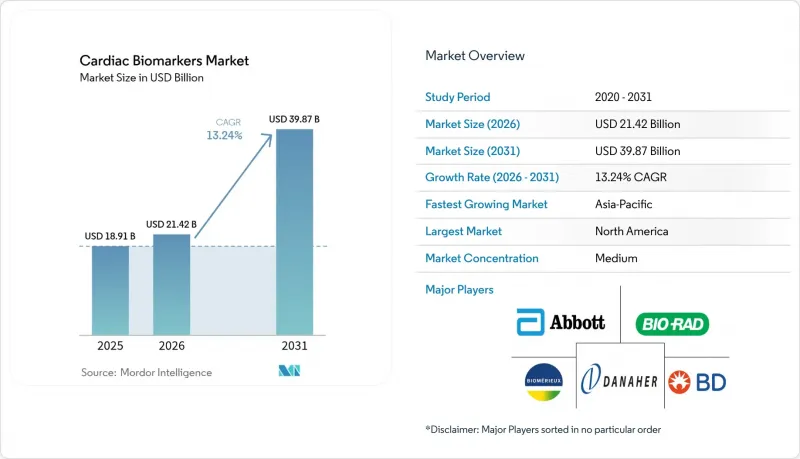
본 보고서는 바이오마커의 유형(트로포닌, 크레아틴 키나제 등), 용도(급성 관상동맥 증후군, 심근경색 등), 검사 실시 장소(중앙 검사실 등), 최종 사용자(병원, 진단실험실 등), 지역(북미, 유럽, 아시아태평양 등)별로 분류되어 있습니다. 시장 규모 및 전망은 금액(달러) 기준으로 제시되어 있습니다.
세계 심장 바이오마커 시장 동향 및 인사이트
심혈관 질환 유병률 증가
심혈관 질환은 여전히 전 세계 사망 원인 1위를 차지하고 있으며, 미국에서는 연간 4,223억 달러의 직접 의료비가 소요되고 있습니다. CMS(미국 의료보험서비스센터)의 2025년 의사 보수 일정에 따라 의무화된 ASCVD(동맥성 심혈관 질환) 위험 평가 코딩에서는 인구통계학적 변수와 검사실의 심장 바이오마커를 결합한 증거 기반 진단이 요구됨에 따라, 의료기관에서의 도입이 가속화되고 있습니다. 가치 기반 의료 계약이 확대되는 가운데, 의료 제공업체들은 측정 가능한 치료 성과를 입증하고 재입원으로 인한 불이익을 피하기 위해 바이오마커 기반 중재에 의존하고 있습니다.
고감도 검사 분야의 기술적 진보
지멘스 헬스인어즈(Siemens Healthineers)의 ‘Atellica IM’ 고감도 트로포닌 I 검사가 FDA 승인을 획득함에 따라, 지표가 되는 사건 발생 후 최대 1년에 걸친 예후 위험의 계층화가 가능해졌습니다. 검사실 수준의 정확도를 갖춘 마이크로플루이딕스 카트리지를 통해 기존 검사법에 비해 10분의 1 수준의 낮은 농도에서도 트로포닌을 정량할 수 있게 되었으며, 몇 분 만에 결과를 얻을 수 있게 되어 다기관 공동 검증 시험에서 100%의 민감도를 달성했습니다. 성별별 기준 범위 설정을 통해 여성 환자에서 기존에 존재하던 진단상의 격차가 해소되고 있으며, 통합형 바이오센서 채택으로 인해 혈장 분리가 필요 없는 손가락 채혈을 통한 전혈 검사가 가능해졌습니다.
엄격한 규제 체계
유럽의 체외진단용 의료기기 규정(IVDR)에서는 광범위한 임상 증거를 의무화하고 있어, CE 마크 취득까지의 기간이 장기화되고 있습니다. SpinChip Diagnostics사는 2025년 말까지 IVDR에 따른 신청을 진행하고 2026년 출시를 예정하고 있으나, 이는 승인 절차의 장기화를 보여주는 한 예입니다. 미국에서는 AI를 활용한 진단 기기에 관한 FDA의 규정안에서 알고리즘의 투명성은 물론 다인종 검증 코호트가 요구되고 있어, 이로 인해 규정 준수 비용이 증가하고 상용화 시작이 지연되고 있습니다.
부문 분석
2025년, 트로포닌은 심장 바이오마커 시장의 59.12%를 차지하고 있으며, 이는 골드 스탠다드로 여겨지는 이 단백질에 대한 수십 년에 걸친 임상적 신뢰가 뒷받침되고 있음을 보여줍니다. 이 부문의 매출은 증상 발현 후 2시간 이내에 미세한 심근 손상을 감지할 수 있는 고감도 형식으로의 전환에 힘입어 성장하고 있습니다. 한편, 허혈 변형 알부민은 연평균 성장률(CAGR) 13.68%로 확대되고 있으며, 이는 일과성 관상동맥 경련 사건의 경우 트로포닌으로는 감지할 수 없는 가역적 허혈을 포착할 수 있는 마커가 필요하다는 인식이 높아지고 있음을 반영합니다.
트로포닌에 기인한 심장 바이오마커 시장 규모는 2025년에 111억 8,000만 달러에 달했습니다. 각 제조업체들은 마이크로RNA와 염증성 단백질을 검사 항목에 추가하고 있지만, 임상 현장에서의 도입은 규제 당국의 승인 및 가이드라인의 권고에 달려 있습니다. 고감도 트로포닌이 뛰어난 특이성을 발휘함에 따라 크레아틴 키나아제 수요는 감소 추세를 보이고 있지만, 미오글로빈은 트로포닌 수치가 상승하기 전의 초조기 트리아지에 주로 사용되는 기존의 대안으로 남아 있습니다.
2025년, 심근경색 분야에서의 응용이 심장 바이오마커 시장 부문 매출의 39.85%를 차지했습니다. 병원에서는 보상 보너스와 직결되는 지표인 ‘도어-투-니들(Door-to-Needle)’ 목표를 달성하기 위해 트로포닌 알고리즘에 의존하고 있습니다. 한편, 급성 관상동맥 증후군 시장은 저위험 환자를 안전하게 퇴원시키고 텔레메트리 병상의 가동률을 낮추는 ‘0/2시간 제외 프로토콜’에 힘입어 연평균 성장률(CAGR) 13.91%로 확대되고 있습니다.
급성 관상동맥 증후군용 심장 바이오마커 시장 규모는 불필요한 입원을 피할 경우 보상을 제공하는 지불자 측의 인센티브에 의해 뒷받침되는 것으로 추정됩니다. 만성기 의료 현장에서도 이용 사례가 확대되고 있습니다. BNP에 기반한 심부전 관리는 메디케어의 ‘병원 재입원 감축 프로그램’에 따른 재입원 벌금을 경감시키는 한편, ASCVD 코딩 요건에 따라 바이오마커 패널이 연간 위험 평가에 통합되고 있습니다.
지역별 분석
북미는 2025년, 재정력이 탄탄한 보험사, 성숙한 검사 기관 네트워크, 그리고 고감도 분석법을 유효한 것으로 인정하는 지침과의 일관성에 힘입어 심장 바이오마커 시장의 41.78%를 차지했습니다. CMS(미국 의료보험서비스센터)의 코딩 업데이트로 인해 예방 심장학 워크플로우에서 바이오마커 요건이 더욱 정착되고 있습니다. 이 지역의 검사 건수는 인구 고령화에 발맞추어 계속 증가할 전망이지만, 종합적 지불 모델에 따른 가격 압박으로 인해 수익 증대는 제한될 가능성이 있습니다.
유럽은 2위 지역으로 그 뒤를 잇고 있으며, 공적 의료 보험 제도가 신속한 배제 진단 프로토콜에 트로포닌 검사의 도입을 뒷받침하고 있습니다. ‘체외진단 의료기기 규정(In-Vitro Diagnostic Regulation)’의 시행으로 규정 준수 비용은 증가하겠지만, 임상적으로 검증된 검사법에 대한 신뢰도 높아지면서 독일, 프랑스, 영국에서의 도입이 촉진되고 있습니다. 시장의 모멘텀은 보상 상한선과 하류 영상 진단의 사용을 줄이는 비용 효율적인 멀티플렉스 패널 간의 균형에 달려 있습니다.
아시아태평양은 가장 성장세가 두드러지는 지역으로, 연평균 성장률(CAGR) 14.11%를 기록할 전망입니다. 400억 달러 규모의 일본 의료기기 부문에서는 PMDA의 신속 심사 제도의 후원을 받아 고감도 트로포닌 및 BNP 검사가 이미 도입되고 있습니다. 중국 국가의약품감독관리국은 2023년에 61건의 혁신적인 진단법을 승인하여, 국내외 바이오마커 공급업체들에게 더 우호적인 길을 제시하고 있습니다. 심혈관 질환 유병률 증가와 정부의 보험 적용 범위 확대가 맞물리면서, 2차 의료기관에서의 분산형 현장 진단(Point-of-Care) 솔루션에 대한 수요가 견인되고 있습니다.
중동 및 아프리카 및 남미는 신흥 추격 시장으로 부상하고 있습니다. 걸프협력회의(GCC) 회원국에서는 고처리량 분석 장비를 갖춘 3차 심장 센터에 대한 투자가 진행되는 한편, 브라질과 멕시코에서는 심근경색 조기 진단 비용을 보상하는 국민건강보험 시범 사업이 전개되고 있습니다. 운송 및 콜드체인의 제약이 지속되는 가운데, 합리적인 가격에 안정적인 상온 보관이 가능한 시약을 제공할 수 있는 공급업체는 시장 점유율을 확대해 나갈 것입니다.
기타 혜택:
- 엑셀 형식 시장 예측(ME) 시트
- 3개월간의 애널리스트 지원
자주 묻는 질문
목차
제1장 서론
제2장 조사 방법
제3장 주요 요약
제4장 시장 구도
제5장 시장 규모와 성장 예측
제6장 경쟁 구도
제7장 시장 기회와 향후 전망
LSH 26.09.09According to Mordor Intelligence, cardiac biomarkers market size in 2026 is estimated at USD 21.42 billion, growing from 2025 value of USD 18.91 billion with 2031 projections showing USD 39.87 billion, growing at 13.24% CAGR over 2026-2031.
This report is Segmented by Biomarker Type (Troponins, Creatine Kinase, and More), Application (Acute Coronary Syndrome, Myocardial Infarction, and More), Location of Testing (Central Laboratory Testing, and More), End-User (Hospitals, Diagnostic Laboratories, and More) and Geography (North America, Europe, Asia-Pacific, and More). The Market and Forecasts are Provided in Terms of Value (USD).
Global Cardiac Biomarkers Market Trends and Insights
Increasing prevalence of cardiovascular diseases
Cardiovascular disorders remain the top global mortality driver, costing the United States USD 422.3 billion annually in direct medical expenses . Mandated ASCVD risk assessment coding under the CMS 2025 Physician Fee Schedule now requires evidence-based diagnostics that combine demographic variables with laboratory cardiac biomarkers, intensifying institutional uptake . As value-based care contracts expand, providers rely on biomarker-guided interventions to document measurable outcome gains and avoid readmission penalties.
Technological advances in high-sensitivity assays
FDA clearance of Siemens Healthineers' Atellica IM high-sensitivity troponin I test enables prognostic risk stratification for up to one year after an index event . Laboratory-quality microfluidic cartridges now quantify troponin at 10-fold lower concentrations than legacy assays and deliver results in minutes, achieving 100% sensitivity in multi-center validation studies. Sex-specific reference ranges are closing historical diagnostic gaps among female patients, while integrated biosensors allow finger-stick whole-blood testing without plasma separation.
Stringent regulatory frameworks
Europe's In-Vitro Diagnostic Regulation now obliges extensive clinical evidence, stretching CE-mark timelines. SpinChip Diagnostics expects to submit under IVDR by end-2025 with launch slated for 2026, illustrating prolonged pathways. In the United States, FDA draft rules for AI-enabled diagnostics require algorithmic transparency plus multi-ethnic validation cohorts, adding compliance costs and delaying commercial roll-out.
Other drivers and restraints analyzed in the detailed report include:
- Growing public- & private-sector R&D funding
- Expansion of multiplex panels for early rule-out protocols
- Reimbursement erosion from bundled-payment models
For complete list of drivers and restraints, kindly check the Table Of Contents.
Segment Analysis
Troponins controlled 59.12% of the cardiac biomarkers market in 2025, validating decades of clinical trust in these gold-standard proteins. Segment revenues benefit from the shift to high-sensitivity formats that detect minute myocardial injury within two hours of symptom onset. Conversely, ischemia-modified albumin is expanding at a 13.68% CAGR, reflecting growing recognition that transient coronary vasospasm events demand markers able to capture reversible ischemia that troponin misses.
The cardiac biomarkers market size attributable to troponins reached USD 11.18 billion in 2025. Manufacturers are augmenting assay menus with microRNAs and inflammatory proteins, yet clinical uptake hinges on regulatory clearance and guideline endorsement. Creatine kinase is tapering as high-sensitivity troponins deliver superior specificity, while myoglobin remains a legacy option used primarily for ultra-early triage before troponin rises.
Applications in myocardial infarction generated 39.85% of segment revenue for the cardiac biomarkers market in 2025. Hospitals rely on troponin algorithms to meet door-to-needle targets, a metric directly tied to reimbursement bonuses. Acute coronary syndrome, however, is climbing at a 13.91% CAGR, driven by 0/2-hour rule-out pathways that safely discharge low-risk patients and decrease telemetry bed occupancy.
The cardiac biomarkers market size for acute coronary syndrome is estimated to be underpinned by payer incentives that reward avoidance of unnecessary admissions. Chronic care settings are also expanding use cases; BNP-based management of heart failure reduces readmission penalties under the Medicare Hospital Readmissions Reduction Program, while ASCVD coding requirements integrate biomarker panels into annual risk reviews.
Complete Report Scope:
- By Biomarker Type
- Troponins
- Creatine Kinase
- Myoglobin
- Ischemia-Modified Albumin
- Other Biomarker Type
- By Application
- Acute Coronary Syndrome
- Myocardial Infarction
- Congestive Heart Failure
- Atherosclerosis
- Other Applications
- By Location of Testing
- Point-of-care Testing
- Central Laboratory Testing
- By End-user
- Hospitals
- Diagnostic Laboratories
- Ambulatory Surgery Centers & Clinics
- Home Healthcare Settings
- Others
- By Geography
- North America
- United States
- Canada
- Mexico
- Europe
- Germany
- United Kingdom
- France
- Italy
- Spain
- Rest of Europe
- Asia-Pacific
- China
- Japan
- India
- Australia
- South Korea
- Rest of Asia-Pacific
- Middle East and Africa
- GCC
- South Africa
- Rest of Middle East and Africa
- South America
- Brazil
- Argentina
- Rest of South America
- North America
Geography Analysis
North America captured 41.78% of the cardiac biomarkers market in 2025, supported by well-funded payers, mature laboratory networks and guideline alignment that validates high-sensitivity assays. CMS coding updates further entrench biomarker requirements within preventative cardiology workflows. The region's testing volumes will keep pace with population aging, yet pricing pressure from bundled payment models is likely to temper revenue expansion.
Europe follows as the second-largest region, with public healthcare systems anchoring troponin adoption for rapid rule-out protocols. Implementation of the In-Vitro Diagnostic Regulation increases compliance costs but also elevates trust in clinically validated assays, reinforcing adoption across Germany, France and the United Kingdom. Market momentum will hinge on balancing reimbursement ceilings with cost-effective multiplex panels that reduce downstream imaging utilization.
Asia-Pacific is the fastest-growing territory, poised to post a 14.11% CAGR. Japan's USD 40 billion medical device sector is already embracing high-sensitivity troponin and BNP testing, aided by PMDA expedited review channels. China's National Medical Products Administration has approved 61 innovative diagnostics in 2023, signaling a friendlier path for foreign and domestic biomarker vendors. Rising cardiovascular prevalence, coupled with government insurance expansion, drives demand for decentralized point-of-care solutions in secondary hospitals.
Middle East & Africa and South America represent emerging catch-up markets. Gulf Cooperation Council states are investing in tertiary cardiac centers equipped with high-throughput analyzers, while Brazil and Mexico roll out universal health coverage pilots that reimburse early myocardial infarction diagnostics. Suppliers able to deliver affordable, stable ambient-temperature reagents will gain share as freight and cold-chain constraints persist.
- Abbott Laboratories
- Roche
- Siemens Healthineers
- Danaher Corp. (Beckman Coulter)
- Thermo Fisher Scientific
- bioMerieux
- QuidelOrtho Corp.
- Randox Laboratories
- Bio-Rad Laboratories
- Beckton Dickinson
- PerkinElmer
- DiaSorin
- Tosoh Corp.
- Trinity Biotech plc
- Mindray
- Werfen SA
- LSI Medience Corp.
- LumiraDx Ltd.
- Response Biomedical
Additional Benefits:
- The market estimate (ME) sheet in Excel format
- 3 months of analyst support
TABLE OF CONTENTS
1 Introduction
- 1.1 Study Assumptions & Market Definition
- 1.2 Scope of the Study
2 Research Methodology
3 Executive Summary
4 Market Landscape
- 4.1 Market Overview
- 4.2 Market Drivers
- 4.2.1 Increasing prevalence of cardiovascular diseases
- 4.2.2 Technological advances in high-sensitivity assays
- 4.2.3 Growing public- & private-sector R&D funding
- 4.2.4 Expansion of multiplex panels for early rule-out protocols
- 4.2.5 AI-enabled predictive analytics integrating troponins with EHRs
- 4.2.6 Adoption of at-home finger-stick cardiac biomarker kits
- 4.3 Market Restraints
- 4.3.1 Stringent regulatory frameworks
- 4.3.2 Reimbursement erosion from bundled-payment models
- 4.3.3 Analytical variability of novel POC devices
- 4.3.4 Limited specificity generating false-positive results
- 4.4 Regulatory Landscape
- 4.5 Technological Outlook
- 4.6 Porters Five Forces Analysis
- 4.6.1 Bargaining Power of Suppliers
- 4.6.2 Bargaining Power of Buyers/Consumers
- 4.6.3 Threat of New Entrants
- 4.6.4 Threat of Substitute Products
- 4.6.5 Intensity of Competitive Rivalry
5 Market Size & Growth Forecasts (Value, USD)
- 5.1 By Biomarker Type
- 5.1.1 Troponins
- 5.1.2 Creatine Kinase
- 5.1.3 Myoglobin
- 5.1.4 Ischemia-Modified Albumin
- 5.1.5 Other Biomarker Type
- 5.2 By Application
- 5.2.1 Acute Coronary Syndrome
- 5.2.2 Myocardial Infarction
- 5.2.3 Congestive Heart Failure
- 5.2.4 Atherosclerosis
- 5.2.5 Other Applications
- 5.3 By Location of Testing
- 5.3.1 Point-of-care Testing
- 5.3.2 Central Laboratory Testing
- 5.4 By End-user
- 5.4.1 Hospitals
- 5.4.2 Diagnostic Laboratories
- 5.4.3 Ambulatory Surgery Centers & Clinics
- 5.4.4 Home Healthcare Settings
- 5.4.5 Others
- 5.5 By Geography
- 5.5.1 North America
- 5.5.1.1 United States
- 5.5.1.2 Canada
- 5.5.1.3 Mexico
- 5.5.2 Europe
- 5.5.2.1 Germany
- 5.5.2.2 United Kingdom
- 5.5.2.3 France
- 5.5.2.4 Italy
- 5.5.2.5 Spain
- 5.5.2.6 Rest of Europe
- 5.5.3 Asia-Pacific
- 5.5.3.1 China
- 5.5.3.2 Japan
- 5.5.3.3 India
- 5.5.3.4 Australia
- 5.5.3.5 South Korea
- 5.5.3.6 Rest of Asia-Pacific
- 5.5.4 Middle East and Africa
- 5.5.4.1 GCC
- 5.5.4.2 South Africa
- 5.5.4.3 Rest of Middle East and Africa
- 5.5.5 South America
- 5.5.5.1 Brazil
- 5.5.5.2 Argentina
- 5.5.5.3 Rest of South America
- 5.5.1 North America
6 Competitive Landscape
- 6.1 Market Concentration
- 6.2 Market Share Analysis
- 6.3 Company Profiles (includes Global level Overview, Market level overview, Core Segments, Financials as available, Strategic Information, Market Rank/Share for key companies, Products & Services, and Recent Developments)
- 6.3.1 Abbott Laboratories
- 6.3.2 F. Hoffmann-La Roche AG
- 6.3.3 Siemens Healthineers
- 6.3.4 Danaher Corp. (Beckman Coulter)
- 6.3.5 Thermo Fisher Scientific
- 6.3.6 bioMerieux SA
- 6.3.7 QuidelOrtho Corp.
- 6.3.8 Randox Laboratories Ltd.
- 6.3.9 Bio-Rad Laboratories Inc.
- 6.3.10 Becton, Dickinson and Company
- 6.3.11 PerkinElmer Inc.
- 6.3.12 DiaSorin SpA
- 6.3.13 Tosoh Corp.
- 6.3.14 Trinity Biotech plc
- 6.3.15 Shenzhen Mindray Bio-Medical Electronics
- 6.3.16 Werfen SA
- 6.3.17 LSI Medience Corp.
- 6.3.18 LumiraDx Ltd.
- 6.3.19 Response Biomedical Corp.
7 Market Opportunities & Future Outlook
- 7.1 White-space & Unmet-need Assessment


