

|
시장보고서
상품코드
2121737
뉴로모픽 칩 : 시장 점유율 분석, 업계 동향과 통계, 성장 예측(2026-2031년)Neuromorphic Chip - Market Share Analysis, Industry Trends & Statistics, Growth Forecasts (2026 - 2031) |
||||||
 Mordor Intelligence
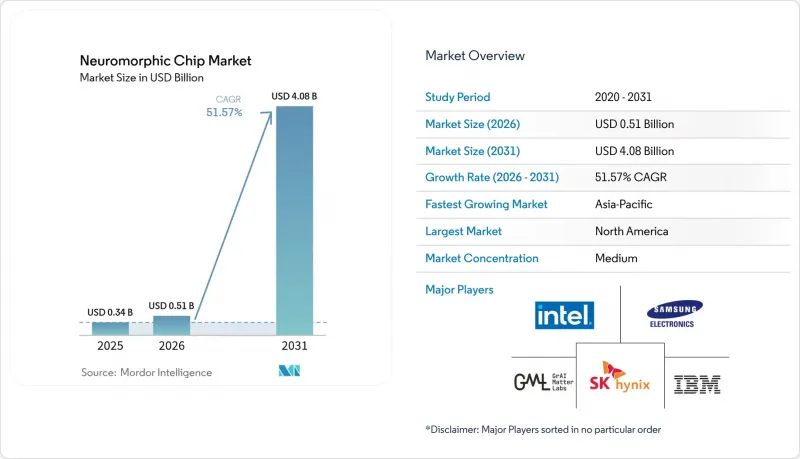
Mordor Intelligence에 따르면 뉴로모픽 칩 시장 규모는 2025년 3억 4,000만 달러, 2026년 5억 1,000만 달러에서 2031년까지 40억 8,000만 달러로 확대할 것으로 예측되고 있으며, 2026-2031년까지 연평균 성장률(CAGR)은 51.57%에 달할 전망입니다.
이 보고서는 칩 유형(아날로그, 디지털, 혼합 신호), 아키텍처(스파이크 신경망, ReRAM 기반 아키텍처, 상변화 메모리 기반 아키텍처), 최종사용자 산업(자동차(ADAS/AV), 가전제품, 항공우주·방위, 기타),배포 모델(엣지 디바이스, 데이터센터·클라우드), 지역별로 분류되어 있습니다. 시장 예측은 금액(달러) 기준으로 제시되어 있습니다.
글로벌 뉴로모픽 칩 시장의 동향 및 인사이트
소비자용·자동차 부문에서의 엣지 AI 수요 증가
스마트폰 및 웨어러블 기기 각 브랜드는 현재, 배터리 소모를 최소화하면서 음성 웨이크 워드, 제스처 제어, 건강 상태 분석을 구현하기 위해 상시 가동형 추론 엔진을 탑재하고 있습니다. Qualcomm의 Snapdragon 플랫폼은 10밀리와트 이하에서 실시간 응답성을 유지하는 이벤트 기반 신경 엔진을 통합하여, 기존 DSP로는 달성할 수 없었던 벤치마크를 수립하고 있습니다. 자동차 부품 공급업체들은 레이더, LiDAR, 카메라 스트림을 10밀리초 이하의 지연 시간으로 융합하는 스파이크 신경망을 중심으로 도메인 컨트롤러의 재설계를 추진하고 있습니다. BrainChip의 ‘Akida’ 코어는 차량내 모니터링 분야에서 ISO 26262 기능 안전 요구 사항을 충족하며, 뉴로모픽 칩 시장이 연산 성능과 안전성 두 가지 요구 사항을 모두 충족할 수 있음을 입증하고 있습니다. 차량이 소프트웨어 정의 아키텍처로 전환됨에 따라 OTA(무선) 업데이트를 통해 재구성 가능한 초저전력 가속기에 대한 수요가 증가하고 있습니다.
데이터센터의 에너지 위기로 인한 초저전력 컴퓨팅의 부상
대규모 언어 모델 훈련은 이미 메가와트시 단위의 전력을 소비하고 있으며, 추론 처리량은 더욱 빠르게 증가하고 있습니다. 인텔 연구소(Intel Laboratories)는 아날로그 인메모리 연산을 통해 곱셈 및 누적 연산의 에너지 소비를 3자리 수만큼 줄일 수 있음을 입증했습니다. IBM의 상변화 메모리를 활용한 프로토타입은 10 피코줄로 시냅스 연산을 수행하며, 1킬로와트 이내의 전력 예산으로 페타플롭스급 랙을 구현하고 있습니다. 자발적인 탄소 배출량 공개 및 효율 인증을 통한 규제적 압박으로 인해 사업자들은 추론당 전력 소비를 최소화하는 칩으로의 전환을 강요받고 있습니다. 전기 요금 상승과 재생 가능 에너지 할당 기준의 엄격화에 따라 데이터센터는 뉴로모픽 칩 시장을 전력 및 냉각 인프라에 대한 자본 지출(CAPEX)을 절감할 수 있는 직접적인 수단으로 보고 있습니다.
미성숙한 소프트웨어 및 툴체인 생태계
기업은 컨볼루션 네트워크를 스파이크로 변환할 때, 시간 상수나 인코더의 수동 조정이 필요한 세분화된 프레임워크에 직면하고 있으며, 그 과정에서 정확도가 저하되는 경우가 많습니다. Intel Lava나 BrainChip MetaTF는 전환을 용이하게 하지만, 둘 다 데이터 과학자들이 기대하는 완전한 레이어 다양성을 지원하지는 않습니다. 벤치마크가 존재하지 않기 때문에 벤더들은 서로 다른 워크로드를 기반으로 전력 소비 수치를 공개하고 있으며, 이는 ROI 분석을 복잡하게 만듭니다. 개발 팀은 GPU와 뉴로모픽 대상 모두를 지원하는 병렬 코드베이스를 유지해야 하며, 이로 인해 예산이 압박받고 프로젝트 일정이 지연됩니다. 이러한 격차는 조달을 지연시키고, 본래 긍정적인 태도를 가진 조직 내에서도 초기 열의를 식게 만들고 있습니다.
부문 분석
혼합 신호 디바이스의 성장률은 52.19%로 예측되며, 이는 기준치인 51.57%를 상회합니다. 2025년에는 디지털 프로세서가 뉴로모픽 칩 시장의 43.56% 점유율을 차지하며, 이는 기업이 결정론적 제어와 탄탄한 소프트웨어 스택에 대해 안심하고 있음을 반영합니다. 인텔 로이히 2(Intel Loihi 2)는 파이썬을 통해 프로그래밍 가능한 완전 비동기식 디지털 메시에 10억 개의 시냅스를 탑재하고 있습니다. 아날로그 크로스바는 에너지 효율 면에서 100배의 우위를 보이지만, 디바이스의 드리프트 문제로 어려움을 겪고 있습니다. 혼합 신호 칩은 아날로그 시냅스 위에 디지털 제어를 적층함으로써, 프로그래밍 가능성을 희생하지 않고도 효율의 상당 부분을 확보하고 있습니다. 이 부문은 테이프아웃 비용이 낮은 성숙한 28nm 노드에서 활기를 띠고 있으며, 스타트업 기업이 적은 자본으로 실리콘화를 실현할 수 있는 길을 열어주고 있습니다.
뉴로모픽 칩 산업에서는 순수 아날로그 프로토타입에 최첨단 공정 노드가 필요하며, 이로 인해 수율 저하가 눈에 띄게 나타난다는 점이 인식되고 있습니다. 대조적으로, 혼합 신호 회로 레이아웃에서는 더 큰 트랜지스터나 다소 유연한 매칭 규칙을 허용할 수 있습니다. Innatera의 ‘Spiking Neural Processor’는 40nm CMOS로 테이프아웃되었으나, 마이크로와트 단위의 웨이크워드 감지 성능에서 디지털 방식의 경쟁 제품을 능가하고 있습니다. 엣지 부문의 각 OEM 업체들이 매년 기능 업그레이드를 요구하는 가운데, 혼합 신호 칩은 저항 크로스바에 더해 펌웨어 유연성이 뛰어난 뉴런을 제공함으로써, 소비자용 및 자동차용 제품 라인 전반에 걸친 장기적인 설계 채택을 확고히 하고 있습니다.
ReRAM 아키텍처는 2025년에 뉴로모픽 칩 시장의 23.67%를 차지하며, 표준 구리 배선과의 원활한 백EOL(End-of-Line)(BEOL) 통합에 힘입어 2031년까지 연평균 52.11%의 성장률을 보일 것으로 전망됩니다. ReRAM 크로스바는 멀티 레벨 셀을 지원하여 다이 면적을 확대하지 않고도 시냅스 밀도를 높일 수 있습니다. IBM의 상변화 메모리는 100만 회의 내구성 사이클과 나노초 단위의 쓰기 속도를 실현하고 있으며, 여전히 유력한 대체 기술로 자리 잡고 있습니다. 그러나 ReRAM은 형성 온도가 낮고 재료 스택이 단순하므로 웨이퍼 비용을 절감할 수 있으며, 스마트폰 규모의 양산에서 결정적인 강점이 됩니다.
이벤트 구동형 스파이크 신경망은 희소 활성화를 통해 ReRAM의 이점을 더욱 증폭시킵니다. 비활성 시냅스는 실질적으로 전류를 소비하지 않기 때문에 시스템 수준의 전력 소비는 마이크로와트 수준으로 낮아집니다. Prophesee의 센서는 비동기 스파이크를 공급하며, 이들이 ReRAM 어레이에 직접 매핑됨으로써 프레임 기반 오버헤드가 제거됩니다. 향후 전망으로, 로드맵에는 모바일 SoC에서 ReRAM 어레이와 디지털 뉴런 컨트롤러가 결합될 것으로 제시되어 있습니다. 이는 삼성과 SK하이닉스가 이러한 블록을 네이티브로 통합할 경우, 가전용 뉴로모픽 칩 시장 규모가 비약적으로 확대되는 요인이 될 것으로 보입니다.
지역별 분석
2025년, 북미는 뉴로모픽 칩 시장에서 39.31%의 점유율을 차지하며 시장을 주도했습니다. 이는 초기 실리콘 개발을 지원하는 IARPA, NSF, 에너지부의 보조금에 힘입은 결과입니다. 인텔은 샌디아 국립연구소와 공동으로 Loihi 시리즈의 각 세대를 개발하여, 학술적 프로토타입 단계에서 데이터센터의 시범 운영 단계로 신속하게 전환했습니다. 캐나다의 벡터 연구소(Vector Institute)와 밀라(Mila)는 상용 툴체인에 직접 활용되는 알고리즘의 획기적인 발전을 이끌고 있는 반면, 멕시코에서는 부상하는 수탁제조 부문이 니어쇼어 조립 역량을 제공하고 있습니다. 재료 연구에서 시스템 통합에 이르기까지 이 지역이 보유한 수직 통합형 생태계는 탄력성을 창출하고 있지만, 아시아태평양의 제조 규모와의 경쟁에 직면해 있습니다.
아시아태평양은 중국의 국가 AI 전략, 일본의 로봇 공학 클러스터, 한국의 메모리 부문 리더십에 힘입어 2031년까지 52.49%의 성장이 예상됩니다. 중국의 ‘제14차 5개년 계획’은 칭화대학교의 ‘뇌형 컴퓨팅 연구소’와 같은 연구 센터에 자금을 지원하고 있으며, 이 연구소에서는 14nm 제조 라인에서 국산 스파이크 네트워크 프로세서의 테이프아웃을 진행하고 있습니다. 일본의 NEDO는 휴머노이드 로봇용 뉴로모픽 코프로세서를 지원하고 있으며, 한편 삼성과 SK하이닉스는 주력 모바일 SoC에 ReRAM 크로스바를 통합하고 있습니다. 인도는 ‘생산 연계형 인센티브(PLI)’ 제도 하에서 조립 및 검사 업무를 유치하고 있지만, 설계용 IP의 대부분은 여전히 해외에 머물러 있습니다.
유럽, 중동 및 아프리카는 매출 규모는 작지만, 학술 성과 면에서는 규모 이상의 존재감을 보이고 있습니다. ‘휴먼 브레인 프로젝트’는 대뇌 피질 시뮬레이션 및 메모리스트성 시냅스에 관한 1,000편 이상의 논문을 발표했습니다. 독일의 자동차 부품 공급업체는 레벨 3 자율주행을 위해 스파이킹 칩의 시범 운용을 진행 중이며, 영국의 그래핀 연구소는 마이크로와트급 디바이스용 2D 시냅스 연구를 추진하고 있습니다. 중동의 스마트 시티 구상에서는 혹독한 기후 조건 하에서 저전력 분석이 요구되고 있으며, 이것이 특수한 틈새 시장을 형성하고 있습니다. 남아프리카의 광산 업체들은 통신 환경이 열악한 지하에서 학습하는 예측 유지보수용 센서의 시험을 진행하고 있습니다. 설계, 제조, 응용 거점의 확대는 뉴로모픽 칩 시장을 형성하는 전 세계적인 상호 의존 관계를 여실히 보여주고 있습니다.
기타 혜택
- 엑셀 형식의 시장 예측(ME) 시트
- 3개월간의 애널리스트 지원
자주 묻는 질문
목차
제1장 서론
제2장 조사 방법
제3장 개요
제4장 시장 구도
제5장 시장 규모와 성장 예측
제6장 경쟁 구도
제7장 시장 기회와 향후 전망
KSA 26.09.03According to Mordor Intelligence, the neuromorphic chip market size is projected to expand from USD 0.34 billion in 2025 and USD 0.51 billion in 2026 to USD 4.08 billion by 2031, registering a CAGR of 51.57% between 2026 to 2031.
This report is Segmented by Chip Type (Analog, Digital, Mixed-Signal), Architecture (Spiking Neural Network, ReRAM-Based Architectures, Phase-Change-Memory Architectures), End-User Industry (Automotive (ADAS / AV), Consumer Electronics, Aerospace and Defense, and More), Deployment Model (Edge Devices, and Data-Centre / Cloud), and Geography. The Market Forecasts are Provided in Terms of Value (USD).
Global Neuromorphic Chip Market Trends and Insights
Rising Edge AI Demand in Consumer and Automotive
Smartphone and wearable brands now embed always-on inference engines to enable voice wake-words, gesture control, and wellness analytics without draining batteries. Qualcomm's Snapdragon platforms integrate event-driven neural engines that maintain real-time responsiveness at 10 milliwatts or less, setting a benchmark that traditional DSPs cannot reach. Automotive suppliers are redesigning domain controllers around spiking neural networks that fuse radar, lidar, and camera streams with sub-10-millisecond latency. BrainChip's Akida core meets ISO 26262 functional-safety targets in in-cabin monitoring, proving that the neuromorphic chip market can satisfy both compute and safety requirements. As vehicles transition toward software-defined architectures, over-the-air updates intensify demand for re-configurable, ultra-low-power accelerators.
Datacenter Energy Crisis Favoring Ultra-Low-Power Compute
Large language model training already consumes megawatt-hours, and inference volumes grow even faster. Intel Laboratories showed that analog in-memory compute reduces multiply-accumulate energy by three orders of magnitude. IBM phase-change prototypes run synaptic operations at 10 picojoules, enabling petaflop-class racks within 1 kilowatt budgets. Regulatory pressure through voluntary carbon disclosure and efficiency certifications nudges operators toward chips that minimize joules per inference. As electricity rates rise and renewable-energy quotas tighten, data centers view the neuromorphic chip market as a direct path to capex savings in power and cooling infrastructure.
Immature Software and Toolchain Ecosystem
Enterprises encounter fragmented frameworks in which converting a convolutional network into spikes requires manual tuning of time constants and encoders, often degrading accuracy. Intel Lava and BrainChip MetaTF ease migration, yet neither supports the full layer diversity data scientists expect. The absence of benchmarks means vendors publish power claims under different workloads, complicating ROI analysis. Development teams must maintain parallel codebases for GPUs and neuromorphic targets, which stretch budgets and extend project timelines. This gap slows procurement and dampens initial enthusiasm inside otherwise receptive organizations.
Other drivers and restraints analyzed in the detailed report include:
- Government Brain-Inspired R&D Programs
- Expansion of Autonomous Vehicle Domain Controller Architectures
- Fabrication Variability of Analog NVM
For complete list of drivers and restraints, kindly check the Table Of Contents.
Segment Analysis
Mixed-signal devices are forecast to grow at 52.19%, beating the 51.57% baseline. In 2025, digital processors held a 43.56% share of the neuromorphic chip market, reflecting corporate comfort with deterministic control and rich software stacks. Intel Loihi 2 packs 1 billion synapses in a fully asynchronous digital mesh programmable through Python. Analog crossbars deliver a 100-fold energy edge but struggle with device drift. Mixed-signal chips layer digital control on analog synapses, harvesting the bulk of the efficiency without surrendering programmability. The segment thrives on mature 28-nanometer nodes that cost less to tape-out, giving startups a capital-light path to silicon.
The neuromorphic chip industry recognizes that pure analog prototypes require leading-edge nodes where yield penalties mount. By contrast, mixed-signal layouts tolerate larger transistors and relaxed matching rules. Innatera's Spiking Neural Processor is taped out on 40-nanometer CMOS yet beats digital rivals on microwatt wake-word detection. As edge OEMs demand annual feature upgrades, mixed-signal chips provide firmware-flexible neurons alongside resistor crossbars, anchoring long-term design wins across consumer and automotive lines.
ReRAM architectures captured 23.67% of the neuromorphic chip market in 2025 and should grow at 52.11% through 2031, aided by seamless back-end-of-line integration with standard copper interconnects. ReRAM crossbars support multi-level cells, increasing synaptic density without enlarging die area. IBM phase-change memory remains a credible alternative, posting 1 million endurance cycles and nanosecond writes. Yet ReRAM's lower formation temperature and simpler materials stack drive lower wafer cost, a decisive lever in smartphone-scale volumes.
Event-driven spiking neural networks amplify ReRAM benefits through sparse activation. Every inactive synapse draws virtually no current, driving system-level power toward the microwatt floor. Prophesee sensors supply asynchronous spikes that map directly onto these arrays, eliminating frame-based overhead. Over the forecast, roadmaps show ReRAM arrays paired with digital neuron controllers in mobile SoCs, a step that positions the neuromorphic chip market size for consumer electronics to jump once Samsung and SK hynix integrate the blocks natively.
Complete Report Scope:
- By Chip Type
- Analog
- Digital
- Mixed-Signal
- By Architecture
- Spiking Neural Network
- ReRAM-Based Architectures
- Phase-Change-Memory Architectures
- By End-User Industry
- Automotive (ADAS / AV)
- Industrial IoT and Robotics
- Consumer Electronics
- Financial Services and Cybersecurity
- Healthcare and Medical Devices
- Aerospace and Defense
- By Deployment Model
- Edge Devices
- Data-Centre / Cloud
- By Geography
- North America
- United States
- Canada
- Mexico
- South America
- Brazil
- Argentina
- Rest of South America
- Europe
- United Kingdom
- Germany
- France
- Italy
- Rest of Europe
- Asia Pacific
- China
- Japan
- India
- South Korea
- Rest of Asia Pacific
- Middle East and Africa
- Middle East
- United Arab Emirates
- Saudi Arabia
- Rest of Middle East
- Africa
- South Africa
- Egypt
- Rest of Africa
- Middle East
- North America
Geography Analysis
North America led the neuromorphic chip market with 39.31% in 2025, buoyed by IARPA, NSF, and Department of Energy grants that subsidize early silicon. Intel co-developed Loihi generations with Sandia National Laboratories, moving quickly from academic prototypes to datacenter pilots. Canada's Vector Institute and Mila deliver algorithmic breakthroughs that feed directly into commercial toolchains, while Mexico's rising contract-manufacturing sector offers near-shore assembly capacity. The region's vertically integrated ecosystem, from materials research to system integration, creates resilience but faces competition from the Asia Pacific's manufacturing scale.
Asia Pacific is forecast to grow at 52.49% through 2031, driven by China's sovereign AI mandate, Japan's robotics cluster, and South Korea's memory leadership. China's 14th Five-Year Plan funds centers like Tsinghua's Brain-Inspired Computing Lab, which tape out domestic spiking-network processors on 14-nanometer lines. Japan's NEDO backs neuromorphic co-processors for humanoid robots, while Samsung and SK Hynix integrate ReRAM crossbars into flagship mobile SoCs. India lures assembly and test operations under its Production Linked Incentive scheme, although design IP largely remains overseas.
Europe, the Middle East, and Africa, though smaller in revenue, punch above their weight in academic output. The Human Brain Project published over 1,000 articles on cortical simulation and memristive synapses. German automotive suppliers pilot spiking chips for L3 autonomy, and U.K. graphene labs explore two-dimensional synapses for microwatt devices. Middle Eastern smart-city initiatives demand low-power analytics under harsh climates, carving a specialized niche. South African miners test predictive-maintenance sensors that learn underground, where connectivity is sparse. The spread of design, fabrication, and application hubs underscores the global interdependencies shaping the neuromorphic chip market.
- Intel Corporation
- International Business Machines Corporation
- Samsung Electronics Co., Ltd.
- SK hynix Inc.
- BrainChip Holdings Ltd
- SynSense AG
- GrAI Matter Labs SAS
- Nepes Corporation
- Qualcomm Technologies, Inc.
- Micron Technology, Inc.
- Synaptics Incorporated
- Innatera Nanosystems BV
- Prophesee SA
- MemryX Inc.
- Mythic Inc.
- Syntiant Corp.
- Gyrfalcon Technology Inc.
- Applied Brain Research Inc.
- General Vision Inc.
- Vicarious Corp.
Additional Benefits:
- The market estimate (ME) sheet in Excel format
- 3 months of analyst support
TABLE OF CONTENTS
1 INTRODUCTION
- 1.1 Study Assumptions and Market Definition
- 1.2 Scope of the Study
2 RESEARCH METHODOLOGY
3 EXECUTIVE SUMMARY
4 MARKET LANDSCAPE
- 4.1 Market Overview
- 4.2 Market Drivers
- 4.2.1 Rising Edge AI Demand in Consumer and Automotive
- 4.2.2 Data-Center Energy Crisis Favoring Ultra-Low-Power Compute
- 4.2.3 Government Brain-Inspired R&D Programs
- 4.2.4 Expansion of Autonomous Vehicle Domain Controller Architectures
- 4.2.5 On-Board Satellite AI Processing Requirements
- 4.2.6 OT-Cybersecurity Anomaly Detection at Network Edge
- 4.3 Market Restraints
- 4.3.1 Immature Software and Toolchain Ecosystem
- 4.3.2 Fabrication Variability of Analog NVM
- 4.3.3 Lack of Spike-System Test and Validation Standards
- 4.3.4 Unclear Medical-Device Regulatory Path
- 4.4 Industry Value Chain Analysis
- 4.5 Regulatory Landscape
- 4.6 Technological Outlook
- 4.7 Porter's Five Forces Analysis
- 4.7.1 Bargaining Power of Suppliers
- 4.7.2 Bargaining Power of Buyers
- 4.7.3 Threat of New Entrants
- 4.7.4 Threat of Substitute Products
- 4.7.5 Intensity of Competitive Rivalry
- 4.8 Emerging Use-Cases for Neuromorphic Chips
- 4.9 Impact of Macroeconomic Factors on the Market
- 4.10 Investment Analysis
5 MARKET SIZE AND GROWTH FORECASTS (VALUE)
- 5.1 By Chip Type
- 5.1.1 Analog
- 5.1.2 Digital
- 5.1.3 Mixed-Signal
- 5.2 By Architecture
- 5.2.1 Spiking Neural Network
- 5.2.2 ReRAM-Based Architectures
- 5.2.3 Phase-Change-Memory Architectures
- 5.3 By End-User Industry
- 5.3.1 Automotive (ADAS / AV)
- 5.3.2 Industrial IoT and Robotics
- 5.3.3 Consumer Electronics
- 5.3.4 Financial Services and Cybersecurity
- 5.3.5 Healthcare and Medical Devices
- 5.3.6 Aerospace and Defense
- 5.4 By Deployment Model
- 5.4.1 Edge Devices
- 5.4.2 Data-Centre / Cloud
- 5.5 By Geography
- 5.5.1 North America
- 5.5.1.1 United States
- 5.5.1.2 Canada
- 5.5.1.3 Mexico
- 5.5.2 South America
- 5.5.2.1 Brazil
- 5.5.2.2 Argentina
- 5.5.2.3 Rest of South America
- 5.5.3 Europe
- 5.5.3.1 United Kingdom
- 5.5.3.2 Germany
- 5.5.3.3 France
- 5.5.3.4 Italy
- 5.5.3.5 Rest of Europe
- 5.5.4 Asia Pacific
- 5.5.4.1 China
- 5.5.4.2 Japan
- 5.5.4.3 India
- 5.5.4.4 South Korea
- 5.5.4.5 Rest of Asia Pacific
- 5.5.5 Middle East and Africa
- 5.5.5.1 Middle East
- 5.5.5.1.1 United Arab Emirates
- 5.5.5.1.2 Saudi Arabia
- 5.5.5.1.3 Rest of Middle East
- 5.5.5.2 Africa
- 5.5.5.2.1 South Africa
- 5.5.5.2.2 Egypt
- 5.5.5.2.3 Rest of Africa
- 5.5.5.1 Middle East
- 5.5.1 North America
6 COMPETITIVE LANDSCAPE
- 6.1 Market Concentration
- 6.2 Strategic Moves
- 6.3 Market Share Analysis
- 6.4 Company Profiles (includes Global Level Overview, Market Level Overview, Core Segments, Financials as Available, Strategic Information, Market Rank/Share for Key Companies, Products and Services, and Recent Developments)
- 6.4.1 Intel Corporation
- 6.4.2 International Business Machines Corporation
- 6.4.3 Samsung Electronics Co., Ltd.
- 6.4.4 SK hynix Inc.
- 6.4.5 BrainChip Holdings Ltd
- 6.4.6 SynSense AG
- 6.4.7 GrAI Matter Labs SAS
- 6.4.8 Nepes Corporation
- 6.4.9 Qualcomm Technologies, Inc.
- 6.4.10 Micron Technology, Inc.
- 6.4.11 Synaptics Incorporated
- 6.4.12 Innatera Nanosystems BV
- 6.4.13 Prophesee SA
- 6.4.14 MemryX Inc.
- 6.4.15 Mythic Inc.
- 6.4.16 Syntiant Corp.
- 6.4.17 Gyrfalcon Technology Inc.
- 6.4.18 Applied Brain Research Inc.
- 6.4.19 General Vision Inc.
- 6.4.20 Vicarious Corp.
7 MARKET OPPORTUNITIES AND FUTURE OUTLOOK
- 7.1 White-Space and Unmet-Need Assessment


