

|
시장보고서
상품코드
2121755
합성고무 : 시장 점유율 분석, 업계 동향과 통계, 성장 예측(2026-2031년)Synthetic Rubber - Market Share Analysis, Industry Trends & Statistics, Growth Forecasts (2026 - 2031) |
||||||
 Mordor Intelligence
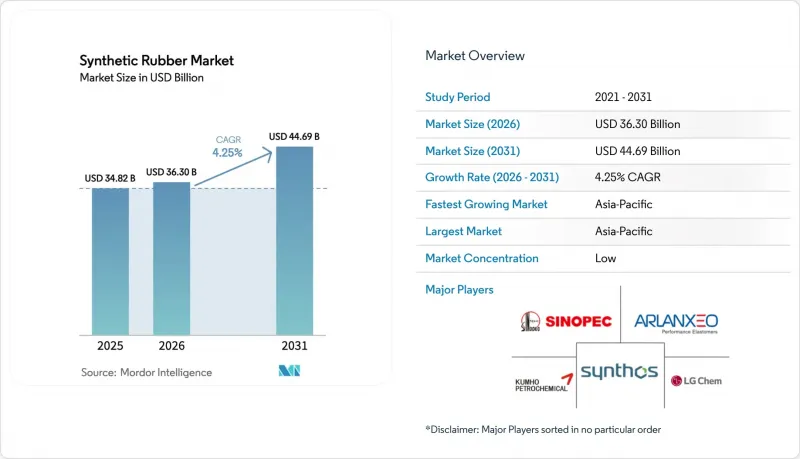
Mordor Intelligence에 따르면 합성고무 시장 규모는 2025년에 348억 2,000만 달러, 2026년에 363억 달러에 달하며, 2031년까지 446억 9,000만 달러에 달할 것으로 예측되고 있으며, 2026-2031년에 CAGR 4.25%로 성장할 것으로 전망되고 있습니다.
이 보고서는 유형(스티렌-부타디엔 고무(SBR), 폴리부타디엔 고무(BR), 기타), 제조 공정(에멀전 중합, 기타), 원료(부타디엔, 이소프렌,스티렌, 기타), 용도(타이어 및 타이어 부품, 타이어 이외의 자동차 용도, 기타), 그리고 지역(아시아태평양, 북미, 유럽, 기타)별로 분류되어 있습니다. 시장 전망은 금액(달러) 단위로 제시되어 있습니다.
세계 합성고무 시장의 동향 및 인사이트
전기자동차 제조사의 고성능 타이어 수요 급증
전기자동차의 토크와 배터리 중량 증가로 인해 트레드 마모가 20-30% 증가하고 있으며, 각 OEM 업체들은 실리카 충전제와 결합하여 구름 저항을 최대 20%까지 저감하는 S-SBR 배합으로의 전환을 요구받고 있습니다. 테슬라의 2024년 공급 계약과 BYD의 2025년 자체 컴파운딩화 추진으로 인해 생산 업체들은 5,000만-8,000만 달러의 설비 투자가 필요하더라도 연속 용액 반응 장치로의 개조를 진행하고 있습니다. 2027년에 전기자동차 판매 대수가 전 세계 소형차 판매 대수의 20%를 차지할 것으로 전망되는 가운데, 기능성 등급을 보유하지 않은 1차 공급업체들은 계약을 잃을 위험에 직면해 있습니다. 사이드월의 얇아짐에 따른 공기역학적 성능 향상은 타이어의 화학 조성물과 차량의 주행 거리를 더욱 밀접하게 연결시키며, 합성고무 시장을 자동차 제조사에게 있으며, 전략적 수단으로 확고히 자리매김하고 있습니다.
재생 가능 에너지 설비용 산업용 고무 제품의 성장
풍력 터빈의 나셀은 -40°C에서 +60°C 사이에서 온도가 변동하므로 천연 고무의 한계를 뛰어넘는 내오존성을 갖춘 EPDM 실이 요구됩니다. 다우(Dow)사가 2025년에 출시한 바이오 카본을 50% 함유한 ‘NORDEL REN EPDM’은 베스타스(Vestas)사와 지멘스 가메사(Siemens Gamesa)사로부터 승인을 받았습니다. 한편, 리튬 광산의 컨베이어 벨트에는 염수나 영하의 환경을 견딜 수 있는 니트릴계 고무가 지정되어 있습니다. 이러한 고부가가치 틈새 시장이 합성고무 시장의 산업용 제품 부문 연평균 성장률(CAGR) 4.58%라는 예측을 지원하고 있습니다.
부타디엔 원료 가격 변동
아시아의 부타디엔 현물 가격은 크래커 가동 중단으로 인해 2024-2025년에 67% 상승했으며, 타이어 제조업체들이 가격 인상에 저항함에 따라 에멀전 SBR의 이익률이 압박을 받았습니다. 솔루션 등급 플랜트는 톤당 100-150달러의 순도 프리미엄을 부과받아 비용 우위가 훼손되었습니다. Saudi Aramco와 SABIC의 수직 통합으로 자체 공급원이 확보되었지만, 인도의 독립 생산자들은 여전히 영향을 받기 쉬워 재고 증가를 피할 수 없게 되었고, 운전자금에 부담이 가중되고 있습니다.
부문별 분석
스티렌-부타디엔 고무(SBR)는 교체용 타이어에서의 비용 우위를 바탕으로 2025년에는 합성 고무 시장 점유율의 40.89%를 차지했습니다. 에틸렌-프로필렌-다이엔 모노머(EPDM)는 지붕 개보수 및 NVH(소음·진동·거칠기) 대책이 확대됨에 따라 연평균 성장률(CAGR) 5.81%로 가장 높은 성장률을 기록할 것으로 예상됩니다. 폴리부타디엔 혼합은 겨울용 타이어의 유연성을 높이는 한편, 부틸고무는 의약품용 마개 분야에서 프리미엄 가격을 유지하고 있습니다. EPDM에 기인한 합성고무 시장의 규모는 그 범용성이 높은 내후성을 반영하여 2031년까지 대폭 확대될 것으로 예상됩니다. 전기자동차(EV)의 보급이 확대되는 가운데, LG화학 및 금호석유화학의 투자도 지원되어 솔루션형 SBR 등급이 초고성능 타이어 시장을 독점하고 있습니다.
연속 반응 장치의 개조 비용은 100kt 라인당 5,000만-8,000만 달러가 소요되므로, 저비용 자금 조달 수단을 보유한 기존 기업이 유리합니다. 2025년에 출시된 ARLANXEO의 ‘Keltan ECO EPDM’은 70%의 바이오 카본을 배합하여 자동차 OEM 각사가 스코프 3 배출량을 감축하는 데 도움이 됩니다. 특수 니트릴과 클로로프렌은 유전용 실 및 난연성 케이블 피복 분야에서 여전히 가치가 높으며, 생산량은 적지만 가격 프리미엄을 확보하고 있습니다. 2027년에 전기자동차 판매 비중이 20%를 넘어섬에 따라 제품 구성은 용액 중합형 SBR로 전환될 것이며, 합성 고무 시장내 경쟁 환경은 더욱 치열해질 것으로 보입니다.
2025년에는 에멀전 중합이 생산 능력의 61.67%를 차지했으나, 분자량 제어 정밀도 향상과 용매 루프 효율화를 통해 용액 중합 공정은 연평균 성장률(CAGR) 5.66%로 성장할 전망입니다. LG화학 여수 공장 확장에서는 점도 균일화를 위한 자동 투여 시스템이 도입되어 편차를 40% 줄였습니다. 연속 기상 기술은 특수한 고시스형 폴리부타디엔으로 한정되어 있지만, 에너지 집약도를 2.5GJ/t 이하로 낮추어 구형 배치 반응기를 능가하고 있습니다.
2010년 이전에 건설된 배치식 에멀전 장치는 증기 소비량이 20-30% 더 많고, COD 수치가 높은 라텍스 폐수가 발생하므로 사업자들은 비용이 많이 드는 폐수 처리 설비 개조를 서둘러야 하는 상황입니다. 금호석유화학이 2027년 가동을 예정하고 있는 40kt 용액법 SBR 프로젝트는 반덤핑 관세 적용 대상에서 제외되는 북미의 전기자동차용 타이어 수요를 목표로 하고 있습니다. 이러한 공정 구성의 변화는 합성고무 시장을 형성하는 지속가능성에 대한 압박을 여실히 드러내고 있습니다.
지역별 분석
아시아태평양은 2025년에 합성고무 시장 매출의 57.89%를 차지하며, 2031년까지 연평균 성장률(CAGR) 4.46%로 확대될 것으로 전망됩니다. 인도의 레이디얼 타이어 생산 라인과 중국의 전기자동차 붐 덕분에, 톤당 1,400달러를 넘는 부타디엔 가격 급등으로 인한 이익률 압박이 상쇄되고 있습니다. 아세안(ASEAN)은 호주와 일본으로의 관세 없는 허브로서 외국인 직접 투자(FDI)를 유치하고 있으며, 지역내 공급원 다각화가 진행되고 있습니다.
북미의 합성고무 수요는 USMCA(미국·멕시코·캐나다 협정)에 따른 생산의 국내 복귀와 미국 에너지부(DOE)가 자금을 지원하는 바이오 모노머 실증 프로젝트에 의해 견인되고 있습니다. 브리지스톤의 에탄올을 부타디엔으로 전환하는 실증 프로젝트와 굿이어와 비솔리스(Visolys)사의 제휴를 통해 이 지역은 재생 가능 원료의 상용화 분야에서 최전선에 위치하고 있습니다.
유럽은 수요의 큰 비중을 차지하고 있지만, REACH의 미세 플라스틱 규제 및 PFAS 모니터링에 직면해 있으며, 컴파운드 제조사들은 비불소계 화학물질로의 전환을 강요받고 있습니다. 그러나 이 대륙의 노후화된 지붕 자재 재고가 매력적인 이익률로 EPDM을 이용한 보수 공사를 지원하고 있습니다. 중동에서는 Saudi Aramco의 합성고무 자산과 SABIC의 푸젠성 복합 단지를 통해 하류 부문과의 통합이 진행되고 있으며, 아시아 및 유럽으로의 수출 판매가 목표로 설정되어 있습니다. 남미의 합성고무 수요는 브라질의 교체용 타이어 부문에 집중되어 있지만, 나이지리아의 초기 단계에 있는 조립 산업은 2027년 이후 수요가 점진적으로 증가할 것으로 전망됩니다.
기타 혜택
- 엑셀 형식의 시장 예측(ME) 시트
- 3개월간의 애널리스트 지원
자주 묻는 질문
목차
제1장 서론
제2장 조사 방법
제3장 개요
제4장 시장 구도
제5장 시장 규모와 성장 예측
제6장 경쟁 구도
제7장 시장 기회와 향후 전망
KSA 26.09.03According to Mordor Intelligence, the synthetic rubber market size is projected to be USD 34.82 billion in 2025, USD 36.30 billion in 2026, and reach USD 44.69 billion by 2031, growing at a CAGR of 4.25% from 2026 to 2031.
This report is Segmented by Type (Styrene-Butadiene Rubber (SBR), Polybutadiene Rubber (BR), and More), Manufacturing Process (Emulsion Polymerization, and More), Raw Material (Butadiene, Isoprene, Styrene, and More), Application (Tire and Tire Components, Non-Tire Automobile Applications, and More), and Geography (Asia-Pacific, North America, Europe, and More). Market Forecasts are Provided in Value (USD).
Global Synthetic Rubber Market Trends and Insights
Surging Demand for High-Performance Tires from EV OEMs
Electric-vehicle torque and battery mass raise tread wear by 20-30%, driving OEMs toward S-SBR formulations that bond to silica fillers and cut rolling resistance up to 20%. Tesla's 2024 supply contracts and BYD's 2025 in-house compounding push producers to retrofit continuous solution reactors despite USD 50-80 million capital outlays. Tier-1 suppliers without functionalized grades risk contract losses as EV sales head toward 20% of global light-vehicle volume in 2027. Aerodynamic gains from thinner sidewalls further link tire chemistry to vehicle range, cementing the synthetic rubber market as a strategic lever for automakers.
Growth of Industrial Rubber Goods for Renewable-Energy Installations
Wind-turbine nacelles cycle between -40 °C and +60 °C, requiring EPDM seals with ozone resistance beyond natural rubber limits. Dow's 2025 launch of NORDEL REN EPDM with 50% bio-carbon secured approvals at Vestas and Siemens Gamesa, while lithium-mine conveyor belts specify nitrile grades that withstand brine and sub-zero exposure. These high-value niches underpin the 4.58% CAGR forecast for industrial goods inside the synthetic rubber market.
Volatility in Butadiene Feedstock Prices
Spot butadiene in Asia climbed 67% from 2024-2025 on cracker outages, squeezing emulsion-SBR margins when tire makers resisted price hikes. Solution-grade plants faced USD 100-150 t purity premiums, eroding their cost advantage. Vertical integration by Saudi Aramco and SABIC secures captive streams, yet independent producers in India remain exposed, forcing higher inventories that strain working capital.
Other drivers and restraints analyzed in the detailed report include:
- Advancements in Medical and Healthcare Applications
- Shift Toward Bio-Based Monomers in North America
- Substitution by High-Performance Polyurethanes in Seals and Gaskets
For complete list of drivers and restraints, kindly check the Table Of Contents.
Segment Analysis
Styrene-butadiene rubber commanded 40.89% of the synthetic rubber market share in 2025, benefiting from replacement-tire cost advantages. Ethylene-Propylene-Diene Monomer (EPDM) is projected to post the fastest 5.81% CAGR as roofing retrofits and NVH upgrades proliferate. Polybutadiene blends enhance winter-tire flexibility, while butyl retains premium pricing in pharmaceutical stoppers. The synthetic rubber market size attributed to EPDM is anticipated to expand significantly by 2031, reflecting its versatile weathering profile. Solution-SBR grades dominate ultra-high-performance tires as EV adoption ramps, aided by investments at LG Chem and Kumho Petrochemical.
Continuous reactor retrofits cost USD 50-80 million per 100 kt line, favoring incumbents with access to low-cost finance. ARLANXEO's Keltan ECO EPDM, launched in 2025, embeds 70% bio-carbon and helps automotive OEMs reduce Scope 3 emissions. Specialty nitrile and chloroprene remain valuable in oil-field seals and flame-retardant cable jackets, capturing price premiums despite modest volumes. As EVs cross the 20% sales threshold in 2027, type-mix will tilt toward solution-grade SBR, tightening competitive dynamics inside the synthetic rubber market.
Emulsion polymerization represented 61.67% of capacity in 2025, yet solution processes will grow at a 5.66% CAGR due to tighter molecular-weight control and solvent-loop efficiency. LG Chem's Yeosu expansion adds automated dosing for viscosity uniformity, trimming variance by 40%. Continuous gas-phase technology remains confined to specialty high-cis polybutadiene but reduces energy intensity below 2.5 GJ t, beating older batch reactors.
Batch emulsion units built pre-2010 consume 20-30% more steam and generate high-COD latex effluent, pushing operators toward costly wastewater retrofits. Kumho Petrochemical's 40 kt solution-SBR project, slated for 2027, targets North American EV tire demand exempt from anti-dumping duties. The process mix shift underlines sustainability pressures shaping the synthetic rubber market.
Complete Report Scope:
- By Type
- Styrene-Butadiene Rubber (SBR)
- Polybutadiene Rubber (BR)
- Ethylene-Propylene-Diene Monomer (EPDM)
- Isobutylene-Isoprene Rubber (IIR)
- Polyisoprene Rubber (IR)
- Others (NBR, CR, ACM, HNBR, etc.)
- By Manufacturing Process
- Emulsion Polymerization (E-SBR)
- Solution Polymerization (S-SBR)
- Advanced Continuous Polymerization
- By Raw Material
- Butadiene
- Isoprene
- Styrene
- Ethylene and Propylene
- Other Specialty Monomers (ACN, Chloroprene)
- By Application
- Tire and Tire Components
- Non-Tire Automobile Applications
- Industrial Goods
- Footwear
- Other Applications
- By Geography
- Asia-Pacific
- China
- India
- Japan
- South Korea
- Malaysia
- Thailand
- Vietnam
- Indonesia
- Rest of Asia-Pacific
- North America
- United States
- Canada
- Mexico
- Europe
- Germany
- United Kingdom
- France
- Italy
- Spain
- Russia
- Nordics
- Turkey
- Rest of Europe
- South America
- Brazil
- Argentina
- Colombia
- Rest of South America
- Middle East and Africa
- Saudi Arabia
- United Arab Emirates
- Qatar
- South Africa
- Egypt
- Nigeria
- Rest of Middle East and Africa
- Asia-Pacific
Geography Analysis
Asia-Pacific commanded 57.89% of the synthetic rubber market revenue in 2025 and is projected to advance at a 4.46% CAGR through 2031. India's radial-tire lines and China's EV boom offset margin pressure from butadiene spikes above USD 1,400 per ton. ASEAN nations gain FDI as tariff-free hubs into Australia and Japan, diversifying regional supply.
North America's synthetic rubber demand is driven by USMCA reshoring and DOE-funded bio-monomer pilots. Bridgestone's ethanol-to-butadiene demo and Goodyear's Visolis tie-up position the region at the forefront of renewable feedstock commercialization.
Europe accounts for significant demand but faces REACH microplastic rules and PFAS scrutiny, nudging formulators toward non-fluorinated chemistries. However, the continent's aged roofing stock drives EPDM retrofits at attractive margins. The Middle East integrates downstream via Saudi Aramco's synthetic-rubber assets and SABIC's Fujian complex, targeting export sales into Asia and Europe. South America's synthetic rubber demand concentrates in Brazil's replacement-tire segment, while Nigeria's nascent assembly industry promises incremental demand post-2027.
- Apcotex Industries
- Arlanxeo
- Asahi Kasei Corporation
- China Petrochemical Corporation
- Dow
- ENEOS Corporation
- Exxon Mobil Corporation
- Indian Synthetic Rubber Private Limited
- Jiangsu Sailboat Petrochemical Co. Ltd.
- Kumho Petrochemical
- LANXESS
- LG Chem
- Mitsubishi Chemical Group Corporation
- Reliance Industries Limited
- SABIC
- Saudi Arabian Oil Co.
- SIBUR Holding PJSC
- Synthos
- The Goodyear Tire & Rubber Company
- Trinseo
- TSRC
- Versalis S.p.A.
- Zeon Corporation
Additional Benefits:
- The market estimate (ME) sheet in Excel format
- 3 months of analyst support
TABLE OF CONTENTS
1 Introduction
- 1.1 Study Assumptions and Market Definition
- 1.2 Scope of the Study
2 Research Methodology
3 Executive Summary
4 Market Landscape
- 4.1 Market Overview
- 4.2 Market Drivers
- 4.2.1 Surging demand for high-performance tires from EV OEMs
- 4.2.2 Growth of industrial rubber goods for renewable-energy installations
- 4.2.3 Advancements in medical and healthcare applications
- 4.2.4 Shift toward bio-based monomers in North America
- 4.2.5 Expansion of 5G infrastructure driving EPDM seal consumption
- 4.3 Market Restraints
- 4.3.1 Volatility in butadiene feedstock prices
- 4.3.2 Substitution by high-performance polyurethanes in seals and gaskets
- 4.3.3 PFAS-linked regulatory pressure on fluoro-elastomer blends
- 4.4 Value Chain Analysis
- 4.5 Porter's Five Forces
- 4.5.1 Bargaining Power of Suppliers
- 4.5.2 Bargaining Power of Buyers
- 4.5.3 Threat of New Entrants
- 4.5.4 Threat of Substitutes
- 4.5.5 Degree of Competition
5 Market Size and Growth Forecasts (Value)
- 5.1 By Type
- 5.1.1 Styrene-Butadiene Rubber (SBR)
- 5.1.2 Polybutadiene Rubber (BR)
- 5.1.3 Ethylene-Propylene-Diene Monomer (EPDM)
- 5.1.4 Isobutylene-Isoprene Rubber (IIR)
- 5.1.5 Polyisoprene Rubber (IR)
- 5.1.6 Others (NBR, CR, ACM, HNBR, etc.)
- 5.2 By Manufacturing Process
- 5.2.1 Emulsion Polymerization (E-SBR)
- 5.2.2 Solution Polymerization (S-SBR)
- 5.2.3 Advanced Continuous Polymerization
- 5.3 By Raw Material
- 5.3.1 Butadiene
- 5.3.2 Isoprene
- 5.3.3 Styrene
- 5.3.4 Ethylene and Propylene
- 5.3.5 Other Specialty Monomers (ACN, Chloroprene)
- 5.4 By Application
- 5.4.1 Tire and Tire Components
- 5.4.2 Non-Tire Automobile Applications
- 5.4.3 Industrial Goods
- 5.4.4 Footwear
- 5.4.5 Other Applications
- 5.5 By Geography
- 5.5.1 Asia-Pacific
- 5.5.1.1 China
- 5.5.1.2 India
- 5.5.1.3 Japan
- 5.5.1.4 South Korea
- 5.5.1.5 Malaysia
- 5.5.1.6 Thailand
- 5.5.1.7 Vietnam
- 5.5.1.8 Indonesia
- 5.5.1.9 Rest of Asia-Pacific
- 5.5.2 North America
- 5.5.2.1 United States
- 5.5.2.2 Canada
- 5.5.2.3 Mexico
- 5.5.3 Europe
- 5.5.3.1 Germany
- 5.5.3.2 United Kingdom
- 5.5.3.3 France
- 5.5.3.4 Italy
- 5.5.3.5 Spain
- 5.5.3.6 Russia
- 5.5.3.7 Nordics
- 5.5.3.8 Turkey
- 5.5.3.9 Rest of Europe
- 5.5.4 South America
- 5.5.4.1 Brazil
- 5.5.4.2 Argentina
- 5.5.4.3 Colombia
- 5.5.4.4 Rest of South America
- 5.5.5 Middle East and Africa
- 5.5.5.1 Saudi Arabia
- 5.5.5.2 United Arab Emirates
- 5.5.5.3 Qatar
- 5.5.5.4 South Africa
- 5.5.5.5 Egypt
- 5.5.5.6 Nigeria
- 5.5.5.7 Rest of Middle East and Africa
- 5.5.1 Asia-Pacific
6 Competitive Landscape
- 6.1 Market Concentration
- 6.2 Strategic Moves
- 6.3 Market Share(%)/Ranking Analysis
- 6.4 Company Profiles (includes Global level Overview, Market level Overview, Core Segments, Financials as available, Strategic Information, Market Rank/Share for key companies, Products and Services, Recent Developments)
- 6.4.1 Apcotex Industries
- 6.4.2 Arlanxeo
- 6.4.3 Asahi Kasei Corporation
- 6.4.4 China Petrochemical Corporation
- 6.4.5 Dow
- 6.4.6 ENEOS Corporation
- 6.4.7 Exxon Mobil Corporation
- 6.4.8 Indian Synthetic Rubber Private Limited
- 6.4.9 Jiangsu Sailboat Petrochemical Co. Ltd.
- 6.4.10 Kumho Petrochemical
- 6.4.11 LANXESS
- 6.4.12 LG Chem
- 6.4.13 Mitsubishi Chemical Group Corporation
- 6.4.14 Reliance Industries Limited
- 6.4.15 SABIC
- 6.4.16 Saudi Arabian Oil Co.
- 6.4.17 SIBUR Holding PJSC
- 6.4.18 Synthos
- 6.4.19 The Goodyear Tire & Rubber Company
- 6.4.20 Trinseo
- 6.4.21 TSRC
- 6.4.22 Versalis S.p.A.
- 6.4.23 Zeon Corporation
7 Market Opportunities and Future Outlook
- 7.1 White-Space and Unmet-Need Assessment
- 7.2 Development of Bio-Based Synthetic Rubbers


