

|
시장보고서
상품코드
2121761
바이탈 사인 모니터링 : 시장 점유율 분석, 업계 동향과 통계, 성장 예측(2026-2031년)Vital Signs Monitoring - Market Share Analysis, Industry Trends & Statistics, Growth Forecasts (2026 - 2031) |
||||||
 Mordor Intelligence
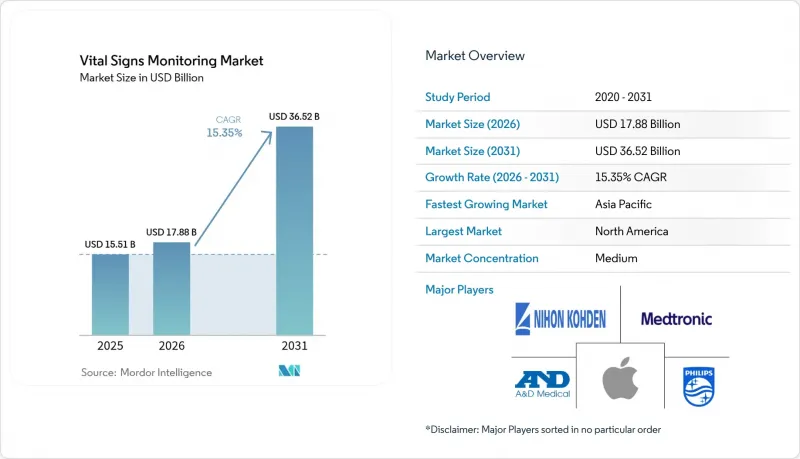
Mordor Intelligence에 따르면 바이탈 사인 모니터링 시장 규모는 2025년 155억 1,000만 달러, 2026년 178억 8,000만 달러에서 2031년까지 365억 2,000만 달러로 확대할 것으로 예측되고 있으며, 2026-2031년에 CAGR 15.35%를 기록할 전망입니다.
이 보고서는 제품별[소비자용 웨어러블 기기(스마트워치, 피트니스·활동 추적기, 기타), 의료용 기기(혈압계, 기타)], 최종사용자별(병원·클리닉, 기타), 폼팩터별(휴대용 기기, 탁상형·침대 옆 모니터, 기타), 지역별(북미, 남미, 유럽, 아시아태평양, 중동 및 아프리카)로 분류되어 있습니다. 시장 예측은 금액()으로 표시되어 있습니다.
전 세계 생체 신호 모니터링 시장의 동향 및 인사이트
만성 심혈관 및 대사성 질환의 급격한 증가
2020-2024년에 전 세계에서 심혈관 질환으로 인한 사망률이 18.6% 상승함에 따라 의료 시스템은 지속적인 심장 모니터링 툴에 자원을 집중하고 있습니다. 현재 미국 성인의 48%가 어떤 형태의 심장 질환을 앓고 있는 만큼, 부정맥이나 야간 고혈압을 감지하는 휴대용 모니터링 솔루션에 대한 자금 배분이 우선시되고 있습니다. 2024년에는 성인 당뇨병 환자 수가 5억 3,700만 명에 달할 것으로 예상됨에 따라 혈당 수치뿐만 아니라 혈압과 심박수도 추적하는 다중 매개변수 모니터에 대한 수요가 증가하고 있습니다. 보험 지급 기관은 연간 4조 1,000억 달러에 달하는 만성질환 부담에 직면해 있으며, 치료 성과 개선을 입증한 원격 모니터링 플랫폼을 높이 평가하고 있으며, 통합형 생체 신호 솔루션의 도입이 가속화되고 있습니다. 이러한 역학적 요인들이 복합적으로 작용하여 생체 신호 모니터링 시장의 장기적인 성장을 지원하고 있습니다.
원격의료의 보급 확대 및 RPM에 대한 보험 급여
CMS(미국 의료보험의료서비스센터)가 원격 환자 모니터링(RPM)의 핵심 코드를 유지하고, 민간 보험사들도 이에 발맞춰 보험 적용 범위를 확대함에 따라 데이터베이스 치료 경로에서 예측 가능한 요금 체계가 보장되었습니다. CPT 99457에서는 소폭의 보수 삭감이 예상되지만, 대규모 의료 제공자 그룹은 수백 명의 재택 환자를 동시에 감독할 수 있는 가상 간호 센터를 확대함으로써 그 영향을 상쇄하고 있습니다. 이와 병행하여, 유나이티드헬스케어와 앤섬은 RPM 적용 대상을 약 2,000만 명의 민간 보험 가입자로 확대했으며, 연결형 혈압 측정 기기에 대해서는 ISO 인증을 통한 정확도를 요건으로 정했습니다. 국제적으로는 영국의 NHS 디지털이 250만 명의 시민에게 연결형 모니터를 공급하기 위해 4억 5,000만 파운드를 편성함으로써, 유럽내 보상 제도의 추세를 확고히 하고 있습니다. 지속적인 자금 지원으로 인해 제조업체의 자본 배분 위험이 경감되었으며, 생체 신호 모니터링 시장의 기반이 되는 판매량 증가가 확고해지고 있습니다.
데이터 개인정보 보호 및 사이버 보안 규정 준수 부담
랜섬웨어 공격이 급증함에 따라 규제 당국은 사이버 보안 요건을 강화해야 하는 상황에 직면해 있습니다. FDA는 현재 모든 510(k) 신청에 대해 소프트웨어 구성표(SBOM), 보안 코딩 증명, 지속적인 패치 적용 프로세스를 요구하고 있습니다. 유럽의 MDR(의료기기 규정) 프레임워크 역시 연간 침투 테스트 및 72시간 이내 사고 보고를 포함한 의무를 부과하고 있습니다. 규정 준수 대응으로 인해 단일 기기 제품군당 최대 180만 달러의 시판 전 개발 비용이 증가할 가능성이 있으며, 소규모 신규 진입 기업의 이익률을 압박하고 있습니다. 대형 기존 기업은 전담 보안 팀을 확충하고 간접비를 광범위한 제품 포트폴리오에 분산시키고 있지만, 스타트업 기업은 출시 지연이나 전략적 철수에 직면하고 있으며, 생체 신호 모니터링 시장 전체의 연평균 성장률(CAGR)을 소폭 끌어내리고 있습니다.
부문 분석
의료기기는 생체 신호 모니터링 시장에서 51.23%라는 압도적인 점유율을 차지하고 있지만, 소비자용 웨어러블 기기는 연평균 성장률(CAGR) 16.78%로 증가할 것으로 예측되어, 규제 대상 의료기기가 오랫동안 유지해 온 우위를 잠식하고 있습니다. Apple Watch Series 10은 FDA 승인을 받은 수면 무호흡증 선별 기능을 대중 시장 가격대에 도입함으로써, 소비자용 브랜드라도 병원 유통 채널 없이도 임상 기준을 충족할 수 있음을 입증했습니다. 스마트워치는 2025년 소비자용 매출에서 두드러진 점유율을 확보한 반면, 패치형 모니터는 접착성 덕분에 환자가 직접 설정할 필요가 없어 수술 후 관리 분야에서 보급이 확대되고 있습니다. 규제 대상 의료기기 부문에서는 2025년 매출에서 펄스 옥시미터가 여전히 큰 점유율을 차지하고 있지만, 피부색에 따른 계층별 검증 의무화로 인해 승인 대기 기간이 6-9개월 연장되면서 연구개발비는 다중 매개변수 플랫폼으로 전환되고 있습니다. 이러한 변화들이 맞물려 대상 사용자층이 확대되면서, 생체 신호 모니터링 시장의 지속적인 성장을 지원하고 있습니다.
또한 각 하드웨어 제조사들은 혈당, 심전도, 혈압 센서를 통합한 키트를 개발하고 있습니다. 이러한 통합을 통해 앱 생태계가 간소화되고, 보험 적용 대상 청구 코드가 증가하며, 의료 제공자의 투자 회수 주기가 단축됩니다. 따라서 소비자용 웨어러블과 관련된 생체 신호 모니터링 시장 규모는 2031년보다 훨씬 이른 시점에 단일 매개변수 의료기기 시장 규모를 추월할 것으로 전망됩니다.
지역별 분석
북미는 2025년에도 45.3%의 점유율을 유지했습니다. 이는 명확한 CPT 코드, 대기업의 웰니스 예산 확충, ‘재택 병원(Hospital-at-Home)’ 병동을 운영하는 124개 의료 시스템의 혜택 덕분입니다. 캐나다의 주 정부 주도 구상과 멕시코에서 시작된 시범 사업도 이 지역의 판매 대수를 더욱 끌어올리고 있습니다. 아시아태평양은 중국의 1조 2,000억 위안 규모의 디지털 헬스 투자와 인도의 통합 건강 기록 시스템 도입을 원동력으로, 연평균 성장률(CAGR) 18.11%라는 가장 빠른 성장률을 기록할 전망입니다. 일본과 한국의 보험 적용 범위 확대는 초고령 사회에서 의료기기의 보급 촉진을 지원하고 있는 반면, 호주는 연방 정부의 보조금을 통해 지방의 통신 환경 격차 해소에 힘쓰고 있습니다.
유럽은 2025년 매출에서 큰 비중을 차지하고 있으며, 만성 심부전, COPD, 당뇨병용 커넥티드 기기에 대한 보험 환급을 허용하는 각국의 제도에 의해 통일되어 있습니다. 독일의 ‘디지털 헬스케어법’에 따라 2025년에는 3억 8,000만 유로의 보험 청구가 이루어져 공적 보험에 대한 수요가 입증되었습니다. 프랑스의 중앙 집중형 원격 모니터링 플랫폼은 18개 기기 브랜드로부터 데이터를 수집하며 대규모 상호 운용성을 입증하고 있습니다. 남미와 중동 및 아프리카는 합쳐서 상당한 시장 점유율을 차지하고 있으며, 브라질과 걸프 국가들에서의 전략적 입찰 수주는 언어 지원 및 배터리 안전 인증의 현지화에 주력하는 벤더들에게 향후 성장 여지가 있음을 시사합니다. 이러한 지역별 특성이 결합되어 생체 신호 모니터링 시장의 다단계적 확장을 주도하고 있습니다.
기타 혜택
- 엑셀 형식의 시장 예측(ME) 시트
- 3개월간의 애널리스트 지원
자주 묻는 질문
목차
제1장 서론
제2장 조사 방법
제3장 개요
제4장 시장 구도
제5장 시장 규모와 성장 예측
제6장 경쟁 구도
제7장 시장 기회와 향후 전망
KSA 26.09.03According to Mordor Intelligence, the vital signs monitoring market size is projected to expand from USD 15.51 billion in 2025 and USD 17.88 billion in 2026 to USD 36.52 billion by 2031, registering a CAGR of 15.35% between 2026 to 2031.
This report is Segmented by Product [Consumer Wearables (Smartwatches, Fitness & Activity Trackers and More), Medical Devices (Blood Pressure Monitors, and More)], End-User (Hospitals & Clinics, and More), Form Factor (Hand-Held, Table-Top, and More), and Geography (North America, South America, Europe, Asia-Pacific, Middle East & Africa). Market Forecasts are Provided in Value (USD).
Global Vital Signs Monitoring Market Trends and Insights
Rising Prevalence of Chronic and Lifestyle Diseases
Cardiovascular mortality climbed 18.6% globally between 2020 and 2024, prompting health systems to shift resources to continuous cardiac surveillance tools. As 48% of U.S. adults now live with some form of heart disease, ambulatory monitoring solutions that capture arrhythmia and nocturnal hypertension are gaining priority funding. Diabetes prevalence reached 537 million adults in 2024, reinforcing demand for multi-parameter monitors that track glucose alongside blood pressure and heart rate. Payers face a USD 4.1 trillion annual chronic-disease burden and are rewarding remote monitoring platforms that demonstrate outcome improvements, accelerating procurement of integrated vital-sign solutions. Collectively, these epidemiologic forces underpin the long-run expansion of the vital signs monitoring market .
Expanding Adoption of Tele-Health & RPM Reimbursement
CMS preserved core Remote Patient Monitoring (RPM) codes while private insurers mirrored coverage, guaranteeing a predictable fee schedule for data-driven care pathways. Although CPT 99457 faces a modest payment cut, large provider groups are offsetting the hit by scaling virtual nursing centers that can supervise hundreds of at-home patients simultaneously. In parallel, UnitedHealthcare and Anthem expanded RPM eligibility to nearly 20 million commercial members, stipulating ISO-validated accuracy for connected blood-pressure devices. Internationally, the United Kingdom's NHS Digital earmarked GBP 450 million to supply 2.5 million citizens with connected monitors, cementing Europe's reimbursement momentum. Sustained funding de-risks capital allocation for manufacturers, anchoring the volume growth that underpins the vital signs monitoring market.
Data-Privacy / Cyber-Security Compliance Burden
An upsurge in ransomware attacks has pushed regulators to tighten cybersecurity requirements. The FDA now demands a software bill-of-materials, proof of secure coding, and evergreen patching processes as part of every 510(k) submission. European MDR frameworks impose parallel obligations that include annual penetration testing and incident reporting within 72 hours. Compliance can lift pre-market development costs by up to USD 1.8 million for a single device family, diluting the margins of smaller entrants. Larger incumbents are scaling dedicated security teams and spreading overhead across wider portfolios, but startups face delayed launches or strategic exits, mildly dampening the overall CAGR of the vital signs monitoring market .
Other drivers and restraints analyzed in the detailed report include:
- Continuous Sensor & Wireless Technology Advances
- Hospital-at-Home Programs Creating ICU-Grade Domiciliary Demand
- High Cap-Ex & Pricing Pressure in Commoditized SKUs
For complete list of drivers and restraints, kindly check the Table Of Contents.
Segment Analysis
Medical devices captured a dominant 51.23% share of the vital signs monitoring market and consumer wearables are projected to rise at a 16.78% CAGR, eroding the long-held dominance of regulated medical devices. Apple Watch Series 10 introduced FDA-cleared sleep-apnea screening at a mass-market price point, proving that consumer brands can meet clinical thresholds without hospital distribution. Smartwatches captured a notable share of 2025 consumer revenue, while patch-based monitors are scaling in post-surgical pathways where their adhesive form eliminates patient setup steps. Within regulated medical devices, pulse oximeters still held significant share of 2025 receipts, but mandatory pigmentation-stratified validation is adding six to nine months to approval queues, tilting R&D dollars toward multi-parameter platforms. Together, these shifts broaden addressable users and underpin sustained expansion of the vital signs monitoring market.
Hardware makers are also converging glucose, ECG, and blood-pressure sensors into unified kits. This consolidation simplifies app ecosystems and multiplies reimbursable billing codes, shortening return-on-investment cycles for providers. The vital signs monitoring market size linked to consumer wearables, therefore, stands to leapfrog that of single-parameter medical devices well before 2031.
Complete Report Scope:
- By Product
- Consumer Wearables
- Smartwatches
- Fitness & Activity Trackers
- Smart Patches
- Other Wearables
- Medical Devices
- Blood Pressure Monitors
- Pulse Oximeters
- Temperature Monitoring Devices
- Respiratory-Rate Monitors
- Consumer Wearables
- By End-User
- Hospitals & Clinics
- Ambulatory & Health Centres
- Home-Care Settings
- By Form Factor
- Hand-Held Devices
- Table-Top / Bedside Monitors
- Wearables
- By Geography
- North America
- United States
- Canada
- Mexico
- Europe
- Germany
- United Kingdom
- France
- Italy
- Spain
- Rest of Europe
- Asia-Pacific
- China
- India
- Japan
- South Korea
- Australia
- Rest of Asia-Pacific
- Middle East and Africa
- GCC
- South Africa
- Rest of Middle East and Africa
- South America
- Brazil
- Argentina
- Rest of South America
- North America
Geography Analysis
North America kept its 45.3% lead in 2025, benefiting from clear CPT codes, large employer wellness budgets, and 124 health systems that run Hospital-at-Home wards. Provincial efforts in Canada and emerging pilots in Mexico further lift regional unit volumes. Asia-Pacific is set for the fastest proportional climb, at 18.11% CAGR, powered by China's RMB 1.2 trillion digital-health investment and India's unified health-record rollout. Reimbursement expansions in Japan and South Korea support incremental device densification in super-aging societies, while Australia targets rural connectivity gaps with federal grants.
Europe represents a significant share of 2025 revenue and is unified by national frameworks that reimburse connected devices for chronic heart failure, COPD, and diabetes. Germany's Digital Healthcare Act saw EUR 380 million in 2025 claims, validating statutory insurance appetite. France's centralized remote-monitoring platform pulls data from 18 device brands, proving interoperability at scale. South America and the Middle East & Africa collectively registered notable share, but strategic tender awards in Brazil and the Gulf states demonstrate the future upside for vendors that localize language support and battery-safety certifications. These regional nuances collectively orchestrate multi-speed expansion of the vital signs monitoring market.
- A&D Company
- Abbott Laboratories
- Apple
- Baxter
- BioBeat Technologies
- Contec Medical Systems
- GE Healthcare
- iRhythm Technologies
- Koninklijke Philips
- Masimo
- Medtronic
- Microlife Corp.
- Mindray
- Nihon Kohden
- Nonin Medical
- OMRON
- ICU Medical
- SunTech Medical
- VivaLNK
Additional Benefits:
- The market estimate (ME) sheet in Excel format
- 3 months of analyst support
TABLE OF CONTENTS
1 Introduction
- 1.1 Study Assumptions & Market Definition
- 1.2 Scope of the Study
2 Research Methodology
3 Executive Summary
4 Market Landscape
- 4.1 Market Overview
- 4.2 Market Drivers
- 4.2.1 Rapid Rise In Chronic Cardio-Metabolic Disorders
- 4.2.2 Expanding Adoption of Tele-Health & RPM Reimbursement
- 4.2.3 Continuous Sensor & Wireless Technology Advances
- 4.2.4 Rising Preference for Home-Based Care & Self-Management
- 4.2.5 Hospital-At-Home Programs Creating ICU-Grade Domiciliary Demand
- 4.2.6 AI-Driven Early-Deterioration Algorithms Bundled With Devices
- 4.3 Market Restraints
- 4.3.1 Data-Privacy / Cyber-Security Compliance Burden
- 4.3.2 High Cap-Ex & Pricing Pressure in Commoditized SKUS
- 4.3.3 Accuracy Bias on Dark-Skin Tones & Motion Artefacts
- 4.3.4 Battery-Life Limits for Multi-Parameter, Always-On Wearables
- 4.4 Supply-Chain Analysis
- 4.5 Regulatory Landscape
- 4.6 Technological Outlook
- 4.7 Porter's Five Forces
- 4.7.1 Threat of New Entrants
- 4.7.2 Bargaining Power of Buyers
- 4.7.3 Bargaining Power of Suppliers
- 4.7.4 Threat of Substitutes
- 4.7.5 Intensity of Competitive Rivalry
5 Market Size & Growth Forecasts (Value, USD)
- 5.1 By Product
- 5.1.1 Consumer Wearables
- 5.1.1.1 Smartwatches
- 5.1.1.2 Fitness & Activity Trackers
- 5.1.1.3 Smart Patches
- 5.1.1.4 Other Wearables
- 5.1.2 Medical Devices
- 5.1.2.1 Blood Pressure Monitors
- 5.1.2.2 Pulse Oximeters
- 5.1.2.3 Temperature Monitoring Devices
- 5.1.2.4 Respiratory-Rate Monitors
- 5.1.1 Consumer Wearables
- 5.2 By End-User
- 5.2.1 Hospitals & Clinics
- 5.2.2 Ambulatory & Health Centres
- 5.2.3 Home-Care Settings
- 5.3 By Form Factor
- 5.3.1 Hand-Held Devices
- 5.3.2 Table-Top / Bedside Monitors
- 5.3.3 Wearables
- 5.4 By Geography
- 5.4.1 North America
- 5.4.1.1 United States
- 5.4.1.2 Canada
- 5.4.1.3 Mexico
- 5.4.2 Europe
- 5.4.2.1 Germany
- 5.4.2.2 United Kingdom
- 5.4.2.3 France
- 5.4.2.4 Italy
- 5.4.2.5 Spain
- 5.4.2.6 Rest of Europe
- 5.4.3 Asia-Pacific
- 5.4.3.1 China
- 5.4.3.2 India
- 5.4.3.3 Japan
- 5.4.3.4 South Korea
- 5.4.3.5 Australia
- 5.4.3.6 Rest of Asia-Pacific
- 5.4.4 Middle East and Africa
- 5.4.4.1 GCC
- 5.4.4.2 South Africa
- 5.4.4.3 Rest of Middle East and Africa
- 5.4.5 South America
- 5.4.5.1 Brazil
- 5.4.5.2 Argentina
- 5.4.5.3 Rest of South America
- 5.4.1 North America
6 Competitive Landscape
- 6.1 Market Concentration
- 6.2 Market Share Analysis
- 6.3 Company Profiles (includes Global-level Overview, Market-level overview, Core Segments, Financials as available, Strategic Information, Market Rank/Share for key companies, Products & Services, and Recent Developments)
- 6.3.1 A&D Company
- 6.3.2 Abbott Laboratories
- 6.3.3 Apple Inc.
- 6.3.4 Baxter
- 6.3.5 BioBeat Technologies
- 6.3.6 Contec Medical Systems
- 6.3.7 GE HealthCare
- 6.3.8 iRhythm Technologies
- 6.3.9 Koninklijke Philips N.V.
- 6.3.10 Masimo Corporation
- 6.3.11 Medtronic plc
- 6.3.12 Microlife Corp.
- 6.3.13 Mindray
- 6.3.14 Nihon Kohden Corporation
- 6.3.15 Nonin Medical
- 6.3.16 Omron Healthcare
- 6.3.17 ICU Medical, Inc.
- 6.3.18 SunTech Medical
- 6.3.19 VivaLNK
7 Market Opportunities & Future Outlook
- 7.1 White-space & Unmet-Need Assessment


