

|
시장보고서
상품코드
2121861
수탁 포장 : 시장 점유율 분석, 업계 동향과 통계, 성장 예측(2026-2031년)Contract Packaging - Market Share Analysis, Industry Trends & Statistics, Growth Forecasts (2026 - 2031) |
||||||
 Mordor Intelligence
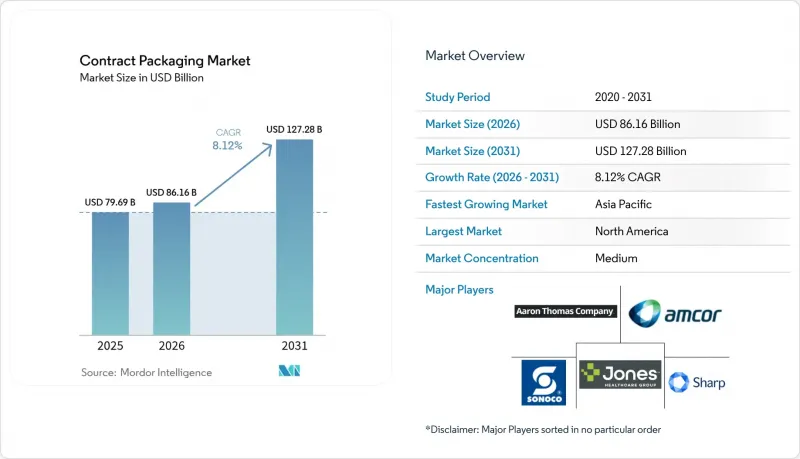
Mordor Intelligence에 따르면 2026년 수탁 포장 시장의 규모는 861억 6,000만 달러로 추정되고 있으며, 2025년 796억 9,000만 달러에서 확대하며, 2031년에는 1,272억 8,000만 달러에 달할 것으로 예측됩니다.
2026-2031년 동안 연평균 성장률(CAGR) 8.12%로 성장할 것으로 전망됩니다.
이 보고서는 소재 유형(플라스틱, 종이·판지, 기타), 포장 유형(1차 포장, 2차 포장, 3차 포장), 서비스 유형(배합·혼합, 충진·조립, 기타), 최종사용자 산업(식품, 음료, 의약품, 기타), 지역(북미, 남미, 기타)별로 분류되어 있습니다. 시장 전망은 금액(달러) 기준으로 제시되어 있습니다.
글로벌 수탁 포장 시장의 동향 및 인사이트
경쟁 우위 확보를 위한 아웃소싱
제약사는 신약 개발에 점점 더 많은 자본을 투입하는 한편, 규제가 엄격한 포장 업무에 대해서는 의약품 수탁 포장 제공업체에 의존하고 있습니다. 2024년에 발표된 복합 제품에 관한 FDA 지침에 따라 검증,용기 및 밀봉 시스템의 무결성, 문서화 요건이 강화됨에 따라 바이오의약품 제조사들은 독일의 자동화 임상 공급 라인에 2,300만 유로(2,713만 달러)를 투자한 카탈렌트(Catalent)와 같은 전문 업체로의 아웃소싱을 확대하고 있습니다. 유럽의약품청(EMA)의 첨단 치료 의약품에 관한 규제로 인해 상황은 더욱 복잡해지고 있으며, 이로 인해 수탁 포장 업체는 규정 준수 위험과 기술 혁신을 담당하게 되어, 후원 기업의 시장 출시 기간을 단축하는 동시에 고액의 시설 업그레이드 부담에서 벗어날 수 있게 되었습니다.
E-Commerce로 인한 SKU의 폭발적인 증가
소비자 직접 유통 채널에서는 소량 생산, 빈번한 아트워크 변경, 팔레트 단위 소매가 아닌 택배 네트워크에 맞춘 보호 설계가 요구됩니다. 유연한 제조 셀과 디지털 작업 지시서를 통해 수탁 포장 업체는 설비 비용을 늘리지 않고도 1교대당 전환 횟수를 늘릴 수 있습니다. 식품 브랜드는 시즌 한정 맛이나 한정 상품에 이러한 민첩성을 활용하는 한편, 동일한 생산 라인에서 온라인 소매업체의 배출량 감축 목표에 부합하는 친환경 소재에도 대응하고 있습니다. 최신 워크플로우 소프트웨어는 추적성 데이터를 수집하여 이를 기업 자원 계획(ERP) 시스템과 연동함으로써 감사 요건을 충족하고 리콜 위험을 줄입니다.
엄격한 국경 간 규정 준수
FDA와 유럽의 규제가 서로 다르기 때문에 공급업체는 검증 프로토콜, 라벨 형식, 감사 추적을 중복하여 작성할 수밖에 없습니다. PPWR 설계 기준이 미국의 식품 접촉 기준과 상충하는 경우가 있으며, 그 결과 이중 재고 관리나 배합 변경이 필요하게 됩니다. 중소규모 기업은 필요한 품질관리 팀, ERP 모듈, 일련 번호 부여 인프라에 대한 자금 조달에 어려움을 겪고 있으며, 글로벌 입찰 참여가 제한되고 있습니다.
부문 분석
플라스틱은 확립된 공급망 덕분에 2025년 매출의 54.78%를 차지했으나, 재생 재료 함유율 할당 및 브랜드의 노력에 힘입어 바이오 기반 및 복합재료의 연평균 성장률(CAGR)은 9.12%로 가속화되고 있습니다. 이러한 변화에 따라 압출 성형 설비의 업그레이드, 상용화제에 대한 노하우, 다층 라미네이트를 사용하지 않고도 유통 기한을 유지할 수 있는 배리어 코팅이 요구되고 있습니다. PPWR의 기한이 다가옴에 따라 식물 유래 폴리머에 대한 수탁 포장 시장 점유율이 확대될 것이며, 배합에 관한 전문 지식을 갖춘 공급업체에게는 가격 면에서 우위가 주어질 것으로 보입니다.
기술적 복잡성으로 인해 경쟁사 간의 격차는 확대되고 있습니다. 사내 연구소를 보유한 공급업체는 전환 검사, 밀봉 강도 검사, 유통기한 검사를 신속하게 수행하여 승인 주기를 단축하고 있습니다. 생분해성 솔루션에 대한 특허 출원 건수는 2024년에 34% 증가하여 급속한 혁신을 지원하는 한편, 이익률 유지를 위해서는 소재 부문에서의 리더십이 극히 중요함을 시사합니다.
1차 포장은 2025년 매출의 56.89%를 차지하며, FDA와 EMA가 요구하는 엄격한 접촉면 검증으로 인해 연평균 성장률(CAGR) 8.96%가 전망됩니다. 수탁 포장에서의 시장 점유율 우위는 용기 및 밀봉 시스템의 무결성, 추출물 및 용출물 검사에 기인하며, 소규모 사내 팀으로는 이를 경제적으로 수행하기 어려운 경우가 많기 때문입니다.
2차 포장은 전 세계에서 골판지 및 카톤 가공 능력이 증가함에 따라 이익률 압박에 직면하고 있지만, 위조 방지, 브랜드 메시지 전달, 일련번호 부여의 관점에서는 여전히 필수적입니다. 3차 포장은 자동화와 함께 진화하고 있으며, 로봇 팔레타이저와 창고용 로봇이 공간 이용률을 향상시키는 인체공학에 기반한 재설계를 추진하고 있습니다.
지역별 분석
북미는 성숙한 의약품 아웃소싱과 첨단 자동화 도입에 힘입어 2025년 매출의 38.55%를 차지했습니다. 아시아태평양의 수탁 포장 시장 규모는 중국의 포장 생산량 8.7% 증가와 제조업 지원 정책에 힘입어 연평균 성장률(CAGR) 11.03%로 확대되고 있습니다. 인도의 백신 생산량 급증과 일본의 의료기기 승인 제도 개혁도 이 지역의 수요를 더욱 끌어올리고 있습니다.
유럽의 성장은 PPWR(플라스틱 포장 폐기물 규제) 준수가 주축을 이루며, 재활용 가능한 기판 및 디지털 추적성 인프라에 대한 투자를 촉진하고 있습니다. 남미, 중동 및 아프리카는 물류 현대화 및 규제 조화에 따라 좌우되는 장기적인 성장 기회를 내포하고 있습니다.
기타 혜택
- 엑셀 형식의 시장 예측(ME) 시트
- 3개월간의 애널리스트 지원
자주 묻는 질문
목차
제1장 서론
제2장 조사 방법
제3장 개요
제4장 시장 구도
제5장 시장 규모와 성장 예측
제6장 경쟁 구도
제7장 시장 기회와 향후 전망
KSA 26.09.03According to Mordor Intelligence, contract packaging market size in 2026 is estimated at USD 86.16 billion, growing from 2025 value of USD 79.69 billion with 2031 projections showing USD 127.28 billion, growing at 8.12% CAGR over 2026-2031.
This report is Segmented by Material Type (Plastics, Paper and Paperboard, and More), Packaging Type (Primary, Secondary, and Tertiary), Service Type (Formulation and Blending, Filling and Assembly, and More), End-User Industry (Food, Beverage, Pharmaceutical, and More), and Geography (North America, South America, and More). The Market Forecasts are Provided in Terms of Value (USD).
Global Contract Packaging Market Trends and Insights
Outsourcing to Gain Competitive Advantage
Pharmaceutical manufacturers increasingly direct capital toward drug discovery while relying on pharmaceutical contract packaging providers for highly regulated packaging tasks. FDA guidance on combination products released in 2024 intensified validation, container-closure integrity, and documentation demands, encouraging biologics producers to outsource to specialists such as Catalent, which invested EUR 23 million (USD 27.13 million) in an automated clinical-supply line in Germany. European Medicines Agency rules for advanced therapy medicinal products heighten the complexity further, prompting contract packagers to shoulder compliance risk and technology refresh, shortening launch timelines for sponsors and freeing them from costly facility upgrades.
Explosive SKU Proliferation from E-commerce
Direct-to-consumer channels require shorter runs, frequent artwork variations, and protective designs tuned for parcel networks rather than palletized retail. Flexible manufacturing cells and digital job tickets allow contract packagers to execute more changeovers per shift without inflating set-up costs. Food brands exploit this agility for seasonal flavors and limited editions, while the same lines accommodate eco-friendly substrates that align with online retailers' emissions goals. Modern workflow software captures traceability data and routes it into enterprise resource planning systems, meeting audit requirements and reducing recall risk.
Stringent Cross-border Regulatory Compliance
Divergent FDA and European rules compel providers to duplicate validation protocols, label formats, and audit trails. PPWR design standards occasionally clash with U.S. food-contact thresholds, obliging dual inventory or reformulation. Smaller firms struggle to fund the necessary quality teams, enterprise resource planning modules, and serialization infrastructure, limiting their participation in global bids.
Other drivers and restraints analyzed in the detailed report include:
- Pharma Outsourcing for Novel Biologics Packaging
- Automation and Robotics Lowering Per-unit Cost
- Competition from In-house Packaging Lines
For complete list of drivers and restraints, kindly check the Table Of Contents.
Segment Analysis
Plastics retained 54.78% of revenue in 2025 thanks to entrenched supply chains, but recycled-content quotas and brand commitments accelerate a 9.12% CAGR for bio-based and composite materials. The shift calls for extrusion upgrades, compatibilizer know-how, and barrier coatings that preserve shelf life without multilayer laminates. Contract packaging market size allocations to plant-based polymers will expand as PPWR deadlines near, giving providers with formulary expertise a pricing premium.
Technical complexity widens competitive gaps. Providers with on-site laboratories conduct migration, seal-strength, and shelf-life tests swiftly, shortening approval cycles. Patent filings for biodegradable solutions rose 34% in 2024, underscoring rapid innovation and signaling that material leadership will be pivotal for margin defense.
Primary packaging accounted for 56.89% of 2025 revenue and is set for a 8.96% CAGR owing to stringent contact-surface validations required by the FDA and EMA. The contract packaging market share premium arises from container-closure integrity, extractables, and leachables testing, which smaller in-house teams often cannot execute economically.
Secondary packs face margin compression as corrugate and carton converting capacities rise globally, yet remain critical for tamper evidence, brand messaging, and serialization. Tertiary packs evolve with automation; robotic palletizers and warehouse robots drive ergonomic redesigns that improve cube utilization.
Complete Report Scope:
- By Material Type
- Plastics
- Paper and Paperboard
- Metal
- Glass
- Bio-based and Composites
- By Packaging Type
- Primary
- Secondary
- Tertiary
- By Service Type
- Formulation and Blending
- Filling and Assembly
- Packaging and Labeling
- Fulfillment and Logistics
- Other Service Types
- By End-User Industry
- Food
- Beverage
- Pharmaceutical
- Cosmetics and Personal Care
- Industrial
- Other End-user Industries
- By Geography
- North America
- United States
- Canada
- Mexico
- South America
- Brazil
- Argentina
- Chile
- Rest of South America
- Europe
- United Kingdom
- Germany
- France
- Spain
- Italy
- Rest of Europe
- Asia-Pacific
- China
- India
- Japan
- Australia
- South Korea
- Vietnam
- Rest of Asia-Pacific
- Middle East and Africa
- Middle East
- Saudi Arabia
- United Arab Emirates
- Turkey
- Rest of Middle East
- Africa
- South Africa
- Nigeria
- Egypt
- Rest of Africa
- Middle East
- North America
Geography Analysis
North America contributed 38.55% of 2025 sales, underpinned by mature pharmaceutical outsourcing and advanced automation adoption. The contract packaging market size in Asia-Pacific is accelerating at 11.03% CAGR, propelled by China's 8.7% packaging output growth and pro-manufacturing policies. India's vaccine output surge and Japan's reform of medical device approvals further lift regional demand.
Europe's growth centers on PPWR compliance, spurring investment in recyclable substrates and digital traceability infrastructure. South America and the Middle East and Africa represent long-horizon opportunities contingent on logistics upgrades and regulatory harmonization.
- Amcor plc
- Sonoco Products Company
- Aaron Thomas Company, Inc.
- Jones Healthcare Group Inc.
- Sharp Packaging Services LLC
- Pharma Tech Industries Inc.
- Reed-Lane Inc.
- Multipack Solutions LLC
- UNICEP Packaging LLC
- Stamar Packaging Inc.
- Budelpack Poortvliet BV
- Complete Co-Packing Services Ltd.
- Catalent Inc.
- PCI Pharma Services
- CCL Industries Inc.
- Smurfit WestRock
- Green Packaging Asia Ltd.
- Nulogy Corporation
- Graphic Packaging Holding Co.
- AptarGroup Inc.
- DHL Supply Chain (Co-Packing Division)
Additional Benefits:
- The market estimate (ME) sheet in Excel format
- 3 months of analyst support
TABLE OF CONTENTS
1 INTRODUCTION
- 1.1 Study Assumptions and Market Definition
- 1.2 Scope of the Study
2 RESEARCH METHODOLOGY
3 EXECUTIVE SUMMARY
4 MARKET LANDSCAPE
- 4.1 Market Overview
- 4.2 Market Drivers
- 4.2.1 Outsourcing to gain competitive advantage
- 4.2.2 Explosive SKU proliferation from e-commerce
- 4.2.3 Pharma outsourcing for novel biologics packaging
- 4.2.4 Automation and robotics lowering per-unit cost
- 4.2.5 Sustainability-led substrate shifts
- 4.2.6 Near-shoring to mitigate geopolitical risk
- 4.3 Market Restraints
- 4.3.1 Stringent cross-border regulatory compliance
- 4.3.2 Competition from in-house packaging lines
- 4.3.3 Volatile resin and energy prices
- 4.3.4 Mismatch between recycled-content goals and supply
- 4.4 Industry Value Chain Analysis
- 4.5 Regulatory Landscape
- 4.6 Technological Outlook
- 4.7 Porter's Five Forces Analysis
- 4.7.1 Bargaining Power of Suppliers
- 4.7.2 Bargaining Power of Buyers
- 4.7.3 Threat of New Entrants
- 4.7.4 Threat of Substitute Products
- 4.7.5 Intensity of Competitive Rivalry
- 4.8 The Impact of Macroeconomic Factors on the Market
5 MARKET SIZE AND GROWTH FORECASTS (Value)
- 5.1 By Material Type
- 5.1.1 Plastics
- 5.1.2 Paper and Paperboard
- 5.1.3 Metal
- 5.1.4 Glass
- 5.1.5 Bio-based and Composites
- 5.2 By Packaging Type
- 5.2.1 Primary
- 5.2.2 Secondary
- 5.2.3 Tertiary
- 5.3 By Service Type
- 5.3.1 Formulation and Blending
- 5.3.2 Filling and Assembly
- 5.3.3 Packaging and Labeling
- 5.3.4 Fulfillment and Logistics
- 5.3.5 Other Service Types
- 5.4 By End-User Industry
- 5.4.1 Food
- 5.4.2 Beverage
- 5.4.3 Pharmaceutical
- 5.4.4 Cosmetics and Personal Care
- 5.4.5 Industrial
- 5.4.6 Other End-user Industries
- 5.5 By Geography
- 5.5.1 North America
- 5.5.1.1 United States
- 5.5.1.2 Canada
- 5.5.1.3 Mexico
- 5.5.2 South America
- 5.5.2.1 Brazil
- 5.5.2.2 Argentina
- 5.5.2.3 Chile
- 5.5.2.4 Rest of South America
- 5.5.3 Europe
- 5.5.3.1 United Kingdom
- 5.5.3.2 Germany
- 5.5.3.3 France
- 5.5.3.4 Spain
- 5.5.3.5 Italy
- 5.5.3.6 Rest of Europe
- 5.5.4 Asia-Pacific
- 5.5.4.1 China
- 5.5.4.2 India
- 5.5.4.3 Japan
- 5.5.4.4 Australia
- 5.5.4.5 South Korea
- 5.5.4.6 Vietnam
- 5.5.4.7 Rest of Asia-Pacific
- 5.5.5 Middle East and Africa
- 5.5.5.1 Middle East
- 5.5.5.1.1 Saudi Arabia
- 5.5.5.1.2 United Arab Emirates
- 5.5.5.1.3 Turkey
- 5.5.5.1.4 Rest of Middle East
- 5.5.5.2 Africa
- 5.5.5.2.1 South Africa
- 5.5.5.2.2 Nigeria
- 5.5.5.2.3 Egypt
- 5.5.5.2.4 Rest of Africa
- 5.5.5.1 Middle East
- 5.5.1 North America
6 COMPETITIVE LANDSCAPE
- 6.1 Market Concentration
- 6.2 Strategic Moves
- 6.3 Market Share Analysis
- 6.4 Company Profiles (includes Global Level Overview, Market Level Overview, Core Segments, Financials as available, Strategic Information, Market Rank/Share, Products and Services, and Recent Developments)
- 6.4.1 Amcor plc
- 6.4.2 Sonoco Products Company
- 6.4.3 Aaron Thomas Company, Inc.
- 6.4.4 Jones Healthcare Group Inc.
- 6.4.5 Sharp Packaging Services LLC
- 6.4.6 Pharma Tech Industries Inc.
- 6.4.7 Reed-Lane Inc.
- 6.4.8 Multipack Solutions LLC
- 6.4.9 UNICEP Packaging LLC
- 6.4.10 Stamar Packaging Inc.
- 6.4.11 Budelpack Poortvliet BV
- 6.4.12 Complete Co-Packing Services Ltd.
- 6.4.13 Catalent Inc.
- 6.4.14 PCI Pharma Services
- 6.4.15 CCL Industries Inc.
- 6.4.16 Smurfit WestRock
- 6.4.17 Green Packaging Asia Ltd.
- 6.4.18 Nulogy Corporation
- 6.4.19 Graphic Packaging Holding Co.
- 6.4.20 AptarGroup Inc.
- 6.4.21 DHL Supply Chain (Co-Packing Division)
7 MARKET OPPORTUNITIES AND FUTURE OUTLOOK
- 7.1 White-space and Unmet-need Assessment


