

|
시장보고서
상품코드
2121888
파라자일렌(PX) 시장 : 시장 점유율 분석, 업계 동향 및 통계, 성장 예측(2026-2031년)Paraxylene (PX) - Market Share Analysis, Industry Trends & Statistics, Growth Forecasts (2026 - 2031) |
||||||
 Mordor Intelligence
Mordor Intelligence에 의하면, 파라자일렌 시장 규모는 2025년에 6,448만 톤으로 평가되었고, 2026년에 6,779만 톤으로 추정되고, 2031년까지 8,714만 톤에 이를 것으로 예측되며, 2026-2031년 CAGR 5.15%로 성장할 전망입니다.
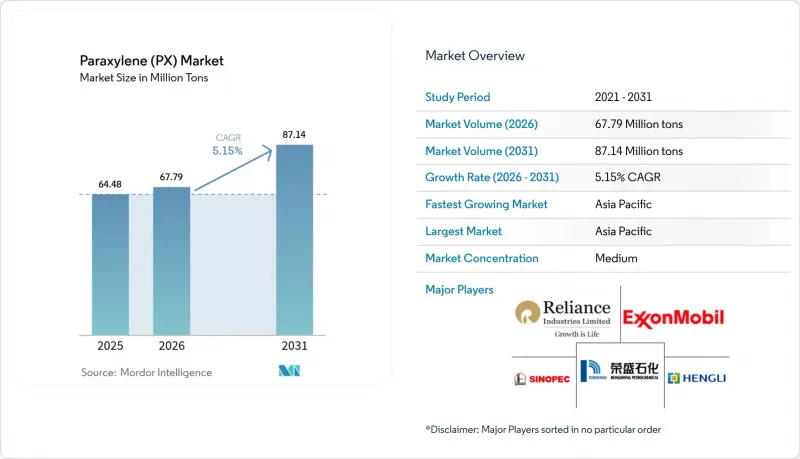
본 보고서는 용도별(정제 테레프탈산, 디메틸 테레프탈산, 기타 용도), 최종 이용 산업별(섬유, 플라스틱, 기타), 지역별(아시아태평양, 북미, 유럽, 남미, 중동 및 아프리카)로 분류되어 있습니다. 시장 전망은 수량(톤) 기준으로 제시되어 있습니다.
세계의 파라자일렌(PX) 시장 동향 및 인사이트
PET 포장 수요 급증
브랜드 소유자의 노력, 도시화의 진전, 콜드체인 물류의 급속한 확대로 인해 재활용 목표가 더욱 엄격해지고 있음에도 불구하고 PET 병에 대한 수요는 증가하고 있습니다. 유럽연합(EU) 규정 2025/40에서는 2030년까지 재활용 소재 함유율에 관한 기준을 의무화하고 있습니다. 그러나 2023년 기준, 유럽에서 회수된 PET 병 중 재활용된 비율은 일부에 그쳤으며, 그 부족분을 보충하기 위해 버진 PTA에 대한 의존이 지속되고 있습니다. 한편, 인도, 인도네시아, 베트남의 회수율은 여전히 낮은 수준에 머물러 있습니다. 그 결과, 이들 국가의 신규 PTA 플랜트는 계속해서 고품질 PX를 원료로 하는 것이 주를 이루고 있습니다. 전 세계 PTA의 정격 생산 능력은 향후 몇 년 동안 대폭 증가할 전망이며, 이는 포장 수요에 대한 확고한 신뢰를 보여줍니다. 석유화학 원료 수요는 2023-2030년간 증가할 것으로 예측되어, 이 부문의 회복력이 부각되고 있습니다. 음료 제조업체들은 바이오 PX 생산 경로를 모색하고 있지만, 그 상업적 공급량은 여전히 파일럿 규모에 그치고 있어 향후 10년 동안은 버진 원료가 주류를 이어갈 것이 확실합니다.
아시아의 폴리에스터 섬유 시장 확대
예측에 따르면, 전 세계 폴리에스터 단섬유 소비량은 급증하여 2030년까지 대폭 증가할 것으로 전망됩니다. 이러한 증가는 주로 가처분 소득 증가와 패스트 패션 공급망의 급속한 확장에 의해 주도되고 있습니다. 2023년, 중국은 파라자일렌(PX) 분야에서 높은 자급률을 달성하는 주목할 만한 이정표를 맞이했습니다. 그러나 하류 원사 제조업체인 헝이(Hengyi)와 통쿤(Tongkun)은 이러한 비용 면에서의 우위를 활용하기 위해 사업을 적극적으로 확장하고 있습니다. 한편, 인도의 야심 찬 정유·석유화학 통합 전략에 따라 2029-30 회계연도까지 원유 처리 능력이 대폭 확대될 전망입니다. 이러한 움직임은 나프타의 흐름을 방향족 화합물로 전환할 뿐만 아니라, 인도의 국내 PX 생산량도 확대하게 될 것입니다. 이를 구체적으로 설명하자면, 나프타의 대폭적인 전용은 PX 생산 능력 증강으로 이어집니다. 따라서 아시아 정유시설의 구조 변경은 업스트림 공급에 직접적인 파급 효과를 가져옵니다. 또한, 이러한 수직 통합은 현물 가격 변동에 대한 완충 역할을 하고 있습니다. 자체 소비용 PTA 사용 기업들은 장기 계약을 통해 원료를 확보함으로써, 파라자일렌 시장에서 아시아의 지배적인 허브로서의 지위를 더욱 공고히 하고 있습니다.
일회용 플라스틱 규제 강화
유럽연합(EU)은 2030년까지 PET 병에 재생재 함유 비율을 의무화하는 목표를 설정했으며, 2040년까지 그 비율을 대폭 높이겠다는 야심찬 계획을 추진하고 있습니다. 미국에서는 캘리포니아주의 SB-54 법안이 유사한 의무를 부과하고 있습니다. 유럽의 기계적 재활용 능력은 현재 2030년 목표를 달성하는 데 필요한 수준에 미치지 못하고 있습니다. 이러한 격차는 공급이 목표에 부합하게 되면 버진 수지의 사용량이 대폭 감소할 것임을 시사합니다. 각 브랜드 소유 기업들도 재활용을 고려한 설계(Design-for-Recycling) 의무화 및 PFAS 금지 조치에 대응하고 있으며, 이로 인해 포장재 1개당 PET 사용량이 감소할 가능성이 있습니다. 시행 시기는 각기 다르지만, 이러한 종합적인 정책 방향은 선진국 시장의 성장을 억제하고 있으며, 생산자들은 화학적 재활용이나 바이오 PX로의 대체를 모색하고 있습니다. 현재 OECD 국가들 수요는 부진하지만, 아시아와 아프리카의 소비에 힘입어 지탱되고 있습니다. 그럼에도 불구하고, 이러한 법규 동향은 파라자일렌 시장에 지속적인 과제로 남아 있습니다.
부문 분석
2025년에는 PTA가 전 세계 PX 소비량의 94.37%를 차지한 것으로 평가되었으며, 2031년까지 연평균 성장률(CAGR) 5.37%로 성장할 것으로 전망됩니다. 이러한 높은 집중도로 인해 파라자일렌 시장은 폴리에스터 시장 동향과 밀접하게 연결되어 있으며, 생산자의 수익성은 섬유 및 포장 산업의 동향에 크게 좌우됩니다. 2021-2026년 아시아에서는 PTA 생산 능력이 대폭 확대되었으며, 중국이 여러 프로젝트를 주도했습니다. 업계에서 규모의 중요성을 보여주는 예로, 퉁쿤(Tongkun)사는 취안저우에 대규모 공장을 가동했습니다. 다롄 헝리와 같은 통합형 단지가 자사 전용 다운스트림 공정 라인에 대한 공급을 확대함에 따라, 파라자일렌 시장에서 PTA에 대한 수요는 계속해서 증가하고 있습니다. 이러한 추세는 일반 거래량 감소로 인해 더욱 두드러지고 있으며, 현물 가격은 예기치 못한 가동 중단의 영향을 받기 쉬워지고 있습니다.
디메틸테레프탈산(DMT)과 일부 특수 용도 수요 점유율은 미미하지만, 그 성장 궤적은 GDP 추이와 밀접하게 연동되어 있습니다. PTA는 비용 대비 성능과 우수한 중합 동역학 덕분에 범용 수지의 주류로서 입지를 확고히 하고 있습니다. 대조적으로, DMT는 주로 특수 필름이나 틈새 폴리에스터 분야에서 독자적인 입지를 구축하고 있으며, 이러한 분야에서는 원료 가격보다 가공의 유연성이 우선시됩니다. 가소제, 이소프탈산 및 소수의 미미한 화학 물질을 포함한 기타 용도는 파라자일렌 시장 전체에 미치는 영향이 극히 미미합니다. 규제 당국의 감독은 PX나 PTA의 순도보다는 하류 폴리머의 지속가능성을 중시하는 경향이 있습니다. 그 결과, 원료의 규정 준수는 ISO 9001 표준이나 수분 함량 표준에 중점을 두고 있으며, 환경적 고려 사항은 뒷전으로 밀려나고 있습니다.
지역별 분석
아시아태평양은 2025년에 PX 출하량의 82.21%를 차지한 것으로 평가되었으며, 2031년까지 연평균 성장률(CAGR) 5.49%로 성장할 전망입니다. 중요한 동향으로, 중국은 2025년 하반기에 새로운 자일렌 생산 능력을 도입하여 국내 자일렌 생산 능력을 확대했습니다. 이 지역의 성장세는 2030년까지 PX 생산을 목표로 하는 ‘시노펙-아람코 푸젠 콤플렉스’와 2028년까지 PX 생산 능력 증강이 예정된 ‘다허 정유시설’ 확장 프로젝트 등을 통해 더욱 뒷받침되고 있습니다. 이러한 동향에 발맞추듯 인도도 자급자족을 목표로 내걸고, 2030년까지 PX 생산 능력 증강을 계획하고 있습니다. 한편, 한국과 일본의 생산자들은 수출 경쟁을 피하기 위해 생산 규모 축소 및 설비 개조를 추진하고 있습니다.
북미는 파라자일렌 시장 점유율이 미미하지만, 중국의 PTA 수입에 대한 보호 관세라는 방패로 보호받고 있습니다. 보몬트를 최대 거점으로 하는 미국 멕시코만 연안 지역에 이 생산 능력의 대부분이 집중되어 있습니다. 한편, 유럽은 구조적인 감소에 직면해 있습니다. 정유시설가 바이오연료로 전환함에 따라 방향족 화합물의 생산량이 감소하고 있습니다. 이러한 변화로 인해 남아 있는 PTA 플랜트는 수입에 의존할 수밖에 없는 상황입니다. 중동에서는 사우디아람코의 자잔 및 계획 중인 얌부 확장 프로젝트가 저비용 원료와 아시아에 대한 전략적 근접성을 활용하여, 해당 지역을 스윙 수출 지역으로 자리매김하고 있습니다. 반면, 남미는 여전히 수입 의존형 시장을 유지하고 있으며, PX와 PTA를 모두 미국 멕시코만 연안 및 아시아에서 조달하고 있으며, 이러한 의존 관계는 향후 10년 동안 지속될 것으로 예측됩니다.
기타 혜택 :
- 엑셀 형식 시장 예측(ME) 시트
- 3개월간의 애널리스트 지원
자주 묻는 질문
목차
제1장 서론
제2장 조사 방법
제3장 주요 요약
제4장 시장 구도
제5장 시장 규모 및 성장 예측(수량 및 금액)
제6장 경쟁 구도
제7장 시장 기회 및 향후 전망
AJY 26.09.09According to Mordor Intelligence, the paraxylene market size is projected to be 64.48 million tons in 2025, 67.79 million tons in 2026, and reach 87.14 million tons by 2031, growing at a CAGR of 5.15% from 2026 to 2031.
This report is Segmented by Application (Purified Terephthalic Acid, Dimethyl Terephthalate, and Other Applications), End-Use Industry (Textile, Plastics, and Others), and Geography (Asia-Pacific, North America, Europe, South America, and Middle-East and Africa). Market Forecasts are Provided in Terms of Volume (Tons).
Global Paraxylene (PX) Market Trends and Insights
Surging Demand for PET Packaging
Brand-owner commitments, urban expansion, and a swift rise in cold-chain logistics are driving up the demand for PET bottles, even as recycling targets become more stringent. The European Union's Regulation 2025/40 mandates a recycled-content threshold by 2030. Yet, in 2023, only a portion of PET bottles collected in Europe were recycled, resulting in a reliance on virgin PTA to bridge the gap. Meanwhile, collection rates in India, Indonesia, and Vietnam remain low. Consequently, new PTA plants in these nations continue to be centered around prime PX feed. Global PTA nameplate capacity is set to rise significantly in the coming years, signaling robust confidence in packaging demand. Petrochemical feedstock demand is projected to grow between 2023 and 2030, highlighting the sector's resilience. While beverage producers are exploring bio-PX pathways, their commercial availability is still confined to pilot volumes, ensuring virgin material's dominance for the remainder of the decade.
Polyester-Fiber Expansion in Asia
Forecasts indicate a surge in global polyester staple fiber consumption, projected to rise significantly by 2030. This uptick is largely driven by increasing disposable incomes and the rapid pace of fast-fashion supply chains. In 2023, China achieved a notable milestone, reaching high self-sufficiency in paraxylene (PX). However, downstream yarn producers, Hengyi and Tongkun, are aggressively expanding their operations to capitalize on these cost advantages. Meanwhile, India's ambitious refining-petrochemical integration strategy is set to introduce substantial crude capacity by FY 2029-30. This move not only reroutes naphtha streams into aromatics but also amplifies the nation's domestic PX production. To put this into perspective, every significant diversion of naphtha translates to an augmentation in PX capacity. Thus, adjustments in Asian refinery configurations have a direct ripple effect on upstream supply. Furthermore, this vertical integration acts as a buffer against spot-price fluctuations. Captive PTA users, by securing feed through long-term contracts, further solidify Asia's position as the dominant hub of the Paraxylene market.
Single-Use-Plastic Legislation Tightening
By 2030, the European Union has set a target of mandating recycled content in PET bottles, with an ambitious increase by 2040. In the U.S., California's SB-54 enforces a similar mandate. Europe's mechanical recycling capacity currently falls short of the required levels to meet the 2030 target. This gap suggests a significant reduction in the use of virgin resin, should the supply align with targets. Brand owners are also navigating design-for-recycling mandates and bans on PFAS, potentially leading to a decrease in PET usage per package. While enforcement timelines differ, the overarching policy direction limits growth in developed markets, steering producers towards chemical recycling or bio-PX alternatives. Currently, while demand in OECD economies lags, it's buoyed by consumption in Asia and Africa. Nonetheless, the legislative trend poses a consistent challenge for the Paraxylene market.
Other drivers and restraints analyzed in the detailed report include:
- Commercialization of High-Yield CCR/PRT Aromatics Units
- Government-Backed Paraxylene Self-Sufficiency Programs in India
- Crude-Oil-Led Feedstock Price Volatility
For complete list of drivers and restraints, kindly check the Table Of Contents.
Segment Analysis
PTA consumed 94.37% of global PX volume in 2025 and is forecast to grow at a 5.37% CAGR through 2031. This heavy concentration ties the Paraxylene market closely to polyester dynamics, making producer economics heavily reliant on trends in textiles and packaging. Between 2021 and 2026, Asia bolstered its PTA capacity significantly, with China leading the charge across multiple projects. A testament to the industry's scale requirements, Tongkun unveiled a large-scale plant in Quanzhou. As integrated sites like Hengli Dalian increasingly feed their captive downstream lines, the Paraxylene market's appetite for PTA continues to swell. This trend is further accentuated by a diminishing merchant trade volume, making spot prices more susceptible to any unforeseen outages.
While Dimethyl Terephthalate and select specialty outlets command a modest share of the demand, their growth trajectory closely mirrors that of GDP. PTA's cost-effectiveness and superior polymerization kinetics have made it the dominant choice for commodity resins. In contrast, DMT finds its niche, primarily in specialized films and niche polyesters, where flexibility in processing takes precedence over feedstock pricing. Other applications, including plasticizers, isophthalic acid, and a handful of minor chemicals, exert minimal influence on the broader Paraxylene market. Regulatory oversight tends to emphasize the sustainability of downstream polymers over the purity of PX or PTA. Consequently, compliance for feedstocks leans more towards ISO 9001 standards and moisture specifications, sidelining environmental considerations.
Complete Report Scope:
- By Application
- Purified Terephthalic Acid (PTA)
- Dimethyl Terephthalate (DMT)
- Other Applications
- By End-use Industry
- Textile
- Plastics
- Others End-user Industries
- By Geography
- Asia-Pacific
- China
- India
- Japan
- South Korea
- Thailand
- Indonesia
- Malaysia
- Vietnam
- Rest of Asia-Pacific
- North America
- United States
- Canada
- Mexico
- Europe
- Germany
- United Kingdom
- France
- Italy
- Spain
- Russia
- Rest of Europe
- South America
- Brazil
- Argentina
- Colombia
- Rest of South America
- Middle-East and Africa
- Saudi Arabia
- United Arab Emirates
- Qatar
- Nigeria
- Egypt
- South Africa
- Rest of Middle-East and Africa
- Asia-Pacific
Geography Analysis
Asia-Pacific captured 82.21% of PX volume in 2025 and is set to expand at a 5.49% CAGR through 2031. In a significant move, China introduced new xylene capacity in the latter half of 2025, elevating its national xylene capacity. The region's momentum is further underscored by projects like the Sinopec-Aramco Fujian complex, targeting PX by 2030, and the Tahe refinery's expansion, set to add PX by 2028. Echoing this trend, India aims for self-sufficiency, planning to add PX by 2030. Meanwhile, producers in South Korea and Japan are either downsizing or retrofitting to stay competitive in exports.
While North America holds a modest share of the Paraxylene market, it enjoys protective tariff shields against Chinese PTA imports. The U.S. Gulf Coast, with Beaumont as its largest unit, houses the bulk of this capacity. Europe, however, faces a structural decline: as refineries pivot to biofuels, the output of aromatics diminishes. This shift leaves the remaining PTA plants reliant on imports. In the Middle East, Saudi Aramco's Jazan and the planned Yanbu expansions are capitalizing on low-cost feedstock and their strategic closeness to Asia, positioning the region as a swing exporter. Conversely, South America remains tethered as an import-dependent market, sourcing both PX and PTA from the Gulf Coast and Asia, a reliance that's projected to persist throughout the decade.
- China Petrochemical Corporation
- CNPC
- Eneos Corporation
- Exxon Mobil Corporation
- FCFC
- GS Caltex Corporation
- Hengli Petrochemical Co., Ltd.
- Idemitsu Kosan Co.,Ltd.
- Ineos
- LOTTE CHEMICAL CORPORATION
- PTT Global Chemical Public Company Limited
- Reliance Industries Limited
- Rongsheng Petrochemical Co., Ltd.
- S-oil Corporation
- TotalEnergies
Additional Benefits:
- The market estimate (ME) sheet in Excel format
- 3 months of analyst support
TABLE OF CONTENTS
1 Introduction
- 1.1 Study Assumptions and Market Definition
- 1.2 Scope of the Study
2 Research Methodology
3 Executive Summary
4 Market Landscape
- 4.1 Market Overview
- 4.2 Market Drivers
- 4.2.1 Surging demand for PET packaging
- 4.2.2 Polyester-fiber expansion in Asia
- 4.2.3 Commercialisation of high-yield CCR/PRT aromatics units
- 4.2.4 Government-backed Paraxylene self-sufficiency programs in India
- 4.2.5 Simulated-Moving-Bed (SMB) revamp boosting Paraxylene yield
- 4.3 Market Restraints
- 4.3.1 Single-use-plastic legislation tightening
- 4.3.2 Crude-oil led feedstock price volatility
- 4.3.3 US-China tariff risk disrupting PX/PTA trade flows
- 4.4 Value Chain Analysis
- 4.5 Porter's Five Forces
- 4.5.1 Bargaining Power of Suppliers
- 4.5.2 Bargaining Power of Buyers
- 4.5.3 Threat of New Entrants
- 4.5.4 Threat of Substitutes
- 4.5.5 Competitive Rivalry
5 Market Size and Growth Forecasts (Volume and Value)
- 5.1 By Application
- 5.1.1 Purified Terephthalic Acid (PTA)
- 5.1.2 Dimethyl Terephthalate (DMT)
- 5.1.3 Other Applications
- 5.2 By End-use Industry
- 5.2.1 Textile
- 5.2.2 Plastics
- 5.2.3 Others End-user Industries
- 5.3 By Geography
- 5.3.1 Asia-Pacific
- 5.3.1.1 China
- 5.3.1.2 India
- 5.3.1.3 Japan
- 5.3.1.4 South Korea
- 5.3.1.5 Thailand
- 5.3.1.6 Indonesia
- 5.3.1.7 Malaysia
- 5.3.1.8 Vietnam
- 5.3.1.9 Rest of Asia-Pacific
- 5.3.2 North America
- 5.3.2.1 United States
- 5.3.2.2 Canada
- 5.3.2.3 Mexico
- 5.3.3 Europe
- 5.3.3.1 Germany
- 5.3.3.2 United Kingdom
- 5.3.3.3 France
- 5.3.3.4 Italy
- 5.3.3.5 Spain
- 5.3.3.6 Russia
- 5.3.3.7 Rest of Europe
- 5.3.4 South America
- 5.3.4.1 Brazil
- 5.3.4.2 Argentina
- 5.3.4.3 Colombia
- 5.3.4.4 Rest of South America
- 5.3.5 Middle-East and Africa
- 5.3.5.1 Saudi Arabia
- 5.3.5.2 United Arab Emirates
- 5.3.5.3 Qatar
- 5.3.5.4 Nigeria
- 5.3.5.5 Egypt
- 5.3.5.6 South Africa
- 5.3.5.7 Rest of Middle-East and Africa
- 5.3.1 Asia-Pacific
6 Competitive Landscape
- 6.1 Market Concentration
- 6.2 Strategic Moves
- 6.3 Market Share(%)/Ranking Analysis
- 6.4 Company Profiles (includes Global level Overview, Market level overview, Core Segments, Financials as available, Strategic Information, Products and Services, and Recent Developments)
- 6.4.1 China Petrochemical Corporation
- 6.4.2 CNPC
- 6.4.3 Eneos Corporation
- 6.4.4 Exxon Mobil Corporation
- 6.4.5 FCFC
- 6.4.6 GS Caltex Corporation
- 6.4.7 Hengli Petrochemical Co., Ltd.
- 6.4.8 Idemitsu Kosan Co.,Ltd.
- 6.4.9 Ineos
- 6.4.10 LOTTE CHEMICAL CORPORATION
- 6.4.11 PTT Global Chemical Public Company Limited
- 6.4.12 Reliance Industries Limited
- 6.4.13 Rongsheng Petrochemical Co., Ltd.
- 6.4.14 S-oil Corporation
- 6.4.15 TotalEnergies
7 Market Opportunities and Future Outlook
- 7.1 White-space and Unmet-Need Assessment


