

|
시장보고서
상품코드
2121961
트랜스펙션 기술 시장 : 시장 점유율 분석, 업계 동향 및 통계, 성장 예측(2026-2031년)Transfection Technologies - Market Share Analysis, Industry Trends & Statistics, Growth Forecasts (2026 - 2031) |
||||||
 Mordor Intelligence
에 의하면, 2026년 트랜스펙션 기술 시장 규모는 15억 5,000만 달러로 추정되고, 2025년 14억 3,000만 달러에서 확대해, 2031년에는 22억 9,000만 달러에 이를 것으로 예측됩니다.
2026-2031년 연평균 성장률(CAGR) 8.17%로 성장할 것으로 전망됩니다.
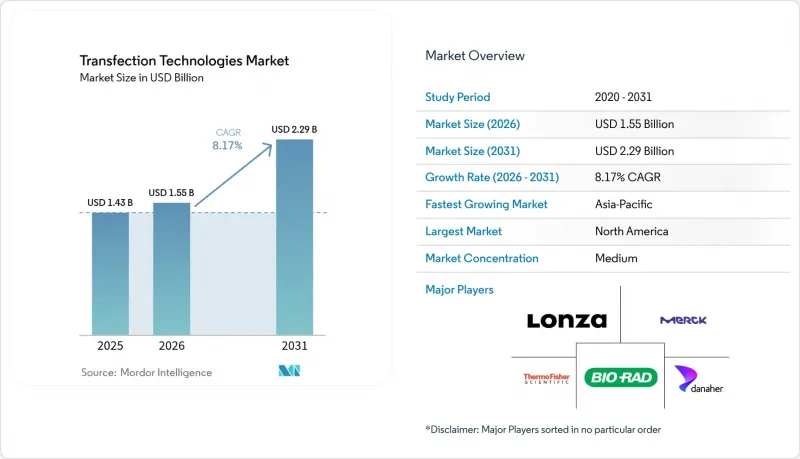
본 보고서는 제품 유형별(키트 및 시약, 장비, 부속품), 용도별(생물의학 연구, 치료제 전달, 단백질 생산 등), 최종 사용자별(학술·연구 기관, 제약·바이오기술 기업 등), 지역별(북미, 유럽, 아시아태평양 등)로 분류되어 있습니다. 시장 전망은 금액(달러)으로 표시되어 있습니다.
세계의 트랜스펙션 기술 시장 동향 및 인사이트
만성 질환 발병률 증가
암, 신경 질환, 유전성 혈액 질환은 전 세계적으로 증가 추세에 있으며, 헬스케어 시스템은 유전자 도입 및 유전체 편집에 기반한 치료적 접근 방식으로 전환되고 있습니다. CAR-T 파이프라인만 보더라도, 1차 T 세포에서 90%의 효율을 달성하면서 85% 이상의 생존율을 유지할 수 있는 형질 도입 플랫폼이 필요하지만, 이 기준치는 최적화된 전기천공 버퍼를 통해 현재 달성되고 있습니다. 집속 초음파를 이용한 CRISPR 도입 기술은 바이러스 벡터를 사용하지 않고도 뇌 내에서 정밀한 편집이 가능함을 입증하며, 치료의 새로운 지평을 열고 있습니다. CASGEVY의 정가가 220만 달러에 달하는 등 치료비 급등은 생산 기간을 수 주에서 수일로 단축하는 첨단 장비에 대한 설비 투자를 정당화합니다.
세포 및 유전자 치료 분야의 연구 개발 확대
2024년 전 세계 임상시험 활동은 진행 중인 시험이 1,200건을 넘어, 확장 가능하고 재현성이 높은 형질 도입 프로토콜에 기반한 상용화를 향한 견고한 파이프라인을 형성하고 있습니다. 동종 세포 뱅크는 한 번의 제조 공정으로 수백 명의 환자를 치료할 수 있어 수요가 확대되고 있으며, 공정 분석 기술을 갖춘 밀폐형 일렉트로포레이션 시스템에 대한 관심이 높아지고 있습니다. Lonza의 CASGEVY 제조 계약과 같은 장기 공급 계약은 플랫폼 제공업체들이 연구 개발의 모멘텀을 수년에 걸친 수익원으로 전환하고 있음을 보여줍니다.
장비의 고액 초기 투자 비용
최첨단 전기천공 스키드의 가격은 50만 달러를 초과하여, 많은 초기 단계 기업들에게 고도의 자동화는 손에 닿지 않는 것이 되고 있습니다. 연간 유지보수 계약이나 일회용 카트리지는 총 소유 비용을 더욱 높입니다. Equipment-as-a-Service(EaaS) 모델을 통해 이러한 지출을 수년에 걸친 운영 예산으로 분산할 수 있지만, 그 도입은 여전히 제한적입니다. 위탁 개발·제조 기관(CDMO)이 부담을 덜어주지만, 생산 할당량 제약으로 인해 IND 신청이 6개월 지연될 가능성이 있습니다. 저비용 레이저 조각 기술로 제조된 마이크로플루이딕스 칩은 부유 세포에서 90% 이상의 형질 도입 효율을 유지하면서 설비 투자 비용을 절감할 수 있는 유망한 수단입니다.
부문 분석
키트 및 시약은 2025년에 55.92%의 시장 점유율을 차지하며 여전히 지배적인 위치를 유지했습니다. 이는 소모품의 정기적인 수익성과 새로운 용도에서의 특수한 배합 요건을 반영한 것입니다. 그러나 2031년까지 연평균 성장률(CAGR) 8.94%를 기록하며 장비 부문이 가장 빠르게 성장하고 있습니다. 이는 세포 치료제 제조에 필요한 자동화와 다양한 세포 유형을 일관된 성능으로 처리할 수 있는 확장 가능한 플랫폼에 대한 수요에 힘입은 결과입니다.
산업 분야의 구매자들은 세포 유형을 아우르는 성능, MES 소프트웨어와의 통합성, 검증된 세척 프로토콜을 기준으로 플랫폼을 평가했습니다. Thermo Fisher의 5L DynaDrive 바이오리액터는 자사의 neon 전기천공 장치와 결합하여 공정 개발 시간을 27% 단축하는 엔드투엔드 솔루션을 형성하고 있습니다. 그 결과, 형질전환 기술 시장의 장비 하위 부문 시장 규모는 기존 시약 라인보다 빠르게 확대되어 2031년까지 4억 4,530만 달러 증가할 것으로 전망됩니다.
지역별 분석
북미는 활발한 벤처 투자, 화학·제조·품질 관리(CMC)에 대한 기대를 명확히 한 FDA의 지침, 그리고 전문적인 CDMO 네트워크 덕분에 2025년 매출의 38.40%를 차지했습니다. mRNA 백신의 규모 확대에 있어 이 지역의 우위 덕분에, 공정 엔지니어들은 감염증 이외의 치료용 페이로드에도 지질 나노입자 제제를 적용하는 방법을 배웠습니다. 그럼에도 불구하고, 인력 부족과 시설 운영 비용의 높음으로 인해, 작업자의 노출을 줄여주는 무인 제조 시설에 대한 관심은 계속해서 높아지고 있습니다.
아시아태평양은 가장 빠르게 성장하는 지역으로, 연평균 성장률(CAGR)은 9.88%로 성장을 지속하고, 있습니다. 싱가포르의 세포 치료 시설에서는 보조금을 지원받은 GMP 스위트가 제공되고 있는 반면, 일본의 Moonshot R&D 프로그램에서는 유도 만능 줄기세포(iPS 세포)의 전달률 향상을 보장하는 전기천공 연구에 보조금이 지급되고 있습니다. 중국의 합성생물학 단지는월1,000주 생산 능력을 목표로 하고 있으며, 이는 지질 나노입자 시약의 대량 조달 계약을 촉진하고 있습니다.
유럽은 성숙한 시장임에도 불구하고 신중한 확장을 지속하고 있는 분야입니다. 독일은 백신 붐을 통해 축적한 mRNA 제조 전문 지식을 활용하여 희귀질환 치료제 분야로의 전환을 모색하고 있습니다. 한편, 유럽의약품청(EMA)의 유전자 변형 세포에 관한 지침은 회원국 간의 품질 기준을 통일하고 있습니다. 엄격한 유전자 변형 생물(GMO) 규제로 인해 농업 분야에서의 응용은 지연되고 있지만, 매력적인 연구 자금이 규제상의 마찰을 어느 정도 상쇄하고 있습니다.
기타 혜택 :
- 엑셀 형식 시장 예측(ME) 시트
- 3개월간의 애널리스트 지원
자주 묻는 질문
목차
제1장 서론
제2장 조사 방법
제3장 주요 요약
제4장 시장 구도
제5장 시장 규모 및 성장 예측
제6장 경쟁 구도
제7장 시장 기회 및 향후 전망
AJY 26.09.09According to Mordor Intelligence, transfection technologies market size in 2026 is estimated at USD 1.55 billion, growing from 2025 value of USD 1.43 billion with 2031 projections showing USD 2.29 billion, growing at 8.17% CAGR over 2026-2031.

This report is Segmented by Product Type (Kits and Reagents, Instruments, and Accessories), Application (Biomedical Research, Therapeutic Delivery, Protein Production, and More), End User (Academic and Research Institutes, Pharmaceutical and Biotechnology Companies and More) and Geography (North America, Europe, Asia Pacific and More). The Market Forecasts are Provided in Terms of Value (USD).
Global Transfection Technologies Market Trends and Insights
Rising Incidence of Chronic Diseases
Cancer, neurological disorders, and inherited hematologic conditions are rising worldwide, pushing healthcare systems toward curative approaches based on gene transfer and genome editing. CAR-T pipelines alone require transfection platforms capable of 90% efficiency in primary T cells while maintaining >=85% viability, a threshold now achieved with optimized electroporation buffers. Focused ultrasound-assisted CRISPR delivery is demonstrating precise in-brain editing without viral vectors, signalling new therapeutic frontiers. High treatment prices-CASGEVY lists at USD 2.2 million-justify capital investment in advanced instruments that compress production timelines from weeks to days.
Expanding R&D in Cell and Gene-Based Therapies
Global clinical activity exceeded 1,200 active trials in 2024, creating a robust funnel for commercial launches that rely on scalable, repeatable transfection protocols. Allogeneic cell banks magnify demand because a single manufacturing run can treat hundreds of patients, intensifying the focus on closed electroporation systems with process analytical technology. Long-term supply contracts-such as Lonza's agreement to produce CASGEVY-illustrate how platform providers convert R&D momentum into multi-year revenue streams.
High Capital Cost of Instruments
State-of-the-art electroporation skids exceed USD 500,000, placing advanced automation out of reach for many early-stage firms. Annual service contracts and single-use cartridges amplify total cost of ownership. Equipment-as-a-service models now spread that outlay over multi-year operating budgets, yet uptake remains modest. Contract development and manufacturing organizations relieve the burden, but slot constraints can delay IND filings by six months. Microfluidic chips fabricated through inexpensive laser engraving show promise to undercut capital costs while sustaining >=90% transfection efficiency in suspension cells.
Other drivers and restraints analyzed in the detailed report include:
- Growing Demand for Synthetic Biology Workflows
- Government Bio-foundry Programmes
- Cytotoxicity and Low Efficiency of Legacy Reagents
For complete list of drivers and restraints, kindly check the Table Of Contents.
Segment Analysis
Kits and reagents maintained their dominant position with 55.92% market share in 2025, reflecting the recurring revenue nature of consumables and the specialized formulation requirements for emerging applications. However, instruments represent the fastest-growing segment at 8.94% CAGR through 2031, driven by automation imperatives in cell therapy manufacturing and the need for scalable platforms that can handle diverse cell types with consistent performance.
Industrial buyers evaluate platforms on cross-cell-type performance, integration with MES software, and validated cleaning protocols. Thermo Fisher's 5 L DynaDrive bioreactor pairs with its neon electroporation device to form an end-to-end solution that trims process development time by 27%. As a result, the transfection technologies market size for instrument sub-segments is projected to expand faster than legacy reagent lines, capturing an incremental USD 445.3 million by 2031.
Complete Report Scope:
- By Product Type
- Kits and Reagents
- Instruments
- Accessories
- By Application
- Biomedical Research
- Therapeutic Delivery
- Protein Production
- Synthetic Biology and Genome Engineering
- Other Applications
- By End User
- Academic and Research Institutes
- Pharmaceutical and Biotechnology Companies
- CROs and CMOs
- Hospitals and Clinical Laboratories
- By Geography
- North America
- United States
- Canada
- Mexico
- Europe
- Germany
- United Kingdom
- France
- Italy
- Spain
- Rest of Europe
- Asia Pacific
- China
- Japan
- India
- Australia
- South Korea
- Rest of Asia Pacific
- Middle East and Africa
- GCC
- South Africa
- Rest of Middle East and Africa
- South America
- Brazil
- Argentina
- Rest of South America
- North America
Geography Analysis
North America retained 38.40% of 2025 revenue thanks to strong venture investment, FDA guidance that clarifies chemistry-manufacturing-control expectations, and a network of specialized CDMOs. The region's dominance in mRNA vaccine scale-up taught process engineers to apply lipid-nanoparticle formulations to therapeutic payloads beyond infectious disease. Nevertheless, labor shortages and high facility overheads sustain interest in lights-out manufacturing suites that reduce operator exposure.
Asia-Pacific is the fastest-growing territory, expanding at a 9.88% CAGR. Singapore's Cell Therapy Facility offers subsidized GMP suites, while Japan's Moonshot R&D program subsidizes electroporation studies that ensure higher delivery rates in induced pluripotent stem cells. China's synthetic-biology parks push for 1,000-strain per month design capacity, driving bulk procurement agreements for lipid-nanoparticle reagents.
Europe remains a mature but cautiously expanding arena. Germany leverages messenger-RNA manufacturing expertise from its vaccine boom to pivot toward rare-disease therapeutics, while EMA guidance on genetically modified cells harmonizes quality expectations across member states. Stringent GMO regulations slow agricultural applications, yet attractive research funding offsets some regulatory friction.
- Thermo Fisher Scientific
- Lonza Group
- QIAGEN
- Merck
- Bio-Rad Laboratories
- Promega
- Agilent Technologies
- MaxCyte
- Altogen Biosystems
- Polyplus-transfection
- SignaGen Laboratories
- Mirus Bio
- Horizon Discovery (PerkinElmer)
- Takara Bio
- Precision NanoSystems
- OriGene Technologies
- Lipocalyx GmbH
- InvivoGen
Additional Benefits:
- The market estimate (ME) sheet in Excel format
- 3 months of analyst support
TABLE OF CONTENTS
1 Introduction
- 1.1 Study Assumptions & Market Definition
- 1.2 Scope of the Study
2 Research Methodology
3 Executive Summary
4 Market Landscape
- 4.1 Market Overview
- 4.2 Market Drivers
- 4.2.1 Rising incidence of chronic diseases
- 4.2.2 Expanding R&D in cell- & gene-based therapies
- 4.2.3 Growing demand for synthetic biology workflows
- 4.2.4 Government bio-foundry programmes
- 4.2.5 mRNA-vaccine scale-up needs high-throughput transfection
- 4.2.6 Automation and standardization of manufacturing processes
- 4.3 Market Restraints
- 4.3.1 High capital cost of instruments
- 4.3.2 Cytotoxicity and low efficiency of legacy reagents
- 4.3.3 Complex cGMP plasmid supply chain bottlenecks
- 4.3.4 Regulatory scrutiny on gene-editing payloads
- 4.4 Regulatory Landscape
- 4.5 Porter's Five Forces Analysis
- 4.5.1 Threat of New Entrants
- 4.5.2 Bargaining Power of Buyers
- 4.5.3 Bargaining Power of Suppliers
- 4.5.4 Threat of Substitutes
- 4.5.5 Intensity of Competitive Rivalry
5 Market Size & Growth Forecasts (Value)
- 5.1 By Product Type
- 5.1.1 Kits and Reagents
- 5.1.2 Instruments
- 5.1.3 Accessories
- 5.2 By Application
- 5.2.1 Biomedical Research
- 5.2.2 Therapeutic Delivery
- 5.2.3 Protein Production
- 5.2.4 Synthetic Biology and Genome Engineering
- 5.2.5 Other Applications
- 5.3 By End User
- 5.3.1 Academic and Research Institutes
- 5.3.2 Pharmaceutical and Biotechnology Companies
- 5.3.3 CROs and CMOs
- 5.3.4 Hospitals and Clinical Laboratories
- 5.4 By Geography
- 5.4.1 North America
- 5.4.1.1 United States
- 5.4.1.2 Canada
- 5.4.1.3 Mexico
- 5.4.2 Europe
- 5.4.2.1 Germany
- 5.4.2.2 United Kingdom
- 5.4.2.3 France
- 5.4.2.4 Italy
- 5.4.2.5 Spain
- 5.4.2.6 Rest of Europe
- 5.4.3 Asia Pacific
- 5.4.3.1 China
- 5.4.3.2 Japan
- 5.4.3.3 India
- 5.4.3.4 Australia
- 5.4.3.5 South Korea
- 5.4.3.6 Rest of Asia Pacific
- 5.4.4 Middle East and Africa
- 5.4.4.1 GCC
- 5.4.4.2 South Africa
- 5.4.4.3 Rest of Middle East and Africa
- 5.4.5 South America
- 5.4.5.1 Brazil
- 5.4.5.2 Argentina
- 5.4.5.3 Rest of South America
- 5.4.1 North America
6 Competitive Landscape
- 6.1 Market Concentration
- 6.2 Market Share Analysis
- 6.3 Company Profiles (includes Global level Overview, Market level overview, Core Segments, Financials as available, Strategic Information, Market Rank/Share for key companies, Products & Services, and Recent Developments)
- 6.3.1 Thermo Fisher Scientific
- 6.3.2 Lonza Group
- 6.3.3 Qiagen NV
- 6.3.4 Merck KGaA
- 6.3.5 Bio-Rad Laboratories
- 6.3.6 Promega Corporation
- 6.3.7 Agilent Technologies
- 6.3.8 MaxCyte Inc.
- 6.3.9 Altogen Biosystems
- 6.3.10 Polyplus-transfection SA
- 6.3.11 SignaGen Laboratories
- 6.3.12 Mirus Bio LLC
- 6.3.13 Horizon Discovery (PerkinElmer)
- 6.3.14 Takara Bio Inc.
- 6.3.15 Precision NanoSystems
- 6.3.16 OriGene Technologies
- 6.3.17 Lipocalyx GmbH
- 6.3.18 InvivoGen
7 Market Opportunities & Future Outlook
- 7.1 White-space & Unmet-need Assessment


