

|
시장보고서
상품코드
2122004
첨단 계량 인프라(AMI) : 시장 점유율 분석, 업계 동향과 통계, 성장 예측(2026-2031년)Advanced Metering Infrastructure - Market Share Analysis, Industry Trends & Statistics, Growth Forecasts (2026 - 2031) |
||||||
 Mordor Intelligence
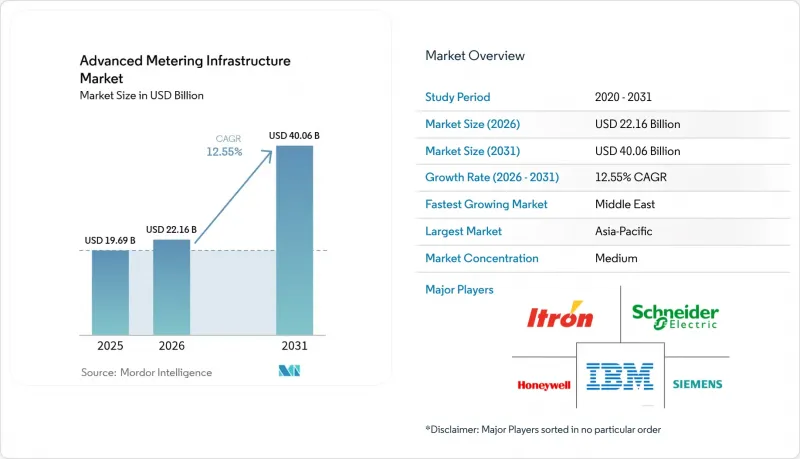
Mordor Intelligence에 따르면 첨단 계량 인프라(AMI) 시장 규모는 2025년 196억 9,000만 달러에서 2026년에는 221억 6,000만 달러로 확대하며, 2026-2031년에 CAGR 12.55%로 추이하며, 2031년에는 400억 6,000만 달러에 달할 것으로 예측됩니다.
이 보고서는 용도별(스마트 계량 기기의 용도 [전력, 상수도, 가스]), 솔루션(계량기 통신 인프라, 계량기 데이터 관리 소프트웨어, 계량기 데이터 분석 소프트웨어), 서비스[전문 서비스, 관리형 서비스], 최종사용자별(주택, 상업, 산업) 및 지역별로 분류되어 있습니다. 시장 예측은 금액(달러) 기준으로 제시되어 있습니다.
전 세계 첨단 계량 인프라(AMI) 시장의 동향 및 인사이트
스마트 계량기 도입에 관한 정부의 의무화 조치
이러한 의무화로 인해 자발적인 업그레이드가 강제적인 프로젝트로 바뀌게 되어, 공급 사업자와 자금 제공자에게 수요의 가시성이 보장됩니다. 2030년까지 모든 가구에 스마트 계량기 도입을 의무화하는 호주의 프로그램은 일괄 조달을 촉발했고, 그로 인해 계량기 단가가 하락하여 유틸리티의 입찰이 가속화되었습니다.
독일에서는 연간 6,000kWh 이상을 소비하는 고객에 대해 지능형 계량 시스템 도입을 의무화하고 있으며, 배전 시스템 운영 사업자는 자본 예산의 제약에도 불구하고 설치 일정을 수립할 수밖에 없는 상황입니다. 2026년까지 2억 5,000만 대의 스마트 계량기 도입을 목표로 하는 인도의 국가 미션은 현재 세계 최대 규모의 단일 프로그램으로 자리 잡았으며, 여러 공급업체 간의 상호 운용성과 규모의 경제를 가능하게 하는 표준화된 사양을 수립하고 있습니다. 의무화 대상 지역의 유틸리티는 대출 기관이 법정 프로젝트를 자발적인 시범 사업보다 위험이 낮다고 간주하므로 일반적으로 더 낮은 금리를 확보할 수 있습니다. 또한 도입 일정이 확실하다는 점은 무선 모듈의 현지 조립을 촉진하고, 반도체 공급망에서의 지정학적 충격을 완화하는 요인이 되고 있습니다.
원격 검침을 통한 유틸리티의 비용 절감
즉각적인 인건비 절감은 특히 광범위한 지역을 관할하는 전력·가스 사업자에게 있으며, 투자의 타당성을 더욱 공고히 합니다. 요크셔 워터(Yorkshire Water)는 AMI(첨단 계량 인프라)로 전환한 후, 수동 검침 비용을 90% 절감하고 고객과의 청구 관련 분쟁을 대폭 줄였습니다. 현장 출장 횟수가 줄어들어 연료비와 이산화탄소 배출량이 억제되는 한편, 자동 검침을 통해 이전에는 현금 흐름을 왜곡하던 추정 청구액의 조정이 대폭 감소합니다. 이를 통해 전력·가스 사업자는 현장 기술자를 부가가치가 더 높은 점검 업무로 재배치할 수 있으며, 신규 채용 없이도 자산의 건전성을 높일 수 있습니다. 지형상 어려움이 있는 지역에서는 원격 검침을 통해 침수된 지하실이나 인적이 드문 오두막에 있는 검침기에 접근할 때 발생하는 안전상의 위험이 해소됩니다. 이러한 이점들이 결합되어 투자 회수 기간이 최단 3년까지 단축되며, AMI에 대한 지속적인 자금 조달 라운드에 대한 이사회 차원의 신뢰가 높아집니다.
높은 초기 설비 투자 비용
통신 백홀, 헤드엔드 소프트웨어 및 통합 서비스를 포함하면, 계량기 1개당 총 소유 비용은 200-400달러로 치솟습니다. 소규모 협동조합이나 지방자치단체의 유틸리티는 수년에 걸친 요금 회수 보장이 없기 때문에 차입금 조달을 더 어렵게 느끼고 있습니다. 벤더의 대출은 이러한 압박을 완화할 수 있지만, 대부분의 경우 금리가 높게 책정되어 비용 절감 효과를 상쇄해 버립니다. 사이버 보안, 직원 재교육, 소비자 인식 제고 활동에 대한 병행 투자로 인해 도입 시작 후 첫 2년 동안은 설비 투자 규모가 더욱 정점에 달합니다. 보조금이나 우대 대출이 존재하기는 하지만, 프로젝트 관리비나 송전망 통합 비용을 충당하는 경우는 거의 없어, 자금 조달에 제약이 있는 사업자의 의사결정 주기를 길게 만들고 있습니다.
부문 분석
2025년, 전력 계량 애플리케이션은 첨단 계량 인프라(AMI) 시장 점유율의 62.05%를 차지했습니다. 이는 전력 부문의 탈탄소화 일정에 대한 규제 당국의 집중적인 노력을 반영한 것입니다. 이 부문은 표준화된 계량기 통신 프로토콜, 원격 차단 기능, 그리고 전력 도난을 즉시 억제할 수 있는 능력의 혜택을 받고 있습니다. 간격 데이터 분석을 도입한 전력 사업자들은 청구 정확도가 99.5% 이상으로 향상되었다고 보고하고 있으며, 이로 인해 수익 누수와 고객 서비스 문의가 감소하고 있습니다. 반면, 상수도 사업자들은 노후화된 상수도망에서 25%를 초과하기도 하는 ‘무수수’를 해결하는 것을 주요 목적으로 AMI를 도입하고 있습니다. 수도 계량기 분야의 연평균 성장률(CAGR) 13.12%는 캘리포니아주와 호주에서 가뭄의 영향이 확대되고 있음을 반영한 것으로, 해당 지역에서는 누수 감지 경보를 통해 손실을 최대 20%까지 줄일 수 있습니다. 반면, 가스 계량기 분야의 성장세는 둔화되고 있습니다. 이는 방폭 인증으로 인해 계량기 정가가 약 30% 상승하는 데다, 주택 개보수 공사에는 소비자가 거부감을 보이는 실내 출입 작업이 필요한 경우가 많기 때문입니다.
애플리케이션 구성은 소프트웨어 지출 패턴에 영향을 미치고 있습니다. 공공사업자들이 인사이트를 도출하기 전에 15분 간격의 데이터를 확장 가능하게 수집하고 정제하는 것이 필수적이라는 점을 인식함에 따라 계량기 데이터 관리 플랫폼은 2025년 매출의 40.96%를 차지했습니다. 계량기 데이터 분석은 연평균 성장률(CAGR) 12.83%로 발전하고 있으며, 유틸리티들은 기존 데이터세트에 예측 유지보수 및 도수 감지 모델을 통합하고 있습니다. 그 결과, ‘전력 우선’을 추구하는 전력 회사들은 소프트웨어 대 하드웨어 지출 비율을 2022년 0.3 대 1에서 2025년까지 0.5 대 1로 높이고 있으며, 이는 도입 완료에서 가치 창출로의 전환을 나타냅니다. 판매 시점에 분석 기능을 헤드엔드 라이선스와 번들로 제공하는 벤더는 분석 기능을 선택적 애드온으로 판매하는 벤더보다 더 우수한 실적을 올리고 있습니다.
지역별 분석
2025년, 아시아태평양은 첨단 계량 인프라(AMI) 시장 점유율의 40.22%를 차지했습니다. 이는 2026년까지 2억 5,000만 대의 계량기를 설치하겠다는 인도의 공약과 중국에서 진행 중인 초고압 송전망 업그레이드가 주요 견인 요인으로 작용했습니다. 일괄 조달 체계를 통해 계량기의 평균 판매 가격은 북미 계약에 비해 18% 낮아졌으며, 이에 따라 유틸리티들은 전력, 상수도, 가스를 동시에 처리하는 멀티 유틸리티 플랫폼의 도입을 촉진하고 있습니다. 그러나 미국에서 조달되는 RF 모듈에 대한 수출 규제로 인해 리드타임의 불확실성이 높아지고 있으며, 국영 제조사들은 무선 생산 능력의 현지화를 추진하고 있습니다.
북미는 여전히 성숙해 가면서도 혁신이 주도하는 지역이며, 텍사스주와 온타리오주에서는 민간 5G 오버레이가 보급되고 있습니다. 미국의 유틸리티는 AMI 예산의 최대 15%를 사이버 보안에 할당하고 있으며, 이는 NERC CIP의 엄격한 시행을 반영한 것입니다. 캐나다의 한랭지 사양에서는 -40°C에서도 작동을 유지할 수 있는 리튬-염화 티오닐 배터리 및 듀얼 밴드 메시 무선기가 요구되고 있으며, 공급업체들은 기후에 강인한 변형 모델을 설계해야 하는 상황에 직면해 있습니다. 멕시코의 정책 자유화로 인해 독립 발전 사업자(IPP)는 상업용 발전소의 출력 제어를 최적화하는 실시간 부하 데이터에 대한 접근 권한을 대가로 AMI 공동 자금 조달에 참여할 수 있게 되었습니다.
유럽의 동향은 EU의 ‘그린 디지털 택소노미’ 프레임워크에 달려 있으며, 이 프레임워크에서는 수명 주기 동안 이산화탄소 배출량 감축이 입증된 계량기에 대해 2025년 이후 인센티브가 제공됩니다. 독일에서는 법으로 정해진 도입 단계에 따라 배전망 사업자가 스마트 계량기를 에너지 절약 대시보드와 통합해야 할 의무가 있는 반면, 영국의 경쟁적인 계량기 시장에서는 혁신적인 관리형 서비스 제공이 장려되고 있습니다.
중동 지역은 사우디아라비아와 아랍에미리트가 AMI를 스마트 시티 구상에 통합하고, 옥상 태양광발전 의무화 및 전기자동차 충전 인프라와 연동하고 있으며, 지역별 가장 높은 연평균 성장률(CAGR) 12.95%를 기록하고 있습니다. 아프리카의 성장은 여전히 초기 단계이지만 전략적 의미를 지닙니다. 남아프리카의 전력 회사는 20%를 초과하는 비기술적 손실을 억제하기 위해 AMI를 도입하고 있는 반면, 나이지리아의 배전 회사(DISCO)는 현금 흐름을 안정화하기 위해 선불식 스마트 계량기의 시범 운영을 진행하고 있습니다.
기타 혜택:
- 엑셀 형식의 시장 예측(ME) 시트
- 3개월간의 애널리스트 지원
자주 묻는 질문
목차
제1장 서론
제2장 조사 방법
제3장 개요
제4장 시장 구도
제5장 시장 규모와 성장 예측
제6장 경쟁 구도
제7장 시장 기회와 향후 전망
KSA 26.09.03According to Mordor Intelligence, the advanced metering infrastructure market size is expected to grow from USD 19.69 billion in 2025 to USD 22.16 billion in 2026 and is forecast to reach USD 40.06 billion by 2031 at 12.55% CAGR over 2026-2031.
This report is Segmented by Application Type (Smart Metering Devices Application [Electricity, Water, and Gas]; Solution (Meter Communication Infrastructure, Meter Data Management Software, and Meter Data Analytics Software); and Services [Professional, and Managed]), End-User (Residential, Commercial, and Industrial), and Geography. The Market Forecasts are Provided in Terms of Value (USD).
Global Advanced Metering Infrastructure Market Trends and Insights
Government Mandates for Smart-Meter Roll-Outs
Mandates transform discretionary upgrades into compulsory projects that guarantee demand visibility for suppliers and financiers. Australia's program obliging every household to adopt smart meters by 2030 triggered bulk procurement that compressed meter unit costs and accelerated utility tenders.
Germany is enforcing intelligent measuring systems for customers consuming more than 6,000 kWh annually, compelling distribution system operators to schedule installations despite capital-budget constraints. India's national mission targeting 250 million smart meters by 2026 is now the world's largest single program, creating standardized specifications that enable multi-vendor interoperability and scale economies.Utilities in mandated regions routinely secure lower interest rates because lenders treat statutory projects as lower risk than voluntary pilots. The certainty surrounding rollout timelines also incentivizes local assembly of radio modules, cushioning geopolitical shocks in semiconductor supply chains.
Utility Cost-Savings from Remote Meter Reading
Immediate labor savings strengthen investment cases, especially for utilities serving dispersed territories. Yorkshire Water eliminated 90% of manual meter-reading costs and materially cut customer-billing disputes after switching to AMI.Reduced truck rolls curb fuel expenses and carbon emissions, while automated reads slash estimated billing adjustments that previously distorted cash flows. Utilities can then redeploy field technicians toward higher-value inspections, enhancing asset health without hiring new staff. In territories with challenging terrain, remote reads remove safety hazards tied to accessing meters in flooded basements or remote cabins. Collectively, these benefits compress payback periods to as little as three years, reinforcing board-level confidence in successive AMI funding rounds.
High Upfront Capital Expenditure
Total cost of ownership climbs to USD 200-400 per meter once communication backhaul, head-end software, and integration services are included. Smaller cooperatives and municipal utilities find it harder to raise debt because they lack multi-year rate-recovery guarantees. Vendor financing can relieve pressure but often carries higher interest rates that erode savings. Parallel investments in cybersecurity, workforce reskilling, and consumer outreach push capex peaks even higher during the first two years of rollout. While grants and concessional loans exist, they rarely cover project-management or grid-integration costs, prolonging decision cycles among cash-constrained operators.
Other drivers and restraints analyzed in the detailed report include:
- Integration of Distributed Energy Resources and Dynamic Pricing
- Private 5G Utility Networks for Low-Latency AMI
- Cybersecurity and Data-Privacy Concerns
For complete list of drivers and restraints, kindly check the Table Of Contents.
Segment Analysis
Electricity metering applications commanded 62.05% of Advanced Metering Infrastructure market share in 2025, mirroring regulators' focus on power-sector decarbonization timelines. This segment benefits from standardized meter communication protocols, remote disconnect features, and the immediate ability to curtail theft. Utilities deploying interval-data analytics report billing-accuracy improvements above 99.5%, which reduces revenue leakage and customer service calls. In contrast, water utilities are adopting AMI primarily to tackle non-revenue water that can exceed 25% in aging networks. Water metering's 13.12% CAGR reflects rising drought exposure in California and Australia, where leak-detection alerts can lower losses by up to 20%. Gas metering lags because explosion-proof certification adds roughly 30% to meter list prices, and residential retrofits often require in-premise appointments that consumers resist.
The application mix influences software spending patterns. Meter data management platforms captured 40.96% of 2025 revenues, as utilities realized that scalable ingestion and cleansing of 15-minute interval data is essential before deriving insights. Meter data analytics is advancing at 12.83% CAGR, with utilities layering predictive maintenance and theft-detection models onto existing datasets. Electricity-first utilities are therefore increasing software-to-hardware spend ratios from 0.3:1 in 2022 to 0.5:1 by 2025, signaling a pivot from roll-out completion to value extraction. Vendors bundling analytics with head-end licenses at point of sale are outperforming those selling analytics as optional add-ons.
Complete Report Scope:
- By Application Type
- Smart Metering Devices Application
- Electricity
- Water
- Gas
- Solution
- Meter Communication Infrastructure
- Meter Data Management Software
- Meter Data Analytics Software
- Services
- Professional (Program Management, Deployment, Consulting)
- Managed
- Smart Metering Devices Application
- By End-User
- Residential
- Commercial
- Industrial
- By Geography
- North America
- United States
- Canada
- Mexico
- South America
- Brazil
- Argentina
- Rest of South America
- Europe
- Germany
- United Kingdom
- France
- Italy
- Rest of Europe
- Asia Pacific
- China
- Japan
- India
- South Korea
- Australia and New Zealand
- Rest of Asia Pacific
- Middle East
- Saudi Arabia
- United Arab Emirates
- Turkey
- Rest of Middle East
- Africa
- South Africa
- Nigeria
- Kenya
- Rest of Africa
- North America
Geography Analysis
Asia Pacific held 40.22% of Advanced Metering Infrastructure market share in 2025, anchored by India's commitment to install 250 million meters by 2026 and China's ongoing ultrahigh-voltage grid upgrades. Bulk procurement frameworks lower meter average selling prices by 18% compared with North American contracts, encouraging utilities to roll out multi-utility platforms that handle electricity, water, and gas concurrently. However, export-control limits on RF modules sourced from the United States add lead-time uncertainty, prompting state-run manufacturers to localize radio production capabilities.
North America remains a mature yet innovation-driven zone, with private 5G overlays gaining traction in Texas and Ontario. Utilities in the United States allocate up to 15% of AMI budgets to cybersecurity, reflecting stringent NERC CIP enforcement. Cold-weather specifications in Canada demand lithium-thionyl chloride batteries and dual-band mesh radios that maintain uptime at -40 °C, pushing vendors to design climate-robust variants. Mexico's policy liberalization invites independent power producers to co-finance AMI in exchange for access to real-time load data that optimize merchant plant dispatch.
Europe's trajectory hinges on the EU Green Digital Taxonomics framework, which grants post-2025 incentives for meters that prove lifecycle carbon reductions. Germany's legislated rollout milestones compel distribution grid operators to integrate smart meters with energy-saving dashboards, while the United Kingdom's competitive metering market fosters innovative managed service offerings.
The Middle East records the fastest regional CAGR of 12.95% as Saudi Arabia and the United Arab Emirates embed AMI into smart-city blueprints, dovetailing with rooftop solar mandates and electric-vehicle charging infrastructure. Africa's growth remains nascent but strategic; South African utilities deploy AMI to curb non-technical losses surpassing 20%, whereas Nigerian discos pilot prepaid smart meters to stabilize cash flow.
- Itron Inc.
- Landis+Gyr Group AG
- Sensus USA Inc. (Xylem Inc.)
- Siemens Aktiengesellschaft
- Schneider Electric SE
- Honeywell International Inc.
- IBM Corporation
- Cisco Systems Inc.
- Aclara Technologies LLC
- Trilliant Holdings Inc.
- Kamstrup A/S
- Badger Meter Inc.
- Diehl Metering GmbH
- Neptune Technology Group Inc.
- Wasion Group Holdings Ltd.
- EDMI Limited
- Hexing Electrical Co. Ltd.
- Iskraemeco d.d.
- Aichi Tokei Denki Co. Ltd.
- Apator SA
Additional Benefits:
- The market estimate (ME) sheet in Excel format
- 3 months of analyst support
TABLE OF CONTENTS
1 INTRODUCTION
- 1.1 Study Assumptions and Market Definition
- 1.2 Scope of the Study
2 RESEARCH METHODOLOGY
3 EXECUTIVE SUMMARY
4 MARKET LANDSCAPE
- 4.1 Market Drivers
- 4.1.1 Government mandates for smart-meter roll-outs
- 4.1.2 Utility cost-savings from remote meter reading
- 4.1.3 Integration of distributed energy resources and dynamic pricing
- 4.1.4 Post-2025 EU Green Digital Taxonomics incentives
- 4.1.5 Private 5G utility networks for low-latency AMI
- 4.1.6 Semiconductor localization grants lowering meter BOM
- 4.2 Market Restraints
- 4.2.1 High upfront capital expenditure
- 4.2.2 Cybersecurity and data-privacy concerns
- 4.2.3 Export-control limits on RF components
- 4.2.4 Utility workforce union resistance to remote disconnect
- 4.3 Industry Value Chain Analysis
- 4.4 Regulatory Landscape
- 4.5 Technological Outlook
- 4.6 Impact of Macroeconomic Factors
- 4.7 Porter's Five Forces Analysis
- 4.7.1 Threat of New Entrants
- 4.7.2 Bargaining Power of Buyers
- 4.7.3 Bargaining Power of Suppliers
- 4.7.4 Threat of Substitute Products
- 4.7.5 Intensity of Competitive Rivalry
5 MARKET SIZE AND GROWTH FORECASTS (VALUE)
- 5.1 By Application Type
- 5.1.1 Smart Metering Devices Application
- 5.1.1.1 Electricity
- 5.1.1.2 Water
- 5.1.1.3 Gas
- 5.1.2 Solution
- 5.1.2.1 Meter Communication Infrastructure
- 5.1.2.2 Meter Data Management Software
- 5.1.2.3 Meter Data Analytics Software
- 5.1.3 Services
- 5.1.3.1 Professional (Program Management, Deployment, Consulting)
- 5.1.3.2 Managed
- 5.1.1 Smart Metering Devices Application
- 5.2 By End-User
- 5.2.1 Residential
- 5.2.2 Commercial
- 5.2.3 Industrial
- 5.3 By Geography
- 5.3.1 North America
- 5.3.1.1 United States
- 5.3.1.2 Canada
- 5.3.1.3 Mexico
- 5.3.2 South America
- 5.3.2.1 Brazil
- 5.3.2.2 Argentina
- 5.3.2.3 Rest of South America
- 5.3.3 Europe
- 5.3.3.1 Germany
- 5.3.3.2 United Kingdom
- 5.3.3.3 France
- 5.3.3.4 Italy
- 5.3.3.5 Rest of Europe
- 5.3.4 Asia Pacific
- 5.3.4.1 China
- 5.3.4.2 Japan
- 5.3.4.3 India
- 5.3.4.4 South Korea
- 5.3.4.5 Australia and New Zealand
- 5.3.4.6 Rest of Asia Pacific
- 5.3.5 Middle East
- 5.3.5.1 Saudi Arabia
- 5.3.5.2 United Arab Emirates
- 5.3.5.3 Turkey
- 5.3.5.4 Rest of Middle East
- 5.3.6 Africa
- 5.3.6.1 South Africa
- 5.3.6.2 Nigeria
- 5.3.6.3 Kenya
- 5.3.6.4 Rest of Africa
- 5.3.1 North America
6 COMPETITIVE LANDSCAPE
- 6.1 Market Concentration
- 6.2 Strategic Moves
- 6.3 Market Share Analysis
- 6.4 Company Profiles (includes Global level Overview, Market level overview, Core Segments, Financials as available, Strategic Information, Market Rank/Share for key companies, Products and Services, and Recent Developments)
- 6.4.1 Itron Inc.
- 6.4.2 Landis+Gyr Group AG
- 6.4.3 Sensus USA Inc. (Xylem Inc.)
- 6.4.4 Siemens Aktiengesellschaft
- 6.4.5 Schneider Electric SE
- 6.4.6 Honeywell International Inc.
- 6.4.7 IBM Corporation
- 6.4.8 Cisco Systems Inc.
- 6.4.9 Aclara Technologies LLC
- 6.4.10 Trilliant Holdings Inc.
- 6.4.11 Kamstrup A/S
- 6.4.12 Badger Meter Inc.
- 6.4.13 Diehl Metering GmbH
- 6.4.14 Neptune Technology Group Inc.
- 6.4.15 Wasion Group Holdings Ltd.
- 6.4.16 EDMI Limited
- 6.4.17 Hexing Electrical Co. Ltd.
- 6.4.18 Iskraemeco d.d.
- 6.4.19 Aichi Tokei Denki Co. Ltd.
- 6.4.20 Apator SA
7 MARKET OPPORTUNITIES AND FUTURE OUTLOOK
- 7.1 White-Space and Unmet-Need Assessment


