

|
시장보고서
상품코드
2122010
창고 로보틱스 : 시장 점유율 분석, 업계 동향과 통계, 성장 예측(2026-2031년)Warehouse Robotics - Market Share Analysis, Industry Trends & Statistics, Growth Forecasts (2026 - 2031) |
||||||
 Mordor Intelligence
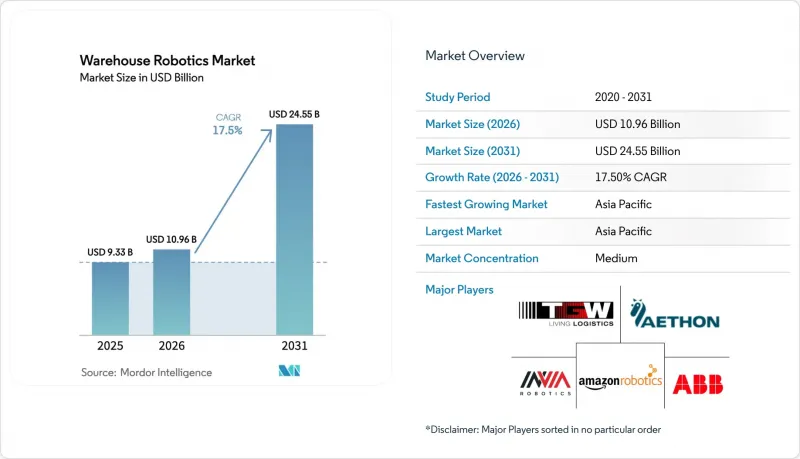
Mordor Intelligence에 따르면 창고 로보틱스 시장 규모는 2025년 93억 3,000만 달러에서 2026년에는 109억 6,000만 달러로 확대하며, 2026-2031년에 CAGR 17.5%로 추이하며, 2031년에는 245억 5,000만 달러에 달할 것으로 예측됩니다.
이 보고서는 유형별(산업용 로봇, 분류 시스템 등), 기능별(보관, 포장 등), 구성 요소별(하드웨어, 소프트웨어, 지원 및 서비스), 최종사용자 산업별(식품 및 음료, 자동차, 소매·E-Commerce,전기·전자, 제약, 3PL 등) 및 지역별로 분류되어 있습니다. 시장 예측은 금액(달러) 기준으로 제시되어 있습니다.
글로벌 창고 로봇 시장의 동향 및 인사이트
E-Commerce 분야의 SKU 급증과 당일 배송에 대한 압박
아마존은 현재 3억 5,000만개 이상의 활성 SKU를 취급하고 있으며, 그 규모는 수작업 피킹 작업자를 압도할 정도이므로, 모양이 각기 다른 상품을 확실하게 잡을 수 있는 로봇 기술이 요구되고 있습니다. 당일 배송 약속으로 인해 주요 대도시권의 사이클 타임이 4시간 미만으로 단축됨에 따라 풀필먼트 센터에서는 피크 시간대에 주문 처리 속도를 3배로 높이는 AMR이 도입되고 있습니다. 계절적 수요 급증으로 처리량이 500%에 달하기도 하여, 수작업에 의존하는 유연한 인력 모델은 비용 면에서 현실적이지 않게 되었습니다. ‘상품에서 사람으로(GTP)’ 시스템은 비생산적인 직원 이동을 없애고, AI를 활용한 재고 배치 툴은 평균 피킹 경로를 60% 단축합니다. 규제 당국은 배송 약속의 정확한 공개를 의무화하고 있으며, 사업자들은 로봇 역량을 활용하여 처리 능력 보장을 강화해야 합니다.
3PL 및 소매업체의 AMR 및 AS/RS에 대한 투자 증가
DSV는 유럽 각 거점에 AMR을 도입하기 위해 5,000만 달러를 배정했으며, 이를 통해 보관 밀도를 85% 향상시키는 동시에 도심 지역의 임대료 급등으로부터 이익률을 보호하고 있습니다. 월마트도 이에 발맞춰 10억 달러 규모의 자동화 투자를 약속하며, 기존 매장 내에 통합된 마이크로 풀필먼트 센터의 도입을 확대하고 있습니다. ‘Robots-as-a-Service(RaaS)’ 방식은 지출을 자본 지출(CAPEX)에서 피킹 1회당 변동 요금으로 전환함으로써 진입 장벽을 낮추고 있습니다. ISO 3691-4 무인 트럭 규격은 리스크 회피 성향이 강한 물류 관리자들에게 규정 준수 로드맵을 제공하여 AMR 시범 프로젝트의 승인을 가속화하고 있습니다.
브라운필드 개조시 발생하는 막대한 CAPEX 및 통합 비용
기존 시설의 개조에는 그린필드 건설보다 60-80% 더 많은 비용이 듭니다. 이는 통로, 메자닌, 전기 설비가 로봇의 동작 범위와 일치하는 경우가 거의 없기 때문입니다. 프로젝트에서는 배선, 바닥 수평 조정, 소프트웨어 인터페이스 비용으로 종종 200만 달러가 발생합니다. 설치로 인한 가동 중단이 1주일 지속될 때마다 처리량에 따른 수익이 5만 달러 손실될 가능성이 있으므로, 사업자는 가동중인 레인을 유지할 수 있도록 도입을 세분화된 단계로 나누어 점진적으로 진행하고 있습니다. 현재 각 벤더사는 기존 랙 내에 설치 가능한 모듈식 포드를 추진하고 있으며, 이를 통해 초기 자금 소모를 줄이고 경영진의 승인 문턱을 낮출 수 있게 되었습니다.
부문 분석
이동형 플랫폼은 2031년까지 연평균 성장률(CAGR) 18.02%로 꾸준히 성장하여, 그린필드 풀필먼트 프로젝트에서 고정식 산업용 유닛을 능가할 전망입니다. 소매업체들이 빈번한 SKU 재설정에 대응할 수 있는 레이아웃의 유연성을 중시하고 있으므로 이동형 로봇용 창고 로봇 시장 규모는 2031년까지 107억 4,000만 달러에 달할 것으로 예측됩니다. 산업용 6축 로봇 암은 여전히 중량물 팔레타이징 시장에서 34.02%의 점유율을 차지하고 있지만, 컨베이어를 사용하지 않는 AMR 전략을 통해 인프라 비용을 70% 절감하고 시운전 기간을 수개월에서 수주일로 단축할 수 있습니다. 소포 허브에서는 2024년 이전 기준치에 비해 이미 40% 더 많은 화물을 처리할 수 있는 고속 분류 시스템이 선호되고 있습니다. 한편, 큐브형 AS/RS는 도시 지역에서 보관 밀도를 4배로 높이고 있습니다. 현재 통합 레이어가 단일 스케줄러 하에서 이동형 로봇 군, 셔틀, 리프트를 조정하여 통로의 혼잡을 방지하고 작업 대기열의 균형을 유지하고 있습니다.
창고 로보틱스 시장에서는 AMR이 토트를 고정식 암 클러스터까지 운반하여 고정밀 피킹을 수행하는 하이브리드형 도입이 계속해서 주목받고 있습니다. AI 경로 엔진이 매초 경로를 재계획함으로써 장애물을 회피하고, 로봇의 유휴 시간을 10% 미만으로 줄입니다. 각 벤더사는 케이스 운반에는 대형 플로어 AMR을, 상품에서 사람으로의 작업에는 소형 스웜봇을 배치하여 공간 활용도를 극대화하고 있습니다. 산업용 팔레타이저에는 임베디드 비전이 탑재되어 패턴 설계 시간을 25% 단축하는 동시에 적재물의 안정성을 향상시키고 있습니다. 이는 파손되기 쉬운 전기자동차용 배터리 팩에 있으며, 매우 중요합니다. 전반적으로 멀티모달 로봇 군은 제품 구성의 변동에 대비해 미래를 내다보는 운영을 실현합니다.
2025년 매출에서 차지하는 비중은 38.05%로, 여전히 보관 분야가 주류를 이루고 있지만, 피킹 및 분류 분야가 부가가치를 주도하고 있으며, 2031년까지 연평균 성장률(CAGR) 18.11%를 기록할 전망입니다. ‘상품에서 사람으로(Goods-to-Person)’ 원칙에 따라 작업자의 이동 거리가 75% 단축됨에 따라 첨단 피킹 시스템을 갖춘 창고 로봇 시장의 점유율은 확대되고 있습니다. 동적 슬롯 배치 알고리즘은 수요 예측을 바탕으로 야간 동안 재고 위치를 재배치하여 평균 피킹 시간을 30초로 단축합니다. 엣지 지연 시간은 현재 30밀리초 미만으로, 로봇이 작업 도중 최적의 경로를 재계산할 수 있게 되었습니다. 크로스독 거점에서는 E-Commerce 반품을 처리하고 당일 중으로 상품을 출하 흐름에 재투입하는 로봇 소터에 대한 투자가 진행되고 있으며, 가격 인하로 인한 이익 감소를 억제하고 있습니다.
예측 분석을 통해 수요 데이터를 AS/RS 셔틀 배정에 연동함으로써, 잘 팔리는 SKU를 인체공학적으로 설계된 피킹 스테이션 근처에 배치하여 매일 진행되는 사이클 카운트에 소요되는 노력을 줄이고 있습니다. 로봇 포장 셀은 상자 크기를 실시간으로 조정하여 골판지 폐기량을 15% 줄이는 동시에 트럭 적재율을 최적화합니다. 무게가 변동하는 상품이 컨베이어의 이송 속도를 방해하는 식료품 풀필먼트 분야에서는 스플릿 케이스 자동화가 보급되고 있습니다. 작업자들은 피킹 성능을 병목 현상으로 인식하고 있으며, 이러한 격차를 해소하기 위해 비전 시스템이 탑재된 엔드 이펙터나 자율주행 카트에 대한 투자가 활발해지고 있습니다.
지역별 분석
아시아태평양은 2025년에 전 세계 매출의 39.52%를 차지하며, 중국 제조업체들의 적극적인 수출과 지역적 임금 상승을 배경으로 2031년까지 연평균 성장률(CAGR) 17.94%를 기록할 전망입니다. Geek+ 등 현지 대기업은 사상 최대 출하량을 기록한 반면, 일본은 노동력 고령화를 보완하기 위해 로봇 기술에 주목하고 있으며, 한국은 국가 산업 정책에 따라 AS/RS를 스마트 공장에 통합했습니다. 인도는 정부가 지원하는 자동화 보조금을 통해 외국인 직접 투자를 유치하며 성장 가속화 단계에 접어들었습니다.
북미는 2위를 차지하며 벤처 자본을 통한 혁신의 지표로서의 위상을 유지하고 있으며, 2024년에는 창고 자동화 스타트업에 20억 달러 이상이 투자되었습니다. 미국의 대형 소매업체들은 마이크로 풀필먼트와 다크 스토어 개념을 선도적으로 도입하고 있는 반면, 캐나다의 토론토-밴쿠버 회랑에서는 노동력 부족을 완화하기 위해 로봇 기술 도입을 확대하고 있습니다. 멕시코는 니어쇼어링의 혜택을 받아 AMR 지원 창고를 도입함으로써 미국 수입업체의 입고 비용을 25% 절감하고 있습니다.
유럽은 눈에 띄는 성장 면에서는 뒤처지고 있지만, 꾸준한 도입이 진행되고 있습니다. 독일은 ‘인더스트리 4.0’ 보조금을 활용하여 자동차 부품 공급업체를 위한 통합형 물류 셀에 자금을 조달하고 있습니다. 영국은 브렉시트 이후의 통관 흐름에 대응할 수 있도록 재조정 가능한 유연한 시스템을 우선시하고 있습니다. 프랑스와 네덜란드는 범유럽 게이트웨이로서의 역할을 수행하며, 토지 제약을 완화하기 위해 큐브형 창고에 대한 투자를 추진하고 있습니다. EU에서 조만간 시행될 AI 법은 규정 준수 비용을 증가시키는 한편, 안전 기준을 높이고 검증된 공급업체를 우대하게 될 것입니다.
기타 혜택:
- 엑셀 형식의 시장 예측(ME) 시트
- 3개월간의 애널리스트 지원
자주 묻는 질문
목차
제1장 서론
제2장 조사 방법
제3장 개요
제4장 시장 구도
제5장 시장 규모와 성장 예측
제6장 경쟁 구도
제7장 시장 기회와 향후 전망
KSA 26.09.03According to Mordor Intelligence, the warehouse robotics market size is expected to grow from USD 9.33 billion in 2025 to USD 10.96 billion in 2026 and is forecast to reach USD 24.55 billion by 2031 at 17.5% CAGR over 2026-2031.
This report is Segmented by Type (Industrial Robots, Sortation Systems, and More), Function (Storage, Packaging, and More), Component (Hardware, Software, and Support and Services), End-User Industry (Food and Beverage, Automotive, Retail and E-Commerce, Electrical and Electronics, Pharmaceutical, 3PL, and More), and Geography. The Market Forecasts are Provided in Terms of Value (USD).
Global Warehouse Robotics Market Trends and Insights
E-commerce SKU Proliferation and Same-Day-Delivery Pressure
Amazon now juggles more than 350 million active SKUs, a scale that overwhelms manual pickers and demands robotic confidence in grasping dissimilar shapes. Same-day commitments shrink cycle times to under four hours in major metros, so fulfillment nodes deploy AMRs that triple order-processing speed during peak events. Seasonal spikes can push volumes 500%, rendering manual flex-labor models cost-prohibitive. Goods-to-person systems erase unproductive employee travel, while AI inventory-placement tools cut average pick paths 60%. Regulators enforce truthful delivery-promise disclosure, compelling operators to harden throughput guarantees with robotic capacity.
Rising Investments by 3PLs and Retailers in AMRs and AS/RS
DSV earmarked USD 50 million to roll out AMRs across European sites, unlocking density gains of 85% and shielding margins from urban rent inflation. Walmart matched with a USD 1 billion automation pledge that widens adoption of micro-fulfillment centers embedded in existing stores. Robots-as-a-service schemes lower entry thresholds by shifting spend from CAPEX to variable fees per pick. ISO 3691-4 driverless-truck standards give risk-averse logistics managers a compliance roadmap, accelerating green-lighting of AMR pilot projects.
High CAPEX and Integration Cost for Brownfield Retrofits
Retrofitting legacy sites costs 60-80% more than greenfield builds because aisles, mezzanines, and electrical services rarely align with robot envelopes. Projects often trigger USD 2 million in wiring, floor leveling, and software-interface expenses. Every week of installation downtime can forfeit USD 50,000 in throughput revenue, so operators stagger rollouts in micro-phases that preserve live lanes. Vendors now push modular pods that fit inside existing racks, trimming upfront cash burn and easing board-level approvals.
Other drivers and restraints analyzed in the detailed report include:
- Shrinking Warehouse Labor Pool in OECD Economies
- AI-Powered Vision Enabling Robotic Picking of Difficult SKUs
- Fragmented Safety and Data-Privacy Regulations by Region
For complete list of drivers and restraints, kindly check the Table Of Contents.
Segment Analysis
Mobile platforms edge forward with an 18.02% CAGR to 2031, eclipsing fixed industrial units for greenfield fulfillment projects. The warehouse robotics market size for mobile robots is projected to reach USD 10.74 billion by 2031 as retailers value layout agility that supports frequent SKU resets. Industrial six-axis arms still own heavy palletizing with 34.02% share, yet conveyor-less AMR strategies cut infrastructure costs 70% and shrink commissioning times from months to weeks. Parcel hubs favor high-speed sortation systems that already handle 40% more packages than pre-2024 baselines, while cube-based AS/RS lifts storage density fourfold in urban footprints. Integration layers now orchestrate mobile fleets, shuttles, and lifts under one scheduler to prevent aisle congestion and balance work queues.
The warehouse robotics market continues to showcase hybrid deployments where AMRs ferry totes to stationary arm clusters for high-dexterity picks. AI route engines re-plan paths every second to dodge obstacles and reduce robot idle to under 10%. Vendors position large-format floor AMRs for case movement and compact swarm bots for goods-to-person tasks, maximizing cube utilization. Industrial palletizers gain embedded vision that trims pattern design times 25% and improves load stability, vital for fragile EV battery packs. Collectively, multi-modal fleets future-proof operations against product-mix volatility.
Storage still dominates with 38.05% slice of 2025 revenue, yet picking and sorting drives incremental value and will post an 18.11% CAGR to 2031. The warehouse robotics market share for advanced picking systems rises as goods-to-person principles cut worker walk distances 75%. Dynamic slotting algorithms reposition inventory overnight based on forecast demand, shrinking average pick span to 30 seconds. Edge latency now measures below 30 milliseconds, letting robots recalculate optimal routes mid-mission. Cross-dock nodes invest in robotic sorters that process e-commerce returns and re-inject goods into outbound flows the same day, limiting markdown erosion.
Predictive analytics tie demand data to AS/RS shuttle assignments, pushing high-velocity SKUs near ergonomic pick stations and lowering daily cycle-count labor. Robotics packaging cells adapt box size in real time, cutting corrugate waste 15% and optimizing truck fill rates. Split-case automation gains traction in grocery fulfillment where variable weight items challenge conveyor pacing. Operators view picking performance as the rate-limiting step, and capital therefore gravitates toward vision-equipped end-effectors and autonomous carts that close the gap.
Complete Report Scope:
- By Type
- Industrial Robots
- Sortation Systems
- Conveyors
- Palletizers
- Automated Storage and Retrieval Systems (AS/RS)
- Mobile Robots (AGVs and AMRs)
- By Function
- Storage
- Packaging
- Trans-shipment
- Picking and Sorting
- By Component
- Hardware
- Software
- Support and Services
- By End-user Industry
- Food and Beverage
- Automotive
- Retail and E-commerce
- Electrical and Electronics
- Pharmaceutical
- Third-Party Logistics (3PL)
- Other End-user Industries
- By Geography
- North America
- United States
- Canada
- South America
- Brazil
- Argentina
- Rest of South America
- Europe
- Germany
- United Kingdom
- France
- Italy
- Rest of Europe
- Asia-Pacific
- China
- Japan
- South Korea
- India
- Rest of Asia-Pacific
- Middle East and Africa
- Middle East
- Saudi Arabia
- United Arab Emirates
- Turkey
- Rest of Middle East
- Africa
- South Africa
- Nigeria
- Rest of Africa
- Middle East
- North America
Geography Analysis
Asia Pacific retained 39.52% of global revenue in 2025 and is tracking an 17.94% CAGR to 2031 as Chinese makers export aggressively and regional wages climb. Local champions such as Geek+ shipped record volumes while Japan turned to robotics to offset an aging workforce and South Korea integrated AS/RS with smart factories under national industrial policy. India enters an acceleration phase on the back of government-backed automation subsidies that attract foreign direct investment.
North America ranks second and remains a bellwether for venture-backed innovation, channeling more than USD 2 billion into warehouse automation startups during 2024. U.S. big-box retailers pioneer micro-fulfillment and dark-store concepts, while Canada's Toronto-Vancouver corridor scales robotics to relieve labor scarcity. Mexico benefits from near-shoring and deploys AMR-ready warehouses that cut landed costs for U.S. importers by 25%.
Europe lags headline growth yet maintains steady adoption. Germany leans on Industry 4.0 grants to fund integrated logistics cells for automotive suppliers. The United Kingdom prioritizes flexible systems that can realign to post-Brexit customs flows. France and the Netherlands act as pan-European gateways, investing in cube-storage to mitigate land constraints. The EU's forthcoming AI Act will raise compliance costs yet elevate safety baselines, favoring established vendors with proven records.
- ABB Ltd.
- Amazon Robotics LLC
- TGW Logistics Group GmbH
- ST Engineering Ltd. (Aethon Inc.)
- inVia Robotics, Inc.
- FANUC Corporation
- Honeywell International Inc.
- Toshiba Corporation
- OMRON Corporation
- Yaskawa Electric Corporation
- KUKA AG
- Fetch Robotics, Inc. (Zebra)
- Geekplus Technology Co., Ltd.
- GreyOrange Pte. Ltd.
- Hangzhou Hikrobot Technology Co., Ltd.
- Syrius Robotics Co., Ltd.
- Locus Robotics Corp.
- Daifuku Co., Ltd.
- Dematic Corp. (KION Group AG)
- Swisslog Holding AG
- Boston Dynamics, Inc.
- Exotec SAS
- Symbotic Inc.
- Teradyne, Inc. (Mobile Industrial Robots A/S)
- Zebra Technologies Corporation
Additional Benefits:
- The market estimate (ME) sheet in Excel format
- 3 months of analyst support
TABLE OF CONTENTS
1 INTRODUCTION
- 1.1 Study Assumptions and Market Definition
- 1.2 Scope of the Study
2 RESEARCH METHODOLOGY
3 EXECUTIVE SUMMARY
4 MARKET LANDSCAPE
- 4.1 Market Overview
- 4.2 Market Drivers
- 4.2.1 E-commerce SKU proliferation and same-day-delivery pressure
- 4.2.2 Rising investments by 3PLs and retailers in AMRs and AS/RS
- 4.2.3 Shrinking warehouse labor pool in OECD economies
- 4.2.4 AI-powered vision enabling robotic picking of "difficult" SKUs
- 4.2.5 Edge-based fleet orchestration cuts downtime and boosts ROI
- 4.2.6 Carbon-neutral warehousing mandates favor low-energy robots
- 4.3 Market Restraints
- 4.3.1 High CAPEX and integration cost for brownfield retrofits
- 4.3.2 Fragmented safety and data-privacy regulations by region
- 4.3.3 Cyber-physical security vulnerabilities in fleet software
- 4.3.4 Lithium-ion battery supply volatility affects AMR BOM costs
- 4.4 Industry Value Chain Analysis
- 4.5 Regulatory Landscape
- 4.6 Technological Outlook
- 4.7 Porter's Five Forces Analysis
- 4.7.1 Bargaining Power of Buyers
- 4.7.2 Bargaining Power of Suppliers
- 4.7.3 Threat of New Entrants
- 4.7.4 Threat of Substitute Products
- 4.7.5 Intensity of Competitive Rivalry
5 MARKET SIZE AND GROWTH FORECASTS (VALUE)
- 5.1 By Type
- 5.1.1 Industrial Robots
- 5.1.2 Sortation Systems
- 5.1.3 Conveyors
- 5.1.4 Palletizers
- 5.1.5 Automated Storage and Retrieval Systems (AS/RS)
- 5.1.6 Mobile Robots (AGVs and AMRs)
- 5.2 By Function
- 5.2.1 Storage
- 5.2.2 Packaging
- 5.2.3 Trans-shipment
- 5.2.4 Picking and Sorting
- 5.3 By Component
- 5.3.1 Hardware
- 5.3.2 Software
- 5.3.3 Support and Services
- 5.4 By End-user Industry
- 5.4.1 Food and Beverage
- 5.4.2 Automotive
- 5.4.3 Retail and E-commerce
- 5.4.4 Electrical and Electronics
- 5.4.5 Pharmaceutical
- 5.4.6 Third-Party Logistics (3PL)
- 5.4.7 Other End-user Industries
- 5.5 By Geography
- 5.5.1 North America
- 5.5.1.1 United States
- 5.5.1.2 Canada
- 5.5.2 South America
- 5.5.2.1 Brazil
- 5.5.2.2 Argentina
- 5.5.2.3 Rest of South America
- 5.5.3 Europe
- 5.5.3.1 Germany
- 5.5.3.2 United Kingdom
- 5.5.3.3 France
- 5.5.3.4 Italy
- 5.5.3.5 Rest of Europe
- 5.5.4 Asia-Pacific
- 5.5.4.1 China
- 5.5.4.2 Japan
- 5.5.4.3 South Korea
- 5.5.4.4 India
- 5.5.4.5 Rest of Asia-Pacific
- 5.5.5 Middle East and Africa
- 5.5.5.1 Middle East
- 5.5.5.1.1 Saudi Arabia
- 5.5.5.1.2 United Arab Emirates
- 5.5.5.1.3 Turkey
- 5.5.5.1.4 Rest of Middle East
- 5.5.5.2 Africa
- 5.5.5.2.1 South Africa
- 5.5.5.2.2 Nigeria
- 5.5.5.2.3 Rest of Africa
- 5.5.5.1 Middle East
- 5.5.1 North America
6 COMPETITIVE LANDSCAPE
- 6.1 Market Concentration
- 6.2 Strategic Moves
- 6.3 Market Share Analysis
- 6.4 Company Profiles (includes Global level Overview, Market level overview, Core Segments, Financials as available, Strategic Information, Market Rank/Share, Products and Services, Recent Developments)
- 6.4.1 ABB Ltd.
- 6.4.2 Amazon Robotics LLC
- 6.4.3 TGW Logistics Group GmbH
- 6.4.4 ST Engineering Ltd. (Aethon Inc.)
- 6.4.5 inVia Robotics, Inc.
- 6.4.6 FANUC Corporation
- 6.4.7 Honeywell International Inc.
- 6.4.8 Toshiba Corporation
- 6.4.9 OMRON Corporation
- 6.4.10 Yaskawa Electric Corporation
- 6.4.11 KUKA AG
- 6.4.12 Fetch Robotics, Inc. (Zebra)
- 6.4.13 Geekplus Technology Co., Ltd.
- 6.4.14 GreyOrange Pte. Ltd.
- 6.4.15 Hangzhou Hikrobot Technology Co., Ltd.
- 6.4.16 Syrius Robotics Co., Ltd.
- 6.4.17 Locus Robotics Corp.
- 6.4.18 Daifuku Co., Ltd.
- 6.4.19 Dematic Corp. (KION Group AG)
- 6.4.20 Swisslog Holding AG
- 6.4.21 Boston Dynamics, Inc.
- 6.4.22 Exotec SAS
- 6.4.23 Symbotic Inc.
- 6.4.24 Teradyne, Inc. (Mobile Industrial Robots A/S)
- 6.4.25 Zebra Technologies Corporation
7 MARKET OPPORTUNITIES AND FUTURE OUTLOOK
- 7.1 White-space and Unmet-need Assessment


