

|
시장보고서
상품코드
2122011
지오폴리머 : 시장 점유율 분석, 업계 동향과 통계, 성장 예측(2026-2031년)Geopolymer - Market Share Analysis, Industry Trends & Statistics, Growth Forecasts (2026 - 2031) |
||||||
 Mordor Intelligence
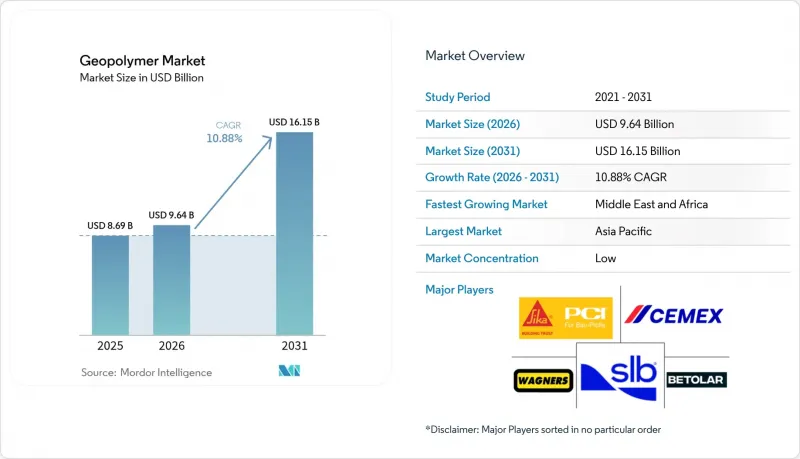
Mordor Intelligence에 따르면 지오폴리머 시장 규모는 2025년 86억 9,000만 달러에서 2026년에는 96억 4,000만 달러로 확대하며, 2026-2031년에 CAGR 10.88%로 추이하며, 2031년까지 161억 5,000만 달러에 달할 것으로 예측됩니다.
이 보고서는 제품 유형(시멘트, 콘크리트 및 프리캐스트 패널, 그라우트 및 바인더, 기타), 용도(건축, 도로, 활주로 교량, 터널, 핵폐기물 고정화 등), 전구체(플라이애시, 슬래그,메타카올린, 농업 폐기물 등) 및 지역(아시아태평양, 북미, 유럽, 남미, 중동 및 아프리카)별로 분류되어 있습니다. 시장 예측은 금액(달러)으로 표시되어 있습니다.
글로벌 지오폴리머 시장의 동향 및 인사이트
시멘트 업계에 대한 엄격한 CO₂ 배출 규제
2026년부터 ‘탄소 국경 조정 메커니즘(CBAM)’에 따라 수입 클링커에 추가 과세가 부과될 예정입니다. 이 조치로 인해 포틀랜드 시멘트와 지오폴리머 결합제의 비용 격차가 더욱 확대될 전망입니다. 중국에서는 일부 성에서 클링커 1톤당 CO₂ 배출량에 상한선이 설정되어 있습니다. 이 규제로 인해 겨울철 생산 제한이 이루어지고 있으며, 그 결과 보조 결합제의 매력이 높아지고 있습니다. 한편, 캘리포니아주의 ‘바이 클린(Buy Clean) 법’에서는 압축 강도 단위당 CO₂ 환산 배출량에 상한선이 의무화되어 있습니다. 특히 플라이애시-지오폴리머 혼합물은 탄소 포집 없이도 이 기준을 달성할 수 있습니다. 또한 ISO 14067 인증은 대형 건설사(Tier-1) 사이에서 보급이 확대되고 있습니다. 이 인증을 통해 수십억 규모의 인프라 프로젝트에 지오폴리머 사양이 효과적으로 반영되고 있습니다. 향후 전망과 관련하여, 국제에너지기구(IEA)는 2030년까지 탄소 가격 책정이 전 세계 시멘트 생산량의 상당 부분을 대상으로 하게 될 것으로 예측하고 있으며, 이러한 규제 변화의 기세는 더욱 강해질 전망입니다.
플라이애시 및 슬래그 원료 공급량 증가
2025년, 인도에서는 플라이애시가 생산되고 정책에 따른 이용 촉진 조치가 시행된 결과, 전구체 가격이 전년 대비 하락했습니다. 중국의 철강 업계에서는 2025년에 슬래그가 대량으로 배출되어 공급 과잉이 발생했습니다. 지오폴리머 용도로 배정된 이 잉여분은 수입 메타카올린보다 저렴한 가격에 공급되고 있습니다. 베트남과 인도네시아에서는 선광 거점이 개설되어 소실률이 5% 미만인 원료가 확보되었습니다. 이러한 진전으로 인해 압축 강도의 편차가 감소했습니다. 북미에서는 석탄 화력 발전소의 폐쇄로 인해 연간 플라이애시 공급량이 감소했습니다. 이러한 공급 부족으로 인해 비용이 높아지면서 배합 설계자들은 분쇄 유리 포졸란의 사용을 선호하고 있습니다. 한편, 오대호 주변의 전기 아크로 제철소에서는 안정적인 슬래그 공급이 확보되어, 해당 지역의 비용 우위가 유지되고 있습니다.
통일된 설계 규범 및 기준의 부재
지오폴리머 콘크리트는 ASTM C94 및 ACI 318에서 공식적으로 인증되지 않았기 때문에 기술자들은 프로젝트별로 승인을 받아야만 하며, 이로 인해 인허가 절차 기간이 길어지고 있습니다. 2024년에 개정된 호주의 AS 3600 성능 조항이 유일한 국가 표준이며, 연구개발 노력은 주로 해당 시장에 집중되어 있습니다. ISO 19596의 제정은 2028년까지 예상되지 않기 때문에 사양 제정자들은 책임 위험을 줄이기 위해 종종 포틀랜드 시멘트로 회귀하고 있습니다. 영국 표준(BS)은 내구성 시험을 거친 지오폴리머 혼합물만을 승인하고 있으며, 중동 지역에서의 채택을 저해하고 있습니다. 또한 독일과 프랑스 간 터널 내화 규정에 모순이 있으며, 양국에 공급하는 공급업체의 규정 준수 비용이 증가하고 있습니다.
부문 분석
2025년에는 시멘트, 콘크리트 및 프리캐스트 패널이 지오폴리머 시장을 독점하며 매출의 52.31%를 차지했습니다. 이러한 급증은 주로 레디믹스 콘크리트 기업이 원파트 시스템을 채택하여 현장에서의 배치 처리를 효율화한 데 기인합니다. 2031년까지 이 부문은 저탄소 교량, 학교, 고층 빌딩의 외벽 등 공공 프로젝트의 호조에 힘입어 지오폴리머 시장의 상당 부분을 차지할 전망입니다. 이러한 패널의 품질은 공장에서 이루어지는 체계적인 양생 과정을 통해 더욱 향상되고 있습니다. 한편, 그라우트 및 바인더 제품은 터널 보수 및 해저 케이블 공사에 힘입어 11.12%의 성장세를 보이고 있습니다. 이러한 용도에서는 빠른 강도 발현이 요구되므로 고가로 거래되고 있습니다.
지오폴리머 시장의 틈새 용도로는 특히 내화·내화학성 라이닝용 도료 및 접착제 분야에서 새로운 전개가 나타나고 있습니다. 그러나 배합 비용이 높아 판매량 증가를 억제하고 있습니다. 이전에는 과제로 여겨졌던 한랭지에서의 성능에 대해서도 현재 대책이 추진되고 있습니다. 노르웨이에서 실시된 칼슘 설포알루미나이트계 촉진제를 사용한 현장 시험에서는 5°C 환경에서 8시간 이내에 15 MPa의 강도를 달성할 수 있음이 입증되었습니다. 특히 유럽과 호주에서 제품 인증이 증가하고 있는 것을 계기로, 많은 프리캐스트 제조업체들이 상온 양생형 혼합물로 전환을 추진하고 있으며, 이를 통해 에너지 비용 절감을 실현하고 있습니다.
지역별 분석
2025년, 아시아태평양은 매출의 44.31%를 차지했습니다. 이는 중국의 고형 폐기물 활용 할당 제도와 인도의 야심 찬 ‘그린 시멘트 미션’에 힘입은 결과입니다. 주목할 만한 성과로, 장쑤성과 저장성에서는 플라이애시계 지오폴리머를 활용한 저렴한 주택을 건설하고, 클링커 수입을 피함으로써 비용 절감을 실현했습니다. 인도의 IS 18417:2024 규격 덕분에 국도에서의 시공이 가속화되었습니다. 일본은 내진 안전성을 우선시하여 교각 개보수에 지오폴리머 그라우트를 지정하는 한편, 한국의 ‘그린 뉴딜’은 항만 및 지하철에서의 시범 프로젝트를 지원했습니다.
북미에서는 ‘인프라 투자 및 고용법’에 따른 저탄소 콘크리트 예산 배정을 활용하고 있습니다. 첫 번째 계약은 해안 방파제 보강과 무게 감량이 극히 중요한 대규모 목조 하이브리드 타워에 초점을 맞추고 있습니다. 유럽에서는 독일이 노르트라인-베스트팔렌주에 위치한 지오폴리머 시범 공장에 투자했습니다. 한편, 영국은 2030년까지 전체 공공 프로젝트의 내재 탄소량을 감축하겠다는 야심찬 목표를 세웠습니다. 프랑스의 RE2020 규제로 인해 수요가 급증하고 있으며, 대파리권 주택에서는 2025년에 도입될 예정입니다.
중동 및 아프리카는 연평균 성장률(CAGR) 10.92%로 이러한 추세를 주도하고 있습니다. NEOM의 선구적인 직선 도시 계획에서는 모든 기초 공사에 저탄소 콘크리트 사용을 의무화하고 있으며, 현지 지오폴리머 공급업체와 장기 계약을 체결했습니다. 중요한 움직임으로, 사우디 아람코는 고온의 자프라 셰일층에서 지오폴리머 유정 시멘트 시험에 성공하여 칭찬할 만한 격리 효과를 달성했습니다. 아랍에미리트(UAE)의 마스다르 시티 2단계 프로젝트에서는 구조용 콘크리트에 지오폴리머 혼합재가 포함되어 있습니다. 남아프리카의 학교 건설 프로젝트와 이집트의 신행정수도 파사드는 이 대륙에서 현지 플라이애시 및 점토 자원과 결합되는 경우가 많은 이러한 자재들이 점점 더 널리 수용되고 있음을 보여줍니다.
기타 혜택:
- 엑셀 형식의 시장 예측(ME) 시트
- 3개월간의 애널리스트 지원
자주 묻는 질문
목차
제1장 서론
제2장 조사 방법
제3장 개요
제4장 시장 구도
제5장 시장 규모와 성장 예측
제6장 경쟁 구도
제7장 시장 기회와 향후 전망
KSA 26.09.03According to Mordor Intelligence, the geopolymer market size is expected to grow from USD 8.69 billion in 2025 to USD 9.64 billion in 2026 and is forecast to reach USD 16.15 billion by 2031 at 10.88% CAGR over 2026-2031.
This report is Segmented by Product Type (Cement, Concrete and Pre-Cast Panels, Grout and Binder, and Others), Application (Building, Road, Runway, Bridge, Tunnel, Nuclear Waste Immobilization, and More), Precursor (Fly Ash, Slag, Metakaolin, Agricultural Wastes, and Others), and Geography (Asia-Pacific, North America, Europe, South America, and Middle-East and Africa). Market Forecasts are in Value (USD).
Global Geopolymer Market Trends and Insights
Stringent CO2-Emissions Regulations on Cement Industry
Starting in 2026, the Carbon Border Adjustment Mechanism will impose an additional charge on imported clinker. This move is set to widen the cost disparity between Portland and geopolymer binders. In China, certain provinces have established a ceiling on CO2 emissions for every tonne of clinker produced. This regulation has led to winter curtailments, subsequently boosting the attractiveness of supplementary binders. Meanwhile, California's Buy Clean Act mandates a limit on CO2-equivalent emissions for each unit of compressive strength. Notably, fly-ash geopolymer mixes can achieve this standard without the need for carbon capture. Furthermore, ISO 14067 certification has gained traction among Tier-1 contractors. This endorsement has effectively integrated geopolymer specifications into infrastructure portfolios worth billions. Looking ahead, the International Energy Agency projects that by 2030, carbon pricing will encompass a significant portion of the global cement output, further strengthening the momentum of these regulatory changes.
Growing Availability of Fly-Ash and Slag Feedstocks
In 2025, India produced fly ash, with policy mandates boosting utilization, leading to a year-on-year drop in precursor prices. China's steel sector churned out slag in 2025, resulting in a surplus. This surplus, earmarked for geopolymer applications, is priced lower than imported metakaolin. Vietnam and Indonesia inaugurated beneficiation hubs, achieving a sub-5% loss-on-ignition feedstock. This advancement has reduced compressive-strength variability. In North America, the retirement of coal plants cut the annual fly-ash supply. This shortfall has nudged formulators towards ground glass pozzolan, despite its higher cost. Meanwhile, electric-arc steel mills around the Great Lakes ensure a steady slag supply, maintaining the region's cost advantage.
Lack of Uniform Design Codes and Standards
Geopolymer concrete lacks recognition in ASTM C94 and ACI 318, leading engineers to seek project-specific approvals and extending permit cycles. Australia's AS 3600 performance clauses, updated in 2024, stand as the sole national standard, channeling research and development efforts predominantly in that market. With ISO 19596 not anticipated until 2028, specifiers often revert to Portland cement to mitigate liability risks. British Standards only acknowledge geopolymer mixes post durability trials, hindering adoption in the Middle East. Additionally, conflicting tunnel fire-resistance regulations between Germany and France inflate compliance costs for suppliers catering to both nations.
Other drivers and restraints analyzed in the detailed report include:
- Demand for Green-Building Certification Materials
- Rapid Uptake of One-Part Geopolymer Formulations
- Price Volatility of Alkali Activators
For complete list of drivers and restraints, kindly check the Table Of Contents.
Segment Analysis
In 2025, cement, concrete, and pre-cast panels dominated the geopolymer market, capturing a 52.31% share of the revenue. This surge was largely driven by ready-mix companies adopting one-part systems, streamlining on-site batching. By 2031, this segment is poised to represent a substantial portion of the geopolymer market, buoyed by public projects like low-carbon bridges, schools, and high-rise facades. The quality of these panels is further enhanced through factory-controlled curing. Meanwhile, grout and binder products are witnessing 11.12% growth, fueled by tunnel repairs and subsea cable work, which command premium pricing for their rapid strength gain.
Niche applications of the geopolymer market are emerging in coatings and adhesives, particularly for fireproofing and chemical-resistant linings. However, the higher formulation costs are tempering volume growth. Cold-weather performance, previously a challenge, is now being addressed. Norwegian field trials using calcium sulfoaluminate accelerators demonstrated the ability to achieve 15 MPa within eight hours at 5 °C. With an uptick in product certifications, especially in Europe and Australia, many precast producers are transitioning to ambient-cured mixtures, reaping energy bill savings.
Complete Report Scope:
- By Product Type
- Cement, Concrete and Pre-cast Panels
- Grout and Binder
- Other Product Types
- By Application
- Building
- Road and Pavement
- Runway
- Pipe and Concrete Repair
- Bridge
- Tunnel Lining
- Railroad Sleeper
- Coating Application
- Fireproofing
- Nuclear Other Toxic Waste Immobilization
- Specific Mold Products
- By Precursor/Raw-Material
- Fly Ash Based
- Slag Based
- Metakaolin Based
- Rice-Husk Ash and Agricultural Wastes
- Others (Red-Mud and Bauxite Residue and Waste Glass and Basalt Powders)
- By Geography
- Asia-Pacific
- China
- India
- Japan
- South Korea
- ASEAN Countries
- Rest of Asia-Pacific
- North America
- United States
- Canada
- Mexico
- Europe
- Germany
- United Kingdom
- France
- Spain
- Italy
- Russia
- Rest of Europe
- South America
- Brazil
- Argentina
- Rest of South America
- Middle-East and Africa
- Saudi Arabia
- United Arab Emirates
- Rest of Middle-East and Africa
- Asia-Pacific
Geography Analysis
In 2025, Asia-Pacific commanded a 44.31% share of the revenue, driven by China's solid-waste utilization quotas and India's ambitious Green Cement Mission. In a notable achievement, Jiangsu and Zhejiang rolled out affordable housing using fly-ash geopolymers, reaping cost savings by sidestepping clinker imports. Thanks to India's IS 18417:2024 standard, placements accelerated on national highways. Japan, prioritizing seismic safety, designated geopolymer grouts for upgrading bridge piers, while South Korea's Green New Deal backed pilot projects at ports and subways.
North America is capitalizing on an allocation for low-carbon concrete under the Infrastructure Investment and Jobs Act. Initial contracts are zeroing in on coastal levee enhancements and mass-timber hybrid towers, where every ounce of weight savings counts. In Europe, Germany invested in geopolymer pilot plants located in North Rhine-Westphalia. Meanwhile, the UK is ambitiously aiming for a reduction in embodied carbon across its public projects by 2030. France's RE2020 regulation has spurred a surge in demand, with Greater Paris housing witnessing installations in 2025.
The Middle-East and Africa are leading the charge with a 10.92% CAGR. NEOM's visionary linear city is mandating low-carbon concrete for all foundation pours, securing long-term contracts with local geopolymer suppliers. In a significant move, Saudi Aramco successfully tested geopolymer well cement in the high-temperature Jafurah shale play, achieving commendable isolation results. The UAE's Masdar City Phase II is integrating geopolymer mixes into its structural concrete. South African school initiatives and the facades of Egypt's New Administrative Capital underscore the continent's growing embrace of these materials, frequently linked to indigenous fly-ash or clay resources.
- Banah UK Ltd
- Betolar PLC
- CEMEX SAB de CV
- Ceskych Lupkovych Zavodech AS
- ClockSpring|NRI
- GCP Saint Gobain
- Geopolymer Solutions LLC
- Green 360 Technologies
- Heidelberg Materials
- IPR
- Murray & Roberts
- PCI Augsburg GmbH
- RENCA Inc
- Rocla Pty Limited
- Schlumberger Limited
- Wagners
- Zeobond Pty Ltd
Additional Benefits:
- The market estimate (ME) sheet in Excel format
- 3 months of analyst support
TABLE OF CONTENTS
1 Introduction
- 1.1 Study Assumptions and Market Definition
- 1.2 Scope of the Study
2 Research Methodology
3 Executive Summary
4 Market Landscape
- 4.1 Market Overview
- 4.2 Market Drivers
- 4.2.1 Stringent CO2-emissions regulations on cement industry
- 4.2.2 Growing availability of fly-ash and slag feedstocks
- 4.2.3 Demand for green-building certification materials
- 4.2.4 Rapid uptake of one-part geopolymer formulations
- 4.2.5 Deep-sea energy and mining infrastructure adoption
- 4.3 Market Restraints
- 4.3.1 Lack of uniform design codes and standards
- 4.3.2 Price volatility of alkali activators (NaOH / Na2SiO3)
- 4.3.3 Feedstock chemical variability compromising QC
- 4.4 Value Chain Analysis
- 4.5 Porter's Five Forces
- 4.5.1 Bargaining Power of Suppliers
- 4.5.2 Bargaining Power of Buyers
- 4.5.3 Threat of New Entrants
- 4.5.4 Threat of Substitutes
- 4.5.5 Degree of Competition
5 Market Size and Growth Forecasts (Value)
- 5.1 By Product Type
- 5.1.1 Cement, Concrete and Pre-cast Panels
- 5.1.2 Grout and Binder
- 5.1.3 Other Product Types
- 5.2 By Application
- 5.2.1 Building
- 5.2.2 Road and Pavement
- 5.2.3 Runway
- 5.2.4 Pipe and Concrete Repair
- 5.2.5 Bridge
- 5.2.6 Tunnel Lining
- 5.2.7 Railroad Sleeper
- 5.2.8 Coating Application
- 5.2.9 Fireproofing
- 5.2.10 Nuclear Other Toxic Waste Immobilization
- 5.2.11 Specific Mold Products
- 5.3 By Precursor/Raw-Material
- 5.3.1 Fly Ash Based
- 5.3.2 Slag Based
- 5.3.3 Metakaolin Based
- 5.3.4 Rice-Husk Ash and Agricultural Wastes
- 5.3.5 Others (Red-Mud and Bauxite Residue and Waste Glass and Basalt Powders)
- 5.4 By Geography
- 5.4.1 Asia-Pacific
- 5.4.1.1 China
- 5.4.1.2 India
- 5.4.1.3 Japan
- 5.4.1.4 South Korea
- 5.4.1.5 ASEAN Countries
- 5.4.1.6 Rest of Asia-Pacific
- 5.4.2 North America
- 5.4.2.1 United States
- 5.4.2.2 Canada
- 5.4.2.3 Mexico
- 5.4.3 Europe
- 5.4.3.1 Germany
- 5.4.3.2 United Kingdom
- 5.4.3.3 France
- 5.4.3.4 Spain
- 5.4.3.5 Italy
- 5.4.3.6 Russia
- 5.4.3.7 Rest of Europe
- 5.4.4 South America
- 5.4.4.1 Brazil
- 5.4.4.2 Argentina
- 5.4.4.3 Rest of South America
- 5.4.5 Middle-East and Africa
- 5.4.5.1 Saudi Arabia
- 5.4.5.2 United Arab Emirates
- 5.4.5.3 Rest of Middle-East and Africa
- 5.4.1 Asia-Pacific
6 Competitive Landscape
- 6.1 Market Concentration
- 6.2 Strategic Moves
- 6.3 Market Share(%)/Ranking Analysis
- 6.4 Company Profiles (includes Global Overview, Market Overview, Core Segments, Financials, Strategic Information, Products and Services, Recent Developments)
- 6.4.1 Banah UK Ltd
- 6.4.2 Betolar PLC
- 6.4.3 CEMEX SAB de CV
- 6.4.4 Ceskych Lupkovych Zavodech AS
- 6.4.5 ClockSpring|NRI
- 6.4.6 GCP Saint Gobain
- 6.4.7 Geopolymer Solutions LLC
- 6.4.8 Green 360 Technologies
- 6.4.9 Heidelberg Materials
- 6.4.10 IPR
- 6.4.11 Murray & Roberts
- 6.4.12 PCI Augsburg GmbH
- 6.4.13 RENCA Inc
- 6.4.14 Rocla Pty Limited
- 6.4.15 Schlumberger Limited
- 6.4.16 Wagners
- 6.4.17 Zeobond Pty Ltd
7 Market Opportunities and Future Outlook
- 7.1 White-Space and Unmet-Need Assessment


