

|
시장보고서
상품코드
2122018
크로마토그래피 수지 : 시장 점유율 분석, 업계 동향과 통계, 성장 예측(2026-2031년)Chromatography Resins - Market Share Analysis, Industry Trends & Statistics, Growth Forecasts (2026 - 2031) |
||||||
 Mordor Intelligence
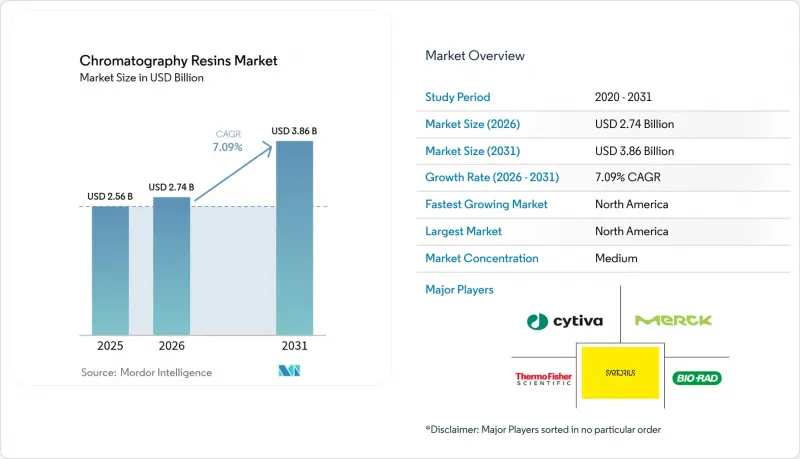
Mordor Intelligence에 의하면, 크로마토그래피 수지 시장 규모는 2025년에 25억 6,000만 달러로 평가되었고, 2026년 27억 4,000만 달러에서 2031년까지 38억 6,000만 달러에 이를 것으로 예측되며, 예측 기간(2026-2031년) CAGR은 7.09%를 기록할 전망입니다.
본 보고서는 원료별(천연 유래 및 합성 유래), 기술별(이온 교환 크로마토그래피 수지, 친화성 크로마토그래피 수지 등), 제품 유형별(프로테인 A, 이온 교환 등), 최종 사용자 산업(제약, 수자원·환경 관련 기관 등), 지역(아시아태평양, 북미, 유럽, 남미, 중동 및 아프리카)별로 분류되어 있습니다.
전 세계 크로마토그래피 수지 시장 동향 및 인사이트
단일클론 항체 생산에 대한 수요 증가
세계 단일클론 항체(mAb) 생산량은 2030년까지 연평균 성장률(CAGR) 13.23%로 계속 증가할 것으로 예상되며, 항체 역가가 10 g/L를 초과함에 따라 수지 소비량도 병행하여 증가하여 프로테인 A 베드는 용량 한계에 도달하고 있습니다. Toyopearl GigaCap S-650M과 같은 대용량 대체 제품은 90 g/L를 초과하는 동적 결합 능력을 발휘하여 기존 매체의 2배 이상의 성능을 실현하고 있습니다. 치료 분야 가치의 51%를 종양학이 차지하고 있으며, 자가면역 질환 파이프라인이 가장 빠르게 확대되면서 정제 수요의 폭도 넓어지고 있습니다. 북미는 항체 생산량의 41.04% 점유율을 유지하고 있지만, 아시아태평양은 연평균 성장률(CAGR) 13.24%로 성장하고 있어 수지 수요의 중심지가 다양화되고 있습니다. 현재 mAb 공급의 78%를 체외 생산이 차지하고 있어, 다운스트림 공정에서의 수지 기술이 전 세계 바이오의약품 접근성을 어떻게 뒷받침하고 있는지가 부각되고 있습니다.
신흥 시장의 백신 파이프라인 확대
인도, 중국, 브라질, 인도네시아에서 팬데믹 이후 생산 능력이 확충됨에 따라 백신 수요는 견조한 추세를 보이고 있으며, 바이러스 및 플라스미드 불순물을 효율적으로 제거하는 수지에 대한 수요가 높아지고 있습니다. Bio-Rad사의 CHT 세라믹 하이드록시아파타이트는 인플루엔자 및 뎅기열 바이러스 입자의 75% 이상을 포획하는 동시에 숙주 단백질을 90%까지 감소시킵니다. Repligen/Navigo사의 스파이크 단백질 친화성 수지와 같은 새로운 리간드는 mRNA 백신 및 바이러스 벡터 백신을 위해 특별히 설계된 솔루션의 좋은 예입니다. EMA에서 WHO에 이르는 규제 당국은 현재 강력한 바이러스 제거 시험을 의무화하고 있으며, 이로 인해 수지 개발자들은 대규모 백신 플랫폼을 위해 더 높은 선택성과 유동성 견고성을 검증해야 하는 압박을 받고 있습니다.
수지 조달 및 검증 비용의 급등
프로테인 A 수지의 가격은 리터당 9,000-12,000달러까지 상승했지만, 대부분의 제품의 결합 능력은 40g/L 미만에 그치고 있어 임상시험과 상업 생산 모두에서 예산을 압박하고 있습니다. 리드 타임이 길어(대부분의 경우 15주를 초과함) 기업들은 안전 재고를 늘리고 운전 자금을 묶어둘 수밖에 없습니다. 공급업체나 로트가 변경될 때마다 동등성 시험이 필요하고, 일정이 지연되며 방대한 문서 작성이 요구되기 때문에 전체 검증 비용이 불어납니다. 중소규모 기업이나 신흥 시장의 공장에서는 이러한 비용을 흡수하기가 더욱 어려워, 국내 생산의 규모 확대가 주춤하고 있습니다.
부문 분석
2025년 매출액 중 합성계 소재가 75.78%를 차지하고 있으며, 이는 제조업체들이 로트 간 균일성과 높은 기계적 강도를 중시하고 있음을 반영합니다. 이러한 특성 덕분에 더 높은 컬럼, 더 빠른 유속, 그리고 손쉬운 규모 확대가 가능해져, 생산 주기가 지속적으로 단축되고 있는 크로마토그래피 수지 시장에서 필수적인 요소로 자리 잡고 있습니다. 대조적으로, 천연 유래 운반체(주로 아가로스)는 불안정한 단백질을 보호하는 온화한 화학적 특성을 가지고 있어, 틈새 시장인 백신 및 유전자 치료용 벡터에 적용하기에 적합합니다. 천연 유래 부문의 예상 연평균 성장률(CAGR) 8.48%는 재생 가능한 원료와 환경 부담 저감에 대한 관심이 다시 높아지고 있음을 나타내며, 특히 친환경 제조에 대한 인센티브가 존재하는 유럽에서 두드러지게 나타납니다.
도입 추세를 살펴보면 이중 구조가 두드러지게 나타납니다. 다국적 기업들은 항체의 연속 포집을 위해 합성 폴리메타크릴레이트 컬럼을 도입하고 있는 반면, 지역 수탁 제조업체들은 다양한 품목에 대응하기 위해 아가로스나 셀룰로오스를 사용하여 생산 능력을 확대되고 있습니다. 불순물 위험에 대한 규제 당국의 관심이 높아짐에 따라 기업의 선호도는 더욱 합성 수지로 기울고 있지만, 생체 적합성에 대한 우려로 인해 천연 유래 등급은 여전히 소아용 및 세포 치료 파이프라인에서 채택되고 있습니다. 두 형태 모두 첨단 리간드 화학 기술을 강화하고 있기 때문에 크로마토그래피 수지 시장의 경쟁은 기질 자체보다는 동적 용량이나 알칼리 안정성과 같은 성능 특성에 초점이 맞추어질 것입니다.
2025년 매출액 중 이온 교환 수지가 38.92%를 차지하며, 포집, 중간, 정제 각 단계에서 수십 년에 걸친 중요한 역할을 확고히 하고 있습니다. 그 폭넓은 작동 범위, 확장성, 그리고 비교적 낮은 비용이라는 특징은 사실상 모든 치료용 단백질에 적합합니다. 한편, 혼합 모드 및 다중 모드 매체는 연평균 8.14%의 복합 성장률이 예상됩니다. 이는 이온성, 소수성 및 수소 결합 상호작용을 결합함으로써 응집체나 숙주 세포 단백질을 단일 공정에서 제거할 수 있고, 완충액 사용량과 스키드 설치 면적을 줄일 수 있기 때문입니다.
단백질 A 컬럼은 가격이 비싸지만 여전히 IgG 포획에 필수적인 반면, 소수성 상호작용 유닛은 연속 정제 과정에서 응집을 억제합니다. 크기 배제 장치는 전단력을 동반하지 않고 완충액 교환 및 탈염을 수행할 수 있으며, 이 틈새 분야의 크로마토그래피 수지 시장 규모는 연평균 성장률(CAGR) 7.99%로 꾸준히 확대될 것으로 예측됩니다. 리간드 결합형 맞춤형 솔루션은 이중 특이성 항체 및 바이러스 벡터에 대한 수요에 힘입어 꾸준히 파일럿 규모로 도입되고 있습니다. 공정 집약화 로드맵에 따르면, 멀티모달 베드가 이온 교환과 HIC를 순차적으로 수행하는 공정을 대체하는 경향이 강해질 것으로 시사되며, 크로마토그래피 수지 시장 내 가치의 중심 이동이 두드러지고 있습니다.
지역별 분석
북미는 2025년에 매출의 42.21%를 차지하며 1위를 차지할 전망이며, 2031년까지의 지역별 연평균 성장률(CAGR)에서도 8.37%로 가장 높은 성장률을 보일 것으로 예측됩니다. Cytiva사와 Pall사의 15억 달러 규모 프로그램, Purolite사의 펜실베니아주 신규 아가로스 공장 등 적극적인 투자가 이루어지고 있으며, 이는 리드타임 단축과 바이오프로세스 공급망의 안정화를 목적으로 하고 있습니다. 2024년에 강화된 FDA의 분석 지침은 수지의 일관성에 대한 전 세계적인 기대를 높였으며, 북미가 규제 기준의 중심지로서의 입지를 공고히 하고 있습니다.
유럽은 금액 기준으로 2위를 차지하며, 오랜 기간 축적된 GMP 전문 지식과 지속가능성에 대한 중요성 증대가 맞물려 성장하고 있습니다. EMA의 공정 검증 규정은 고분해능 분리를 의무화하고, 재활용이 가능하거나 폐기물이 적은 매트릭스를 권장하고 있습니다. 머크 KGaA의 다름슈타트에 3억 유로 규모의 연구 거점 건설과 도소 바이오사이언스의 독일 내 사업 확대와 같은 투자가 국내 공급 체계를 강화하고 있습니다. 친환경 제조에 대한 인센티브로 인해, 크로마토그래피 수지 시장에서 제조업체들은 바이오 아가로스 및 폐쇄형 용매 시스템으로의 전환을 더욱 가속화하고 있습니다.
아시아태평양에서는 중국, 일본, 한국의 바이오의약품 프로그램과 아세안(ASEAN)의 백신 이니셔티브에 힘입어 가장 활발한 구조적 확장이 나타나고 있습니다. 도소(Tosoh)의 요카이치(Yokkaichi) 신공장은 지역 수요에 맞춘 생산 능력 조정을 구현하고 있습니다. 정책 입안자들은 현지 단일클론항체(mAb) 및 세포 치료제 공장에 보조금을 지원하고 있으며, 다국적 기업들이 생산을 현지화함에 따라 대용량 수지 소비량이 증가하고 있습니다. 인도와 인도네시아에서는 팬데믹에 대비해 비축량을 늘리고 있으며, 연속 유동 배지 고객 기반을 확대되고 있습니다.
남미에서는 브라질과 아르헨티나에서 생산 체제가 점차 정비되고 있으며, 공중보건상의 백신 수요에 초점을 맞추었습니다. 이 분야에서는 바이러스 제거를 목적으로 하는 듀얼 리간드 혼합 모드 베드에 대한 수요가 점점 더 높아지고 있습니다. 중동 및 아프리카는 여전히 발전 단계에 있지만, 인슐린,혈장, 백신의 자급자족을 추구하는 걸프 국가들의 제약 클러스터 주변에서 국지적인 성장이 나타나고 있습니다. 전반적으로 비OECD 지역은 현재 시장 점유율이 적지만, 두 자릿수 성장이 예상되어 크로마토그래피 수지 시장의 세계화를 뒷받침하고 있습니다.
기타 혜택:
- 엑셀 형식 시장 예측(ME) 시트
- 3개월간의 애널리스트 지원
자주 묻는 질문
목차
제1장 서론
제2장 조사 방법
제3장 주요 요약
제4장 시장 구도
제5장 시장 규모와 성장 예측
제6장 경쟁 구도
제7장 시장 기회와 향후 전망
LSH 26.09.10According to Mordor Intelligence, the chromatography resins market size was valued at USD 2.56 billion in 2025 and estimated to grow from USD 2.74 billion in 2026 to reach USD 3.86 billion by 2031, at a CAGR of 7.09% during the forecast period (2026-2031).
This report is Segmented by Origin (Natural-Based and Synthetic-Based), Technology (Ion Exchange Chromatography Resins, Affinity Chromatography Resins, and More), Product Type (Protein-A, Ion Exchange and More), End-User Industry (Pharmaceuticals, Water and Environmental Agencies, and More), and Geography (Asia-Pacific, North America, Europe, South America, and Middle-East and Africa).
Global Chromatography Resins Market Trends and Insights
Rising Demand for Monoclonal-Antibody Production
Global mAb volumes keep climbing at a projected 13.23% CAGR to 2030, and resin consumption rises in parallel as antibody titers top 10 g/L, pushing Protein A beds to capacity limits. High-capacity alternatives such as Toyopearl GigaCap S-650M deliver dynamic binding above 90 g/L, more than doubling traditional media. Oncology indications account for 51% of therapeutic value, with autoimmune pipelines expanding fastest and broadening purification needs. North America retains 41.04% share of antibody output, yet Asia-Pacific advances at 13.24% CAGR, diversifying resin demand centers. In-vitro production now holds 78% of mAb supply, underscoring how downstream resin technology underwrites global access to biologics.
Expanding Vaccine Pipelines Across Emerging Markets
Post-pandemic capacity build-outs in India, China, Brazil and Indonesia keep vaccine demand buoyant, elevating need for resins that efficiently clear viral and plasmid impurities. Bio-Rad's CHT Ceramic Hydroxyapatite captures more than 75% of influenza and dengue viral particles while trimming host proteins by 90%. New ligands such as Repligen/Navigo's spike-protein affinity resin exemplify purpose-built solutions for mRNA and viral-vector vaccines. Regulatory agencies from EMA to WHO now stipulate robust viral clearance studies, driving resin developers to validate higher selectivity and flow robustness for large-scale vaccine platforms.
High Resin Procurement and Validation Cost
Protein A resin prices have climbed to USD 9,000-12,000 per liter, yet most products bind under 40 g/L, stressing budgets for both clinical and commercial runs. Lengthy lead times-often beyond 15 weeks-force firms to raise safety stocks and tie up working capital. Each supplier or lot change triggers comparability testing, extending timelines and requiring extensive documentation that inflates overall validation expenses. Smaller firms and emerging-market plants find it harder to absorb these costs, slowing domestic production scale-up.
Other drivers and restraints analyzed in the detailed report include:
- Transition Toward Single-Use Downstream Systems
- Regulatory Push for Higher-Purity Biologics
- Scarcity of Skilled Downstream-Processing Professionals
For complete list of drivers and restraints, kindly check the Table Of Contents.
Segment Analysis
Synthetic-based materials represented 75.78% of 2025 revenue, reflecting manufacturers' preference for lot-to-lot consistency and high mechanical strength. Such characteristics enable taller columns, faster flow, and straightforward scale-up, vital to the chromatography resins market where production cycles continue to shorten. In contrast, natural media-chiefly agarose-retain gentler chemistries that safeguard labile proteins, positioning them for niche vaccines and gene-therapy vectors. The natural segment's 8.48% forecast CAGR signals renewed interest in renewable feedstocks and lower environmental footprints, especially in Europe where green- manufacturing incentives exist.
Adoption patterns illustrate a two-tier structure: multinationals install synthetic polymethacrylate beds for continuous antibody capture, whereas regional contract manufacturers expand capacity with agarose or cellulose for multi-product suites. The regulatory spotlight on adventitious-agent risk further pivots enterprise preference toward synthetics, yet biocompatibility concerns still pull natural grades into pediatric and cell-therapy pipelines. With both formats strengthening advanced ligand chemistries, competition will revolve less around base matrix and more around performance attributes such as dynamic capacity and alkaline stability in the chromatography resins market.
Ion-exchange resins accounted for 38.92% of 2025 sales, cementing a decades-long role across capture, intermediate, and polishing stages. Their broad operating window, scalability, and relative affordability suit virtually every therapeutic protein. However, mixed-mode and multimodal media are projected to compound at 8.14% annually, because combined ionic, hydrophobic, and hydrogen-bond interactions allow single-step removal of aggregates and host-cell proteins, trimming buffer usage and skid footprint.
Protein A columns remain essential for IgG capture despite premium pricing, while hydrophobic-interaction units mitigate aggregation in continuous polishing. Size-exclusion devices fulfill buffer exchange or desalting without shear, an area where the chromatography resins market size for this niche is projected to widen steadily with a 7.99% CAGR. Ligand-coupled custom solutions are steadily entering pilot scale, driven by bispecific antibodies and viral vectors. Process-intensification roadmaps suggest multimodal beds will increasingly displace sequential ion-exchange-plus-HIC operations, underscoring shifting value pools inside the chromatography resins market
Complete Report Scope:
- By Origin
- Natural-based
- Agarose
- Cellulose
- Synthetic-based
- Silica Gel
- Aluminum Oxide
- Polystyrene
- Other Synthetic Based Resins
- Natural-based
- By Product Type
- Protein-A
- Ion-Exchange
- Mixed-Mode and Multimodal
- Hydrophobic-Interaction
- Size-Exclusion
- Ligand-Coupled Custom Resins
- By Technology
- Affinity Chromotography Resins
- Ion-Exchange Chromotography Resins
- Hydrophobic-Interaction Chromotography Resins
- Size-Exclusion Chromotography Resins
- Other Technologies
- By End-user Industry
- Pharmaceuticals
- Biotechnology
- Drug Discovery
- Drug Production
- Water and Environmental Agencies
- Food and Beverages
- Other End-user Industries
- Pharmaceuticals
- By Geography
- By Geography
- Asia-Pacific
- China
- Japan
- India
- South Korea
- ASEAN Countries
- Rest of Asia-Pacific
- North America
- United States
- Canada
- Mexico
- Europe
- Germany
- United Kingdom
- France
- Italy
- Spain
- Russia
- NORDIC Countries
- Rest of Europe
- South America
- Brazil
- Argentina
- Rest of South America
- Middle-East and Africa
- Saudi Arabia
- South Africa
- Rest of Middle-East and Africa
- Asia-Pacific
- By Geography
Geography Analysis
North America led with a 42.21% revenue contribution in 2025 and mirrors the fastest regional CAGR at 8.37% through 2031. Aggressive investments-Cytiva and Pall's USD 1.5 billion program and Purolite's new Pennsylvania agarose plant-aim to shorten lead times and insulate bioprocess supply chains. FDA analytical guidelines that tightened in 2024 cascade global expectations for resin consistency, anchoring North America's status as regulatory reference hub.
Europe ranked second in value terms, combining long-standing GMP expertise with rising emphasis on sustainability. EMA process-validation rules force high-resolution separation and lean toward recyclable or lower-waste matrices. Investments such as Merck KGaA's EUR 300 million research hub in Darmstadt and Tosoh Bioscience's German expansion reinforce domestic supply. Green manufacturing incentives further nudge producers toward bio-based agarose and closed-loop solvent systems inside the chromatography resins market.
Asia-Pacific records the briskest structural expansion, spurred by Chinese, Japanese and Korean biologics programs as well as ASEAN vaccine initiatives. Tosoh's new Yokkaichi plant exemplifies capacity alignment with regional demand. Policymakers funnel grants into local mAb and cell-therapy plants, raising consumption of high-capacity resins as multinationals localize production. India and Indonesia add volume in pandemic- readiness stockpiles, extending the customer base for continuous-flow compatible media.
South America sees gradual build-up in Brazil and Argentina, focusing on public-health vaccine needs that increasingly seek dual-ligand mixed-mode beds for viral clearance. The Middle East and Africa remain nascent but exhibit pockets of growth around Gulf state pharma clusters pursuing insulin, plasma, and vaccine self-sufficiency. Collectively, non-OECD regions contribute modest shares today yet represent double-digit growth prospects, underscoring the globalization of the chromatography resins market.
- Avantor, Inc
- Bio-Rad Laboratories, Inc.
- Bio-Works
- Cytiva
- Dupont
- JSR Life Sciences, LLC
- Kaneka Eurogentec S.A.
- Merck KGaA
- Mitsubishi Chemical Corporation
- Purolite
- Repligen Corporation
- Sartorius Stedim Biotech
- Sepax Technologies
- Thermo Fisher Scientific
- Thermo Vectorlabs
Additional Benefits:
- The market estimate (ME) sheet in Excel format
- 3 months of analyst support
TABLE OF CONTENTS
1 Introduction
- 1.1 Study Assumptions and Market Definition
- 1.2 Scope of the Study
2 Research Methodology
3 Executive Summary
4 Market Landscape
- 4.1 Market Overview
- 4.2 Market Drivers
- 4.2.1 Rising demand for monoclonal-antibody (mAb) production
- 4.2.2 Expanding vaccine pipelines across emerging markets
- 4.2.3 Transition toward single-use downstream systems
- 4.2.4 Regulatory push for higher-purity biologics
- 4.2.5 Need for high-flow resins in continuous bioprocessing
- 4.3 Market Restraints
- 4.3.1 High resin procurement and validation cost
- 4.3.2 Scarcity of skilled downstream-processing professionals
- 4.3.3 Competition from disposable membrane chromatography
- 4.4 Value Chain Analysis
- 4.5 Porter's Five Forces
- 4.5.1 Bargaining Power of Suppliers
- 4.5.2 Bargaining Power of Buyers
- 4.5.3 Threat of New Entrants
- 4.5.4 Threat of Substitutes
- 4.5.5 Degree of Competition
5 Market Size and Growth Forecasts (Value)
- 5.1 By Origin
- 5.1.1 Natural-based
- 5.1.1.1 Agarose
- 5.1.1.2 Cellulose
- 5.1.2 Synthetic-based
- 5.1.2.1 Silica Gel
- 5.1.2.2 Aluminum Oxide
- 5.1.2.3 Polystyrene
- 5.1.2.4 Other Synthetic Based Resins
- 5.1.1 Natural-based
- 5.2 By Product Type
- 5.2.1 Protein-A
- 5.2.2 Ion-Exchange
- 5.2.3 Mixed-Mode and Multimodal
- 5.2.4 Hydrophobic-Interaction
- 5.2.5 Size-Exclusion
- 5.2.6 Ligand-Coupled Custom Resins
- 5.3 By Technology
- 5.3.1 Affinity Chromotography Resins
- 5.3.2 Ion-Exchange Chromotography Resins
- 5.3.3 Hydrophobic-Interaction Chromotography Resins
- 5.3.4 Size-Exclusion Chromotography Resins
- 5.3.5 Other Technologies
- 5.4 By End-user Industry
- 5.4.1 Pharmaceuticals
- 5.4.1.1 Biotechnology
- 5.4.1.2 Drug Discovery
- 5.4.1.3 Drug Production
- 5.4.2 Water and Environmental Agencies
- 5.4.3 Food and Beverages
- 5.4.4 Other End-user Industries
- 5.4.1 Pharmaceuticals
- 5.5 By Geography
- 5.5.1 By Geography
- 5.5.1.1 Asia-Pacific
- 5.5.1.1.1 China
- 5.5.1.1.2 Japan
- 5.5.1.1.3 India
- 5.5.1.1.4 South Korea
- 5.5.1.1.5 ASEAN Countries
- 5.5.1.1.6 Rest of Asia-Pacific
- 5.5.1.2 North America
- 5.5.1.2.1 United States
- 5.5.1.2.2 Canada
- 5.5.1.2.3 Mexico
- 5.5.1.3 Europe
- 5.5.1.3.1 Germany
- 5.5.1.3.2 United Kingdom
- 5.5.1.3.3 France
- 5.5.1.3.4 Italy
- 5.5.1.3.5 Spain
- 5.5.1.3.6 Russia
- 5.5.1.3.7 NORDIC Countries
- 5.5.1.3.8 Rest of Europe
- 5.5.1.4 South America
- 5.5.1.4.1 Brazil
- 5.5.1.4.2 Argentina
- 5.5.1.4.3 Rest of South America
- 5.5.1.5 Middle-East and Africa
- 5.5.1.5.1 Saudi Arabia
- 5.5.1.5.2 South Africa
- 5.5.1.5.3 Rest of Middle-East and Africa
- 5.5.1.1 Asia-Pacific
- 5.5.1 By Geography
6 Competitive Landscape
- 6.1 Market Concentration
- 6.2 Strategic Moves
- 6.3 Market Share (%)/Ranking Analysis
- 6.4 Company Profiles (includes Global level Overview, Market level overview, Core Segments, Financials as available, Strategic Information, Market Rank/Share for key companies, Products and Services, and Recent Developments)
- 6.4.1 Avantor, Inc
- 6.4.2 Bio-Rad Laboratories, Inc.
- 6.4.3 Bio-Works
- 6.4.4 Cytiva
- 6.4.5 Dupont
- 6.4.6 JSR Life Sciences, LLC
- 6.4.7 Kaneka Eurogentec S.A.
- 6.4.8 Merck KGaA
- 6.4.9 Mitsubishi Chemical Corporation
- 6.4.10 Purolite
- 6.4.11 Repligen Corporation
- 6.4.12 Sartorius Stedim Biotech
- 6.4.13 Sepax Technologies
- 6.4.14 Thermo Fisher Scientific
- 6.4.15 Thermo Vectorlabs
7 Market Opportunities and Future Outlook
- 7.1 White-space and unmet-need assessment


