

|
시장보고서
상품코드
2122028
APC(Advanced Process Control) : 시장 점유율 분석, 업계 동향과 통계, 성장 예측(2026-2031년)Advanced Process Control - Market Share Analysis, Industry Trends & Statistics, Growth Forecasts (2026 - 2031) |
||||||
 Mordor Intelligence
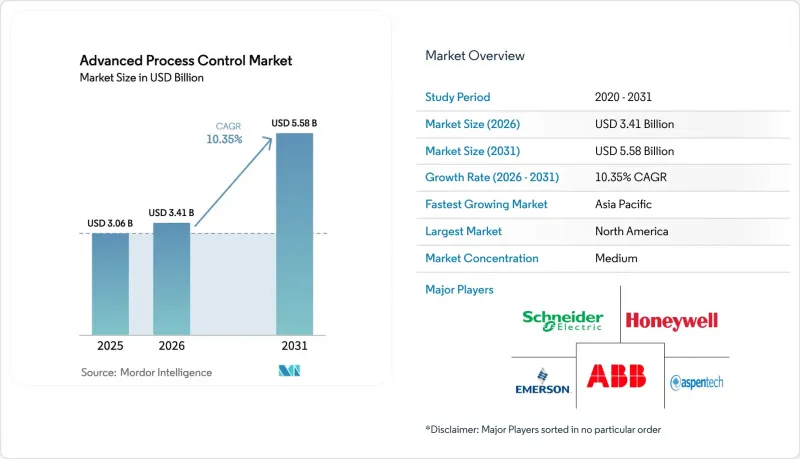
Mordor Intelligence에 따르면 APC(Advanced Process Control) 시장 규모는 2025년에 30억 6,000만 달러로 평가되며, 2026년 34억 1,000만 달러에서 2031년까지 55억 8,000만 달러에 달할 것으로 예측되고 있으며, 예측 기간(2026-2031년)에 CAGR은 10.35%에 달할 전망입니다.
이 보고서는 구성 요소(하드웨어, 소프트웨어, 서비스), 제품 유형(고급 규제 제어 등), 배포 방식(온프레미스, 클라우드 기반, 하이브리드), 공정 유형(연속 공정, 배치 공정), 최종사용자 산업(석유 및 가스, 화학·석유화학 등) 및 지역별로 분류되어 있습니다. 시장 전망은 금액(달러) 기준으로 제시되어 있습니다.
글로벌 첨단 공정 제어 시장의 동향 및 인사이트
실시간 에너지 비용 최적화에 대한 필요성
변동이 심한 전력 및 가스 현물 가격으로 인해 플랜트의 경제성 담당 팀은 에너지를 고정비 항목이 아닌 변동하는 제약 요인으로 취급할 수밖에 없게 되었습니다. 독일의 자유화 시장에서는 데이-어헤드(다음 날) 경매 가격이 한 세션 내에서 100유로(113달러) 이상 변동하게 되어, 화학 단지는 배치 처리를 비수기 시간대로 미루거나 수요 피크 시간대에는 부하를 줄여야만 하는 상황에 처해 있습니다. 고급 공정 제어 루프는 요금 데이터를 수집하여 이익률을 유지하기 위해 환류비, 압축기 흡입량 및 증기 감압을 자동으로 조정합니다. 미국 멕시코만 연안 지역의 정유소들도 지역 가스 허브가 헨리 허브에서 분리되었을 때 이와 유사한 압박에 직면하고 있습니다. 몇 분마다 원료 흐름을 재분배하고 히터 가동량을 조정할 수 있는 제어 시스템을 도입함으로써 유틸리티 비용을 두 자릿수 비율로 절감할 수 있습니다. 이러한 기능을 도입한 플랜트에서는 일반적으로 12-18개월 이내에 소프트웨어 구독 비용을 회수할 수 있으므로, 이후 최적화 프로젝트에 대한 이사회 승인이 신속하게 이루어집니다.
APC와 IIoT 및 AI 분석의 통합
엣지 게이트웨이는 현재 진동, 온도, 스펙트럼 데이터를 로컬에서 전처리하여 이상 점수를 모델 예측 제약 행렬에 직접 전송하고 있습니다. 이러한 융합을 통해 제어 담당자는 경보에 반응하는 대신, 고장이 발생하기 전에 설비의 정격 출력을 낮출 수 있게 됩니다. 에머슨의 DeltaV 에지 환경은 필드 컨트롤러에 TensorFlow-Lite 모델을 내장하여 압력 손실 및 열유속 프록시를 사용해 조성을 추정함으로써, 온라인 크로마토그래프의 10분 지연을 피합니다. 아스펜테크(AspenTech)가 걸프 코스트의 크래커 공장에서 Mtell의 예측 유지보수와 DMC3 제어를 결합한 결과, 턴어라운드 주기가 1년 가까이 연장되어 2,500만 달러 상당의 가동 시간을 확보할 수 있었습니다. 정책 면에서도 호재가 되고 있습니다. 중국 국무원(국무원)은 2025년까지 대규모 공장의 절반이 스마트 제조 시스템을 도입하는 것을 목표로 하고 있으며, IIoT와 APC의 융합은 이사회 수준의 평가 지표가 되고 있습니다.
높은 초기 비용과 통합의 복잡성
플랜트 전체를 최적화하려면 단일 컨트롤러에 50만 달러, 사이트 전체 솔루션에는 1,000만 달러의 비용이 소요될 수 있습니다. 구형 제어 시스템을 사후에 도입하려면 히스토리안 업그레이드, 부문화된 네트워크, 맞춤형 필드버스 게이트웨이가 필요하며, 이는 예산과 일정을 압박합니다. 최근 업계 조사에 따르면 시운전이 공급업체의 예정보다 30% 이상 지연된 경우, 42%의 운영자가 프로젝트를 연기했으며, 그 원인은 대개 예상치 못한 루프 간 상호작용 때문이었습니다. 1980년대 공압식 계측 시스템으로 건설된 남미의 플랜트에서는 우선 아날로그 신호를 디지털화해야 하는데, 이로 인해 수개월 분의 작업이 추가되어 투자 회수 기간이 기업의 허용 범위를 초과하게 됩니다. 구독형 라이선싱은 초기 자금 부담을 줄여주지만, 연간 10만 달러를 초과하는 이용료는 대차대조표상 2년 이내에 투자 회수를 달성해야 하는 기업에게는 여전히 장벽으로 작용하고 있습니다.
부문 분석
2025년에는 모델 예측 제어 패키지, 추론형 센서, 실시간 최적화기가 고급 공정 제어 시장의 가치를 주도함에 따라 소프트웨어가 매출의 51.71%를 차지했습니다. 그러나 서비스 부문은 2031년까지 연평균 성장률(CAGR) 11.22%로 확대될 것으로 예상되어, 하드웨어를 능가하는 성장이 전망됩니다. 이는 플랜트가 컨트롤러를 최상의 성능으로 유지하기 위해 분기별 재조정, 디지털 트윈과의 동기화, IEC 62443 준수 침입 테스트가 필요하기 때문입니다. 구독 모델은 자본 지출을 운영비로 전환하여, 경기 변동에 민감한 업계의 재무적 요구를 충족시킵니다. Emerson의 DeltaV SaaS는 라이선싱, 호스팅, 분기별 상태 점검을 컨트롤러 1대당 요금으로 일괄 제공하여 중견 제조업체의 진입 장벽을 낮추고 있습니다. 지연 시간 제약으로 인해 클라우드와의 왕복 통신이 허용되지 않는 상황에서는 하드웨어가 여전히 중요합니다. 폴리머 반응기나 촉매 크래커의 경우, 100밀리초 미만의 루프 타임을 유지하기 위해 에지 서버를 현장에 계속 설치하고 있습니다.
2세대 도입 이후, 모델을 방치하면 성능이 저하된다는 엄중한 교훈이 드러났습니다. 20년 전 도입된 컨트롤러의 거의 절반이 3년 이내에 가동 불능 상태에 빠졌습니다. 현재 공급업체들은 계약에 유지보수를 포함하고 있으며, 일부 기업은 성능을 보증하기도 합니다. KPI 임계값을 하회할 경우, 구독 요금 할인이 적용됩니다. 이러한 서비스 중심의 접근 방식은 수익을 안정화시킬 뿐만 아니라, 고객 락인을 강화하고, 풍부한 분야 전문가를 보유한 공급업체 간의 경쟁을 심화시키고 있습니다.
2025년에는 고급 규제 제어가 매출의 38.28%를 차지했으나, 원료의 변동성이나 선형 모델로는 완전히 파악할 수 없는 바이오의약품 발효 공정 등으로 인해 비선형 MPC는 연평균 성장률(CAGR) 10.84%로 증가할 것으로 예측됩니다. 다변량 예측 제어는 원유 증류 등 이득이 준선형으로 유지되는 정상 상태의 유닛에서 여전히 핵심적인 역할을 수행하고 있습니다. 추론 제어는 분석 장비가 부족한 현장에서 활용이 확대되고 있습니다. 중동의 한 정유소에서는 6대의 크로마토그래프를 신경망 소프트 센서로 대체하여 연간 40만 달러의 유지보수 비용을 절감했습니다.
연속식 제약 발효조는 이러한 변화를 여실히 보여주고 있습니다. 세포 증식 동태는 거의 1시간마다 변화하므로 Aspen Hybrid Models는 제1원리와 기계학습을 융합하여 이득을 실시간으로 갱신함으로써 유효 성분의 편차를 18% 줄였습니다. 폴리머 제조업체도 유사한 요구를 가지고 있습니다. 용융 지수(MI)의 목표값은 촉매 로트 변경에 따라 변동하므로 적응형 모델이 필수적입니다. 규제 당국이 블랙박스형 AI를 면밀히 검토하는 한편, 각 벤더사는 경계 제약 최적화 및 모델 설명 가능성 모듈을 활용하여 투명성을 높이고, 안전 계장 시스템 감사 담당자의 요구 사항을 충족시키고 있습니다.
지역별 분석
아시아태평양은 2025년 매출의 34.53%를 차지하며, 2031년까지 연평균 성장률(CAGR) 11.81%로 성장하여 세계에서 가장 빠른 성장세를 보일 것으로 전망됩니다. 중국은 자동화 비용의 최대 20%를 환급하는 보조금을 통해 스마트 팩토리로의 개조를 지원하고 있으며, 이에 따라 내몽골의 석탄 화학 복합 시설과 저장성의 정유·석유화학 허브에서 플랜트 전반에 걸친 MPC 도입이 진행되고 있습니다. 인도의 ‘생산 연계형 인센티브 제도’는 신규 건설(그린필드) 제약 자동화에 대해 보조금을 지급하고 있으며, 2025년 한 해에만 12개 플랜트가 클라우드 호스팅형 컨트롤러의 가동을 시작했습니다. 일본의 ‘사회 5.0’ 정책은 노후화된 식품 및 정밀화학 생산 라인에 대해 직관적인 운영자 지원 체계로의 전환을 추진하고 있습니다. 한편, 한국의 석유화학 클러스터에서는 2030년까지 온실가스 배출량을 35% 감축해야 하는 의무를 이동하기 위해 1990년대 제어 시스템의 개보수가 진행되고 있습니다.
북미와 유럽은 시장 전체의 평균 수준에 가까워지고 있지만, 첨단인 도입 면에서는 여전히 선두를 달리고 있습니다. 2020년 이후 미국 멕시코만 연안에 신설된 15기의 에틸렌 크래커는 모두 올레핀 수율을 극대화하기 위해 반응기 가동, 급냉, 분리를 조정하는 최적화 스위트를 갖추고 있습니다. 유럽의 더욱 엄격한 배출 규제로 인해 시멘트 공장과 제철소에서는 연속 모니터링과 연소 제어의 통합이 진행되고 있으며, 이는 다변수 알고리즘에 적합한 조합입니다. 미국에 비해 3배나 높은 가스 비용을 감당하고 있는 독일의 화학 단지는 증기 네트워크의 균형 조정을 수행하는 MPC(모델 예측 제어)를 활용하여 1년 이내에 투자 회수를 실현하고 있습니다.
중동 및 아프리카, 남미 및 아시아의 신흥 국가에서는 도입 현황에 편차가 보입니다. 사우디아라비아의 자프라 가스 프로젝트에서는 외딴 지역의 스키드에 엣지 AI를 도입하여, 다란의 기술자가 수백 킬로미터 떨어진 유정을 모니터링하고 있습니다. 브라질의 해상 유전에서는 아시아태평양의 탑사이드 설비가 포화 상태에 이르렀을 때, 해저 다상 최적화 기술을 활용하여 생산량을 늘리고 있습니다. 남아프리카의 석탄 액화 플랜트에서는 톤당 190랜드(10달러)의 탄소세 하에서 CO₂ 배출 강도를 억제하기 위해 규제에 기반한 피셔-트로프스 반응기 제어 시스템을 도입하고 있습니다. 여전히 장벽이 존재하며, 현지 인력 부족, 제한된 자본 예산, 공급업체 지원 체계의 미비로 인해 프로젝트는 현장 전체로 확대되지 못하고 단일 유닛의 시범 사업 수준에 그치는 경우가 많습니다.
기타 혜택:
- 엑셀 형식의 시장 예측(ME) 시트
- 3개월간의 애널리스트 지원
자주 묻는 질문
목차
제1장 서론
제2장 조사 방법
제3장 개요
제4장 시장 구도
제5장 시장 규모와 성장 예측
제6장 경쟁 구도
제7장 시장 기회와 향후 전망
KSA 26.09.03According to Mordor Intelligence, the advanced process control market size was valued at USD 3.06 billion in 2025 and is estimated to grow from USD 3.41 billion in 2026 to reach USD 5.58 billion by 2031, at a CAGR of 10.35% during the forecast period (2026-2031).
This report is Segmented by Component (Hardware, Software, and Services), Product Type (Advanced Regulatory Control, and More), Deployment Mode (On-Premises, Cloud-Based, and Hybrid), Process Type (Continuous Processes, and Batch Processes), End-User Industry (Oil and Gas, Chemicals and Petrochemicals, and More), and Geography. The Market Forecasts are Provided in Terms of Value (USD).
Global Advanced Process Control Market Trends and Insights
Real-Time Energy Cost Optimisation Needs
Volatile spot power and gas prices are forcing plant economics teams to treat energy as a moving constraint, not a fixed line item. In Germany's liberalized market, day-ahead auction prices now swing by more than EUR 100 (USD 113) within a single session, compelling chemical complexes to shift batch starts to off-peak windows or curtail load during spikes. Advanced process control loops ingest tariff feeds, then automatically trim reflux ratios, compressor draws, and steam let-downs to preserve margin. U.S. Gulf Coast refiners face similar pressure when regional gas hubs decouple from Henry Hub; controllers capable of re-routing feed and adjusting heater duty every few minutes can unlock double-digit percentage savings in utility spend. Plants that deploy these capabilities typically recover software subscription costs within 12-18 months, accelerating board approval for follow-on optimization projects.
Integration of APC with IIoT and AI Analytics
Edge gateways now preprocess vibration, temperature, and spectral data locally, pushing anomaly scores straight into model predictive constraint matrices. This fusion lets controllers derate equipment before failure rather than reacting to alarms. Emerson's DeltaV Edge Environment embeds TensorFlow-Lite models on field controllers, using pressure-drop and heat-flux proxies to estimate composition and sidestep the 10-minute lag of on-line chromatographs. When AspenTech coupled Mtell predictive maintenance with DMC3 control at a Gulf Coast cracker, turnaround intervals stretched by nearly a year, freeing USD 25 million of uptime. Policy adds tailwinds: China's State Council wants half of large factories to run smart manufacturing systems by 2025, making IIoT-APC convergence a board-level metric.
High Upfront Cost and Integration Complexity
Full-plant optimisation can cost USD 500 000 for a single controller or USD 10 million for a site-wide suite. Retrofitting older control systems demands historian upgrades, segmented networks, and custom fieldbus gateways, stretching budgets and schedules. A recent industry survey found 42% of operators delayed projects when commissioning overshot vendor timelines by more than 30 percent, usually due to unplanned loop interactions. South American plants built with 1980s pneumatic instrumentation must first digitize analog signals, adding months of work and pushing payback beyond corporate hurdles. Subscription licensing eases the initial cash hit, yet annual fees above USD 100 000 still deter companies whose balance sheets require two-year payback.
Other drivers and restraints analyzed in the detailed report include:
- Emission-Driven Regulatory Stringency
- Complexity of Mega Specialty Chemical and LNG Projects
- Scarcity of APC Expertise and Model Maintenance Burden
For complete list of drivers and restraints, kindly check the Table Of Contents.
Segment Analysis
In 2025, software represented 51.71% of revenue as model predictive control packages, inferential sensors, and real-time optimizers formed the core of advanced process control market value. Services, however, are forecast to expand at an 11.22% CAGR through 2031, outpacing hardware because plants need quarterly retuning, digital-twin synchronization, and IEC 62443 penetration tests to keep controllers at peak performance. Subscription models convert capital expense to operating expense, aligning with financial preferences in cyclical industries. Emerson's DeltaV SaaS bundles licenses, hosting, and quarterly health checks under a per-controller fee, cutting entry friction for mid-tier producers. Hardware still matters where latency permits no cloud round-trip; polymer reactors and catalytic crackers keep edge servers local to maintain sub-100 millisecond loop times.
Second-generation deployments expose a hard lesson: neglected models decay. Two decades ago, nearly half of installed controllers drifted out of service within three years. Today, vendors bake maintenance into contracts, and some even guarantee performance; if KPI thresholds slip, subscription discounts kick in. This service-heavy approach not only stabilizes revenue but also tightens customer lock-in, intensifying competition among suppliers that can marshal deep benches of domain specialists.
Advanced regulatory control accounted for 38.28% of revenue in 2025, yet non-linear MPC is projected to rise at a 10.84% CAGR thanks to feedstock variability and biologics fermentation that linear models cannot capture. Multivariable predictive control remains the backbone for steady-state units such as crude distillation where gains stay quasi-linear. Inferential controls flourish where analyzers are scarce; a Middle East refinery replaced six chromatographs with neural soft sensors and saved USD 400 000 in annual maintenance.
Continuous pharmaceutical fermenters illustrate the shift. Cell growth kinetics vary almost hourly, so Aspen Hybrid Models blend first-principles and machine learning to update gains on the fly, cutting potency variation by 18%. Polymer producers echo the need; melt-index targets move with catalyst lot changes, making adaptive models essential. While regulators scrutinize black-box AI, vendors improve transparency with bound-constrained optimization and model explainability modules, satisfying safety-instrumented-system auditors.
Complete Report Scope:
- By Component
- Hardware
- Software
- Services
- By Product Type
- Advanced Regulatory Control (ARC)
- Model Predictive Control (MPC)
- Non-Linear MPC
- Multivariable Predictive Control
- Inferential and Other Controls
- By Deployment Mode
- On-Premises
- Cloud-Based
- Hybrid
- By Process Type
- Continuous Processes
- Batch Processes
- By End-User Industry
- Oil and Gas
- Chemicals and Petrochemicals
- Pharmaceutical
- Food and Beverage
- Energy and Power
- Cement
- Metal Processing
- Pulp and Paper
- Rest of End-User Industry
- By Geography
- North America
- United States
- Canada
- Mexico
- South America
- Brazil
- Argentina
- Rest of South America
- Europe
- Germany
- United Kingdom
- France
- Italy
- Russia
- Rest of Europe
- Asia Pacific
- China
- Japan
- India
- South Korea
- Australia and New Zealand
- Rest of Asia Pacific
- Middle East and Africa
- Middle East
- Saudi Arabia
- United Arab Emirates
- Turkey
- Rest of Middle East
- Africa
- South Africa
- Nigeria
- Rest of Africa
- Middle East
- North America
Geography Analysis
Asia Pacific held 34.53% of 2025 revenue and will advance at an 11.81% CAGR through 2031, the fastest pace worldwide. China backs smart-factory retrofits with grants that refund up to 20% of automation spend, prompting coal-to-chemicals complexes in Inner Mongolia and refinery-petrochemical hubs in Zhejiang to install plant-wide MPC. India's Production-Linked Incentive scheme reimburses greenfield pharmaceutical automation, with twelve plants commissioning cloud-hosted controllers in 2025 alone. Japan's Society 5.0 policy steers aging food and fine-chemical lines toward intuitive operator support, while South Korean petrochemical clusters retrofit 1990s control systems to meet 35% greenhouse-gas cut mandates by 2030.
North America and Europe grow nearer to the overall market rate yet lead in advanced deployments. Fifteen ethylene crackers added since 2020 on the U.S. Gulf Coast all include optimisation suites that juggle furnace duty, quench cooling, and separation to maximize olefin yields. Europe's stricter emissions limits push cement and steel mills to integrate continuous monitoring with combustion control, a match suited to multivariable algorithms. German chemical complexes facing triple the U.S. gas cost rely on steam-network balancing MPC to hit one-year paybacks.
Middle East and Africa, South America, and emerging Asian nations display mixed adoption. Saudi Arabia's Jafurah gas program installs edge AI on remote skids so technologists in Dhahran supervise wells hundreds of kilometers away. Offshore Brazil fields use subsea multiphase optimisation to lift production when topside Asia Pacific pinches. South Africa's coal-to-liquid plants adopt regulatory-driven control of Fischer-Tropsch reactors to curb CO2 intensity under a ZAR 190 (USD 10) per ton carbon tax. Barriers persist; scarce local talent, lean capital budgets, and patchy vendor support often limit projects to single-unit pilots rather than full-site rollouts.
- ABB Ltd.
- Aspen Technology, Inc.
- Emerson Electric Co.
- General Electric Company
- Honeywell International Inc.
- Rockwell Automation, Inc.
- Schneider Electric SE
- Siemens AG
- Yokogawa Electric Corporation
- SUPCON Technology Co., Ltd.
- Hollysys Automation Technologies Ltd.
- Endress+Hauser Group Services AG
- Valmet Oyj
- Metso Corporation
- FLSmidth & Co. A/S
- AVEVA Group plc
- Azbil Corporation
- Imubit Inc.
- Onto Innovation Inc.
Additional Benefits:
- The market estimate (ME) sheet in Excel format
- 3 months of analyst support
TABLE OF CONTENTS
1 INTRODUCTION
- 1.1 Study Assumptions and Market Definition
- 1.2 Scope of the Study
2 RESEARCH METHODOLOGY
3 EXECUTIVE SUMMARY
4 MARKET LANDSCAPE
- 4.1 Market Overview
- 4.2 Market Drivers
- 4.2.1 Real-Time Energy Cost Optimisation Needs
- 4.2.2 Integration of APC with IIoT and AI Analytics
- 4.2.3 Emission-Driven Regulatory Stringency
- 4.2.4 Complexity of Mega Specialty Chemical and LNG Projects
- 4.2.5 Plug-and-Play Cloud APC for Modular Skids
- 4.2.6 Edge-Embedded AI Enables Self-Optimising Remote Operations
- 4.3 Market Restraints
- 4.3.1 High Upfront Cost and Integration Complexity
- 4.3.2 Scarcity of APC Expertise and Model Maintenance Burden
- 4.3.3 Cybersecurity Exposure in Cloud-Native Control Loops
- 4.3.4 Model Degradation in Bio-Based Continuous Fermentation Lines
- 4.4 Impact of Macroeconomic Factors on the Market
- 4.5 Industry Value-Chain Analysis
- 4.6 Regulatory Landscape
- 4.7 Technological Outlook
- 4.8 Analysis of New APC Systems vs Modernization
- 4.9 Porter's Five Forces Analysis
- 4.9.1 Bargaining Power of Suppliers
- 4.9.2 Bargaining Power of Buyers
- 4.9.3 Threat of New Entrants
- 4.9.4 Threat of Substitute Products
- 4.9.5 Degree of Competition
5 MARKET SIZE AND GROWTH FORECASTS (VALUE)
- 5.1 By Component
- 5.1.1 Hardware
- 5.1.2 Software
- 5.1.3 Services
- 5.2 By Product Type
- 5.2.1 Advanced Regulatory Control (ARC)
- 5.2.2 Model Predictive Control (MPC)
- 5.2.3 Non-Linear MPC
- 5.2.4 Multivariable Predictive Control
- 5.2.5 Inferential and Other Controls
- 5.3 By Deployment Mode
- 5.3.1 On-Premises
- 5.3.2 Cloud-Based
- 5.3.3 Hybrid
- 5.4 By Process Type
- 5.4.1 Continuous Processes
- 5.4.2 Batch Processes
- 5.5 By End-User Industry
- 5.5.1 Oil and Gas
- 5.5.2 Chemicals and Petrochemicals
- 5.5.3 Pharmaceutical
- 5.5.4 Food and Beverage
- 5.5.5 Energy and Power
- 5.5.6 Cement
- 5.5.7 Metal Processing
- 5.5.8 Pulp and Paper
- 5.5.9 Rest of End-User Industry
- 5.6 By Geography
- 5.6.1 North America
- 5.6.1.1 United States
- 5.6.1.2 Canada
- 5.6.1.3 Mexico
- 5.6.2 South America
- 5.6.2.1 Brazil
- 5.6.2.2 Argentina
- 5.6.2.3 Rest of South America
- 5.6.3 Europe
- 5.6.3.1 Germany
- 5.6.3.2 United Kingdom
- 5.6.3.3 France
- 5.6.3.4 Italy
- 5.6.3.5 Russia
- 5.6.3.6 Rest of Europe
- 5.6.4 Asia Pacific
- 5.6.4.1 China
- 5.6.4.2 Japan
- 5.6.4.3 India
- 5.6.4.4 South Korea
- 5.6.4.5 Australia and New Zealand
- 5.6.4.6 Rest of Asia Pacific
- 5.6.5 Middle East and Africa
- 5.6.5.1 Middle East
- 5.6.5.1.1 Saudi Arabia
- 5.6.5.1.2 United Arab Emirates
- 5.6.5.1.3 Turkey
- 5.6.5.1.4 Rest of Middle East
- 5.6.5.2 Africa
- 5.6.5.2.1 South Africa
- 5.6.5.2.2 Nigeria
- 5.6.5.2.3 Rest of Africa
- 5.6.5.1 Middle East
- 5.6.1 North America
6 COMPETITIVE LANDSCAPE
- 6.1 Market Concentration
- 6.2 Strategic Moves
- 6.3 Market Share Analysis
- 6.4 Company Profiles (includes Global Level Overview, Market Level Overview, Core Segments, Financials as available, Strategic Information, Market Rank/Share for Key Companies, Products and Services, and Recent Developments)
- 6.4.1 ABB Ltd.
- 6.4.2 Aspen Technology, Inc.
- 6.4.3 Emerson Electric Co.
- 6.4.4 General Electric Company
- 6.4.5 Honeywell International Inc.
- 6.4.6 Rockwell Automation, Inc.
- 6.4.7 Schneider Electric SE
- 6.4.8 Siemens AG
- 6.4.9 Yokogawa Electric Corporation
- 6.4.10 SUPCON Technology Co., Ltd.
- 6.4.11 Hollysys Automation Technologies Ltd.
- 6.4.12 Endress+Hauser Group Services AG
- 6.4.13 Valmet Oyj
- 6.4.14 Metso Corporation
- 6.4.15 FLSmidth & Co. A/S
- 6.4.16 AVEVA Group plc
- 6.4.17 Azbil Corporation
- 6.4.18 Imubit Inc.
- 6.4.19 Onto Innovation Inc.
7 MARKET OPPORTUNITIES AND FUTURE OUTLOOK
- 7.1 White-Space and Unmet-Need Assessment


