

|
시장보고서
상품코드
2122036
아프리카의 농업용 트랙터 기계 : 시장 점유율 분석, 업계 동향과 통계, 성장 예측(2026-2031년)Africa Agricultural Tractor Machinery - Market Share Analysis, Industry Trends & Statistics, Growth Forecasts (2026 - 2031) |
||||||
 Mordor Intelligence
Mordor Intelligence에 따르면 아프리카의 농업용 트랙터 기계 시장 규모는 2025년 23억 6,000만 달러에서 2026년에는 25억 8,000만 달러로 확대하며, 2026-2031년에 CAGR 4.79%로 추이하며, 2031년까지 32억 6,000만 달러에 달할 것으로 예측됩니다.
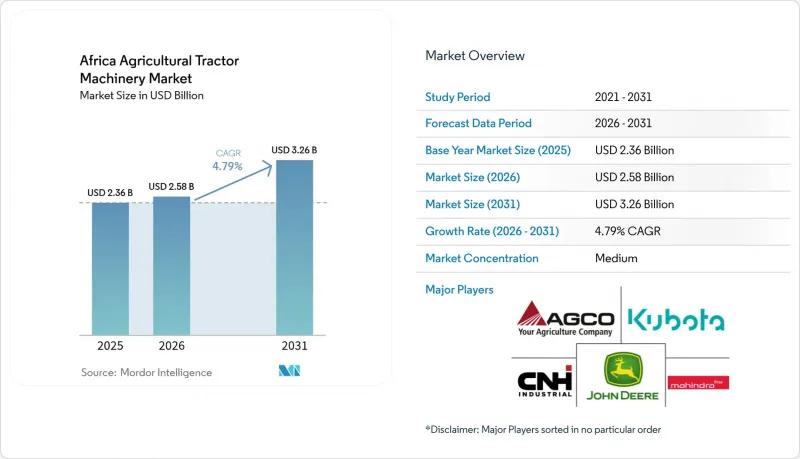
이 보고서는 제품 유형별(경운·경작 기계, 파종 기계, 분무기, 건초·사료용 기계, 기타), 최종사용자별(소규모 농가, 중규모 상업 농장, 대규모 농장 및 농업 지분 회사 등), 지역별(나이지리아, 남아프리카 등)로 분류되어 있습니다. 시장 전망은 금액(달러) 기준으로 제시되어 있습니다.
아프리카 농업용 트랙터 시장의 동향 및 인사이트
기계화에 대한 보조금 및 범아프리카적 자금 조달 프로그램의 확대
저금리 대출 제도 및 보조금 지원 리스 덕분에, 불과 5헥타르 규모의 소규모 농장이라도 초기 자본 요건이 완화되고 투자 회수 기간이 단축되고 있습니다. 각국의 보조금 제도에 따라 기계 조달 형태는 개인 소유에서 협동조합에 의한 공동 소유나 공적으로 관리되는 대여 센터로 전환되고 있습니다. 2025년 2월, 연방 정부는 아프리카 최대 규모의 농업기계화 구상을 시작하여 전국에 2,000대의 트랙터와 9,000대 이상의 정밀 농기계를 도입했습니다. 이 구상은 생산성 향상, 경작지 확대, 그리고 식량안보 강화를 목표로 하고 있습니다. 케냐 농업·축산 개발부는 농업기계화율을 현재 30%에서 50%로 높여 식량 및 영양 안보를 강화하기 위해 2023년에 ‘국가 기계화 프로그램’을 시작했습니다. 이 프로그램은 농업기계, 설비 및 관련 농기구를 공급하고, 충분히 활용되지 않고 있는 정부 소유 토지를 기계화된 농업 경영으로 전환하는 것을 목표로 하고 있습니다. 이러한 노력은 수요의 예측 가능성을 확보하는 동시에 가격 협상을 일원화함으로써, 제조업체가 부품을 현지에서 조달하도록 촉진하고 지불 기한 연장에 합의하도록 유도합니다. 이러한 시책들은 종합적으로, 소유권 기반 경제 모델을 10년에 걸친 장기 계약에서 관리가 용이한 운영 리스로 전환하고, 차량 교체 주기를 가속화하며, 아프리카 농업용 트랙터 시장을 활성화할 것입니다.
대규모 상업 농업의 확대
평균 5,000헥타르 규모의 대규모 농장은 해외 직접 투자를 유치하고 트랙터의 대량 발주를 이끌어내며, 인근 소규모 농가에게 베스트 프랙티스가 되고 있습니다. 케냐의 농업 부문은 눈에 띄는 회복세를 보였으며, 곡물 수확 면적은 2021년 268만 헥타르에서 2024년에는 294만 헥타르로 증가했습니다. 이러한 성장에 따라 경운, 파종, 수확 능력을 확충할 필요가 생겼습니다. 2025년 7월부터 9월까지 1억 9,560만 달러 규모에 달한 케냐의 원예 작물 수출은 관개 및 과수원 가지치기 작업에서 센티미터 단위의 정밀도를 실현하는 협궤 트랙터에 의존하고 있습니다. 분쟁 이후 수단의 농업 부흥은 게지라 계획에 중점을 두고 있습니다. 2025년 관개 인프라 복구로 인해 많은 헥타르가 생산에 복귀하면서 트랙터 및 관련 기계에 대한 수요를 견인했습니다. 대규모 농장은 딜러 네트워크의 거점이 되어 애프터서비스용 부품의 물류 비용을 절감하고, 파종 시즌 내내 수요를 안정적으로 유지하고 있습니다.
분산된 애프터서비스 네트워크로 인해 기계 가동 시간 제한
딜러 네트워크의 미비함과 부품 배송 지연으로 인해 중요한 농업 기간 중 다수의 트랙터가 가동 불능 상태에 빠지고 있습니다. 나이지리아 농업부에 따르면 수년이 지난 트랙터의 대부분은 해안 지역 창고에서 교체 부품이 도착하기까지 오랜 시간이 소요되어 최근 수년간 가동 불능 상태에 있었습니다. 에티오피아에서는 정부가 배포한 트랙터의 상당 부분이 매년 장기간 가동 중단을 피할 수 없었습니다. 마찬가지로 케냐의 농촌 지역에서도 서비스 제공이 크게 지연되어 연중 트랙터 이용률이 저하되었습니다. ‘Hello Tractor’는 이동식 정비사를 파견하여 이 문제를 해결하고 있으며, 보통 며칠 이내에 기계를 수리하고 있습니다. 각 제조사가 지역 거점 설치나 독립 정비 공장 육성에 힘쓰고 있는 반면, 외딴 지역의 기계 보유 대수가 적은 점은 전용 서비스 센터의 경제적 실현 가능성을 여전히 저해하고 있습니다.
부문 분석
경운·중경용 기계는 가장 큰 제품 유형으로, 2025년에는 아프리카 농업용 트랙터 기계 시장 점유율의 41.6%를 차지했습니다. 이는 토양 정비가 여전히 소규모 및 중규모 농장 운영에 있으며, 필수적인 전제 조건이기 때문입니다. 탄자니아 정부의 바우처 프로그램에서는 수작업 경작으로 인한 수확량 손실을 보전하기 위해 경운기 및 해로우에 기계화 예산이 배정되었습니다. 2026년 2월, 나이지리아 연방 정부는 ‘새로운 희망 국가 농업기계화 프로그램(RHAMP)’의 일환으로 9,000대 이상의 농업 기구 배포를 공식적으로 시작했습니다. 여기에는 다수의 디스크 해로우가 포함되어 있습니다. 많은 농지에서는 저침습형 시스템을 도입하기 전에 초기 심층 경작이 필요하므로 보전 경작 캠페인을 통해 수요가 지속되고 있습니다.
분무기는 가장 빠르게 성장하는 제품군으로, 수출 시장에서 잔류 기준이 엄격해지고 기후 변화 대응 프로젝트가 화학 물질의 정밀한 사용을 장려함에 따라 2031년까지 연평균 성장률(CAGR) 5.9%로 확대될 것으로 예상됩니다. 남아프리카의 와인 및 감귤류 생산자들은 효율성과 지속가능성을 높이기 위해 가변 살포량 분무기 등의 스마트 기술을 도입하고 있습니다. 이러한 노력은 기후 변화가 초래하는 과제와 효과적인 물 관리에 대한 증가하는 수요에 대응하기 위한 것입니다. 살포량을 정밀하게 조절함으로써 농약 비용을 절감할 수 있으므로 아프리카 농업용 트랙터 기계 시장에서 분무기는 꾸준히 성장하여 범용 쟁기나 파종기의 시장 점유율을 빼앗을 것으로 예측됩니다. 시드 드릴, 파종기, 살포기를 포함한 파종용 기계는 주요 옥수수 및 대두 생산 지역에서 정밀 파종 기술의 도입 확대에 힘입어 향후 수년간 큰 시장 점유율을 차지할 것으로 예상됩니다. 수확기, 컨디셔너, 베일러 등 건초 및 사료용 기계는 특히 남아프리카의 축산업과 케냐의 낙농 부문을 지원하는 데 있으며, 매우 중요한 역할을 할 것으로 예상됩니다. 또한 감자 수확기나 사탕수수 수확기 등 특수 농기계를 포함한 기타 기종은 특정 농업 수요에 대응하며 틈새 작물 시장을 지원할 것으로 전망됩니다.
기타 혜택:
- 엑셀 형식의 시장 예측(ME) 시트
- 3개월간의 애널리스트 지원
자주 묻는 질문
목차
제1장 서론
제2장 조사 방법
제3장 개요
제4장 시장 구도
제5장 시장 규모와 성장 예측
제6장 경쟁 구도
제7장 시장 기회와 향후 전망
KSA 26.09.03According to Mordor Intelligence, the Africa agricultural tractor machinery market size is projected to grow from USD 2.36 billion in 2025 to USD 2.58 billion in 2026 and is forecast to reach USD 3.26 billion by 2031 at a 4.79% CAGR over 2026-2031.
This report is Segmented by Product Type (Plowing and Cultivating Machinery, Planting Machinery, Sprayers, Haying and Forage Machinery, and Other Types), by End-User (Smallholder Farms, Medium Commercial Farms, Large Estates and Agro-Holdings, and More), and by Geography (Nigeria, South Africa, and More). The Market Forecasts are Provided in Terms of Value (USD).
Africa Agricultural Tractor Machinery Market Trends and Insights
Rising Mechanization Subsidies and Pan-African Finance Programs
Soft-loan schemes and subsidized leases lower initial capital requirements and shorten payback periods for farms as small as 5 hectares. National subsidy schemes are shifting machinery procurement from individual ownership to cooperative pools and publicly managed hiring centers. In February 2025, the Federal Government launched the largest agricultural mechanization initiative in Africa, deploying 2,000 tractors and over 9,000 precision implements nationwide. This initiative aims to enhance productivity, expand cultivated land, and improve food security. The Kenyan Ministry of Agriculture and Livestock Development launched the National Mechanization Program in 2023 to enhance food and nutritional security by increasing farm mechanization from the current 30% to 50%. This program aims to supply farm machinery, equipment, and related implements to transform underutilized government-owned land into mechanized farming operations. Such initiatives assure predictable demand while concentrating price negotiations, pushing manufacturers to localize parts content and to agree to extended payment terms. Collectively, these schemes shift ownership economics from a decade-long commitment to manageable operating leases, accelerate fleet renewal cycles, and bolster the Africa agricultural tractor machinery market.
Expansion of Large-Scale Commercial Farming
Large estates, averaging 5,000 hectares, attract foreign direct investment, generate bulk tractor orders, and serve as demonstration models for neighboring smallholders. Kenya's agricultural sector experienced a notable recovery, with the cereal harvested area increasing to 2.94 million hectares in 2024, up from 2.68 million hectares in 2021. This growth necessitated additional plowing, planting, and harvesting capacity. Kenya's export horticulture, worth USD 195.6 million between July and September 2025, relies on narrow-track tractors that deliver centimeter-level accuracy for irrigation and orchard pruning. Sudan's agricultural recovery following the conflict has focused on the Gezira Scheme. The rehabilitation of irrigation infrastructure in 2025 facilitated the return of hectares to production, driving demand for tractors and related machinery. Mega-farms anchor dealership footprints, reduce logistical costs for after-sales parts, and stabilize demand across cropping seasons.
Fragmented After-Sales Networks Limiting Machinery Uptime
Sparse dealer networks and prolonged parts-delivery times result in a significant number of tractors being out of service during critical agricultural periods. According to Nigeria's agriculture ministry, a majority of tractors older than several years were non-functional in recent years due to replacement parts requiring extended periods to arrive from coastal warehouses. In Ethiopia, a substantial portion of state-distributed tractors experienced lengthy annual downtimes. Similarly, rural counties in Kenya experienced significant service delays, reducing annual tractor utilization. Hello Tractor addresses this issue by deploying mobile mechanics, who typically restore machines within a few days. While manufacturers are establishing regional hubs and training independent workshops, low machinery densities in remote areas continue to hinder the economic feasibility of dedicated service centers.
Other drivers and restraints analyzed in the detailed report include:
- Growth of Pay-Per-Use Digital Equipment Hire Platforms
- Climate-Smart Agriculture Incentives Boosting Demand for Precision Implements
- Land-Tenure Uncertainty Deterring Long-Payback Investments
For complete list of drivers and restraints, kindly check the Table Of Contents.
Segment Analysis
Plowing and cultivating machinery is the largest product type and captured 41.6% of the Africa agricultural tractor machinery market share in 2025, as soil preparation remains a precursor for most smallholder and medium farm operations. Government voucher programs in Tanzania allocated mechanization budgets to plows and harrows to offset yield losses from manual tillage. In February 2026, the Federal Government of Nigeria officially commenced the distribution of over 9,000 agricultural implements, which include a significant number of disc harrows, as part of the Renewed Hope National Agricultural Mechanisation Programme (RHAMP). Demand persists across conservation-tillage campaigns because many fields still require initial deep ripping before adopting minimal-disturbance systems.
Sprayers are the fastest-growing product line, advancing at a 5.9% CAGR through 2031 as export markets enforce residue limits and climate projects incentivize precise chemical use. South African wine and citrus producers are adopting smart technologies, such as variable-rate sprayers, to enhance efficiency and sustainability. These efforts address challenges posed by climate change and the growing need for effective water management. As calibrated applications reduce pesticide costs, the Africa agricultural tractor machinery market for sprayers is projected to grow steadily, capturing budget share from generic plows and seeders. Planting machinery, including seed drills, planters, and spreaders, is projected to hold a significant market share in the coming years, driven by the increasing adoption of precision planting techniques in key maize- and soybean-producing regions. Haying and forage machinery, including mowers, conditioners, and balers, is anticipated to play a crucial role, particularly in supporting the livestock industry in South Africa and the dairy sector in Kenya. Other machinery types, including specialized implements such as potato diggers and sugarcane harvesters, are projected to serve niche crop markets, addressing specific agricultural needs.
Complete Report Scope:
- By Product Type
- Plowing and Cultivating Machinery
- Plows
- Harrows
- Rotovators and Cultivators
- Other Equipment
- Planting Machinery
- Seed Drills
- Planters
- Spreaders
- Other Planting Machinery
- Sprayers
- Haying and Forage Machinery
- Mowers and Conditioners
- Balers
- Other Haying and Forage Machinery
- Other Types
- Plowing and Cultivating Machinery
- By End-User
- Smallholder Farms
- Medium Commercial Farms
- Large Estates and Agro-holdings
- Contract-Hire and Rental Fleets
- By Geography
- Nigeria
- South Africa
- Kenya
- Egypt
- Ethiopia
- Rest of Africa
List of Companies Covered in this Report:
- Deere & Company
- CNH Industrial N.V.
- AGCO Corporation
- Mahindra & Mahindra Limited
- Kubota Corporation
- Rovic & Leers (Pty) Ltd.
- Yanmar Holdings Co., Ltd.
- International Tractors Limited
- CLAAS KGaA mbH
- Weichai Lovol Intelligent Agricultural Technology Co., Ltd. (Weichai Power Co., Ltd.)
- SDF S.p.A (Same Deutz-Fahr)
- Agrimont Industrial Group
- Dongfeng Agricultural Machinery Group Co., Ltd.
- Zoomlion Heavy Industry Science and Technology Co., Ltd.
- Zetor Tractors a.s. (HTC Holding)
Additional Benefits:
- The market estimate (ME) sheet in Excel format
- 3 months of analyst support
TABLE OF CONTENTS
1 Introduction
- 1.1 Study Assumptions and Market Definition
- 1.2 Scope of the Study
2 Research Methodology
3 Executive Summary
4 Market Landscape
- 4.1 Market Overview
- 4.2 Market Drivers
- 4.2.1 Rising mechanization subsidies and pan-African finance programs
- 4.2.2 Expansion of large-scale commercial farming
- 4.2.3 Growth of pay-per-use digital equipment hire platforms
- 4.2.4 Climate-smart agriculture incentives boosting demand for precision implements
- 4.2.5 China-Africa industrial parks enabling low-cost completely knocked down tractor assembly
- 4.2.6 Emergence of renewable-powered autonomous equipment in high-solar belts
- 4.3 Market Restraints
- 4.3.1 Fragmented after-sales networks limiting machinery uptime
- 4.3.2 Local-currency depreciation escalating import component costs
- 4.3.3 Land-tenure uncertainty deterring long-payback investments
- 4.3.4 Electronic-control-unit chip shortages prolonging delivery cycles
- 4.4 Regulatory Landscape
- 4.5 Technological Outlook
- 4.6 Porter's Five Forces Analysis
- 4.6.1 Bargaining Power of Suppliers
- 4.6.2 Bargaining Power of Buyers
- 4.6.3 Threat of New Entrants
- 4.6.4 Threat of Substitutes
- 4.6.5 Intensity of Competitive Rivalry
5 Market Size and Growth Forecasts (Value)
- 5.1 By Product Type
- 5.1.1 Plowing and Cultivating Machinery
- 5.1.1.1 Plows
- 5.1.1.2 Harrows
- 5.1.1.3 Rotovators and Cultivators
- 5.1.1.4 Other Equipment
- 5.1.2 Planting Machinery
- 5.1.2.1 Seed Drills
- 5.1.2.2 Planters
- 5.1.2.3 Spreaders
- 5.1.2.4 Other Planting Machinery
- 5.1.3 Sprayers
- 5.1.4 Haying and Forage Machinery
- 5.1.4.1 Mowers and Conditioners
- 5.1.4.2 Balers
- 5.1.4.3 Other Haying and Forage Machinery
- 5.1.5 Other Types
- 5.1.1 Plowing and Cultivating Machinery
- 5.2 By End-User
- 5.2.1 Smallholder Farms
- 5.2.2 Medium Commercial Farms
- 5.2.3 Large Estates and Agro-holdings
- 5.2.4 Contract-Hire and Rental Fleets
- 5.3 By Geography
- 5.3.1 Nigeria
- 5.3.2 South Africa
- 5.3.3 Kenya
- 5.3.4 Egypt
- 5.3.5 Ethiopia
- 5.3.6 Rest of Africa
6 Competitive Landscape
- 6.1 Market Concentration
- 6.2 Strategic Moves
- 6.3 Market Share Analysis
- 6.4 Company Profiles (Includes Global Level Overview, Market Level Overview, Core Segments, Financials as Available, Strategic Information, Market Rank/Share for Key Companies, Products and Services, and Recent Developments)
- 6.4.1 Deere & Company
- 6.4.2 CNH Industrial N.V.
- 6.4.3 AGCO Corporation
- 6.4.4 Mahindra & Mahindra Limited
- 6.4.5 Kubota Corporation
- 6.4.6 Rovic & Leers (Pty) Ltd.
- 6.4.7 Yanmar Holdings Co., Ltd.
- 6.4.8 International Tractors Limited
- 6.4.9 CLAAS KGaA mbH
- 6.4.10 Weichai Lovol Intelligent Agricultural Technology Co., Ltd. (Weichai Power Co., Ltd.)
- 6.4.11 SDF S.p.A (Same Deutz-Fahr)
- 6.4.12 Agrimont Industrial Group
- 6.4.13 Dongfeng Agricultural Machinery Group Co., Ltd.
- 6.4.14 Zoomlion Heavy Industry Science and Technology Co., Ltd.
- 6.4.15 Zetor Tractors a.s. (HTC Holding)


