

|
시장보고서
상품코드
2122049
고성능 섬유 : 시장 점유율 분석, 업계 동향과 통계, 성장 예측(2026-2031년)High-Performance Fibers - Market Share Analysis, Industry Trends & Statistics, Growth Forecasts (2026 - 2031) |
||||||
 Mordor Intelligence
Mordor Intelligence에 의하면, 고성능 섬유 시장 규모는 2025년에 179억 1,000만 달러로 평가되었고, 2026년 193억 5,000만 달러에서 2031년까지 284억 3,000만 달러에 이를 것으로 예측되며, 예측 기간(2026-2031년) CAGR은 8.01%를 기록할 전망입니다.
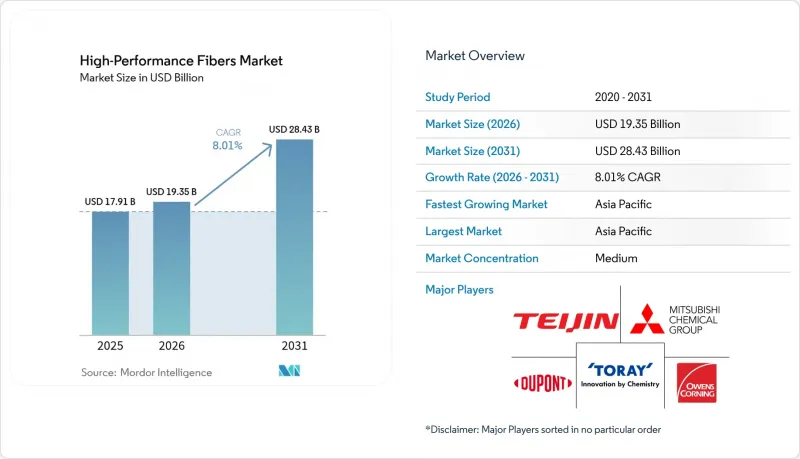
본 보고서는 유형별(탄소섬유, 아라미드 섬유, 유리섬유, 폴리페닐렌 설파이드(PPS) 등), 최종 사용자 산업별(항공우주 및 방위, 자동차, 스포츠 용품, 대체 에너지, 전자·통신 등),및 지역별(아시아태평양, 북미, 유럽, 남미, 중동 및 아프리카)로 분류되어 있습니다. 시장 예측은 금액(달러)으로 제시되어 있습니다.
세계 고성능 섬유 시장 동향 및 인사이트
경량 해상 풍력 발전용 블레이드 수요 급증
길이가 100m를 초과하는 터빈 블레이드는 이전 모델에 비해 훨씬 더 많은 탄소섬유를 소비하게 되었습니다. 또한, 자동 섬유 배열 기술로 인해 생산 비용이 낮아지면서 일부 제조업체에서는 풍력 발전이 항공우주 산업을 제치고 최대 판매처가 되었습니다. 강성, 내식성 및 낙뢰 보호의 균형을 맞추기 위해 탄소섬유와 유리섬유를 조합한 하이브리드 소재가 채택되고 있습니다. 자체 섬유 생산 라인을 보유한 중국 및 유럽의 블레이드 제조업체들은 북해와 동중국해에서의 급속한 생산 능력 확대에 따라 비용 면에서 우위를 점하고 있습니다.
항공우주 및 방위 산업의 높은 수요
전투기 부대의 현대화, 무인 항공기 시스템, 우주 발사 로켓의 개발로 인해 국방 예산은 계속해서 초고탄성률 탄소섬유 및 세라믹 섬유에 투입되고 있습니다. 민간 항공의 회복에 따라 복합재를 다용도로 활용한 와이드바디 항공기의 수주가 다시 증가하고 있는 한편, ‘모어 일렉트릭(More Electric)’ 항공기 아키텍처의 도입으로 인해 전자기 차폐 요건이 발생하고 있어, 탄소섬유와 아라미드섬유를 조합한 하이브리드 적층재가 선호되고 있습니다.
변동이 심한 폴리아크릴로니트릴(PAN) 전구체공급망
2024년 폴리아크릴로니트릴 가격의 30-40% 변동으로 인해, 업스트림 공정으로의 통합을 추진하지 않은 독립 계열 방적 제조업체들의 이익률이 압박을 받았습니다. 전구체의 생산 능력을 장악하고 있는 토레와 중국 내 주요 제조업체들은 가격 급등의 영향을 피할 수 있었던 반면, 유럽과 미국의 몇몇 생산자들은 원료 공급 전망이 더 안정될 때까지 확장 계획을 연기했습니다. 미국에서 진행 중인 바이오 유래 아크릴로니트릴 파일럿 프로젝트는 원료 다각화로 이어질 가능성이 있지만, 상업적 생산 실현까지는 아직 수년이 소요될 것으로 전망됩니다.
부문별 분석
탄소섬유는 2025년에 고성능 섬유 시장 점유율의 42.35%를 차지할 것이며, 자동차 경량화 규제와 재생에너지 인프라 확충을 배경으로 2031년까지 연평균 성장률(CAGR) 8.88%로 확대될 것으로 예측됩니다. 중푸 쉔잉(Zhongfu Shenying) 등 아시아의 생산자들은 비용에 민감한 산업 분야에 진출하기 위해 장쑤성에 연간 3만 톤의 생산 능력(투자액 8억 6,600만 달러)을 새롭게 도입하고 있습니다. 아라미드 섬유는 방탄 및 통신 용도에서 계속해서 지배적인 위치를 유지하고 있습니다. 또한, 테이진(Teijin)이 네덜란드에 보유한 산업 규모의 재활용 플랜트에서는 아라미드 실을 재처리하여 새로운 섬유로 재생하고 있어, 전체 수명 주기 동안의 배출량을 줄이고 있습니다. 유리섬유는 건설 및 일반 자동차 패널 용도로 여전히 저비용의 주력 소재로 자리 잡고 있습니다. 한편, 전기차 배터리 팩에는 내열성 및 내화학성이 요구되기 때문에 폴리페닐렌 설파이드(PPS)는 두 자릿수 성장을 기록하고 있습니다. 초고분자량 폴리에틸렌(UHMWPE) 섬유와 세라믹 섬유는 각각 극저온 저장 및 초음속 플랫폼 분야에서 틈새 역할을 수행하고 있습니다.
산업용 등급 탄소섬유 전반에 걸친 급격한 원가 하락이 조달 전략의 재구성을 촉진하고 있습니다. 자동차 제조업체는 공급을 확보하기 위해 다년 계약을 체결하는 반면, 풍력 발전 설비 제조업체는 공급량 보장을 대가로 가격 상한선을 설정하는 위탁 가공 계약을 협상하고 있습니다. 소재 배합 제조업체들은 높은 처리량의 블레이드 생산 목표를 달성하기 위해 카본 토와 저점도 에폭시 수지를 조합하고 있습니다. 동시에, 고성능 섬유 시장에서는 PAN에 대한 의존도를 낮추고 환경 성능을 향상시키기 위해 리그닌 유래 카본에 대한 벤처 투자가 증가하고 있습니다. 아직 상용화 전 단계이긴 하지만, 파일럿 라인에서는 스포츠 용품용 라미네이트에 적합한 35 Msi 이상의 탄성률을 가진 섬유가 생산되고 있으며, 이는 이번 10년 후반에 기존 공급망에 변혁을 가져올 가능성을 시사하고 있습니다.
지역별 분석
아시아태평양은 중국의 재생에너지 도입과 자동차 전동화를 위한 적극적인 일정에 힘입어 2025년에는 고성능 섬유 시장 점유율의 40.10%를 차지하며 시장을 주도하고 있습니다. 중국의 ‘제14차 5개년 계획’에서는 연간 100GW 이상의 해상 풍력 발전 설비 증설이 추진되고 있어, 대구경 블레이드에 사용되는 섬유 사용량은 2배로 증가할 전망입니다. 국내 제조업체들은 T1000급 탄소섬유 분야에서 서유럽의 독점을 타파하여, 현지 OEM 제조업체들이 첨단 전투기용 방위 및 항공우주 규격을 충족할 수 있도록 했습니다. 일본의 도레이와 테이진은 계속해서 프리미엄 틈새 시장을 주도하고 있는 반면, 한국은 PPS와 유리섬유를 배터리 하우징 및 전자 기판에 활용하고 있습니다.
북미에서는 ‘인플레이션 억제법’과 ‘바이 아메리칸’ 정책에 힘입어 국내 탄소섬유 생산이 우선시되고 있습니다. 워싱턴주, 앨라배마주, 퀘벡주에 신설되는 생산 라인을 통해 2027년까지 연간 1만 5,000톤을 넘는 생산 능력이 추가되어, 아시아산 전구체에 대한 의존도를 낮추는 동시에 전투기 프로그램 및 우주 로켓과 관련된 국가 안보 목표에 부합하게 될 것입니다. 멕시코의 전기차(EV) 조립 능력 확대에 따라 아라미드 섬유와 유리 섬유의 수입이 국경 남쪽으로 이동하고 있으며, 이에 따라 지역 가공 업체들은 최종 조립 거점 근처로 거점을 집중시키고 있습니다.
유럽 시장 동향에서는 지속가능성과 순환 경제의 원칙이 중시되고 있으며, 규제 체계 내에서 기존 소재보다 바이오 및 재활용 가능한 섬유 솔루션이 점점 더 우선시되고 있습니다. 이 지역의 풍력 발전 부문은 탄소섬유 수요를 크게 견인하고 있는 반면, 자동차 용도에서는 배출 감축 목표를 뒷받침하는 경량화 솔루션에 초점이 맞추어져 있습니다. 독일의 자동차 제조업체들은 재용융이 용이한 열가소성 탄소섬유 구조의 검증을 진행하고 있으며, 북유럽의 에너지 개발 기업들은 해상 풍력 발전 프로토타입에서 바이오 에폭시 매트릭스를 시험하고 있습니다. 이 지역의 성장 속도는 아시아에 미치지 못하지만, 엄격한 품질 및 환경 기준으로 인해 평균 판매 가격은 아시아보다 높은 수준을 유지하고 있습니다.
남미 및 중동의 새로운 수요는 인프라 및 재생 에너지 메가 프로젝트와 연계되어 기회를 포착하는 형태이지만, 환율 변동과 숙련된 인력 부족으로 인해 그 기세가 억제되고 있습니다.
기타 혜택:
- 엑셀 형식 시장 예측(ME) 시트
- 3개월간의 애널리스트 지원
자주 묻는 질문
목차
제1장 서론
제2장 조사 방법
제3장 주요 요약
제4장 시장 구도
제5장 시장 규모와 성장 예측
제6장 경쟁 구도
제7장 시장 기회와 향후 전망
LSH 26.09.10According to Mordor Intelligence, the high-Performance fibers market size was valued at USD 17.91 billion in 2025 and estimated to grow from USD 19.35 billion in 2026 to reach USD 28.43 billion by 2031, at a CAGR of 8.01% during the forecast period (2026-2031).
This report is Segmented by Type (Carbon Fiber, Aramid Fiber, Glass Fiber, Polyphenylene Sulfide (PPS), and More), End-User Industry (Aerospace and Defense, Automotive, Sporting Goods, Alternative Energy, Electronics & Telecommunications, and More), and Geography (Asia-Pacific, North America, Europe, South America, and Middle-East and Africa). The Market Forecasts are Provided in Value (USD).
Global High-Performance Fibers Market Trends and Insights
Surging Demand for Lightweight Offshore-Wind Blades
Turbine blades topping 100 m now consume far greater volumes of carbon fiber than earlier models, and automated fiber placement is lowering production costs, allowing wind to surpass aerospace as the single largest volume outlet for some manufacturers. Hybrids that combine carbon and glass are being adopted to balance stiffness, corrosion resistance, and lightning-strike protection. Chinese and European blade makers with captive fiber lines gain cost advantages during rapid capacity build-outs in the North Sea and East China Sea.
High Demand from Aerospace and Defense Industry
Modernization of fighter fleets, uncrewed aerial systems, and space-launch vehicles keeps defense budgets invested in ultra-high-modulus carbon and ceramic fibers. Commercial aviation recovery has renewed orders for composite-rich wide-body platforms, while "more-electric" aircraft architectures introduce electromagnetic-shielding requirements that favor hybrid carbon-aramid lay-ups.
Volatile Polyacrylonitrile (PAN)-Precursor Supply Chain
Polyacrylonitrile price swings of 30-40% in 2024 curtailed margins for independent spinners lacking backward integration. Toray and domestic Chinese majors that control precursor capacity insulated themselves from spikes, while several Western producers postponed expansion plans pending more stable feedstock visibility. Bio-based acrylonitrile pilot projects in the United States could diversify inputs, yet commercial output remains years away.
Other drivers and restraints analyzed in the detailed report include:
- Commercial Rollout of Type-IV Hydrogen Pressure Vessels
- 5G Fiber-Optic Cabling Shift to Aramid Yarn
- Limited Recycling Infrastructure for Multi-Material Composites
For complete list of drivers and restraints, kindly check the Table Of Contents.
Segment Analysis
Carbon fiber captured 42.35% of the high-performance fibers market share in 2025 and is forecast to climb at a 8.88% CAGR to 2031, underpinned by automotive lightweighting mandates and renewable-energy infrastructure roll-outs. Asia-based producers such as Zhongfu Shenying are injecting fresh capacity-USD 866 million for 30,000 t/y in Jiangsu-to penetrate cost-sensitive industrial segments. Aramid continues to dominate ballistic and telecom applications; Teijin's industrial-scale recycling plant in the Netherlands now reprocesses aramid yarn into new fiber, lowering lifecycle emissions. Glass fiber remains the low-cost mainstay for construction and standard automotive panels, while polyphenylene sulfide (PPS) enjoys double-digit growth as electric-vehicle battery packs require thermal and chemical resilience. UHMWPE and ceramic fibers fill niche roles in cryogenic storage and hypersonic platforms, respectively.
Rapid cost erosion across industrial-grade carbon is reshaping procurement strategies. Automakers are locking multiyear contracts to assure supply, while wind OEMs negotiate tolling arrangements that exchange volume commitments for price ceilings. Material formulators are coupling carbon tow with low-viscosity epoxy resins to meet high-throughput blade production targets. Concurrently, the high-performance fibers market is witnessing growing venture investment in lignin-derived carbon to ease PAN dependence and improve environmental credentials. Although still pre-commercial, pilot lines have produced 35+ Msi modulus fibers suitable for sporting-goods laminates, signaling potential to disrupt incumbent supply chains later in the decade.
Complete Report Scope:
- By Type
- Carbon Fiber
- Composite Materials
- Carbon Fiber Reinforced Polymer (CFRP)
- Reinforced Carbon Carbon (RCC)
- Textiles
- Microelectrodes
- Catalysis
- Composite Materials
- Aramid Fiber
- Meta-Aramid
- Para-Aramid
- Glass Fiber
- Polyphenylene Sulfide (PPS)
- Other Types (Ultra-High Molecular Weight Polyethylene (UHMWPE), Polybenzimidazole (PBI), Poly(p-phenylene-2,6-benzobisoxazole)(PBO), Silicon Carbide (SiC), Basalt)
- Carbon Fiber
- By End-user Industry
- Aerospace & Defense
- Automotive
- Sporting Goods
- Alternative Energy
- Electronics & Telecommunications
- Construction & Infrastructure
- Other End User Industries (Healthcare & Medical Devices, etc.)
- By Geography
- Asia-Pacific
- China
- Japan
- India
- South Korea
- ASEAN Countries
- Rest of Asia-Pacific
- North America
- United States
- Canada
- Mexico
- Europe
- Germany
- United Kingdom
- France
- Italy
- Spain
- Russia
- NORDIC Countries
- Rest of Europe
- South America
- Brazil
- Argentina
- Rest of South America
- Middle East and Africa
- Saudi Arabia
- South Africa
- Rest of Middle East and Africa
- Asia-Pacific
Geography Analysis
Asia-Pacific dominates with 40.10% of the high-performance fibers market share in 2025, propelled by China's renewable-energy deployment and aggressive vehicle-electrification timelines. Beijing's Five-Year Plan backs >100 GW/year of offshore-wind additions, doubling fiber usage in large-diameter blades. Domestic producers have broken Western monopoly on T1000-class carbon, enabling local OEMs to meet defense and aerospace specifications for advanced fighter jets. Japan's Toray and Teijin continue to command premium niches, while South Korea channels PPS and glass fiber into battery housings and electronic substrates.
North America, supported by the Inflation Reduction Act and Buy-American policies, is prioritizing domestic carbon-fiber output. New lines in Washington State, Alabama, and Quebec will add >15,000 t/y by 2027, mitigating reliance on Asian precursors and aligning with national-security objectives for fighter programs and space launchers. Mexico's growing EV assembly capacity is pulling aramid and glass imports south of the border, prompting regional converters to co-locate near final assembly hubs.
Europe's market evolution emphasizes sustainability and circular economy principles, with regulatory frameworks that increasingly favor bio-based and recyclable fiber solutions over conventional materials. The region's wind energy sector drives significant carbon fiber demand, while automotive applications focus on lightweight solutions that support emission reduction targets . German automakers validate thermoplastic carbon architectures that allow easier re-melt, while Nordic energy developers test bio-based epoxy matrices in offshore prototypes. Regional growth lags Asia's pace yet commands higher average selling prices due to stringent quality and environmental standards.
Emerging demand in South America and the Middle East remains opportunistic, tied to infrastructure and renewable-energy megaprojects but tempered by currency volatility and skills shortages.
- Avient Corporation
- Bally Ribbon Mills
- China Jushi Co., Ltd.
- DuPont
- Hexcel Corporation
- Honeywell International Inc.
- Huvis Corp
- Kolon Industries, Inc.
- Kureha Corporation
- Mitsubishi Chemical Carbon Fiber and Composites, Inc.
- Owens Corning
- PBI Performance Products, Inc.
- Sarla Performance Fibers Limited
- Solvay
- Teijin Limited
- Toray Industries Inc.
- Toyobo Co., Ltd.
- TOYOBO MC Corporation
- Weihai Guangwei Group Co., Ltd.
- W. L. Gore & Associates
- Yantai Tayho Advanced Materials Co., Ltd.
Additional Benefits:
- The market estimate (ME) sheet in Excel format
- 3 months of analyst support
TABLE OF CONTENTS
1 Introduction
- 1.1 Study Assumptions & Market Definition
- 1.2 Scope of the Study
2 Research Methodology
3 Executive Summary
4 Market Landscape
- 4.1 Market Overview
- 4.2 Market Drivers
- 4.2.1 Surging Demand for Lightweight Offshore-Wind Blades
- 4.2.2 High Demand from Aerodpace and Defense Industry
- 4.2.3 Commercial Rollout of Type-IV Hydrogen Pressure Vessels
- 4.2.4 5G fiber-optic Cabling Shift to Aramid Yarn
- 4.2.5 High Demand for Sporting and Protective Products
- 4.3 Market Restraints
- 4.3.1 Volatile Polyacrylonitrile (PAN)-Precursor Supply Chain
- 4.3.2 Limited Recycling Infrastructure for Multi-Material Composites
- 4.3.3 Chinese Over-Capacity Driving Price Compression
- 4.4 Value Chain Analysis
- 4.5 Porter's Five Forces
- 4.5.1 Bargaining Power of Suppliers
- 4.5.2 Bargaining Power of Buyers
- 4.5.3 Threat of New Entrants
- 4.5.4 Threat of Substitutes
- 4.5.5 Degree of Competition
5 Market Size & Growth Forecasts (Value)
- 5.1 By Type
- 5.1.1 Carbon Fiber
- 5.1.1.1 Composite Materials
- 5.1.1.1.1 Carbon Fiber Reinforced Polymer (CFRP)
- 5.1.1.1.2 Reinforced Carbon Carbon (RCC)
- 5.1.1.2 Textiles
- 5.1.1.3 Microelectrodes
- 5.1.1.4 Catalysis
- 5.1.1.1 Composite Materials
- 5.1.2 Aramid Fiber
- 5.1.2.1 Meta-Aramid
- 5.1.2.2 Para-Aramid
- 5.1.3 Glass Fiber
- 5.1.4 Polyphenylene Sulfide (PPS)
- 5.1.5 Other Types (Ultra-High Molecular Weight Polyethylene (UHMWPE), Polybenzimidazole (PBI), Poly(p-phenylene-2,6-benzobisoxazole)(PBO), Silicon Carbide (SiC), Basalt)
- 5.1.1 Carbon Fiber
- 5.2 By End-user Industry
- 5.2.1 Aerospace & Defense
- 5.2.2 Automotive
- 5.2.3 Sporting Goods
- 5.2.4 Alternative Energy
- 5.2.5 Electronics & Telecommunications
- 5.2.6 Construction & Infrastructure
- 5.2.7 Other End User Industries (Healthcare & Medical Devices, etc.)
- 5.3 By Geography
- 5.3.1 Asia-Pacific
- 5.3.1.1 China
- 5.3.1.2 Japan
- 5.3.1.3 India
- 5.3.1.4 South Korea
- 5.3.1.5 ASEAN Countries
- 5.3.1.6 Rest of Asia-Pacific
- 5.3.2 North America
- 5.3.2.1 United States
- 5.3.2.2 Canada
- 5.3.2.3 Mexico
- 5.3.3 Europe
- 5.3.3.1 Germany
- 5.3.3.2 United Kingdom
- 5.3.3.3 France
- 5.3.3.4 Italy
- 5.3.3.5 Spain
- 5.3.3.6 Russia
- 5.3.3.7 NORDIC Countries
- 5.3.3.8 Rest of Europe
- 5.3.4 South America
- 5.3.4.1 Brazil
- 5.3.4.2 Argentina
- 5.3.4.3 Rest of South America
- 5.3.5 Middle East and Africa
- 5.3.5.1 Saudi Arabia
- 5.3.5.2 South Africa
- 5.3.5.3 Rest of Middle East and Africa
- 5.3.1 Asia-Pacific
6 Competitive Landscape
- 6.1 Market Concentration
- 6.2 Strategic Moves
- 6.3 Market Share(%)/Ranking Analysis
- 6.4 Company Profiles (includes Global-level Overview, Market-level Overview, Core Segments, Financials, Strategic Information, Market Rank/Share, Products & Services, Recent Developments)
- 6.4.1 Avient Corporation
- 6.4.2 Bally Ribbon Mills
- 6.4.3 China Jushi Co., Ltd.
- 6.4.4 DuPont
- 6.4.5 Hexcel Corporation
- 6.4.6 Honeywell International Inc.
- 6.4.7 Huvis Corp
- 6.4.8 Kolon Industries, Inc.
- 6.4.9 Kureha Corporation
- 6.4.10 Mitsubishi Chemical Carbon Fiber and Composites, Inc.
- 6.4.11 Owens Corning
- 6.4.12 PBI Performance Products, Inc.
- 6.4.13 Sarla Performance Fibers Limited
- 6.4.14 Solvay
- 6.4.15 Teijin Limited
- 6.4.16 Toray Industries Inc.
- 6.4.17 Toyobo Co., Ltd.
- 6.4.18 TOYOBO MC Corporation
- 6.4.19 Weihai Guangwei Group Co., Ltd.
- 6.4.20 W. L. Gore & Associates
- 6.4.21 Yantai Tayho Advanced Materials Co., Ltd.
7 Market Opportunities & Future Outlook
- 7.1 White-space & Unmet-need Assessment
- 7.2 Emerging of Nanofibers and Ceramic Fibers


