

|
시장보고서
상품코드
2122051
고흡수성 폴리머(SAP) : 시장 점유율 분석, 업계 동향과 통계, 성장 예측(2026-2031년)Super Absorbent Polymers (SAP) - Market Share Analysis, Industry Trends & Statistics, Growth Forecasts (2026 - 2031) |
||||||
 Mordor Intelligence
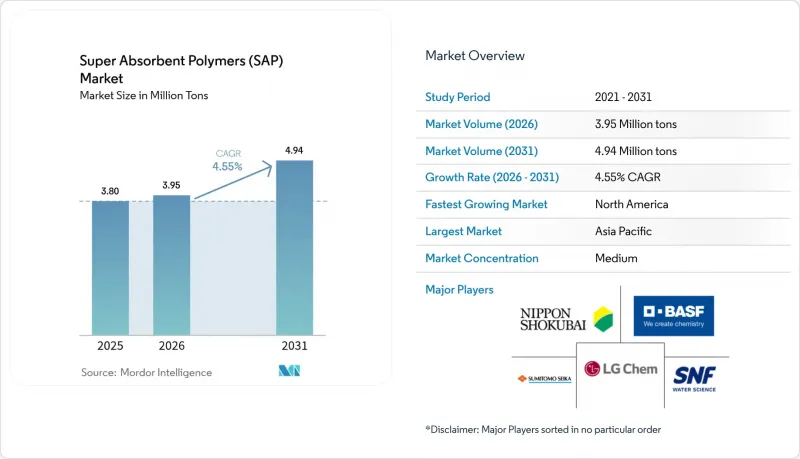
Mordor Intelligence에 따르면 고흡수성 폴리머(SAP) 시장 규모는 2025년 380만 톤에서 2026년에는 395만 톤으로 확대하며, 2031년까지 494만 톤에 달할 것으로 예측되고 있으며, 2026-2031년에 CAGR 4.55%로 성장할 것으로 전망되고 있습니다.
이 보고서는 제품 유형(폴리아크릴아미드, 아크릴산계, 기타), 중합 공정(용액 중합, 기타),용도(아기 기저귀, 기타), 최종사용자 산업(퍼스널 케어·위생용품 제조업체, 농자재 공급업체, 기타) 및 지역(아시아태평양, 북미, 기타)별로 분류되어 있습니다. 시장 예측은 톤 단위로 제시되어 있습니다.
전 세계 고흡수성 폴리머(SAP) 시장의 동향 및 인사이트
중국 및 인도의 1인당 기저귀 지출 증가
인도에서는 2024년 유아용품에 대한 상품 및 서비스세(GST)가 18%로 인하됨에 따라 2025년 일회용 기저귀 지출액은 17억 4,000만 달러에 달했습니다. 이로 인해 2·3선 도시에서도 브랜드 기저귀를 보다 저렴한 가격에 구입할 수 있게 되었습니다. 중국에서는 주요 E-Commerce 플랫폼이 정기 구독 서비스에 로열티 할인을 결합함에 따라 2025년 유아용 기저귀 보급률은 70%에 달했습니다. 그 결과, 기저귀 1장당 SAP의 평균 사용량은 8그램에서 12그램으로 증가했으며, 이러한 급증은 초박형 코어로의 전환에 의해 주도되었습니다. 새틀라이트 케미컬(Satellite Chemical)과 같은 국내 공급업체들은 이 프리미엄 부문에 대응하기 위해 특수 폴리아크릴아미드 생산 라인을 확충하고 있습니다. 한편, 다국적 기업은 리드 타임 단축과 재고 감축을 도모하기 위해 광둥성 및 장쑤성의 기저귀 공장 옆에 새로운 SAP 반응 장치를 병설하고 있습니다. 이러한 시너지 효과로 인해 아시아 소비자들이 1장당 SAP 함유량이 많은 제품으로 구매를 전환하는 경향이 강해지는 가운데, 고흡수성 폴리머 시장은 장기적인 성장 궤도를 유지하고 있습니다.
아시아 및 유럽에서 SAP 함량이 높은 성인용 요실금 패드의 급속한 보급
2024년, 일본의 65세 이상 인구 비율은 29.1%를 넘어섰고, 한국에서는 요실금 용품에 대한 국민건강보험의 급여 범위가 확대되어 소비자의 본인 부담금이 약 40% 감소했습니다. 유럽 국가들도 유사한 고령화 추세에 직면해 있으며, 독일과 이탈리아에서는 고령자 비율이 20%를 넘어섰습니다. 각 제조사들은 15-20그램의 SAP를 함유하고, 표면 가교 기술을 활용하여 800밀리리터 이상을 새지 않고 흡수할 수 있는 ‘액티브 라이프스타일’형 패드를 잇달아 출시하고 있습니다. 이러한 설계 덕분에 야간 사용이 가능해졌으며, 교체 횟수도 줄일 수 있게 되었습니다. 잔류 모노머 목표치 하향 조정(300ppm 미만)은 제조 공정을 복잡하게 만드는 한편, 각 브랜드가 10-15%의 가격 프리미엄을 책정할 수 있게 하고 있습니다. 따라서 이러한 인구 통계학적 추세에 따라 고흡수성 폴리머 시장은 부가가치가 더 높은 성인용 케어 등급으로 이동하고 있습니다.
아크릴산 원료 가격 변동
2024년, 동북아시아의 아크릴산 현물 가격은 크래커의 예기치 못한 가동 중단으로 인해 톤당 1,200-1,600달러 사이에서 변동했습니다. 또한 2025년 초에는 정유업체들이 프로필렌의 제품별 생산을 억제함에 따라 유럽의 계약 가격은 전 분기 대비 8% 상승했습니다. 비통합형 SAP 가공업체들은 수년에 걸친 모노머 계약을 체결할 협상력이 부족하여, 한 분기 동안 150-200 베이시스 포인트의 이익률 압박을 겪고 있습니다. 그 결과 발생한 업계 재편으로 인해 2024년에는 에보닉이 SAP 사업 부문을 ICIG에 매각했고, 산요화학이 해당 분야에서 철수했습니다. 이는 고흡수성 폴리머 시장에서 살아남기 위해서는 규모 확대와 후방 통합이 필수적임을 보여주는 증거입니다.
부문별 분석
아크릴산계 SAP는 300 g/g을 초과하는 팽윤 능력과 고속 기저귀 생산 라인과의 원활한 호환성 덕분에 2025년에는 출하 점유율의 72.54%를 차지했습니다. 폴리아크릴아미드 계열 등급은 장기간의 가뭄에도 보습성을 유지할 수 있는 가교 네트워크를 원하는 농업용 공급업체의 수요에 힘입어 2031년까지 연평균 성장률(CAGR) 6.67%로 성장을 이어가고 있습니다. 전분 그래프트 및 셀룰로오스 하이드로겔은 겔 강도가 낮아 기저귀에 사용되는 데 제한이 있고, 효소에 의한 전처리로 인해 비용이 상승하므로 여전히 틈새 시장에 머물러 있습니다. 인도 및 호주의 정부 보조금 정책은 폴리아크릴아미드계 토양 개량제의 사용을 촉진하고 있으며, 고흡수성 폴리머 시장의 수요 기반 다변화를 지원하고 있습니다.
고급 제품 시장에서는 블렌딩 화학 기술이 부상하고 있습니다. 일본의 기저귀 브랜드는 액체 흡수를 촉진하고 잔류 모노머를 줄이기 위해 천연 다당류를 산재시킨 표면 가교 아크릴계 SAP를 지정하고 있습니다. 기능적인 미세 조정을 거듭할수록 공급업체는 더 높은 이익률을 확보하고 고객 충성도를 강화함으로써, 고흡수성 폴리머 시장을 순수한 상품 가격 변동 주기로부터 보호하고 있습니다.
겔 중합은 단일 공정으로 고팽윤성 입자를 생성하고 비용이 많이 드는 분쇄 공정을 피할 수 있으므로 2025년 생산 능력의 60.64%를 차지하고 있습니다. 그러나 생리대 및 초박형 기저귀 제조사들이 분진 발생 없이 균일한 코어를 구현하는 150미크론 미만의 입자를 요구함에 따라 용액 중합은 연평균 성장률(CAGR) 5.18%의 성장 궤도에 올라 있습니다. 또한 용액 중합 반응기에서는 제조 공정 중 잔류 모노머 농도를 200 ppm 미만으로 억제할 수 있으며, 추가 세척 공정을 생략할 수 있으며, 영유아용 제품에 대한 더욱 엄격한 안전 기준도 충족합니다.
설비 투자 규모에는 차이가 있습니다. 수평 벨트식 겔화 플랜트의 경우, 연간 30 kt 규모의 생산 라인을 구축하려면 5,000만 달러 이상이 필요하지만, 용액법으로 전환할 경우 기존 배치식 반응기를 활용할 수 있는 반면, 용매 회수에 소요되는 에너지 소비량이 증가합니다. 이러한 상충 관계는 고흡수성 폴리머 시장에서 기업이 규모의 경제와 유연성 중 어느 쪽을 우선시할지 선택할 때 경쟁 구도를 좌우하고 있습니다.
지역별 분석
아시아태평양은 중국의 기저귀 수요 증가와 일본의 고령자 간병 붐에 힘입어 2025년 생산량의 42.59%를 차지하며 시장을 독점했습니다. 인도에서는 도시 지역의 핵가족이 편리한 육아 용품을 채택함에 따라 일회용 기저귀 소매 시장 규모가 17억 4,000만 달러로 확대되었습니다. 이 지역의 연평균 성장률(CAGR)은 지난 10년에 비해 둔화되었지만, 출산율이 정체되어 있음에도 기저귀 1장당 SAP 사용량이 증가하고 있으며, 여전히 견고한 수준을 유지하고 있습니다.
유럽은 2025년에 20%대 중반의 점유율을 유지했습니다. ‘폐기물 프레임워크 지침’부터 각국의 EPR(생산자 책임 확대) 수수료에 이르기까지의 규제 동향으로 인해 가공업체들은 퇴비화 가능한 코어 소재나 재생 포장재로 전환해야 하는 압박을 받고 있으며, 연구개발 비용은 증가하는 한편, 고흡수성 폴리머(SAP) 시장은 바이오 기반 등급으로의 단계적 전환을 위한 체제가 마련되고 있습니다. 고령자 돌봄 커버율이 거의 100%에 달하는 북유럽 국가들에서는 피부 건강을 고려하여 SAP와 통기성 있는 안감을 조합한 고급 성인용 기저귀의 시범 도입이 진행되고 있으며, 수량보다 부가가치를 중시하는 경향이 강해지고 있습니다.
2031년까지 연평균 성장률(CAGR)이 5.59%로 예측되는 북미에서는 미국 콘벨트 지역에서의 정밀농업 보급이 호재로 작용하고 있습니다. 옥수수 포장 시험에서 SAP 토양 개량제를 통해 관개량을 30-50% 절감할 수 있음이 확인되었습니다. 또한 바이오의약품 콜드 체인의 확대도 추가적인 호재로 작용하고 있으며, 의약품 라스트 마일 배송에서 흡수성 패드가 표준 장비로 자리 잡고 있습니다. 남미, 중동 및 아프리카의 시장 점유율은 한 자릿수에 그치지만, 일부 지역에서는 현저한 성장이 나타나고 있습니다. 브라질에서는 중산층의 부상으로 기저귀 수요가 증가하고 있으며, 사우디아라비아에서는 광섬유망 확장에 따라 물을 차단하는 섬유의 수요가 높아지고 있습니다. 또한 남아프리카공화국에서는 가뭄에 취약한 옥수수 재배 지역을 보호하기 위해 SAP의 시범 도입이 진행되고 있습니다.
기타 혜택:
- 엑셀 형식의 시장 예측(ME) 시트
- 3개월간의 애널리스트 지원
자주 묻는 질문
목차
제1장 서론
제2장 조사 방법
제3장 개요
제4장 시장 구도
제5장 시장 규모와 성장 예측
제6장 경쟁 구도
제7장 시장 기회와 향후 전망
KSA 26.09.03According to Mordor Intelligence, the super absorbent polymers market size is projected to grow from 3.80 million tons in 2025 to 3.95 million tons in 2026, and reach 4.94 million tons by 2031, growing at a CAGR of 4.55% from 2026 to 2031.
This report is Segmented by Product Type (Polyacrylamide, Acrylic Acid Based, and Others), Polymerization Process (Solution, and More), Application (Baby Diapers, and More), End-User Industry (Personal Care and Hygiene Manufacturers, Agriculture Input Suppliers, and More), and Geography (Asia-Pacific, North America, and More). Market Forecasts are Provided in Terms of Volume (Tons).
Global Super Absorbent Polymers (SAP) Market Trends and Insights
Rising Per-Capita Diaper Spend in China and India
India's disposable diaper outlays reached USD 1.74 billion in 2025 after the Goods and Services Tax on baby-care items was cut to 18% in 2024, making branded diapers more affordable for tier-two and tier-three cities. China's infant-diaper penetration rose to 70% in 2025 as leading e-commerce platforms bundled subscription deliveries with loyalty discounts that raised average SAP loading per diaper from 8 grams to 12 grams, a jump driven by the shift to ultra-thin cores. Domestic suppliers such as Satellite Chemical have been scaling specialty polyacrylamide lines to serve this premium segment, while multinationals co-locate new SAP reactors next to diaper plants in Guangdong and Jiangsu to shorten lead times and cut inventory. The combined effect keeps the Super absorbent polymers market on a secular expansion path as Asian consumers trade up to higher SAP weights per article.
Rapid Adoption of High-SAP Adult Incontinence Pads in Asia and Europe
Japan's population aged 65 plus crossed 29.1% in 2024, and South Korea widened National Health Insurance reimbursement for incontinence supplies, trimming consumer out-of-pocket expense by roughly 40%. European nations face a parallel aging trend, with Germany and Italy crossing the 20% threshold of seniors. Manufacturers are rolling out "active-lifestyle" pads containing 15-20 grams of SAP and using surface-cross-linking to hold more than 800 milliliters without leakage, a design that supports overnight use and fewer changes. Lower residual monomer targets-below 300 ppm-add process complexity yet allow brands to command 10-15% price premiums. This demographic tide is therefore steering the super absorbent polymers market toward higher-value adult-care grades.
Volatile Acrylic-Acid Feedstock Prices
Northeast Asian acrylic-acid spot quotes swung between USD 1,200 and USD 1,600 per ton in 2024 after unplanned cracker outages, and European contracts climbed 8% quarter-on-quarter in early 2025 as refiners throttled propylene co-product output. Non-integrated SAP converters lack bargaining power for multi-year monomer deals, so margin compression reaches 150-200 basis points in a single quarter. The resulting shake-out saw Evonik sell its SAP unit to ICIG and Sanyo Chemical exit the field in 2024, evidence that scale and backward integration are prerequisites for survival in the super absorbent polymers market.
Other drivers and restraints analyzed in the detailed report include:
- E-Commerce-Led Demand Spike for Absorbent Cold-Chain Pads
- 5G Cable Roll-Outs Driving SAP Water-Blocking Yarn Demand
- Residual-Monomer Safety Concerns in Infant Diapers
For complete list of drivers and restraints, kindly check the Table Of Contents.
Segment Analysis
Acrylic-acid SAP captured 72.54% shipment share in 2025, owing to swelling capacity above 300 g/g and seamless fit with high-speed diaper lines. Polyacrylamide grades are pacing ahead at 6.67% CAGR to 2031 as agriculture suppliers seek cross-linked networks that hold water through extended droughts. Starch-graft and cellulose hydrogels remain niche because lower gel strength limits diaper use, and enzyme pretreatment inflates cost. Government subsidies in India and Australia encourage polyacrylamide soil conditioners, reinforcing a diversified demand base for the super absorbent polymers market.
Blended chemistries are emerging at the premium end: Japanese diaper brands specify surface-cross-linked acrylic SAP interspersed with natural polysaccharides to speed fluid uptake and lower residual monomer. With each functional tweak, suppliers secure higher margins and deepen customer lock-in, cushioning the Super absorbent polymers market from pure commodity pricing cycles.
Gel polymerization held 60.64% of 2025 capacity because it produces high-swelling particles in a single pass and avoids costly grinding. Yet solution polymerization is on a 5.18% CAGR trajectory as feminine-pad and thin-diaper makers request sub-150 micron particles that deliver uniform cores without dusting. Solution reactors also hit residual monomer below 200 ppm in-process, saving an extra washing step and aligning with tighter safety targets for infant products.
Capital profiles diverge: horizontal belt gel plants require more than USD 50 million for a 30 kt/yr line, whereas solution retrofits can leverage existing batch reactors but consume more energy due to solvent recovery. This trade-off sets the competitive tempo as firms choose between scale economies and flexibility within the superabsorbent polymers market.
Complete Report Scope:
- By Product Type
- Polyacrylamide
- Acrylic Acid Based
- Others
- By Polymerization Process
- Solution Polymerization
- Suspension/Inverse-Suspension Polymerization
- Gel Polymerization
- By Application
- Baby Diapers
- Adult Incontinence Products
- Feminine Hygiene
- Agriculture Support
- Other Application
- By End-User Industry
- Personal Care and Hygiene Manufacturers
- Agriculture Input Suppliers
- Healthcare Providers
- Other End-use Industries (Telecom and Power Cable Makers and Food and Pharmaceutical Cold-Chain Logistics)
- Geography
- Asia-Pacific
- China
- Japan
- India
- South Korea
- Rest of Asia-Pacific
- North America
- United States
- Canada
- Mexico
- Europe
- Germany
- United Kingdom
- France
- Italy
- Spain
- Nordics
- Rest of Europe
- South America
- Brazil
- Argentina
- Rest of South America
- Middle-East and Africa
- Saudi Arabia
- South Africa
- Egypt
- Nigeria
- Rest of Middle-East and Africa
- Asia-Pacific
Geography Analysis
Asia-Pacific dominated with 42.59% of 2025 volume, led by China's diaper uptick and Japan's elderly-care boom. India's disposable diaper retail climbed toward USD 1.74 billion as urban nuclear families adopted convenient baby-care products. Regional CAGR moderated versus the last decade, yet remains solid because SAP intensity per diaper rises even as birth rates flatten.
Europe held a mid-twenties share in 2025. Regulatory momentum-from the Waste Framework Directive to national EPR fees-pushes converters toward compostable cores and recycled packaging, adding research and development cost but positioning the super absorbent polymers market for a gradual pivot to bio-based grades. Nordic countries, with near-universal senior-care coverage, are testing premium adult pads that blend SAP with breathable back-sheets for skin health, reinforcing value over volume.
North America, forecast at 5.59% CAGR through 2031, benefits from precision-ag training in the U.S. Corn Belt where SAP soil conditioners cut irrigation 30-50% in maize field trials. Biologics cold-chain expansion adds another tailwind as absorbent pads become standard in last-mile pharmaceutical parcels. South America and the Middle East and Africa represent single-digit shares yet are notable for pockets of high growth: Brazil's rising middle class lifts diaper uptake, Saudi Arabia's fiber-optic expansion needs water-blocking yarns, and South Africa trials SAPs to buffer drought-prone maize zones.
- ADM
- BASF
- Braskem
- Chase Corp.
- Chemtex Speciality Limited
- Formosa Plastics Group
- LG Chem
- NIPPON SHOKUBAI CO., LTD.
- SANYO CHEMICAL INDUSTRIES, LTD.
- SAP SE
- Satellite Chemical
- SNF
- SONGWON
- SUMITOMO SEIKA CHEMICALS CO.,LTD.
- TOYO BOEKI Co.,Ltd.
- Wanhua
- Yixing Danson Technology
Additional Benefits:
- The market estimate (ME) sheet in Excel format
- 3 months of analyst support
TABLE OF CONTENTS
1 Introduction
- 1.1 Study Assumptions and Market Definition
- 1.2 Scope of the Study
2 Research Methodology
3 Executive Summary
4 Market Landscape
- 4.1 Market Overview
- 4.2 Market Drivers
- 4.2.1 Rising per-capita diaper spend in China and India
- 4.2.2 Rapid adoption of high-SAP adult incontinence pads in Asia and Europe
- 4.2.3 E-commerce-led demand spike for absorbent cold-chain pads
- 4.2.4 5G cable roll-outs driving SAP water-blocking yarn demand
- 4.2.5 Vertical-farming substrates seeking SAP hydrogels
- 4.3 Market Restraints
- 4.3.1 Volatile acrylic-acid feedstock prices
- 4.3.2 Residual-monomer safety concerns in infant diapers
- 4.3.3 Limited biodegradability adding landfill pressure
- 4.4 Value Chain Analysis
- 4.5 Porter's Five Forces
- 4.5.1 Bargaining Power of Suppliers
- 4.5.2 Bargaining Power of Buyers
- 4.5.3 Threat of New Entrants
- 4.5.4 Threat of Substitutes
- 4.5.5 Intensity of Rivalry
5 Market Size and Growth Forecasts (Volume)
- 5.1 By Product Type
- 5.1.1 Polyacrylamide
- 5.1.2 Acrylic Acid Based
- 5.1.3 Others
- 5.2 By Polymerization Process
- 5.2.1 Solution Polymerization
- 5.2.2 Suspension/Inverse-Suspension Polymerization
- 5.2.3 Gel Polymerization
- 5.3 By Application
- 5.3.1 Baby Diapers
- 5.3.2 Adult Incontinence Products
- 5.3.3 Feminine Hygiene
- 5.3.4 Agriculture Support
- 5.3.5 Other Application
- 5.4 By End-User Industry
- 5.4.1 Personal Care and Hygiene Manufacturers
- 5.4.2 Agriculture Input Suppliers
- 5.4.3 Healthcare Providers
- 5.4.4 Other End-use Industries (Telecom and Power Cable Makers and Food and Pharmaceutical Cold-Chain Logistics)
- 5.5 Geography
- 5.5.1 Asia-Pacific
- 5.5.1.1 China
- 5.5.1.2 Japan
- 5.5.1.3 India
- 5.5.1.4 South Korea
- 5.5.1.5 Rest of Asia-Pacific
- 5.5.2 North America
- 5.5.2.1 United States
- 5.5.2.2 Canada
- 5.5.2.3 Mexico
- 5.5.3 Europe
- 5.5.3.1 Germany
- 5.5.3.2 United Kingdom
- 5.5.3.3 France
- 5.5.3.4 Italy
- 5.5.3.5 Spain
- 5.5.3.6 Nordics
- 5.5.3.7 Rest of Europe
- 5.5.4 South America
- 5.5.4.1 Brazil
- 5.5.4.2 Argentina
- 5.5.4.3 Rest of South America
- 5.5.5 Middle-East and Africa
- 5.5.5.1 Saudi Arabia
- 5.5.5.2 South Africa
- 5.5.5.3 Egypt
- 5.5.5.4 Nigeria
- 5.5.5.5 Rest of Middle-East and Africa
- 5.5.1 Asia-Pacific
6 Competitive Landscape
- 6.1 Market Concentration
- 6.2 Strategic Moves
- 6.3 Market Share(%)/Ranking Analysis
- 6.4 Company Profiles (includes Global Overview, Market Overview, Core Segments, Financials, Strategic Info, Products and Services, Recent Developments)
- 6.4.1 ADM
- 6.4.2 BASF
- 6.4.3 Braskem
- 6.4.4 Chase Corp.
- 6.4.5 Chemtex Speciality Limited
- 6.4.6 Formosa Plastics Group
- 6.4.7 LG Chem
- 6.4.8 NIPPON SHOKUBAI CO., LTD.
- 6.4.9 SANYO CHEMICAL INDUSTRIES, LTD.
- 6.4.10 SAP SE
- 6.4.11 Satellite Chemical
- 6.4.12 SNF
- 6.4.13 SONGWON
- 6.4.14 SUMITOMO SEIKA CHEMICALS CO.,LTD.
- 6.4.15 TOYO BOEKI Co.,Ltd.
- 6.4.16 Wanhua
- 6.4.17 Yixing Danson Technology
7 Market Opportunities and Future Outlook
- 7.1 White-space and Unmet-Need Assessment
- 7.2 Commercial Scale-up of 100 % Bio-Based SAP


