

|
시장보고서
상품코드
2122227
몰입형 가상현실 : 시장 점유율 분석, 업계 동향과 통계, 성장 예측(2026-2031년)Immersive Virtual Reality - Market Share Analysis, Industry Trends & Statistics, Growth Forecasts (2026 - 2031) |
||||||
 Mordor Intelligence
Mordor Intelligence에 따르면 몰입형 가상현실(VR) 시장 규모는 2025년 127억 5,000만 달러에서 2026년에는 162억 9,000만 달러로 확대하며, 2026-2031년에 CAGR 27.68%로 추이하며, 2031년에는 552억 9,000만 달러에 달할 것으로 예측됩니다.
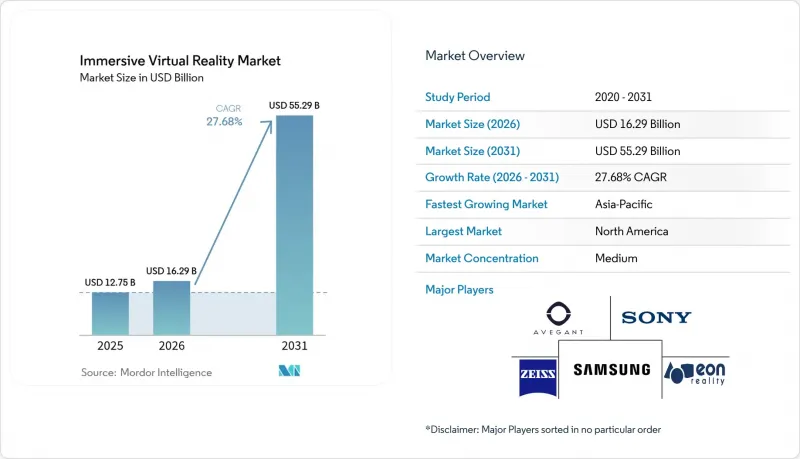
이 보고서는 기기별(헤드마운트 디스플레이[HMD], 제스처 추적 기기, 햅틱 피드백 기기, VR 카메라), 최종사용자 산업별(엔터테인먼트·게임,항공우주·방위, 헬스케어, 교육·연수 등), 구성 요소(하드웨어, 소프트웨어, 서비스), 몰입감 유형(완전 몰입형, 반 몰입형, 비몰입형) 및 지역별로 분류되어 있습니다.
전 세계 몰입형 가상현실 시장의 동향 및 인사이트
항공우주·방위 분야에서의 VR 활용
방위 기관들은 몰입형 시뮬레이터를 핵심 교육 과정에 통합하고 있습니다. 미국 공군은 ‘조종사 훈련 혁신(Pilot Training Transformation)’ 구상의 일환으로 225대의 VR 기기를 배치한 반면, Mass Virtual사는 관련 계약을 통해 6,700만 달러를 확보했습니다. 록히드 마틴(Lockheed Martin)과 Red 6는 TF-50 훈련기를 위해 증강현실(AR) 오버레이를 통합했으며, Vrgineers는 F-35의 시뮬레이션 능력을 확장하기 위한 체코와의 합의에 참여했습니다. 연방항공청(FAA)이 Vertex Solutions 및 Varjo와 협력하여 민간용 비행 시뮬레이터 기준을 갱신함에 따라 규제 조화가 진행되고 있습니다. 이러한 움직임으로 인해 기술 습득 주기가 단축되고 실제 비행시 연료비가 절감될 뿐만 아니라, 몰입형 가상현실 시장의 지속적인 성장을 지원하고 있습니다. 유럽 및 아시아에서의 지속적인 조달 프로젝트는 중기 전망을 더욱 공고히 하고 있습니다.
게이밍용 HMD를 통한 소비자 보급
2024년 전 세계 VR 헤드셋 출하량은 960만 대로 증가했으며, Meta가 73%의 점유율을 차지한 반면, Apple의 Vision Pro는 3,499달러라는 가격 설정에도 불구하고 5%의 프리미엄 틈새 시장을 확보했습니다. 구매자들이 케이블 없는 사용을 선호함에 따라 독립형 HMD 시장은 연평균 성장률(CAGR) 33.20%로 확대되고 있지만, 퀘스트 3S와 같은 저가형 모델의 출시로도 연말 성수기 판매 부진을 완전히 상쇄할 수는 없었으며, 이는 가격과 마찬가지로 컨텐츠의 다양성이 중요함을 시사합니다. 중국의 해외산 하드웨어에 대한 105% 관세 및 지역적인 GPU 부족으로 인해 소매 가격이 상승할 위험이 있지만, 지방 자치 단체의 자금 지원을 받은 대규모 로케이션형 VR 체험은 계속해서 첫 이용자를 끌어들이고 있으며, 단기적인 판매량 증가를 지원하고 있습니다. 5G 확산 가속화와 클라우드 렌더링으로 인해 성능상의 장벽은 더욱 낮아질 것이며, 몰입형 가상현실 시장의 성장세는 지속될 것입니다.
다감각 지원 장비의 높은 총 소유 비용
Apple Vision Pro의 부품 원가는 1,542달러이며, 마이크로 OLED 디스플레이만으로도 비용의 35%를 차지하고 있으며, 첨단 광학 기술이 소매 가격을 끌어올리고 있음을 여실히 보여주고 있습니다. 허리케인 ‘헬렌’으로 인해 반도체 포토리소그래피에 필수적인 고순도 석영의 전 세계 공급량의 최대 90%를 차지하는 노스캐롤라이나주의 석영 광산이 피해를 입어 부품 가격 상승을 초래하고 있습니다. 중국산 헤드셋에 부과되는 100%가 넘는 관세에 더해, TSMC의 지진으로 인한 가동 중단에 따른 GPU 공급 부족이 소비자 및 기업의 구매 비용을 끌어올리고 있습니다. 미국 반도체 제조 공장의 운영 비용은 아시아의 동종 업계 경쟁사보다 35% 높아, 국내 가격 억제를 방해하고 있습니다. 기업은 공급을 확보하기 위해 일괄 사전 구매 계약을 체결하며 대응하고 있지만, 단기적인 가격 급등으로 인해 가격에 민감한 지역에서의 도입이 위축되면서 몰입형 가상현실 시장의 성장 궤도에 제동이 걸리고 있습니다.
부문 분석
2025년, 헤드 마운트 디스플레이(HMD)는 몰입형 가상현실 시장에서 지배적인 위치를 차지하며 매출 점유율 85.40%를 확보했습니다. 스탠드얼론형은 가장 빠른 성장이 예상되며, 초기 설정을 신속하게 할 수 있는 무선 조작을 선호하는 구매자가 늘어남에 따라 2031년까지 연평균 성장률(CAGR) 32.20%로 확대될 것으로 전망됩니다. Meta의 Quest 시리즈는 출하량 점유율 73%를 유지하고 있지만, 299달러짜리 Quest 3S는 연말 성수기 수요를 이끌어내지 못하여, 가격보다 컨텐츠가 더 큰 제약 요인임이 부각되었습니다. 무선 스트리밍으로 인해 지연 시간이 줄어들면서 유선 연결형 기기의 인기는 떨어지고 있으며, 전용 하드웨어가 더 저렴하고 고성능이기 때문에 스마트폰용 뷰어는 퇴조하는 추세입니다.
제스처 추적용 액세서리와 햅틱 장갑은 정확한 손 움직임이 필요한 기업용 훈련 프로그램에서 주목을 받고 있습니다. 메타, 소니, 마이크로소프트의 촉각 피드백 관련 특허 출원은 사용자의 몰입감을 높이고 있지만, 전신 슈트는 비용이 높고 세척이 복잡하여 여전히 틈새 시장 수준에 머물러 있습니다. VR 카메라는 2024년에 100곳 이상의 시설을 개설한 중국의 위치 기반 엔터테인먼트 사업자에게 판매되어 현지 컨텐츠 제작을 강화하고 있습니다. 석영 광산 가동 중단에 따른 부품 부족으로 인해 모든 기기 카테고리에서 부품 원가가 상승할 가능성이 있지만, 디스플레이 수율 및 배터리 밀도 향상으로 2026년 이후에는 비용 상승이 완화될 것으로 예상되어, 몰입형 가상현실 시장으로의 기기 보급 확대가 촉진될 전망입니다.
2025년, 엔터테인먼트 및 게임 분야는 대히트 타이틀과 e-sports 이벤트가 소비자 지출을 지원함에 따라 몰입형 가상현실 시장 규모에서 45.55%의 점유율을 유지했습니다. 한편, 의료 분야는 가장 급격한 성장을 기록하고 있으며, 보험 환급의 길을 열어주는 FDA 및 CE 승인을 배경으로 2031년까지 연평균 성장률(CAGR) 28.65%를 달성할 것으로 추정됩니다. ‘RelieVRx’ 및 ‘DeepWell DTx’의 승인으로 통증 관리 및 정신건강 분야에 치료용 컨텐츠 도입이 진행되면서, 이 부문은 실험 단계에서 처방전이 필요한 영역으로 전환되고 있습니다.
방위·항공우주 분야에서는 이미 225개의 미 공군(USAF) 훈련 부대에 시뮬레이터가 배치된 사실에서 알 수 있듯이, 대규모 시뮬레이터 군의 도입이 계속되고 있습니다. 한편, 월마트, 보잉, 뱅크 오브 아메리카 등이 두 자릿수의 생산성 향상 효과를 수치화하고 있는 점으로 미루어 볼 때, 교육 기관들도 이 분야의 선구자로서 시장에 진입하고 있습니다. 루프트한자나 CAE와 같은 자동차 관련 기업은 승무원 지도 및 조종석 숙련 훈련에 혼합 현실(MR)을 활용하고 있으며, 건축 설계 사무소에서는 홀로그래픽을 활용한 워크스루를 통해 설계상의 결함을 조기에 파악하고 있습니다. 소매 업계에서의 도입은 여전히 모색 단계에 있으며, 컨텐츠 비용과 헤드셋의 위생에 대한 우려가 걸림돌이 되고 있습니다. BP 등 대형 제조·에너지 기업은 안전 교육 모듈을 도입하고 있으며, 의료 분야에서 입증된 효과가 인접 분야로도 파급되고 있음이 드러나고 있습니다. 이에 따라 몰입형 가상현실 시장의 성장세가 더욱 가속화되고 있습니다.
지역별 분석
북미는 막대한 국방 지출과 기업의 조기 도입에 힘입어 2025년에도 매출 점유율 37.60%로 몰입형 가상현실 시장을 계속 주도했습니다. 미국 기업은 대규모 조종사 훈련 예산과 의료 분야의 보험 환급 파이프라인의 혜택을 받고 있지만, 반도체 제조 비용의 급등으로 인해 아시아의 경쟁사들에 비해 하드웨어 가격이 상승하고 있습니다. 이 지역에서는 클라우드 인프라와 5G 구축을 활용하여 기기 비용 장벽을 상쇄할 수 있는 원격 렌더링 솔루션의 시범 운영을 추진하고 있습니다. 월마트, 보잉, 뱅크 오브 아메리카의 기업 교육 프로그램은 국내에서의 실증 사례를 제공하며, 벤더들이 북미 고객에 집중하는 태도를 지원하고 있습니다.
아시아태평양은 중국의 체계적인 메타버스 정책 프레임워크와 2024년에 가동을 시작한 100건 이상의 대규모 VR 도입에 힘입어 31.85%라는 지역별 최고 연평균 성장률(CAGR)을 기록했습니다. 공업정보화부는 기기 프로토콜을 통일하기 위한 표준화 위원회를 설립했으며, 국가영화국은 VR 영화관 확장을 장려했습니다. IDC는 2029년까지 이 지역의 AR/VR 관련 지출이 105억 달러를 넘어 전 세계 지출의 26.5%를 차지할 것으로 예측하고 있습니다. 일본과 한국은 교육 및 스마트 제조 시범 사업에 대한 정부 보조금을 통해 성장세를 가속화하고 있으며, 인도의 비용 효율이 뛰어난 개발자층이 현지화된 컨텐츠 제작을 가속화하고 있습니다. 부품 공급망과의 근접성은 운송 지연을 완화하는 데 도움이 되고 있지만, TSMC의 지진 및 태풍으로 인한 석영 공급 차질과 같은 자연재해 위험은 여전히 운영상 우려 사항으로 남아 있습니다.
유럽은 전략적 중간 지위를 차지하고 있으며, 유럽연합 집행위원회의 가상 세계 로드맵과 다년간의 국가 자금 지원을 받고 있는 60개 기업으로 구성된 독일의 ‘XR-Interaction’ 네트워크에 힘입고 있습니다. ‘가상현실·증강현실 산업 연합(Virtual and Augmented Reality Industrial Coalition)’은 2025년까지 유럽에서 86만 개의 신규 일자리가 창출될 것으로 예측하고 있으며, 이는 미국이나 중국의 생태계와 경쟁하려는 정치적 의지를 보여줍니다. 런던 정치경제대학(LSE)은 산업 전문 지식을 결집하기 위한 ‘메타버스판 에어버스’를 제안하고 있는 반면, BMW, IKEA, 보쉬 등의 기업은 상호 운용 가능한 디지털 트윈 실험을 진행하고 있습니다. 환율 변동이나 개인정보 보호 규제 강화로 인해 소비자 보급 속도는 둔화될 가능성이 있지만, 표준 및 윤리에 관한 국경을 초월한 협력은 장기적인 지역 경쟁력을 높이고, 몰입형 가상현실 시장에서 유럽의 기여를 지속시킬 것입니다.
기타 혜택:
- 엑셀 형식의 시장 예측(ME) 시트
- 3개월간의 애널리스트 지원
자주 묻는 질문
목차
제1장 서론
제2장 조사 방법
제3장 개요
제4장 시장 구도
제5장 시장 규모와 성장 예측
제6장 경쟁 구도
제7장 시장 기회와 향후 전망
KSA 26.09.04According to Mordor Intelligence, the immersive virtual reality market size is expected to grow from USD 12.75 billion in 2025 to USD 16.29 billion in 2026 and is forecast to reach USD 55.29 billion by 2031 at 27.68% CAGR over 2026-2031.
This report is Segmented by Device (Head-Mounted Displays [HMDs], Gesture Tracking Devices, Haptic Feedback Devices, and VR Cameras), End-User Industry (Entertainment and Gaming, Aerospace and Defense, Healthcare, Education and Training, and More), Component (Hardware, Software, and Services), Immersion Type (Fully-Immersive, Semi-Immersive, and Non-Immersive), and Geography.
Global Immersive Virtual Reality Market Trends and Insights
Use of VR in Aerospace and Defence Training
Defense agencies are embedding immersive simulators into core curricula. The U.S. Air Force deployed 225 VR devices under its Pilot Training Transformation initiative, while Mass Virtual secured USD 67 million in related contracts. Lockheed Martin and Red 6 integrated augmented overlays for the TF-50 trainer, and Vrgineers joined a Czech agreement to extend F-35 simulation capability. Regulatory alignment is advancing as the Federal Aviation Administration collaborates with Vertex Solutions and Varjo to update standards for civilian flight simulators. These moves shorten skill-acquisition cycles, reduce live-flight fuel spending, and underpin sustained growth for the immersive virtual reality market. Continued procurement pipelines in Europe and Asia reinforce the medium-term outlook.
Consumer Adoption via Gaming HMDs
Global VR headset shipments rose to 9.6 million units in 2024, with Meta holding 73% share and Apple's Vision Pro securing a 5% premium niche despite a USD 3,499 price tag. Stand-alone HMDs are expanding at 33.20% CAGR as buyers favor cable-free use, yet lower-priced launches such as the Quest 3S did not fully offset holiday-season softness, suggesting that content breadth is as vital as price. China's 105% tariffs on overseas hardware and regional GPU shortages risk lifting retail prices, but large-scale location-based VR experiences funded by local authorities continue to attract first-time users, supporting near-term unit growth. Accelerated 5G roll-out and cloud rendering will further lower performance barriers, sustaining momentum for the immersive virtual reality market.
High Total Cost of Ownership of Multi-Sensory Rigs
Apple Vision Pro's bill of materials stands at USD 1,542, with micro-OLED displays alone forming 35% of the cost, underscoring how sophisticated optics inflate retail pricing. Hurricane Helene damaged North Carolina quartz mines that supply up to 90% of global high-purity quartz, vital for semiconductor photolithography, pushing component prices higher. Tariffs exceeding 100% on China-built headsets, plus GPU shortages after TSMC earthquake disruptions, elevate consumer and enterprise acquisition expenses. U.S. fabs operate at operating costs 35% above Asian peers, curbing domestic price relief. Enterprises respond with bulk pre-purchase contracts to lock in supply, yet near-term sticker shock trims adoption in price-sensitive regions and tempers the immersive virtual reality market trajectory.
Other drivers and restraints analyzed in the detailed report include:
- Government-Funded VR Healthcare Therapy Pilots
- Enterprise Metaverse Platforms for Remote Collaboration
- Content Scarcity and Ecosystem Fragmentation
For complete list of drivers and restraints, kindly check the Table Of Contents.
Segment Analysis
The immersive virtual reality market size for head-mounted displays stood dominant in 2025 as the form factor secured 85.40% revenue share. Stand-alone variants are poised for the fastest climb, advancing at a projected 32.20% CAGR to 2031 as buyers gravitate toward wire-free operation that speeds initial set-up. Meta's Quest line continues to hold 73% share of shipments, yet the USD 299 Quest 3S failed to ignite holiday demand, underscoring content rather than price as the limiting factor. Tethered rigs are losing favor as wireless streaming narrows latency, while smartphone-shell viewers retreat because dedicated hardware is more affordable and performant.
Gesture-tracking accessories and haptic gloves are gaining traction within enterprise training programs that need precise hand articulation. Patent filings from Meta, Sony, and Microsoft around tactile feedback elevate user immersion, though full-body suits remain niche given higher cost and cleaning complexity. VR cameras are selling into China's location-based entertainment operators that launched over 100 venues in 2024, enriching local content capture. Component shortages tied to quartz mine disruptions can raise the bill of materials across all device classes yet advances in display yield and battery density are expected to moderate cost escalation after 2026, supporting broader device penetration into the immersive virtual reality market.
Entertainment and gaming retained a 45.55% share of the immersive virtual reality market size during 2025 as blockbuster titles and esports events anchored consumer spend. Healthcare, however, is tracking the steepest ascent, estimated to deliver a 28.65% CAGR through 2031 on the back of FDA and CE approvals that open reimbursement lanes. RelieVRx and DeepWell DTx clearances usher therapeutic content into pain management and mental health, shifting the segment from experimental to prescription territory.
Defense and aerospace continue to procure large simulator fleets, evidenced by 225 USAF training units already fielded, while education providers join the vanguard as Walmart, Boeing, and Bank of America quantify double-digit productivity lifts. Automotive firms like Lufthansa and CAE apply mixed reality to crew guidance and cockpit familiarization, and architecture studios leverage holographic walkthroughs to identify design flaws early. Retail engagement remains exploratory, held back by content costs and headset hygiene concerns. Manufacturing and energy majors such as BP roll out safety modules, demonstrating how healthcare's validation effect is permeating adjacent sectors, which amplifies growth momentum for the immersive virtual reality market.
Complete Report Scope:
- By Device
- Head-Mounted Displays (HMDs)
- Stand-alone HMDs
- Tethered HMDs
- Smartphone-based HMDs
- Gesture Tracking Devices
- Haptic Gloves
- Motion Controllers
- Full-Body Suits
- Haptic Feedback Devices
- VR Cameras
- Head-Mounted Displays (HMDs)
- By End-user Industry
- Entertainment and Gaming
- Aerospace and Defence
- Healthcare
- Surgery and Medical Training
- Rehabilitation Therapy
- Mental Health and Pain Management
- Education and Training
- Automotive and Transportation
- Architecture, Engineering and Construction (AEC)
- Retail and E-commerce
- Other Industries
- By Component
- Hardware
- Software
- Services
- By Immersion Type
- Fully-Immersive
- Semi-Immersive
- Non-Immersive
- By Geography
- North America
- United States
- Canada
- Mexico
- South America
- Brazil
- Argentina
- Rest of South America
- Europe
- United Kingdom
- Germany
- France
- Italy
- Spain
- Rest of Europe
- Asia-Pacific
- China
- Japan
- South Korea
- India
- Rest of Asia-Pacific
- Middle East
- United Arab Emirates
- Saudi Arabia
- Turkey
- Rest of Middle East
- Africa
- South Africa
- Nigeria
- Kenya
- Rest of Africa
- North America
Geography Analysis
North America continued to lead the immersive virtual reality market with 37.60% revenue share in 2025, buoyed by substantial defense spending and early enterprise adoption. U.S. companies benefit from large pilot training budgets and healthcare reimbursement pipelines, although higher semiconductor fabrication costs raise hardware prices relative to Asian competitors. The region is leveraging cloud infrastructure and 5G roll-out to pilot remote rendering solutions that could offset device cost barriers. Corporate training programs at Walmart, Boeing, and Bank of America supply domestic proof points, reinforcing vendor focus on North American clients.
Asia Pacific registered the highest regional CAGR at 31.85%, propelled by China's structured metaverse policy framework and more than 100 large-scale VR installations commissioned in 2024. The Ministry of Industry and Information Technology formed a standards committee that aligns device protocols, while the National Film Administration encouraged VR cinema roll-outs. IDC projects regional AR/VR spending to surpass USD 10.5 billion by 2029, equal to 26.5% of global outlays. Japan and South Korea add momentum through government grants for education and smart-manufacturing pilots, and India's cost-efficient developer pool accelerates localized content creation. Proximity to component supply chains helps mitigate freight delays, though natural disaster risks such as TSMC's earthquake and typhoon-driven quartz disruptions remain operational concerns.
Europe holds a strategic middle position, supported by the European Commission's virtual worlds roadmap and Germany's XR-Interaction network of 60 firms receiving multi-year state funding. The Virtual and Augmented Reality Industrial Coalition forecasts 860,000 new European jobs by 2025, signaling political will to compete with U.S. and Chinese ecosystems. The London School of Economics champions an "Airbus for the metaverse" to pool industrial expertise, while companies such as BMW, IKEA, and Bosch experiment with interoperable digital twins. Currency fluctuations and stricter privacy rules can slow consumer uptake, yet cross-border collaboration on standards and ethics enhances long-term regional competitiveness, sustaining European contribution to the immersive virtual reality market.
- Meta Platforms Inc. (Oculus)
- Sony Corporation
- HTC Corporation
- Apple Inc.
- Samsung Electronics Co., Ltd.
- Microsoft Corporation
- Pico Interactive (ByteDance Ltd.)
- Valve Corporation
- Varjo Technologies Oy
- HP Inc.
- Carl Zeiss AG
- Avegant Corporation
- Varjo Technologies
- Vrgineers
- Magic Leap, Inc.
- Google LLC
- Eon Reality, Inc.
- CyberGlove Systems LLC
- Ultraleap Ltd. (Leap Motion)
- Sixense Enterprises Inc.
- Vuzix Corporation
- Lenovo Group Ltd.
- Ultraleap Ltd.
Additional Benefits:
- The market estimate (ME) sheet in Excel format
- 3 months of analyst support
TABLE OF CONTENTS
1 INTRODUCTION
- 1.1 Study Assumptions and Market Definition
- 1.2 Scope of the Study
2 RESEARCH METHODOLOGY
3 EXECUTIVE SUMMARY
4 MARKET LANDSCAPE
- 4.1 Market Drivers
- 4.1.1 Use of VR in aerospace and defence training
- 4.1.2 Consumer adoption via gaming HMDs
- 4.1.3 Government-funded VR healthcare therapy pilots
- 4.1.4 Enterprise metaverse platforms for remote collaboration
- 4.1.5 AI-powered adaptive learning in VR education
- 4.1.6 Cloud-rendered VR streaming lowers hardware barrier
- 4.2 Market Restraints
- 4.2.1 High total cost of ownership of multi-sensory rigs
- 4.2.2 Content scarcity and ecosystem fragmentation
- 4.2.3 Latency-driven motion-sickness limits session length
- 4.2.4 Privacy concerns over biometric and gaze analytics
- 4.3 Value/Supply-Chain Analysis
- 4.4 Regulatory Landscape
- 4.5 Technological Outlook
- 4.6 Porter's Five Forces Analysis
- 4.6.1 Threat of New Entrants
- 4.6.2 Bargaining Power of Buyers/Consumers
- 4.6.3 Bargaining Power of Suppliers
- 4.6.4 Threat of Substitute Products
- 4.6.5 Intensity of Competitive Rivalry
- 4.7 Investment Analysis
5 MARKET SIZE AND GROWTH FORECASTS (VALUE)
- 5.1 By Device
- 5.1.1 Head-Mounted Displays (HMDs)
- 5.1.1.1 Stand-alone HMDs
- 5.1.1.2 Tethered HMDs
- 5.1.1.3 Smartphone-based HMDs
- 5.1.2 Gesture Tracking Devices
- 5.1.2.1 Haptic Gloves
- 5.1.2.2 Motion Controllers
- 5.1.2.3 Full-Body Suits
- 5.1.3 Haptic Feedback Devices
- 5.1.4 VR Cameras
- 5.1.1 Head-Mounted Displays (HMDs)
- 5.2 By End-user Industry
- 5.2.1 Entertainment and Gaming
- 5.2.2 Aerospace and Defence
- 5.2.3 Healthcare
- 5.2.3.1 Surgery and Medical Training
- 5.2.3.2 Rehabilitation Therapy
- 5.2.3.3 Mental Health and Pain Management
- 5.2.4 Education and Training
- 5.2.5 Automotive and Transportation
- 5.2.6 Architecture, Engineering and Construction (AEC)
- 5.2.7 Retail and E-commerce
- 5.2.8 Other Industries
- 5.3 By Component
- 5.3.1 Hardware
- 5.3.2 Software
- 5.3.3 Services
- 5.4 By Immersion Type
- 5.4.1 Fully-Immersive
- 5.4.2 Semi-Immersive
- 5.4.3 Non-Immersive
- 5.5 By Geography
- 5.5.1 North America
- 5.5.1.1 United States
- 5.5.1.2 Canada
- 5.5.1.3 Mexico
- 5.5.2 South America
- 5.5.2.1 Brazil
- 5.5.2.2 Argentina
- 5.5.2.3 Rest of South America
- 5.5.3 Europe
- 5.5.3.1 United Kingdom
- 5.5.3.2 Germany
- 5.5.3.3 France
- 5.5.3.4 Italy
- 5.5.3.5 Spain
- 5.5.3.6 Rest of Europe
- 5.5.4 Asia-Pacific
- 5.5.4.1 China
- 5.5.4.2 Japan
- 5.5.4.3 South Korea
- 5.5.4.4 India
- 5.5.4.5 Rest of Asia-Pacific
- 5.5.5 Middle East
- 5.5.5.1 United Arab Emirates
- 5.5.5.2 Saudi Arabia
- 5.5.5.3 Turkey
- 5.5.5.4 Rest of Middle East
- 5.5.6 Africa
- 5.5.6.1 South Africa
- 5.5.6.2 Nigeria
- 5.5.6.3 Kenya
- 5.5.6.4 Rest of Africa
- 5.5.1 North America
6 COMPETITIVE LANDSCAPE
- 6.1 Strategic Moves
- 6.2 Market Share Analysis
- 6.3 Company Profiles (includes Global level Overview, Market level overview, Core Segments, Financials as available, Strategic Information, Market Rank/Share for key companies, Products and Services, and Recent Developments)
- 6.3.1 Meta Platforms Inc. (Oculus)
- 6.3.2 Sony Corporation
- 6.3.3 HTC Corporation
- 6.3.4 Apple Inc.
- 6.3.5 Samsung Electronics Co., Ltd.
- 6.3.6 Microsoft Corporation
- 6.3.7 Pico Interactive (ByteDance Ltd.)
- 6.3.8 Valve Corporation
- 6.3.9 Varjo Technologies Oy
- 6.3.10 HP Inc.
- 6.3.11 Carl Zeiss AG
- 6.3.12 Avegant Corporation
- 6.3.13 Varjo Technologies
- 6.3.14 Vrgineers
- 6.3.15 Magic Leap, Inc.
- 6.3.16 Google LLC
- 6.3.17 Eon Reality, Inc.
- 6.3.18 CyberGlove Systems LLC
- 6.3.19 Ultraleap Ltd. (Leap Motion)
- 6.3.20 Sixense Enterprises Inc.
- 6.3.21 Vuzix Corporation
- 6.3.22 Lenovo Group Ltd.
- 6.3.23 Ultraleap Ltd.
7 MARKET OPPORTUNITIES AND FUTURE OUTLOOK
- 7.1 White-space and unmet-need assessment


