

|
시장보고서
상품코드
2122252
외상 고정 기기 : 시장 점유율 분석, 업계 동향과 통계, 성장 예측(2026-2031년)Trauma Fixation Devices - Market Share Analysis, Industry Trends & Statistics, Growth Forecasts (2026 - 2031) |
||||||
 Mordor Intelligence
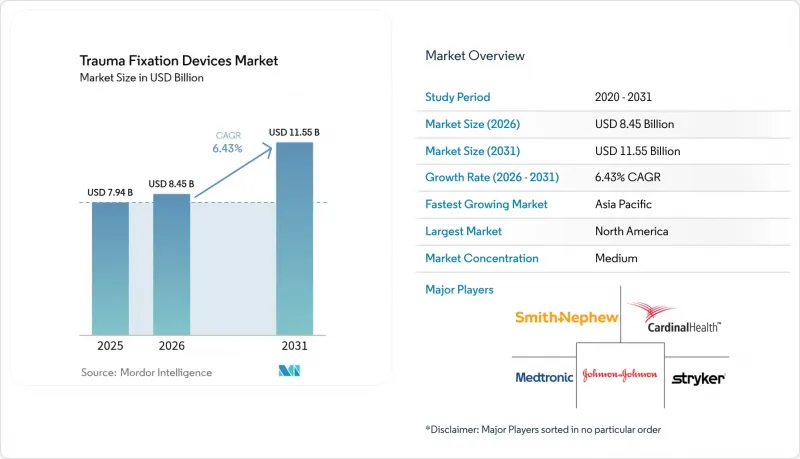
Mordor Intelligence에 따르면 외상 고정 기기 시장 규모는 2025년 79억 4,000만 달러에서 2026년에는 84억 5,000만 달러로 확대하며, 2026-2031년에 CAGR 6.43%로 추이하며, 2031년에는 115억 5,000만 달러에 달할 것으로 예측됩니다.
이 보고서는 기기 유형(내부 고정 장치[플레이트, 나사 등], 외부 고정 장치[일측 및 양측 고정 장치 등]), 수술 부위(하지[고관절 및 골반 등], 상지), 최종사용자(병원, 외래 수술 센터 등) 및 지역(북미, 유럽 등)별로 분류되어 있습니다. 시장 예측은 금액(달러) 기준으로 제시되어 있습니다.
전 세계 외상 고정 기기 시장의 동향 및 인사이트
골 퇴행성 질환 및 골다공증 유병률 증가
전 세계에서 약 5억 명이 골다공증을 앓고 있으며, 이는 골질이 저하된 상태에 맞는 고정 솔루션에 대한 수요를 재구성하고 있습니다. 과거에는 고에너지 외상이 입원의 주요 원인이었으나, 현재는 취약성 골절이 그 자리를 대신하고 있으며, 이에 따라 각 기기 제조업체들은 골형성 촉진제를 나사나 플레이트에 직접 통합하고 있습니다. 미국 의료 시스템에서 골절과 관련된 연간 비용은 250억 달러를 초과하며, 보험사는 재골절을 방지하기 위한 예방적 임플란트에 자금을 지원해야 하는 상황에 처해 있습니다. 따라서 각 제조사들은 골유착을 강화하는 동시에, 치유 중인 뼈에 가해지는 부하를 점진적으로 경감시키는 생체활성 구조의 유효성을 입증하기 위해 경쟁하고 있습니다. 이러한 추세는 고령화 속도가 가장 빠르고, 보험 환급 제도가 고성능 임플란트를 지원하고 있는 북미 및 유럽에서 가장 두드러집니다. 장기적으로는 이러한 요인으로 인해 외상 고정 기기 시장의 연평균 성장률(CAGR)이 1.2포인트 상승할 것으로 예상됩니다.
교통사고 및 외상으로 인한 부상 발생률 증가
WHO 기록에 따르면 부상으로 인한 사망자 수는 매년 440만 명에 달하며, 자동차 보급이 안전 인프라 구축을 앞지르고 있는 아시아태평양이 가장 큰 부담을 안고 있습니다. 도시 지역의 스포츠 문화 확대와 산업 현장의 증가로 인해 골절의 복잡성이 더욱 커지고 있으며, 한 번의 시술로 여러 개의 뼈를 안정화할 수 있는 모듈식 고정 시스템이 요구되고 있습니다. 각 의료기기 제조사들은 수술 시간을 단축하고 재고 관리를 효율화하는 통합 플랫폼을 도입하고 있습니다. 중기적인 전망으로는 인도, 중국, 동남아시아의 외상 발생률 상승이 외상 고정 기기 시장의 예상 연평균 성장률(CAGR)을 0.8%포인트 끌어올릴 것으로 보입니다.
높은 수술 비용과 기기 비용
고가의 생체흡수성 임플란트나 약물 방출형 임플란트는 초기 비용이 높기 때문에 저소득 지역에서의 보급이 제한되고 있습니다. 포괄적 지불 제도에 따라 병원 및 외래 진료 센터는 치료 과정 전체의 비용을 엄격히 검토할 수밖에 없어, 재고 예산을 최대한 활용할 수 있는 모듈식 시스템을 선택하는 경우가 늘고 있습니다. 이러한 비용 측면의 마찰로 인해 단기적인 외상 고정 기기 시장의 성장률은 0.7%포인트 하락하고 있습니다.
부문 분석
2025년 기준, 내부 고정 장치는 외상 고정 기기 시장의 63.98% 점유율을 차지하고 있으며, 해당 하위 부문은 2031년까지 연평균 성장률(CAGR) 8.05%를 기록할 것으로 전망되어, 이는 모든 기기 카테고리 중 가장 높은 성장률입니다. 따라서 소아과 및 노인의학 분야에서 생체흡수성 나사가 보급됨에 따라 내부 고정 장치에 기인한 외상 고정 기기 시장의 규모는 업계 전체의 성장 속도를 상회할 것으로 전망됩니다. 동적 압축 슬롯이 장착된 플레이트는 골유합을 촉진하는 제어된 미세 운동을 가능하게 합니다. Zimmer Biomet사의 MotionLoc 나사는 이 기능을 잘 보여주는 대표적인 예입니다.
스마트 합금 및 모듈식 트레이 레이아웃의 등장으로 외과의사는 수술 중 고정 구조의 강성을 조정할 수 있게 되어 재고를 최대 30%까지 줄일 수 있습니다. 약물 방출 코팅은 기계적 지지력과 생물학적 치료를 융합함으로써 내부 고정 기구의 차별화를 더욱 촉진하고 있습니다. 외부 고정 장치는 복잡한 개방 골절이나 손상 통제 정형외과 분야에서 여전히 필수적이지만, 보험 급여 압박으로 인해 사례당 비용을 절감할 수 있는 재사용 가능한 프레임 키트에 대한 관심이 높아지고 있습니다. 이러한 동향들이 결합되면서 내부 고정 솔루션은 우위를 유지하고 있지만, 시장 점유율을 지키기 위해서는 지속적인 혁신이 요구되고 있습니다.
지역별 분석
북미는 2025년에 전 세계 매출의 39.05%를 차지하며, 견고한 보험 급여 체계와 높은 외과 의사 밀도를 바탕으로 2031년까지 그 주도적 지위를 유지할 전망입니다. 2024년 11월에 발표된 뼈 플레이트 및 나사에 관한 FDA 지침은 심사 기준을 엄격화한 한편, 승인 절차를 명확히 하고 디지털 호환 임플란트의 승인 주기를 단축했습니다. 미국의 보험사들은 2차 수술을 피하기 위해 생체흡수성 임플란트에 대한 자금 지원을 적극적으로 하고 있는 반면, 캐나다의 병원들은 절개 부위 축소와 환자 회전율 향상을 목적으로 로봇 기술에 대한 투자를 추진하고 있습니다.
아시아태평양에서는 의료 시스템이 정형외과수술실과 외상 센터를 확충하고 있으며, 2026-2031년에 연평균 성장률(CAGR) 7.55%라는 가장 높은 성장률을 기록할 것으로 예측됩니다. 중국과 인도에서는 도시 지역의 교통수단 및 건설 공사와 관련된 외상 환자 수가 급격히 증가하고 있으며, 범용성이 높은 모듈식 고정 장치의 조달이 진행되고 있습니다. 일본의 초고령화 사회를 배경으로 고령자용 나사 고정 시스템이 추진되는 한편, 한국에서는 AI를 활용한 골절 치료 계획이 선도적으로 도입되고 있습니다. 중국의 국내 OEM(Original Equipment Manufacturer)들은 티타늄 플레이트의 글로벌 공급망에 진입하며 경쟁을 더욱 격화시키고 있습니다.
유럽은 엄격한 CE 마크 심사와 의료 종사자·산업계의 강력한 협력에 힘입어 여전히 안정적인 제3의 축을 이루고 있습니다. 독일과 영국은 환경 지침에 부합하는 생분해성 임플란트의 임상 시험을 주도하고 있습니다. 남유럽 시장에서는 지출 억제를 위해 재사용에 최적화된 외부 고정 장치의 도입이 가속화되고 있습니다. 중동부 유럽에서는 EU의 구조 기금을 통해 외상 치료 부문이 정비되면서 다국적 기업에 새로운 입찰 기회가 제공되고 있습니다.
중동 및 아프리카 및 남미에서는 각국 정부가 석유 수입이나 재건 자금을 3차 의료 기관에 투입하고 있으며, 합쳐서 한 자릿수 중반대의 성장이 예상됩니다. 걸프 국가에서는 내비게이션 기능을 갖춘 고급 시스템이 구매되고 있는 반면, 사하라 이남 아프리카에서는 재사용 가능한 외부 고정 프레임을 필요로 하는 기부금 지원 골절 치료 프로그램에 의존하고 있습니다. 라틴아메리카 전역에서는 브라질의 공적 의료 서비스가 당뇨병성 족부 골절 예방을 목적으로 한 약물 방출형 플레이트의 보험 적용을 확대하고 있으며, 이 지역의 조달 기준을 높이는 요인이 되고 있습니다.
기타 혜택:
- 엑셀 형식의 시장 전망(ME) 시트
- 3개월간의 애널리스트 지원
자주 묻는 질문
목차
제1장 서론
제2장 조사 방법
제3장 개요
제4장 시장 구도
제5장 시장 규모와 성장 예측
제6장 경쟁 구도
제7장 시장 기회와 향후 전망
KSA 26.09.07According to Mordor Intelligence, the trauma fixation devices market size is expected to grow from USD 7.94 billion in 2025 to USD 8.45 billion in 2026 and is forecast to reach USD 11.55 billion by 2031 at 6.43% CAGR over 2026-2031.
This report is Segmented by Device Type (Internal Fixators [Plates, Screws, and More], External Fixators [Unilateral & Bilateral Fixators, and More]), Surgical Site (Lower Extremities [Hip & Pelvic, and More], and Upper Extremities), End User (Hospitals, Ambulatory Surgery Centers, and More), and Geography (North America, Europe, and More). The Market Forecasts are Provided in Terms of Value (USD).
Global Trauma Fixation Devices Market Trends and Insights
Rising Prevalence of Bone-Degenerative Diseases & Osteoporosis
Global osteoporosis affects an estimated 500 million people and is reshaping demand for fixation solutions tailored to compromised bone quality. Fragility fractures now drive hospital admissions that once stemmed from high-energy trauma, prompting device makers to integrate bone-building pharmaceuticals directly into screws and plates. Health systems in the United States incur annual fracture costs above USD 25 billion, forcing payers to fund preventive implants that avert refracture. Manufacturers are therefore racing to validate bioactive constructs that strengthen osseointegration while gradually off-loading stress to healing bone. The trend is most visible in North America and Europe where aging curves are steepest and reimbursement supports premium implants. Over the long term, this driver is expected to add 1.2 percentage points to the trauma fixation devices market CAGR.
Increasing Incidence of Road Traffic Accidents & Trauma Injuries
WHO records show injuries claim 4.4 million lives each year, with Asia-Pacific bearing the heaviest load as motorization outpaces safety infrastructure. Expanding urban sports cultures and industrial workplaces add further fracture complexity, demanding modular fixation systems capable of stabilizing multiple bones in a single session. Device makers are introducing integrated platforms that cut operating time and streamline inventory. In medium-term horizons, rising trauma exposure in India, China, and Southeast Asia injects 0.8 percentage points into the projected CAGR for the trauma fixation devices market.
High Procedure & Device Costs
Premium bioabsorbable and drug-eluting implants cost more up front, limiting uptake in lower-income settings. Bundled payments push hospitals and ambulatory centers to scrutinize total episode cost, often opting for modular systems that stretch inventory budgets. This cost friction shaves 0.7 percentage points off short-term trauma fixation devices market growth.
Other drivers and restraints analyzed in the detailed report include:
- Growing Geriatric Population Vulnerable to Fractures
- Technological Advances in Bio-Compatible & Bio-Absorbable Fixation Materials
- Rising Implant-Associated MDR-Infection Concerns
For complete list of drivers and restraints, kindly check the Table Of Contents.
Segment Analysis
Internal fixators generated 63.98% of trauma fixation devices market share in 2025, while their sub-segment is set to log an 8.05% CAGR to 2031, the fastest across all device categories. The trauma fixation devices market size attributed to internal fixators will thus outpace overall industry expansion as bioabsorbable screws gain traction in pediatrics and geriatrics. Plates equipped with dynamic compression slots permit controlled micromotion that encourages callus formation; Zimmer Biomet's MotionLoc screw exemplifies this capability.
The advent of smart alloys and modular tray layouts lets surgeons adjust construct stiffness intraoperatively, cutting inventory by up to 30%. Drug-eluting coatings further differentiate internal hardware by merging mechanical support with biologic therapy. External fixators remain indispensable for complex open fractures and damage-control orthopedics, yet reimbursement pressures drive interest toward reusable frame kits that lower per-case expenditure. Together, these trends keep internal solutions ahead but invite continuous innovation to protect share.
Complete Report Scope:
- By Device Type
- Internal Fixators
- Plates
- Screws
- Nails
- Others
- External Fixators
- Unilateral & Bilateral Fixators
- Circular Fixators
- Hybrid Fixators
- Internal Fixators
- By Surgical Site
- Lower Extremities
- Hip & Pelvic
- Foot & Ankle
- Knee
- Others
- Upper Extremities
- Hand & Wrist
- Shoulder
- Spine
- Others
- Lower Extremities
- By End User
- Hospitals
- Ambulatory Surgery Centers
- Other End Users
- Geography
- North America
- United States
- Canada
- Mexico
- Europe
- Germany
- United Kingdom
- France
- Italy
- Spain
- Rest of Europe
- Asia-Pacific
- China
- Japan
- India
- South Korea
- Australia
- Rest of Asia-Pacific
- Middle East and Africa
- GCC
- South Africa
- Rest of Middle East and Africa
- South America
- Brazil
- Argentina
- Rest of South America
- North America
Geography Analysis
North America controlled 39.05% of global revenue in 2025 and will maintain its lead through 2031 on the back of robust reimbursement and high surgical skill density. The November 2024 FDA guidance for bone plates and screws has sharpened review criteria yet also clarified pathways, shortening approval cycles for digital-ready implants. United States payers actively fund bioabsorbable implants to dodge secondary surgery, while Canadian hospitals invest in robotics aimed at smaller incisions and quicker turnover.
Asia-Pacific is forecast to clock the fastest 7.55% CAGR over 2026-2031 as healthcare systems expand orthopedic theaters and trauma centers. China and India witness rapid trauma growth tied to urban transportation and construction, prompting procurement of versatile modular fixators. Japan's super-aged society pushes geriatric-specific nailing systems, whereas South Korea pioneers AI-driven fracture planning. Domestic OEMs in China are entering global supply chains for titanium plates, adding competitive heat.
Europe remains a stable third pillar, buffered by tight CE-Mark scrutiny and strong clinician-industry collaboration. Germany and the United Kingdom spearhead biodegradable implant trials aligned with environmental directives. Southern European markets accelerate adoption of reuse-optimized external fixators to curb spending. In Central-Eastern Europe, EU structural funds upgrade trauma units, giving multinationals fresh tenders.
The Middle East and Africa, alongside South America, collectively offer mid-single-digit expansion as governments channel oil proceeds and recovery funds into tertiary hospitals. Gulf states buy premium navigation-enabled systems, whereas Sub-Saharan Africa leans on donor-funded fracture programs that seek reusable ex-fix frames. Across Latin America, Brazil's public health service increasingly reimburses drug-eluting plates for diabetic foot fracture prevention, nudging regional procurement norms higher.
- Arthrex
- B. Braun
- Cardinal Health
- Conmed
- Johnson & Johnson
- Orthofix
- Medtronic
- Smiths Group
- Stryker
- Zimmer Biomet
- Invibio
- Globus Medical
- Acumed
- Wright Medical Group
- NuVasive
- MicroPort
- OsteoMed LLC
- Integra LifeSciences Holdings Corp.
- Bio-Medical Enterprises Inc.
- Orthopaedic Implant Company
Additional Benefits:
- The market estimate (ME) sheet in Excel format
- 3 months of analyst support
TABLE OF CONTENTS
1 Introduction
- 1.1 Study Assumptions & Market Definition
- 1.2 Scope of the Study
2 Research Methodology
3 Executive Summary
4 Market Landscape
- 4.1 Market Overview
- 4.2 Market Drivers
- 4.2.1 Rising Prevalence Of Bone-Degenerative Diseases & Osteoporosis
- 4.2.2 Increasing Incidence Of Road Traffic Accidents & Trauma Injuries
- 4.2.3 Growing Geriatric Population Vulnerable To Fractures
- 4.2.4 Technological Advances In Bio-Compatible & Bio-Absorbable Fixation Materials
- 4.2.5 Orthobiologic-Enhanced Fixation (Drug-Eluting Plates / Screws)
- 4.2.6 Value-Based Procurement Driving Modular Reusable External Fixators In EMs
- 4.3 Market Restraints
- 4.3.1 High Procedure & Device Costs
- 4.3.2 Stringent & Time-Consuming Regulatory Approvals
- 4.3.3 Supply-Chain Risk For Medical-Grade Ti & Nitinol Alloys
- 4.3.4 Rising Implant-Associated MDR-Infection Concerns
- 4.4 Technological Outlook
- 4.5 Porter's Five Forces
- 4.5.1 Bargaining Power of Buyers
- 4.5.2 Bargaining Power of Suppliers
- 4.5.3 Threat of New Entrants
- 4.5.4 Threat of Substitutes
- 4.5.5 Intensity of Competitive Rivalry
5 Market Size & Growth Forecasts (Value, USD)
- 5.1 By Device Type
- 5.1.1 Internal Fixators
- 5.1.1.1 Plates
- 5.1.1.2 Screws
- 5.1.1.3 Nails
- 5.1.1.4 Others
- 5.1.2 External Fixators
- 5.1.2.1 Unilateral & Bilateral Fixators
- 5.1.2.2 Circular Fixators
- 5.1.2.3 Hybrid Fixators
- 5.1.1 Internal Fixators
- 5.2 By Surgical Site
- 5.2.1 Lower Extremities
- 5.2.1.1 Hip & Pelvic
- 5.2.1.2 Foot & Ankle
- 5.2.1.3 Knee
- 5.2.1.4 Others
- 5.2.2 Upper Extremities
- 5.2.2.1 Hand & Wrist
- 5.2.2.2 Shoulder
- 5.2.2.3 Spine
- 5.2.2.4 Others
- 5.2.1 Lower Extremities
- 5.3 By End User
- 5.3.1 Hospitals
- 5.3.2 Ambulatory Surgery Centers
- 5.3.3 Other End Users
- 5.4 Geography
- 5.4.1 North America
- 5.4.1.1 United States
- 5.4.1.2 Canada
- 5.4.1.3 Mexico
- 5.4.2 Europe
- 5.4.2.1 Germany
- 5.4.2.2 United Kingdom
- 5.4.2.3 France
- 5.4.2.4 Italy
- 5.4.2.5 Spain
- 5.4.2.6 Rest of Europe
- 5.4.3 Asia-Pacific
- 5.4.3.1 China
- 5.4.3.2 Japan
- 5.4.3.3 India
- 5.4.3.4 South Korea
- 5.4.3.5 Australia
- 5.4.3.6 Rest of Asia-Pacific
- 5.4.4 Middle East and Africa
- 5.4.4.1 GCC
- 5.4.4.2 South Africa
- 5.4.4.3 Rest of Middle East and Africa
- 5.4.5 South America
- 5.4.5.1 Brazil
- 5.4.5.2 Argentina
- 5.4.5.3 Rest of South America
- 5.4.1 North America
6 Competitive Landscape
- 6.1 Market Concentration
- 6.2 Market Share Analysis
- 6.3 Company Profiles (includes Global level Overview, Market level overview, Core Segments, Financials as available, Strategic Information, Market Rank/Share for key companies, Products & Services, and Recent Developments)
- 6.3.1 Arthrex Inc.
- 6.3.2 B. Braun Melsungen AG
- 6.3.3 Cardinal Health Inc.
- 6.3.4 CONMED Corporation
- 6.3.5 Johnson & Johnson (DePuy Synthes)
- 6.3.6 Orthofix Medical Inc.
- 6.3.7 Medtronic plc
- 6.3.8 Smith & Nephew plc
- 6.3.9 Stryker Corporation
- 6.3.10 Zimmer Biomet Holdings Inc.
- 6.3.11 Invibio Ltd
- 6.3.12 Globus Medical Inc.
- 6.3.13 Acumed LLC
- 6.3.14 Wright Medical Group N.V.
- 6.3.15 NuVasive Inc.
- 6.3.16 MicroPort Orthopedics Inc.
- 6.3.17 OsteoMed LLC
- 6.3.18 Integra LifeSciences Holdings Corp.
- 6.3.19 Bio-Medical Enterprises Inc.
- 6.3.20 Orthopaedic Implant Company
7 Market Opportunities & Future Outlook
- 7.1 White-space & Unmet-Need Assessment


