

|
시장보고서
상품코드
2122336
중환자 진단 : 시장 점유율 분석, 업계 동향과 통계, 성장 예측(2026-2031년)Critical Care Diagnostics - Market Share Analysis, Industry Trends & Statistics, Growth Forecasts (2026 - 2031) |
||||||
 Mordor Intelligence
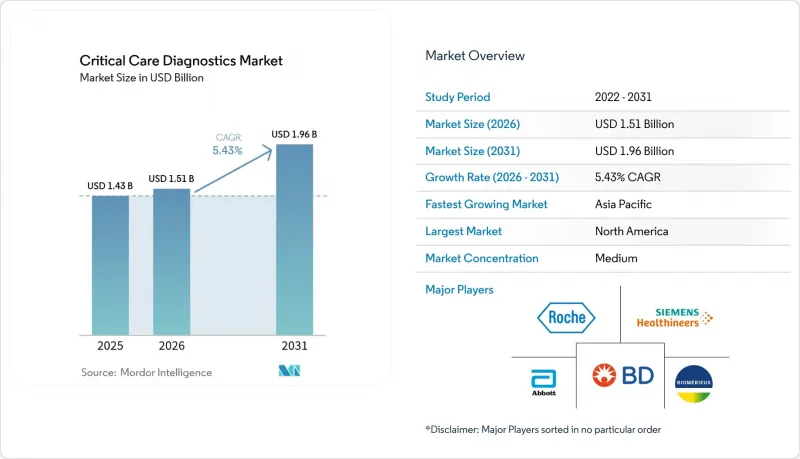
Mordor Intelligence에 의하면, 중환자 진단 시장 규모는 2025년 14억 3,000만 달러에서 2026년에는 15억 1,000만 달러에 이르고, 2026-2031년 CAGR 5.43%로 성장을 지속하여 2031년에는 19억 6,000만 달러에 달할 것으로 예측됩니다.
본 보고서는 검사 유형별(유세포분석, 혈액검사, 미생물학·감염병 검사, 기타), 기술별(중앙 검사실용 분석기, 기타), 최종 사용자별(중환자실(ICU), 기타), 검체 유형별(전혈, 기타),지역별(북미, 유럽, 아시아태평양, 중동 및 아프리카, 남미)로 분류되어 있습니다. 시장 예측은 금액(미화) 기준으로 제시되어 있습니다.
전 세계 중환자 진단 시장 동향 및 인사이트
신속한 진단이 필요한 중증 질환으로 인한 부담 증가
패혈증은 매년 170만 명 이상의 미국 성인에게 영향을 미치며, 진단이 6시간 이상 지연되면 사망률이 급격히 상승합니다. 2025년 MeMed BV의 숙주 반응 검사가 FDA 승인을 받음에 따라, 임상의는 20분 이내에 세균성 감염과 바이러스성 감염을 구별할 수 있게 되었습니다. 고령화에 따라 이미 복잡한 중환자실(ICU) 환자 구성에 다중 질환이 더해지는 한편, 신흥 시장에서는 외상 및 감염병의 부담이 증가하고 있습니다. 고감도 트로포닌, 젖산, 프로칼시토닌을 추적하는 예측 알고리즘을 통해 뚜렷한 증상이 나타나기 6-12시간 전에 생리 기능 저하를 경고할 수 있게 되어, 치료 성과 향상과 의료 자원 효율화가 도모되고 있습니다.
급성기 의료 현장에서의 포인트 오브 케어 검사 확대
휴대용 카트리지 분석 장치의 도입으로, 기존에는 검사 결과가 나올 때까지 45-90분이나 소요되던 검체 이송이 불필요해졌습니다. Nova Biomedical의 ‘Stat Profile Prime Plus’와 같은 기기는 90µL의 모세혈관에서 11개 항목의 검사 패널을 생성하여, 혈역학 상태가 불안정한 환자의 검체량을 절약합니다. 트로포닌 검사를 중앙 검사실에서 병상 옆 플랫폼으로 전환한 응급실에서는 검사 처리 시간이 30-40% 단축되었다고 보고되고 있습니다. 코로나19 위기 중에 도입된 휴대용 분자진단 장치는 현재 구급차에도 탑재되어 있어, 병원 문이 열리기 전부터 혈전 용해 요법이나 항생제 요법을 시작할 수 있게 되었습니다.
첨단 진단 플랫폼의 높은 자본 비용과 운영 비용
AI 지원 혈액가스 분석 워크스테이션은 1대당 50만 달러 이상 들 수 있으며, 서비스 계약비로 연간 약 10%의 추가 비용이 발생합니다. 검사 건수가 투자 회수를 보장하지 못하는 경우, 소규모 지역 병원은 도입을 주저하는 경향이 있습니다. 구독형이나 치료 성과 연동형 가격 모델이 등장하고 있지만, 경영진은 도입을 결정하기 전에 수년에 걸친 실적을 제시해 줄 것을 요구하는 경우가 많습니다.
부문 분석
2025년, 혈액학 검사는 중환자 치료 진단 시장 규모의 24.18%를 차지하고 있으며, 이는 수혈 결정, 응고 모니터링, 감염증 모니터링에서 그 역할을 반영하고 있습니다. 현재 자동 분석기는 60초 이내에 전혈구 계수 결과를 출력하며, 수혈 관리 소프트웨어와 직접 연동되고 있습니다. 응고 하위 패널은 혈전 형성을 실시간으로 추적하는 점탄성 측정법에 의해 확대되고 있으며, 외상 시 소생 조치에서 표적화된 항섬유소용해 요법의 지침이 되고 있습니다.
루틴 및 특수 화학 검사는 고감도 트로포닌, 프레셉신, 그리고 조기 병세 악화를 예측할 수 있게 해주는 대사 스트레스 마커를 포괄하는 검사 항목의 확대에 힘입어 연평균 성장률(CAGR) 7.54%로 성장할 전망입니다. 미생물학 및 분자 병원체 검사 패널은 항생제 적정 사용 의무화와 발맞추어 발전하고 있으며, 1시간 이내에 감수성 프로파일을 제공함으로써 광범위 스펙트럼 항생제의 사용을 억제하고 있습니다. 유세포분석법은 이식 중환자실(ICU)의 면역억제 환자군에 대해 여전히 그 가치를 유지하고 있는 반면, 면역 단백질 검사는 패혈증 위험을 정밀하게 계층화할 수 있는 용해성 CD14 변이체의 도입으로 적용 범위를 확대되고 있습니다. 전반적으로 이러한 변화는 개별 매개변수가 아닌 환자의 전체적인 상황을 제시하는 멀티플렉스 대시보드에 대한 임상의의 요구와 부합하며, 통합 플랫폼이 조달 결정의 최전선에 자리 잡고 있습니다.
포인트 오브 케어(POC) 기기는 2025년 중환자 치료 진단 시장의 매출의 52.02%를 차지하며, 병상에서 검사 결과 보고 시간을 대폭 단축하는 데 필수적인 존재로 남아 있습니다. 카트리지 방식의 혈액가스 분석기, 휴대용 혈당·케톤체 측정기, 소형 면역 분석기는 유지보수가 최소화되고 긴급한 워크플로우에 원활하게 통합될 수 있어 구매 목록 상위권을 차지하고 있습니다.
그러나 연평균 성장률(CAGR) 7.66%로 확대될 것으로 예상되는 AI 기반 의사결정 지원 시스템이 구매자의 기대를 재정의하고 있습니다. 신경망을 탑재한 미들웨어 허브는 종단적 바이오마커 데이터를 지속적으로 분석하고, 최대 12시간 후까지 유해 사건을 예측함으로써 프로토콜에 기반한 중재를 촉발합니다. 중앙 검사실용 분석 장비는 여전히 높은 처리량에 대한 요구를 충족시키고 있지만, 분산화의 진전에 따라 그 미래는 단계적 치료 환경을 지원하는 허브 앤 스포크형 아키텍처에 있다고 할 수 있습니다. 하이브리드 클라우드 인프라는 계산 부하를 줄여 지역 병원의 진입 장벽을 낮추는 동시에, 사이버 보안을 강화하여 환자 데이터 유출에 대한 높아지는 우려에 대응하고 있습니다. 이러한 동향을 종합해 보면, 병상 옆의 하드웨어와 클라우드 인텔리전스가 긴밀히 연계되어 임상 성과를 향상시키는 기술 융합이 예상됩니다.
지역별 분석
북미는 높은 중환자실(ICU) 병상 밀도, 광범위한 보험 제도, 의료기기의 신속한 승인을 가능하게 하는 간소화된 FDA 승인 절차를 배경으로 2025년 매출의 42.03%를 계속 차지했습니다. 미국의 병원들은 가치 기반 상환 제도를 준수하기 위해 AI 대시보드 도입을 추진하고 있는 반면, 캐나다 각 주에서 진행하는 입찰에서는 분산된 의료 환경 전반에 걸친 카트리지의 상호 운용성이 중시되고 있습니다. 유럽은 현대화 프로그램과 중증 질환 발생률을 높이는 고령화 인구에 힘입어 견조한 수요를 보이고 있습니다. 독일은 점탄성 응고 분석 장비를 지정된 외상 네트워크에 자금을 지원하고 있으며, 프랑스는 항생제 내성 문제에 대처하기 위해 마이크로플루이딕스 분자 플랫폼에 투자하고 있습니다. 영국이 지역 진단센터에 23억 파운드를 투자하는 것은 검사의 분산화로의 전환을 시사합니다.
아시아태평양은 중국과 인도가 수십억 달러 규모의 예산을 새로운 3차 병원 및 이동형 중환자실(ICU) 도입에 투입함에 따라, 2031년까지 연평균 성장률(CAGR) 6.46%로 성장을 주도할 전망입니다. 현지 합작을 통한 조립 라인 구축으로 수입 관세가 절감되고, 중규모 병원에 대한 접근성이 확대되고 있습니다. 일본은 AI를 활용한 패혈증 경보 시스템을 정교화하는 한편, 한국은 지역 병원 간 클라우드 연결된 심장 트로포닌 네트워크 도입을 선도하고 있습니다. 동남아시아에서는 휴대용 PCR 장비와 혈액가스 분석기가 지방 클리닉에 도입되어, 기존에 검사 서비스를 이용하기 어려웠던 사람들 사이에서 의료 격차 해소가 진행되고 있습니다.
중동 및 아프리카에서는 걸프협력회의(GCC) 회원국들의 석유 자금을 활용한 병원 건설 프로젝트와 북아프리카의 기부자 지원 외상 센터가 기여하고 있습니다. 남미에서는 안정적인 한 자릿수 중반대의 성장률을 기록하고 있으며, 브라질에서는 높은 뇌혈관 질환 사망률에 대응하기 위해 CT 및 혈액가스 분석 장비를 갖춘 이동식 뇌졸중 유닛이 도입되고 있습니다. 이러한 지역별 동향이 맞물려, 예측 기간 동안 중환자 진단 시장은 지역별로 특화된 형태이면서도 전체적으로는 조화로운 성장을 이룰 것으로 전망됩니다.
기타 혜택
- 엑셀 형식 시장 예측(ME) 시트
- 3개월간의 애널리스트 지원
자주 묻는 질문
목차
제1장 서론
제2장 조사 방법
제3장 주요 요약
제4장 시장 구도
제5장 시장 규모와 성장 예측
제6장 경쟁 구도
제7장 시장 기회와 향후 전망
LSH 26.09.04According to Mordor Intelligence, the critical care diagnostics market size is expected to grow from USD 1.43 billion in 2025 to USD 1.51 billion in 2026 and is forecast to reach USD 1.96 billion by 2031 at 5.43% CAGR over 2026-2031.
This report is Segmented by Test Type (Flow Cytometry, Hematology Tests, Microbiology & Infectious Disease Tests, and More), Technology (Central-Lab Analyzers, and More), End User (Intensive Care Units, and More), Sample Type (Whole Blood, and More), and Geography (North America, Europe, Asia-Pacific, Middle East & Africa, South America). The Market Forecasts are Provided in Terms of Value (USD).
Global Critical Care Diagnostics Market Trends and Insights
Growing Burden of Critical Illnesses Requiring Rapid Diagnostics
Sepsis affects more than 1.7 million U.S. adults each year, and mortality jumps when diagnosis is delayed beyond six hours. FDA clearance of the MeMed BV host-response test in 2025 enables clinicians to distinguish bacterial from viral infections in under 20 minutes. Aging populations add multimorbidity to already complex ICU rosters, while emerging markets confront rising trauma and infectious-disease burdens. Predictive algorithms that track high-sensitivity troponin, lactate and procalcitonin can now warn of physiologic decline six to twelve hours before overt symptoms, improving outcomes and reducing resource utilization.
Expansion of Point-of-Care Testing in Acute Care Settings
Hand-held cartridge analyzers eliminate specimen shuttling that previously added 45-90 minutes to turnaround. Devices such as Nova Biomedical's Stat Profile Prime Plus produce 11-parameter panels from 90 µL of capillary blood, preserving sample volume for hemodynamically unstable patients. Emergency rooms that migrated troponin assays from central labs to bedside platforms report 30-40% shorter throughput times. Portable molecular units introduced during the COVID-19 crisis now equip ambulances, allowing thrombolysis or antibiotic therapy to begin even before hospital doors open.
High Capital and Operational Costs of Advanced Diagnostic Platforms
AI-ready blood-gas workstations can cost more than USD 500,000 per unit, while service contracts add roughly 10% annually. Smaller community hospitals hesitate when test volumes cannot guarantee payback. Subscription or outcome-based pricing models have emerged, yet boards often demand multi-year evidence before committing.
Other drivers and restraints analyzed in the detailed report include:
- Integration of Diagnostics into Connected Hospital Ecosystems
- Government and Private Investments in Intensive-Care Infrastructure
- Limited Skilled Workforce in Critical Care Laboratories
For complete list of drivers and restraints, kindly check the Table Of Contents.
Segment Analysis
Hematology tests accounted for 24.18% of the critical care diagnostics market size in 2025, reflecting their role in transfusion decisions, coagulation surveillance and infection monitoring. Automated analyzers now deliver a complete blood count in under 60 seconds and link directly to transfusion-management software. Coagulation sub-panels have expanded with viscoelastic assays that track clot formation in real time, guiding targeted antifibrinolytic therapy during trauma resuscitation.
Routine and special chemistry is set to grow at a 7.54% CAGR, fueled by expanded panels covering high-sensitivity troponins, presepsin and metabolic stress markers that enable early deterioration prediction. Microbiology and molecular pathogen panels advance in tandem with antibiotic stewardship mandates, providing sub-hour susceptibility profiles that curtail broad-spectrum drug use. Flow cytometry retains value for immunosuppressed cohorts in transplant ICUs, while immunoprotein assays broaden with soluble CD14 variants that refine sepsis risk stratification. Collectively, these shifts align with clinician demand for multiplex dashboards that present holistic patient snapshots rather than isolated parameters, positioning integrated platforms at the forefront of procurement decisions.
Point-of-care devices generated 52.02% of 2025 revenue for the critical care diagnostics market and remain essential for collapsing turnaround times at the bedside. Cartridge-based blood-gas analyzers, handheld glucose-ketone meters and compact immunoassay instruments dominate purchase lists because they require minimal maintenance and fit seamlessly into high-acuity workflows.
Yet AI-enabled decision-support systems, projected to expand at a 7.66% CAGR, are reshaping buyer expectations. Middleware hubs equipped with neural networks continuously analyze longitudinal biomarker data to predict adverse events up to 12 hours in advance, triggering protocol-driven interventions. Central-lab analyzers still serve high-throughput needs, but increased decentralization means their future lies in hub-and-spoke architectures that support tiered care settings. Hybrid cloud infrastructures lower entry barriers for community hospitals by offloading computational demands, while cybersecurity enhancements address rising concern over patient-data breaches. Collectively, these developments forecast a technology mix where bedside hardware and cloud intelligence operate in lock-step to bolster clinical outcomes.
Complete Report Scope:
- By Test Type
- Flow Cytometry
- Hematology Tests
- Microbiology & Infectious Disease Tests
- Coagulation Tests
- Immunoprotein Assays
- Routine & Special Chemistry
- Other Test Types
- By Technology
- Central-Lab Analyzers
- Point-Of-Care Devices
- Molecular Diagnostics (PCR/NGS)
- Immunoassay Platforms
- Microfluidic & Lab-On-Chip
- AI-Enabled Decision-Support Systems
- By End User
- Intensive Care Units (ICU)
- Emergency Rooms (ER)
- Operating Rooms (OR)
- Ambulance & Mobile ICUs
- Other End User
- By Sample Type
- Whole Blood
- Plasma / Serum
- Point-Of-Care Capillary
- Respiratory Secretions
- Other Sample Types
- Geography
- North America
- United States
- Canada
- Mexico
- Europe
- Germany
- United Kingdom
- France
- Italy
- Spain
- Rest of Europe
- Asia-Pacific
- China
- Japan
- India
- Australia
- South Korea
- Rest of Asia-Pacific
- Middle East & Africa
- GCC
- South Africa
- Rest of Middle East & Africa
- South America
- Brazil
- Argentina
- Rest of South America
- North America
Geography Analysis
North America retained 42.03% of 2025 revenue, underpinned by advanced ICU bed density, expansive payer systems and streamlined FDA pathways that allow rapid device clearance. U.S. hospitals continue to integrate AI dashboards to comply with value-based reimbursement, while Canadian provincial tenders emphasize cartridge interoperability across dispersed care settings. Europe follows with robust demand driven by modernization programs and an aging demographic that elevates critical-illness incidence. Germany funds trauma networks that specify viscoelastic coagulation analyzers, and France invests in micro-fluidic molecular platforms to tackle antimicrobial resistance. The United Kingdom's GBP 2.3 billion commitment to community diagnostic centers demonstrates a shift toward decentralized testing.
Asia-Pacific will lead growth at a 6.46% CAGR through 2031 as China and India channel multibillion-dollar budgets into new tertiary hospitals and mobile ICU fleets. Local joint-venture assembly lines reduce import duties, expanding accessibility for mid-tier hospitals. Japan refines AI-assisted sepsis alerts, while South Korea pioneers cloud-connected cardiac troponin networks across regional hospitals. In Southeast Asia, portable PCR and blood-gas analyzers equip rural clinics, bridging health-equity gaps for populations historically distant from laboratory services.
The Middle East and Africa benefit from oil-funded hospital projects in Gulf Cooperation Council states and donor-backed trauma centers in North Africa. South America records stable mid-single-digit gains, with Brazil deploying mobile stroke units fit with CT and blood-gas analyzers to address high cerebrovascular mortality. Together these geographic threads position the critical care diagnostics market for synchronized yet region-specific expansion over the forecast period.
- Abbott Laboratories
- Roche
- Siemens Healthineers
- Danaher (Beckman Coulter & Cepheid)
- bioMerieux
- Sysmex
- Beckton Dickinson
- Thermo Fisher Scientific
- Bayer
- Chembio Diagnostics
- Radiometer Medical
- Instrumentation Laboratory (Werfen)
- Nova Biomedical
- QuidelOrtho
- Werfen Group
- PixCell Medical
- Truvian Health
- EKF Diagnostics
- OptiMedical Systems
- Randox Laboratories
Additional Benefits:
- The market estimate (ME) sheet in Excel format
- 3 months of analyst support
TABLE OF CONTENTS
1 Introduction
- 1.1 Study Assumptions & Market Definition
- 1.2 Scope of the Study
2 Research Methodology
3 Executive Summary
4 Market Landscape
- 4.1 Market Overview
- 4.2 Market Drivers
- 4.2.1 Growing Burden of Critical Illnesses Requiring Rapid Diagnostics
- 4.2.2 Expansion of Point-of-Care Testing in Acute Care Settings
- 4.2.3 Integration of Diagnostics Into Connected Hospital Ecosystems
- 4.2.4 Government and Private Investments in Intensive Care Infrastructure
- 4.2.5 Continuous Technological Innovations Enhancing Test Speed and Accuracy
- 4.2.6 Shift Toward Value-Based Care Emphasizing Early Clinical Decision-Making
- 4.3 Market Restraints
- 4.3.1 High Capital And Operational Costs of Advanced Diagnostic Platforms
- 4.3.2 Limited Skilled Workforce in Critical Care Laboratories
- 4.3.3 Regulatory and Reimbursement Uncertainties for Novel Tests
- 4.3.4 Data Security and Privacy Concerns in Connected Diagnostic Devices
- 4.4 Regulatory Landscape
- 4.5 Porter's Five Forces Analysis
- 4.5.1 Threat Of New Entrants
- 4.5.2 Bargaining Power Of Buyers
- 4.5.3 Bargaining Power Of Suppliers
- 4.5.4 Threat Of Substitutes
- 4.5.5 Competitive Rivalry
5 Market Size & Growth Forecasts (Value, USD)
- 5.1 By Test Type
- 5.1.1 Flow Cytometry
- 5.1.2 Hematology Tests
- 5.1.3 Microbiology & Infectious Disease Tests
- 5.1.4 Coagulation Tests
- 5.1.5 Immunoprotein Assays
- 5.1.6 Routine & Special Chemistry
- 5.1.7 Other Test Types
- 5.2 By Technology
- 5.2.1 Central-Lab Analyzers
- 5.2.2 Point-Of-Care Devices
- 5.2.3 Molecular Diagnostics (PCR/NGS)
- 5.2.4 Immunoassay Platforms
- 5.2.5 Microfluidic & Lab-On-Chip
- 5.2.6 AI-Enabled Decision-Support Systems
- 5.3 By End User
- 5.3.1 Intensive Care Units (ICU)
- 5.3.2 Emergency Rooms (ER)
- 5.3.3 Operating Rooms (OR)
- 5.3.4 Ambulance & Mobile ICUs
- 5.3.5 Other End User
- 5.4 By Sample Type
- 5.4.1 Whole Blood
- 5.4.2 Plasma / Serum
- 5.4.3 Point-Of-Care Capillary
- 5.4.4 Respiratory Secretions
- 5.4.5 Other Sample Types
- 5.5 Geography
- 5.5.1 North America
- 5.5.1.1 United States
- 5.5.1.2 Canada
- 5.5.1.3 Mexico
- 5.5.2 Europe
- 5.5.2.1 Germany
- 5.5.2.2 United Kingdom
- 5.5.2.3 France
- 5.5.2.4 Italy
- 5.5.2.5 Spain
- 5.5.2.6 Rest of Europe
- 5.5.3 Asia-Pacific
- 5.5.3.1 China
- 5.5.3.2 Japan
- 5.5.3.3 India
- 5.5.3.4 Australia
- 5.5.3.5 South Korea
- 5.5.3.6 Rest of Asia-Pacific
- 5.5.4 Middle East & Africa
- 5.5.4.1 GCC
- 5.5.4.2 South Africa
- 5.5.4.3 Rest of Middle East & Africa
- 5.5.5 South America
- 5.5.5.1 Brazil
- 5.5.5.2 Argentina
- 5.5.5.3 Rest of South America
- 5.5.1 North America
6 Competitive Landscape
- 6.1 Market Concentration
- 6.2 Market Share Analysis
- 6.3 Company Profiles (includes Global level Overview, Market level overview, Core Business Segments, Financials, Headcount, Key Information, Market Rank, Market Share, Products and Services, and analysis of Recent Developments)
- 6.3.1 Abbott
- 6.3.2 F. Hoffmann-La Roche
- 6.3.3 Siemens Healthineers
- 6.3.4 Danaher (Beckman Coulter & Cepheid)
- 6.3.5 bioMerieux
- 6.3.6 Sysmex Corporation
- 6.3.7 Becton, Dickinson & Company
- 6.3.8 Thermo Fisher Scientific
- 6.3.9 Bayer AG
- 6.3.10 Chembio Diagnostics
- 6.3.11 Radiometer Medical
- 6.3.12 Instrumentation Laboratory (Werfen)
- 6.3.13 Nova Biomedical
- 6.3.14 QuidelOrtho
- 6.3.15 Werfen Group
- 6.3.16 PixCell Medical
- 6.3.17 Truvian Health
- 6.3.18 EKF Diagnostics
- 6.3.19 OptiMedical Systems
- 6.3.20 Randox Laboratories
7 Market Opportunities & Future Outlook
- 7.1 White-Space & Unmet-Need Assessment


