

|
시장보고서
상품코드
2122345
신경 복원 및 재생 : 시장 점유율 분석, 업계 동향과 통계, 성장 예측(2026-2031년)Nerve Repair And Regeneration - Market Share Analysis, Industry Trends & Statistics, Growth Forecasts (2026 - 2031) |
||||||
 Mordor Intelligence
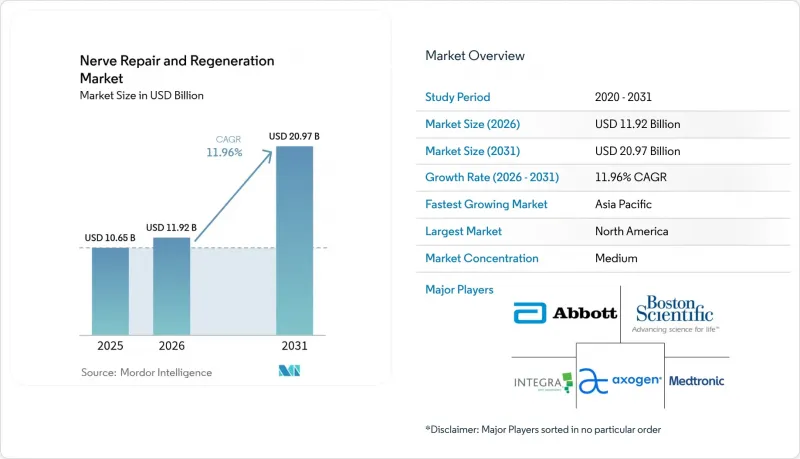
Mordor Intelligence에 의하면, 신경 복원 및 재생 시장 규모는 2025년 106억 5,000만 달러에서 2026년에는 119억 2,000만 달러에 이르고, 2026-2031년 CAGR 11.96%로 성장을 지속하여 2031년에는 209억 7,000만 달러에 달할 것으로 예측됩니다.
본 보고서는 제품 유형별(신경 자극·신경 조절 기기, 생체 재료), 용도별(신경 자극·신경 조절 수술, 직접 신경 복원·신경 봉합, 기타), 최종 사용자별(병원, 외래수술센터(ASC), 기타), 지역별(북미, 유럽, 아시아태평양, 기타)로 분류되어 있습니다. 시장 예측은 금액(달러) 기준으로 제시되어 있습니다.
전 세계 신경 복원 및 재생 시장 동향과 인사이트
신경 손상 및 신경 질환 발생률 증가
미국에서는 상지 신경 손상이 연간 100만 명당 43.8명에게 발생하며, 1건당 평균 치료비는 4만 7,004달러입니다. 당뇨병과 관련된 말초 신경 장애나 노화에 따른 신경 퇴행성 질환은 재생 의학의 대상이 되는 환자층을 더욱 확대시키고 있습니다. 그 부담은 급성 외상에 그치지 않고 장기적인 장애까지 미치므로, 의료 시스템은 보다 조기적인 신경 재건을 추진해야 할 압박을 받고 있습니다. 군사 분쟁이나 산업 재해로 인해 말초 신경 외상은 정책 과제로 계속해서 주목받고 있으며, 한편으로는 신경의 병태생리에 대한 이해가 깊어짐에 따라 첨단 치료법의 적용 대상도 확대되고 있습니다. 이러한 경향이 맞물리면서 신경 복원·재생 시장의 대상 환자층이 확대되고 있습니다.
신경 조절 및 생체 재료 분야의 기술 발전
메드트로닉(Medtronic)사의 ‘Percept RC’ 신경 자극 장치는 실시간으로 뇌 신호를 포착하여 치료를 개인화합니다. 폐루프 제어는 정적인 개입에서 동적인 개입으로의 전환을 나타내며, 치료 성과 향상과 유해 사건 감소로 이어질 가능성이 있습니다. 동시에, 뉴로트로핀-3을 내장한 3D 바이오 프린팅 키토산 도관은 말초 신경 복구를 위한 생체공학적 미세 환경을 조성하고 있습니다. 전도성 실크 피브로인 스캐폴드와 전기 자극을 결합한 것은 전임상 단계의 회복 지표에서 기존 가이드 재료를 능가하는 성과를 보이고 있습니다. 이러한 획기적인 진전을 통해 생체 재료는 ‘재생을 최우선으로 하는’ 선택지로서의 위상을 확립하고 있으며, 신경 복구·재생 시장 내 제품 구성의 큰 전환을 시사하고 있습니다.
임플란트 및 시술의 높은 비용
척수 자극 장치는 수술 비용을 제외하고 대당 2만-5만 달러이며, 보험이 적용되는 지역이라 하더라도 평생 비용은 10만 달러를 초과할 수 있습니다. 의료용 등급 부품공급망 부족으로 인해 가격이 상승하고 납기 기간이 길어지고 있습니다. 높은 초기 비용은 자원이 부족한 환경에서 조기 도입을 저해하며, 신경 복원·재생 시장에서 첨단 기술의 보급을 지연시키고 있습니다.
부문 분석
2025년, 신경 복원 및 재생 시장에서 신경 자극 및 신경 조절 기기의 점유율은 58.74%를 차지했습니다. 이는 광범위한 임상적 증거, 외과의사의 높은 숙련도, 확립된 보험 환급 채널에 힘입은 결과입니다. 같은 해, 생체 재료는 초기 인체 안전성 기준을 통과한 자가 섬유아세포 유래의 골격이 필요 없는 컨듀이트를 통해 수요 패턴의 변화를 시작했습니다. 생체재료와 관련된 신경 복원·재생 시장 규모는 환자 개개인에 맞춤화된 이식편을 제조하는 3D 프린팅 기술과, 신경 영양 인자를 제어하여 방출하는 키토산 컨듀이트의 보급에 힘입어 연평균 성장률(CAGR) 14.01%로 확대될 것으로 예측됩니다.
체내형 신경 자극 장치는 평균 판매 가격이 높고, 만성 신경병성 통증, 파킨슨병, 척수 손상 등의 적응증에서 선호되기 때문에 매출의 대부분을 차지하고 있습니다. 경두개 자기 자극기나 경피 전기 자극 장치를 포함한 체외형 자극 장치는 재활 치료 분야에서 꾸준히 보급되고 있습니다. 금 나노입자를 부착한 전도성 실크 피브로인 골격은 전임상시험에서 우수한 축삭 신장을 보였으며, 기존 리드선을 대체할 미래의 가능성을 시사하고 있습니다. 바이오 제조 비용 곡선이 낮아지고 임상 데이터가 축적됨에 따라, 생체 재료는 신경 복원 및 재생 시장의 장기적인 제품 구성을 혁신할 준비가 점차 갖춰지고 있습니다.
지역별 분석
北米は,高度な保?適用範?,臨床試?の密度の高さ,28億3,300万米ドルのNINDS予算に代表される??的な公的R&D投資を背景に,2025年においても?上高シェアの41.35%를 유지했습니다. DARPA의 ‘Bridging the Gap Plus’ 프로그램과 6억 5,000만 달러 규모의 ‘Military Burn Research Program’을 통한 군사 연구는 말초 신경 복구 분야의 혁신을 더욱 가속화하고 있습니다. 캐나다에서는 공평한 접근을 뒷받침하는 국민건강보험 제도를 통해 점진적인 성장이 예상되며, 멕시코에서는 의료 관광 패키지를 통해 국경을 넘는 시술 건수가 증가하고 있습니다. FDA의 사이버 보안 규제는 의료기기 인증 기준을 형성하고 있으며, 전 세계 수출의 성공에 영향을 미치고 있습니다.
아시아태평양은 대규모 환자층과 뇌-컴퓨터 인터페이스(BCI)에 대한 정부의 적극적인 추진에 힘입어, 지역별 가장 높은 연평균 성장률(CAGR)인 12.45%를 나타낼 것으로 예측됩니다. 중국 국가의료보장국은 신경 치료 서비스를 공식적으로 인정하여 대규모 보험 적용의 길을 열었습니다. 일본은 첨단 기술력과 신경 질환 유병률이 높은 고령화 사회의 특성을 활용하고 있습니다. 인도는 민간 병원의 확대와 지역 내 의료 관광을 유치하는 저렴한 시술 비용을 통해 발전하고 있습니다. 호주에서는 세계 최초로 후각 수초 세포를 이용한 임상시험이 진행되고 있으며, 호주는 중개 연구의 거점으로서의 위상을 확립하고 있습니다.
유럽은 유기적으로 연계된 의료 시스템과 의료기기의 보급을 통해 견실한 시장 점유율을 유지하고 있습니다. 독일은 산업 디자인의 강점을 활용하는 한편, 영국은 초기 단계의 줄기세포 연구를 선도하고 있습니다. ‘의료기기 규정(Medical Device Regulation)’에 따른 규제 조화를 통해 유럽 대륙의 승인 절차가 합리화되면서 차세대 임플란트의 보급이 가속화되고 있습니다. 중동 및 아프리카에서는 도시 지역을 중심으로 중증 환자 대응 센터의 확장이 시작되고 있으나, 전문의 수가 제한적이어서 보급에는 한계가 있습니다. 남미에서는 브라질과 아르헨티나가 신경 의료에 대한 예산 배정을 확대하고 있어 꾸준한 개선이 나타나고 있으며, 신경 복원·재생 시장의 전 세계적 확산이 지속되고 있습니다.
기타 혜택
- 엑셀 형식 시장 예측(ME) 시트
- 3개월간의 애널리스트 지원
자주 묻는 질문
목차
제1장 서론
제2장 조사 방법
제3장 주요 요약
제4장 시장 구도
제5장 시장 규모와 성장 예측
제6장 경쟁 구도
제7장 시장 기회와 향후 전망
LSH 26.09.04According to Mordor Intelligence, the nerve repair and regeneration market size is expected to grow from USD 10.65 billion in 2025 to USD 11.92 billion in 2026 and is forecast to reach USD 20.97 billion by 2031 at 11.96% CAGR over 2026-2031.
This report is Segmented by Product Type (Neurostimulation and Neuromodulation Devices, and Biomaterials), Application (Neurostimulation and Neuromodulation Surgeries, Direct Nerve Repair / Neurorrhaphy, and More), End-User (Hospitals, Ambulatory Surgical Centres, and More), and Geography (North America, Europe, Asia-Pacific, and More). The Market Forecasts are Provided in Terms of Value (USD).
Global Nerve Repair And Regeneration Market Trends and Insights
Growing Incidence Of Nerve Injuries & Neurological Disorders
Upper-extremity nerve injuries affect 43.8 per million people annually in the United States, with average charges of USD 47,004 per case. Diabetes-linked peripheral neuropathy and age-related neurodegeneration further enlarge the candidate pool for regenerative interventions. The burden extends beyond acute trauma to long-term disability, pushing health systems to embrace earlier nerve reconstruction. Military conflicts and industrial accidents keep peripheral nerve trauma on policy agendas, while better understanding of nerve pathophysiology broadens eligibility for advanced therapies. Collectively these patterns expand the addressable population in the nerve repair and regeneration market.
Technological Advances In Neuro-Modulation & Biomaterials
Medtronic's Percept RC neurostimulator captures real-time brain signals and personalizes therapy delivery. Closed-loop control represents a shift from static to dynamic intervention, potentially improving outcomes and lowering adverse events. Concurrently, 3D-bioprinted chitosan conduits embedded with neurotrophin-3 create bionic microenvironments for peripheral repair. Conductive silk-fibroin scaffolds combined with electrical stimulation have surpassed traditional guides in preclinical recovery metrics. These breakthroughs position biomaterials as a regeneration-first alternative, signalling a major product-mix shift inside the nerve repair and regeneration market.
High Cost Of Implants & Procedures
Spinal cord stimulators range from USD 20,000 to USD 50,000 per implant, excluding surgical expenses, and lifetime costs can surpass USD 100,000 even in insured regions. Supply chain shortages in medical-grade components have inflated prices and elongated lead times. High up-front costs dampen early adoption in low-resource settings and slow diffusion of advanced technologies in the nerve repair and regeneration market.
Other drivers and restraints analyzed in the detailed report include:
- Rising Healthcare Expenditure & Favourable Reimbursement
- AI-Enabled Closed-Loop Bio-Electronic Medicine Adoption
- Cyber-Security & Data-Privacy Risks In Connected Implants
For complete list of drivers and restraints, kindly check the Table Of Contents.
Segment Analysis
Neurostimulation and neuromodulation devices accounted for 58.74% of the nerve repair and regeneration market share in 2025, powered by extensive clinical evidence, surgeon familiarity, and established reimbursement channels. Within the same year, biomaterials began reshaping demand patterns through scaffold-free conduits derived from autologous fibroblasts that passed early human safety benchmarks. The nerve repair and regeneration market size tied to biomaterials is expected to grow at 14.01% CAGR, riding on 3D-printing that fabricates patient-specific grafts and chitosan conduits delivering controlled neurotrophic factors.
Internal neurostimulators dominate revenue with higher average selling prices and preferred indications like chronic neuropathic pain, Parkinson's disease, and spinal injury. External stimulators, including transcranial magnetic and trans-cutaneous electrical devices, post steady uptake in rehabilitation therapy. Conductive silk-fibroin scaffolds loaded with gold nanoparticles are yielding superior axonal growth in preclinical work, hinting at future substitution potential for traditional leads. As cost curves of biofabrication decline and clinical data matures, biomaterials are poised to transform long-term product mix inside the nerve repair and regeneration market.
Complete Report Scope:
- By Product Type
- Neurostimulation & Neuromodulation Devices
- Internal Neurostimulation Devices
- Spinal Cord Stimulation (SCS)
- Deep Brain Stimulation (DBS)
- Vagus Nerve Stimulation (VNS)
- Sacral Nerve Stimulation (SNS)
- Gastric Electrical Stimulation (GES)
- External Neurostimulation Devices
- Trans-cutaneous Electrical Nerve Stimulation (TENS)
- Trans-cranial Magnetic Stimulation (TMS)
- Internal Neurostimulation Devices
- Biomaterials
- Nerve Conduits
- Nerve Protectors
- Nerve Connectors
- Other Biomaterials
- Neurostimulation & Neuromodulation Devices
- By Application
- Neuro-stimulation & Neuro-modulation Surgeries
- Direct Nerve Repair / Neurorrhaphy
- Nerve Grafting
- Stem-Cell Therapy
- Other Applications
- By End-User
- Hospitals
- Ambulatory Surgical Centres
- Specialty Neurology & Orthopaedic Clinics
- Rehabilitation Centres
- Geography
- North America
- United States
- Canada
- Mexico
- Europe
- Germany
- United Kingdom
- France
- Italy
- Spain
- Rest of Europe
- Asia-Pacific
- China
- Japan
- India
- South Korea
- Australia
- Rest of Asia-Pacific
- Middle East and Africa
- GCC
- South Africa
- Rest of Middle East and Africa
- South America
- Brazil
- Argentina
- Rest of South America
- North America
Geography Analysis
North America retained 41.35% revenue share in 2025 on the back of advanced insurance coverage, deep clinical trial density, and continuous public R&D investment such as the USD 2.833 billion NINDS budget. Military research through DARPA's Bridging the Gap Plus program and the USD 650 million Military Burn Research Program further accelerates innovation in peripheral nerve repair. Canada adds incremental growth via universal health benefits that support equitable access, and Mexico improves cross-border procedure volumes through medical tourism packages. Cybersecurity regulation from the FDA shapes device certification standards and influences global export success.
Asia-Pacific is forecast to deliver a 12.45% CAGR, the highest regional pace, propelled by large patient pools and active government promotion of brain-computer interfaces. China's National Healthcare Security Administration formally recognized neural care services, paving the way for scaled reimbursement. Japan contributes sophisticated engineering and an aging demographic with high neurological disease prevalence. India advances through private hospital expansion and lower-cost procedural pricing that attract regional medical tourism. Australia's world-first olfactory ensheathing cell trial positions the country as a translational research hub.
Europe maintains solid share through coordinated healthcare systems and device adoption. Germany leverages industrial design strengths, while the United Kingdom spearheads early-stage stem-cell studies. Regulatory harmonization under the Medical Device Regulation streamlines continental approvals, speeding dissemination of next-gen implants. Middle East and Africa begin scaling high-acuity centers in urban corridors, though limited specialist availability caps penetration. South America exhibits steady improvements as Brazil and Argentina allocate more budget to neurological care, ensuring that the nerve repair and regeneration market continues its global diffusion.
- Medtronic
- Boston Scientific
- Abbott Laboratories
- Stryker
- Integra LifeSciences
- LivaNova
- Axogen
- Baxter
- Neuronetics
- NeuroPace
- Phagenesis
- MyndTec
- CheckPoint Surgical
- Synapse Biomedical
- Polyganics
- Renishaw
- Collagen Matrix
- BlueWind Medical
- ElectroCore
- Stimwave
Additional Benefits:
- The market estimate (ME) sheet in Excel format
- 3 months of analyst support
TABLE OF CONTENTS
1 Introduction
- 1.1 Study Assumptions & Market Definition
- 1.2 Scope of the Study
2 Research Methodology
3 Executive Summary
4 Market Landscape
- 4.1 Market Overview
- 4.2 Market Drivers
- 4.2.1 Growing Incidence Of Nerve Injuries & Neurological Disorders
- 4.2.2 Technological Advances In Neuro-Modulation & Biomaterials
- 4.2.3 Rising Healthcare Expenditure & Favourable Reimbursement
- 4.2.4 AI-Enabled Closed-Loop Bio-Electronic Medicine Adoption
- 4.2.5 Military & Elite-Sports Funding For Peripheral-Nerve Repair
- 4.2.6 3-D Bioprinted, Patient-Specific Nerve Graft Breakthroughs
- 4.3 Market Restraints
- 4.3.1 High Cost Of Implants & Procedures
- 4.3.2 Dearth Of Trained Neurosurgeons & Rehab Specialists
- 4.3.3 Medical-Grade Polymer (Chitosan, PTFE) Supply Constraints
- 4.3.4 Cyber-Security & Data-Privacy Risks In Connected Implants
- 4.4 Porter's Five Forces
- 4.4.1 Threat of New Entrants
- 4.4.2 Bargaining Power of Buyers
- 4.4.3 Bargaining Power of Suppliers
- 4.4.4 Threat of Substitutes
- 4.4.5 Competitive Rivalry
5 Market Size & Growth Forecasts (Value, USD)
- 5.1 By Product Type
- 5.1.1 Neurostimulation & Neuromodulation Devices
- 5.1.1.1 Internal Neurostimulation Devices
- 5.1.1.1.1 Spinal Cord Stimulation (SCS)
- 5.1.1.1.2 Deep Brain Stimulation (DBS)
- 5.1.1.1.3 Vagus Nerve Stimulation (VNS)
- 5.1.1.1.4 Sacral Nerve Stimulation (SNS)
- 5.1.1.1.5 Gastric Electrical Stimulation (GES)
- 5.1.1.2 External Neurostimulation Devices
- 5.1.1.2.1 Trans-cutaneous Electrical Nerve Stimulation (TENS)
- 5.1.1.2.2 Trans-cranial Magnetic Stimulation (TMS)
- 5.1.1.1 Internal Neurostimulation Devices
- 5.1.2 Biomaterials
- 5.1.2.1 Nerve Conduits
- 5.1.2.2 Nerve Protectors
- 5.1.2.3 Nerve Connectors
- 5.1.2.4 Other Biomaterials
- 5.1.1 Neurostimulation & Neuromodulation Devices
- 5.2 By Application
- 5.2.1 Neuro-stimulation & Neuro-modulation Surgeries
- 5.2.2 Direct Nerve Repair / Neurorrhaphy
- 5.2.3 Nerve Grafting
- 5.2.4 Stem-Cell Therapy
- 5.2.5 Other Applications
- 5.3 By End-User
- 5.3.1 Hospitals
- 5.3.2 Ambulatory Surgical Centres
- 5.3.3 Specialty Neurology & Orthopaedic Clinics
- 5.3.4 Rehabilitation Centres
- 5.4 Geography
- 5.4.1 North America
- 5.4.1.1 United States
- 5.4.1.2 Canada
- 5.4.1.3 Mexico
- 5.4.2 Europe
- 5.4.2.1 Germany
- 5.4.2.2 United Kingdom
- 5.4.2.3 France
- 5.4.2.4 Italy
- 5.4.2.5 Spain
- 5.4.2.6 Rest of Europe
- 5.4.3 Asia-Pacific
- 5.4.3.1 China
- 5.4.3.2 Japan
- 5.4.3.3 India
- 5.4.3.4 South Korea
- 5.4.3.5 Australia
- 5.4.3.6 Rest of Asia-Pacific
- 5.4.4 Middle East and Africa
- 5.4.4.1 GCC
- 5.4.4.2 South Africa
- 5.4.4.3 Rest of Middle East and Africa
- 5.4.5 South America
- 5.4.5.1 Brazil
- 5.4.5.2 Argentina
- 5.4.5.3 Rest of South America
- 5.4.1 North America
6 Competitive Landscape
- 6.1 Market Concentration
- 6.2 Market Share Analysis
- 6.3 Company Profiles (includes Global level Overview, Market level overview, Core Segments, Financials as available, Strategic Information, Market Rank/Share for key companies, Products & Services, and Recent Developments)
- 6.3.1 Medtronic plc
- 6.3.2 Boston Scientific Corp.
- 6.3.3 Abbott Laboratories
- 6.3.4 Stryker
- 6.3.5 Integra LifeSciences Corporation
- 6.3.6 LivaNova
- 6.3.7 Axogen Corporation
- 6.3.8 Baxter
- 6.3.9 Neuronetics
- 6.3.10 NeuroPace
- 6.3.11 Phagenesis
- 6.3.12 MyndTec
- 6.3.13 CheckPoint Surgical
- 6.3.14 Synapse Biomedical
- 6.3.15 Polyganics
- 6.3.16 Renishaw
- 6.3.17 Collagen Matrix
- 6.3.18 BlueWind Medical
- 6.3.19 ElectroCore
- 6.3.20 Stimwave
7 Market Opportunities & Future Outlook
- 7.1 White-space & Unmet-Need Assessment


