

|
시장보고서
상품코드
2122349
파이로젠 검사 시장 : 시장 점유율 분석, 업계 동향 및 통계, 성장 예측(2026-2031년)Pyrogen Testing - Market Share Analysis, Industry Trends & Statistics, Growth Forecasts (2026 - 2031) |
||||||
 Mordor Intelligence
Mordor Intelligence에 의하면, 파이로젠 검사 시장 규모는 2025년 15억 7,000만 달러로 평가되었고, 2026년에는 17억 3,000만 달러로 추정되고, 2026-2031년 CAGR 11.51%로 성장을 지속할 전망이며, 2031년에는 29억 9,000만 달러에 이를 것으로 예측됩니다.
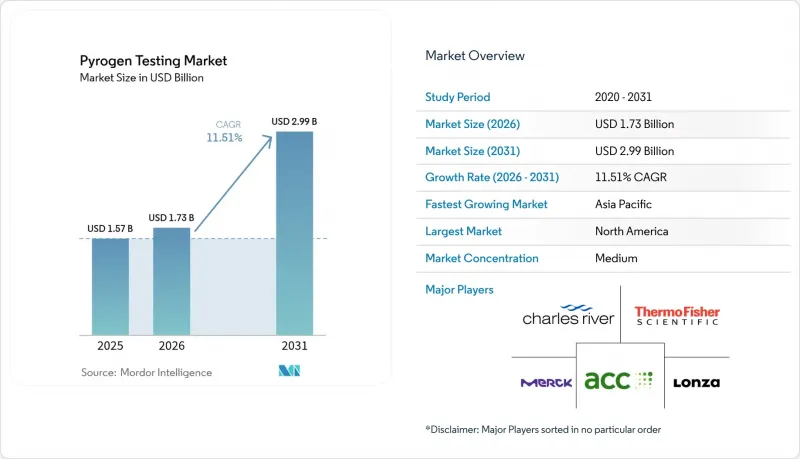
본 보고서는 제품 및 서비스별(키트 및 시약, 기기, 서비스), 검출 기술별(동물 유래 시험, 재조합/세포 유래 시험, 기기 일체형 신속 검사 시스템), 시료·공정 단계별(원재료·물 등), 시험 유형별(LAL 등), 최종 사용자별(제약·바이오기술, 기타), 지역별(북미, 기타)로 분류되어 있습니다. 시장 예측은 금액(달러)으로 표시되어 있습니다.
세계의 파이로젠 검사 시장 동향 및 인사이트
생물학적 제제 및 백신의 파이프라인 확대
2025년, 전 세계 규제 당국은 46개의 신약과 18개의 바이오시밀러를 승인했습니다. 이 중 거의 모든 제품이 비경구 제제였으며, 모든 바이오프로세스 단계에서 품질 관리용 시료의 양이 증가했습니다. 여러 COVID-19 변이주에 대응하는 mRNA 백신의 경우, 새로운 충전 및 마무리 라인이 도입됨에 따라 새로운 구성 부품의 적합성 평가가 필요하게 되었습니다. 각 단일클론 항체 또는 바이러스 벡터 치료제는 업스트림 공정의 수확, 다운스트림 공정의 풀링, 그리고 최종 바이알 단계에서 ±0.05 EU/mL라는 엄격한 기준을 충족해야 하며, 이는 파이로젠 검사 시장 수요를 지속적으로 끌어올리고 있습니다. 일라이 릴리, 아스트라제네카, 존슨앤드존슨의 대규모 설비 투자 프로젝트로 인해 무균 제조 능력이 확대되고 있으며, 2027년에는 검증 배치의 생산이 시작될 전망입니다. 이에 따라 검사량의 지속적인 증가가 확실시됩니다. ICH 관할 구역과의 상호 인정을 목표로 하는 신흥 시장의 제조업체들도 마찬가지로 품질 관리 인프라를 확충하고 있어, 전 세계적으로 피로겐 검사 시장의 확대가 진행되고 있습니다.
새로운 USP 85 및 Ph. Eur. 2.6.14의 필수 엔도톡신 기준
2025년 7월 USP 개정에서는 동등성이 입증되는 대로 rFC를 LAL과 동등한 것으로 공식 인정하여, 완전한 자료 재검증 없이 시험법을 대체할 수 있게 되었습니다. 이와 병행하여, 유럽에서는 2025년 7월부터 토끼를 이용한 발열 물질 시험법이 폐지되므로, EU 수출 제품의 경우 즉시 MAT 채택이 의무화됩니다. 이러한 조화된 방침을 통해, 재조합 및 세포 기반 플랫폼의 보급을 저해하던 기존의 모호성이 해소되어, 기존 제품의 규정 준수 달성까지 소요되는 기간이 단축됩니다. 각 시약 제조업체는 새로운 약전 기준치에 부합하는 감도 0.05 EU/mL를 실현하는 차세대 MAT 키트를 출시하여 이에 대응하고 있습니다. 이러한 규제 변경은 종합적으로 발열 물질 시험 시장의 규제적 기반을 강화하는 것입니다.
중소기업의 높은 검증 비용
단일 생물학적 제제 라인을 MAT 또는 rFC로 전환할 경우, 적합성 평가 및 문서화에 소요되는 비용은 50만 달러를 초과할 수 있으며, 중소규모 기업들은 새로운 실험실에 투자하기보다는 외부 위탁을 통해 이 부담을 감당하는 경우가 많습니다. 이러한 비용 측면의 역풍으로 인해, 저비용 검증 지원에 대한 접근성이 여전히 제한적인 신흥 지역에서는 발열 물질 시험 시장의 전환이 더딘 양상을 보이고 있습니다.
부문 분석
2025년 매출 중 키트 및 시약이 56.67%를 차지했으며, 이는 피로젠 검사 시장의 소모품 규모를 뒷받침하는 ‘면도기와 면도날’ 모델을 여실히 보여줍니다. 그러나 제조업체들이 인력 부족 문제를 해결하고 출시 기간을 단축하기 위해 마이크로플루이딕스 시스템을 도입함에 따라, 장비 부문은 2031년까지 연평균 성장률(CAGR) 13.62%로 성장할 것으로 전망됩니다. 자동 판독 장치는 LIMS와 원활하게 연동되어 데이터 무결성에 대한 기대를 충족시키고, 지속적인 바이오프로세스 워크플로우를 지원합니다. 자체 개발한 카트리지는 지속적인 수익을 확보하고 공급업체에 대한 종속성을 강화합니다. 서비스(주로 CRO가 수행하는 로트 릴리스 시험)는 사내 품질 관리 체제가 갖춰지지 않은 초기 단계의 생명공학 기업에게 여전히 매력적이며, 파이로젠 시험 시장에 대한 추가 수요를 불러일으키고 있습니다.
인력 확보 및 감사 추적 기록에 대한 면밀한 검토로 인해, 완전히 통합된 분석 장비에 대한 설비 투자가 가속화되고 있습니다. 그 대표적인 예가 머크의 카트리지 기반 플랫폼으로, 이를 통해 비전문가 담당자라도 충전 및 마무리 공정 현장에서 직접 시험을 수행할 수 있게 됩니다. 소모품은 여전히 최대 수익원이 될 것, 하드웨어 도입으로 인해 평균 판매 가격이 상승하여 높은 이익률을 기록하는 분석 장비 공급업체들의 파이로젠 검사 시장 점유율이 확대될 것입니다.
2025년 파이로젠 검사 시장에서 동물 실험법은 72.52%의 점유율을 차지했으나, 재조합 인자 C(rFC) 및 MAT 플랫폼은 2031년까지 연평균 성장률(CAGR) 14.77%를 나타낼 것으로 예측됩니다. 2026년 2월에 발효되는 미국 약전(USP) 제1085장에서는 동등성이 입증될 경우 rFC의 대체가 허용되게 되어, 동물을 사용하지 않는 기법에 대한 마지막 큰 장벽이 제거되었습니다. 유럽에서는 토끼를 이용한 시험이 폐지됨에 따라 EU 역내로 출하되는 모든 신규 및 기존 제품에 대해 MAT가 의무화되어, 세포 기반 검증 일정이 단축되었습니다.
중국 공급업체들은 rFC 키트를 유럽 및 미국의 LAL 가격보다 30-40% 저렴하게 판매하고 있으며, 이로 인해 아시아태평양 시설에서의 채택이 확대되면서 재조합 용액용 발열 물질 시험 시장 규모가 커지고 있습니다. LAL은 기존의 BLA(생물학적 제제 승인 신청)에서 여전히 주류를 이루고 있지만, 갑각류의 할당량이 부족해질 때마다 간헐적인 공급 충격에 직면하고 있습니다. 현재 신속 카트리지식 장치는 30분 만에 정량적 결과를 제공할 수 있게 되었으며, 이러한 속도와 규제상의 명확성이 결합되어 기술 구성이 동물 유래 리사트에서 점차 전환되고 있음을 보여줍니다.
지역별 분석
북미는 미국의 탄탄한 바이오의약품 파이프라인과 빈번한 비경구 제형 승인을 바탕으로 2025년 매출의 39.14%를 차지했습니다. USP의 rFC 공식 승인은 검사법 전환을 촉진하고, 해당 지역의 소프트웨어 통합 및 장비 수요 기회를 확대할 것으로 예측됩니다. 캐나다와 멕시코에서는 무균 충전 및 마무리 공정의 니어쇼어링이 확대됨에 따라 꾸준한 성장이 예상됩니다.
유럽은 2위 지역으로 뒤를 잇고 있습니다. 2025년 7월 토끼 실험이 폐지됨에 따라 유럽 전역에서 MAT 채택이 의무화되어, 장비 및 키트 구매가 촉진될 전망입니다. 독일, 영국, 프랑스가 계속해서 수요의 주축이 되는 한편, 동유럽은 바이오시밀러 아웃소싱을 통해 시장 점유율을 확대되고 있습니다.
아시아태평양은 중국의 국내 rFC 생산 능력과 인도의 무균 의약품 수출에 대한 의욕 고조에 힘입어, 2031년까지 연평균 성장률(CAGR) 13.63%로 성장을 주도할 것으로 예측됩니다. 일본과 한국에서는 기술 인력의 고령화를 보완하기 위한 자동화 현대화가 진행되고 있어, 지역 전체의 동향을 보완하고 있습니다. 중동 및 아프리카 및 남미는 여전히 발전 단계에 있지만, 다국적 기업과 현지 정부가 GMP 시설 건설에 협력하며 파이로젠 시험 시장 전망를 위한 기반을 다지고 있어 매력적인 목표 시장이 되고 있습니다.
기타 혜택 :
- 엑셀 형식 시장 예측(ME) 시트
- 3개월간의 애널리스트 지원
자주 묻는 질문
목차
제1장 서론
제2장 조사 방법
제3장 주요 요약
제4장 시장 구도
제5장 시장 규모 및 성장 예측
제6장 경쟁 구도
제7장 시장 기회 및 향후 전망
AJY 26.09.07According to Mordor Intelligence, the pyrogen testing market size is expected to grow from USD 1.57 billion in 2025 to USD 1.73 billion in 2026 and is forecast to reach USD 2.99 billion by 2031 at 11.51% CAGR over 2026-2031.
This report is Segmented by Product & Service (Kits & Reagents, Instruments, Services), Detection Technology (Animal-Based Tests, Recombinant/Cell-Based Tests, Instrument-Integrated Rapid Systems), Sample/Process Stage (Raw Materials & Water, and More), Test Type (LAL, and More), End User (Pharma & Biotech, and More), and Geography (North America, and More). Market Forecasts are Provided in Value (USD).
Global Pyrogen Testing Market Trends and Insights
Biologics & Vaccine Pipeline Expansion
Global regulators cleared 46 novel drugs and 18 biosimilars in 2025, nearly all parenteral, enlarging quality-control sample volumes at every bioprocess stage. Multiple COVID-19 strain-updated mRNA vaccines incorporated new fill-finish lines that demanded fresh component qualifications. Each monoclonal antibody or viral-vector therapy must meet strict +-0.05 EU/mL limits for upstream harvest, downstream pools, and final vials, driving recurring pyrogen testing market demand. Large-scale capital projects by Eli Lilly, AstraZeneca, and Johnson & Johnson are adding sterile capacity that will begin generating validation batches in 2027, locking in sustained testing volumes. Emerging-market producers seeking mutual recognition with ICH jurisdictions are similarly upgrading QC infrastructures, broadening the global footprint of the pyrogen testing market.
Mandatory Endotoxin Limits in New USP 85 and Ph. Eur. 2.6.14
USP's July 2025 update formally recognizes rFC as equivalent to LAL once equivalence is proven, enabling method substitution without full dossier revalidation. In parallel, Europe's deletion of the rabbit-pyrogen method effective July 2025 compels immediate MAT adoption for products headed to the EU. These harmonized policies eliminate historical ambiguity that held back recombinant and cell-based platforms and compress compliance timelines for legacy products. Reagent makers have responded with next-generation MAT kits offering 0.05 EU/mL sensitivity, aligning with new pharmacopeial thresholds. Collectively, the rule changes strengthen the regulatory foundation of the pyrogen testing market.
High Validation Cost for SMEs
Adapting a single biologic line to MAT or rFC can exceed USD 500,000 in qualification and documentation spend, a burden that smaller firms often absorb by outsourcing rather than capitalizing new labs. The cost headwind slows the pyrogen testing market transition in emerging regions where access to low-cost validation support remains limited.
Other drivers and restraints analyzed in the detailed report include:
- Outsourcing to CROs & CDMOs
- Automation-Ready Microfluidic Analyzers
- Horseshoe-Crab Harvest Restrictions
For complete list of drivers and restraints, kindly check the Table Of Contents.
Segment Analysis
Kits and reagents supplied 56.67% of 2025 revenue, underscoring the razor-and-blade model that anchors the pyrogen testing market size for consumables. However, instruments are poised for a 13.62% CAGR through 2031 as manufacturers install microfluidic systems to combat labor shortages and compress release timelines. Automated readers integrate seamlessly with LIMS, satisfying data-integrity expectations and supporting continuous bioprocessing workflows. Proprietary cartridges ensure recurring revenue, reinforcing supplier lock-in. Services-chiefly CRO lot-release testing-remain attractive to early-stage biotech clients that lack in-house QC, funneling incremental volumes into the pyrogen testing market.
Labor availability and audit-trail scrutiny accelerate capital outlays for fully integrated analyzers, exemplified by Merck's cartridge-based platform that allows non-specialists to test directly in fill-finish suites. While consumables will continue as the largest revenue pool, hardware adoption raises average selling prices and broadens the pyrogen testing market share of high-margin instrument vendors.
Animal-based assays held 72.52 % of the 2025 pyrogen testing market share, yet recombinant Factor C and MAT platforms are forecast to post a 14.77 % CAGR through 2031. USP Chapter (1085), effective February 2026, now allows rFC substitution once equivalence is proven, removing the last major barrier to animal-free methods. Europe's deletion of the rabbit test mandates MAT for all new and legacy products shipped into the EU, compressing timelines for cell-based validation.
Chinese suppliers sell rFC kits 30-40 % below Western LAL prices, widening adoption across APAC facilities and increasing the pyrogen testing market size for recombinant solutions. LAL retains primacy in legacy BLAs but faces episodic supply shocks whenever horseshoe-crab quotas tighten. Rapid cartridge devices now deliver quantitative results in 30 minutes, demonstrating that speed and regulatory clarity together are tipping the technology mix away from animal lysate.
Complete Report Scope:
- By Product & Service
- Kits & Reagents
- Instruments
- Services
- By Detection Technology
- Animal-Based Tests
- Recombinant / Cell-Based Tests
- Instrument-Integrated Rapid Systems
- By Sample / Process Stage
- Raw Materials & Water Testing
- In-Process (Upstream & Downstream)
- Final Product / Lot-Release
- Medical Device Surface & Rinse Tests
- By Test Type
- Limulus Amebocyte Lysate (LAL) Tests
- Recombinant Factor C (rFC) Assays
- Monocyte Activation Test (MAT)
- Rabbit Pyrogen Test
- By End User
- Pharmaceutical & Biotechnology Companies
- Medical Device Companies
- Contract Research Organizations (CROs)
- Academic & Research Institutes
- By Geography
- North America
- United States
- Canada
- Mexico
- Europe
- Germany
- France
- United Kingdom
- Italy
- Spain
- Rest of Europe
- Asia-Pacific
- China
- Japan
- India
- South Korea
- Australia
- Rest of Asia-Pacific
- Middle East & Africa
- GCC
- South Africa
- Rest of Middle East & Africa
- South America
- Brazil
- Argentina
- Rest of South America
- North America
Geography Analysis
North America held 39.14% of 2025 revenue, buoyed by the United States' dense biopharma pipeline and frequent parenteral approvals. USP's formal rFC recognition will likely catalyze method substitutions, enlarging the region's software-integration and equipment opportunities. Canada and Mexico show steady growth as near-shoring of sterile fill-finish expands.
Europe follows as the second-largest region. The July 2025 rabbit-test sunset forces continent-wide MAT adoption, triggering equipment and kit purchases. Germany, the United Kingdom, and France continue to anchor demand, while Eastern Europe gains share through biosimilar outsourcing.
Asia-Pacific is projected to lead growth at 13.63% CAGR through 2031, fueled by China's domestic rFC capacity and India's rising sterile-drug export ambitions. Japan and South Korea complement the regional picture with automation upgrades to offset aging technical workforces. The Middle East and Africa plus South America remain nascent but attractive targets as multinational firms and local governments collaborate on GMP facility build-outs, planting future seeds for the pyrogen testing market.
- Accugen Laboratories Inc.
- Associates of Cape Cod Inc.
- bioMerieux
- Charles River
- Ellab
- Eurofins
- FUJIFILM Wako Pure Chemical Corporation
- Genscript
- Hyglos GmbH
- InvivoGen
- Lonza Group
- Merck KGaA (MilliporeSigma)
- Microcoat Biotechnologie
- Minerva Analytix GmbH
- Nelson Laboratories LLC
- Pacific BioLabs
- Sanquin Reagents B.V.
- Sartorius
- Thermo Fisher Scientific
- WuXi AppTec Co., Ltd.
Additional Benefits:
- The market estimate (ME) sheet in Excel format
- 3 months of analyst support
TABLE OF CONTENTS
1 Introduction
- 1.1 Study Assumptions & Market Definition
- 1.2 Scope of the Study
2 Research Methodology
3 Executive Summary
4 Market Landscape
- 4.1 Market Overview
- 4.2 Market Drivers
- 4.2.1 Biologics & Vaccine Pipeline Expansion
- 4.2.2 Mandatory Endotoxin Limits in New USP <85> / Ph. Eur. 2.6.14 Revisions
- 4.2.3 Outsourcing To CROs & CDMOs For Lot-Release Testing
- 4.2.4 Automation-Ready Microfluidic/LAL Analyzers Adopted by Big Pharma
- 4.2.5 EU Phase-Out of Rabbit Tests Accelerating MAT Procurement Budgets
- 4.2.6 Chinese RFC Reagent Start-Ups Lowering Cost Floor, Spurring APAC Demand
- 4.3 Market Restraints
- 4.3.1 High Capital Cost of MAT & RFC Validation for SME Manufacturers
- 4.3.2 Horseshoe-Crab Harvest Restrictions Causing Supply Bottlenecks For LAL
- 4.3.3 Persistent Low Endotoxin Recovery (LER) Events Delaying Biosimilar Launches
- 4.3.4 Divergent Data-Integrity Rules (E.G., China GxP) Complicate Lab Automation ROI
- 4.4 Value / Supply-Chain Analysis
- 4.5 Regulatory Landscape
- 4.6 Technological Outlook
- 4.7 Porter's Five Forces Analysis
- 4.7.1 Threat of New Entrants
- 4.7.2 Bargaining Power of Suppliers
- 4.7.3 Bargaining Power of Buyers
- 4.7.4 Threat of Substitutes
- 4.7.5 Intensity of Competitive Rivalry
5 Market Size & Growth Forecasts (Value in USD)
- 5.1 By Product & Service
- 5.1.1 Kits & Reagents
- 5.1.2 Instruments
- 5.1.3 Services
- 5.2 By Detection Technology
- 5.2.1 Animal-Based Tests
- 5.2.2 Recombinant / Cell-Based Tests
- 5.2.3 Instrument-Integrated Rapid Systems
- 5.3 By Sample / Process Stage
- 5.3.1 Raw Materials & Water Testing
- 5.3.2 In-Process (Upstream & Downstream)
- 5.3.3 Final Product / Lot-Release
- 5.3.4 Medical Device Surface & Rinse Tests
- 5.4 By Test Type
- 5.4.1 Limulus Amebocyte Lysate (LAL) Tests
- 5.4.2 Recombinant Factor C (rFC) Assays
- 5.4.3 Monocyte Activation Test (MAT)
- 5.4.4 Rabbit Pyrogen Test
- 5.5 By End User
- 5.5.1 Pharmaceutical & Biotechnology Companies
- 5.5.2 Medical Device Companies
- 5.5.3 Contract Research Organizations (CROs)
- 5.5.4 Academic & Research Institutes
- 5.6 By Geography
- 5.6.1 North America
- 5.6.1.1 United States
- 5.6.1.2 Canada
- 5.6.1.3 Mexico
- 5.6.2 Europe
- 5.6.2.1 Germany
- 5.6.2.2 France
- 5.6.2.3 United Kingdom
- 5.6.2.4 Italy
- 5.6.2.5 Spain
- 5.6.2.6 Rest of Europe
- 5.6.3 Asia-Pacific
- 5.6.3.1 China
- 5.6.3.2 Japan
- 5.6.3.3 India
- 5.6.3.4 South Korea
- 5.6.3.5 Australia
- 5.6.3.6 Rest of Asia-Pacific
- 5.6.4 Middle East & Africa
- 5.6.4.1 GCC
- 5.6.4.2 South Africa
- 5.6.4.3 Rest of Middle East & Africa
- 5.6.5 South America
- 5.6.5.1 Brazil
- 5.6.5.2 Argentina
- 5.6.5.3 Rest of South America
- 5.6.1 North America
6 Competitive Landscape
- 6.1 Market Concentration
- 6.2 Market Share Analysis
- 6.3 Company Profiles (includes Global level Overview, Market level overview, Core Segments, Financials as available, Strategic Information, Market Rank/Share for key companies, Products and Services, and Recent Developments)
- 6.3.1 Accugen Laboratories Inc.
- 6.3.2 Associates of Cape Cod Inc.
- 6.3.3 bioMerieux SA
- 6.3.4 Charles River Laboratories International Inc.
- 6.3.5 Ellab A/S
- 6.3.6 Eurofins Scientific SE
- 6.3.7 FUJIFILM Wako Pure Chemical Corporation
- 6.3.8 GenScript Biotech Corporation
- 6.3.9 Hyglos GmbH
- 6.3.10 InvivoGen
- 6.3.11 Lonza Group AG
- 6.3.12 Merck KGaA (MilliporeSigma)
- 6.3.13 Microcoat Biotechnologie GmbH
- 6.3.14 Minerva Analytix GmbH
- 6.3.15 Nelson Laboratories LLC
- 6.3.16 Pacific BioLabs
- 6.3.17 Sanquin Reagents B.V.
- 6.3.18 Sartorius AG
- 6.3.19 Thermo Fisher Scientific Inc.
- 6.3.20 WuXi AppTec Co., Ltd.
7 Market Opportunities & Future Outlook
- 7.1 White-space & Unmet-Need Assessment


