

|
시장보고서
상품코드
2122425
세라믹 매트릭스 복합재료 : 시장 점유율 분석, 업계 동향과 통계, 성장 예측(2026-2031년)Ceramic Matrix Composites - Market Share Analysis, Industry Trends & Statistics, Growth Forecasts (2026 - 2031) |
||||||
 Mordor Intelligence
Mordor Intelligence에 의하면, 2026년 세라믹 매트릭스 복합재료 시장 규모는 74억 1,000만 달러로 추정되며, 2025년 68억 1,000만 달러에서 2031년에는 113억 2,000만 달러에 달할 것으로 예측됩니다.
2026-2031년 연평균 성장률(CAGR) 8.84%를 기록할 전망입니다.
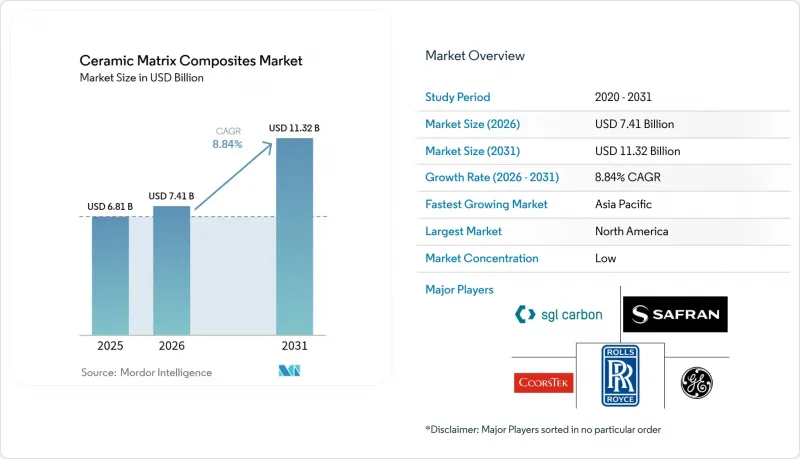
본 보고서에서는 업계를 제품 유형(C/C, C/SiC, 산화물/산화물 등), 최종 사용자 산업(자동차, 항공우주, 방위 등), 지역(아시아태평양, 북미, 유럽, 남미, 중동 및 아프리카)별로 분류하고 있습니다. 시장 전망은 금액(달러) 기준으로 제시되어 있습니다.
세계 세라믹 매트릭스 복합재료 시장 동향 및 인사이트
방위용 열 차단재의 용도 확대
현재 방위 기관들은 내열 성능을 주요 설계 기준으로 중시하고 있습니다. 미국의 초음속 무기 프로그램에서는 2,000°C 이상에서도 구조적 안정성을 유지할 수 있는 소재가 요구되고 있으며, 이 임계값으로 인해 대부분의 초합금이 제외되고 있습니다. 록히드 마틴사의 일련의 시험은 전자 기기의 내환경성 향상 및 항공기 외장 보호 측면에서 CMC의 필요성을 부각시키고 있습니다. 방위 관련 기업들이 생존성 향상을 위해 감수하는 높은 가격은 CMC의 조기 인증을 가속화하며, 다른 분야에도 혜택을 주는 학습 곡선을 만들어내고 있습니다. 탄소섬유 강화 실리콘 카바이드 복합재료는 여러 번의 고열 사이클을 거친 후에도 재사용이 가능한 성능을 발휘하며, 이러한 장점은 수명 주기 비용 계산식을 변화시킵니다.
경량 차량 플랫폼에 대한 수요
전기차 및 자율주행차 프로그램에서는 1kg의 경량화마다 주행 거리와 냉각 효율이 향상되므로, 적극적인 경량화 목표가 추구되고 있습니다. 세라믹 매트릭스 복합재료는 니켈 기반 합금에 비해 최대 65% 더 가벼우면서도 배기 온도에서도 기능적인 강도를 유지합니다. 일본의 실증용 세라믹 가스 터빈은 열효율 40% 이상을 달성함과 동시에 부품 중량을 두 자릿수 비율로 줄였습니다. 자동차 생산량은 공급업체에 대해 자동 섬유 배향(AFP) 등의 니어넷쉐이프 가공으로의 전환을 촉진하고 있으며, 이로 인해 몇 시간이 걸리던 적층 공정이 몇 분 단위의 사이클로 단축되었습니다.
슈퍼 합금과의 비교: 높은 제조 비용
CMC 부품은 고온에서의 섬유 인출 및 장시간이 소요되는 함침 공정으로 인해, 동등한 금속 부품에 비해 여전히 3-5배의 비용이 듭니다. SCANCUT 프로젝트에서는 혁신적인 밀링 경로를 통해 가공 시간을 70% 단축했으며, 이와 같은 자동화 분야의 획기적인 발전으로 인해 그 비용 격차는 점차 줄어들고 있습니다. CMC의 수명이 연장됨에 따라 총 소유 비용은 개선되겠지만, 가격에 민감한 전력·자동차 업계 사용자들에게는 초기 도입 가격이 여전히 장벽으로 작용하고 있습니다. GE가 앨라배마주에 건설한 2억 달러 규모의 시설은 항공우주 분야의 양산화를 통해 비용 균형을 맞추는 것을 목표로 하고 있습니다.
부문별 분석
SiC/SiC 복합재료는 2025년에 세라믹 매트릭스 복합재료 시장에서 54.62%의 점유율을 차지할 것으로 예상되며, 2031년까지 연평균 성장률(CAGR) 10.83%로 성장할 것으로 전망됩니다. 2 GPa를 초과하는 강도를 실현하는 더 미세한 피치의 섬유를 통합함으로써 그 구조적 적용 범위가 확대되고 있습니다. SiC/SiC 용도의 세라믹 매트릭스 복합재료 시장 규모는 새로운 제트 엔진 코어에서 슈라우드, 연소실 라이너, 노즐 익스텐션이 인증됨에 따라 급격히 확대될 것으로 예측됩니다. 탄소/탄소계 소재는 산화를 제어할 수 있는 로켓 노즐 분야에서 틈새 시장을 유지하고 있으며, 산화물/산화물계 등급은 최고 온도보다 고유한 산화 안정성을 중시하는 산업용 열교환기에서 보급이 확대되고 있습니다.
공정 발전 측면에서는 열 사이클 중 섬유의 손상을 경감시키는 나노 엔지니어링이 적용된 계면층을 들 수 있습니다. 미쓰비시 화학 그룹의 탄소섬유 기반 C/SiC는 1,500°C까지의 노출에 적합하며, 하이브리드 화학 조성이 우주선의 내열 온도 상한을 어떻게 확대하고 있는지를 보여줍니다. SiC 슬러리를 직물 프리폼 위에 적층 성형함으로써, 기존의 적층 방식으로는 실현할 수 없었던 복잡한 냉각 통로의 형성이 가능해집니다. 이러한 혁신을 통해 SiC/SiC계 소재의 우위성이 유지되고 있으며, 주요 터빈 제조업체들의 투자를 유치하고 있습니다.
지역별 분석
항공우주 및 방위 분야의 생태계가 긴밀하게 형성되어 있는 덕분에, 2025년에는 북미가 세라믹 매트릭스 복합재료 시장 매출의 37.55%를 차지했습니다. 이 지역에는 SiC 섬유 인발, 부품 적층, 기계 가공, 엔진 조립에 이르는 수직 통합형 공급망이 존재합니다. ‘첨단 복합재료 제조 혁신 연구소(Institute for Advanced Composites Manufacturing Innovation)’와 같은 정부 주도의 노력을 통해 파일럿 라인에 보조금이 투입되어 지역의 생산 능력을 뒷받침하고 있습니다. 롤스로이스와 GE는 수요 주기를 평준화하고, 추가적인 공장 확장의 타당성을 뒷받침하는 다년간의 수주를 진행하고 있습니다.
아시아태평양은 중국과 일본이 전략적 소재 프로그램을 강화하는 가운데, 2031년까지 연평균 성장률(CAGR) 10.56%라는 가장 높은 성장률을 보이고 있습니다. 각국의 계획은 고성능 섬유의 자급자족을 목표로 하고 있으며, 2035년을 목표 연도로 하는 이정표가 설정되어 있습니다. 자동차의 전동화 역시 경량성이 뛰어나고 내열성이 우수한 부품에 대한 지역 내 수요를 자극하고 있습니다. 낮은 인건비와 적극적인 보조금 덕분에 경쟁력 있는 수출 가격이 실현되고 있으며, 이 지역은 세라믹 매트릭스 복합재 시장에서 중요한 소비지이자 세계적 공급지로서의 입지를 확고히 하고 있습니다.
유럽은 재생에너지 비율이 높은 전력망을 뒷받침하는 터빈 개조 및 롤스로이스의 ‘UltraFan’과 같은 신형 항공기 엔진 실증기를 통해 안정적인 시장 점유율을 유지하고 있습니다. EU의 연구 네트워크는 공공 자금과 민간 자금을 통합하여 산업용로에 적합한 산화물-산화물계 등급의 성숙도를 높이고, 응용 범위를 확대되고 있습니다. 엄격한 배출 규제는 CMC와 같은 효율 향상 소재에 유리한 정책 환경을 조성하여 유럽 수요를 뒷받침하고 있습니다.
기타 혜택:
- 엑셀 형식 시장 예측(ME) 시트
- 3개월간의 애널리스트 지원
자주 묻는 질문
목차
제1장 서론
제2장 조사 방법
제3장 주요 요약
제4장 시장 구도
제5장 시장 규모와 성장 예측
제6장 경쟁 구도
제7장 시장 기회와 향후 전망
LSH 26.09.03According to Mordor Intelligence, ceramic matrix composites market size in 2026 is estimated at USD 7.41 billion, growing from 2025 value of USD 6.81 billion with 2031 projections showing USD 11.32 billion, growing at 8.84% CAGR over 2026-2031.
This report Segments the Industry by Product Type (C/C, C/SiC, Oxide/Oxide, and More), End-User Industry (Automotive, Aerospace, Defense, and More), and Geography (Asia-Pacific, North America, Europe, South America, and Middle East and Africa). The Market Forecasts are Provided in Terms of Value (USD).
Global Ceramic Matrix Composites Market Trends and Insights
Increasing Defense-Grade Thermal Barrier Applications
Defense agencies now treat thermal capability as a primary design filter. Hypersonic munitions programs in the United States require materials that remain structurally stable above 2,000 °C, a threshold that eliminates most super-alloys. Lockheed Martin's test series highlights the need for CMCs in electronics ruggedization and aero-shell protection. The premium prices defense contractors accept for survivability accelerate early CMC qualification, generating learning curves that benefit other sectors. Carbon-fiber reinforced silicon carbide composites have demonstrated reusable performance after multiple high-heat cycles, an advantage that shifts life-cycle cost equations.
Lightweight Vehicle Platforms Demand
Electric and autonomous vehicle programs pursue aggressive mass-reduction targets because every kilogram saved improves driving range and cooling efficiency. Ceramic matrix composites weigh up to 65% less than nickel-based alloys yet retain functional strength at exhaust temperatures. Demonstration ceramic gas turbines in Japan reached thermal efficiencies above 40% while cutting component weight by double-digit percentages. Automotive production volumes push suppliers toward near-net-shape processes such as automated fiber placement that convert hours-long layups into minute-level cycles.
High Production Cost vs. Super-Alloys
CMC parts still cost 3-5 times more than comparable metallic parts due to high-temperature fiber draw and lengthy infiltration steps. The SCANCUT project cut machining time by 70% through novel milling paths, and similar automation breakthroughs are narrowing the gap. Total cost of ownership improves as CMC lifetimes lengthen, but initial acquisition price remains a hurdle for price-sensitive power and automotive users. GE's USD 200 million Alabama facility targets cost parity at scale geaerospace.
Other drivers and restraints analyzed in the detailed report include:
- Growing Renewable Gas-Turbine Retrofits
- Hypersonic Vehicle R&D Acceleration
- Complex Multi-Step Manufacturing Routes
For complete list of drivers and restraints, kindly check the Table Of Contents.
Segment Analysis
SiC/SiC composites held 54.62% ceramic matrix composites market share in 2025 and are projected to grow at an 10.83% CAGR to 2031. Integration of finer pitch fibers delivering strengths above 2 GPa has expanded their structural envelope. The ceramic matrix composites market size for SiC/SiC applications is forecast to rise sharply as new jet engine cores qualify shrouds, combustor liners, and nozzle extensions. Carbon/carbon systems maintain niches in rocket nozzles where oxidation can be controlled, and oxide/oxide grades gain traction in industrial heat exchangers that value inherent oxidation stability over peak temperature.
Process advances include nano-engineered interphases that mitigate fiber damage during thermal cycling. Mitsubishi Chemical Group's carbon-fiber-based C/SiC, qualified for 1,500 °C exposure, shows how hybrid chemistries extend temperature ceilings for space vehicles. The additive deposition of SiC slurry onto woven preforms makes complex cooling passages not feasible with legacy layups. Such innovations maintain the lead of the SiC/SiC family and attract investment from turbine primes.
Complete Report Scope:
- By Product Type
- C/C
- C/SiC
- Oxide/Oxide
- SiC/SiC
- By End-user Industry
- Automotive
- Aerospace
- Defense
- Energy & Power
- Electrical & Electronics
- Other End-User Industries (Medical, etc.)
- By Geography
- Asia-Pacific
- China
- India
- Japan
- South Korea
- Malaysia
- Thailand
- Indonesia
- Vietnam
- Rest of Asia-Pacific
- North America
- United States
- Canada
- Mexico
- Europe
- Germany
- United Kingdom
- France
- Italy
- Spain
- Turkey
- Russia
- Nordic Countries
- Rest of Europe
- South America
- Brazil
- Argentina
- Colombia
- Rest of South America
- Middle East and Africa
- Saudi Arabia
- United Arab Emirates
- Qatar
- Egypt
- Nigeria
- South Africa
- Rest of Middle East and Africa
- Asia-Pacific
Geography Analysis
Due to dense aerospace and defense ecosystems, North America commanded 37.55% of the ceramic matrix composites market revenue in 2025. The region houses vertically integrated supply chains that span SiC fiber draw, component layup, machining, and engine assembly. Government initiatives like the Institute for Advanced Composites Manufacturing Innovation funnel grants toward pilot lines, underpinning local capacity. Rolls-Royce and GE place multi-year orders that smooth demand cycles and justify further plant expansions.
Asia-Pacific delivers the fastest 10.56% CAGR through 2031 as China and Japan escalate strategic materials programs. National plans seek supply independence for high-performance fibers, with milestone targets set for 2035. Automotive electrification also stimulates regional demand for lightweight, thermally resilient parts. Lower labor costs and proactive subsidies enable competitive export pricing, positioning the region as a significant consumer and global ceramic matrix composites market supplier.
Europe maintains a steady share through turbine retrofits that support renewable-heavy grids and through new aircraft engine demonstrators such as Rolls-Royce UltraFan. EU research networks pool public and private funds to mature oxide-oxide grades suitable for industrial furnaces, widening application scope. Strict emission regulations create a positive policy environment for efficiency-raising materials like CMCs, reinforcing European demand.
- 3M
- applied thin films inc.
- CeramTec GmbH
- COIC
- CoorsTek Inc.
- General Electric Company
- HTMS Ltd.
- KYOCERA Corporation
- LANCER SYSTEMS
- Mitsubishi Chemical Group Corporation
- Pratt & Whitney
- Rolls-Royce
- Safran
- SGL Carbon
- Starfire Systems Inc.
- TORAY INDUSTRIES, INC.
- UBE Corporation
Additional Benefits:
- The market estimate (ME) sheet in Excel format
- 3 months of analyst support
TABLE OF CONTENTS
1 Introduction
- 1.1 Study Assumptions & Market Definition
- 1.2 Scope of the Study
2 Research Methodology
3 Executive Summary
4 Market Landscape
- 4.1 Market Overview
- 4.2 Market Drivers
- 4.2.1 Increasing defense-grade thermal barrier applications
- 4.2.2 Lightweight vehicle platforms demand
- 4.2.3 Increasing Application of Ceramic Matrix Composites in Defense Sector
- 4.2.4 Growing renewable gas-turbine retrofits
- 4.2.5 Hypersonic vehicle R&D acceleration
- 4.3 Market Restraints
- 4.3.1 High production cost vs. super-alloys
- 4.3.2 Complex multi-step manufacturing routes
- 4.3.3 Stricter fibre-dust emission norms
- 4.4 ValueChain Analysis
- 4.5 Porter's Five Forces
- 4.5.1 Bargaining Power of Suppliers
- 4.5.2 Bargaining Power of Buyers
- 4.5.3 Threat of New Entrants
- 4.5.4 Threat of Substitutes
- 4.5.5 Degree of Competition
5 Market Size & Growth Forecasts (Value)
- 5.1 By Product Type
- 5.1.1 C/C
- 5.1.2 C/SiC
- 5.1.3 Oxide/Oxide
- 5.1.4 SiC/SiC
- 5.2 By End-user Industry
- 5.2.1 Automotive
- 5.2.2 Aerospace
- 5.2.3 Defense
- 5.2.4 Energy & Power
- 5.2.5 Electrical & Electronics
- 5.2.6 Other End-User Industries (Medical, etc.)
- 5.3 By Geography
- 5.3.1 Asia-Pacific
- 5.3.1.1 China
- 5.3.1.2 India
- 5.3.1.3 Japan
- 5.3.1.4 South Korea
- 5.3.1.5 Malaysia
- 5.3.1.6 Thailand
- 5.3.1.7 Indonesia
- 5.3.1.8 Vietnam
- 5.3.1.9 Rest of Asia-Pacific
- 5.3.2 North America
- 5.3.2.1 United States
- 5.3.2.2 Canada
- 5.3.2.3 Mexico
- 5.3.3 Europe
- 5.3.3.1 Germany
- 5.3.3.2 United Kingdom
- 5.3.3.3 France
- 5.3.3.4 Italy
- 5.3.3.5 Spain
- 5.3.3.6 Turkey
- 5.3.3.7 Russia
- 5.3.3.8 Nordic Countries
- 5.3.3.9 Rest of Europe
- 5.3.4 South America
- 5.3.4.1 Brazil
- 5.3.4.2 Argentina
- 5.3.4.3 Colombia
- 5.3.4.4 Rest of South America
- 5.3.5 Middle East and Africa
- 5.3.5.1 Saudi Arabia
- 5.3.5.2 United Arab Emirates
- 5.3.5.3 Qatar
- 5.3.5.4 Egypt
- 5.3.5.5 Nigeria
- 5.3.5.6 South Africa
- 5.3.5.7 Rest of Middle East and Africa
- 5.3.1 Asia-Pacific
6 Competitive Landscape
- 6.1 Market Concentration
- 6.2 Strategic Moves
- 6.3 Market Share (%)/Ranking Analysis
- 6.4 Company Profiles (includes Global level Overview, Market level overview, Core Segments, Financials as available, Strategic Information, Market Rank/Share for key companies, Products & Services, and Recent Developments)
- 6.4.1 3M
- 6.4.2 applied thin films inc.
- 6.4.3 CeramTec GmbH
- 6.4.4 COIC
- 6.4.5 CoorsTek Inc.
- 6.4.6 General Electric Company
- 6.4.7 HTMS Ltd.
- 6.4.8 KYOCERA Corporation
- 6.4.9 LANCER SYSTEMS
- 6.4.10 Mitsubishi Chemical Group Corporation
- 6.4.11 Pratt & Whitney
- 6.4.12 Rolls-Royce
- 6.4.13 Safran
- 6.4.14 SGL Carbon
- 6.4.15 Starfire Systems Inc.
- 6.4.16 TORAY INDUSTRIES, INC.
- 6.4.17 UBE Corporation
7 Market Opportunities & Future Outlook
- 7.1 White-space & Unmet-Need Assessment


