

|
시장보고서
상품코드
2122453
인간성장호르몬(HGH) : 시장 점유율 분석, 업계 동향과 통계, 성장 예측(2026-2031년)Global Human Growth Hormone (HGH) - Market Share Analysis, Industry Trends & Statistics, Growth Forecasts (2026 - 2031) |
||||||
 Mordor Intelligence
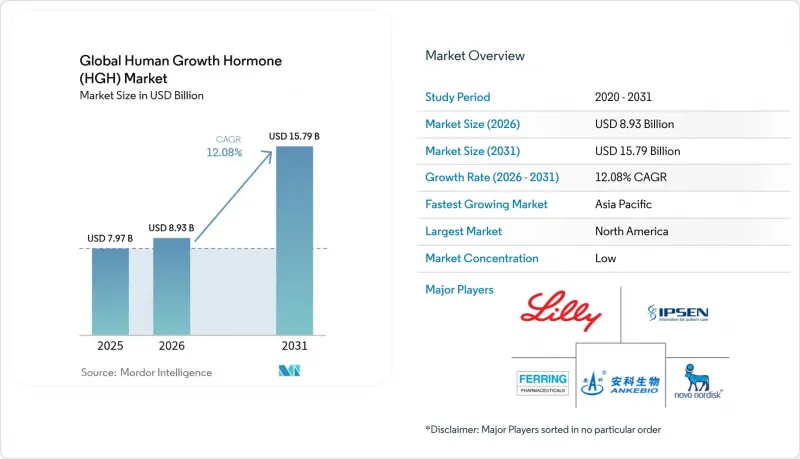
Mordor Intelligence에 의하면, 인간성장호르몬(HGH) 시장 규모는 2025년 79억 7,000만 달러에서 2026년에는 89억 3,000만 달러로 성장하고, 2026-2031년 CAGR 12.08%로 성장을 지속하여 2031년까지 157억 9,000만 달러에 달할 것으로 예측됩니다.
본 보고서에서는 시장을 용도별(성장 호르몬 결핍증, 터너 증후군 등), 투여 경로별(피하 투여, 정맥 내 투여 등), 제형별(속효성, 서방형), 유통 채널별(병원, 약국 등), 환자 유형별(성인, 소아) 및 지역별로 분류하고 있습니다. 시장 규모 및 전망은 금액(달러) 기준으로 제시되어 있습니다.
전 세계 인간 성장 호르몬(HGH) 시장 동향 및 인사이트
장시간 작용형 rhGH 제제의 개발 및 보급
Skytrofa, Ngenla, Sogroya 등의 주 1회 투여 제제는 2020년부터 2023년 사이에 FDA 및 EMA로부터 승인을 획득하여, 약물 복용 순응도에 대한 기대를 재정의하고 있습니다. 임상의들은 편의성 향상을 장기적인 신장 증가 속도의 중요한 결정 요인으로 간주하고 있으며, 이는 소아 의료 분야에서 특히 의미가 큽니다. 의료 제도 측면에서도 복약 순응도 향상에 따른 하류 비용 절감이 확인되고 있으나, 보험사는 15-25%의 가격 프리미엄을 우려하여 처방에 대한 사전 승인을 의무화하고 있습니다. 비용 측면의 우려는 있지만, 지속적인 안전성 모니터링 결과 현재로서는 복약 순응도의 이점을 상쇄할 만한 징후는 확인되지 않았으며, 이는 인간 성장 호르몬 시장 내에서의 지속적인 보급 전망을 뒷받침하고 있습니다.
성장 호르몬 결핍증 및 관련 질환의 유병률 증가
IGF-1 검사의 표준화, 자극 검사의 보급, 그리고 의사에 대한 교육의 확충으로 인해 소아 및 성인 코호트 모두에서 진단률이 상승하고 있습니다. 과거에는 인식이 부족했던 성인 성장 호르몬 결핍증은 대사 증후군 및 심혈관 위험과의 관련성으로 인해 현재는 빈번하게 선별 검사가 이루어지고 있습니다. 고도의 유전자 서열 분석을 통해 임상의는 터너 증후군, 프라더-윌리 증후군, 그리고 재태주수 상대 저체중 사례를 더 조기에 발견할 수 있게 되었으며, 그 결과 환자 1인당 치료 기간이 장기화되고 있습니다. 적절한 성장 호르몬 수치와 뼈 건강 및 인지 기능 간의 연관성을 보여주는 연구를 통해, 성인기까지 치료를 지속해야 할 임상적 근거가 더욱 확대되고 있습니다.
만성 rhGH 요법의 부작용 및 안전성에 대한 우려
시판 후 데이터에 따르면, 내당능 장애과 부종, 그리고 장기 치료를 받고 있는 성인의 잠재적 암 위험에 관한 미해결 논쟁이 주목받고 있습니다. PATRO 바이오시밀러 등록 제도에서는 의사의 의사 결정 지침이 되는 안전성에 관한 최신 정보가 지속적으로 공개되고 있습니다. EMA 및 FDA는 지속형 제제의 승인에 엄격한 장기 모니터링 요건을 부과하고 있으며, 이에 따라 처방 의사는 보다 상세한 기준선 위험 평가와 지속적인 대사 모니터링을 실시해야 합니다. 안전성 우려는 관리 가능한 범위 내에 머물러 있지만, 추가적인 행정적 부담이 경계 사례에서의 치료 도입을 방해할 가능성이 있어, 인간 성장 호르몬 시장의 전반적인 성장 추세를 둔화시키고 있습니다.
부문 분석
성장 호르몬 결핍증은 최대 수익원으로, 2025년 총 매출의 43.12%를 차지하며 그 확고한 임상적 위상을 뒷받침하고 있습니다. 광범위한 임상 데이터, 표준화된 투여 알고리즘, 그리고 오랜 기간에 걸친 보험 급여 지원이 이러한 선도적 지위를 뒷받침하고 있습니다. 그럼에도 불구하고, 특발성 저신장증은 2031년까지 연평균 성장률(CAGR) 12.61%를 기록하며 그 격차를 좁혀가고 있습니다. 내분비 전문의들은 적격 신장-표준편차 범위를 확대하고 있으며, 보험사들도 장기적인 유효성을 보여주는 긍정적인 결과의 논문이 발표됨에 따라 점차 보험 적용을 허용하고 있습니다. 터너 증후군 및 프라더-윌리 증후군은 지속적인 접근을 보장하는 희귀질환 의약품 정책에 힘입어 안정적인 상태를 유지하고 있으나, 수요량은 적은 상황입니다. 만성 신부전이라는 적응증은 이식 성과가 향상됨에 따라 상대적인 중요성이 점차 낮아지고 있습니다.
적응증의 다양화가 지속됨에 따라, 각 환자군에 맞추어 투여 기기, 용량 조절 소프트웨어, 지원 프로그램을 최적화하는 포트폴리오 전략이 촉진되고 있습니다. 제품 제공 형태를 질환별 치료 경로에 부합시키는 기업은 인간 성장 호르몬 시장에서의 입지를 강화할 수 있을 것으로 전망됩니다. 2025년에는 성장 호르몬 결핍증이 인간 성장 호르몬 시장 규모의 43.12%를 차지하여, 기업 계획에서 그 중요성이 부각되고 있습니다.
피하 투여는 2025년 내내 64.98%의 점유율을 유지하고 있으며, 의사들이 수십 년에 걸쳐 익숙해져 온 점, 신뢰할 수 있는 생체 이용률, 그리고 통합된 간호사 교육 인프라의 혜택을 받고 있습니다. 그 규모로 인해 바이오시밀러와의 경쟁이 격화되고 가격 투명성은 높아지고 있지만, 임상적 관성으로 인해 매일 투여하는 주사제가 정착되어 있어 여전히 적정한 이익률은 유지되고 있습니다. 정맥 내 투여나 근육 내 투여는 입원 환자에 대한 투여로 제한되어 있습니다.
LUM-201을 필두로 하는 경구/구강 점막 투여 후보 약물은 연평균 성장률(CAGR) 13.05%가 예상되며, 3상 임상시험 데이터가 확보되면 현재 시장 구조에 큰 변화를 가져올 가능성이 있습니다. 유효성 평가 지표가 주사제의 기준을 충족한다면, 복약 순응도 향상이 기대되므로 보험사의 신속한 전환이 지원될 가능성이 있습니다. 현재 시점에서 피하 투여용 기기는 바늘의 굵기를 가늘게 하고 디지털 일지 기능을 통합하는 방향으로 진화하고 있으며, 이는 단기적으로 경구제 시장 침투를 지연시킬 가능성이 있습니다.
지역별 분석
2025년, 북미는 전 세계 매출의 41.72%를 차지했습니다. 미국에서는 복약 순응도 향상과 장기적인 비용 절감 간의 연관성을 보여주는 근거에 기반하여, 보험사가 비교적 광범위한 보험 적용을 승인함에 따라 Skytrofa, Ngenla, Sogroya의 조기 도입이 가속화되었습니다. 캐나다에서는 공적 의료 제도에서 삶의 질(QOL)의 관점에서 주 1회 투여를 허용하는 의료 기술 평가가 이루어졌습니다. 멕시코에서는 보험 적용 품목의 확대가 시작되고 있지만, 비용에 대한 민감성으로 인해 프리미엄 제품의 단기적인 시장 침투에는 한계가 있습니다.
유럽은 EMA에 의한 통일된 승인 및 잘 정비된 희귀질환 의약품에 대한 우대 조치를 통해 인간 성장 호르몬 시장의 상당 부분을 차지하고 있습니다. 독일은 장시간 작용형 제제의 도입을 주도하고 있으며, 유럽 대륙 전체의 안전성 인식에 영향을 미치는 견고한 시판 후 등록 시스템을 유지하고 있습니다. 프랑스와 영국은 엄격한 비용 대비 효과 기준을 적용하고 있으며, 이는 바이오시밀러 간의 경쟁을 심화시키고 순가격을 억제하고 있습니다. 동유럽 국가들은 공동 조달을 활용하여 가격 면에서의 양보를 이끌어내면서, rhGH를 보험 환급 목록에 점진적으로 추가하고 있습니다.
아시아태평양은 연평균 성장률(CAGR) 14.05%로 가장 빠르게 성장하고 있습니다. 중국에서는 보험 적용 목록에의 추가와 가격을 낮추는 국내 생산으로 인해 견조한 수요가 나타나고 있습니다. 일본의 성숙한 전문의 네트워크는 안정적이고 고부가가치 소비를 뒷받침하고 있으며, 종단적 환자 등록 데이터베이스가 매우 중요한 안전성 데이터를 제공합니다. 인도는 인프라가 부족한 측면이 있지만, 민간 보험 보급률 상승과 진단 기술 향상에 힘입어 눈부신 성장을 보이고 있습니다. 다국적 기업들의 현지 생산 능력에 대한 투자는 공급 리드타임을 단축하고, 인간 성장 호르몬 시장을 전 세계적인 공급 부족으로부터 보호하는 것을 목표로 하고 있습니다.
기타 혜택:
- 엑셀 형식 시장 예측(ME) 시트
- 3개월간의 애널리스트 지원
자주 묻는 질문
목차
제1장 서론
제2장 조사 방법
제3장 주요 요약
제4장 시장 구도
제5장 시장 규모와 성장 예측
제6장 경쟁 구도
제7장 시장 기회와 향후 전망
LSH 26.09.03According to Mordor Intelligence, the human growth hormone market size is expected to grow from USD 7.97 billion in 2025 to USD 8.93 billion in 2026 and is forecast to reach USD 15.79 billion by 2031 at 12.08% CAGR over 2026-2031.
This report Segments the Industry Into by Application (Growth Hormone Deficiency, Turner Syndrome, and More), Route of Administration (Subcutaneous, Intravenous, and More), Formulation (Short-Acting and Long-Acting), by Distribution Channel (Hospitals Pharmacies, and More), Patient Type (Adult and Pediatric), and Geography. The Market Sizes and Forecasts are Provided in Terms of Value (USD).
Global Human Growth Hormone (HGH) Market Trends and Insights
Development and Uptake of Long-Acting rhGH Formulations
Weekly products such as Skytrofa, Ngenla, and Sogroya obtained both FDA and EMA authorizations between 2020 and 2023 and are redefining adherence expectations. Clinicians view the improved convenience as a critical determinant of long-term height velocity, which is particularly meaningful in pediatric care. Health systems also register downstream cost savings tied to better adherence, though payers flag the 15-25% price premium and subject prescriptions to prior authorization. Despite cost tensions, ongoing safety surveillance has yet to identify signals that offset the compliance benefit, underpinning durable adoption prospects inside the human growth hormone market.
Rising Prevalence of Growth Hormone Deficiency and Related Disorders
Standardized IGF-1 testing, broader stimulation-test availability, and heightened physician education are lifting diagnostic rates across pediatric and adult cohorts. Adult growth hormone deficiency-once under-recognized-is now frequently screened due to its links with metabolic syndrome and cardiovascular risk. Advanced genetic sequencing helps clinicians detect Turner syndrome, Prader-Willi syndrome, and small-for-gestational-age cases earlier, which translates into longer therapy duration per patient. Research that connects adequate growth hormone levels with bone health and cognitive performance further widens the clinical rationale for continued therapy into adulthood .
Adverse Effects and Safety Concerns of Chronic rhGH Therapy
Post-marketing data draw attention to glucose intolerance, edema, and unresolved debates over potential cancer risk in adults on prolonged therapy. The PATRO biosimilar registry continues to publish safety updates that guide physician decision-making . EMA and FDA have attached rigorous long-term surveillance requirements to long-acting approvals, prompting prescribers to adopt more detailed baseline risk assessments and ongoing metabolic monitoring. While safety signals have remained manageable, the extra administrative load may deter uptake in borderline cases and moderates the overall growth trajectory of the human growth hormone market.
Other drivers and restraints analyzed in the detailed report include:
- Expanding Adult and Anti-Aging Off-Label Demand
- Continued Advances in Recombinant DNA and Protein-Engineering Platforms
- High Therapy Cost
For complete list of drivers and restraints, kindly check the Table Of Contents.
Segment Analysis
Growth hormone deficiency generated the largest revenue pool and held 43.12% of total 2025 sales, confirming its entrenched clinical standing. The breadth of clinical data, standardized dosing algorithms, and long-standing reimbursement support sustain its leadership. Nonetheless, idiopathic short stature is recording a 12.61% CAGR through 2031 and is compressing the gap. Endocrinologists are expanding the qualifying height-standard-deviation window, and payers are gradually conceding coverage following favorable long-term efficacy publications. Turner syndrome and Prader-Willi syndrome supply stable but lower-volume demand, supported by orphan-drug policies that guarantee continued access. Chronic renal insufficiency as a use case is receding in relative importance as transplantation outcomes improve.
Continued indication diversification promotes portfolio strategies that tailor dosing devices, titration software, and support programs to each distinct cohort. Companies that align product presentation with condition-specific pathways stand to reinforce their positions within the human growth hormone market. Growth hormone deficiency accounted for 43.12% of the human growth hormone market size in 2025, underlining its weight in corporate planning.
Subcutaneous delivery maintained 64.98% share during 2025, enjoying decades of physician familiarity, reliable bioavailability, and integrated nurse-training infrastructure. Its scale attracts biosimilar competition, which increases price transparency but still preserves moderate margin because clinical inertia keeps daily injectables entrenched. Intravenous or intramuscular administration is confined to inpatient settings.
Oral / buccal candidates, led by LUM-201, promise a 13.05% CAGR that could meaningfully disrupt the current hierarchy once phase 3 data mature. If efficacy endpoints match injectable standards, payers may support rapid substitution due to superior adherence potential. For now, subcutaneous devices are evolving toward thinner needles and digital diary integration, which may slow near-term oral encroachment.
Complete Report Scope:
- By Application
- Growth Hormone Deficiency
- Turner Syndrome
- Idiopathic Short Stature
- Prader-Willi Syndrome
- Small for Gestational Age
- Chronic Renal Insufficiency
- By Route of Administration
- Subcutaneous
- Intravenous
- Intramuscular
- Oral / Buccal
- By Formulation
- Short-acting
- Long-acting
- By Distribution Channel
- Hospital Pharmacies
- Retail & Specialty Pharmacies
- Online Pharmacies
- By Patient Type
- Pediatric
- Adult
- By Geography
- North America
- United States
- Canada
- Mexico
- Europe
- Germany
- United Kingdom
- France
- Italy
- Spain
- Rest of Europe
- Asia-Pacific
- China
- Japan
- India
- Australia
- South Korea
- Rest of Asia-Pacific
- Middle East & Africa
- GCC
- South Africa
- Rest of Middle East & Africa
- South America
- Brazil
- Argentina
- Rest of South America
- North America
Geography Analysis
North America controlled 41.72% of global turnover in 2025. United States payers granted relatively broad coverage after evidence linked improved adherence with long-run cost containment, which accelerated early adoption of Skytrofa, Ngenla, and Sogroya. Canada followed with health-technology assessments that accepted weekly dosing on quality-of-life grounds within the public system. Mexico is beginning to expand insurance formularies, though cost sensitivity caps near-term penetration of premium products.
Europe contributes a sizable portion of the human growth hormone market through harmonized EMA approvals and well-structured orphan-drug incentives. Germany leads uptake of long-acting molecules and maintains robust post-marketing registries that influence safety perceptions across the continent. France and the United Kingdom enforce strict cost-effectiveness thresholds, which intensify biosimilar competition and moderate net price. Eastern European countries gradually add rhGH to reimbursement lists, leveraging pooled procurement to gain price concessions.
Asia-Pacific is growing fastest at 14.05% CAGR. China registers strong demand following insurance-catalog additions and domestic manufacturing that compresses price. Japan's mature specialist network supports stable high-value consumption, and longitudinal patient registries contribute pivotal safety data. India, despite infrastructure gaps, shows meaningful growth as private insurance penetration rises and diagnostics improve. Local capacity investments by multinational firms aim to shorten supply lead-times and insulate the human growth hormone market against global shortages.
- Novo Nordisk
- Pfizer
- Eli Lilly and Company
- Sandoz International GmbH (Novartis)
- Ipsen
- EMD Serono Inc. (Merck KGaA)
- Roche
- Ascendis Pharma A/S
- Opko Health
- Ferring Pharmaceuticals
- Teva Pharmaceutical Industries
- GeneScience Pharmaceuticals
- AnkeBio
- LG Life Sciences Ltd
- Sinobioway Hygene Biomedicine
- Aeterna Zentaris Inc.
- Strongbridge Biopharma plc
- Hanmi Pharmaceutical Co. Ltd
- Yamo Pharmaceuticals
- Cadila Healthcare Ltd (Zydus Lifesciences)
Additional Benefits:
- The market estimate (ME) sheet in Excel format
- 3 months of analyst support
TABLE OF CONTENTS
1 Introduction
- 1.1 Study Assumptions & Market Definition
- 1.2 Scope of the Study
2 Research Methodology
3 Executive Summary
4 Market Landscape
- 4.1 Market Overview
- 4.2 Market Drivers
- 4.2.1 Development & uptake of long-acting rhGH formulations
- 4.2.2 Rising prevalence of growth hormone deficiency (GHD) & related disorders
- 4.2.3 Expanding adult & anti-aging off-label demand
- 4.2.4 Continued advances in recombinant DNA and protein-engineering platforms
- 4.2.5 Gradual inclusion of hGH treatments in public and private reimbursement formularies
- 4.2.6 Rare-disease fast-track incentives accelerating pipeline (under-reported)
- 4.3 Market Restraints
- 4.3.1 Adverse effects & safety concerns of chronic rhGH therapy
- 4.3.2 High therapy cost
- 4.3.3 Regulatory uncertainty
- 4.3.4 Counterfeit & grey-market hGH eroding brand trust (under-reported)
- 4.4 Value / Supply-Chain Analysis
- 4.5 Regulatory Landscape
- 4.6 Technological Outlook
- 4.7 Porter's Five Forces Analysis
- 4.7.1 Threat of New Entrants
- 4.7.2 Bargaining Power of Buyers/Consumers
- 4.7.3 Bargaining Power of Suppliers
- 4.7.4 Threat of Substitute Products
- 4.7.5 Intensity of Competitive Rivalry
5 Market Size & Growth Forecasts (Value, USD)
- 5.1 By Application
- 5.1.1 Growth Hormone Deficiency
- 5.1.2 Turner Syndrome
- 5.1.3 Idiopathic Short Stature
- 5.1.4 Prader-Willi Syndrome
- 5.1.5 Small for Gestational Age
- 5.1.6 Chronic Renal Insufficiency
- 5.2 By Route of Administration
- 5.2.1 Subcutaneous
- 5.2.2 Intravenous
- 5.2.3 Intramuscular
- 5.2.4 Oral / Buccal
- 5.3 By Formulation
- 5.3.1 Short-acting
- 5.3.2 Long-acting
- 5.4 By Distribution Channel
- 5.4.1 Hospital Pharmacies
- 5.4.2 Retail & Specialty Pharmacies
- 5.4.3 Online Pharmacies
- 5.5 By Patient Type
- 5.5.1 Pediatric
- 5.5.2 Adult
- 5.6 By Geography
- 5.6.1 North America
- 5.6.1.1 United States
- 5.6.1.2 Canada
- 5.6.1.3 Mexico
- 5.6.2 Europe
- 5.6.2.1 Germany
- 5.6.2.2 United Kingdom
- 5.6.2.3 France
- 5.6.2.4 Italy
- 5.6.2.5 Spain
- 5.6.2.6 Rest of Europe
- 5.6.3 Asia-Pacific
- 5.6.3.1 China
- 5.6.3.2 Japan
- 5.6.3.3 India
- 5.6.3.4 Australia
- 5.6.3.5 South Korea
- 5.6.3.6 Rest of Asia-Pacific
- 5.6.4 Middle East & Africa
- 5.6.4.1 GCC
- 5.6.4.2 South Africa
- 5.6.4.3 Rest of Middle East & Africa
- 5.6.5 South America
- 5.6.5.1 Brazil
- 5.6.5.2 Argentina
- 5.6.5.3 Rest of South America
- 5.6.1 North America
6 Competitive Landscape
- 6.1 Market Concentration
- 6.2 Market Share Analysis
- 6.3 Company Profiles (includes Global level Overview, Market level overview, Core Segments, Financials as available, Strategic Information, Market Rank/Share for key companies, Products & Services, and Recent Developments)
- 6.3.1 Novo Nordisk A/S
- 6.3.2 Pfizer Inc.
- 6.3.3 Eli Lilly and Company
- 6.3.4 Sandoz International GmbH (Novartis)
- 6.3.5 Ipsen SA
- 6.3.6 EMD Serono Inc. (Merck KGaA)
- 6.3.7 F. Hoffmann-La Roche Ltd
- 6.3.8 Ascendis Pharma A/S
- 6.3.9 OPKO Health Inc.
- 6.3.10 Ferring BV
- 6.3.11 Teva Pharmaceutical Industries Ltd
- 6.3.12 GeneScience Pharmaceuticals Co. Ltd
- 6.3.13 AnkeBio Co. Ltd
- 6.3.14 LG Life Sciences Ltd
- 6.3.15 Sinobioway Hygene Biomedicine Co. Ltd
- 6.3.16 Aeterna Zentaris Inc.
- 6.3.17 Strongbridge Biopharma plc
- 6.3.18 Hanmi Pharmaceutical Co. Ltd
- 6.3.19 Yamo Pharmaceuticals
- 6.3.20 Cadila Healthcare Ltd (Zydus Lifesciences)
7 Market Opportunities & Future Outlook
- 7.1 White-space & Unmet-Need Assessment


