

|
시장보고서
상품코드
2122465
니들 코크스 : 시장 점유율 분석, 업계 동향과 통계, 성장 예측(2026-2031년)Needle Coke - Market Share Analysis, Industry Trends & Statistics, Growth Forecasts (2026 - 2031) |
||||||
 Mordor Intelligence
Mordor Intelligence에 의하면, 니들 코크스 시장 규모는 2025년 258만 메트릭 톤에서 2026년에는 297만 메트릭 톤으로 확대되고, 2026-2031년 CAGR 15.11%로 성장을 지속하여 2031년에는 600만 메트릭 톤에 이를 것으로 예측됩니다.
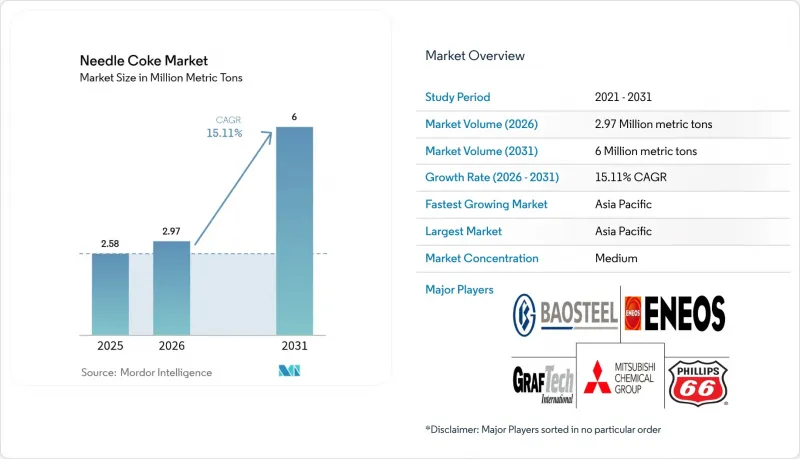
본 보고서는 제품 유형(석유계 니들 코크스 및 콜타르 피치계 니들 코크스), 용도(흑연 전극, 리튬 이온 배터리, 기타 용도), 지역(아시아태평양, 북미, 유럽, 남미, 중동 및 아프리카)별로 분류되어 있습니다. 시장 예측은 수량(미터톤) 기준으로 제시됩니다.
세계 니들 코크스 시장 동향 및 인사이트
증가하는 전기로(EAF) 제강 설비 건설 계획
현재 총 3억 3,700만 메트릭톤에 달하는 전 세계 전기로(EAF) 프로젝트는 발표된 제강 능력 증설 계획 전체의 거의 절반을 차지하고 있으며,새로운 전기로(EAF) 생산 능력 100만 메트릭톤당 약 1,360 메트릭톤의 초고출력 흑연 전극이 소비됩니다. 40%의 전환율을 기준으로 할 때, 이 계획은 약 183,000 메트릭 톤의 니들 코크스 원료 증가에 해당합니다. 가동 개시까지의 기간 단축, 자본 집약도 감소, 그리고 직접 배출량의 대폭적인 감축으로 인해 EAF 제철소는 유망한 성장 분야로 자리매김하고 있으며, 그 결과 엄격한 회분 및 황 함량 제한을 충족하는 석유 유래 등급에 대한 장기적인 수요가 촉진되고 있습니다.
전 세계적으로 확대되는 전기차용 리튬 이온 배터리 기가팩토리
전기차 판매 대수는 2025년에 2,700만 대를 넘어설 전망이며, 1대당 50-80kg의 합성 흑연 음극재가 필요합니다. 중국의 음극재 생산 능력은 향후 10년 후반에 소폭공급 과잉이 발생할 가능성이 있지만, 현재 전 세계 석유 코크스 생산량 중 배터리 등급의 순도 기준을 충족하는 것은 고작 3분의 1에 불과합니다. 예를 들어, 한국의 POSCO Future M은 원료를 확보하기 위해 철강, 전극, 배터리 각 사업을 연계한 3억 달러 규모의 프로그램 하에서 음극용 등급의 생산 능력을 4배로 확대되고 있습니다. 그 결과, 국지적으로 흑연 공급 과잉 현상이 나타나는 지역이 있음에도 불구하고, 니들 코크스 시장은 여전히 공급 부족 상태가 지속되고 있습니다.
지연 코크스화 과정에서의 노동 및 환경적 위험
미국 환경보호청(EPA)의 벤젠 규제로 인해 설비 1기당 8,000만-1억 2,000만 달러의 개조 비용이 필요하게 되었으며, 많은 중소 정제 업체들은 이 비용을 감당할 수 없습니다. 2021년 이후 북미에서는 이미 약 180만 톤의 코크스 생산 능력이 시장에서 철수했으며, 생산은 재무 기반이 탄탄하고 엄격한 환경 규정 준수 프로그램을 갖춘 기업에 집중되고 있습니다.
부문별 분석
석유 유래 니들 코크스는 2025년 총량의 85.23%를 차지하고 있으며, 정유시설와 일체화된 생산자들이 초저황 원료를 확보함에 따라 2031년까지 연평균 성장률(CAGR) 16.18%로 니들 코크스 시장 규모 내 점유율이 더욱 확대될 것으로 예측됩니다. 콜타르 유래 제조 경로는 여전히 회분 함량이 높고 황 함유량의 편차가 크다는 제약에 직면해 있지만, 중국의 생산자들은 연간 30만 톤 규모의 심가공 프로젝트를 확대하고 있어, 이로 인해 순도 격차가 줄어들 가능성이 있습니다. EU의 탄소 발자국 규제 강화는 톤당 수명 주기 배출량이 적다는 점을 고려할 때, 석유 유래 제품의 우위를 더욱 공고히 하고 있습니다. 미쓰비시 화학의 ‘캡슐화 억제제 피치’와 같은 공정 혁신을 통해 2027년 이후에는 콜타르 유래 수율이 향상될 가능성이 있지만, 실용화에 대해서는 여전히 불투명합니다.
비용 면에서도 정제 경로가 유리합니다. 이는 공동 생산 구조를 통해 연료용 코크스나 유황의 제조 비용을 고정비로 흡수할 수 있기 때문입니다. Philips 66의 험버 정유시설는 연간 130만 대의 전기차에 충분한 배터리 등급 제품을 공급하고 있는 반면, 그래프텍의 시드리프트 공장은 중국을 제외한 전 세계 생산 능력의 약 19-20%를 차지하고 있어, 이 회사는 전극의 이익률을 안정적으로 유지하고 있습니다.
지역별 분석
2025년, 아시아태평양은 니들 코크스 시장에서 출하량의 87.88%를 차지하며 주도적인 위치를 차지하고 있으며, 2031년까지 연평균 성장률(CAGR) 15.56%로 성장을 지속할 것으로 예측됩니다. 2024년에는 중국이 단독으로 세계 생산량의 대부분을 공급하고 있으며, 콜타르 및 석유 플랫폼 생산 확대에 따라 그 규모는 더욱 커지고 있습니다. 한국의 POSCO Future M은 2026년까지 연산 3만 6,000톤 규모의 합성 흑연 생산 라인 가동을 계획하고 있는 반면,인도 석유공사(Indian Oil Corporation)의 파라딥 프로젝트에서는 2028년까지 연산 5만 6,000톤의 소성 흑연 생산 능력이 가동에 들어갈 전망이며, 이는 지역 통합의 진전을 여실히 보여주고 있습니다.
북미는 현재 시장 점유율이 중간 수준에 머물러 있지만, GrafTech사의 연산 14만 톤 규모의 시드리프트 공장과, Epsilon Advanced Materials사와 2025년 공급 계약을 체결한 Phillips 66사의 레이크찰스 정유시설 등 자사 자산의 혜택을 누리고 있습니다. 미국 에너지부는 니들 코크스를 중요한 배터리 재료로 지정하고, 국내 프로젝트를 촉진하기 위해 1,600만 달러의 보조금을 배정했습니다. 이러한 움직임으로 인해 해당 지역의 생산량이 증가하고 수입 의존도가 낮아질 것으로 예상되며, 2031년까지 미국 내 니들 코크스 시장 점유율은 최대 2퍼센트 포인트 상승할 것으로 전망됩니다.
유럽에서는 여전히 공급 부족이 지속되고 있으며, Philips 66의 험버 정유시설만이 연간 130만 대의 전기차(EV)에 충분한 배터리 등급 니들 코크스를 생산하고 있습니다. 도카이 카본이 독일의 전극 사업에서 철수한 것은 여전히 지속되고 있는 이익률 압박을 여실히 드러내고 있습니다. 그러나 EU 배터리 규정 2023/1542는 EMR의 버밍엄 시설과 같은 연간 2,000톤 규모의 시범 재활용 라인을 장려하고 있으며, 해당 시설에서는 ASTM 규격을 준수하는 순도 99.9%의 재생 흑연을 공급하고 있습니다.
기타 혜택:
- 엑셀 형식 시장 예측(ME) 시트
- 3개월간의 애널리스트 지원
자주 묻는 질문
목차
제1장 서론
제2장 조사 방법
제3장 주요 요약
제4장 시장 구도
제5장 시장 규모와 성장 예측
제6장 경쟁 구도
제7장 시장 기회와 향후 전망
LSH 26.09.03According to Mordor Intelligence, the needle coke market size is expected to grow from 2.58 Million metric tons in 2025 to 2.97 Million metric tons in 2026 and is forecast to reach 6 Million metric tons by 2031 at 15.11% CAGR over 2026-2031.
This report is Segmented by Product Type (Petroleum-Based Needle Coke and Coal-Tar Pitch-Based Needle Coke), Application (Graphite Electrodes, Lithium-Ion Batteries, and Other Applications), and Geography (Asia-Pacific, North America, Europe, South America, and Middle-East and Africa). The Market Forecasts are Provided in Terms of Volume (Metric Tons).
Global Needle Coke Market Trends and Insights
Increasing EAF-Steel Capacity Pipelines
Global EAF projects totaling 337 million metric tons now represent nearly half of all announced steelmaking additions, and every 1 million metric tons of new EAF capacity consumes roughly 1,360 metric tons of ultra-high-power graphite electrodes. Based on a 40% conversion ratio, this pipeline translates into about 183,000 metric tons of incremental needle coke feedstock. Faster commissioning, lower capital intensity, and sharply lower direct-emission profiles position EAF mills as the favored growth vector, thereby reinforcing long-run demand for petroleum-based grades that meet stringent ash and sulfur limits.
EV Li-ion Battery Gigafactories Scaling Globally
Electric-vehicle sales are on track to top 27 million units in 2025, and each vehicle requires 50-80 kg of synthetic graphite anode material. Although Chinese anode capacity could run a small surplus later in the decade, only one-third of global petroleum coke output currently meets battery-grade purity thresholds. South Korea's POSCO Future M, for example, is quadrupling anode-grade capacity under a USD 300 million program that pairs steel, electrode, and battery businesses to secure feedstock. Net result: the needle coke market continues to tighten despite pockets of localized graphite surplus.
Occupational and Environmental Hazards in Delayed Coking
U.S. EPA benzene-control rules require USD 80-120 million retrofits per unit, costs that many smaller refiners cannot absorb. Roughly 1.8 million t of North American coke capacity has already exited since 2021, concentrating output among firms with strong balance sheets and rigorous environmental compliance programs.
Other drivers and restraints analyzed in the detailed report include:
- Scrap-Steel Mandates in China and European Union
- Refinery Upgrades Producing Ultra-Low-Sulfur Decant Oil
- Emergence of Bio-Based Hard-Carbon Anodes
For complete list of drivers and restraints, kindly check the Table Of Contents.
Segment Analysis
Petroleum-based needle coke accounted for 85.23% of 2025 volume, and their share of the needle coke market size is projected to rise further at a 16.18% CAGR through 2031 as refinery-integrated producers secure ultra-low-sulfur feedstock. Coal-tar routes remain constrained by higher ash and sulfur variability, yet Chinese producers are scaling 300,000 tpa deep-processing projects that could narrow the purity gap. Tightening EU carbon-footprint rules reinforce the petroleum advantage, given lower life-cycle emissions per tonne. Process innovation-such as Mitsubishi Chemical's encapsulated inhibitor pitch-may lift coal-tar yields after 2027, but commercialization remains uncertain.
Cost spreads also favor refinery paths because co-production metrics allow fixed-cost absorption across fuel-grade coke and sulfur. Phillips 66's Humber refinery supplies battery-grade output adequate for 1.3 million EVs annually, while GrafTech's Seadrift plant covers about 19-20% of ex-China capacity, stabilizing its electrode margins.
Complete Report Scope:
- By Product Type
- Petroleum-based Needle Coke
- Coal-tar Pitch-based Needle Coke
- By Application
- Graphite Electrodes
- Lithium-ion Batteries
- Other Applications
- By Geography
- Asia-Pacific
- China
- India
- Japan
- South Korea
- Rest of Asia-Pacific
- North America
- United States
- Canada
- Mexico
- Europe
- Germany
- United Kingdom
- France
- Italy
- Russia
- Rest of Europe
- South America
- Brazil
- Argentina
- Rest of South America
- Middle-East and Africa
- Saudi Arabia
- South Africa
- Rest of Middle-East and Africa
- Asia-Pacific
Geography Analysis
Asia-Pacific dominated the needle coke market in 2025 with 87.88% volume and is forecast to keep expanding at a 15.56% CAGR through 2031. China alone supplied the majority of global output in 2024 and is growing as coal-tar and petroleum platforms ramp up. POSCO Future M in South Korea plans a 36,000 tpa synthetic-graphite line by 2026, while Indian Oil Corporation's Paradip project will bring 56,000 tpa calcined capacity online by 2028, underlining regional integration.
North America presently holds a moderate share yet benefits from captive assets such as GrafTech's 140,000 tpa Seadrift plant and Phillips 66's Lake Charles refinery, which inked a 2025 supply deal with Epsilon Advanced Materials. The U.S. Department of Energy lists needle coke as a critical battery material and has earmarked USD 16 million in grant funding to spur domestic projects. These moves are projected to lift regional output and reduce import reliance, raising the needle coke market share in the United States by up to 2 percentage points by 2031 .
Europe remains supply-short with only Phillips 66's Humber refinery producing battery-grade output sufficient for 1.3 million EVs annually. Tokai Carbon's retreat from its German electrode unit underscores lingering margin pressure. EU Battery Regulation 2023/1542, however, is catalyzing 2,000 tpa pilot recycling lines such as EMR's Birmingham facility, which offers 99.9%-purity recovered graphite compliant with ASTM specifications.
- China Baowu Steel Group Corp., Ltd.
- China National Petroleum Corporation
- ENEOS Corporation
- GrafTech International
- Indian Oil Corporation
- Mitsubishi Chemical Group Corporation
- Nippon Steel Corporation
- PetroChina
- Phillips 66 Company
- POSCO Future M
- Shandong Yida New Materials Co., Ltd.
- Shanxi Hongte Coal Chemical Co Ltd
- Sinopec
- Tokai Carbon Co., Ltd
Additional Benefits:
- The market estimate (ME) sheet in Excel format
- 3 months of analyst support
TABLE OF CONTENTS
1 Introduction
- 1.1 Study Assumptions and Market Definition
- 1.2 Scope of the Study
2 Research Methodology
3 Executive Summary
4 Market Landscape
- 4.1 Market Overview
- 4.2 Market Drivers
- 4.2.1 Increasing EAF-steel capacity pipelines
- 4.2.2 EV Li-ion battery gigafactories scaling globally
- 4.2.3 Scrap-steel mandates in China and European Union
- 4.2.4 Refinery upgrades producing ultra-low-sulphur decant oil
- 4.2.5 Accelerated anode-grade graphite recycling patents
- 4.3 Market Restraints
- 4.3.1 Occupational and environmental hazards in delayed coking
- 4.3.2 Feed-stock price volatility
- 4.3.3 Emergence of bio-based hard-carbon anodes
- 4.4 Value Chain Analysis
- 4.5 Porter's Five Forces
- 4.5.1 Bargaining Power of Suppliers
- 4.5.2 Bargaining Power of Buyers
- 4.5.3 Threat of New Entrants
- 4.5.4 Threat of Substitutes
- 4.5.5 Degree of Competition
- 4.6 Price Overview
5 Market Size and Growth Forecasts (Volume)
- 5.1 By Product Type
- 5.1.1 Petroleum-based Needle Coke
- 5.1.2 Coal-tar Pitch-based Needle Coke
- 5.2 By Application
- 5.2.1 Graphite Electrodes
- 5.2.2 Lithium-ion Batteries
- 5.2.3 Other Applications
- 5.3 By Geography
- 5.3.1 Asia-Pacific
- 5.3.1.1 China
- 5.3.1.2 India
- 5.3.1.3 Japan
- 5.3.1.4 South Korea
- 5.3.1.5 Rest of Asia-Pacific
- 5.3.2 North America
- 5.3.2.1 United States
- 5.3.2.2 Canada
- 5.3.2.3 Mexico
- 5.3.3 Europe
- 5.3.3.1 Germany
- 5.3.3.2 United Kingdom
- 5.3.3.3 France
- 5.3.3.4 Italy
- 5.3.3.5 Russia
- 5.3.3.6 Rest of Europe
- 5.3.4 South America
- 5.3.4.1 Brazil
- 5.3.4.2 Argentina
- 5.3.4.3 Rest of South America
- 5.3.5 Middle-East and Africa
- 5.3.5.1 Saudi Arabia
- 5.3.5.2 South Africa
- 5.3.5.3 Rest of Middle-East and Africa
- 5.3.1 Asia-Pacific
6 Competitive Landscape
- 6.1 Market Concentration
- 6.2 Strategic Moves
- 6.3 Market Share(%)/Ranking Analysis
- 6.4 Company Profiles (includes Global Overview, Market Overview, Core Segments, Financials, Strategic Information, Products and Services, Recent Developments)
- 6.4.1 China Baowu Steel Group Corp., Ltd.
- 6.4.2 China National Petroleum Corporation
- 6.4.3 ENEOS Corporation
- 6.4.4 GrafTech International
- 6.4.5 Indian Oil Corporation
- 6.4.6 Mitsubishi Chemical Group Corporation
- 6.4.7 Nippon Steel Corporation
- 6.4.8 PetroChina
- 6.4.9 Phillips 66 Company
- 6.4.10 POSCO Future M
- 6.4.11 Shandong Yida New Materials Co., Ltd.
- 6.4.12 Shanxi Hongte Coal Chemical Co Ltd
- 6.4.13 Sinopec
- 6.4.14 Tokai Carbon Co., Ltd
7 Market Opportunities and Future Outlook
- 7.1 White-space and Unmet-need Assessment


