

|
시장보고서
상품코드
2122523
Hadoop 빅데이터 분석 : 시장 점유율 분석, 업계 동향과 통계, 성장 예측(2026-2031년)Hadoop Big Data Analytics - Market Share Analysis, Industry Trends & Statistics, Growth Forecasts (2026 - 2031) |
||||||
 Mordor Intelligence
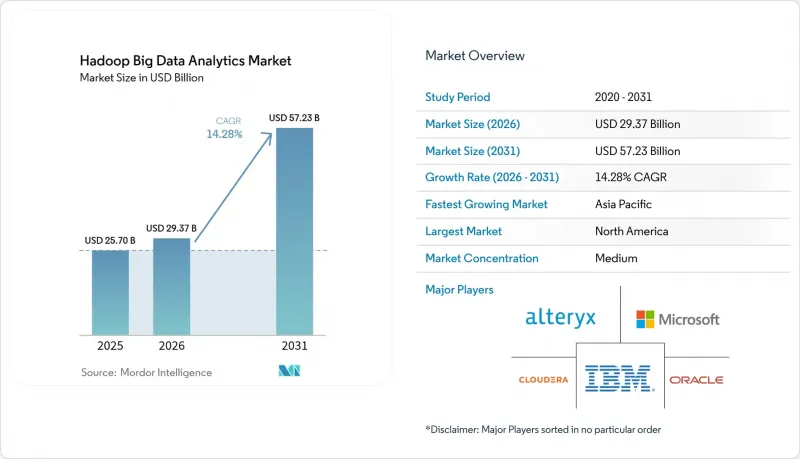
Mordor Intelligence에 의하면, Hadoop 빅데이터 분석 시장 규모는 2025년 257억 달러에서 2026년에는 293억 7,000만 달러로 성장하고, 2026-2031년 CAGR 14.28%로 성장을 지속하여 2031년에는 572억 3,000만 달러에 달할 것으로 예측됩니다.
본 보고서는 솔루션별(데이터 디스커버리 및 시각화(DDV), 고급 분석(AA) 등),최종 이용 산업별(은행, 금융서비스 및 보험(BFSI), 소매, IT 및 통신, 헬스케어 및 생명과학 등), 도입 형태별(On-Premise, 클라우드 등), 조직 규모별(대기업 및 중소기업), 그리고 지역별로 분류되어 있습니다. 시장 예측은 금액(달러) 기준으로 제시되어 있습니다.
세계 Hadoop 빅데이터 분석 시장 동향 및 인사이트
연결된 기기 및 스트리밍 소스에서 발생하는 데이터 폭발
IoT 엔드포인트의 끊임없는 증가로 인해 Hadoop은 배치 처리 엔진에서 실시간 분석의 중추로 변모하고 있습니다. 제조업 기업에서는 센서 분석을 엣지 통합형 Hadoop 클러스터로 이전한 결과, 네트워크 대역폭을 최대 90%까지 절감하는 데 성공했습니다. 독일과 중국의 제조업체들은 여러 공장에 걸쳐 있는 전체 네트워크에 Hadoop을 활용한 예측 유지보수 워크플로를 도입한 결과, 두 자릿수의 생산성 향상을 달성했다고 보고하고 있습니다. 이 플랫폼이 가진 ‘스키마 온 리드(Schema-on-Read)’의 유연성 덕분에 데이터 팀은 구조화된 SCADA 로그와 반구조화된 품질 이미지, 비구조화된 동영상 스트림을 단일 연합 패브릭(federated fabric) 상에서 통합할 수 있게 되었습니다.
중소기업을 위한 TCO를 절감하는 클라우드 네이티브 Hadoop 플랫폼
관리형 Hadoop 서비스는 랙 설치, 패치 적용, 튜닝과 같은 오버헤드를 제거함으로써 중소기업의 빅데이터 워크로드 활용을 확대되고 있습니다. 한 대형 통신사는 클라우드 네이티브 가시성 레이어를 도입한 결과, 근본 원인 분석 주기를 수 주에서 1분으로 단축함과 동시에 분석 비용을 70% 절감했습니다. 의료 분야의 유사한 사례에서는 기존의 관계형 스택과 비교하여 쿼리 성능이 3-5배 향상되고, 스토리지 비용을 90% 절감할 수 있었던 것으로 나타났습니다. 이러한 경제성과 사용량 기반 과금 체계가 결합되어, 중소기업은 희소한 분산 시스템 엔지니어를 채용하지 않고도 엔터프라이즈급 인사이트 프로그램에 필적하는 성과를 거둘 수 있게 됩니다.
분산 시스템 엔지니어링 분야의 인력 부족
Uptime Institute의 2024년 조사에 따르면, 운영자의 58%가 중요한 데이터 엔지니어링 직책을 채우지 못하고 있으며, 이로 인해 자체 관리형 Hadoop 환경의 총 소유 비용(TCO)이 증가하고 있습니다. 시니어 데이터 엔지니어의 연봉이 21만 8,000달러를 초과함에 따라, 일부 도입 기업들은 On-Premise 프로젝트를 연기하거나 보류하고, 풀 매니지드형 대체 솔루션을 선택하고 있습니다. 대학에서는 전문 교육 프로그램을 확충하고 있지만, 졸업생 공급량은 여전히 기업 수요를 따라가지 못하고 있어 향후 수년간 구조적인 제약이 예상됩니다.
부문 분석
2025년, 비즈니스 사용자가 점점 더 대규모화되는 클러스터에서 직관적인 쿼리 처리를 요구하는 가운데, ‘데이터 탐색 및 시각화’는 Hadoop 빅데이터 분석 시장의 42.05%를 차지했습니다. ‘Hadoop-as-a-Service(HaaS)’가 급속한 성장을 이루며 15.34%의 연평균 성장률(CAGR)을 기록, 다른 어떤 솔루션 그룹보다도 높은 성장세를 보이고 있습니다. 이러한 SaaS와 유사한 모델에서는 클러스터 오케스트레이션 및 패치 적용이 외부에 위탁되므로, 고객은 저수준 튜닝에서 해방되어 사용량 급증에 맞추어 비용을 조정할 수 있게 됩니다. Cloudera의 퍼블릭 클라우드 블루프린트에 따르면, 리프트 앤 시프트(Lift-and-Shift) 방식의 대안과 비교해 50%의 비용 절감이 가능하며, 이것이 해당 기업의 HaaS 성장세를 뒷받침하는 명확한 요인으로 작용하고 있습니다.
또한, 관리형 확장성을 통해 공유 YARN 풀에서의 실시간 AI 추론이 지원되므로, 개발자는 초기 자본 지출(Capex) 없이 단기간 동안 GPU 노드를 가동할 수 있습니다. 독립 벤더들은 ETL 및 카탈로그 기능을 통합 콘솔에 포함시켰으며, 데이터 팀은 단일 화면 내에서 데이터 가져오기, 전처리, 시각화를 일관되게 수행할 수 있습니다. 분산형 캐시 및 의도 기반 작업 스케줄링에 관한 특허 동향은 특히 네이티브 BI 플러그인을 통해 표시되는 높은 동시 실행 수의 대시보드에서 효율성 향상이 지속될 것임을 시사합니다.
IT 및 통신 업계는 사기 감지, 네트워크 텔레메트리, 고객 행동 분석에 Hadoop을 활용함으로써 2025년에도 매출 점유율 27.55%를 유지했습니다. 그러나 가장 빠르게 성장하고 있는 분야는 의료 산업으로, 유전체학, 전자건강기록(EHR) 상호운용성에 관한 규제, 그리고 연결된 기기의 원격 측정 데이터로 인해 페타바이트 규모의 데이터가 데이터 레이크로 유입되면서 연평균 성장률(CAGR) 14.81%를 기록하며 확장하고 있습니다. 영국의 ‘10만 유전체 프로젝트’나 이와 유사한 종양학 이니셔티브에서는 변이 감지 및 환자의 종단적 기록을 프로덕션 환경 수준의 속도로 처리하기 위해 분산형 스토리지가 요구되고 있습니다.
정밀의료 파이프라인에서는 모델 재학습을 가속화하는 Hadoop 기반 특징량 저장소가 활용되고 있으며, 한편 HIPAA를 준수하는 HDFS 암호화 모듈이 엄격한 규정 준수 요건을 충족하고 있습니다. 과거 이미지 아카이브를 마이그레이션한 결과, 스토리지 TCO를 90% 절감했다고 보고한 병원도 있어, 이것이 도입을 뒷받침하는 경제적 요인으로 작용하고 있습니다. 이 분야의 성장 추세는 파일럿 프로젝트에서 컴퓨팅 성능과 스토리지 규모의 동기화가 요구되는 임상 등급 AI를 활용한 워크플로로 전환되고 있음을 시사합니다.
지역별 분석
북미는 2025년 매출의 37.55%를 차지하며, 대형 금융 서비스 기업과 하이퍼스케일러들이 미션 크리티컬 분석에서 Hadoop의 역할을 확고히 했습니다. JPMorgan Chase는 사기 감지 및 유동성 리스크 모델에서 150PB가 넘는 데이터를 운영하고 있으며, 이는 프로덕션 환경 규모의 도입을 보여주는 좋은 사례입니다. 헬스케어 분야의 혁신 기업들은 암호화된 Hadoop 스토리지에서 쿼리 속도가 3자리 수로 향상되었다고 보고하고 있으며, 이러한 추세는 AWS, 마이크로소프트, 구글이 제공하는 풍부한 클라우드 인프라에 힘입어 가속화되고 있습니다. 각 기업은 2025년 초, 분기별 클라우드 매출이 120억 달러를 넘어 사상 최고치를 기록했다고 발표했습니다.
아시아태평양은 가장 빠르게 성장하는 시장으로, 알리바바, 텐센트, 화웨이의 수년에 걸친 투자를 통해 지역 클라우드에 독자적인 처리 능력과 AI에 최적화된 반도체를 추가함으로써 연평균 성장률(CAGR) 15.42%로 성장을 지속하고, 있습니다. 중국만 해도 2024년에 클라우드 인프라 확충에 400억 달러를 투자했으며, 2027년까지 AI 및 데이터센터를 위해 3,800억 위안을 배정하고 있습니다. 인도의 데이터 현지화 관련 법규는 특히 BFSI(은행 및 금융 및 보험) 및 전자 거버넌스 분야에서 국내 Hadoop 도입을 더욱 촉진하고 있습니다.
유럽에서는 GDPR(EU 개인정보보호규정)의 엄격한 거주지 요건 하에서 꾸준한 확장이 이어지고 있습니다. 문화 기관은 디지털화된 아카이브를 현지 Hadoop 클러스터에 배치함으로써 프랑스 문화유산법의 요건을 충족하고 있는 반면, 공공 기관은 예산 분석을 위해 Spark 엔진을 프론트엔드로 한 국내 오브젝트 스토어를 활용하고 있습니다. 남미 및 중동 및 아프리카(MEA)의 신흥 지역은 아직 발전 단계에 있지만, 스마트 시티 시범 사업과 설비 투자(Capex) 제약을 피하기 위해 클라우드 호스팅형 HaaS를 활용하는 통신 분석에 힘입어 성장을 거듭하고 있습니다.
기타 혜택:
- 엑셀 형식 시장 예측(ME) 시트
- 3개월간의 애널리스트 지원
자주 묻는 질문
목차
제1장 서론
제2장 조사 방법
제3장 주요 요약
제4장 시장 구도
제5장 시장 규모와 성장 예측
제6장 경쟁 구도
제7장 시장 기회와 향후 전망
LSH 26.09.03According to Mordor Intelligence, the hadoop big data analytics market size market is expected to grow from USD 25.70 billion in 2025 to USD 29.37 billion in 2026 and is forecast to reach USD 57.23 billion by 2031 at 14.28% CAGR over 2026-2031.
This report is Segmented by Solution (Data Discovery and Visualization (DDV), Advanced Analytics (AA), and More), End-Use Industry (BFSI, Retail, IT and Telecom, Healthcare and Life Sciences, and More), Deployment Mode (On-Premise, Cloud, and More), Organization Size (Large Enterprises and Small and Medium Enterprises), and Geography. The Market Forecasts are Provided in Terms of Value (USD).
Global Hadoop Big Data Analytics Market Trends and Insights
Data explosion from connected devices and streaming sources
Unrelenting growth in IoT endpoints is transforming Hadoop from a batch engine into a real-time analytics backbone. Industrial firms have trimmed network bandwidth by up to 90% after shifting sensor analytics to edge-integrated Hadoop clusters. German and Chinese manufacturers report double-digit productivity gains after embedding Hadoop-driven predictive-maintenance workflows across multi-plant networks. The platform's schema-on-read flexibility lets data teams fuse structured SCADA logs with semi-structured quality images and unstructured video streams in one federated fabric.
Cloud-native Hadoop platforms cutting TCO for SMEs
Managed Hadoop services are democratizing big-data workloads for smaller firms by eliminating racking, patching, and tuning overhead. A leading telco cut root-cause analysis cycles from several weeks to one minute while lowering analytics spend 70% after adopting a cloud-native observability layer. Parallel cases in healthcare show 3-5 X query-performance lifts and 90% storage savings compared with legacy relational stacks. These economics, coupled with usage-based billing, enable SMEs to rival enterprise-class insight programs without hiring scarce distributed-systems engineers.
Talent scarcity in distributed-systems engineering
Uptime Institute's 2024 survey found 58% of operators unable to fill critical data-engineering roles, inflating total cost of ownership for self-managed Hadoop estates. Salary bands topping USD 218,000 for senior data engineers push some adopters to defer or shelve on-premise projects in favor of fully managed alternatives. Universities have ramped dedicated programs, yet graduate throughput still trails enterprise demand, signaling a multi-year structural constraint.
Other drivers and restraints analyzed in the detailed report include:
- Convergence of Hadoop with AI/ML workloads
- Government data-localization mandates
- Rising popularity of lakehouse engines
For complete list of drivers and restraints, kindly check the Table Of Contents.
Segment Analysis
Data Discovery and Visualization captured 42.05% of the Hadoop big data analytics market in 2025 as business users demanded intuitive querying on ever-larger clusters. Hadoop-as-a-Service (HaaS) is the breakout, tracking a 15.34% CAGR that outpaces every other solution group. The SaaS-like model outsources cluster orchestration and patching, freeing customers from low-level tuning and aligning spend with usage spikes. Cloudera's public-cloud blueprint shows 50% cost savings against lift-and-shift alternatives, a clear driver of its HaaS momentum.
Managed elasticity also underpins real-time AI inference on shared YARN pools, allowing developers to launch short-lived GPU nodes without upfront capex. Independent tooling vendors fold ETL and cataloging into unified consoles so data teams traverse ingest, preparation, and visualization inside a single pane. Patent activity around decentralized caching and intent-based job scheduling suggests continued efficiency improvements, especially for high-concurrency dashboards surfaced through native BI plug-ins
IT and Telecom retained 27.55% revenue share in 2025 by relying on Hadoop for fraud detection, network telemetry, and customer-behavior analytics.Yet, healthcare is the fastest climber, advancing at 14.81% CAGR as genomics, EHR interoperability mandates, and connected-device telemetry flood data lakes with petabyte-scale feeds. England's 100,000 Genomes Project and similar oncology initiatives require distributed stores to crunch variant calls and longitudinal patient records at production speed.
Precision-medicine pipelines benefit from Hadoop-backed feature stores that accelerate model retraining, while HIPAA-aligned HDFS encryption modules satisfy strict compliance needs. Hospitals reporting 90% storage TCO savings after migrating historical imaging archives add financial impetus to adoption. The sector's growth trajectory signals a pivot from pilot projects to clinical-grade, AI-infused workflows that demand synchronized compute and storage scale.
Complete Report Scope:
- By Solution
- Data Discovery and Visualization
- Advanced Analytics
- Data Integration and ETL
- Hadoop-as-a-Service (HaaS)
- Consulting and Support Services
- By End-Use Industry
- BFSI
- Retail and E-commerce
- IT and Telecom
- Healthcare and Life Sciences
- Manufacturing and Industrial
- Media and Entertainment
- Government and Public Sector
- Other End-Use Industries
- By Deployment Mode
- On-premise
- Cloud
- Hybrid
- By Organization Size
- Large Enterprises
- Small and Medium Enterprises
- By Geography
- North America
- United States
- Canada
- Mexico
- South America
- Brazil
- Argentina
- Rest of South America
- Europe
- United Kingdom
- Germany
- France
- Italy
- Rest of Europe
- Asia-Pacific
- China
- Japan
- India
- South Korea
- Rest of Asia-Pacific
- Middle East and Africa
- Middle East
- Saudi Arabia
- United Arab Emirates
- Turkey
- Rest of Middle East
- Africa
- South Africa
- Nigeria
- Rest of Africa
- Middle East
- North America
Geography Analysis
North America generated 37.55% of 2025 revenue as financial-services majors and hyperscalers cemented Hadoop's role in mission-critical analytics. JPMorgan Chase runs more than 150 PB across fraud-detection and liquidity-risk models, an exemplar of production-scale deployment. Healthcare innovators report triple-digit query-speed gains on encrypted Hadoop stores, a dynamic reinforced by abundant cloud infrastructure from AWS, Microsoft, and Google, each disclosing record quarterly cloud revenue above USD 12 billion in early 2025.
Asia Pacific is the fastest-moving theatre, charting a 15.42% CAGR as multiyear investments from Alibaba, Tencent, and Huawei add sovereign capacity and AI-optimized silicon to regional clouds. China alone committed USD 40 billion to cloud build-out in 2024, with an additional CNY 380 billion earmarked for AI and data centers through 2027. India's data-localization edicts further boost domestic Hadoop rollouts, especially in BFSI and e-governance.
Europe maintains steady expansion under GDPR's strict residency rules. Cultural institutions comply with France's Heritage Code by placing digitized archives on local Hadoop clusters, while public-sector agencies rely on in-country object stores fronted by Spark engines for budget analytics. Emerging regions in South America and MEA are nascent but rising, driven by smart-city pilots and telecom analytics that tap cloud-hosted HaaS to bypass capex constraints.
- Amazon Web Services (EMR)
- Microsoft (Azure HDInsight)
- IBM Corporation
- Cloudera
- Google Cloud (Dataproc)
- SAS Institute
- Teradata
- Databricks
- Oracle Corporation
- Snowflake Inc.
- SAP SE
- Alteryx Inc.
- Palantir Technologies
- Splunk Inc.
- TIBCO Software
- Cloudera, Inc.
- Dell Technologies
- Hewlett Packard Enterprise (Ezmeral)
- Hitachi Vantara
- Acceldata
Additional Benefits:
- The market estimate (ME) sheet in Excel format
- 3 months of analyst support
TABLE OF CONTENTS
1 INTRODUCTION
- 1.1 Study Assumptions and Market Definition
- 1.2 Scope of the Study
2 RESEARCH METHODOLOGY
3 EXECUTIVE SUMMARY
4 MARKET LANDSCAPE
- 4.1 Market Overview
- 4.2 Market Drivers
- 4.2.1 Data explosion from connected devices and streaming sources
- 4.2.2 Cloud-native Hadoop platforms slashing TCO for SMEs
- 4.2.3 Convergence of Hadoop with AI/ML work-loads (Spark, TensorFlow on YARN)
- 4.2.4 Government mandates on data localization requiring in-country clusters
- 4.2.5 Real-time cyber-threat analytics in BFSI and telecom
- 4.2.6 Edge-to-core architectures enabling manufacturing predictive quality
- 4.3 Market Restraints
- 4.3.1 Talent scarcity in distributed-systems engineering
- 4.3.2 Rising popularity of lakehouse engines (e.g., Snowflake, Databricks) cannibalizing Hadoop spend
- 4.3.3 Vendor lock-in risks after Cloudera HDP/CDH end-of-support
- 4.3.4 Escalating privacy fines under GDPR and CCPA on mis-governed data lakes
- 4.4 Industry Value Chain Analysis
- 4.5 Regulatory Landscape
- 4.6 Technological Outlook
- 4.7 Porter's Five Forces Analysis
- 4.7.1 Bargaining Power of Suppliers
- 4.7.2 Bargaining Power of Buyers
- 4.7.3 Threat of New Entrants
- 4.7.4 Threat of Substitutes
- 4.7.5 Intensity of Competitive Rivalry
- 4.8 Investment Analysis
5 MARKET SIZE AND GROWTH FORECASTS (VALUE)
- 5.1 By Solution
- 5.1.1 Data Discovery and Visualization
- 5.1.2 Advanced Analytics
- 5.1.3 Data Integration and ETL
- 5.1.4 Hadoop-as-a-Service (HaaS)
- 5.1.5 Consulting and Support Services
- 5.2 By End-Use Industry
- 5.2.1 BFSI
- 5.2.2 Retail and E-commerce
- 5.2.3 IT and Telecom
- 5.2.4 Healthcare and Life Sciences
- 5.2.5 Manufacturing and Industrial
- 5.2.6 Media and Entertainment
- 5.2.7 Government and Public Sector
- 5.2.8 Other End-Use Industries
- 5.3 By Deployment Mode
- 5.3.1 On-premise
- 5.3.2 Cloud
- 5.3.3 Hybrid
- 5.4 By Organization Size
- 5.4.1 Large Enterprises
- 5.4.2 Small and Medium Enterprises
- 5.5 By Geography
- 5.5.1 North America
- 5.5.1.1 United States
- 5.5.1.2 Canada
- 5.5.1.3 Mexico
- 5.5.2 South America
- 5.5.2.1 Brazil
- 5.5.2.2 Argentina
- 5.5.2.3 Rest of South America
- 5.5.3 Europe
- 5.5.3.1 United Kingdom
- 5.5.3.2 Germany
- 5.5.3.3 France
- 5.5.3.4 Italy
- 5.5.3.5 Rest of Europe
- 5.5.4 Asia-Pacific
- 5.5.4.1 China
- 5.5.4.2 Japan
- 5.5.4.3 India
- 5.5.4.4 South Korea
- 5.5.4.5 Rest of Asia-Pacific
- 5.5.5 Middle East and Africa
- 5.5.5.1 Middle East
- 5.5.5.1.1 Saudi Arabia
- 5.5.5.1.2 United Arab Emirates
- 5.5.5.1.3 Turkey
- 5.5.5.1.4 Rest of Middle East
- 5.5.5.2 Africa
- 5.5.5.2.1 South Africa
- 5.5.5.2.2 Nigeria
- 5.5.5.2.3 Rest of Africa
- 5.5.5.1 Middle East
- 5.5.1 North America
6 COMPETITIVE LANDSCAPE
- 6.1 Market Concentration
- 6.2 Strategic Moves
- 6.3 Market Share Analysis
- 6.4 Company Profiles (includes Global level Overview, Market level overview, Core Segments, Financials as available, Strategic Information, Market Rank/Share for key companies, Products and Services, and Recent Developments)
- 6.4.1 Amazon Web Services (EMR)
- 6.4.2 Microsoft (Azure HDInsight)
- 6.4.3 IBM Corporation
- 6.4.4 Cloudera
- 6.4.5 Google Cloud (Dataproc)
- 6.4.6 SAS Institute
- 6.4.7 Teradata
- 6.4.8 Databricks
- 6.4.9 Oracle Corporation
- 6.4.10 Snowflake Inc.
- 6.4.11 SAP SE
- 6.4.12 Alteryx Inc.
- 6.4.13 Palantir Technologies
- 6.4.14 Splunk Inc.
- 6.4.15 TIBCO Software
- 6.4.16 Cloudera, Inc.
- 6.4.17 Dell Technologies
- 6.4.18 Hewlett Packard Enterprise (Ezmeral)
- 6.4.19 Hitachi Vantara
- 6.4.20 Acceldata
7 MARKET OPPORTUNITIES AND FUTURE OUTLOOK
- 7.1 White-space and Unmet-need Assessment


