|
시장보고서
상품코드
2122528
차세대 방화벽 : 시장 점유율 분석, 업계 동향과 통계, 성장 예측(2026-2031년)Next Generation Firewall - Market Share Analysis, Industry Trends & Statistics, Growth Forecasts (2026 - 2031) |
||||||
 Mordor Intelligence
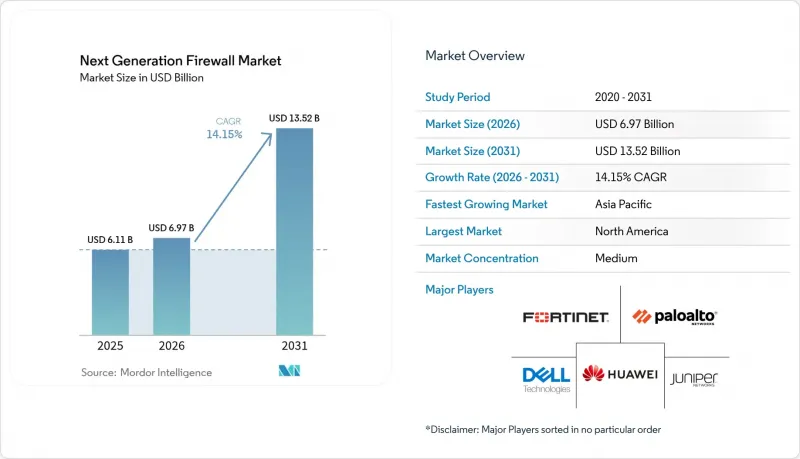
Mordor Intelligence에 의하면, 2026년 차세대 방화벽 시장 규모는 69억 7,000만 달러로 추정되며, 2025년 61억 1,000만 달러에서 2031년에는 135억 2,000만 달러에 달할 것으로 예측됩니다.
또한 2026-2031년 연평균 성장률(CAGR)은 14.15%를 기록할 것으로 전망됩니다.
본 보고서는 기업 규모(중소기업 및 대기업), 솔루션 유형(하드웨어 어플라이언스 및 가상/클라우드 기반), 도입 형태(On-Premise, 퍼블릭 클라우드 등), 최종 사용자 산업(은행 및 금융 서비스·보험(BFSI), 정보 기술(IT)·통신 등), 그리고 지역별로 분류되어 있습니다. 시장 전망은 금액(달러) 기준으로 제시되어 있습니다.
세계 차세대 방화벽 시장 동향 및 인사이트
클라우드 전환이 가속화됨에 따라 L7을 지원하는 인라인형 보안 솔루션에 대한 수요가 증가하고 있습니다.
현재 기업 워크로드의 68%가 퍼블릭, 프라이빗 또는 하이브리드 클라우드에서 실행되고 있으며, 기존 방화벽으로는 검사할 수 없는 이스트-웨스트 트래픽에 노출되어 있습니다. 용도 인식 검사 기능을 갖춘 클라우드 네이티브 NGFW는 경계만 제어하는 방식에 비해 위협의 평균 감지 시간을 63% 단축하고 보안 사고를 47% 감소시킵니다. 마이크로서비스 전반에 걸친 상세한 가시성을 통해 보안 팀은 통합된 정책을 유지할 수 있습니다. 2025년에는 기업의 72%가 클라우드 예산을 증액할 전망이며, NGFW는 분산형 아키텍처의 제어 플레인으로서 확고한 입지를 다지고 있습니다.
하이브리드 근무의 확산이 공격 표면을 확대
하이브리드 근무가 일상화되면서 원격 액세스 엔드포인트가 급증하여, 현재 기기의 42%가 관리 대상에서 제외된 상태입니다. 제로 트러스트 네트워크 액세스를 통합한 NGFW는 모든 연결을 검증하며, SonicWall의 ‘Cloud Secure Edge’ 수주액을 전년 대비 54% 증가시켰습니다. ID 인식형 정책은 인증 정보의 악용을 방지하고, 2023년 이후 37% 증가한 이러한 공격에 대응하는 동시에, 기업 네트워크와 가정 네트워크 사이를 오가는 직원의 보안을 보장하기 위한 수단을 기업에 제공합니다.
자본 집약적인 ASIC 로드맵이 중소기업용 가격 하락을 억제하고 있습니다.
고성능 SSL/TLS 복호화 기능으로 인해 벤더들은 맞춤형 실리콘 채택을 강요받고 있습니다. Fortinet의 SP5 프로세서는 전력 소비를 대폭 줄이면서 방화벽 처리량을 7배 향상시켰지만, 연구 개발비 부담으로 인해 엔트리 레벨 가격은 여전히 높은 수준을 유지하고 있으며, 중소기업의 43%가 비용을 가장 큰 장벽으로 꼽고 있습니다. ASIC은 에너지 효율을 향상시키고 있지만(FortiGate 70G는 경쟁 제품에 비해 Gbps당 62분의 1의 와트만 소모합니다), 예산에 제약이 있는 구매자에게는 초기 비용이 여전히 큰 부담이 되고 있습니다.
부문 분석
대기업은 넉넉한 예산 덕분에 지연 없이 암호화된 트래픽을 검사하는 멀티 기가비트 어플라이언스를 도입할 수 있었기 때문에 2025년 매출의 69.25%를 차지했습니다. 대기업은 중앙 집중식 정책 오케스트레이션과 결합된 어플라이언스상의 ASIC 가속을 계속해서 선호하고 있습니다. 대조적으로, 중소기업은 자본 측면의 장벽을 낮추는 종량제 구독 및 관리형 서비스의 부양에 힘입어 2031년까지 연평균 성장률(CAGR) 16.05%를 나타낼 것으로 예측됩니다. 유연한 라이선싱 체계와 턴키 관리를 통해, 리소스가 제한된 팀도 복잡한 작업을 외부에 위탁하면서 엔터프라이즈급 제어 기능을 활용할 수 있게 됩니다. 그 결과, 차세대 방화벽 시장은 세계 다국적 기업을 위한 타협 없는 처리량과 중소기업을 위한 간소화된 서비스 주도형 솔루션이라는 두 가지 명확한 가치 제안을 실현하고 있습니다.
규제상의 의무도 지출 패턴에 영향을 미치고 있습니다. 대규모 조직은 엄격한 감사 추적을 준수해야 하며, 데이터센터, 지사, 자회사 전반에 걸친 세밀한 제어를 입증해야 합니다. 반면, 중소기업은 ‘도구의 난립’을 피하기 위해 SD-WAN, IPS, 제로 트러스트 액세스를 단일 스택으로 통합한 통합 플랫폼을 선호하는 경향이 있습니다. 사용량 기반 과금 방식의 가상 방화벽 이용 가능성이 확대됨에 따라, 특히 자본 집약도가 우려되는 개발도상국에서 차세대 방화벽 시장은 신규 도입 기업에게도 계속해서 접근하기 쉬운 시장이 될 것으로 예측됩니다.
2025년에도 하드웨어 어플라이언스는 54.35%의 점유율을 유지하고 있으며, 이는 On-Premise 데이터센터에서 보여주는 높은 신뢰성의 성능 특성을 반영한 것입니다. FortiGate 700G와 같은 ASIC을 탑재한 플래그십 모델은 164Gbps의 방화벽 처리량을 실현하며, 전력 효율은 업계 평균의 7배에 달할 전망입니다. 이는 고대역폭을 다루는 사업자들이 결정론적 지연 시간을 확보하기 위해 계속해서 물리적 장치를 선호하는 이유를 여실히 보여줍니다. 반면, 가상 및 클라우드 기반 솔루션의 매출 비중은 탄력적인 워크로드와 ‘인프라스트럭처 애즈 코드(Infrastructure as Code)’의 경제성에 힘입어 연평균 성장률(CAGR) 15.1%로 증가하고 있습니다.
클라우드 호스팅형 NGFW는 여러 테넌트에 걸친 위협을 상호 연관성 분석하는 통합된 AI 분석 기능에 강점을 가지고 있습니다. Versa Networks는 독립적인 보안 테스트에서 99.90%의 점수를 기록하며, 기존 하드웨어 기반 벤더와 동등한 성능을 입증했습니다. 기업들이 툴체인을 간소화함에 따라, 방화벽 기능을 종합적인 SASE 및 SSE 프레임워크에 통합하는 사례가 증가하고 있으며, 가상 제품의 도입률이 높아지고 있습니다. 이 두 가지 추세가 결합된 진화를 통해 차세대 방화벽 시장은 성능이 중요한 데이터센터의 요구 사항과 민첩한 DevOps 파이프라인 모두에 대응할 수 있게 될 것입니다.
지역별 분석
북미는 2025년에 35.60%의 점유율을 유지하며 선두 자리를 지켰습니다. 제로 트러스트 프레임워크의 조기 도입, NIST 가이드라인 등의 규정 준수 요인, 그리고 주요 벤더의 존재가 높은 지출 수준을 뒷받침하고 있습니다. 미국의 금융 서비스 및 의료 기관은 암호화된 트래픽에 대한 상세한 검사 및 마이크로 세분화을 우선시하고 있어, 하이엔드 어플라이언스에 대한 수요를 촉진하고 있습니다. 중요 인프라의 현대화를 도모하는 연방 정부의 프로그램 또한 조달 규모를 더욱 확대시키고 있습니다.
아시아태평양은 2031년까지 연평균 성장률(CAGR) 15.95%를 나타낼 것으로 예측됩니다. 일본, 인도, 싱가포르의 소버린 클라우드 정책과 급성장하는 디지털 서비스 경제가 맞물려 클라우드 네이티브 방어책의 도입이 가속화되고 있습니다. 파로알토 네트웍스가 최근 Prisma Access Browser를 지역 데이터센터로 확장한 것은 거주 요건을 충족하면서도 안전한 원격 액세스를 가능하게 하려는 벤더의 노력을 뒷받침하는 것입니다. 관리형 보안 서비스의 확대는 기술 인력 부족 문제 해결에도 기여하고 있으며, 기업들은 대규모 사내 팀을 보유하지 않고도 엔터프라이즈급 NGFW 기능을 도입할 수 있게 됩니다.
유럽은 GDPR(EU 개인정보보호규정) 및 NIS2 지침이 견고한 트래픽 검사 및 데이터 취급에 관한 안전 대책을 의무화하고 있기 때문에 상당한 규모의 잠재 시장을 형성하고 있습니다. 곧 시행될 EU AI 법은 보안 제품에서의 책임 있는 AI 통합에 새로운 중점을 두고 있어, 벤더가 위협 감지 엔진을 어떻게 포지셔닝할지에 영향을 미치고 있습니다. 에너지, 운송, 금융 시장 인프라 등 중요 인프라 사업자들 수요가 두드러집니다.
중동 및 아프리카에서는 각국의 디지털 전환 전략의 일환으로 5G, 스마트 시티 프로젝트, 전자정부 플랫폼이 전개되며 견조한 성장을 보이고 있습니다. 사우디아라비아와 아랍에미리트(UAE)에서는 사이버 보안에 대한 GDP 배분이 충실하여 경쟁 입찰이 활발해지고 있습니다. 구매자들은 포스트 양자암호화에 대한 대응 및 유연한 이용 모델을 요구하고 있습니다. 규모는 작지만, 이러한 지역들은 차세대 방화벽 시장에 다양성을 더하며, 시스템 통합사업자에게 새로운 판로 기회를 창출하고 있습니다.
기타 혜택:
- 엑셀 형식 시장 예측(ME) 시트
- 3개월간의 애널리스트 지원
목차
제1장 서론
제2장 조사 방법
제3장 주요 요약
제4장 시장 구도
제5장 시장 규모와 성장 예측
제6장 경쟁 구도
제7장 시장 기회와 향후 전망
LSHAccording to Mordor Intelligence, next generation firewall market size in 2026 is estimated at USD 6.97 billion, growing from 2025 value of USD 6.11 billion with 2031 projections showing USD 13.52 billion, growing at 14.15% CAGR over 2026-2031.
This report is Segmented by Enterprise Size (SMEs and Large Enterprises), Solution Type (Hardware Appliance and Virtual / Cloud-Based), Deployment Mode (On-Premises, Public Cloud, and More), End-User Industry (Banking, Financial Services and Insurance (BFSI), Information Technology (IT) and Telecom, and More), and Geography. The Market Forecasts are Provided in Terms of Value (USD).
Global Next Generation Firewall Market Trends and Insights
Accelerated cloud migration demands inline L7-aware security
Sixty-eight percent of enterprise workloads now run in public, private, or hybrid clouds, exposing east-west traffic that legacy firewalls cannot inspect. Cloud-native NGFWs equipped with application-aware inspection shorten average threat detection time by 63% and cut security incidents by 47% compared with perimeter-only controls. Deep visibility across microservices lets security teams retain uniform policies as 72% of enterprises boost cloud budgets in 2025, firmly positioning NGFWs as the control plane for distributed architectures.
Hybrid-work proliferation expanding attack surface
Remote access endpoints grew sharply when hybrid work became permanent, with 42% of devices now unmanaged. NGFWs that embed zero-trust network access validate every connection and have driven a 54% year-on-year booking increase for SonicWall's Cloud Secure Edge. Identity-aware policies prevent credential abuse, addressing the 37% rise in such attacks since 2023, and equip firms to secure staff who move between corporate and home networks.
Capital-intensive ASIC road-map limits SMB-grade price declines
High-performance SSL/TLS decryption drives vendors toward custom silicon. Fortinet's SP5 processor gives 7X higher firewall throughput while consuming far less power, yet the research and development outlay keeps entry-level pricing elevated, with 43% of small businesses citing cost as the chief barrier. Although ASICs improve energy efficiency-FortiGate 70G needs 62X fewer watts per Gbps than rivals-the upfront spend remains daunting for budget-constrained buyers.
Other drivers and restraints analyzed in the detailed report include:
- Mandatory zero-trust architecture roll-outs in regulated sectors
- AI-driven threat intelligence transforms detection capabilities
- Shortage of deep-packet-inspection talent raises service costs
For complete list of drivers and restraints, kindly check the Table Of Contents.
Segment Analysis
Large enterprises contributed 69.25% of 2025 revenue as their sizable budgets allowed deployment of multi-gigabit appliances inspecting encrypted traffic without latency. They continue to favor on-appliance ASIC acceleration paired with centralized policy orchestration. In contrast, SMEs are forecast to post a 16.05% CAGR to 2031, propelled by consumption-based subscriptions and managed services that lower capital hurdles. Flexible licensing and turnkey management let resource-limited teams gain enterprise-grade controls while outsourcing complexity. As a result, the next generation firewall market captures two distinct value propositions: uncompromising throughput for global multinationals and simplified, service-led offerings for smaller firms.
Regulatory obligations also shape spending patterns. Larger organizations confront stringent audit trails and must demonstrate granular control across data centers, branches, and subsidiaries. Smaller companies, meanwhile, gravitate toward consolidated platforms that integrate SD-WAN, IPS, and zero-trust access in a single stack, avoiding "tool sprawl." The widening availability of pay-as-you-go virtual firewalls is expected to keep the next generation firewall market accessible to new adopters, especially across developing economies where capital intensity is a concern.
Hardware appliances retained 54.35% share in 2025, reflecting trusted performance characteristics within on-premises data centers. ASIC-laden flagships such as the FortiGate 700G deliver 164 Gbps firewall throughput at 7X better power efficiency than the industry mean, underscoring why high-bandwidth operators continue to prefer physical devices for deterministic latency. Meanwhile, the portion of revenue from virtual and cloud-based offerings is rising at a 15.1% CAGR, accelerated by elastic workloads and the economics of infrastructure-as-code.
Cloud-hosted NGFWs draw strength from centralized AI analytics that correlate threats across multiple tenants. Versa Networks scored 99.90% in independent security tests, signaling parity with hardware incumbents. As enterprises rationalize toolchains, they increasingly embed firewall functions within holistic SASE or SSE frameworks, boosting attach rates for virtual products. This dual-track evolution ensures the next generation firewall market addresses both performance-bound data-center needs and agile DevOps pipelines.
Complete Report Scope:
- By Enterprise Size
- Small and Medium Enterprises (SMEs)
- Large Enterprises
- By Solution Type
- Hardware Appliance
- Virtual / Cloud-based
- By Deployment Mode
- On-premises
- Public Cloud
- Private / Hybrid Cloud
- By End-User Industry
- Banking, Financial Services and Insurance (BFSI)
- Information Technology (IT) and Telecom
- Government and Defense
- Healthcare
- Manufacturing
- Retail and E-commerce
- Energy and Utilities
- Others
- By Geography
- North America
- United States
- Canada
- Mexico
- South America
- Brazil
- Argentina
- Rest of South America
- Europe
- United Kingdom
- Germany
- France
- Russia
- Rest of Europe
- Asia-Pacific
- China
- Japan
- India
- South Korea
- Australia and New Zealand
- Rest of Asia-Pacific
- Middle East and Africa
- Middle East
- Saudi Arabia
- United Arab Emirates
- Turkey
- Rest of Middle East
- Africa
- South Africa
- Nigeria
- Rest of Africa
- Middle East
- North America
Geography Analysis
North America maintained first place with a 35.60% share in 2025. Early adoption of zero-trust frameworks, compliance drivers such as the NIST guidelines, and the presence of leading vendors sustain high spending depths. Financial services and healthcare institutions in the United States prioritize deep inspection of encrypted traffic and micro-segmentation, reinforcing demand for high-end appliances. Federal programs that modernize critical infrastructure further amplify procurement.
Asia-Pacific is projected to grow at 15.95% CAGR through 2031. Sovereign-cloud policies in Japan, India, and Singapore, together with a surging digital-services economy, accelerate rollouts of cloud-native defenses. Palo Alto Networks' recent expansion of Prisma Access Browser to regional data centers underlines vendor efforts to meet residency rules while enabling secure remote access. The climb in managed security services also addresses skills shortages, allowing enterprises to deploy enterprise-grade NGFW capabilities without large in-house teams.
Europe forms a sizable addressable base as GDPR and the NIS2 Directive require robust traffic inspection and data-handling safeguards. The forthcoming EU AI Act places new emphasis on responsible AI integration within security products, influencing how vendors position threat-detection engines. Demand is notable among critical infrastructure operators in energy, transport, and financial market utilities.
The Middle East and Africa are registering solid growth as national digital-transformation agendas roll out 5G, smart-city projects, and e-government platforms. Robust GDP allocation to cybersecurity in Saudi Arabia and the United Arab Emirates stimulates competitive tenders, with buyers looking for post-quantum cryptography readiness and flexible consumption models. Although starting from a smaller base, these regions add diversity to the next generation firewall market and open channel opportunities for system integrators.
- Palo Alto Networks Inc.
- Fortinet Inc.
- Cisco Systems Inc.
- Check Point Software Technologies Ltd.
- Juniper Networks Inc.
- Huawei Technologies Co. Ltd.
- Dell Technologies (SonicWall)
- SonicWall Inc.
- Barracuda Networks Inc.
- Forcepoint LLC
- WatchGuard Technologies Inc.
- Sophos Ltd.
- Hillstone Networks
- Zscaler Inc.
- Untangle Inc.
- Trend Micro Inc.
- Alibaba Cloud
- F5 Inc.
- VMware Inc.
- Meraki (Cisco)
- GajShield Infotech
- A10 Networks Inc.
Additional Benefits:
- The market estimate (ME) sheet in Excel format
- 3 months of analyst support
TABLE OF CONTENTS
1 INTRODUCTION
- 1.1 Study Assumptions and Market Definition
- 1.2 Scope of the Study
2 RESEARCH METHODOLOGY
3 EXECUTIVE SUMMARY
4 MARKET LANDSCAPE
- 4.1 Market Overview
- 4.2 Market Drivers
- 4.2.1 Accelerated cloud migration demands inline L7-aware security
- 4.2.2 Hybrid-work proliferation expanding attack surface
- 4.2.3 Mandatory zero-trust architecture roll-outs in regulated sectors
- 4.2.4 AI-driven, real-time threat-intel feeds embedded in NGFWs
- 4.2.5 Sovereign-cloud initiatives boosting regional NGFW spend
- 4.3 Market Restraints
- 4.3.1 Capital-intensive ASIC road-map limits SMB-grade price declines
- 4.3.2 Shortage of deep-packet-inspection talent raises service costs
- 4.3.3 Fragmented data-residency laws slowing global SaaS NGFW uptake
- 4.3.4 Open-source eBPF firewalls eroding entry-level revenues
- 4.4 Supply Chain Analysis
- 4.5 Regulatory Landscape
- 4.6 Technological Outlook
- 4.7 Porter's Five Forces
- 4.7.1 Threat of New Entrants
- 4.7.2 Bargaining Power of Buyers
- 4.7.3 Bargaining Power of Suppliers
- 4.7.4 Threat of Substitutes
- 4.7.5 Intensity of Competitive Rivalry
5 MARKET SIZE AND GROWTH FORECASTS (VALUE)
- 5.1 By Enterprise Size
- 5.1.1 Small and Medium Enterprises (SMEs)
- 5.1.2 Large Enterprises
- 5.2 By Solution Type
- 5.2.1 Hardware Appliance
- 5.2.2 Virtual / Cloud-based
- 5.3 By Deployment Mode
- 5.3.1 On-premises
- 5.3.2 Public Cloud
- 5.3.3 Private / Hybrid Cloud
- 5.4 By End-User Industry
- 5.4.1 Banking, Financial Services and Insurance (BFSI)
- 5.4.2 Information Technology (IT) and Telecom
- 5.4.3 Government and Defense
- 5.4.4 Healthcare
- 5.4.5 Manufacturing
- 5.4.6 Retail and E-commerce
- 5.4.7 Energy and Utilities
- 5.4.8 Others
- 5.5 By Geography
- 5.5.1 North America
- 5.5.1.1 United States
- 5.5.1.2 Canada
- 5.5.1.3 Mexico
- 5.5.2 South America
- 5.5.2.1 Brazil
- 5.5.2.2 Argentina
- 5.5.2.3 Rest of South America
- 5.5.3 Europe
- 5.5.3.1 United Kingdom
- 5.5.3.2 Germany
- 5.5.3.3 France
- 5.5.3.4 Russia
- 5.5.3.5 Rest of Europe
- 5.5.4 Asia-Pacific
- 5.5.4.1 China
- 5.5.4.2 Japan
- 5.5.4.3 India
- 5.5.4.4 South Korea
- 5.5.4.5 Australia and New Zealand
- 5.5.4.6 Rest of Asia-Pacific
- 5.5.5 Middle East and Africa
- 5.5.5.1 Middle East
- 5.5.5.1.1 Saudi Arabia
- 5.5.5.1.2 United Arab Emirates
- 5.5.5.1.3 Turkey
- 5.5.5.1.4 Rest of Middle East
- 5.5.5.2 Africa
- 5.5.5.2.1 South Africa
- 5.5.5.2.2 Nigeria
- 5.5.5.2.3 Rest of Africa
- 5.5.5.1 Middle East
- 5.5.1 North America
6 COMPETITIVE LANDSCAPE
- 6.1 Market Concentration
- 6.2 Strategic Moves
- 6.3 Market Share Analysis
- 6.4 Company Profiles (includes Global-level Overview, Market-level Overview, Core Segments, Financials as available, Strategic Information, Market Rank/Share, Products and Services, Recent Developments)
- 6.4.1 Palo Alto Networks Inc.
- 6.4.2 Fortinet Inc.
- 6.4.3 Cisco Systems Inc.
- 6.4.4 Check Point Software Technologies Ltd.
- 6.4.5 Juniper Networks Inc.
- 6.4.6 Huawei Technologies Co. Ltd.
- 6.4.7 Dell Technologies (SonicWall)
- 6.4.8 SonicWall Inc.
- 6.4.9 Barracuda Networks Inc.
- 6.4.10 Forcepoint LLC
- 6.4.11 WatchGuard Technologies Inc.
- 6.4.12 Sophos Ltd.
- 6.4.13 Hillstone Networks
- 6.4.14 Zscaler Inc.
- 6.4.15 Untangle Inc.
- 6.4.16 Trend Micro Inc.
- 6.4.17 Alibaba Cloud
- 6.4.18 F5 Inc.
- 6.4.19 VMware Inc.
- 6.4.20 Meraki (Cisco)
- 6.4.21 GajShield Infotech
- 6.4.22 A10 Networks Inc.
7 MARKET OPPORTUNITIES AND FUTURE OUTLOOK
- 7.1 White-space and Unmet Need Analysis