

|
시장보고서
상품코드
2122559
접착 라벨 : 시장 점유율 분석, 업계 동향과 통계, 성장 예측(2026-2031년)Self-adhesive Labels - Market Share Analysis, Industry Trends & Statistics, Growth Forecasts (2026 - 2031) |
||||||
 Mordor Intelligence
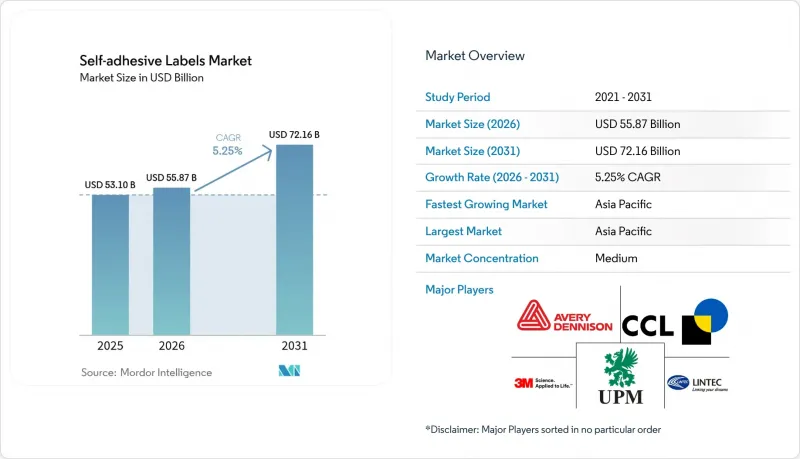
Mordor Intelligence에 의하면, 점착 라벨 시장 규모는 2025년 531억 달러, 2026년 558억 7,000만 달러에서 2031년까지 721억 6,000만 달러로 성장할 것으로 예측되며, 2026-2031년 연평균 복합 성장률(CAGR)은 5.25%를 기록할 전망입니다.
본 보고서는 접착제 유형(핫멜트, 에멀젼 아크릴, 용제계),기재(종이 및 플라스틱(폴리프로필렌, 폴리에스터, 비닐, 기타 플라스틱)), 최종 사용자 산업(식품 및 음료, 의약품, 물류 및 운송, 퍼스널케어 등), 지역(아시아태평양, 북미 등)별로 분류되어 있습니다. 시장 전망은 금액(달러) 기준으로 제시되어 있습니다.
세계 접착 라벨 시장 동향 및 인사이트
전자상거래 소포 처리량의 급증으로 물류 라벨 수요 견인
2024년부터 2025년에 걸쳐 국경을 넘는 소포 유통량이 급증했으며, 현재는 그 일부가 미리 반송용 라벨이 인쇄된 상태로 창고에서 출고되고 있습니다. 감압성 라벨 구조에는 QR 코드나 통관 신고서 등의 가변 데이터 인쇄 기능이 통합되어 있어, 분당 100m를 초과하는 디지털 인쇄기의 속도로 인쇄가 가능하며, 도시 지역의 마이크로 풀필먼트 센터에서 2시간마다 이루어지는 발송 주기에 대응하고 있습니다. 폴리에스테르 기판에 내장된 시간·온도 표시기는 신선 식품의 콜드체인 위반을 기록하며, 한편 IATA 규정에 따라 국제 소포의 약 5분의 1에 리튬 배터리 위험물 표시가 의무화되어 있습니다. 이러한 기능적 요구 사항이 결합되면서, 자체 접착 라벨 시장과 기존의 습식 접착제를 사용한 대체 제품 간의 성능 격차가 확대되고 있습니다.
신흥 아시아 지역의 포장 식품 및 음료 생산 확대
2025년, 중국의 즉석 식품 부문은 눈부신 성장을 이루었고, 이에 따라 각 컨버터 기업들은 120°C에서도 박리되지 않고 접착 강도를 유지하는 전자레인지용 핫멜트 라벨의 인증 취득을 서둘러야 했습니다. 같은 해, 인도의 조직화된 소매망이 확대되면서 SKU 재고를 줄이고 인도 전역으로의 확장을 가속화하는 집중적인 라벨 조달이 가능해졌습니다. 아세안(ASEAN)의 규제 조화로 인해 라벨 승인 주기가 4개월로 단축되었으며, 인도네시아와 베트남 전역에서 감압 접착제 라벨의 채택이 촉진되었습니다. 이러한 변화들이 맞물려 접착 라벨 시장에 추가적인 수요를 창출하고 있습니다.
접착제 및 원지 오염으로 인한 재활용 과제
유럽에서는 매년 PET 및 HDPE 재분쇄 재료가 접착제 잔류물로 인한 오염 문제에 직면하고 있습니다. 이러한 오염으로 인해 펠릿의 투명도가 저하되어 재판매 가치가 떨어지게 됩니다. 2028년까지 PPWR(플라스틱 폐기물 감축 규정)에 따라 워시오프 라벨이 의무화됨에 따라, 공급업체들은 친수성 택 섬유를 사용하여 핫멜트 접착제를 조정할 수밖에 없게 됩니다. 또한, 이들 공급업체는 6개월간의 전환 시험을 통과해야 하며, 그 결과 재료비 증가로 이어집니다. 북미에서는 EPR(생산자 책임 확대) 제도에 따라 재활용이 불가능한 포장재에 부과금이 부과되고 있어, 이러한 추가 비용을 흡수하는 데 어려움을 겪고 있는 변환업체에 대한 압박이 커지고 있습니다. Recyclass 인증은 규정 준수를 위한 길을 제시하고 있지만, 신청 건수 중 A 등급을 획득한 경우는 극히 일부에 그치고 있어, 이에 기술적인 과제가 있음을 여실히 드러내고 있습니다.
부문 분석
핫멜트 배합은 가장 빠르게 성장하는 접착제 카테고리이며, 컨버터들이 순간적으로 경화되고 에너지 사용량을 4분의 1로 줄이는 고속 라인을 표준화해 감에 따라 2031년까지 연평균 성장률(CAGR) 6.14%로 확대될 것으로 전망됩니다. 대조적으로, 에멀젼 아크릴은 수성 화학 성분으로 인해 전 세계 식품 접촉 규제를 쉽게 충족할 수 있으며, 2025년에는 자체 접착 라벨 시장 점유율의 44.14%를 차지했습니다. 특히 핫멜트 시스템과 밀접하게 관련된 자가 접착 라벨 시장은 2031년까지 성장이 가속화될 것으로 예측됩니다. 이러한 급성장은 SIS 폴리머의 개량에 기인하며, 이를 통해 전자레인지 사용이 가능한 식품에 필수적인 내열성이 실현되었습니다. 한편, 용제계 제품은 이물질 규제의 상한선으로 인해 과제에 직면해 있습니다. 더 비싼 지방족 이소시아네이트로의 전환이 진행되고 있음에도 불구하고, 공급업체들은 규제 강화라는 어려운 상황에 직면해 있습니다.
현재 진행 중인 연구 개발에서는 폴리올레핀에 적합한 핫멜트에 초점을 맞추었습니다. 이러한 혁신적인 제품들은 프라이머를 사용하지 않고도 표면 에너지가 낮은 플라스틱에 매끄럽게 접착됩니다. 이 방향에서 주목할 만한 진전으로, 2025년에 새로운 제품군이 도입되었습니다. 이러한 화학적 진보를 보완하듯, 각 장비 제조업체들은 인라인 UV 바니시 도포 기능을 통합하고 있습니다. 이러한 혁신을 통해 인쇄 후 후가공 공정이 불필요해질 뿐만 아니라, 전환 시간도 불과 몇 분으로 단축됩니다. 이러한 일관된 전략을 통해 핫멜트는 물류 및 내구 소비재용 라벨 분야에서 최적의 선택지로서의 입지를 공고히 하고 있으며, 더 광범위한 접착 라벨 시장 동향에 더욱 큰 영향을 미치고 있습니다.
지역별 분석
아시아태평양은 2025년 전 세계 매출의 35.80%를 차지하며, 연평균 성장률(CAGR) 6.09%로 가장 빠른 성장세를 보이고 있습니다. 중국에서는 전자레인지용 식품의 급증으로 인해 고온 재가열을 견딜 수 있도록 설계된 SIS 핫멜트 라벨 수요가 주도되고 있습니다. 한편, 인도의 소매업 확장에 따라 각 브랜드는 중앙 집중식 감압 접착 라벨 생산 라인으로의 전환을 추진하고 있으며, 지역별 SKU 중복을 효과적으로 줄이고 있습니다. 일본의 엄격한 의약품 추적 및トレ?サビリティ 규제는 PET 일련번호 라벨 수요를 뒷받침하고 있습니다. 한국에서는 화장품 수출 증가가 홀로그래픽 페이스스톡의 채택을 촉진하고 있습니다. 또한, 동남아시아 전역에 걸친 콜드체인 물류에 대한 투자로 인해 라벨의 보급이 주요 도시를 넘어 확산되면서, 접착 라벨 시장의 지속적인 수량 성장을 뒷받침하고 있습니다.
유럽 및 북미에서는 단순한 수량보다 재활용 가능성이 더 중요시되고 있습니다. PPWR(플라스틱 포장 재활용 지침)에 따라 PET 병에는 워시오프 라벨의 사용이 의무화되었습니다. 이러한 변화로 인해 핫멜트 접착제의 배합 변경 주기가 빈번해져 비용 상승을 초래하고 있습니다. 또한, 미국의 일부 주에서는 재활용이 불가능한 포장재에 대한 EPR(생산자 책임) 요금이 도입되어, 친수성 접착제를 조기에 도입한 기업들에게 경쟁 우위를 제공합니다. 국경을 넘는 소포의 급증으로 물류용 라벨 출하량이 증가하고 있지만, 주로 소비재(FMCG) 부문의 포화 상태로 인해 미국의 절대적인 톤수는 아시아에 뒤처지고 있습니다.
남미, 중동 및 아프리카는 매출 기여도는 낮지만, 현저한 성장 가속화가 나타나고 있습니다. 브라질에서는 포장 식품 업계의 재편이 진행 중이며, 관세상의 과제가 있음에도 불구하고 수입된 감압성 소재로의 전환이 진행되고 있습니다. 아르헨티나에서는 거시경제의 안정화로 인해 음료용 라벨 생산 라인의 업그레이드가 활성화되어 전환 시간이 대폭 단축되고 있습니다. 사우디아라비아에서는 국내 의약품 제조의 현지화가 진행됨에 따라 SFDA 규정을 준수하는 일련번호 라벨 수요가 그에 상응하여 급증하고 있습니다. 남아프리카의 와인 수출업체들은 시장 접근성을 유지하기 위해 현재 EU 규격에 부합하는 워시오프 라벨을 채택하고 있습니다. 그러나 특히 냉장 운송과 관련된 인프라상의 과제가 여전히 시장에서 접착 라벨의 더 광범위한 보급을 저해하고 있습니다.
기타 혜택:
- 엑셀 형식 시장 예측(ME) 시트
- 3개월간의 애널리스트 지원
자주 묻는 질문
목차
제1장 서론
제2장 조사 방법
제3장 주요 요약
제4장 시장 구도
제5장 시장 규모와 성장 예측
제6장 경쟁 구도
제7장 시장 기회와 향후 전망
LSH 26.09.03According to Mordor Intelligence, the self-adhesive labels market size is projected to expand from USD 53.10 billion in 2025 and USD 55.87 billion in 2026 to USD 72.16 billion by 2031, registering a CAGR of 5.25% between 2026 to 2031.
This report is Segmented by Adhesive Type (Hot-Melt, Emulsion-Acrylic, and Solvent Based), Face Material (Paper and Plastic [Polypropylene, Polyester, Vinyl, and Other Plastics]), End-User Industry (Food and Beverage, Pharmaceutical, Logistics and Transport, Personal Care, and More), and Geography (Asia-Pacific, North America, and More). The Market Forecasts are Provided in Terms of Value (USD).
Global Self-adhesive Labels Market Trends and Insights
E-Commerce Parcel Volume Surge Fueling Logistics Label Demand
Cross-border parcel flows jumped during 2024-2025, and some of those shipments now leave warehouses with pre-printed return labels. Pressure-sensitive constructions integrate variable-data printing for QR codes and customs declarations at digital-press speeds above 100 m/min, matching the two-hour dispatch cycles of urban micro-fulfillment centers. Time-temperature indicators built into polyester facestocks document cold-chain breaches on perishables, while IATA regulations obligate lithium-battery hazard markings on almost one-fifth of international parcels. Together, these functional requirements are widening the performance gap between the self-adhesive labels market and traditional wet-glue alternatives.
Expansion of Packaged Food and Beverage Production in Emerging Asia
In 2025, China's ready-to-eat meal category experienced significant growth, pushing converters to certify microwave-safe hot-melt labels that retain bond strength at 120 °C without delamination. India's organized retail footprint expanded in the same year, enabling centralized label procurement that trims SKU inventory and accelerates pan-India rollout. ASEAN harmonization reduced label-approval cycles to four months, lifting adoption of pressure-sensitive formats across Indonesia and Vietnam. Collectively, these shifts inject additional volume into the self-adhesive labels market.
Recycling Challenges From Adhesive and Facestock Contamination
Each year, the PET and HDPE regrind in Europe face contamination from adhesive residue. This contamination reduces pellet clarity and lowers resale values. By 2028, PPWR will require wash-off labels, pushing suppliers to adjust their hot-melts with hydrophilic tackifiers. These suppliers will also need to pass a six-month migration test, resulting in an increase in material costs. In North America, EPR schemes levy fees on non-recyclable packaging, intensifying pressure on converters who struggle to absorb these added costs. While Recyclass certification provides a pathway to compliance, only a small percentage of submissions secured an A rating, highlighting the technical challenges involved.
Other drivers and restraints analyzed in the detailed report include:
- Converter Shift to High-Speed Automated Hot-Melt Lines
- Regulatory Preference for Solvent-Free Adhesives in Consumer Packaging
- Competitive Threat From Linerless Label Technologies
For complete list of drivers and restraints, kindly check the Table Of Contents.
Segment Analysis
Hot-melt formulations represent the fastest-growing adhesive class, advancing at 6.14% CAGR through 2031 as converters standardize on high-speed lines that cure instantly and cut energy use by one-quarter. In contrast, emulsion-acrylic held 44.14% of the self-adhesive labels market share during 2025 because its waterborne chemistry easily passes global food-contact regulations. The self-adhesive labels market, particularly linked to hot-melt systems, anticipates a boost by 2031. This surge follows SIS polymer upgrades, which have unlocked the coveted heat resistance essential for microwave-ready meals. On the other hand, solvent-based products are facing challenges due to migration caps. Even with a shift to pricier aliphatic isocyanates, suppliers grapple with a tightening regulatory window.
Ongoing research and development is honing in on polyolefin-friendly hot-melts. These innovations bond seamlessly to low-surface-energy plastics without the need for primers. A notable stride in this direction was the introduction of a new portfolio in 2025. Complementing these chemical advancements, equipment manufacturers are integrating inline UV varnishing. This innovation not only eliminates the need for post-press handling but also reduces changeover times to mere minutes. Such a cohesive strategy solidifies hot-melt's position as the preferred choice for logistics and consumer-durable labels, further influencing the dynamics of the broader self-adhesive labels market.
Complete Report Scope:
- By Adhesive Types
- Hot-Melt
- Emulsion-Acrylic
- Solvent Based
- By Face Material
- Paper
- Plastic
- Polypropylene
- Polyester
- Vinyl
- Other Plastics
- By End-user Industry
- Food and Beverage
- Pharmaceutical
- Logistics and Transport
- Personal Care
- Consumer Durables
- Other End-user Industries
- By Geography
- Asia-Pacific
- China
- India
- Japan
- South Korea
- Rest of Asia-Pacific
- North America
- United States
- Canada
- Mexico
- Europe
- Germany
- United Kingdom
- Italy
- France
- Rest of Europe
- South America
- Brazil
- Argentina
- Rest of South America
- Middle-East and Africa
- Saudi Arabia
- South Africa
- Rest of Middle-East and Africa
- Asia-Pacific
Geography Analysis
Asia-Pacific generated 35.80% of 2025 global revenue and is growing fastest at a 6.09% CAGR. In China, the surge in microwave meals drives the demand for SIS hot-melt labels, engineered to withstand reheating at high temperatures. Meanwhile, India's retail expansion is steering brands towards centralized pressure-sensitive lines, effectively reducing regional SKU duplication. Japan's rigorous pharmaceutical track-and-trace regulations bolster the demand for PET serialization labels. In South Korea, an uptick in cosmetics exports is propelling the adoption of holographic facestock. Furthermore, investments in cold-chain logistics across Southeast Asia are broadening label penetration beyond tier-1 cities, fueling sustained volume growth in the self-adhesive labels market.
In Europe and North America, the emphasis is on recyclability over sheer volume. The PPWR mandates that PET bottles must utilize wash-off labels. This shift is prompting more frequent hot-melt reformulation cycles and pushing up costs. Additionally, several states in the U.S. have introduced EPR fees on non-recyclable packaging, creating a competitive edge for early adopters of hydrophilic adhesives. While a surge in cross-border parcels buoys logistics label volumes, the absolute tonnage in the U.S. lags behind Asia, primarily due to saturation in the fast-moving consumer goods sector.
South America and the Middle-East, and Africa, though contributing less to revenues, are witnessing notable accelerations. In Brazil, a consolidation in packaged foods is leaning towards imported pressure-sensitive materials, even with tariff challenges. Argentina's macro-stabilization has revitalized beverage label line upgrades, slashing changeover times significantly. In Saudi Arabia, as the nation localizes its drug manufacturing, there's a corresponding spike in demand for serialized labels, in line with SFDA regulations. South African wine exporters, aiming to maintain market access, are now using EU-compliant wash-off labels. However, infrastructure challenges, especially in refrigerated transport, continue to hinder the broader adoption of self-adhesive labels in the market.
- 3M
- Asteria Group
- Avery Dennison Corporation
- CCL Industries
- Fuji Seal International, Inc.
- H.B. Fuller Company
- HERMA GmbH
- Lecta Adestor
- LINTEC Corporation
- Mondi
- Optimum Group
- Symbio Inc.
- UPM Global
Additional Benefits:
- The market estimate (ME) sheet in Excel format
- 3 months of analyst support
TABLE OF CONTENTS
1 Introduction
- 1.1 Study Assumptions and Market Definition
- 1.2 Scope of the Study
2 Research Methodology
3 Executive Summary
4 Market Landscape
- 4.1 Market Overview
- 4.2 Market Drivers
- 4.2.1 E-commerce parcel volume surge fueling logistics label demand
- 4.2.2 Expansion of packaged food and beverage production in emerging Asia
- 4.2.3 Converter shift to high-speed automated hot-melt labeling lines
- 4.2.4 Regulatory preference for solvent-free adhesives in consumer packaging
- 4.2.5 Rapid uptake of microwave-safe hot-melt labels for ready-meal trays
- 4.3 Market Restraints
- 4.3.1 Recycling challenges from adhesive and facestock contamination
- 4.3.2 Competitive threat from linerless label technologies
- 4.3.3 Oxidative discoloration of rubber-based hot-melt labels in premium cosmetics
- 4.4 Value Chain Analysis
- 4.5 Porter's Five Forces
- 4.5.1 Bargaining Power of Suppliers
- 4.5.2 Bargaining Power of Buyers
- 4.5.3 Threat of New Entrants
- 4.5.4 Threat of Substitutes
- 4.5.5 Degree of Competition
5 Market Size and Growth Forecasts (Value)
- 5.1 By Adhesive Types
- 5.1.1 Hot-Melt
- 5.1.2 Emulsion-Acrylic
- 5.1.3 Solvent Based
- 5.2 By Face Material
- 5.2.1 Paper
- 5.2.2 Plastic
- 5.2.2.1 Polypropylene
- 5.2.2.2 Polyester
- 5.2.2.3 Vinyl
- 5.2.2.4 Other Plastics
- 5.3 By End-user Industry
- 5.3.1 Food and Beverage
- 5.3.2 Pharmaceutical
- 5.3.3 Logistics and Transport
- 5.3.4 Personal Care
- 5.3.5 Consumer Durables
- 5.3.6 Other End-user Industries
- 5.4 By Geography
- 5.4.1 Asia-Pacific
- 5.4.1.1 China
- 5.4.1.2 India
- 5.4.1.3 Japan
- 5.4.1.4 South Korea
- 5.4.1.5 Rest of Asia-Pacific
- 5.4.2 North America
- 5.4.2.1 United States
- 5.4.2.2 Canada
- 5.4.2.3 Mexico
- 5.4.3 Europe
- 5.4.3.1 Germany
- 5.4.3.2 United Kingdom
- 5.4.3.3 Italy
- 5.4.3.4 France
- 5.4.3.5 Rest of Europe
- 5.4.4 South America
- 5.4.4.1 Brazil
- 5.4.4.2 Argentina
- 5.4.4.3 Rest of South America
- 5.4.5 Middle-East and Africa
- 5.4.5.1 Saudi Arabia
- 5.4.5.2 South Africa
- 5.4.5.3 Rest of Middle-East and Africa
- 5.4.1 Asia-Pacific
6 Competitive Landscape
- 6.1 Market Concentration
- 6.2 Strategic Moves
- 6.3 Market Share/Ranking Analysis
- 6.4 Company Profiles {(includes Global level Overview, Market level overview, Core Segments, Financials as available, Strategic Information, Products and Services, and Recent Developments)}
- 6.4.1 3M
- 6.4.2 Asteria Group
- 6.4.3 Avery Dennison Corporation
- 6.4.4 CCL Industries
- 6.4.5 Fuji Seal International, Inc.
- 6.4.6 H.B. Fuller Company
- 6.4.7 HERMA GmbH
- 6.4.8 Lecta Adestor
- 6.4.9 LINTEC Corporation
- 6.4.10 Mondi
- 6.4.11 Optimum Group
- 6.4.12 Symbio Inc.
- 6.4.13 UPM Global
7 Market Opportunities and Future Outlook
- 7.1 White-space and Unmet-need Assessment


