

|
시장보고서
상품코드
2122584
인간 재조합 인슐린 : 시장 점유율 분석, 업계 동향과 통계, 성장 예측(2026-2031년)Human Recombinant Insulin - Market Share Analysis, Industry Trends & Statistics, Growth Forecasts (2026 - 2031) |
||||||
 Mordor Intelligence
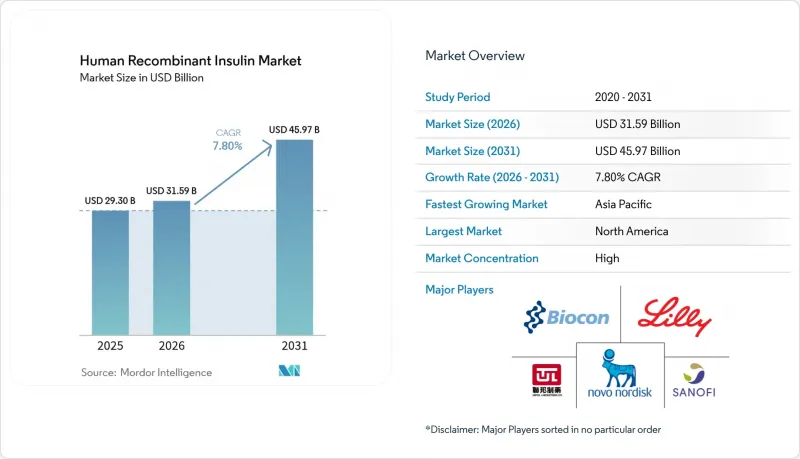
Mordor Intelligence에 의하면, 2026년 인간 재조합 인슐린 시장 규모는 315억 9,000만 달러로 추정되며, 2025년 293억 달러에서 2031년에는 459억 7,000만 달러에 달할 것으로 예측됩니다.
또한 2026-2031년 연평균 성장률(CAGR) 7.80%를 기록할 전망입니다.
본 보고서는 약제 유형(속효성 인슐린 등), 브랜드(휴마린 등), 투여 기기(바이알·주사기, 인슐린 펜(재사용 가능·일회용) 등), 당뇨병 유형(1형 당뇨병·2형 당뇨병), 최종 사용자(병원 및 진료소 등), 지역(북미 등)을 기준으로 분석합니다. 시장 예측은 금액(달러) 기준으로 제시됩니다.
전 세계 재조합 인슐린 시장 동향 및 인사이트
전 세계 당뇨병 유병률 증가
당뇨병 환자 수는 8억 명을 넘어 의료 시스템의 수용 능력을 근본적으로 압박하고 있으며, 인슐린에 대한 장기적인 수요를 확고히 하고 있습니다. 2형 당뇨병 유병률은 앉아 있는 생활 습관과 식생활의 변화가 맞물리면서, 도시화가 진행되고 있는 아시아 및 중동의 경제권에서 가장 빠르게 증가하고 있습니다. 치료 순응도가 향상됨에 따라, 인슐린 요법은 일반적으로 질병의 초기 단계에서 시작되기 때문에 사용량도 증가하고 있습니다. 인슐린은 평생에 걸쳐 사용될 것으로 예상되므로, 현재 진행 중인 수십억 달러 규모의 공장 투자가 뒷받침되고 있습니다. 이러한 생산 능력 확충은 궁극적으로 공급 안정성을 높이고, 주요 기업들이 확대되는 환자층에 대응할 수 있는 체제를 갖추는 데 기여합니다.
각국의 확대되는 보험 급여 프로그램
합리적인 가격을 실현하기 위한 노력은 처방량 증가로 직결됩니다. 미국에서는 2026년에 메디케어 파트 D의월상한액 35달러가 시행됨에 따라, 수백만 명의 고령자에게 가격이 더 이상 장벽이 되지 않게 될 것입니다. 유럽의 보험사들은 비용 대비 효과 기준을 강화하면서도, 바이오시밀러에 우선 처방 목록의 자리를 부여함으로써 여전히 접근성을 확대되고 있습니다. 2026년 도입이 예정된 인도의 생산 연계형 인센티브 제도는 당뇨병 치료제의 국내 생산을 장려함으로써, 산업 정책과 환자 접근성 향상이라는 목표를 융합하고 있습니다. 이러한 노력들은 종합적으로 치료 대상 인구를 확대하고, 처방 목록 내 브랜드 선택의 역학을 변화시키고 있습니다.
전 세계적인 엄격한 가격 규제
합리적인 가격 확보 의무화는 이익률을 압박하여 연구개발(R&D) 예산 배분 변경을 초래할 가능성이 있습니다. ‘인플레이션 억제법’은 미국 메디케어의 인슐린 가격에 상한선을 설정하여, 2026년 1월부터 ‘트레시바’ 및 ‘피아스파’의 정가를 70% 자발적으로 인하하는 계기가 되었습니다. 유럽에서는 현재 모든 당뇨병 치료제가 비용 대비 효과 벤치마크에 따라 평가되고 있으며, 고가의 아날로그 제제는 예산 관리자의 엄격한 감시 하에 놓여 있습니다. 중국의 수량 기준 조달 제도는 입찰 낙찰자에게 대폭적인 가격 할인을 강요하고 있습니다. 이러한 정책들이 종합적으로 작용함에 따라, 제약사들은 가격 인상이 아닌 생산 효율성 향상이나 제품 포트폴리오 재구성을 통해 비용 절감을 도모해야 하는 상황에 몰리고 있습니다.
부문 분석
프리믹스 인간 인슐린은 눈부신 성장을 이루고 있으며, 1일당 주사 횟수의 감소가 예상에 따라 2026년부터 2031년까지 연평균 성장률(CAGR) 9.22%를 나타낼 것으로 전망됩니다. 단시간 작용형 제제는 2025년 시점에서 여전히 37.88%라는 최대 점유율을 차지하고 있으며, 식사 시 혈당 조절에 중요한 역할을 함으로써 인간 재조합 인슐린 시장의 기반을 지탱하고 있습니다. 중간 작용형 제품은 임상적으로 가치 있는 제품과, 기초 작용 및 볼러스 작용을 하나의 펜에 결합한 새로운 복합 제제에 의한 대체 위험에 직면해 있습니다.
인간 재조합 인슐린 시장은 환자들이 원하는 간편한 투여법에 부응하는 형태로, 기업들이 생리학적 프로파일을 보다 충실하게 재현하는 2상형 비율을 정교화하도록 촉진하고 있습니다. 생산 능력의 배분도 성장에 영향을 미치고 있습니다. 노보노르디스크가 레베밀의 생산 중단을 결정함에 따라, 고부가가치 아날로그 제제를 위한 탱크가 확보되었으며, 기존 부문은 수요 증가만으로는 설명할 수 없는 수준으로 급속히 축소될 가능성이 있음을 시사합니다. 주 1회 투여형 기저 인슐린 후보 약물은 미국에서의 승인이 좌절되어 여전히 불투명한 상황이지만, 중국에서 인슐린 이코덱의 승인은 위험과 이점에 대한 허용도에 지역적 차이가 있음을 보여줍니다.
2025년, 휴마린은 매출의 31.02%를 차지하며, 수십 년에 걸친 처방전 내 확고한 입지를 반영하고 있습니다. 그럼에도 불구하고, 사노피의 인스만은 신흥 시장에서 타겟을 명확히 한 가격 책정과 바이오시밀러 제품 라인 확장에 힘입어 연평균 성장률(CAGR) 9.51%라는 더 빠른 성장 궤도에 올라 있습니다. 노보린은 광범위한 소매 유통망을 활용하고 있지만, 지불 주체층의 마음을 사로잡을 만한 혁신적인 판매 포인트에서는 뒤처지고 있습니다.
특허 만료에 따라 바이오시밀러로부터의 압박은 가속화되고 있습니다. 원개발사는 ‘엄브렐라’ 전략을 채택하고 있습니다. 예를 들어, 일라이 릴리(Eli Lilly)는 브랜드 제품의 SKU에 대한 리베이트 흐름을 보호하면서 시장 점유율 침식을 막기 위해 정가의 절반 가격으로 무브랜드 리스프로(Lispro)를 출시했습니다. 유럽에서는 여러 가지 그라루긴 계열 바이오시밀러가 공존하고 있으며, 선발 제품의 정가는 하락했으나 리베이트 적용 후의 실제 가격은 여전히 불투명하다는 점에서 시장 후반부의 동향을 일찌감치 엿볼 수 있습니다. 이처럼, 인간 재조합 인슐린 시장은 정가의 표면적인 모습과 실제 거래 경제성이 얼마나 괴리되어 있는지를 여실히 보여주고 있습니다.
지역별 분석
북미는 종합적인 보험 적용과 차세대 투여 시스템의 급속한 보급에 힘입어 2025년 매출의 41.98%를 차지하며 1위를 차지하고 있습니다. 2026년에 시행될 메디케어의 35달러 상한선 규정은 인간 재조합 인슐린 시장 수요 지속성을 더욱 공고히할 것입니다. 각 제조업체는 현지 공급 체계를 강화하고 있으며, 노보노르디스크의 노스캐롤라이나 주 거점과 일라이 릴리의 인디애나 주 복합 시설은 합쳐서 700만 제곱피트 이상의 제제 및 충전·마감 능력을 추가할 것입니다.
아시아태평양은 2031년까지 연평균 성장률(CAGR) 8.63%로 가장 높은 성장률을 기록할 전망입니다. 중국은 세계 최대의 당뇨병 환자 수를 보유하고 있으며, 최근에는 우선 의약품에 대한 규제 심사 기간을 단축하고 있습니다. 국내 생산에 대한 우대 조치로 인해 다국적 기업과 국내 기업 모두 공장 건설에 나서면서 비용 경쟁이 격화되고 있습니다. 인도의 우대 조치 프로그램 역시 현지 생산을 촉진하여, 인도를 지역 수출 허브로 자리매김할 가능성이 있으며, 이는 인간 재조합 인슐린 시장의 범위를 더욱 확대시킬 것입니다.
유럽은 성숙해 가면서도 계속 진화하는 환경을 보이고 있습니다. 의료 기술 평가 기관이 상대적인 비용 대비 효과를 면밀히 검토하고 있어 바이오시밀러에는 호재가 되고 있으며, 가격 급등을 억제하고 있습니다. 2024년 EMA(유럽의약품청) 지침 개정에 따라 치료법 선택에 경제적 고려 사항이 반영되어, 임상적 유효성을 훼손하지 않으면서 처방 의사가 더 저렴한 대안을 선택하도록 장려되고 있습니다. 가격·수량 계약은 여전히 일반적이며, 오리지널 제약사의 할인 전략으로 인해 바이오시밀러의 우위성이 일부 제한되고 있습니다.
중동 및 아프리카 및 남미는 합쳐서 규모는 작지만 증가 추세를 보이는 시장 점유율을 차지하고 있습니다. 아프리카에서 최근 시행된 공동 조달 시범 사업을 통해 바이알당 비용을 두 자릿수 수준으로 절감했으나, 그 대가로 공급업체의 이익률은 압박을 받고 있습니다. 현재 콜드체인의 미비로 인해 간헐적인 재고 부족이 발생하고 성장 잠재력이 제한되고 있으므로, 냉장 창고에 대한 인프라 투자가 매우 중요합니다. 이 지역에서의 성공은 안정적인 공급을 확보하기 위한 유연한 유통 모델과 현지 기반의 부가가치 서비스에 달려 있습니다.
기타 혜택:
- 엑셀 형식 시장 예측(ME) 시트
- 3개월간의 애널리스트 지원
자주 묻는 질문
목차
제1장 서론
제2장 조사 방법
제3장 주요 요약
제4장 시장 구도
제5장 시장 규모와 성장 예측
제6장 경쟁 구도
제7장 시장 기회와 향후 전망
LSH 26.09.03According to Mordor Intelligence, the human recombinant insulin market size in 2026 is estimated at USD 31.59 billion, growing from 2025 value of USD 29.30 billion with 2031 projections showing USD 45.97 billion, growing at 7.80% CAGR over 2026-2031.
This report is Segmented by Drug Type (Short-Acting Human Insulin, and More), Brand (Humulin, and More), Delivery Device (Vials & Syringes, Insulin Pens (Reusable & Disposable), and More), Diabetes Type (Type-1 Diabetes and Type-2 Diabetes), End User (Hospitals & Clinics, and More), Geography (North America, and More). The Market Forecasts are Provided in Terms of Value (USD).
Global Human Recombinant Insulin Market Trends and Insights
Rising Global Diabetes Prevalence
Diabetes incidence has surged to more than 800 million patients, fundamentally stretching health-system capacity and cementing long-duration demand for insulin. Type-2 Diabetes prevalence is rising fastest in urbanizing Asian and Middle-Eastern economies where sedentary lifestyles and dietary shifts converge. As treatment adherence improves, unit volumes climb because insulin therapy typically starts earlier in the disease continuum. The predictable lifetime-use nature of insulin supports the multibillion-dollar factory investments now underway. That manufacturing build-out, in turn, strengthens supply security and positions leaders to meet the expanding patient base.
Expanding National Reimbursement Programs
Affordability initiatives directly translate into higher script volumes. In the United States, the Medicare Part D USD 35 monthly cap takes effect in 2026, neutralizing price as a barrier for millions of seniors. European payers are tightening cost-effectiveness thresholds yet still broaden access by giving biosimilars preferred formulary slots. India's production-linked incentive scheme, scheduled for 2026, mixes industrial policy with patient-access goals by rewarding local output of diabetes medicines. These actions collectively enlarge the treated population and change brand-choice dynamics inside formularies.
Stringent Global Price Controls
Affordability mandates compress margins and can redirect R&D budgets. The Inflation Reduction Act capped U.S. Medicare insulin prices and catalyzed a voluntary 70% list-price cut for Tresiba and Fiasp effective January 2026. Europe now assesses all diabetes therapies against cost-effectiveness benchmarks, putting premium analogues under budget-holder scrutiny. China's volume-based procurement scheme forces deep discounts for tender winners. Collectively, these policies push manufacturers to find savings in production efficiency and portfolio mix rather than price increases.
Other drivers and restraints analyzed in the detailed report include:
- Growing Adoption of Biosimilar Insulins
- Localization of Biomanufacturing Facilities
- Supply Chain Vulnerabilities in Cold Storage
For complete list of drivers and restraints, kindly check the Table Of Contents.
Segment Analysis
Premixed Human Insulin is the breakout growth story, tracking a 9.22% CAGR for 2026-2031 on the promise of fewer daily injections. Short-Acting formulations still hold the largest slice at 37.88% in 2025, anchoring the human recombinant insulin market through their critical role in mealtime glucose control. Intermediate-Acting products, although clinically valuable, face substitution risk from newer co-formulations that combine basal and bolus action in a single pen.
The human recombinant insulin market responds to patients' desire for simple regimens, pushing firms to refine biphasic ratios that better mimic physiologic profiles. Capacity allocation also shapes growth: Novo Nordisk's choice to cease Levemir production frees tanks for higher-value analogues, hinting that legacy segments may contract faster than demand alone would dictate. Weekly basal candidates remain in limbo after a U.S. filing setback, yet China's nod to insulin icodec displays regional divergence in benefit-risk tolerance.
Humulin commanded 31.02% revenue in 2025, reflecting decades-deep formulary entrenchment. Still, Sanofi's Insuman is on a faster trajectory with a 9.51% CAGR, buoyed by targeted pricing in emerging markets and expanding biosimilar lines. Novolin leverages wide retail distribution but lags on innovation hooks that resonate with payers.
Biosimilar pressure accelerates as patents sunset. Originators adopt "umbrella" strategies: Eli Lilly released an unbranded lispro at half list price to blunt share erosion while protecting rebate flows on the branded SKU. Europe supplies an early look at end-game dynamics, where multiple glargine biosimilars coexist and originator list prices fell yet net prices, after rebates, remain opaque. The human recombinant insulin market thus illustrates how list-price optics diverge from actual transaction economics.
Complete Report Scope:
- By Drug Type
- Short-Acting Human Insulin
- Intermediate-Acting Human Insulin
- Premixed Human Insulin
- By Brand
- Humulin
- Insuman
- Novolin
- Other Brands
- By Delivery Device
- Vials & Syringes
- Insulin Pens (Reusable & Disposable)
- Insulin Pumps & Patch Pumps
- By Diabetes Type
- Type-1 Diabetes
- Type-2 Diabetes
- By End User
- Hospitals & Clinics
- Homecare / Self-Administration
- Geography
- North America
- United States
- Canada
- Mexico
- Europe
- Germany
- United Kingdom
- France
- Italy
- Spain
- Rest of Europe
- Asia-Pacific
- China
- Japan
- India
- Australia
- South Korea
- Rest of Asia-Pacific
- Middle East & Africa
- GCC
- South Africa
- Rest of Middle East & Africa
- South America
- Brazil
- Argentina
- Rest of South America
- North America
Geography Analysis
North America led with 41.98% of 2025 revenue, fueled by comprehensive insurance coverage and rapid adoption of next-generation delivery systems. The Medicare USD 35 cap, effective 2026, will further secure demand continuity for the human recombinant insulin market. Manufacturers cement local supply: Novo Nordisk's North Carolina site and Eli Lilly's Indiana complex collectively add more than 7 million square feet of formulation and fill-finish capacity.
Asia-Pacific is set to deliver the fastest 8.63% CAGR through 2031. China holds the world's largest diabetic population and has recently accelerated regulatory review timelines for priority drugs. Domestic manufacturing incentives encourage both multinationals and homegrown firms to build plants, tightening cost competition. India's incentive program will similarly foster local output and could position the country as a regional export hub, deepening the human recombinant insulin market reach.
Europe exhibits a mature yet evolving environment. Health Technology Assessment bodies scrutinize relative cost-effectiveness, giving biosimilars a tailwind and restraining price inflation. EMA guideline updates in 2024 integrated economic considerations into therapy selection, nudging prescribers toward lower-priced options without compromising clinical efficacy. Price-volume contracts remain common, with originator discounting strategies keeping some biosimilar advantages in check.
Middle East & Africa and South America together account for a modest but rising slice. Recent pooled procurement pilots in Africa lowered per-vial costs by double digits, albeit straining supplier margins. Infrastructure investments in refrigerated warehousing are pivotal, as cold-chain lapses currently drive intermittent stock-outs that cap growth potential. Success in these regions will depend on adaptable distribution models and localized value-add services that ensure consistent supply.
- Novo Nordisk
- Eli Lilly and Company
- Sanofi
- Biocon Ltd
- Bioton
- Gan & Lee Pharmaceuticals
- Julphar
- Zhuhai United Laboratories
- Tonghua Dongbao Pharmaceutical
- Wockhardt
- Aspen Pharmacare
- Sandoz (Novartis)
- Ypsomed
- Dongfeng Biologics
- Civica Rx
- MannKind
- Adocia
- Biopharmax
- Oramed Pharmaceuticals
- Hanmi Pharm
Additional Benefits:
- The market estimate (ME) sheet in Excel format
- 3 months of analyst support
TABLE OF CONTENTS
1 Introduction
- 1.1 Study Assumptions & Market Definition
- 1.2 Scope of the Study
2 Research Methodology
3 Executive Summary
4 Market Landscape
- 4.1 Market Overview
- 4.2 Market Drivers
- 4.2.1 Rising Global Diabetes Prevalence
- 4.2.2 Expanding National Reimbursement Programs
- 4.2.3 Growing Adoption of Biosimilar Insulins
- 4.2.4 Localization of Biomanufacturing Facilities
- 4.2.5 Technological Advances in Yeast Fermentation Efficiency
- 4.2.6 Strategic Pooled Procurement in Emerging Economies
- 4.3 Market Restraints
- 4.3.1 Stringent Global Price Controls
- 4.3.2 Supply Chain Vulnerabilities in Cold Storage
- 4.3.3 High Entry Barriers Due To Biologics Manufacturing Complexity
- 4.3.4 Persistent Plasmid DNA Production Bottlenecks
- 4.4 Regulatory Landscape
- 4.5 Porter's Five Forces Analysis
- 4.5.1 Bargaining Power Of Buyers/Consumers
- 4.5.2 Bargaining Power Of Suppliers
- 4.5.3 Threat Of New Entrants
- 4.5.4 Threat Of Substitute Products
- 4.5.5 Intensity Of Competitive Rivalry
5 Market Size & Growth Forecasts (Value, USD)
- 5.1 By Drug Type
- 5.1.1 Short-Acting Human Insulin
- 5.1.2 Intermediate-Acting Human Insulin
- 5.1.3 Premixed Human Insulin
- 5.2 By Brand
- 5.2.1 Humulin
- 5.2.2 Insuman
- 5.2.3 Novolin
- 5.2.4 Other Brands
- 5.3 By Delivery Device
- 5.3.1 Vials & Syringes
- 5.3.2 Insulin Pens (Reusable & Disposable)
- 5.3.3 Insulin Pumps & Patch Pumps
- 5.4 By Diabetes Type
- 5.4.1 Type-1 Diabetes
- 5.4.2 Type-2 Diabetes
- 5.5 By End User
- 5.5.1 Hospitals & Clinics
- 5.5.2 Homecare / Self-Administration
- 5.6 Geography
- 5.6.1 North America
- 5.6.1.1 United States
- 5.6.1.2 Canada
- 5.6.1.3 Mexico
- 5.6.2 Europe
- 5.6.2.1 Germany
- 5.6.2.2 United Kingdom
- 5.6.2.3 France
- 5.6.2.4 Italy
- 5.6.2.5 Spain
- 5.6.2.6 Rest of Europe
- 5.6.3 Asia-Pacific
- 5.6.3.1 China
- 5.6.3.2 Japan
- 5.6.3.3 India
- 5.6.3.4 Australia
- 5.6.3.5 South Korea
- 5.6.3.6 Rest of Asia-Pacific
- 5.6.4 Middle East & Africa
- 5.6.4.1 GCC
- 5.6.4.2 South Africa
- 5.6.4.3 Rest of Middle East & Africa
- 5.6.5 South America
- 5.6.5.1 Brazil
- 5.6.5.2 Argentina
- 5.6.5.3 Rest of South America
- 5.6.1 North America
6 Competitive Landscape
- 6.1 Market Concentration
- 6.2 Market Share Analysis
- 6.3 Company Profiles (includes Global level Overview, Market level overview, Core Business Segments, Financials, Headcount, Key Information, Market Rank, Market Share, Products and Services, and analysis of Recent Developments)
- 6.3.1 Novo Nordisk A/S
- 6.3.2 Eli Lilly And Company
- 6.3.3 Sanofi S.A.
- 6.3.4 Biocon Ltd
- 6.3.5 Bioton S.A.
- 6.3.6 Gan & Lee Pharmaceuticals
- 6.3.7 Julphar Gulf Pharmaceutical Industries
- 6.3.8 Zhuhai United Laboratories Co., Ltd.
- 6.3.9 Tonghua Dongbao Pharmaceutical
- 6.3.10 Wockhardt Ltd
- 6.3.11 Aspen Pharmacare
- 6.3.12 Sandoz (Novartis)
- 6.3.13 Ypsomed AG
- 6.3.14 Dongfeng Biologics
- 6.3.15 Civica Rx
- 6.3.16 MannKind Corporation
- 6.3.17 Adocia
- 6.3.18 Biopharmax
- 6.3.19 Oramed Pharmaceuticals
- 6.3.20 Hanmi Pharm
7 Market Opportunities & Future Outlook
- 7.1 White-Space & Unmet-Need Assessment


