

|
시장보고서
상품코드
2122589
전기영동 시약 : 시장 점유율 분석, 업계 동향과 통계, 성장 예측(2026-2031년)Electrophoresis Reagents - Market Share Analysis, Industry Trends & Statistics, Growth Forecasts (2026 - 2031) |
||||||
 Mordor Intelligence
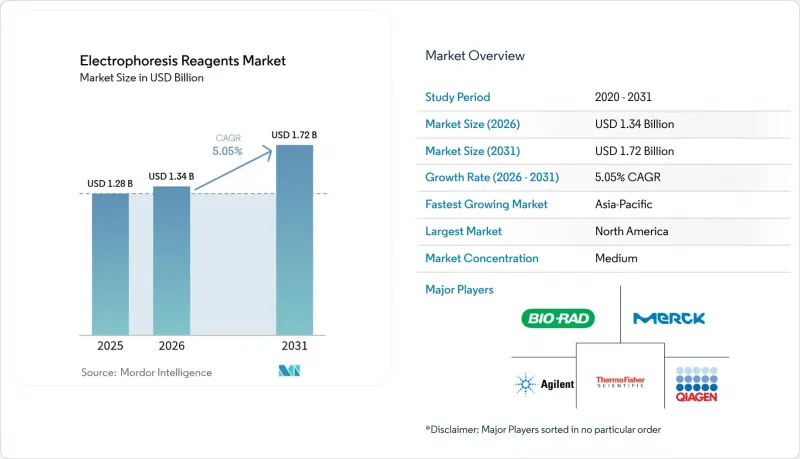
Mordor Intelligence에 의하면, 전기영동 시약 시장 규모는 2025년 12억 8,000만 달러에서 2026년에는 13억 4,000만 달러로 성장하고, 2026-2031년 CAGR 5.05%로 성장을 지속하여 2031년에는 17억 2,000만 달러에 달할 것으로 예측됩니다.
본 보고서는 제품별(젤, 염료, 완충액, 기타 제품), 기법별(젤 전기영동 및 모세관 전기영동), 최종 사용자별(학술·연구 기관, 제약·바이오기술 기업 등),지역별(북미, 유럽, 아시아태평양, 중동 및 아프리카, 남미)로 분류되어 있습니다. 시장 예측은 금액(달러) 기준으로 제시되어 있습니다.
전 세계 전기영동 시약 시장 동향 및 인사이트
유전체·프로테옴 연구에 대한 자금 지원 증가
미국 국립보건원(NIH)은 2024년 ‘건강 및 질병을 위한 멀티오믹스 컨소시엄’에 5,030만 달러를 배정했습니다. 이는 신뢰할 수 있는 바이오마커 검증에 전기영동 시약이 필요한 통합 분석 플랫폼에 대한 지지가 지속되고 있음을 보여줍니다. 공적 자금의 확대에 따라 공급업체들은 단순한 소모품이 아닌, 종합적이고 워크플로우에 적합한 제품군을 제공해야만 하는 상황에 놓였습니다. 제약 기업들이 신약 개발 프로그램을 위해 공공 인프라를 활용하는 가운데, 민간 부문의 공동 투자가 이러한 긍정적 흐름을 더욱 강화하고 있습니다. 현재, 계산 유전체학은 국립인간유전체연구소의 2023 회계연도 예산의 30%를 차지하고 있으며, 데이터 집약적 연구에서 알고리즘 파이프라인을 위해 재현 가능한 정량적 결과를 생성할 수 있는 고처리량 전기영동 시스템이 중시되고 있음을 여실히 보여주고 있습니다. 이러한 자금 조달 모델은 구매를 다년간의 연구 보조금과 연계함으로써, 전기영동 시약 시장 전체 수요 전망을 장기화하고 있습니다.
만성 질환 유병률 증가
세계적인 고령화 추세에 따라 진단의 복잡성이 증가하고 있으며, 질병의 초기 단계에서 미세한 단백질체학 변동을 감지할 수 있는 고분해능 분리 기술이 중요시되고 있습니다. 모세관 전기영동은 치료용 단백질의 전하 변이 분석을 지원하며, 이는 바이오의약품의 규제 당국에 대한 신청에 있어 필수적인 요건입니다. 종양학 분야에서는 순환 종양 DNA의 전기영동 분리를 통해 조직 기반 진단을 대체하는 비침습적인 체액 생검 검사가 가능해지면서 환자 1인당 검사 빈도가 증가하고 있습니다. 선진국 시장의 예방 의료 모델은 일회성 진단 기회를 지속적인 시약 수요로 전환시켜, 역학적 동향을 전기영동 시약 시장의 시약 판매량 증가와 직접적으로 연결하고 있습니다.
시간이 많이 소요되는 워크플로우와 수작업에 의한 겔 조제
폴리아크릴아미드 겔 주조, 시료 로딩, 그리고 전기영동 후 염색에는 최대 8시간이 소요될 수 있으며, 이는 고처리량 환경에서 인건비가 가장 큰 변동비가 되고 있습니다. Bio-Rad사의 ‘Stain-Free’ 겔은 염색 공정을 생략할 수 있지만, 가격이 비싸고 새로운 장비 도입이 필요하기 때문에 예산이 제한된 연구실에서는 도입이 어려워지고 있습니다. 전 세계적으로 숙련된 기술자가 부족함에 따라 워크플로우의 병목 현상이 심화되고 있으며, 조달 팀은 총 소유 비용을 면밀히 검토하여 대체 기술 도입을 고려하고 있습니다.
부문 분석
2025년, 겔은 전기영동 시약 시장의 43.12%를 차지하며, DNA, RNA, 단백질 응용 분야에 걸친 사실상 모든 분리 워크플로우를 뒷받침하고 있습니다. 아가로스는 저비용이며 주조하기 쉽기 때문에 핵산 분석의 표준으로 남아 있지만, 폴리아크릴아미드는 고분해능 단백질 분석을 뒷받침하고 있습니다. 염료의 매출 규모는 작지만, 에티디움 브로마이드 대체제에 대한 규제 움직임이 강화됨에 따라 연평균 성장률(CAGR) 7.74%로 증가할 것으로 예상되며, 이는 전기영동 시약 시장의 구조를 재편하고 있습니다. 각 공급업체들은 처리량을 중시하는 형식을 통해 젤의 차별화를 꾀하고 있습니다. 2024년에 발표된 96웰 폴리아크릴아미드 프로토타입은 수평 전기영동과 전사 호환성을 동시에 실현하고 있어, 향후 다중 시료 대응 제품이 주류가 될 것임을 시사합니다. Tris/Acetate/EDTA 등의 완충액 시스템은 독자적인 개량을 통한 점진적인 이점보다 성능과 비용의 안정성이 우선시되기 때문에 여전히 업계 표준으로 자리 잡고 있습니다. 한편, Biotium사의 ‘One-Step Lumitein’ 시리즈와 같은 새로운 염색 플랫폼에서는 염색 처리가 젤 매트릭스에 직접 통합되어 있어 세척 공정이 불필요해지고, 프로토콜이 단축됩니다. 이는 인력 부족이라는 과제에 대한 직접적인 대응책입니다.
지역별 분석
북미는 2025년 전기영동 시약 시장 매출의 39.78%를 차지할 것으로 예상되며, 그 배경에는 NIH의 꾸준한 자금 지원과 밀집된 제약 제조 거점이 있습니다. 1,540만 달러 규모의 NIH-NSF RNA 연구 프로그램은 거시경제의 변동과 관계없이 시약 소비를 뒷받침하는 공공 자금 메커니즘의 한 예입니다. 서모피셔사가 2029년까지 실시할 20억 달러 규모의 국내 투자는 세액 공제 및 리쇼어링(국내 복귀)에 대한 우대 조치를 염두에 둔, 국내 제조 및 연구개발(R&D) 생산 능력 확대를 위한 공급업체의 노력을 뒷받침하고 있습니다. 유럽은 여전히 성숙한 시장인 동시에 규제가 엄격한 지역이기도 합니다. ‘기업 지속가능성 실사 지침’에 따라 유해 화학 물질의 대체가 가속화되고 있으며, 보다 환경 친화적인 제제에 대한 수요가 증가하고 있습니다. 칼 로스(Karl Ross)사의 재생 용매 및 바이오에탄올로 구성된 ‘SOLVAGREEN’ 시리즈는 유럽공급업체들이 규제 대응 노력에 맞추어 제품 포트폴리오를 조정하고 있음을 보여줍니다.
아시아태평양은 2031년까지 연평균 성장률(CAGR)이 6.32%로 예상되는 가장 빠르게 성장하는 하위 시장입니다. 이는 2021년 이후 벤처 자금 조달이 22% 감소했음에도 불구하고, 정부의 생명과학 관련 예산 증가와 바이오의약품 생산 능력 확대에 힘입은 결과입니다. 중국의 국내 설비에 대한 보조금과 인도의 생산 연계형 인센티브로 인해 설비 투자는 지역 공급업체로 더욱 쏠리고 있지만, 지적 재산권 및 공급망 보안에 대한 우려로 인해 다국적 기업들은 합작 투자나 현지 제조 거점 설립을 모색하고 있습니다. QIAGEN의 리야드 허브 설립 및 사우디아라비아 보건부와의 양해각서 체결은 중동 국가 정부들이 전략적 파트너십을 활용하여 분자진단 생태계를 구축하고 있음을 보여줍니다. 아프리카와 남미는 여전히 기여도가 낮은 상황입니다. 특정 기부자나 정부의 보건 프로그램으로 인해 시약 수요는 안정적인 성장 궤도라기보다는 때때로 급증하는 경향을 보이고 있습니다.
기타 혜택:
- 엑셀 형식 시장 전망(ME) 시트
- 3개월간의 애널리스트 지원
자주 묻는 질문
목차
제1장 서론
제2장 조사 방법
제3장 주요 요약
제4장 시장 구도
제5장 시장 규모와 성장 예측
제6장 경쟁 구도
제7장 시장 기회와 향후 전망
LSH 26.09.03According to Mordor Intelligence, the electrophoresis reagents market size is expected to grow from USD 1.28 billion in 2025 to USD 1.34 billion in 2026 and is forecast to reach USD 1.72 billion by 2031 at 5.05% CAGR over 2026-2031.
This report is Segmented by Product (Gel, Dyes, Buffers, and Other Products), Technique (Gel Electrophoresis and Capillary Electrophoresis), End User (Academic & Research Institutions, Pharmaceutical & Biotechnology Companies, and More), Geography (North America, Europe, Asia-Pacific, The Middle East and Africa, and South America). The Market Forecasts are Provided in Terms of Value (USD).
Global Electrophoresis Reagents Market Trends and Insights
Increasing Funding for Genomic & Proteomic Research
The National Institutes of Health allocated USD 50.3 million in 2024 to its Multi-Omics for Health and Disease Consortium, signaling a sustained preference for integrated analytical platforms that require electrophoresis reagents for reliable biomarker validation. Expanded public funding compels suppliers to offer comprehensive, workflow-compatible product suites instead of stand-alone consumables. Private-sector co-investment magnifies these tailwinds, as pharmaceutical sponsors leverage public infrastructure for drug-discovery programs. Computational genomics now consumes 30% of the National Human Genome Research Institute's FY2023 budget, underscoring how data-intensive research favors high-throughput electrophoresis systems capable of generating reproducible quantitative outputs for algorithmic pipelines. Together, these funding models lengthen demand visibility across the electrophoresis reagents market by anchoring purchases to multiyear research grants.
Rising Prevalence of Chronic Diseases
The global shift toward aging populations elevates diagnostic complexity, favoring high-resolution separation techniques that can detect subtle proteomic variations in early disease states. Capillary electrophoresis supports charge-variant analysis of therapeutic proteins, a critical requirement in regulatory submissions for biopharmaceuticals. In oncology, electrophoretic separation of circulating tumor DNA enables minimally invasive liquid-biopsy assays that replace tissue-based diagnostics, thereby increasing test frequency per patient episode. Preventive-care models in developed markets convert one-off diagnostic events into recurring reagent demand, translating epidemiological trends directly into higher reagent volumes for the electrophoresis reagents market.
Time-consuming workflows & manual gel preparation
Casting polyacrylamide gels, loading samples, and post-run staining can require up to 8 hours, making labor the most significant variable cost in high-throughput environments. Bio-Rad's Stain-Free gels remove the staining step, but premium pricing and new-equipment needs deter adoption in budget-constrained labs. Global shortages of skilled technicians intensify workflow bottlenecks, prompting procurement teams to scrutinize total-cost-of-ownership and consider alternative technologies.
Other drivers and restraints analyzed in the detailed report include:
- Growing adoption of personalized medicine
- Lab-on-a-chip reagent kits for point-of-care molecular testing
- Availability of alternative separation technologies
For complete list of drivers and restraints, kindly check the Table Of Contents.
Segment Analysis
Gels accounted for 43.12% of the electrophoresis reagents market in 2025, underpinning virtually every separation workflow across DNA, RNA, and protein applications. Agarose remains a staple for nucleic-acid analysis thanks to low cost and straightforward casting, whereas polyacrylamide supports high-resolution protein work. Dye sales, though smaller, are set to climb at a 7.74% CAGR as ethidium-bromide replacements gain regulatory traction, reshaping the electrophoresis reagents market. Suppliers are differentiating gels through throughput-oriented formats; a 96-well polyacrylamide prototype published in 2024 demonstrated simultaneous horizontal electrophoresis with transfer compatibility, hinting at future multi-sample mainstream offerings. Buffer systems such as Tris/Acetate/EDTA remain entrenched industry standards because performance and cost stability outweigh incremental gains from proprietary modifications. Concurrently, newer dye platforms like Biotium's One-Step Lumitein series integrate staining directly into gel matrices, removing wash steps and shortening protocols-a direct response to labor-shortage challenges.
Complete Report Scope:
- By Product
- Gels
- Agarose Gels
- Polyacrylamide Gels
- Starch Gels
- Dyes
- Ethidium Bromide (EtBr)
- Bromophenol Blue
- SYBR Dyes
- Other Dyes
- Buffers
- Tris/Acetate/EDTA
- Tris/Borate/EDTA
- Other Buffers
- Other Products
- Gels
- By Technique
- Gel Electrophoresis
- Capillary Electrophoresis
- By End User
- Academic & Research Institutions
- Pharmaceutical & Biotechnology Companies
- Clinical & Diagnostic Laboratories
- Other End Users
- Geography
- North America
- United States
- Canada
- Mexico
- Europe
- Germany
- United Kingdom
- France
- Italy
- Spain
- Rest of Europe
- Asia-Pacific
- China
- Japan
- India
- Australia
- South Korea
- Rest of Asia-Pacific
- Middle East & Africa
- GCC
- South Africa
- Rest of Middle East & Africa
- South America
- Brazil
- Argentina
- Rest of South America
- North America
Geography Analysis
North America generated 39.78% of 2025 revenue for the electrophoresis reagents market, anchored by robust NIH funding and a dense pharmaceutical manufacturing base. The USD 15.4 million NIH-NSF RNA research program exemplifies the public-funding mechanism that sustains reagent consumption irrespective of macroeconomic volatility. Thermo Fisher's USD 2 billion domestic investment through 2029 underscores supplier commitment to on-shore manufacturing and R&D capacity expansion in anticipation of tax credits and reshoring incentives. Europe remains a mature yet regulation-intensive region; the Corporate Sustainability Due Diligence Directive accelerates substitution of hazardous chemicals, driving demand for greener formulations. Carl Roth's SOLVAGREEN line of recycled solvents and bioethanol illustrates how European vendors align portfolios with regulatory commitments.
Asia-Pacific is the fastest-growing sub-market with a 6.32% projected CAGR to 2031, fueled by rising government life-science budgets and expanding biopharmaceutical capacity despite a 22% venture-finance decline since 2021. China's domestic-equipment subsidies and India's production-linked incentives further tilt capital spending toward regional suppliers, though intellectual-property and supply-chain security concerns encourage multinationals to pursue joint ventures or local manufacturing branches. QIAGEN's establishment of a Riyadh hub and its memorandum with the Saudi Ministry of Health reveal how Middle East governments leverage strategic partnerships to build molecular-diagnostics ecosystems. Africa and South America remain smaller contributors; targeted donor and government health programs create episodic reagent spikes rather than smooth growth trajectories.
- Agilent Technologies
- Analytik Jena GmbH
- BioAtlas
- Bio-Rad Laboratories
- Cleaver Scientific Ltd.
- Cytiva
- Greiner Bio-One GmbH
- Helena Laboratories Corp.
- Hoefer Inc. (Harvard Bioscience)
- Labnet International Inc.
- Lonza Group
- Merck KGaA / Sigma-Aldrich
- New England Biolabs
- NIPPON Genetics Co., Ltd.
- PerkinElmer
- Promega
- QIAGEN
- Randox Laboratories
- Sebia
- SERVA Electrophoresis
- Takara Bio
- Thermo Fisher Scientific
Additional Benefits:
- The market estimate (ME) sheet in Excel format
- 3 months of analyst support
TABLE OF CONTENTS
1 Introduction
- 1.1 Study Assumptions & Market Definition
- 1.2 Scope of the Study
2 Research Methodology
3 Executive Summary
4 Market Landscape
- 4.1 Market Overview
- 4.2 Market Drivers
- 4.2.1 Increasing Funding for Genomic & Proteomic Research
- 4.2.2 Rising Prevalence of Chronic Diseases
- 4.2.3 Technological Advances in High-Throughput Electrophoresis
- 4.2.4 Growing Adoption of Personalized Medicine
- 4.2.5 Lab-On-A-Chip Reagent Kits for Point-Of-Care Molecular Testing
- 4.2.6 Shift Toward Greener, Non-Toxic Dyes & Buffers (ESG-Driven)
- 4.3 Market Restraints
- 4.3.1 Time-Consuming Workflows & Manual Gel Preparation
- 4.3.2 Availability of Alternative Separation Technologies
- 4.3.3 Acrylamide Feedstock Shortages Inflating Reagent Costs
- 4.3.4 Strict Disposal Rules for Ethidium-Bromide-Based Stains
- 4.4 Regulatory Landscape
- 4.5 Porter's Five Forces Analysis
- 4.5.1 Threat of New Entrants
- 4.5.2 Bargaining Power of Buyers
- 4.5.3 Bargaining Power of Suppliers
- 4.5.4 Threat of Substitute Products
- 4.5.5 Intensity of Competitive Rivalry
5 Market Size & Growth Forecasts (Value, USD)
- 5.1 By Product
- 5.1.1 Gels
- 5.1.1.1 Agarose Gels
- 5.1.1.2 Polyacrylamide Gels
- 5.1.1.3 Starch Gels
- 5.1.2 Dyes
- 5.1.2.1 Ethidium Bromide (EtBr)
- 5.1.2.2 Bromophenol Blue
- 5.1.2.3 SYBR Dyes
- 5.1.2.4 Other Dyes
- 5.1.3 Buffers
- 5.1.3.1 Tris/Acetate/EDTA
- 5.1.3.2 Tris/Borate/EDTA
- 5.1.3.3 Other Buffers
- 5.1.4 Other Products
- 5.1.1 Gels
- 5.2 By Technique
- 5.2.1 Gel Electrophoresis
- 5.2.2 Capillary Electrophoresis
- 5.3 By End User
- 5.3.1 Academic & Research Institutions
- 5.3.2 Pharmaceutical & Biotechnology Companies
- 5.3.3 Clinical & Diagnostic Laboratories
- 5.3.4 Other End Users
- 5.4 Geography
- 5.4.1 North America
- 5.4.1.1 United States
- 5.4.1.2 Canada
- 5.4.1.3 Mexico
- 5.4.2 Europe
- 5.4.2.1 Germany
- 5.4.2.2 United Kingdom
- 5.4.2.3 France
- 5.4.2.4 Italy
- 5.4.2.5 Spain
- 5.4.2.6 Rest of Europe
- 5.4.3 Asia-Pacific
- 5.4.3.1 China
- 5.4.3.2 Japan
- 5.4.3.3 India
- 5.4.3.4 Australia
- 5.4.3.5 South Korea
- 5.4.3.6 Rest of Asia-Pacific
- 5.4.4 Middle East & Africa
- 5.4.4.1 GCC
- 5.4.4.2 South Africa
- 5.4.4.3 Rest of Middle East & Africa
- 5.4.5 South America
- 5.4.5.1 Brazil
- 5.4.5.2 Argentina
- 5.4.5.3 Rest of South America
- 5.4.1 North America
6 Competitive Landscape
- 6.1 Market Concentration
- 6.2 Market Share Analysis
- 6.3 Company Profiles (includes Global level Overview, Market level overview, Core Business Segments, Financials, Headcount, Key Information, Market Rank, Market Share, Products and Services, and analysis of Recent Developments)
- 6.3.1 Agilent Technologies Inc.
- 6.3.2 Analytik Jena GmbH
- 6.3.3 BioAtlas
- 6.3.4 Bio-Rad Laboratories Inc.
- 6.3.5 Cleaver Scientific Ltd.
- 6.3.6 Cytiva (Danaher)
- 6.3.7 Greiner Bio-One GmbH
- 6.3.8 Helena Laboratories Corp.
- 6.3.9 Hoefer Inc. (Harvard Bioscience)
- 6.3.10 Labnet International Inc.
- 6.3.11 Lonza Group AG
- 6.3.12 Merck KGaA / Sigma-Aldrich
- 6.3.13 New England Biolabs Inc.
- 6.3.14 NIPPON Genetics Co., Ltd.
- 6.3.15 PerkinElmer Inc.
- 6.3.16 Promega Corporation
- 6.3.17 Qiagen N.V.
- 6.3.18 Randox Laboratories Ltd.
- 6.3.19 Sebia Group
- 6.3.20 SERVA Electrophoresis GmbH
- 6.3.21 Takara Bio Inc.
- 6.3.22 Thermo Fisher Scientific Inc.
7 Market Opportunities & Future Outlook
- 7.1 White-space & Unmet-Need Assessment


