|
시장보고서
상품코드
2122593
수익 주기 관리(RCM) : 시장 점유율 분석, 업계 동향과 통계, 성장 예측(2026-2031년)Revenue Cycle Management - Market Share Analysis, Industry Trends & Statistics, Growth Forecasts (2026 - 2031) |
||||||
 Mordor Intelligence
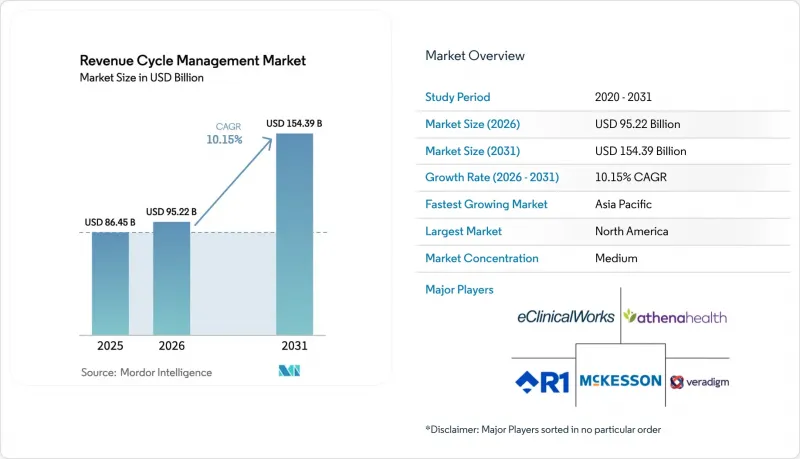
Mordor Intelligence에 의하면, 수익 주기 관리(RCM) 시장 규모는 2025년 864억 5,000만 달러에서 2026년에는 952억 2,000만 달러로 성장하고, 2026-2031년 CAGR 10.15%로 성장을 지속하여 2031년에는 1,543억 9,000만 달러에 달할 것으로 예측됩니다.
본 보고서에서는 구성 요소(소프트웨어(통합 RCM 제품군 등) 및 서비스(RCM BPO 아웃소싱 등)), 도입 형태(클라우드 기반 및 On-Premise형), 기능(청구 및 거절 관리 등), 최종 사용자(병원, 검사 기관 등), 전문 분야(방사선과, 종양학과 등), 지역(북미, 유럽 등)별로 분류되어 있습니다. 시장 예측은 금액(달러) 기준으로 제시되어 있습니다.
세계 수익 주기 관리 시장 동향 및 인사이트
가치 기반 및 성과 연계형 환급으로의 전 세계적 전환
현재 주요 보험사와의 계약에 포함된 가치 기반 의료는 지불을 서비스 양이 아닌 임상 품질과 연계함으로써 수익 주기 관리 업계의 우선순위를 재편하고 있습니다. 책임 의료(Accountable Care) 프레임워크를 채택한 의료 시스템은 총 7억 달러 이상의 비용 절감을 달성했으며, 조직이 품질 지표를 적절히 관리할 경우 재정적 이점을 얻을 수 있음을 입증하고 있습니다. 이에 대응하기 위해 RCM 플랫폼에는 임상 결과를 보상 촉발 요인으로 전환하는 ‘인구 건강 대시보드’가 통합되어, 의료 제공업체가 지급 위험이 표면화되기 전에 치료의 격차를 추적할 수 있게 되었습니다. 이러한 진화는 다양한 출처의 데이터 표준화를 암묵적으로 요구하며, 상호 운용성에 새로운 상업적 시급성을 부여하고 있습니다.
증가하는 관리 비용 압박에 따른 RCM 자동화 추진
관리비는 미국 의료비의 20-25%를 꾸준히 차지하고 있기 때문에 경영진은 자동화를 비용 상승을 막는 검증된 수단으로 간주하고 있습니다. AI가 탑재된 봇은 이전에는 수동 심사와 며칠에 걸친 직원의 후속 조치가 필요했던 일상적인 사전 승인 절차를 불과 몇 초 만에 완료할 수 있게 되었습니다. 도입 후 청구서 작성 시간이 50% 단축되었다고 보고하는 병원도 있습니다. 이러한 개선을 통해 청구 담당자는 복잡한 예외 사례에 집중할 수 있게 되었으며, 경영진이 환자 대응 업무에 인력을 재배치할 수 있는 예상치 못한 생산성 향상이 이루어지고 있습니다. 중요한 점은 입원부터 현금 결제까지의 워크플로우를 자동화한 의료기관에서는 번거롭고 실수가 발생하기 쉬운 데이터 입력 업무가 사라짐에 따라 직원 만족도가 향상되고 있다고 보고되고 있습니다.
다양하고 끊임없이 변화하는 보험사의 규정과 코딩 기준
10-15% 전후로 유지되는 불승인률은 지급 기관의 심사 기준 및 정책 갱신이, 본래는 규정을 준수하는 청구조차 얼마나 신속하게 기각시킬 수 있는지를 보여줍니다. 의료 그룹의 리더는 2024년에 기각률이 더욱 상승했음을 확인했으며, 이에 따라 각 조직은 코드의 지속적인 업데이트와 제출 전에 기각 가능성을 경고하는 예측형 스크루버에 대한 투자를 추진하고 있습니다. 선견지명을 갖춘 의료 시스템은 거절의 근본 원인을 규명하기 위한 전담 팀을 배치하고 있으며, 코더와 임상의 간의 반복적인 피드백 루프를 통해 수정 주기를 단축하고 있습니다. 지급자의 지급 명세서를 통해 자체 학습을 수행하는 AI 기반 규칙 엔진 덕분에 첨부 자료 요청이 측정 가능한 수준으로 감소하여 관리상의 오버헤드가 줄어들고 있습니다.
부문 분석
2025년 수익 주기 관리(RCM) 시장 규모에서 서비스 부문은 77.30%의 시장 점유율을 차지하고 있으며, 이는 인력 부족 속에서 의료 서비스 제공업체들이 턴키 방식의 전문 지식을 선호하는 경향을 반영합니다. 고객은 서비스 파트너가 기술 투자와 지속적인 프로세스 개선에 대한 책임을 지기 때문에 아웃소싱을 회수율 향상을 위한 즉각적인 수단으로 간주하고 있습니다. 그럼에도 불구하고, 클라우드 기반 소프트웨어는 구독형 가격 책정을 통해 비용이 사용량에 비례하게 되고, 막대한 설비 투자라는 장벽이 제거됨에 따라 2031년까지 연평균 성장률(CAGR)이 13.65%로 전체 시장 성장률을 상회하고 있습니다.
클라우드 기반 RCM 제품군을 도입한 병원에서는 의사의 문서화 미비 사항을 실시간으로 시각화하는 대시보드 등 부수적인 이점이 종종 발견되고 있습니다. 이를 통해 한 교대 근무 시간 내에 시정 지도를 실시할 수 있게 됩니다. 시간이 지남에 따라 이러한 분석 기능을 통해 병원 내 팀은 단순 사무 업무에서 수익의 일관성을 확보하는 전략적 역할로 전환하도록 유도됩니다. 이러한 이중 성장 패턴은 자사 내 감독 기능을 유지하면서 선택적으로 아웃소싱을 결합한 하이브리드 운영 모델이 일반화될 것임을 시사하며, 소프트웨어 기업과 서비스 제공업체 모두에게 수익 주기 관리 업계에서의 비즈니스 기회가 확대될 것입니다.
On-Premise 도입은 2025년에도 수익 주기 관리 시장의 57.90% 점유율을 유지하고 있으며, 이는 이전의 설비 투자와 여전히 남아 있는 보안상의 우려를 반영한 것입니다. 그러나 클라우드 도입은 유연한 인프라, 자동 업그레이드, 그리고 지불자 API와의 손쉬운 통합에 힘입어 2031년까지 연평균 성장률(CAGR) 13.65%로 성장할 전망입니다. HFMA의 기술 도입 곡선을 따라 상승하고 있는 조직들은 사이클 타임 지표가 하락세로 돌아서기 시작한 전환점으로 클라우드 전환을 자주 꼽고 있습니다. 확인된 이점 중 하나는 규제 코드 세트의 도입이 가속화된다는 점입니다. 이는 클라우드 공급업체가 고객의 IT 팀에 의존하지 않고 중앙 집중식으로 업데이트를 배포하기 때문입니다.
사이버 보안 프레임워크가 성숙해짐에 따라 오프사이트 호스팅에 대한 이사회 차원의 거부감은 점차 사라지고 있으며, CFO들은 예측 가능한 구독 요금이 다년간의 예산 편성을 간소화한다고 지적하고 있습니다. 이러한 비용 투명성은 수익 주기 관리(RCM) 시장 전체의 규모 확대를 은연중에 뒷받침하는 요인이 되고 있습니다. 과거에는 대규모 대학 부속 병원에만 국한되었던 기능을, 이제는 중규모 병원에서도 이용할 수 있게 되었기 때문입니다.
지역별 분석
북미는 복잡한 다중 지불자(multi-payer) 체계와 EHR(전자 건강 기록) 도입의 오랜 역사를 바탕으로, 현재 수익 주기 관리 시장 규모의 47.20%를 차지하고 있습니다. R1 RCM을 통한 89억 달러 규모의 거래가 보여주듯이, 벤더 간의 통합이 활발해지고 있으며, 이는 규모를 확대한 프로세스 전문 지식이 엄청난 현금 흐름 증가를 가져온다는 사모펀드의 확신을 보여줍니다. 미국 병원의 46%가 수익 사이클 워크플로우에서 이미 어떤 형태로든 AI를 활용하고 있다고 보고하고 있습니다. 흥미롭게도, 캐나다의 단일 지불자 제도에서도 주별 정산 처리를 위해 RCM 도구가 여전히 필요하며, 지불자의 복잡성만이 성장의 원동력이 아니라는 사실이 밝혀졌습니다. 이 지역의 보상 투명성에 관한 규제로 인해 풍부한 데이터 세트가 생성되어, 벤더들은 다른 지역보다 더 신속하게 머신러닝 모델을 정교화할 수 있게 되었으며, 이는 북미의 리더십을 더욱 공고히 하고 있습니다.
아시아태평양은 정부 주도의 디지털 헬스 투자와 민간 보험에 대한 중산층 수요 증가에 힘입어 2031년까지 연평균 성장률(CAGR) 15.92%를 나타낼 것으로 예측되며, 이는 수익 주기 관리 업계에서 지역별 가장 빠른 성장 속도입니다. 인도의 국민보험 확대는 표준화된 청구 인프라 구축을 촉진하고 있으며, 조기에 청구 업무의 디지털화를 추진한 병원들은 결제 기간 단축을 실현하고 있습니다. 중국의 3선 도시 병원에서는 다른 업계에서 볼 수 있는 스마트폰 보급 곡선과 마찬가지로, 기존의 클라이언트-서버형 모델을 뛰어넘기 위해 클라우드 기반 RCM 도입이 점점 더 활발해지고 있습니다. 데이터 현지화법이 호스팅 아키텍처를 규정하고 있는 일본 등 시장에서는 규제 당국의 승인을 얻기 위해 현지 파트너가 여전히 필수적입니다. 이러한 상황에 따른 적응의 필요성은 세계 벤더에게는 진입 장벽이 되는 한편, 선구자적 지위를 확보한 기업에게는 높은 수익을 가져다줍니다.
유럽에서는 수익 주기 관리(RCM) 시장 점유율이 여전히 일정 수준을 유지하고 있지만, 많은 국가에서 청구 기준이 통일된 단일 지불자 모델이 채택되어 있어 성장이 더욱 안정적입니다. 그럼에도 불구하고, GDPR(EU 개인정보보호규정) 요건으로 인해 병원들은 엄격한 암호화 및 감사 추적이 갖춰진 클라우드 환경으로의 전환을 강요받고 있으며, 프라이버시 엔지니어링에 정통한 미국과 유럽의 소프트웨어 기업들 간의 합작 사업이 활발해지고 있습니다. 영국에서는 국민보건서비스(NHS)가 미처리 건 수 감축에 다시 주력하고 있어, 민간 부문의 RCM과 유사한 AI 기반 일정 관리 및 청구 분류 기능에 대한 관심이 높아지고 있습니다. 한편, 중동 및 아프리카, 남미는 신흥 시장으로, 민간 병원 체인이 초기 수요를 주도하고 있으며, 규제 체계가 성숙해지면 도입이 가속화될 기반이 마련될 것입니다.
기타 혜택:
- 엑셀 형식 시장 예측(ME) 시트
- 3개월간의 애널리스트 지원
목차
제1장 서론
제2장 조사 방법
제3장 주요 요약
제4장 시장 구도
제5장 시장 규모와 성장 예측
제6장 경쟁 구도
제7장 시장 기회와 향후 전망
LSHAccording to Mordor Intelligence, the revenue cycle management market size is expected to grow from USD 86.45 billion in 2025 to USD 95.22 billion in 2026 and is forecast to reach USD 154.39 billion by 2031 at 10.15% CAGR over 2026-2031.
This report Segments by Component (Software [Integrated RCM Suite, and More], and Services [Outsourced RCM BPO, and More]), Deployment (Cloud-Based and On-Premise), Function (Claims & Denial Management, and More) End User (Hospitals, Laboratories, and More), Specialty (Radiology, Oncology, and More) and Geography (North America, Europe, and More). The Market Forecasts are Provided in Terms of Value (USD).
Global Revenue Cycle Management Market Trends and Insights
Global Shift Toward Value-Based & Outcome-Linked Reimbursement
Value-based care, now written into major payer contracts, is recasting Revenue Cycle Management industry priorities by tying payment to clinical quality rather than service volume. Health systems that adopted accountable care frameworks recorded collective savings in excess of USD 700 million, proving that financial upside exists once organizations master quality metrics. As a response, RCM platforms are integrating population-health dashboards that translate clinical outcomes into reimbursement triggers, ensuring that providers track gaps in care before payment risk materializes. That evolution implicitly demands normalized data from disparate sources, giving interoperability a new commercial urgency.
Escalating Administrative Cost Pressure Prompting RCM Automation
Administrative expenses routinely consume 20 - 25 % of United States healthcare spending, so executives view automation as a proven lever to arrest cost inflation. AI-enabled bots now complete routine prior authorization transactions in seconds, a process that previously required manual review and days of staff follow-up, and some hospitals have documented a 50 % reduction in claim preparation time after deployment. These improvements free billing professionals to concentrate on complex exceptions, generating an unplanned productivity dividend that management can redeploy toward patient-facing roles. Importantly, institutions that automate admit-through-cash workflows report heightened staff satisfaction because tedious, error-prone data entry tasks disappear.
Heterogeneous, Ever-Changing Payer Rules and Coding Standards
Denial rates hovering around 10 - 15 % illustrate how quickly payer edits and policy updates can overturn otherwise compliant claims. Medical group leaders confirm that denials climbed further in 2024, so organizations are investing in continuous code updates and predictive scrubbers that flag likely rejections before submission. Forward-looking health systems allocate dedicated teams to mine denial root causes, and iterative feedback loops between coders and clinicians are shortening correction cycles. AI-driven rules engines that self-learn from payer remittances now deliver measurable reductions in attachment requests, cutting administrative overhead.
Other drivers and restraints analyzed in the detailed report include:
- Accelerated Digital-Health & Interoperability Mandates Worldwide
- Consumerization of Healthcare Increasing Patient Billing Complexity
- Persistent Shortage of Skilled Coding and RCM Talent
For complete list of drivers and restraints, kindly check the Table Of Contents.
Segment Analysis
Services hold 77.30% market share of the Revenue Cycle Management market size in 2025, mirroring providers' preference for turnkey expertise amid staffing shortages. Clients view outsourcing as an immediate route to improved collections because service partners assume responsibility for technology investment and continuous process refinement. Nevertheless, cloud-based software is posting a 13.65% CAGR through 2031, more than the overall market growth, because subscription pricing aligns cost with usage and removes large capital hurdles.
Hospitals that implement cloud RCM suites often discover secondary benefits, such as real-time dashboards that spotlight physician documentation gaps, enabling corrective coaching within a single shift. Over time, these analytics capabilities encourage in-house teams to transition from transactional tasks to strategic revenue integrity roles. The dual-track growth pattern implies that hybrid operating models, combining retained oversight with selective outsourcing-will become common, broadening the Revenue Cycle Management industry opportunity for both software firms and service bureaus.
On-premise deployments retain 57.90% Revenue Cycle Management market share in 2025, reflecting earlier capital purchases and residual security concerns. Yet cloud installations are expanding at a 13.65% CAGR to 2031, propelled by flexible infrastructure, automatic upgrades, and easier integration with payer APIs. Organizations that climb the HFMA technology-adoption curve frequently cite cloud moves as the inflection point when cycle-time metrics start to trend downward. One observed benefit is faster implementation of regulatory code sets, since cloud vendors push updates centrally instead of relying on client IT teams.
As cyber-security frameworks mature, board-level resistance to off-site hosting is receding, and CFOs note that predictable subscription fees simplify multi-year budgeting. This cost transparency acts as a hidden accelerant to overall Revenue Cycle Management market size growth because even mid-tier hospitals can now access features that were once reserved for large academic centers.
Complete Report Scope:
- By Component
- Software
- Integrated RCM Suite
- Standalone Modules
- Services
- Outsourced RCM BPO
- Consulting & Training
- Software
- By Deployment
- Cloud-based
- On-premise
- By Function
- Claims & Denial Management
- Medical Coding & Billing
- Electronic Health Record (Integrated RCM)
- Clinical Documentation Improvement (CDI)
- Insurance Eligibility Verification
- Other Functions (Patient Scheduling, Pricing Transparency)
- By End User
- Hospitals
- Physician Offices & Clinics
- Ambulatory Surgery Centers
- Laboratories
- Diagnostic Imaging Centers
- Other End Users
- By Specialty
- Radiology
- Oncology
- Cardiology
- Pathology
- Multi-specialty & Others
- Geography
- North America
- United States
- Canada
- Mexico
- Europe
- Germany
- United Kingdom
- France
- Italy
- Spain
- Rest of Europe
- Asia-Pacific
- China
- Japan
- India
- Australia
- South Korea
- Rest of Asia-Pacific
- Middle East and Africa
- GCC
- South Africa
- Rest of Middle East and Africa
- South America
- Brazil
- Argentina
- Rest of South America
- North America
Geography Analysis
North America commands 47.20% of the current Revenue Cycle Management market size, supported by complex multi-payer frameworks and a long history of EHR adoption. Vendor consolidation is active, evidenced by R1 RCM's USD 8.9 billion transaction, signaling private-equity conviction that scaled process expertise can deliver outsized cash-flow gains. Hospitals in the United States report that 46% already utilize some form of AI in revenue-cycle workflows. Interestingly, Canadian single-payer structures still require RCM tools for provincial reconciliation, revealing that payer complexity is not the only growth driver. The region's reimbursement transparency mandates create rich data sets, enabling vendors to refine machine-learning models faster than elsewhere, reinforcing North American leadership.
Asia-Pacific is forecast to post a 15.92% CAGR through 2031, the fastest regional pace in the Revenue Cycle Management industry, propelled by government-backed digital-health investments and swelling middle-class demand for private insurance. India's national insurance expansion is catalyzing standardized claims infrastructure, and hospitals that digitize billing early capture accelerated settlement times. China's tier-three city hospitals increasingly seek cloud RCM to leapfrog older client-server models, mirroring the smartphone adoption curve seen in other industries. Local partners remain critical for navigating regulatory approval in markets such as Japan, where data localization laws shape hosting architecture. This need for contextual adaptation presents a barrier to entry for global vendors but simultaneously offers high returns to firms that secure first-mover standing.
Europe retains meaningful Revenue Cycle Management market share, although growth is steadier because many countries operate single-payer models that centralize claim standards. Even so, GDPR requirements push hospitals toward cloud environments with strict encryption and audit trails, spurring joint ventures between U.S. and European software firms experienced in privacy engineering. In the United Kingdom, the National Health Service's renewed focus on backlog reduction has elevated interest in AI scheduling and billing triage features that resemble private-sector RCM. Meanwhile, Middle East, Africa, and South America represent emerging territories where private hospital chains drive early demand, setting a foundation for accelerated adoption once regulatory frameworks mature.
- Optum (UnitedHealth Group)
- R1 RCM
- Conifer Health Solutions
- Cognizant (Trizetto)
- athenahealth
- Oracle
- Epic Systems
- Veradigm
- Solventum
- GeBBS Healthcare
- MCKESSON Corporation
- Accenture Health
- Infosys
- Med-Metrix
- Access Healthcare
- Conduent
- eClinicalWorks
- XIFIN
- Quest Diagnostics RCM
- HCLTech Healthcare
Additional Benefits:
- The market estimate (ME) sheet in Excel format
- 3 months of analyst support
TABLE OF CONTENTS
1 Introduction
- 1.1 Study Assumptions & Market Definition
- 1.2 Scope of the Study
2 Research Methodology
3 Executive Summary
4 Market Landscape
- 4.1 Market Overview
- 4.2 Market Drivers
- 4.2.1 Global Shift Toward Value-Based & Outcome-Linked Reimbursement
- 4.2.2 Escalating Administrative Cost Pressure Prompting RCM Automation
- 4.2.3 Accelerated Digital-Health & Interoperability Mandates Worldwide
- 4.2.4 Consumerization of Healthcare Increasing Patient Billing Complexity
- 4.2.5 Proliferation of Cloud-Native Health IT Platforms & SaaS Economics
- 4.3 Market Restraints
- 4.3.1 Heterogeneous, Ever-Changing Payer Rules and Coding Standards
- 4.3.2 Persistent Shortage of Skilled Coding & RCM Talent
- 4.3.3 Data-Privacy & Cyber-security Risks Handling Protected Health Info
- 4.3.4 High Up-Front Investment and Change-Management Barriers
- 4.4 Technological Outlook
- 4.5 Porter's Five Forces
- 4.5.1 Threat of New Entrants
- 4.5.2 Bargaining Power of Buyers
- 4.5.3 Bargaining Power of Suppliers
- 4.5.4 Threat of Substitutes
- 4.5.5 Intensity of Rivalry
5 Market Size & Growth Forecasts (Value, USD)
- 5.1 By Component
- 5.1.1 Software
- 5.1.1.1 Integrated RCM Suite
- 5.1.1.2 Standalone Modules
- 5.1.2 Services
- 5.1.2.1 Outsourced RCM BPO
- 5.1.2.2 Consulting & Training
- 5.1.1 Software
- 5.2 By Deployment
- 5.2.1 Cloud-based
- 5.2.2 On-premise
- 5.3 By Function
- 5.3.1 Claims & Denial Management
- 5.3.2 Medical Coding & Billing
- 5.3.3 Electronic Health Record (Integrated RCM)
- 5.3.4 Clinical Documentation Improvement (CDI)
- 5.3.5 Insurance Eligibility Verification
- 5.3.6 Other Functions (Patient Scheduling, Pricing Transparency)
- 5.4 By End User
- 5.4.1 Hospitals
- 5.4.2 Physician Offices & Clinics
- 5.4.3 Ambulatory Surgery Centers
- 5.4.4 Laboratories
- 5.4.5 Diagnostic Imaging Centers
- 5.4.6 Other End Users
- 5.5 By Specialty
- 5.5.1 Radiology
- 5.5.2 Oncology
- 5.5.3 Cardiology
- 5.5.4 Pathology
- 5.5.5 Multi-specialty & Others
- 5.6 Geography
- 5.6.1 North America
- 5.6.1.1 United States
- 5.6.1.2 Canada
- 5.6.1.3 Mexico
- 5.6.2 Europe
- 5.6.2.1 Germany
- 5.6.2.2 United Kingdom
- 5.6.2.3 France
- 5.6.2.4 Italy
- 5.6.2.5 Spain
- 5.6.2.6 Rest of Europe
- 5.6.3 Asia-Pacific
- 5.6.3.1 China
- 5.6.3.2 Japan
- 5.6.3.3 India
- 5.6.3.4 Australia
- 5.6.3.5 South Korea
- 5.6.3.6 Rest of Asia-Pacific
- 5.6.4 Middle East and Africa
- 5.6.4.1 GCC
- 5.6.4.2 South Africa
- 5.6.4.3 Rest of Middle East and Africa
- 5.6.5 South America
- 5.6.5.1 Brazil
- 5.6.5.2 Argentina
- 5.6.5.3 Rest of South America
- 5.6.1 North America
6 Competitive Landscape
- 6.1 Market Concentration
- 6.2 Market Share Analysis
- 6.3 Company Profiles (includes Global level Overview, Market level overview, Core Business Segments, Financials, Headcount, Key Information, Market Rank, Market Share, Products and Services, and analysis of Recent Developments)
- 6.3.1 Optum (UnitedHealth Group)
- 6.3.2 R1 RCM Inc.
- 6.3.3 Conifer Health Solutions
- 6.3.4 Cognizant (Trizetto)
- 6.3.5 athenahealth
- 6.3.6 Oracle Cerner
- 6.3.7 Epic Systems
- 6.3.8 Veradigm LLC
- 6.3.9 Solventum
- 6.3.10 GeBBS Healthcare
- 6.3.11 MCKESSON Corporation
- 6.3.12 Accenture Health
- 6.3.13 Infosys Limited
- 6.3.14 Med-Metrix
- 6.3.15 Access Healthcare
- 6.3.16 Conduent
- 6.3.17 eClinicalWorks
- 6.3.18 XIFIN
- 6.3.19 Quest Diagnostics RCM
- 6.3.20 HCLTech Healthcare
7 Market Opportunities & Future Outlook
- 7.1 White-space & Unmet-Need Assessment