

|
시장보고서
상품코드
2122594
연조직 동종이식편 : 시장 점유율 분석, 업계 동향과 통계, 성장 예측(2026-2031년)Soft Tissue Allografts - Market Share Analysis, Industry Trends & Statistics, Growth Forecasts (2026 - 2031) |
||||||
 Mordor Intelligence
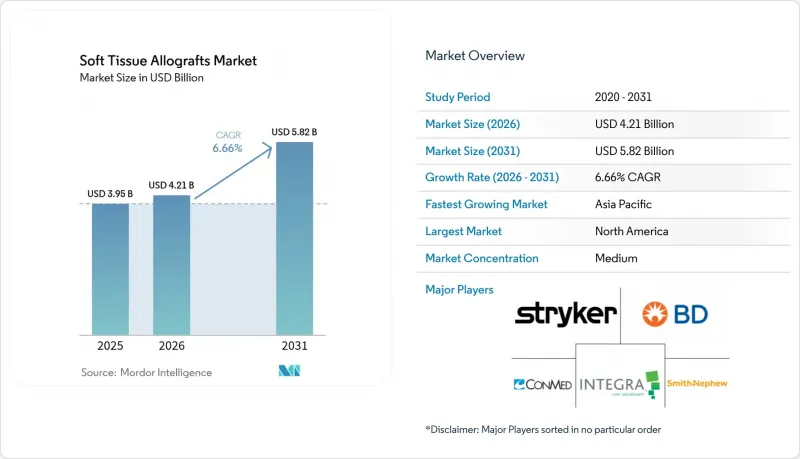
Mordor Intelligence에 의하면, 연부 조직 동종이식편 시장 규모는 2025년 39억 5,000만 달러에서 2026년에는 42억 1,000만 달러로 성장하고, 2026-2031년 CAGR 6.66%로 성장을 지속하여 2031년에는 58억 2,000만 달러에 달할 것으로 예측됩니다.
본 보고서는 이식편의 유형(연골 동종 이식편, 힘줄 동종 이식편 등), 가공·보존 방법(생동결, 동결보존 등), 용도(정형외과 재건, 스포츠 의학 등), 최종 사용자(병원 등), 지역(북미, 유럽 등)별로 분류되어 있습니다. 시장 예측은 금액(달러) 기준으로 제시되어 있습니다.
전 세계 연조직 동종 이식편 시장 동향 및 인사이트
근골격계 질환 유병률 증가
근골격계 질환 증가로 인해 연조직 동종 이식편 시장은 산발적인 외상에 의한 개입에서 예측 가능한 선택적 수술로 전환되고 있습니다. 만성적인 무릎, 어깨, 척추 병변에는 계획적인 재건 수술이 필요하며, 이를 통해 조직 은행은 수요를 예측하고, 기증자의 특성을 수혜자의 필요에 맞추어 낭비를 줄일 수 있게 됩니다. 고령화가 진행됨에 따라 이러한 추세는 더욱 강화되고 있습니다. 고령자의 경우 퇴행성 조직 손실로 인해 자가 이식이 불가능한 경우가 많기 때문입니다. 이에 따라 외과의사들은 수술 시간을 단축하고 기증 부위의 합병증을 피할 수 있는 전처리된 동종 이식편을 채택하게 되었으며, 이는 고령자 집단에서 자가 이식편에 필적하는 양호한 임상 결과를 가져오고 있습니다. 그 결과, 수요 곡선이 안정화되어 가공업체는 재고를 최적화할 수 있을 뿐만 아니라, 연조직 동종 이식편 시장 전체의 수익 전망도 개선되고 있습니다.
고령 인구 증가
고령 환자는 치유 능력이 제한적이며, 자가 이식에 적합한 부위도 부족합니다. 따라서 복잡한 발, 발목, 척추 수술에서는 동종 이식편이 첫 번째 선택지가 되고 있습니다. 2024년 12월 FDA가 무세포 조직공학 혈관인 ‘Symvess’를 승인한 것은 허약한 환자 집단에서의 혈관 재건을 위한 첨단 동종 이식편에 대해 규제 당국이 긍정적인 태도를 보이고 있음을 나타냅니다. 현재 병원 측은 마취 시간 단축과 합병증 감소를 우선시하고 있어, 가격이 비싸더라도 기성 이식편을 선호하고 있습니다. 그 결과, 고령층 증가가 연조직 동종 이식편 시장의 장기적인 성장을 뒷받침하고 있습니다.
고액의 치료비와 이식편 비용
보험 지급 기관은 동종 이식편 비용을 자가 이식의 대안과 비교하고 있으며, 이로 인해 사전 승인 절차의 장벽이 발생하여 도입이 지연되고 있습니다. 특히 선택적 손가락 신경 복원술의 경우, 병원의 청구액 중앙값이 3만 5,295달러에 달하고, 자가 이식 수술보다 1만 1,224달러 더 비쌉니다. 의료 서비스 제공업체는 현재 이식편 사용이 기능 향상 및 재수술률 감소로 이어진다는 것을 입증하는 임상 데이터를 제시해야 합니다. 또한 동종 이식편에는 검증된 콜드체인 물류 및 추적 시스템이 필요하며, 이로 인해 병원 및 외래수술센터(ASC)의 운영 비용이 증가하고 있습니다. 이러한 요인들로 인해 가격에 민감한 지역에서는 일시적으로 도입이 주춤할 수는 있겠지만, 연조직 동종 이식편 시장의 장기적인 성장을 저해할 가능성은 낮을 것으로 보입니다.
부문 분석
힘줄 동종 이식편은 2025년 매출의 34.12%를 차지하며, 전방십자인대(ACL) 및 회전근개 재건에서 그 역할을 확고히 하고 있습니다. 이 부문은 외과의들 사이에서 확고한 인지도와 뛰어난 생체역학적 성능 덕분에 연조직 동종 이식편 시장의 기반을 형성하고 있습니다. 한편, 치과 및 치주 이식편은 임플란트 치과 및 치조골 증대술을 배경으로 연평균 성장률(CAGR) 8.34%로 성장을 지속하고, 있습니다. 덴츠프라이 시로나의 ‘Symbios’ 포트폴리오는 엄격한 기증자 선별 과정과 10-6 수준의 무균 보증 수준이 치주 전문의들에게 어떻게 평가받고 있는지를 여실히 보여주고 있습니다. 연골 및 반월상 연골 이식편은 틈새 시장인 관절 표면 결손을 다루고 있는 반면, 인대 이식편은 활동적인 젊은 성인층에서 자가 이식편과 경쟁하고 있습니다. 지방 유래 매트릭스 및 특수 결합 조직은 현재 초기 단계의 틈새 시장이지만, 더 광범위한 재건의 가능성을 시사하고 있습니다. 이 이식편 분야의 경쟁 초점은 가공 제조업체들이 단일 임상 영역에 대한 의존 위험을 줄이기 위해 제품 라인을 다각화하고 있으며, 이를 통해 연조직 동종 이식편 시장 전체 수요를 유지하고 있음을 보여줍니다.
현재 외과의들은 환자의 연령, 활동 수준, 치유 경향을 고려하여 이식편 선택을 검토하고 있습니다. 예를 들어, 반월판 동종 이식편은 합성 소재에는 없는 충격 흡수성이 필요한 젊은 운동선수들에게 선호되고 있습니다. 카테고리에 관계없이 장기적인 치료 성과에 대한 지속적인 보고는 보험사의 신뢰를 높이고 보험 환급 절차를 원활하게 하여, 이는 연조직 동종 이식편 시장 전체에서 지속적인 이용으로 이어지고 있습니다.
2025년에는 생동결 이식편이 41.90%의 점유율을 차지하며, 수십 년에 걸친 임상 데이터와 수술실에서의 폭넓은 인지도를 바탕으로 연조직 동종 이식편 시장에서 주류 제품으로서의 입지를 확고히 했습니다. 그럼에도 불구하고, 외과의사들이 거부 반응 감소와 조직 통합 개선을 우선시함에 따라, 탈세포화 및 무세포 이식편은 연평균 성장률(CAGR) 8.12%로 성장을 가속화하고 있습니다. 동결보존은 정형외과용 연골 플러그의 생세포를 유지하는 반면, 동결 건조는 전장이나 오지에서의 의료에 이상적인 수년에 걸친 보존 기간을 제공합니다. 감마선 조사는 여전히 멸균의 주된 방법이지만, 고선량에서는 콜라겐이 열화될 수 있습니다. 골 재생 분야에서 탈회 골 기질은 기존의 동종 이식편과 합성 대체재 사이의 가교 역할을 하며, 골 유도성 단백질을 유지합니다.
선정 기준은 단순한 입수 가능성보다 재생 가능성을 중시하는 방향으로 점점 더 변화하고 있습니다. 고정밀 탈세포화 처리는 생체역학적 완전성과 세포외 신호 전달을 유지하며, 이식 후 혈관 신생을 촉진합니다. 그 결과, 성과 중심의 구매 동향에 맞추어 프리미엄 가격 책정이 이루어지고 있으며, 가공업체들은 연구 개발에 자금을 투자하여 처리 시간 단축, 성장 인자 보호 및 제조 규모 확대를 도모하고 있습니다. 이러한 기술 경쟁이 연조직 동종 이식편 시장 내 경쟁의 계층 구조를 형성하고 있습니다.
지역별 분석
북미는 2025년 매출의 45.10%를 차지하고 있으며, 이는 성숙한 조직 은행, 정교한 보험 환급 제도, 그리고 견고한 임상 연구 생태계를 반영합니다. LifeNet Health 및 MTF Biologics와 같은 대형 가공업체와 통합된 조달 조직의 존재로 인해 신뢰할 수 있는 기증자 풀과 안정적인 처리 능력이 확보되어 있습니다. 지배적인 지위를 차지하고 있음에도 불구하고, 가치 기반 의료(Value-Based Care) 이니셔티브로 인해 외과의들은 프리미엄 이식편을 선택하기 전에 임상적 우위와 비용 절감 효과를 입증해야 합니다. 또한 2025년으로 다가온 연방 정부의 규정 준수 기한으로 인해 미국의 소규모 은행들은 합병이나 폐쇄를 피할 수 없게 되었으며, 이로 인해 지역별 공급 동향이 미묘하게 변화하면서 연조직 동종 이식편 시장의 중요성이 더욱 커지고 있습니다.
아시아태평양은 가장 빠르게 성장하고 있으며, 2031년까지 연평균 성장률(CAGR) 7.32%로 확대될 것으로 전망됩니다. 일본은 60건 이상의 iPS 세포를 활용한 임상시험을 실시하며 재생의료를 주도하고 있으며, 그 중 다수는 탈세포화 동종 이식편과 시너지 효과를 낼 수 있는 스캐폴드 기술과 관련되어 있습니다. 2024년 중국 당국이 Artivion사의 ‘BioGlue’를 승인한 것은 복잡한 생물학적 제제에 대한 개방적인 태도를 보여주는 것이며, 도시 지역 병원에서는 수술실과 극저온 보존 설비의 현대화가 진행되고 있습니다. 한편, 인도와 동남아시아에서는 중산층의 소득 증가와 건강보험 보급이 진행되고 있지만, 여전히 규제 불일치가 국경을 넘는 조직 유통을 방해하는 과제에 직면해 있습니다. 그럼에도 불구하고 이 지역의 성장에 힘입어 연조직 동종 이식편 시장의 세계적 입지는 더욱 확대되고 있습니다.
유럽에서는 국경을 넘는 공급을 효율화하는 유럽연합(EU)의 ‘조직 및 세포에 관한 법령’에 기반한 조화로운 지침에 힘입어 안정적인 보급이 예상됩니다. 각국의 의료 제도에서는 품질 인증을 받은 이식편이 우선적으로 사용되며, 많은 외과의사가 장기적인 치료 성과를 기록하는 레지스트리에 참여하고 있어, 증거에 기반한 조달 체계가 강화되고 있습니다. 중동 및 아프리카, 남미와 같은 중규모 시장은 콜드체인 인프라 부족과 높은 본인 부담 비용으로 인해 현재는 뒤처져 있지만, 민간 전문 병원이 급증하고 있어 장기적인 기회를 내포하고 있습니다. 그 결과, 전략적 확장 계획에서는 성숙한 북미 시장과 아시아태평양의 성장 동력 간의 균형을 점점 더 중시하는 한편, 신흥 지역에서의 입지를 공고히 하여 연조직 동종 이식편 시장에서 미래의 점유율을 확보하고자 하고 있습니다.
기타 혜택:
- 엑셀 형식 시장 예측(ME) 시트
- 3개월간의 애널리스트 지원
자주 묻는 질문
목차
제1장 서론
제2장 조사 방법
제3장 주요 요약
제4장 시장 구도
제5장 시장 규모와 성장 예측
제6장 경쟁 구도
제7장 시장 기회와 향후 전망
LSH 26.09.03According to Mordor Intelligence, the soft tissue allografts market size is expected to grow from USD 3.95 billion in 2025 to USD 4.21 billion in 2026 and is forecast to reach USD 5.82 billion by 2031 at 6.66% CAGR over 2026-2031.
This report is Segmented by Graft Type (Cartilage Allograft, Tendon Allograft, and More), Processing & Preservation Method (Fresh-Frozen, Cryopreserved, and More), Application (Orthopedic Reconstruction, Sports Medicine, and More), End User (Hospitals, and More), Geography (North America, Europe, and More). The Market Forecasts are Provided in Terms of Value (USD).
Global Soft Tissue Allografts Market Trends and Insights
Rising Prevalence of Musculoskeletal Disorders
Musculoskeletal conditions have shifted the soft tissue allografts market toward predictable, elective procedures instead of sporadic trauma-driven interventions. Chronic knee, shoulder, and spinal pathologies require planned reconstruction, enabling tissue banks to forecast demand, match donor characteristics to recipient needs, and reduce wastage. Aging demographics magnify this trend because degenerative tissue loss in seniors often rules out autografts. Surgeons therefore turn to pre-processed allografts that shorten operating times and avoid donor-site morbidity, producing clinical outcomes that compare favorably with autografts in elderly cohorts. The result is a durable demand curve that allows processors to optimize inventory and drives revenue visibility across the soft tissue allografts market.
Expanding Geriatric Population Base
Older patients exhibit limited healing capacity and insufficient autograft sites. Allografts thus become first-line options in complex foot, ankle, and spine surgeries. The FDA's December2024 approval of Symvess, an acellular tissue-engineered vessel, illustrates a regulatory embrace of advanced allografts for vascular reconstruction in fragile patient groups. Hospitals now prioritize shorter anesthesia times and fewer complications, favoring off-the-shelf grafts despite higher prices. Consequently, the geriatric demographic strengthens long-term growth for the soft tissue allografts market.
High Treatment and Graft Costs
Insurance payers compare allograft charges with autograft alternatives, triggering pre-authorization hurdles that slow adoption, particularly for elective digital nerve repair where median hospital billing reaches USD35,295, exceeding autograft procedures by USD11,224. Providers must now supply clinical data linking graft use to superior function or lower revision rates. Moreover, allografts require validated cold-chain logistics and traceability systems, inflating overhead for hospitals and ASCs. These factors temporarily temper uptake in price-sensitive regions but are unlikely to derail the long-range expansion of the soft tissue allografts market.
Other drivers and restraints analyzed in the detailed report include:
- Increasing Sports and Recreation Injuries
- Rapid Advances in Tissue Engineering Technologies
- Stringent and Fragmented Regulatory Landscape
For complete list of drivers and restraints, kindly check the Table Of Contents.
Segment Analysis
Tendon allografts accounted for34.12% of2025 revenue, cementing their role in ACL and rotator cuff reconstruction. This segment's entrenched surgeon familiarity and strong biomechanical performance anchor the soft tissue allografts market. Dental/periodontal grafts, however, register an8.34% CAGR, rising on the back of implant dentistry and ridge augmentation. Dentsply Sirona's Symbios portfolio underscores how rigorous donor screening and a Sterility Assurance Level of10-6 resonate with periodontists. Cartilage and meniscus grafts cater to niche joint-surface defects, while ligament grafts contend with autografts in active young adults. Adipose-derived matrices and specialty connective tissues mark early-stage niches but hint at broader reconstructive potential. Competitive emphasis in this graft-type landscape shows processors diversifying lines to de-risk reliance on a single clinical domain, thereby sustaining demand across the soft tissue allografts market.
Surgeons now weigh graft selection against patient age, activity, and healing profile. For example, meniscus allografts appeal to younger athletes needing shock-absorbing properties unavailable in synthetics. Across categories, continuous documentation of long-term outcomes bolsters payer confidence and streamlines reimbursement, feeding back into sustained use throughout the soft tissue allografts market.
Fresh-frozen grafts held41.90% share in2025, benefiting from decades of clinical data and broad operating-room familiarity, positioning them as a staple in the soft tissue allografts market. Nonetheless, decellularized and acellular grafts accelerate at an8.12% CAGR because surgeons prioritize reduced rejection and improved integration. Cryopreservation maintains viable cells for orthopedic cartilage plugs, while lyophilization offers multi-year shelf life ideal for battlefield or rural care. Gamma irradiation remains a sterilization mainstay, though high doses may degrade collagen. In bone repair, demineralized bone matrix bridges classic allografts with synthetic substitutes, preserving osteoinductive proteins.
Selection criteria increasingly pivot on regenerative potential rather than simple availability. High-fidelity decellularization preserves biomechanical integrity and extracellular signaling, facilitating vascular invasion once implanted. Consequently, premium pricing aligns with outcome-focused purchasing, and processors finance R&D to compress processing time, guard growth factors, and scale manufacture. This technological arms race shapes competitive hierarchies inside the soft tissue allografts market.
Complete Report Scope:
- By Graft Type
- Cartilage Allograft
- Tendon Allograft
- Meniscus Allograft
- Ligament Allograft
- Dental/Periodontal Allograft
- Other Graft Types
- By Processing & Preservation Method
- Fresh-Frozen
- Cryopreserved
- Lyophilized
- Gamma-Irradiated Sterilized
- Decellularized & Acellular
- Demineralized Bone Matrix (DBM)
- By Application
- Orthopedic Reconstruction
- Sports Medicine
- Dentistry & Periodontics
- Wound & Burn Management
- Cosmetic & Plastic Surgery
- Other Applications
- By End User
- Hospitals
- Ambulatory Surgical Centers
- Orthopedic Specialty Clinics
- Other End Users
- Geography
- North America
- United States
- Canada
- Mexico
- Europe
- Germany
- United Kingdom
- France
- Italy
- Spain
- Rest of Europe
- Asia-Pacific
- China
- Japan
- India
- Australia
- South Korea
- Rest of Asia-Pacific
- Middle East & Africa
- GCC
- South Africa
- Rest of Middle East & Africa
- South America
- Brazil
- Argentina
- Rest of South America
- North America
Geography Analysis
North America controlled45.10% of2025 revenue, reflecting mature tissue banks, sophisticated reimbursement, and a robust clinical research ecosystem. The presence of large processors such as LifeNet Health and MTF Biologics, together with integrated procurement organizations, ensures reliable donor pools and steady throughput. Despite dominance, value-based care initiatives urge surgeons to prove clinical superiority and cost offsets before selecting premium grafts. Upcoming federal compliance deadlines in2025 also press smaller US banks to merge or close, subtly reshaping regional supply dynamics and reinforcing the centrality of the soft tissue allografts market.
Asia-Pacific is the fastest riser, growing at7.32% CAGR through2031. Japan spearheads regenerative medicine with over60 iPS clinical trials, many intersecting with scaffold technologies that could dovetail with decellularized allografts. China's regulatory green light for Artivion's BioGlue in2024 signals openness to complex biologics, while urban hospitals modernize operating suites and cryogenic storage. Elsewhere, India and Southeast Asia benefit from expanding middle-class incomes and health insurance penetration, yet still grapple with fragmented regulations that slow cross-border tissue flow. Nonetheless, regional growth broadens the global footprint of the soft tissue allografts market.
Europe offers stable uptake, underpinned by harmonized directives under the European Union Tissues and Cells legislation that streamline supply across borders. National health systems favor quality-accredited grafts, and many surgeons participate in registries documenting long-term outcomes, strengthening evidence-based procurement. Mid-tier markets like the Middle East, Africa, and South America currently lag because of limited cold-chain infrastructure and higher out-of-pocket costs, yet represent long-range opportunities as private specialty hospitals proliferate. Consequently, strategic expansion plans increasingly balance the mature North American base with Asia-Pacific momentum, while nurturing footholds in emerging geographies to secure future share in the soft tissue allografts market.
- AbbVie (Allergan Aesthetics)
- Conmed
- Xtant Medical Holdings
- Bone Bank Allografts
- Smiths Group
- Beckton Dickinson
- Integra LifeSciences
- Stryker
- Zimmer Biomet
- Arthrex
- Medtronic
- Johnson & Johnson
- LifeNet Health
- Organogenesis Holdings
- AlloSource
- CryoLife (Artivion)
- Tissue Regenix Group
- MiMedx Group
- Axogen Inc.
- MTF Biologics
Additional Benefits:
- The market estimate (ME) sheet in Excel format
- 3 months of analyst support
TABLE OF CONTENTS
1 Introduction
- 1.1 Study Assumptions & Market Definition
- 1.2 Scope of the Study
2 Research Methodology
3 Executive Summary
4 Market Landscape
- 4.1 Market Overview
- 4.2 Market Drivers
- 4.2.1 Rising Prevalence of Musculoskeletal Disorders
- 4.2.2 Expanding Geriatric Population Base
- 4.2.3 Increasing Sports and Recreation Injuries
- 4.2.4 Rapid Advances in Tissue Engineering Technologies
- 4.2.5 Growing Healthcare Expenditure in Emerging Economies
- 4.2.6 Favorable Reimbursement and Policy Support
- 4.3 Market Restraints
- 4.3.1 High Treatment and Graft Costs
- 4.3.2 Stringent and Fragmented Regulatory Landscape
- 4.3.3 Limited Availability of Donor Tissue
- 4.3.4 Potential Risk of Disease Transmission
- 4.4 Regulatory Landscape
- 4.5 Porter's Five Forces Analysis
- 4.5.1 Threat of New Entrants
- 4.5.2 Bargaining Power of Buyers
- 4.5.3 Bargaining Power of Suppliers
- 4.5.4 Threat of Substitutes
- 4.5.5 Competitive Rivalry
5 Market Size & Growth Forecasts (Value, USD)
- 5.1 By Graft Type
- 5.1.1 Cartilage Allograft
- 5.1.2 Tendon Allograft
- 5.1.3 Meniscus Allograft
- 5.1.4 Ligament Allograft
- 5.1.5 Dental/Periodontal Allograft
- 5.1.6 Other Graft Types
- 5.2 By Processing & Preservation Method
- 5.2.1 Fresh-Frozen
- 5.2.2 Cryopreserved
- 5.2.3 Lyophilized
- 5.2.4 Gamma-Irradiated Sterilized
- 5.2.5 Decellularized & Acellular
- 5.2.6 Demineralized Bone Matrix (DBM)
- 5.3 By Application
- 5.3.1 Orthopedic Reconstruction
- 5.3.2 Sports Medicine
- 5.3.3 Dentistry & Periodontics
- 5.3.4 Wound & Burn Management
- 5.3.5 Cosmetic & Plastic Surgery
- 5.3.6 Other Applications
- 5.4 By End User
- 5.4.1 Hospitals
- 5.4.2 Ambulatory Surgical Centers
- 5.4.3 Orthopedic Specialty Clinics
- 5.4.4 Other End Users
- 5.5 Geography
- 5.5.1 North America
- 5.5.1.1 United States
- 5.5.1.2 Canada
- 5.5.1.3 Mexico
- 5.5.2 Europe
- 5.5.2.1 Germany
- 5.5.2.2 United Kingdom
- 5.5.2.3 France
- 5.5.2.4 Italy
- 5.5.2.5 Spain
- 5.5.2.6 Rest of Europe
- 5.5.3 Asia-Pacific
- 5.5.3.1 China
- 5.5.3.2 Japan
- 5.5.3.3 India
- 5.5.3.4 Australia
- 5.5.3.5 South Korea
- 5.5.3.6 Rest of Asia-Pacific
- 5.5.4 Middle East & Africa
- 5.5.4.1 GCC
- 5.5.4.2 South Africa
- 5.5.4.3 Rest of Middle East & Africa
- 5.5.5 South America
- 5.5.5.1 Brazil
- 5.5.5.2 Argentina
- 5.5.5.3 Rest of South America
- 5.5.1 North America
6 Competitive Landscape
- 6.1 Market Concentration
- 6.2 Market Share Analysis
- 6.3 Company Profiles (includes Global level Overview, Market level overview, Core Business Segments, Financials, Headcount, Key Information, Market Rank, Market Share, Products and Services, and analysis of Recent Developments)
- 6.3.1 AbbVie (Allergan Aesthetics)
- 6.3.2 CONMED Corporation
- 6.3.3 Xtant Medical Holdings
- 6.3.4 Bone Bank Allografts
- 6.3.5 Smith & Nephew (Osiris Therapeutics Inc.)
- 6.3.6 BD (Becton Dickinson and Company)
- 6.3.7 Integra LifeSciences Corporation
- 6.3.8 Stryker Corporation
- 6.3.9 Zimmer Biomet
- 6.3.10 Arthrex
- 6.3.11 Medtronic
- 6.3.12 Johnson & Johnson (DePuy Synthes)
- 6.3.13 LifeNet Health
- 6.3.14 Organogenesis Holdings
- 6.3.15 AlloSource
- 6.3.16 CryoLife (Artivion)
- 6.3.17 Tissue Regenix Group
- 6.3.18 MiMedx Group
- 6.3.19 Axogen Inc.
- 6.3.20 MTF Biologics
7 Market Opportunities & Future Outlook
- 7.1 White-Space & Unmet-Need Assessment


