

|
시장보고서
상품코드
2122601
제산제 : 시장 점유율 분석, 업계 동향과 통계, 성장 예측(2026-2031년)Antacids - Market Share Analysis, Industry Trends & Statistics, Growth Forecasts (2026 - 2031) |
||||||
 Mordor Intelligence
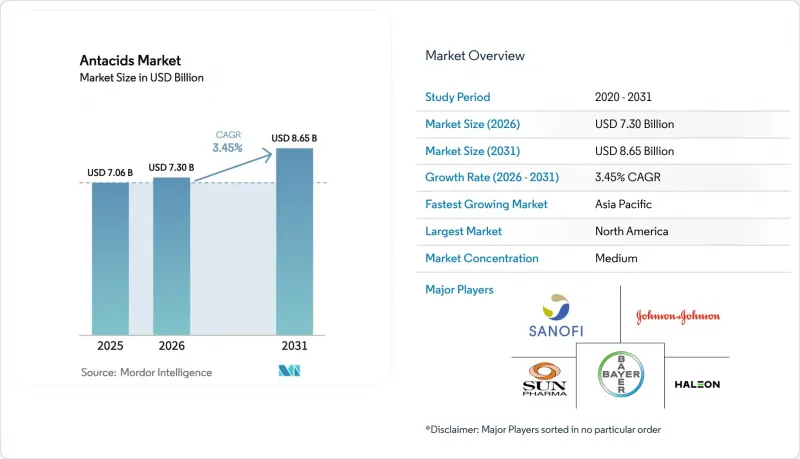
Mordor Intelligence에 의하면, 제산제 시장 규모는 2025년 70억 6,000만 달러, 2026년 73억 달러에서 2031년까지 86억 5,000만 달러로 성장할 것으로 예측되며, 2026-2031년 연평균 복합 성장률(CAGR)은 3.45%를 기록할 전망입니다.
본 보고서는 제형(정제, 분말 등), 유효 성분 유형(탄산칼슘, 알긴산계 등), 적응증(속쓰림, 위식도 역류병(GERD) 등), 판매 채널(병원 약국, 전자상거래 등), 지역(북미, 유럽 등)별로 분류되어 있습니다. 시장 전망은 금액(달러) 기준으로 제시되어 있습니다.
전 세계 제산제 시장 동향 및 인사이트
고령화와 소화기 질환 발병률 증가
2030년까지 65세 이상 성인은 전 세계 인구의 16%를 차지할 것으로 예상되며, 이 연령대는 젊은 층에 비해 위식도 역류증 발병률이 거의 2배에 달하기 때문에 제산제 시장의 주요 구매층이 될 것입니다. 일본에서는 이미 인구의 29% 이상이 고령층을 차지하고 있으며, 1인당 제산제 사용량은 다른 어느 나라보다 높습니다. 이탈리아나 독일 등 유럽 국가에서는 2031년까지 고령자 인구 비율이 약 28%를 나타낼 것으로 예측되며, 만성 역류성 식도염 치료에 양성자 펌프 억제제(PPI)가 처방되더라도 기본적인 수요는 유지될 것입니다. 각 제약사는 고혈압 관리에 적합한 저나트륨 액상 제제나, 제산제와 뼈 건강에 도움이 되는 영양소를 조합한 세트 상품 등으로 이에 대응하고 있습니다. 전반적으로 이러한 인구 동향의 호재에 힘입어, 장기적으로는 제산제 시장에서 확고한 시장 점유율을 확보할 전망입니다.
건강에 해로운 식습관과 앉아 있는 시간이 많은 생활 방식
아시아태평양의 도시화로 인해 고지방 가공식품 소비가 증가하고 있으며, 이는 속쓰림 발생률을 높여 제산제 시장에 새로운 수요를 창출하고 있습니다. 중국의 비만율은 2025년까지 14%를 넘어설 전망이며, 한편 인도의 대도시에서는 기능성 소화불량의 유병률이 20%에 육박하고 있습니다. 제조업체에게는 매운 요리에 대응하는 허브 유래 진정 성분을 첨가하는 등 제제를 현지화할 수 있는 미개척 기회가 있지만, 대부분의 브랜드는 지역에 맞춘 조정을 하지 않고 세계 SKU를 계속 수출하고 있어 국내 신규 진출기업에게 진입의 여지를 남기고 있습니다.
양성자 펌프 억제제(PPI) 및 H2 수용체 길항제로의 전환
미국 내 양성자 펌프 억제제(PPI)의 연간 소매 매출액은 40억 달러를 초과하고 있습니다. 이는 의사들이 1일 1회 투여로 산 분비를 억제할 수 있는 PPI를 선호하는 경향을 반영하며, 제산제 시장의 잠재적 판매량 증가에는 상한선이 설정되어 있습니다. 그러나 PPI의 장기 사용에 대한 안전성 우려가 커지면서 일부 환자들은 간헐적인 제산제 사용으로 되돌아가고 있으며, 이는 판매량 증가를 부분적으로 상쇄하는 요인이 되고 있습니다.
부문 분석
2025년 기준, 정제 형태의 제산제 시장 규모는 매출의 41.56%를 차지했으나, 구미 및 씹어 먹는 소프트젤은 연평균 성장률(CAGR) 9.25%로 확대되며 이 부문 내에서 가장 높은 성장률을 보이고 있습니다. 구미는 과자 같은 식감에 더해 수면을 촉진하는 멜라토닌을 배합할 수 있다는 장점이 있어, 제산제 사용을 더 광범위한 취침 전 루틴의 일부로 자리매김하는 데 기여하고 있습니다. 한편, 액상 제제는 소아 및 고령층의 확대에 따라 7.7%의 성장률을 보이고 있습니다. 분말제 및 발포제는 규모는 작지만 안정적인 성장세를 보이고 있으며, 여행자나 스포츠 애호가들로부터 효과가 빠르게 나타난다는 점에서 높은 평가를 받고 있습니다.
액상 제제는 포장이 무겁고 파손되기 쉬워 물류 비용 압박에 직면해 있지만, 제조업체가 맛 마스킹 기술을 도입함으로써 기호성은 향상되고 있습니다. 기존 정제는 제산제 시장에서 최대 점유율을 유지할 전망이지만, 밀레니얼 세대와 Z세대가 나이를 먹으며 위장 질환 유병률이 높아짐에 따라 그 우위는 점차 약화되고 있으며, 인접한 건강기능식품 카테고리에서 구미 제형으로의 선호도가 유입되고 있습니다.
탄산칼슘은 산을 중화시키는 동시에 식이 유래 칼슘을 공급한다는 이중의 이점으로 2025년 매출의 35.53%를 차지했으나, 알지네이트는 연평균 성장률(CAGR) 8.85%라는 눈부신 성장의 원동력이 되고 있습니다. 그 ‘라프트 형성’ 메커니즘은 의약품을 포함하지 않는 해결책을 찾는 소비자들의 공감을 불러일으키며, 가비스콘(Gaviscon)과 같은 브랜드를 차별화하고 있습니다. 마그네슘 및 알루미늄 화합물은 중위권을 유지하고 있지만, 안전성에 대한 우려로 인해 빈번한 반복 사용이 제한되고 있습니다. 중탄산나트륨은 여전히 저렴한 선택지이며 일시적인 증상을 신속하게 완화하는 데 도움이 되지만, 나트륨 함량이 높다는 점이 과제로 남아 있습니다.
복합 제품은 칼슘과 수산화마그네슘을 배합하거나, 시메티콘을 첨가하여 복부 팽만감을 완화함으로써 기능성 소화불량으로 고생하는 사람들에게 지지를 받고 있습니다. 알긴산염 제품의 보급을 저해하는 주요 요인은 원재료비이며, 의약품 등급의 알긴산나트륨은 탄산염계 제제에 비해 50% 높은 가격에 판매되고 있지만, 인식 제고 캠페인과 의료진의 지지가 높아짐에 따라 제산제 시장에서 이러한 가격 차이가 정당화되고 있습니다.
지역별 분석
북미는 2025년 매출의 39.53%를 차지하며, 자가 치료율이 높고 증상이 나타날 때 신속하게 제품을 전환하는 경향으로 인해 제산제 시장에서 여전히 가장 규모가 큰 지역으로 자리 잡고 있습니다. PPI(양성자 펌프 억제제)의 다용도 사용자가 증가함에 따라 판매량은 정체되고 있지만, 구미 유형이나 클린 라벨 제품의 출시가 판매 감소분을 상쇄하고 있습니다. 캐나다와 멕시코는 국경을 초월한 전자상거래를 통해, 그동안 격리되어 있던 소매 환경에 미국의 SKU가 유입되면서 한 자릿수 중반대의 성장률을 기록하며 확대되고 있습니다.
아시아태평양은 두드러진 성장 동력으로, 2031년까지 연평균 성장률(CAGR) 9.51%를 기록하며 매출액이 10억 달러 가까이 증가할 것으로 예측됩니다. 일본에서는 전례 없는 고령화가 진행됨에 따라 액상 제제 및 저나트륨 제품이 성장을 주도하고 있습니다. 한편, 중국에서는 일반의약품에 대한 규제가 간소화됨에 따라 해외 기업과 국내 기업 모두에서 신제품 출시 주기가 단축되고 있습니다. 인도에서는 도시와 농촌 간에 현저한 격차가 나타납니다. 대도시권의 소화불량 유병률은 20%에 달하는 반면, 가격에 민감한 농촌 지역 소비자들은 제네릭 분말 제제를 선호하는 경향이 있습니다.
유럽은 이 둘의 중간에 위치해 있으며, 유럽의약품청(EMA)의 엄격한 표시 규제와 양성자 펌프 억제제(PPI)의 광범위한 보험 적용이 과제로 대두되고 있습니다. 영국에서는 생활 습관 개선이나 제산제로 시작하는 단계적 치료 프로토콜이 채택되어 있어 일정한 수요가 확보되고 있습니다. 브렉시트로 인한 통관 절차의 복잡화로 수입 비용이 상승하고 있어, 일부 기업은 제조의 지역 분산화를 추진하고 있습니다.
중동 및 아프리카, 남미는 합쳐서 소폭이지만 증가 추세를 보이는 시장 점유율을 차지하고 있습니다. 걸프협력회의(GCC) 회원국에서는 비만율이 30%를 초과하여 속쓰림 호소 사례가 증가하고 있으나, 전자상거래 인프라는 여전히 발전 단계에 있습니다. 브라질과 아르헨티나는 여전히 불안정한 상황에 놓여 있으며, 환율 변동으로 인해 소비자들이 자체 브랜드 제품으로 눈을 돌리고 있어 현지 수탁 제조업체에 유리한 상황이 되고 있습니다.
기타 혜택:
- 엑셀 형식 시장 예측(ME) 시트
- 3개월간의 애널리스트 지원
자주 묻는 질문
목차
제1장 서론
제2장 조사 방법
제3장 주요 요약
제4장 시장 구도
제5장 시장 규모와 성장 예측
제6장 경쟁 구도
제7장 시장 기회와 향후 전망
LSH 26.09.03According to Mordor Intelligence, the antacids market size is projected to expand from USD 7.06 billion in 2025 and USD 7.30 billion in 2026 to USD 8.65 billion by 2031, registering a CAGR of 3.45% between 2026 to 2031.
This report is Segmented by Formulation Type (Tablets, Powders, and More), Active Ingredient Type (Calcium Carbonate, Alginate-Based, and More), Indication (Heartburn, Gastroesophageal Reflux Disease (GERD), and More), Distribution Channel (Hospital Pharmacies, E-Commerce, and More), Geography (North America, Europe, and More). The Market Forecasts are Provided in Terms of Value (USD).
Global Antacids Market Trends and Insights
Aging Population and Rising Gastrointestinal Disorder Incidence
Adults aged 65 and older will comprise 16% of the world's residents by 2030, and this demographic experiences gastroesophageal reflux disease at nearly twice the rate of younger cohorts, making them habitual purchasers in the antacids market. Japan already reports more than 29% of its population in the senior bracket, and per-capita antacid use there outpaces all other countries. European economies such as Italy and Germany will reach senior shares of roughly 28% by 2031, sustaining baseline demand even as prescription proton pump inhibitors (PPIs) address chronic reflux. Manufacturers are answering with lower-sodium liquids that accommodate hypertension management and with bundle packs that pair antacids with bone-health nutrients. Collectively, demographic tailwinds secure a dependable slice of the antacids market over the long term.
Unhealthy Dietary Habits and Sedentary Lifestyles
Urbanization across Asia-Pacific is amplifying consumption of high-fat convenience foods, pushing heartburn incidence upward and generating fresh demand in the antacids market. Obesity rates in China are on course to exceed 14% by 2025, while India's largest cities are recording functional dyspepsia prevalence near 20%. Producers have an untapped opportunity to localize formulations-such as adding herbal demulcents helpful against spicy cuisines-yet most brands continue to export global SKUs without regional tweaks, leaving room for domestic challengers.
Switch to Proton Pump Inhibitors and H2 Antagonists
United States PPIs exceed USD 4 billion in annual retail sales, reflecting physician preference for once-daily acid suppression and placing a ceiling on potential volume gains for the antacids market. Yet emerging safety concerns regarding chronic PPI use are nudging certain patients back toward intermittent antacids, creating a partial offset.
Other drivers and restraints analyzed in the detailed report include:
- Over-the-Counter Accessibility and Self-Medication Culture
- Microbiome-Focused Combination Research and Development
- Safety Concerns with Chronic Antacid Use
For complete list of drivers and restraints, kindly check the Table Of Contents.
Segment Analysis
The antacids market size for tablets reached 41.56% of revenue in 2025, whereas gummies and chewable soft-gels are climbing at a 9.25% CAGR, the fastest within this segmentation. Gummies benefit from confectionery textures and the ability to layer sleep-enhancing melatonin, recasting antacid use as part of a broader nighttime routine. Meanwhile, liquids grow at 7.7% as pediatric and geriatric cohorts expand. Powders and effervescents remain small but stable, prized for rapid onset by travelers and sports enthusiasts.
Liquids face logistic cost pressure because packaging is heavier and more fragile, but their palatability gains when manufacturers employ taste-masking technology. Traditional tablets will likely keep the largest slice of the antacids market, yet their dominance erodes as millennials and Gen-Z age into higher gastric-symptom prevalence and import gummy preferences from adjacent supplement categories.
Calcium carbonate commanded 35.53% of 2025 revenue thanks to its dual benefit of neutralizing acid and delivering dietary calcium, but alginates are the standout growth engine at an 8.85% CAGR. The raft-forming mechanism resonates with consumers seeking drug-free solutions and differentiates brands such as Gaviscon. Magnesium and aluminum compounds maintain mid-tier status but face safety perceptions that limit heavy repeat use. Sodium bicarbonate remains a budget choice, useful for rapid, episodic relief yet hampered by high sodium content.
Combination products blend calcium with magnesium hydroxide or add simethicone to tackle bloating, appealing to functional dyspepsia sufferers. Raw-material cost is the primary brake on alginate roll-out because pharmaceutical-grade sodium alginate trades at a 50% premium to carbonate salts, but educational campaigns and growing clinician endorsement are beginning to justify the price differential inside the antacids market.
Complete Report Scope:
- By Formulation Type
- Tablets
- Liquids / Suspensions
- Powders
- Gummies / Chewable Soft-Gels
- Effervescent Granules
- Other Formulations
- By Active Ingredient Type
- Calcium Carbonate
- Magnesium Compounds
- Aluminium Compounds
- Sodium Bicarbonate
- Alginate-Based
- Combination Preparations
- By Indication
- Heartburn
- Gastroesophageal Reflux Disease (GERD)
- Peptic Ulcer
- Functional Dyspepsia
- Other Acid-Related Disorders
- By Distribution Channel
- Hospital Pharmacies
- Retail Pharmacies & Drug Stores
- E-Commerce
- Other Channels
- Geography
- North America
- United States
- Canada
- Mexico
- Europe
- Germany
- United Kingdom
- France
- Italy
- Spain
- Rest of Europe
- Asia-Pacific
- China
- India
- Japan
- Australia
- South Korea
- Rest of Asia-Pacific
- Middle East and Africa
- GCC
- South Africa
- Rest of Middle East and Africa
- South America
- Brazil
- Argentina
- Rest of South America
- North America
Geography Analysis
North America, at 39.53% of 2025 revenue, remains the largest territory in the antacids market because of high self-medication rates and fast product switching upon symptom onset. Unit volumes plateau as heavy PPI users emerge, but gummy and clean-label launches offset attrition. Canada and Mexico expand at mid-single-digit rates as cross-border e-commerce brings United States SKUs into previously insulated retail environments.
Asia-Pacific is the standout growth engine, forecast to add nearly USD 1 billion in incremental sales through 2031 at a 9.51% CAGR. Japan's unprecedented aging profile propels liquids and low-sodium variants, while China's streamlined over-the-counter rules shorten launch cycles for foreigners and domestic players alike. India illustrates urban-rural divergence: metropolitan dyspepsia prevalence hits 20%, yet price-sensitive rural consumers gravitate toward generic powders.
Europe sits in between, challenged by strict European Medicines Agency labeling and widespread PPI reimbursement. The United Kingdom follows a step-up protocol that begins with lifestyle modification and antacids, ensuring baseline demand. Brexit-related customs complexities inflate import costs, nudging some companies to regionalize manufacturing.
The Middle East, Africa, and South America together contribute a modest but rising share. Gulf Cooperation Council nations show obesity rates above 30%, stimulating heartburn complaints, yet e-commerce infrastructure is still developing. Brazil and Argentina remain volatile; currency swings push shoppers toward private-label products, favoring local contract manufacturers.
- Abbott Laboratories
- Adcock Ingram Holdings Ltd.
- AdvaCare
- Advance Pharmaceutical
- Akums Drugs & Pharmaceuticals Ltd.
- AstraZeneca
- Bayer
- CVS Health
- Dr. Reddy's Laboratories
- Haleon Plc
- Johnson & Johnson (Kenvue)
- Novartis
- Perrigo Company
- Pfizer
- Procter & Gamble
- Reckitt Benckiser Group
- Sanofi
- Sun Pharmaceuticals Industries
- Takeda Pharmaceuticals
- WellSpring Pharmaceutical
Additional Benefits:
- The market estimate (ME) sheet in Excel format
- 3 months of analyst support
TABLE OF CONTENTS
1 Introduction
- 1.1 Study Assumptions & Market Definition
- 1.2 Scope of the Study
2 Research Methodology
3 Executive Summary
4 Market Landscape
- 4.1 Market Overview
- 4.2 Market Drivers
- 4.2.1 Aging population & rising GI disorder incidence
- 4.2.2 Unhealthy dietary habits & sedentary lifestyles
- 4.2.3 OTC accessibility & self-medication culture
- 4.2.4 Expansion of retail pharmacy & e-commerce channels
- 4.2.5 Microbiome-focused combination R&D
- 4.2.6 Digital gut-symptom tracking partnerships
- 4.3 Market Restraints
- 4.3.1 Switch to PPIs & H2 antagonists
- 4.3.2 Safety concerns with chronic antacid use
- 4.3.3 Volatile mineral-based raw-material supply
- 4.3.4 ESG-driven aluminum footprint scrutiny
- 4.4 Supply-Chain Analysis
- 4.5 Regulatory Landscape
- 4.6 Technological Outlook
- 4.7 Porter's Five Forces
- 4.7.1 Bargaining Power of Buyers
- 4.7.2 Bargaining Power of Suppliers
- 4.7.3 Threat of New Entrants
- 4.7.4 Threat of Substitutes
- 4.7.5 Intensity of Competitive Rivalry
5 Market Size & Growth Forecasts (Value, USD)
- 5.1 By Formulation Type
- 5.1.1 Tablets
- 5.1.2 Liquids / Suspensions
- 5.1.3 Powders
- 5.1.4 Gummies / Chewable Soft-Gels
- 5.1.5 Effervescent Granules
- 5.1.6 Other Formulations
- 5.2 By Active Ingredient Type
- 5.2.1 Calcium Carbonate
- 5.2.2 Magnesium Compounds
- 5.2.3 Aluminium Compounds
- 5.2.4 Sodium Bicarbonate
- 5.2.5 Alginate-Based
- 5.2.6 Combination Preparations
- 5.3 By Indication
- 5.3.1 Heartburn
- 5.3.2 Gastroesophageal Reflux Disease (GERD)
- 5.3.3 Peptic Ulcer
- 5.3.4 Functional Dyspepsia
- 5.3.5 Other Acid-Related Disorders
- 5.4 By Distribution Channel
- 5.4.1 Hospital Pharmacies
- 5.4.2 Retail Pharmacies & Drug Stores
- 5.4.3 E-Commerce
- 5.4.4 Other Channels
- 5.5 Geography
- 5.5.1 North America
- 5.5.1.1 United States
- 5.5.1.2 Canada
- 5.5.1.3 Mexico
- 5.5.2 Europe
- 5.5.2.1 Germany
- 5.5.2.2 United Kingdom
- 5.5.2.3 France
- 5.5.2.4 Italy
- 5.5.2.5 Spain
- 5.5.2.6 Rest of Europe
- 5.5.3 Asia-Pacific
- 5.5.3.1 China
- 5.5.3.2 India
- 5.5.3.3 Japan
- 5.5.3.4 Australia
- 5.5.3.5 South Korea
- 5.5.3.6 Rest of Asia-Pacific
- 5.5.4 Middle East and Africa
- 5.5.4.1 GCC
- 5.5.4.2 South Africa
- 5.5.4.3 Rest of Middle East and Africa
- 5.5.5 South America
- 5.5.5.1 Brazil
- 5.5.5.2 Argentina
- 5.5.5.3 Rest of South America
- 5.5.1 North America
6 Competitive Landscape
- 6.1 Market Concentration
- 6.2 Market Share Analysis
- 6.3 Company Profiles (includes Global level Overview, Market level overview, Core Segments, Financials as available, Strategic Information, Market Rank/Share for key companies, Products & Services, and Recent Developments)
- 6.3.1 Abbott Laboratories
- 6.3.2 Adcock Ingram Holdings Ltd.
- 6.3.3 AdvaCare Pharma
- 6.3.4 Advance Pharmaceutical Inc.
- 6.3.5 Akums Drugs & Pharmaceuticals Ltd.
- 6.3.6 AstraZeneca Plc
- 6.3.7 Bayer AG
- 6.3.8 CVS Health Corporation
- 6.3.9 Dr. Reddy's Laboratories Ltd.
- 6.3.10 Haleon Plc
- 6.3.11 Johnson & Johnson (Kenvue)
- 6.3.12 Novartis AG
- 6.3.13 Perrigo Company Plc
- 6.3.14 Pfizer Inc.
- 6.3.15 Procter & Gamble Co.
- 6.3.16 Reckitt Benckiser Group Plc
- 6.3.17 Sanofi S.A.
- 6.3.18 Sun Pharmaceutical Industries Ltd.
- 6.3.19 Takeda Pharmaceutical Company Ltd.
- 6.3.20 WellSpring Pharmaceutical Corporation
7 Market Opportunities & Future Outlook
- 7.1 White-Space & Unmet-Need Assessment


