

|
시장보고서
상품코드
2122604
돼지 백신 : 시장 점유율 분석, 업계 동향과 통계, 성장 예측(2026-2031년)Porcine Vaccines - Market Share Analysis, Industry Trends & Statistics, Growth Forecasts (2026 - 2031) |
||||||
 Mordor Intelligence
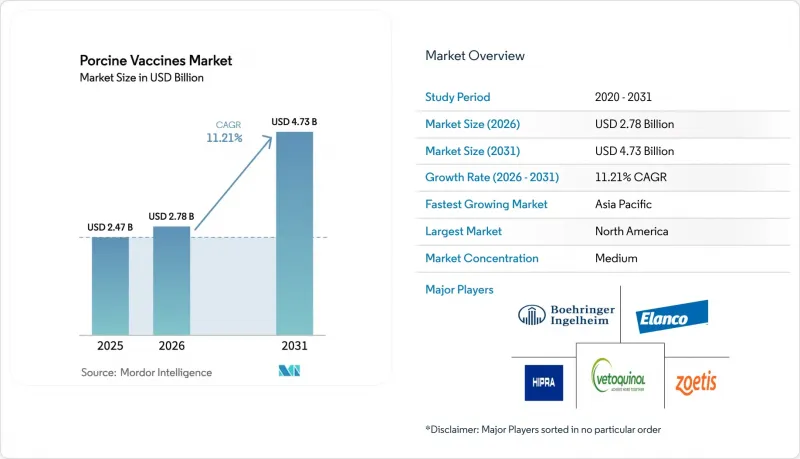
Mordor Intelligence에 의하면, 돼지 백신 시장 규모는 2025년에 24억 7,000만 달러, 2026년에 27억 8,000만 달러에 이르고, 2031년까지 47억 3,000만 달러에 이를 것으로 예측되며, 2026-2031년 CAGR 11.21%를 기록할 전망입니다.
본 보고서에서는 대상 질환(돼지 생식 호흡기 증후군 등), 기술 플랫폼(약독 생백신 등), 제형(단가 백신 등), 투여 경로(근육 내 주사 등), 유통 채널(동물병원 등) 및 지역별로 시장을 분류하고 있습니다. 시장 예측은 금액(달러) 기준으로 제시되어 있습니다.
세계 돼지 백신 시장 동향 및 인사이트
신흥 경제국에서의 돼지고기 단백질 수요 증가
급속한 도시화로 인해 2024년부터 2025년에 걸쳐 동남아시아의 1인당 돼지고기 소비량은 7% 증가했으며, 현대적인 가공업체와의 계약 사육 계약에서 백신 접종이 필수 조건이 되었습니다. 중국의 모돈 사육 두수는 2025년 말까지 4,390만 마리로 회복될 전망이며, 현재 각 성의 규정에 따라 도축장으로 반입하기 전에 분기별 백신 접종 기록을 제출해야 합니다. 중동의 수입업체들은 수의사 증명서에 PRRS 및 인플루엔자 예방접종 증명 기재가 의무화되어 있으며, 이는 기존에 예방접종률이 낮았던 수출국에서도 마찬가지입니다. 생산자 입장에서는 1두당 2-3달러의 백신 비용이, 특히 돼지고기가 동물성 단백질 지출의 40%를 차지하는 지역에서 10%의 사망률이 발생할 경우의 경제적 타격에 비하면 극히 미미한 것으로 간주됩니다. 그 결과, 돼지 백신 시장은 베트남, 필리핀 및 중국 남부의 소득 증가와 밀접하게 연동되어 있습니다.
PRRS, PEDV, ASF의 유행 확대
2025년, 필리핀 양돈장에서 ASF 검출 건수는 34% 급증하여 살처분 범위를 확대할 수밖에 없게 되었으며, 실험 단계에 있는 서브유닛형 백신 후보에 대한 수요를 촉진했습니다. PRRS는 여전히 미국 생산자들에게 연간 6억 6,400만 달러의 손실을 초래하고 있으며, 이종 균주는 백신 접종을 마친 무리에서도 생산성을 5-8% 저하시킵니다. 중국 중부에서 출현하고 있는 PRRS의 재조합 변이주는 기존 백신의 예방 효과를 저해하고 있어, 제조업체들은 종주 교체를 강요받고 있으며, 신속한 대응이 가능한 플랫폼에 대한 수요가 지속되고 있습니다. 2024년부터 2025년에 걸쳐 유럽에서 발생한 PEDV의 겨울철 유행은 질병 압력의 감소가 예방 조치 준수율을 떨어뜨려, 이후 감염 확산을 증폭시키는 감수성이 높은 돼지 집단을 만들어냅니다는 것을 보여주었습니다. 이러한 진화 역학으로 인해 돼지 백신 시장은 끊임없는 연구 개발 주기에 놓여 있으며, 신속한 항원 교체를 가능하게 하는 기술이 높이 평가받고 있습니다.
개발도상 지역의 콜드체인 물류 비용
백신을 2-8°C에서 보관하려면 전기 요금이 0.25달러/kWh를 초과하고, 라스트 마일 운송이 오토바이에 의존하는 경우, 1회분당 0.80-1.20달러의 추가 비용이 발생합니다. 나이지리아, 탄자니아, 우간다에서 실시된 조사에 따르면, 배송의 42%에서 온도 제한을 초과하고 있으며, 이로 인해 효능이 최대 60%까지 저하되어 백신에 대한 신뢰가 훼손되고 있습니다. 인도 아삼주에서는 태양열 냉장고 도입으로 백신 변질률이 28%에서 9%로 감소했지만, 대당 1,500달러라는 단가는 보조금 없이는 감당하기 어려울 정도로 비쌉니다. 그 결과, 백신 접종률이 주기적으로 하락하고 질병이 근절되지 않아, 돼지 백신 시장의 단기적인 성장을 저해하고 있습니다.
부문 분석
2025년에는 설사병용 제제가 27.48%라는 압도적인 점유율을 차지하며, 돼지 백신 시장 매출에서 가장 큰 비중을 차지했습니다. 한편, 돼지 인플루엔자용 제품은 고밀도 사육 돼지 사육장에서 H1N1 및 H3N2 변이주가 더욱 활발하게 유행하고 있기 때문에 연평균 성장률(CAGR) 12.76%로 확대되고 있습니다. 또한, 인플루엔자는 인수공통감염병으로 확산될 위험도 내포하고 있어, 규제 당국이 백신의 신속한 개발과 갱신을 지원할 필요성이 부각되고 있습니다. 오랫동안 필수적인 것으로 여겨져 온 PRRS 백신은 재조합 야생주가 기존 면역원을 회피하게 됨에 따라 유효성 문제에 직면하고 있어, 지속적인 연구 개발(R&D)에 대한 투자가 요구되고 있습니다. 아프리카 돼지열병(ASF)은 여전히 미개척 시장 기회로 남아 있습니다. 중국과 베트남을 제외하면 전 세계적으로 시판되는 백신은 존재하지 않지만, 개발의 최종 단계에 있는 서브유닛형 후보 백신은 규제상의 장벽을 극복할 경우, 돼지 백신 시장에서 수요가 대폭 확대될 가능성이 있습니다.
설사증 대책 제품의 실적은 분만 시설에서의 급성 사망률에 영향을 받습니다. 발생 시 사망률이 40%를 초과할 경우, 예방 접종 예산의 즉각적인 배정이 정당화됩니다. 대조적으로, 호흡기계 백신은 사료 효율 향상 및 출하까지 소요되는 일수 단축이라는 측면에서 통합형 양돈업자들에게 지지를 받고 있습니다. 두 부문 모두 양극화 현상이 나타나고 있습니다. 즉, 장계 제품이 안정적인 판매량을 견인하는 한편, 호흡기계 솔루션은 돼지 백신 시장의 성장에 크게 기여하고 있습니다.
약독 생백신은 저렴한 비용과 지속적인 면역 효과 덕분에 2025년 매출의 35.62%를 계속 차지하고 있지만, 약물감시 부담과 잠재적인 원형 복귀 위험을 안고 있습니다. 재조합 벡터 플랫폼은 체액성 및 세포성 이중 면역 반응을 유도할 수 있다는 점과 생바이러스에 의한 위험이 없습니다는 점을 강점으로 삼아 연평균 성장률(CAGR) 14.73%로 성장하고 있습니다. 불활성화 백신은 특히 돼지 인플루엔자의 경우, 유효성보다 안전성이 우선시되는 분야에서 주류를 이루고 있으나, 추가 접종에 따른 번거로움이 소규모 생산자들에게 장벽이 될 가능성이 있습니다. 최신 PCV2d 구성체 등의 아단위 백신은 콜드체인의 취약성을 피할 수 있으므로, 고온 지역에서의 보급이 확실시되고 있습니다. 미국에서 제3상 임상시험이 진행 중인 DNA 백신이나 나노입자 보조제를 배합한 프로토타입은 다음 단계의 가능성을 시사하고 있으며, 병원체 상황이 변화하는 가운데 돼지 백신 시장은 더욱 신속한 항원 전환 주기에 대응할 수 있게 되어가고 있습니다.
경제적 요인도 플랫폼 선택에 영향을 미치고 있습니다. 재조합 백신은 MLV 제품에 비해 2-3배의 비용이 소요되지만, 예측 가능한 안전성 프로파일 덕분에 수출 인증이나 소비자 대상 표시가 요구되는 경우에는 그 높은 가격도 정당화됩니다. 그 결과, 다국적 기업들은 단계적인 제품 포트폴리오를 전개하고 있으며, 시장 점유율을 지키기 위해 기존 형태의 제품에 대해 적극적으로 가격을 책정하는 한편, 더 엄격한 생물보안 요건을 가진 고객에게는 새로운 벡터를 활용한 제품을 업셀링하고 있습니다.
지역별 분석
북미는 2025년 매출의 38.35%를 차지할 것으로 예상되며, 그 기반이 되는 것은 미국의 7,400만 마리의 가축 사육 두수와 수출 지향적인 수직 통합형 시스템입니다. 캐나다의 항생제 무사용 생산으로의 전환은 미국 가공업체의 의무화 방침과 부합하며, 2024년부터 2025년에 걸쳐 PRRS 및 PCV 매출을 두 자릿수 성장으로 끌어올리고 있습니다. 2025년 멕시코의 돼지고기 생산량 6% 증가는 니어쇼어 가공의 확대를 반영하고 있지만, 신용 제약으로 인해 소규모 농가에서의 백신 보급률은 여전히 50% 미만에 머물고 있습니다. 2024년에 발효되는 FDA의 항균제 규제로 인해 백신은 질병 예방의 표준 수단이 될 것이며, 한편 조에티스(Zoetis)사가 미시간주의 생물제제 공장에 1억 2,000만 달러를 투자함에 따라 2027년까지 해당 지역의 생산 능력은 30% 확대될 전망입니다.
아시아태평양은 중국의 아프리카 돼지열병(ASF) 이후 회복세와 동남아시아의 보조금 지원에 힘입어 연평균 14.25%의 성장이 예상됩니다. 베트남은 국가 자금 지원을 통해 2026년까지 번식용 돼지 군의 80%에 백신 접종을 목표로 하고 있으나, 일본과 한국에서는 거의 100%의 백신 접종률을 유지하고 있음에도 불구하고 돼지 군 규모는 정체 상태입니다. 인도의 시범 프로그램에서는 2025년에 참여 마을에서 91%의 접종률을 달성했으며, 물류상의 과제가 해결된다면 더 큰 잠재력이 있을 것으로 시사되고 있습니다. 호주는 질병이 없는 상태이지만 규모가 작아, 홍반 및 렙토스피라증 백신 수요라는 안정적인 틈새 시장을 제공합니다. 지속적인 진전은 중국이 아프리카 돼지열병(ASF)의 대규모 재발을 피하고, 각국 정부가 백신 접종을 전략적이고 부분적으로 보조 대상으로 삼는 노력을 지속할 수 있는지에 달려 있습니다.
유럽에서는 ‘동물위생법’에 따른 규제가 철저히 시행됨에 따라 견조한 수요가 유지되고 있습니다. 이 법에서는 PRRS와 ASF가 상위 2개 질병 범주로 분류되어 있습니다. 독일, 스페인, 덴마크는 해당 지역의 돼지고기 공급량의 58%를 차지하며, 백신 접종률이 거의 100%에 달할 전망입니다. 한편, 폴란드와 루마니아에서는 멧돼지 개체군 내 ASF의 지속적인 유입으로 인해 두 자릿수의 높은 성장률을 기록하고 있습니다. 스페인의 통합형 생산자들은 소매업체가 요구하는 동물 복지 지표에 힘입어 2025년에는 1두당 백신 지출을 3.50유로로 인상했습니다. 영국은 EU 기준을 준수하면서도 신규 플랫폼에 대한 신속한 승인 절차를 모색하고 있으며, 2024년에는 세바(Seba)사의 영국용 ‘Hyogen’ 신청 서류가 승인되었습니다. 동유럽의 업계 재편 국면에서는 대규모 사업 운영에 맞춘 기술 지원을 제공하는 다국적 기업이 유리한 입지를 점하고 있어, 돼지 백신 시장의 적정한 집중화가 더욱 진전되고 있습니다.
기타 혜택:
- 엑셀 형식 시장 예측(ME) 시트
- 3개월간의 애널리스트 지원
자주 묻는 질문
목차
제1장 서론
제2장 조사 방법
제3장 주요 요약
제4장 시장 구도
제5장 시장 규모와 성장 예측
제6장 경쟁 구도
제7장 시장 기회와 향후 전망
LSH 26.09.03According to Mordor Intelligence, the porcine vaccines market size is projected to be USD 2.47 billion in 2025, USD 2.78 billion in 2026, and reach USD 4.73 billion by 2031, growing at a CAGR of 11.21% from 2026 to 2031.
This report Segments the Industry Into by Target Disease (Porcine Reproductive & Respiratory Syndrome, and More), Technology Platform ( Live-Attenuated, and More), Product Formulation (Monovalent Vaccines, and More), Administration Route (Intramuscular, and More), Distribution Channel (Veterinary Hospitals, and More), and Geography. The Market Forecasts are Provided in Terms of Value (USD).
Global Porcine Vaccines Market Trends and Insights
Rising Demand for Pork Protein in Emerging Economies
Rapid urbanization increased Southeast Asian per-capita pork consumption by 7% between 2024 and 2025, making vaccination a prerequisite for contract farming agreements with modern processors. China's sow herd recovered to 43.9 million head by late 2025, and provincial regulations now require quarterly vaccination logs to be submitted before slaughterhouse entry. Middle-Eastern importers mandate proof of PRRS and influenza immunization on veterinary certificates, even in exporting nations with historically low coverage. Producers view a USD 2-3 per-head vaccine outlay as negligible compared to the financial shock of a 10% mortality event, especially where pork accounts for 40% of animal protein spending. Consequently, the porcine vaccine market is tracking closely with income growth in Vietnam, the Philippines, and southern China.
Increasing Prevalence of PRRS, PEDV & ASF
ASF detections in Philippine herds surged 34% in 2025, forcing culling radii to widen and catalyzing demand for experimental subunit candidates. PRRS still costs U.S. producers USD 664 million annually, and heterologous strains cut performance 5-8% even in vaccinated herds. PRRS recombinant variants emerging in central China erode existing vaccine protection, compelling manufacturers to replace seed strains and sustain demand for fast-pivot platforms. Europe's winter 2024-2025 PEDV outbreaks demonstrated that waning disease pressure reduces compliance, creating pools of susceptible pigs that amplify the subsequent incursion. These evolutionary dynamics keep the porcine vaccine market on a perpetual R&D cycle, rewarding technologies that enable rapid antigen substitution.
Cold-Chain Logistics Cost in Developing Regions
Keeping vaccines at 2-8 °C adds USD 0.80-1.20 per dose where electricity exceeds USD 0.25/kWh and last-mile transport relies on motorcycles. Surveys in Nigeria, Tanzania, and Uganda revealed that 42% of deliveries exceeded temperature limits, reducing potency by up to 60% and eroding trust in vaccines. Solar refrigerators reduced spoilage in India's Assam state from 28% to 9%, yet a unit cost of USD 1,500 is prohibitive without a subsidy. The result is cyclical under-vaccination, which perpetuates disease and dampens near-term growth in the porcine vaccine market.
Other drivers and restraints analyzed in the detailed report include:
- Government-Backed Mass-Vaccination Programs
- Shift to Antibiotic-Free Pork Production
- Adverse Reactions & Vaccine Failure with Live-Attenuated Strains
For complete list of drivers and restraints, kindly check the Table Of Contents.
Segment Analysis
Diarrheal formulations held a commanding 27.48% share in 2025, making them the single most significant slice of the porcine vaccine market revenue. Swine influenza lines, however, are advancing at a 12.76% CAGR as H1N1 and H3N2 variants circulate more aggressively in densely stocked barns. Influenza also poses a zoonotic spillover risk, underscoring the need for regulatory agencies to support the rapid development and update of vaccines. PRRS vaccines, long considered indispensable, face efficacy challenges as recombinant field strains evade existing immunogens, necessitating sustained research and development (R&D) investment. ASF remains a white-space opportunity; no globally commercialized dose exists outside of China and Vietnam, but subunit candidates in late-stage development could unlock substantial incremental demand for the porcine vaccine market once regulatory hurdles are cleared.
The performance of diarrheal products is influenced by acute mortality in farrowing units; mortality exceeding 40% in outbreaks justifies immediate allocation of an immunization budget. In contrast, respiratory vaccines appeal to integrators for improving feed efficiency and days-to-market. Both segments illustrate a bifurcation: enteric lines drive steady volume, while respiratory solutions contribute significantly to the growth of the porcine vaccine market.
Live-attenuated formats still accounted for 35.62% of 2025 revenue due to their low cost and durable immunity, yet they shoulder pharmacovigilance burdens and potential reversion events. Recombinant-vector platforms are rising at 14.73% CAGR, benefiting from dual humoral-cellular responses and the absence of live-virus risk. Inactivated vaccines dominate where safety trumps potency, especially for swine influenza, though booster-dose labor can deter smaller producers. Subunit offerings, such as the latest PCV2d constructs, bypass cold-chain fragility, securing uptake in high-temperature regions. DNA and nanoparticle-adjuvanted prototypes in Phase III U.S. trials signal the next frontier, positioning the porcine vaccine market for even faster antigen-switch cycles as pathogen landscapes shift.
Economics influence platform choice: while recombinant doses cost 2-3 times more than MLV products, their predictable safety profile justifies the premium where export certification or consumer labeling is a consideration. Consequently, multinationals deploy tiered portfolios, pricing traditional formats aggressively to defend share while upselling novel vectors to customers with tighter biosecurity requirements.
Complete Report Scope:
- By Disease Type
- Porcine Reproductive & Respiratory Syndrome
- Porcine Circovirus Associated Disease
- Diarrheal Diseases
- Swine Influenza
- Classical & African Swine Fever
- Other Diseases
- By Technology Platform
- Live-attenuated
- Inactivated/Killed
- Toxoid & Subunit
- Recombinant Vector
- Other Technology Platform
- By Product Formulation
- Monovalent Vaccines
- Multivalent / Combination
- By Administration Route
- Intramuscular
- Intradermal
- Oral & Intranasal Mucosal
- By Distribution Channel
- Veterinary Hospitals
- Veterinary Clinics
- Other End Users
- By Geography
- North America
- United States
- Canada
- Mexico
- Europe
- Germany
- United Kingdom
- France
- Italy
- Spain
- Rest of Europe
- Asia-Pacific
- China
- Japan
- India
- Australia
- South Korea
- Rest of Asia-Pacific
- Middle East & Africa
- GCC
- South Africa
- Rest of Middle East & Africa
- South America
- Brazil
- Argentina
- Rest of South America
- North America
Geography Analysis
North America contributed 38.35% of 2025 revenue, anchored by the United States' 74 million-head inventory and export-oriented, vertically integrated systems. Canada's shift toward antibiotic-free production aligns with U.S. processor mandates, pushing PRRS and PCV sales into double-digit growth during 2024-2025. Mexico's 6% increase in pork output in 2025 reflects near-shored processing; however, vaccine penetration remains below 50% among smallholders due to credit constraints. The FDA's antimicrobial curbs, effective 2024, will convert vaccines into the default disease-prevention tool, while Zoetis' USD 120 million investment in a Michigan biologics plant will expand regional capacity by 30% by 2027.
The Asia-Pacific region is projected to grow at a rate of 14.25% annually, driven by China's post-ASF rebound and subsidies in Southeast Asia. Vietnam's state funding aims for 80% breeding-herd coverage by 2026, while Japan and South Korea maintain near-universal vaccination but flat herd sizes. India's pilot programs achieved 91% coverage in participating villages during 2025, hinting at latent potential if logistical hurdles are solved. Australia, disease-free but small in scale, provides a steady niche for erysipelas and leptospirosis doses. Sustained progress hinges on China avoiding major ASF relapses and governments continuing to treat vaccination as a strategic, partially subsidized input.
Europe maintains robust demand due to regulatory enforcement under the Animal Health Law, which classifies PRRS and ASF in the top two disease categories. Germany, Spain, and Denmark generate 58% of the regional pork supply and display near-total vaccine adoption, while Poland and Romania record high double-digit growth due to ongoing ASF incursions in wild boar populations. Spain's integrated producers increased per-pig vaccine spending to EUR 3.50 in 2025, driven by animal welfare metrics demanded by retailers. The United Kingdom harmonizes with EU standards but seeks quicker pathways for novel platforms, attracting Ceva's UK-specific Hyogen dossier in 2024. Eastern Europe's consolidation phase favors multinationals offering technical support tailored to large-scale operations, reinforcing the moderate concentration of the porcine vaccine market.
- Biogenesis Bago
- Bimeda Biologicals
- Boehringer Ingelheim
- Ceva Sante Animale
- Chengdu Tech-Bank/Winsun Bio
- CJ CheilJedang Bio
- Elanco
- Hester Biosciences
- Hipra
- Huvepharma
- IDT Biologika
- Indian Immunologicals
- KM Biologics
- Merck
- Phibro Animal Health
- Qilu Animal Health
- Ringpu Bio-Pharmacy
- Vetoquinol
- Virbac
- Zoetis
Additional Benefits:
- The market estimate (ME) sheet in Excel format
- 3 months of analyst support
TABLE OF CONTENTS
1 Introduction
- 1.1 Study Assumptions & Market Definition
- 1.2 Scope of the Study
2 Research Methodology
3 Executive Summary
4 Market Landscape
- 4.1 Market Overview
- 4.2 Market Drivers
- 4.2.1 Rising Demand for Pork Protein in Emerging Economies
- 4.2.2 Increasing Prevalence of PRRS, PEDV & ASF
- 4.2.3 Government-Backed Mass-Vaccination Programs
- 4.2.4 Shift To Antibiotic-Free Pork Production
- 4.2.5 Thermostable & Needle-Free Delivery Unlocking Low-Infrastructure Markets
- 4.2.6 AI-Enabled Disease-Surveillance Guiding Targeted Vaccination
- 4.3 Market Restraints
- 4.3.1 Cold-Chain Logistics Cost in Developing Regions
- 4.3.2 Adverse Reactions & Vaccine Failure with Live-Attenuated Strains
- 4.3.3 Vaccine-Derived Recombination Eroding Efficacy
- 4.3.4 Capital Flight Toward Looming ASF Subunit Vaccines
- 4.4 Value / Supply-Chain Analysis
- 4.5 Regulatory Landscape
- 4.6 Technological Outlook
- 4.7 Porter's Five Forces Analysis
- 4.7.1 Threat of New Entrants
- 4.7.2 Bargaining Power of Buyers
- 4.7.3 Bargaining Power of Suppliers
- 4.7.4 Threat of Substitutes
- 4.7.5 Competitive Rivalry
5 Market Size & Growth Forecasts
- 5.1 By Disease Type
- 5.1.1 Porcine Reproductive & Respiratory Syndrome
- 5.1.2 Porcine Circovirus Associated Disease
- 5.1.3 Diarrheal Diseases
- 5.1.4 Swine Influenza
- 5.1.5 Classical & African Swine Fever
- 5.1.6 Other Diseases
- 5.2 By Technology Platform
- 5.2.1 Live-attenuated
- 5.2.2 Inactivated/Killed
- 5.2.3 Toxoid & Subunit
- 5.2.4 Recombinant Vector
- 5.2.5 Other Technology Platform
- 5.3 By Product Formulation
- 5.3.1 Monovalent Vaccines
- 5.3.2 Multivalent / Combination
- 5.4 By Administration Route
- 5.4.1 Intramuscular
- 5.4.2 Intradermal
- 5.4.3 Oral & Intranasal Mucosal
- 5.5 By Distribution Channel
- 5.5.1 Veterinary Hospitals
- 5.5.2 Veterinary Clinics
- 5.5.3 Other End Users
- 5.6 By Geography
- 5.6.1 North America
- 5.6.1.1 United States
- 5.6.1.2 Canada
- 5.6.1.3 Mexico
- 5.6.2 Europe
- 5.6.2.1 Germany
- 5.6.2.2 United Kingdom
- 5.6.2.3 France
- 5.6.2.4 Italy
- 5.6.2.5 Spain
- 5.6.2.6 Rest of Europe
- 5.6.3 Asia-Pacific
- 5.6.3.1 China
- 5.6.3.2 Japan
- 5.6.3.3 India
- 5.6.3.4 Australia
- 5.6.3.5 South Korea
- 5.6.3.6 Rest of Asia-Pacific
- 5.6.4 Middle East & Africa
- 5.6.4.1 GCC
- 5.6.4.2 South Africa
- 5.6.4.3 Rest of Middle East & Africa
- 5.6.5 South America
- 5.6.5.1 Brazil
- 5.6.5.2 Argentina
- 5.6.5.3 Rest of South America
- 5.6.1 North America
6 Competitive Landscape
- 6.1 Market Concentration
- 6.2 Market Share Analysis
- 6.3 Company Profiles (includes Global level Overview, Market-level Overview, Core Segments, Financials, Strategic Information, Market Rank/Share, Products & Services, Recent Developments)
- 6.3.1 Biogenesis Bago
- 6.3.2 Bimeda Biologicals
- 6.3.3 Boehringer Ingelheim Animal Health
- 6.3.4 Ceva Sante Animale
- 6.3.5 Chengdu Tech-Bank/Winsun Bio
- 6.3.6 CJ CheilJedang Bio
- 6.3.7 Elanco Animal Health
- 6.3.8 Hester Biosciences
- 6.3.9 HIPRA
- 6.3.10 Huvepharma
- 6.3.11 IDT Biologika
- 6.3.12 Indian Immunologicals
- 6.3.13 KM Biologics
- 6.3.14 Merck Animal Health
- 6.3.15 Phibro Animal Health
- 6.3.16 Qilu Animal Health
- 6.3.17 Ringpu Bio-Pharmacy
- 6.3.18 Vetoquinol
- 6.3.19 Virbac
- 6.3.20 Zoetis Inc.
7 Market Opportunities & Future Outlook
- 7.1 White-space & Unmet-need Assessment


