

|
시장보고서
상품코드
2122612
배터리 전해액 : 시장 점유율 분석, 업계 동향과 통계, 성장 예측(2026-2031년)Battery Electrolyte - Market Share Analysis, Industry Trends & Statistics, Growth Forecasts (2026 - 2031) |
||||||
 Mordor Intelligence
Mordor Intelligence에 의하면, 배터리 전해액 시장 규모는 2025년에 140억 6,000만 달러로 평가되었고, 2026년158억 4,000만 달러에서 2031년까지 287억 2,000만 달러에 이를 것으로 예측되며, 예측 기간(2026년-2031년) CAGR은 12.63%를 기록할 전망입니다.
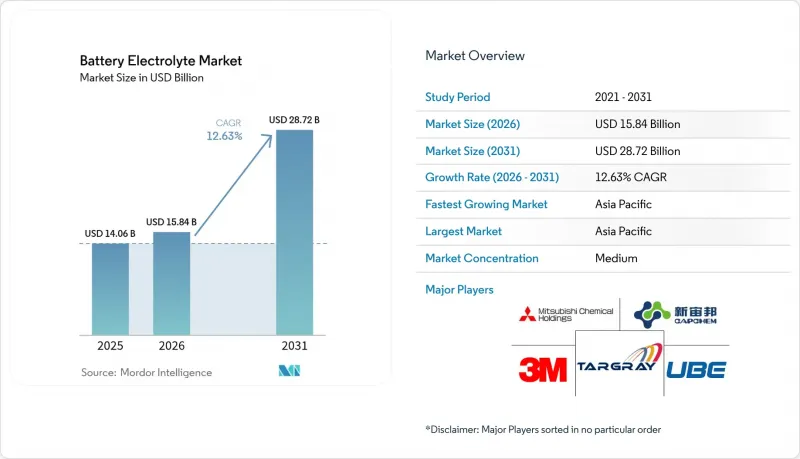
본 보고서는 배터리 및 전해액의 유형(납축전지, 리튬 이온 배터리, 플로우 배터리, 기타 화학 계열), 최종 사용자(전기자동차, 에너지 저장, 소비자용 전자기기, 산업용 및 특수 용도), 그리고 지역(북미, 유럽, 아시아태평양, 남미, 중동 및 아프리카)별로 분류되어 있습니다. 시장 규모 및 전망은 금액(달러) 기준으로 제시되어 있습니다.
세계 배터리 전해액 시장 동향 및 인사이트
중국 및 유럽의 전기차(EV) 관련 수요 급증
2024년, 중국의 전기차 생산 대수는 70% 증가할 전망이며, 유럽에서는 IPCEI의 지원을 받는 기가팩토리가 2030년까지 연간 400 GWh의 셀 생산 능력을 목표로 하고 있어, 전해액 수요는 이 두 지역에 집중되어 있습니다. EU 배터리 규정 2023/1542에 따른 현지 조달 규칙에 따라, 유럽의 배터리 제조업체들은 지역 전해액 공급업체와 직접 계약을 체결하도록 권장받고 있습니다. 그 예로 Capchem사와 체결한 6억 7,600만 달러 규모의 다년 계약을 들 수 있으며, 이는 단기적인 비용 증가를 감수하는 대가로 공급망의 가시성을 확보하고 있습니다. 그 결과, 규모 확대로 인해 비용 효율성이 향상되는 한편, 무역 혼란이 전구체 공급에 영향을 미칠 경우 지정학적 위험도 높아집니다.
인플레이션 억제법, 미국 내 공급망 활성화
이 법의 국내 조달 기준에 따라 2024년 이후 배터리 밸류체인에 1,500억 달러가 넘는 투자가 약속되었습니다. UBE 코퍼레이션은 루이지애나주에 5억 달러를 투자한 공장 착공에 들어갔습니다. 이 공장은 2026년까지 연간 5만 톤의 탄산염 용매를 생산할 예정이며, 아시아산 수입에 대한 의존도를 낮추는 한편, 생산자들은 북미 내 규제 준수 비용 및 인건비 급등에 직면하게 될 것입니다. 장기적인 사업 지속가능성은 2032년 이후에도 세제 혜택이 지속되는 것과, GM-Lithium Americas사의 점토 채굴 파트너십과 같은 리튬 가공 사업에 대한 허가 절차의 간소화에 달려 있습니다.
불소계 용매에 대한 PFAS 단계적 폐지 규제
EU의 PFAS 규제안에 따라 2026년까지 플루오로에틸렌 카보네이트가 금지될 가능성이 있어, 리튬 이온 배터리의 약 60%에 사용되는 전해액의 재조성이 불가피할 우려가 있습니다. 미국 환경보호청(EPA)의 조사에 따라 불소를 포함하지 않는 첨가제로의 선제적인 전환이 진행되고 있으나, 대체품은 이온 전도도를 저하시키고 비용을 최대 30%까지 상승시키는 요인이 됩니다. 일본공급업체들은 독자적인 에테르계 블렌드에 투자하고 있지만, 재인증 주기가 2년에 달하기 때문에 시장 내 본격적인 확대가 지연되고 있습니다.
부문 분석
2025년, 리튬 이온 배터리용 배합은 배터리 전해액 시장의 81.74%를 차지하고 있으며, 이는 기가팩토리 인프라가 정착되어 있고 전기차(EV)에서의 실적이 반영된 결과입니다. 고니켈 양극재에는 알루미늄 집전체의 부식을 억제하고 고전압을 안정화시키는 첨가제가 필요하며, 이로 인해 고품질 용매에 대한 수요가 유지되고 있습니다. 한편, 나트륨 이온 및 아연-공기 전지를 포함한 ‘기타 화학 계열’은 리튬 공급 제약으로부터 공급망을 분리할 수 있는 소재의 입수 용이성이라는 이점에 힘입어, 2031년까지 연평균 성장률(CAGR) 22.1%를 나타낼 것으로 전망됩니다. 바나듐 플로우 전해액은 10시간 이상의 방전이 요구되는 전력 계통용 축전을 목표로 하고 있으며, 중국의 한 연구소에서는 스택 출력 밀도를 70kW까지 향상시키고 시스템 비용을 40% 절감하는 데 성공했습니다. 젤 유형은 누액 방지 기능과 낮은 초기 비용이 여전히 결정적인 요인으로 작용하는 실내용 납축전지의 대체재로서 계속해서 중요한 위치를 차지하고 있습니다.
각 제조업체들은 단일 화학 계열이 지배적인 미래에 대비하여 제품 포트폴리오를 확대되고 있습니다. 고체 리튬 시스템은 에너지 밀도를 30% 향상시킬 것으로 기대되지만, 황화물 분말 취급 및 산화물 소결 수율과 관련된 규모 확대의 병목 현상에 직면해 있습니다. 나트륨 이온 배터리 프로토타입은 2024년에 연구개발(R&D) 실험실에서 상업 생산 라인으로 전환되었으며, 파일럿 팩이 마이크로 전기차 및 가정용 에너지 저장 캐비닛에 전력을 공급하고 있습니다. 이러한 복잡한 시장 상황 속에서 탄산염계, 에테르계, 이온 액체계 등 각 계열 간에 유연하게 전환할 수 있는 공급업체들은 배터리 전해질 시장에서 장기적인 입지를 공고히 하고 있습니다.
지역별 분석
아시아태평양은 2025년 매출의 69.65%를 차지하며, 연평균 성장률(CAGR) 13.97%로 성장하고 있습니다. 이는 긴밀한 공급망, 정부의 인센티브, 그리고 양극재 및 분리막 공장에 대한 지리적 근접성에 의해 뒷받침되고 있습니다. 중국만 해도 Tinci나 Capchem과 같은 기업을 통해 전 세계 전해액 생산 능력의 60% 이상을 장악하고 있으며, 경쟁력 있는 가격의 제품을 국제 바이어에게 대량으로 공급하는 수출 전략을 가능하게 하고 있습니다. 일본과 한국은 하이엔드 배터리용 고성능 등급에 주력하는 반면, 인도는 ‘생산 연계형 인센티브(PLI)’ 제도를 통해 비용 효율을 중시하는 제조업체를 유치하고 있습니다. 나트륨 이온 배터리 및 전고체 배터리의 프로토타입에 대한 기술적 리더십은 여전히 동아시아에 집중되어 있으며, 다른 대륙에서 생산이 현지화되어 가는 상황 속에서도 동아시아가 앞으로도 배터리 화학 로드맵을 주도해 나갈 것임을 시사합니다.
북미에서는 ‘인플레이션 억제법’의 제정에 따라 국내 생산 능력 확충이 급속도로 진행되고 있습니다. 투자 계획에는 UBE사의 루이지애나주 내 5만 톤 규모 공장 건설과 텍사스주 및 오하이오주에서의 탄산염·용매 관련 시설 확장 등이 포함됩니다. 캐나다는 신흥 리튬 정제 거점으로서 기여하고 있으며, 멕시코는 미국 자동차 제조업체의 물류 비용을 절감해 주는 조립 거점으로서의 이점을 제공합니다. 성공의 열쇠는 아시아의 기존 기업들과의 비용 격차(현재 15-25%)를 줄이면서도 자동차 업계의 엄격한 품질 기준을 충족시키는 데 있습니다. 미국 에너지부는 2035년까지 에너지 저장 시스템 도입량이 6배 증가할 것으로 예측하고 있으며, 국내 공장은 이러한 수요 급증에 대응할 수 있도록 준비를 갖추어야 합니다.
유럽은 지속가능성을 전략의 기반으로 삼고 있습니다. EU 배터리 규정 2023/1542는 재활용 소재 사용 비율 및 수명 주기 정보 공개를 의무화하고 있으며, 이로 인해 화학 제조업체들은 재생에너지를 활용한 폐쇄형 공정 및 저탄소 생산에 대한 투자를 강요받고 있습니다. IPCEI 지원을 받는 기가팩토리는 2030년까지 연간 셀 생산 능력 400GWh에 달할 것으로 예상되며, 이는 수백 킬로톤 규모의 전해액 수요에 해당합니다. BASF, 솔베이(Solvay), 그리고 신규 진출기업인 FUCHS-E-Lyte는 전력 비용 급등에도 불구하고 높은 마진을 확보할 수 있는 고부가가치 특수 블렌드에 주목하며 지역 공장의 규모를 확대되고 있습니다. 순환 경제 의무화로 인해 2031년까지 리튬 회수율 80%라는 적극적인 전해액 재활용 목표가 촉진되며, 재활용 사업을 수직 통합하는 화학 공급업체에게 새로운 수익원이 열릴 것입니다.
기타 혜택:
- 엑셀 형식 시장 예측(ME) 시트
- 3개월간의 애널리스트 지원
자주 묻는 질문
목차
제1장 서론
제2장 조사 방법
제3장 주요 요약
제4장 시장 구도
제5장 시장 규모와 성장 예측
제6장 경쟁 구도
제7장 시장 기회와 향후 전망
LSH 26.09.03According to Mordor Intelligence, the battery electrolyte market size was valued at USD 14.06 billion in 2025 and estimated to grow from USD 15.84 billion in 2026 to reach USD 28.72 billion by 2031, at a CAGR of 12.63% during the forecast period (2026-2031).
This report is Segmented by Battery & Electrolyte Type (Lead-Acid, Lithium-Ion, Flow Batteries, and Other Chemistries), End User (Electric Vehicles, Energy Storage, Consumer Electronics, and Industrial and Specialty), and Geography (North America, Europe, Asia-Pacific, South America, and Middle East and Africa). The Market Sizes and Forecasts are Provided in Terms of Value (USD).
Global Battery Electrolyte Market Trends and Insights
Surging EV-linked demand in China & Europe
China's EV output rose 70% in 2024, and Europe's IPCEI-backed gigafactories aim to target 400 GWh of annual cell capacity by 2030, concentrating electrolyte demand in two regions. Local sourcing rules under the EU Battery Regulation 2023/1542 motivate European cell makers to contract directly with regional electrolyte suppliers, such as Capchem's USD 676 million multi-year deal, which trades higher short-term costs for supply-chain visibility. The resulting scale creates cost efficiencies but also elevates geopolitical risk when trade disruptions affect precursor flows.
Inflation Reduction Act spurring U.S. local supply chains
The Act's domestic-content criteria have triggered more than USD 150 billion of battery-value-chain commitments since 2024. UBE Corporation broke ground on a USD 500 million Louisiana plant that will produce 50,000 t of annual carbonate solvents by 2026, reducing reliance on Asian imports while exposing producers to higher North American compliance and labor costs. Long-term viability depends on the continuation of tax incentives beyond 2032 and on streamlined permitting for lithium processing ventures such as GM-Lithium Americas' clay extraction partnership.
PFAS-phase-out regulations on fluorinated solvents
The EU's draft PFAS restriction could ban fluoroethylene carbonate by 2026, potentially forcing the reformulation of electrolytes used in approximately 60% of lithium-ion batteries.U.S. EPA investigations are driving pre-emptive transitions to fluorine-free additives; however, replacements reduce ionic conductivity and raise costs by up to 30%. Japanese suppliers invested in proprietary ether-based blends, yet requalification cycles stretch to two years, delaying full market rollout.
Other drivers and restraints analyzed in the detailed report include:
- Shift to high-voltage solid & gel chemistries
- Roll-out of grid-scale BESS
- Volatile lithium carbonate spot prices
For complete list of drivers and restraints, kindly check the Table Of Contents.
Segment Analysis
Lithium-ion formulations controlled 81.74% of the battery electrolyte market in 2025, reflecting entrenched gigafactory infrastructure and proven performance in EVs. High-nickel cathodes demand additives that suppress aluminum collector corrosion and stabilize elevated voltages, sustaining premium-grade solvent demand. Meanwhile, the other-chemistry cohort-including sodium-ion and zinc-air-posts a 22.1% CAGR to 2031, propelled by material availability advantages that insulate supply chains from lithium constraints. Vanadium flow electrolytes target grid storage with discharge requirements of 10+ hours, and Chinese labs have increased stack power density by 70 kW, reducing system costs by 40%. Gel variants remain relevant for indoor lead-acid replacements, where spill-proof operation and low upfront costs remain decisive factors.
Manufacturers are broadening their portfolios to hedge against a future dominated by a single chemistry. Solid-state lithium systems promise 30% energy-density gains yet face scale bottlenecks around sulfide powder handling and oxide sintering yields. Sodium-ion prototypes moved from R&D labs to commercial lines in 2024, with pilot packs powering micro-EVs and residential storage cabinets. In this nuanced landscape, suppliers able to flexibly pivot between carbonate, ether, and ionic liquid families strengthen their long-term positioning within the battery electrolyte market.
Complete Report Scope:
- By Battery & Electrolyte Type
- Lead-acid
- Liquid
- Gel
- Lithium-ion
- Liquid
- Gel
- Solid
- Flow Batteries
- Vanadium
- Zinc-bromide
- Other Chemistries (Na-ion, Zn-air, etc.)
- Lead-acid
- By End User
- Electric Vehicles
- Energy Storage (Grid, C&I, Residential)
- Consumer Electronics
- Industrial and Specialty
- By Geography
- North America
- United States
- Canada
- Mexico
- Europe
- Germany
- United Kingdom
- France
- Italy
- NORDIC Countries
- Russia
- Rest of Europe
- Asia-Pacific
- China
- India
- Japan
- South Korea
- ASEAN Countries
- Rest of Asia-Pacific
- South America
- Brazil
- Argentina
- Rest of South America
- Middle East and Africa
- Saudi Arabia
- United Arab Emirates
- South Africa
- Egypt
- Rest of Middle East and Africa
- North America
Geography Analysis
Asia-Pacific captured 69.65% of 2025 revenue and is growing at a 13.97% CAGR, supported by dense supply chains, state incentives, and proximity to cathode and separator plants. China alone controls more than 60% of global electrolyte capacity through firms such as Tinci and Capchem, enabling export strategies that flood international buyers with competitively priced products. Japan and South Korea focus on high-performance grades for premium batteries, while India courts cost-sensitive producers with Production-Linked Incentive schemes. Technology leadership in sodium-ion and solid-state prototypes remains concentrated in East Asia, indicating that the region will continue to set chemistry roadmaps even as other continents localize volumes.
North America is racing to build domestic capacity following the passage of the Inflation Reduction Act. Capital commitments include UBE's 50,000 t Louisiana plant and several carbonate-solvent expansions in Texas and Ohio. Canada contributes to emerging lithium refining hubs, and Mexico provides assembly proximity that reduces logistics costs for U.S. automakers. Success depends on narrowing cost gaps-currently 15-25%-with Asian incumbents, while meeting strict automotive quality metrics. The U.S. Department of Energy projects a six-fold increase in storage deployment by 2035, a demand wave that domestic plants must be prepared to supply.
Europe anchors its strategy in sustainability. The EU Battery Regulation 2023/1542 requires recycled-content quotas and life-cycle disclosures, prompting chemical manufacturers to invest in closed-loop processes and low-carbon production powered by renewable energy. IPCEI-backed gigafactories are expected to reach 400 GWh of annual cell capacity by 2030, which translates to a multi-hundred-kiloton electrolyte demand. BASF, Solvay, and newcomer FUCHS-E-Lyte are scaling regional plants with an eye on high-value specialty blends that can command margin premiums despite elevated utility costs. Circular-economy mandates facilitate aggressive electrolyte recycling targets-80% lithium recovery by 2031-opening ancillary revenue streams for chemistry suppliers that vertically integrate recycling operations.
- 3M
- Guangzhou Tinci Materials
- Shenzhen Capchem Technology
- Mitsubishi Chemical Group
- Mitsui Chemicals
- UBE Corporation
- Targray
- NEI Corporation
- NOHMs Technologies (Orion Material)
- Panasonic Energy
- LG Chem
- Samsung SDI
- BYD Co. Ltd.
- CATL
- Gotion High-Tech
- Solvay
- BASF
- Asahi Kasei
- Arkema (Novolyte)
- Enchem Co. Ltd.
Additional Benefits:
- The market estimate (ME) sheet in Excel format
- 3 months of analyst support
TABLE OF CONTENTS
1 Introduction
- 1.1 Study Assumptions & Market Definition
- 1.2 Scope of the Study
2 Research Methodology
3 Executive Summary
4 Market Landscape
- 4.1 Market Overview
- 4.2 Market Drivers
- 4.2.1 Surging EV?linked demand in China & Europe
- 4.2.2 Inflation Reduction Act spurring U.S. local supply chains
- 4.2.3 Shift to high?voltage solid & gel chemistries
- 4.2.4 Roll-out of grid-scale battery energy storage systems (BESS)
- 4.2.5 Sodium-ion R&D lowering raw-material constraints
- 4.2.6 Li-ion electrolyte recycling economics turning positive
- 4.3 Market Restraints
- 4.3.1 PFAS-phase-out regulations on fluorinated solvents
- 4.3.2 Volatile lithium carbonate spot prices
- 4.3.3 Safety recalls linked to thermal-runaway incidents
- 4.3.4 Patent thickets around next-gen solid electrolytes
- 4.4 Supply-Chain Analysis
- 4.5 Regulatory Landscape
- 4.6 Technological Outlook
- 4.7 Porter's Five Forces
- 4.7.1 Bargaining Power of Suppliers
- 4.7.2 Bargaining Power of Consumers
- 4.7.3 Threat of New Entrants
- 4.7.4 Threat of Substitute Products & Services
- 4.7.5 Intensity of Competitive Rivalry
5 Market Size & Growth Forecasts
- 5.1 By Battery & Electrolyte Type
- 5.1.1 Lead-acid
- 5.1.1.1 Liquid
- 5.1.1.2 Gel
- 5.1.2 Lithium-ion
- 5.1.2.1 Liquid
- 5.1.2.2 Gel
- 5.1.2.3 Solid
- 5.1.3 Flow Batteries
- 5.1.3.1 Vanadium
- 5.1.3.2 Zinc-bromide
- 5.1.4 Other Chemistries (Na-ion, Zn-air, etc.)
- 5.1.1 Lead-acid
- 5.2 By End User
- 5.2.1 Electric Vehicles
- 5.2.2 Energy Storage (Grid, C&I, Residential)
- 5.2.3 Consumer Electronics
- 5.2.4 Industrial and Specialty
- 5.3 By Geography
- 5.3.1 North America
- 5.3.1.1 United States
- 5.3.1.2 Canada
- 5.3.1.3 Mexico
- 5.3.2 Europe
- 5.3.2.1 Germany
- 5.3.2.2 United Kingdom
- 5.3.2.3 France
- 5.3.2.4 Italy
- 5.3.2.5 NORDIC Countries
- 5.3.2.6 Russia
- 5.3.2.7 Rest of Europe
- 5.3.3 Asia-Pacific
- 5.3.3.1 China
- 5.3.3.2 India
- 5.3.3.3 Japan
- 5.3.3.4 South Korea
- 5.3.3.5 ASEAN Countries
- 5.3.3.6 Rest of Asia-Pacific
- 5.3.4 South America
- 5.3.4.1 Brazil
- 5.3.4.2 Argentina
- 5.3.4.3 Rest of South America
- 5.3.5 Middle East and Africa
- 5.3.5.1 Saudi Arabia
- 5.3.5.2 United Arab Emirates
- 5.3.5.3 South Africa
- 5.3.5.4 Egypt
- 5.3.5.5 Rest of Middle East and Africa
- 5.3.1 North America
6 Competitive Landscape
- 6.1 Market Concentration
- 6.2 Strategic Moves (M&A, Partnerships, PPAs)
- 6.3 Market Share Analysis (Market Rank/Share for key companies)
- 6.4 Company Profiles (includes Global level Overview, Market level overview, Core Segments, Financials as available, Strategic Information, Products & Services, and Recent Developments)
- 6.4.1 3M
- 6.4.2 Guangzhou Tinci Materials
- 6.4.3 Shenzhen Capchem Technology
- 6.4.4 Mitsubishi Chemical Group
- 6.4.5 Mitsui Chemicals
- 6.4.6 UBE Corporation
- 6.4.7 Targray
- 6.4.8 NEI Corporation
- 6.4.9 NOHMs Technologies (Orion Material)
- 6.4.10 Panasonic Energy
- 6.4.11 LG Chem
- 6.4.12 Samsung SDI
- 6.4.13 BYD Co. Ltd.
- 6.4.14 CATL
- 6.4.15 Gotion High-Tech
- 6.4.16 Solvay
- 6.4.17 BASF
- 6.4.18 Asahi Kasei
- 6.4.19 Arkema (Novolyte)
- 6.4.20 Enchem Co. Ltd.
7 Market Opportunities & Future Outlook
- 7.1 White-space & Unmet-need Assessment


