

|
시장보고서
상품코드
2122614
레벨 센서 : 시장 점유율 분석, 업계 동향과 통계, 성장 예측(2026-2031년)Level Sensor - Market Share Analysis, Industry Trends & Statistics, Growth Forecasts (2026 - 2031) |
||||||
 Mordor Intelligence
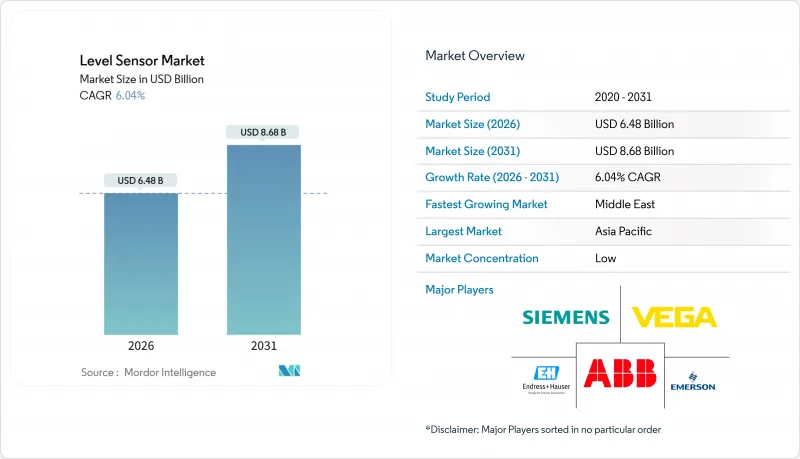
Mordor Intelligence에 의하면, 레벨 센서 시장 규모는 2026년에 64억 8,000만 달러에 이르고, 2031년까지 86억 8,000만 달러에 이르고, CAGR 6.04%로 확대될 것으로 예측됩니다.
본 보고서는 감시 방식(포인트 레벨 센서 및 연속 레벨 센서), 기술(접촉식 센서 및 비접촉식 센서), 센서 기술(정전용량식, 전도식, 광학식/광전식, 마이크로파/레이더식 등),구성 부품(감지 소자 및 프로브, 트랜스미터/컨버터, 디스플레이 및 컨트롤러), 그리고 지역별로 분류되어 있습니다. 시장 예측은 금액(달러) 기준으로 제시되어 있습니다.
전 세계 레벨 센서 시장 동향 및 인사이트
북미의 카스토디 트랜스퍼 시스템에서 80GHz FMCW 레이더로의 전환
미국 및 캐나다의 파이프라인 사업자와 정유업체들은 미국석유협회(API)가 정한 더 엄격한 석유 측정 기준을 충족하기 위해 기존의 24 기가헤르츠 센서에서 80 기가헤르츠 주파수 변조 연속파(FMCW) 장치로의 전환을 추진하고 있습니다. 주파수를 높임으로써 빔 각도가 좁아져, 높고 가느다란 탱크 내부의 오에코를 최소화하면서 ±0.5mm의 정확도를 실현합니다. 현재 계약 조항에서는 원유 터미널, 액화석유 및 가스(LPG) 저장소 및 액화천연가스(LNG) 수출 부두에서 80기가헤르츠 장치의 사용을 명시적으로 의무화하고 있습니다. 각 벤더사는 WirelessHART 및 IO-Link를 통합함으로써 신호 케이블을 불필요하게 만들고, 정밀도가 저하되기 전에 안테나의 오염을 감지하는 예측 진단 기능을 가능하게 하고 있습니다. 멕시코만 연안 및 캐나다 서부에 위치한 약 12,000기의 탱크는 2029년까지 개보수가 예정되어 있어, 이를 통해 지속적인 수익원이 창출될 것입니다.
걸프협력회의(GCC) 지역 내 디지털화를 주도하는 탱크 팜 자동화의 급속한 확대
사우디 아람코, ADNOC, 쿠웨이트 석유 공사는 10,000기 이상의 저장 탱크 자동화를 추진하고 있으며, IEC 61511의 위험 감소 요건을 충족하는 이중화 아키텍처를 갖춘 레이더 및 가이드웨이브 방식의 트랜스미터를 도입하고 있습니다. 수동 계량 작업의 폐지로 인해 제품 손실에 대한 클레임이 감소하고, 레시피에 기반한 블렌딩이 가능해짐에 따라 배럴당 정유 마진이 향상됩니다. 각 프로젝트에서는 탄화수소 용도에 대해 안전 무결성 수준(SIL) 2 인증, 황화수소 환경에 대해 SIL 3 인증이 규정되어 있어, 이에 따라 종합적인 인증 포트폴리오를 보유한 공급업체에 대한 수요가 증가하고 있습니다. GCC 국가들이 무인화 현장을 선호하는 경향이 있어, 클라우드 기반 재고 대시보드의 도입이 더욱 가속화되고 있습니다.
80GHz 프런트엔드용 8인치 GaAs MMIC 파운드리 생산 능력 부족
세계적으로 8인치 갈륨 비소(GaAs) 웨이퍼를 가공할 수 있는 파운드리 업체는 10곳 미만이며, 그중 3곳이 생산량의 70% 이상을 차지하고 있습니다. 자동차용 레이더, 5G, 위성 관련 수주가 산업용 수요를 압박하고 있어 리드타임이 52주까지 늘어났습니다. 80 기가헤르츠 프런트엔드의 수율은 60% 전후로 유지되고 있습니다. 이는 전자 이동도의 목표값이 8,000 cm²V?¹을 초과하면 결함 밀도가 상승하기 때문입니다. 중견 센서 공급업체들은 제품 출시를 연기하거나 24기가헤르츠 플랫폼으로 회귀하고 있어, 계량 거래 고객들이 요구하는 정밀도를 희생하고 있습니다. IQE 및 AWSC의 신규 생산 능력 가동은 2027년 하반기가 되어야 가능할 것으로 예상되므로, 송신기 가격은 높은 수준을 유지하고 있으며, 수처리 및 식품 가공 분야의 입찰에서 이익률이 압박받고 있습니다.
부문 분석
연속 측정형 장치는 2025년에 매출 점유율의 67.80%를 차지할 것이며, 정유시설, 화학 산업 단지 및 배터리 전해액 생산 라인이 재고 가시화를 추구함에 따라 연평균 성장률(CAGR) 8.50%로 계속 확대될 전망입니다. 레이더, 초음파 및 자기 변형식 솔루션은 기포층, 교반기 소용돌이 및 층상 계면을 실시간으로 감지하여 예기치 않은 가동 중단을 약 20% 줄여줍니다. HART, Profibus, Foundation Fieldbus와 같은 디지털 프로토콜은 교정 데이터 및 진단 데이터를 트랜스미터에 통합함으로써 시운전 시간을 단축하고 원격 성능 테스트를 가능하게 합니다. 대조적으로, 포인트 레벨 측정 장치는 펌프 인터록, 과충진 방지, 저레벨 경보에 바이너리 로직에 의존하기 때문에 매출 성장세가 뒤처지고 있지만, 소형 탱크나 데이 베셀에서는 여전히 견조한 수요를 유지하고 있습니다. 기계식 플로트는 구형 설비나 계측 전문 지식이 제한적인 지역에서 여전히 사용되고 있지만, 안전 감사에 따라 업그레이드가 의무화됨에 따라 그 점유율은 해마다 줄어들고 있습니다. 레벨 센서 시장은 고부가가치 공정 플랜트에서 예측 유지보수가 의무화됨에 따라 혜택을 보고 있으며, 보수적인 운영자조차도 연속 측정 아키텍처로의 전환을 추진하고 있습니다.
포인트 레벨 센서는 고형물 처리, 오버필 경보 및 저비용 물 탱크 분야에서 귀중한 틈새 시장을 계속 유지할 것입니다. 진동 포크는 주파수 저하가 건조 상태와 고장 상태를 모두 나타내기 때문에 페일세이프 설계를 구현합니다. 전도도 프로브는 산 및 염수 응용 분야에서 여전히 선호되지만, 유전율에 대한 의존성으로 인해 탄화수소 스트림에서의 사용은 제한적입니다. 장거리 케이블식 플로트는 특히 레이더 도입 비용이 여전히 너무 높은 개방형 저수지에서 개발도상국 시장에서 여전히 사용되고 있습니다. 전반적으로, 산업용 IoT(IIoT) 이니셔티브가 확대됨에 따라 연속 모니터링은 자산 관리 대시보드 및 공급업체가 호스팅하는 클라우드 분석과 연동되어 레벨 센서 시장 내 이러한 변화를 뒷받침하고 있습니다.
비접촉식 기술은 2025년 도입 건수의 62.10%를 차지하며, 연평균 성장률(CAGR) 9.32%로 성장할 전망입니다. 초음파식 장치는 최대 15미터까지의 물 및 폐수 용도에서 주류를 이루고 있지만, 80 기가헤르츠 레이더는 3도 미만의 좁은 빔 각도와 유전율 변동의 영향을 받지 않는 특성으로 인해 계량 거래 분야에서 주도적인 위치를 차지하고 있습니다. 광학식 적외선 센서는 의약품 분야의 위생적인 용도 및 투명한 액체의 측정에 대응하고 있으며, 이 분야에서 접촉식 프로브를 사용하면 21 CFR Part 11에 따른 세척 검증 절차가 복잡해집니다. 접촉형 부문은 100바를 초과하는 고압 반응기나 -160°C 이하의 극저온 탄화수소 분야에서 여전히 중요성을 유지하고 있으며, 이러한 용도에서는 자기변형식 및 도파관 레이더가 서브mm급의 분해능을 발휘합니다. 정수압식 트랜스미터는 밀폐 탱크 용도에서 여전히 널리 사용되고 있으며, 기포나 증기의 구성에 영향을 받지 않는 차압 측정을 활용합니다.
도파 레이더는 프로브가 바이오필름이 발생하기 쉬운 데드레그 구역을 형성하기 때문에 위생 규제를 준수하는 데 어려움을 겪고 있지만, 높은 유전율이나 층분화로 인해 비접촉 감지가 어려운 액화천연가스 탱크에서는 이 기술이 뛰어난 성능을 발휘합니다. 따라서 접촉식과 비접촉식 방식이 공존하고 있지만, 비용 절감과 무선 프로토콜의 보급에 따라 비접촉식에 대한 평가가 높아지고 있습니다. 이러한 양극화는 레벨 센서 시장에서 두 가지 성장 기회가 존재함을 여실히 보여주고 있습니다.
지역별 분석
아시아태평양은 2025년에 전 세계 매출의 38.50%를 차지하며, 가장 큰 도입 실적을 유지하고 있습니다. 중국만 해도 2024년부터 2025년에 걸쳐 180 기가와트시의 리튬 이온 배터리 셀 생산 능력이 추가될 예정이며, 각 기가팩토리에는 리튬 헥사플루오로인산염 및 에틸렌 카보네이트 탱크용 레이더 및 자기변형식 센서가 장착되어 있습니다. 인도의 해수 담수화 시설 건설에는 프로젝트당 4,000대 이상의 레이더 및 초음파 유닛이 필요한 것으로 파악되며, 동남아시아의 액화천연가스(LNG) 수입 터미널에서는 극저온 에탄 저장을 위해 가이드웨이브 레이더가 채택되고 있습니다. 일본과 한국에서는 석유화학 산업단지에서 IEC 61508 규격 준수를 보장하기 위해 꾸준한 업데이트 주기가 시행되고 있는 반면, 호주의 구리, 니켈, 리튬 광산에서는 광미 댐에 내구성이 뛰어난 레이더가 설치되어 있습니다.
중동은 2031년까지 연평균 성장률(CAGR) 10.40%라는 가장 높은 성장이 예상됩니다. 사우디 아람코의 라스 타누라, 주바이르, 얌부 자동화 프로젝트에서는 수동 계량 작업을 폐지하고 레이더 송신기를 클라우드 대시보드에 통합함으로써 제품 손실로 인한 클레임을 15% 감소시켰습니다. 카타르의 노스필드 액화천연가스(LNG) 확장 프로젝트에서는 -160°C 환경의 프로판 저장 탱크에 가이드파 레이더가 채택되었습니다. 무인 터미널 전략, IEC 61511의 채택, 그리고 각국의 수소 로드맵에 따라 SIL 인증을 획득한 브랜드에 유리한 프리미엄 수요가 창출되고 있습니다.
북미와 유럽을 합치면 2025년 매출의 절반에 조금 못 미치는 비중을 차지합니다. 미국석유협회(API)의 규정 개정에 따라 멕시코만 연안에서 앨버타주의 오일샌드에 이르기까지 80기가헤르츠로의 교체 움직임이 가속화되고 있습니다. 유럽의 SIL-3 의무화로 인해 산업 전반의 생산량이 정체되어 있는 상황에서도 트윈 레이더 아키텍처 도입이 진행되고 있습니다. 남미에서는 현지 OEM 제조업체가 인증 비용을 부담할 수밖에 없고, 8인치 갈륨비소 파운드리 접근성도 제한적이어서 80기가헤르츠로의 전환 속도가 둔화되고 있습니다.
기타 혜택:
- 엑셀 형식 시장 예측(ME) 시트
- 3개월간 애널리스트 지원
자주 묻는 질문
목차
제1장 서론
제2장 조사 방법
제3장 주요 요약
제4장 시장 구도
제5장 시장 규모와 성장 예측
제6장 경쟁 구도
제7장 시장 기회와 향후 전망
LSH 26.09.03According to Mordor Intelligence, the level sensors market size stands at USD 6.48 billion in 2026 and is forecast to reach USD 8.68 billion by 2031, advancing at a 6.04% CAGR.
This report is Segmented by Monitoring Type (Point Level Sensors, and Continuous Level Sensors), Technology (Contact Sensors, and Non-Contact Sensors), Sensor Technology (Capacitive, Conductive, Optical/Photoelectric, Microwave/Radar, and More), Component (Sensing Element and Probe, Transmitter/Converter, and Display and Controller), and Geography. The Market Forecasts are Provided in Terms of Value (USD).
Global Level Sensor Market Trends and Insights
Transition to 80 GHz FMCW Radar in North American Custody-Transfer Systems
Pipeline operators and refiners in the United States and Canada are migrating from legacy 24 gigahertz sensors to 80 gigahertz frequency-modulated continuous-wave units to meet the American Petroleum Institute's tighter manual of petroleum measurement standards. The higher frequency narrows the beam angle, minimizing false echoes in tall, slender tanks while achieving +-0.5 millimeter accuracy. Contract clauses now explicitly require 80-gigahertz devices for crude-oil terminals, liquefied petroleum gas caverns, and liquefied natural gas export berths. Vendors embed WirelessHART and IO-Link to eliminate signal cabling and enable predictive diagnostics that flag antenna fouling before accuracy drifts. Roughly 12,000 tanks on the Gulf Coast and in Western Canada are slated for retrofit by 2029, creating a durable replacement revenue stream.
Digitization-Driven Tank-Farm Automation Surge in Gulf Cooperation Council
Saudi Aramco, ADNOC, and Kuwait Petroleum Corporation are automating more than 10,000 storage tanks, installing radar and guided-wave transmitters with redundant architectures that satisfy IEC 61511 risk-reduction factors . The removal of manual gauging trims product-loss claims and enables recipe-based blending that lifts refinery margin per barrel. Projects specify Safety Integrity Level 2 certification for hydrocarbon service and SIL 3 for hydrogen-sulfide environments, pushing demand toward vendors with full certificate portfolios. The GCC's preference for unmanned sites further accelerates the adoption of cloud-based inventory dashboards.
Shortage of 8-Inch GaAs MMIC Foundry Capacity for 80 GHz Front-Ends
Fewer than 10 foundries worldwide can process 8-inch gallium-arsenide wafers, and three of them account for over 70% of the volume. Automotive radar, 5G, and satellite contracts crowd out industrial demand, stretching lead times to 52 weeks. Yield for 80 gigahertz front-ends hovers near 60% because defect densities rise as electron mobility targets climb above 8,000 cm^2 V-s. Mid-tier sensor vendors have postponed launches or reverted to 24-gigahertz platforms, sacrificing the accuracy that custody-transfer clients demand. New capacity from IQE and AWSC arrives only in late 2027, keeping transmitter prices elevated and squeezing margins on water-treatment and food-processing bids.
Other drivers and restraints analyzed in the detailed report include:
- Rapid Build-Out of Desalination and Waste-Water Megaprojects Across Asia-Pacific
- Mandatory SIL-3 Safety Audits in European Chemical Parks Boosting Radar Installations
- EMI-Induced Accuracy Drift in Steel Mills Limiting Adoption in India
For complete list of drivers and restraints, kindly check the Table Of Contents.
Segment Analysis
Continuous devices captured a 67.80% revenue share in 2025 and will keep expanding at an 8.50% CAGR as refineries, chemical parks, and battery-electrolyte lines pursue inventory transparency. Radar, ultrasonic, and magnetostrictive solutions reduce unplanned shutdowns by roughly 20% because they detect foam blankets, agitator swirl, and stratified interfaces in real time. Digital protocols such as HART, Profibus, and Foundation Fieldbus embed calibration and diagnostic data within the transmitter, cutting commissioning hours and enabling remote proof tests. In contrast, point-level devices rely on binary logic for pump interlock, overfill protection, and low-level alarms, so their revenue growth trails but remains resilient in small tanks and day vessels. Mechanical floats linger in legacy installations and regions with limited instrumentation expertise, yet their footprint erodes each year as safety audits force upgrades. The level sensors market benefits from predictive-maintenance mandates in high-value process plants, nudging even conservative operators toward continuous architectures.
Point-level sensors will keep a valuable niche in solids handling, overfill alarms, and low-cost water tanks. Vibratory forks offer a fail-safe design because frequency drops signal both dry and fault conditions. Conductivity probes retain traction in acid and brine service, but dielectric dependence limits usage in hydrocarbon streams. Long-span cable floats survive in developing regions, particularly for open reservoirs where radar budgets remain prohibitive. Overall, as Industrial Internet of Things initiatives spread, continuous monitoring aligns with asset-management dashboards and vendor-hosted cloud analytics, reinforcing the shift inside the level sensors market.
Non-contact technologies accounted for 62.10% of 2025 deployments and are headed for a 9.32% CAGR. Ultrasonic units dominate water and wastewater applications up to 15 meters, while 80 gigahertz radar leads in custody transfer thanks to a beam angle narrower than 3 degrees and independence from dielectric constant variation. Optical infrared sensors cover hygienic and transparent-liquid duties in pharmaceuticals where contact probes complicate cleaning validation under 21 CFR Part 11. The contact segment retains relevance in high-pressure reactors above 100 bar and cryogenic hydrocarbons below -160 °C, where magnetostrictive and guided-wave radar demonstrate sub-millimeter resolution. Hydrostatic transmitters persist for sealed-tank applications, leveraging differential-pressure measurement that remains immune to foam and vapor composition.
Guided-wave radar struggles with hygienic regulations because probes create dead-leg zones susceptible to biofilm, yet the technology excels in liquefied natural gas tanks where high dielectric and stratified layers complicate non-contact sensing. Contact and non-contact approaches therefore coexist, but the value narrative leans toward non-contact as costs fall and wireless protocols proliferate. This split underlines the dual-thrust growth opportunities inside the level sensors market.
Complete Report Scope:
- By Monitoring Type
- Point Level Sensors
- Mechanical and Magnetic Float
- Capacitance
- Vibratory Probe
- Conductivity
- Other Point Level Sensors
- Continuous Level Sensors
- Laser
- Ultrasonic
- Magnetostrictive
- Radar
- Other Continuous Level Sensors
- Mechanical and Magnetic Float
- By Technology
- Contact Sensors
- Hydrostatic
- Magnetostrictive
- Guided-Wave Radar
- Non-Contact Sensors
- Ultrasonic
- 24 GHz Radar
- 80 GHz Radar
- Optical / IR
- Contact Sensors
- By Sensor Technology
- Capacitive
- Conductive
- Optical / Photoelectric
- Microwave / Radar
- Ultrasonic
- Vibratory Fork
- By Component
- Sensing Element and Probe
- Transmitter / Converter
- Display and Controller
- Point Level Sensors
- By Geography
- North America
- United States
- Canada
- Mexico
- Europe
- Germany
- United Kingdom
- France
- Italy
- Spain
- Russia
- Rest of Europe
- Asia-Pacific
- China
- Japan
- India
- South Korea
- Australia
- Rest of Asia-Pacific
- Middle East
- Saudi Arabia
- United Arab Emirates
- Turkey
- Rest of Middle East
- Africa
- South Africa
- Nigeria
- Rest of Africa
- South America
- Brazil
- Argentina
- Rest of South America
- North America
Geography Analysis
Asia-Pacific generated 38.50% of global revenue in 2025 and maintains the largest installed base. China alone added 180 gigawatt-hours of lithium-ion cell capacity during 2024-2025, each gigafactory outfitted with radar and magnetostrictive sensors for lithium hexafluorophosphate and ethylene carbonate tanks. India's desalination build-out requires more than 4,000 radar and ultrasonic units per project, and Southeast Asia's liquefied natural gas import terminals select guided-wave radar for cryogenic ethane storage. Japan and South Korea execute steady replacement cycles to secure IEC 61508 compliance in petrochemical parks, while Australia's copper, nickel, and lithium mines install heavy-duty radar in tailings dams.
The Middle East is poised for the fastest 10.40% CAGR through 2031. Saudi Aramco's Ras Tanura, Jubail, and Yanbu automation projects eliminate manual gauging and integrate radar transmitters into cloud dashboards that cut product-loss claims by 15%. Qatar's North Field liquefied natural gas expansion specifies guided-wave radar for propane spheres at -160 °C. Unmanned terminal strategies, IEC 61511 adoption, and national hydrogen roadmaps create premium demand that favors brands with SIL certificates.
North America and Europe together account for just under half of 2025 revenue. Updated American Petroleum Institute rules trigger an 80 gigahertz replacement wave from the Gulf Coast to Alberta oil sands. Europe's SIL-3 mandates drive twin-radar architectures even as overall industrial output plateaus. South America lags because local original equipment manufacturers bear high certification costs and minimal access to 8-inch gallium-arsenide foundries, limiting the pace of 80 gigahertz migration.
- ABB Ltd
- Emerson Electric Co.
- Honeywell International Inc.
- Siemens AG
- Endress + Hauser AG
- Sick AG
- VEGA Grieshaber KG
- KROHNE Group
- Baumer Group
- TE Connectivity Ltd
- First Sensor AG
- BinMaster Inc.
- AMETEK Inc.
- Pepperl + Fuchs SE
- Anton Paar GmbH
- Omega Engineering Inc.
- ifm electronic GmbH
- Yokogawa Electric Corp.
- Omron Corporation
- Rockwell Automation Inc.
- KOBOLD Messring GmbH
Additional Benefits:
- The market estimate (ME) sheet in Excel format
- 3 months of analyst support
TABLE OF CONTENTS
1 INTRODUCTION
- 1.1 Study Assumptions and Market Definition
- 1.2 Scope of the Study
2 RESEARCH METHODOLOGY
3 EXECUTIVE SUMMARY
4 MARKET LANDSCAPE
- 4.1 Market Overview
- 4.2 Market Drivers
- 4.2.1 Digitisation-Driven Tank-Farm Automation Surge in Gulf Cooperation Council (GCC)
- 4.2.2 Rapid Build-Out of Desalination and Waste-Water Megaprojects Across Asia-Pacific
- 4.2.3 Mandatory SIL-3 Safety Audits in European Chemical Parks Boosting Radar Installations
- 4.2.4 Transition to 80 GHz FMCW Radar in North-American Custody-Transfer Systems
- 4.2.5 Battery-Electric Vehicle Electrolyte Production Capacity Investments in China
- 4.2.6 LNG Floating Storage and Regasification Unit Orders Accelerating Point-Level Demand
- 4.3 Market Restraints
- 4.3.1 EMI-Induced Accuracy Drift in Steel Mills Limiting Adoption in India
- 4.3.2 Low Acceptance of Guided-Wave Radar in Hygienic Pharma Lines (US and EU GMP)
- 4.3.3 Shortage of 8-inch GaAs MMIC Foundry Capacity for 80 GHz Front-Ends
- 4.3.4 Complex SIL Certification Cost for Small OEMs in South America
- 4.4 Industry Value Chain Analysis
- 4.5 Regulatory Landscape
- 4.6 Technological Outlook
- 4.7 Impact of Macroeconomic Factors
- 4.8 Porter's Five Forces Analysis
- 4.8.1 Threat of New Entrants
- 4.8.2 Bargaining Power of Suppliers
- 4.8.3 Bargaining Power of Buyers
- 4.8.4 Threat of Substitutes
- 4.8.5 Competitive Rivalry
5 MARKET SIZE AND GROWTH FORECASTS (VALUE)
- 5.1 By Monitoring Type
- 5.1.1 Point Level Sensors
- 5.1.1.1 Mechanical and Magnetic Float
- 5.1.1.1.1 Capacitance
- 5.1.1.1.2 Vibratory Probe
- 5.1.1.1.3 Conductivity
- 5.1.1.1.4 Other Point Level Sensors
- 5.1.1.2 Continuous Level Sensors
- 5.1.1.2.1 Laser
- 5.1.1.2.2 Ultrasonic
- 5.1.1.2.3 Magnetostrictive
- 5.1.1.2.4 Radar
- 5.1.1.2.5 Other Continuous Level Sensors
- 5.1.1.1 Mechanical and Magnetic Float
- 5.1.2 By Technology
- 5.1.2.1 Contact Sensors
- 5.1.2.1.1 Hydrostatic
- 5.1.2.1.2 Magnetostrictive
- 5.1.2.1.3 Guided-Wave Radar
- 5.1.2.2 Non-Contact Sensors
- 5.1.2.2.1 Ultrasonic
- 5.1.2.2.2 24 GHz Radar
- 5.1.2.2.3 80 GHz Radar
- 5.1.2.2.4 Optical / IR
- 5.1.2.1 Contact Sensors
- 5.1.3 By Sensor Technology
- 5.1.3.1 Capacitive
- 5.1.3.2 Conductive
- 5.1.3.3 Optical / Photoelectric
- 5.1.3.4 Microwave / Radar
- 5.1.3.5 Ultrasonic
- 5.1.3.6 Vibratory Fork
- 5.1.4 By Component
- 5.1.4.1 Sensing Element and Probe
- 5.1.4.2 Transmitter / Converter
- 5.1.4.3 Display and Controller
- 5.1.1 Point Level Sensors
- 5.2 By Geography
- 5.2.1 North America
- 5.2.1.1 United States
- 5.2.1.2 Canada
- 5.2.1.3 Mexico
- 5.2.2 Europe
- 5.2.2.1 Germany
- 5.2.2.2 United Kingdom
- 5.2.2.3 France
- 5.2.2.4 Italy
- 5.2.2.5 Spain
- 5.2.2.6 Russia
- 5.2.2.7 Rest of Europe
- 5.2.3 Asia-Pacific
- 5.2.3.1 China
- 5.2.3.2 Japan
- 5.2.3.3 India
- 5.2.3.4 South Korea
- 5.2.3.5 Australia
- 5.2.3.6 Rest of Asia-Pacific
- 5.2.4 Middle East
- 5.2.4.1 Saudi Arabia
- 5.2.4.2 United Arab Emirates
- 5.2.4.3 Turkey
- 5.2.4.4 Rest of Middle East
- 5.2.5 Africa
- 5.2.5.1 South Africa
- 5.2.5.2 Nigeria
- 5.2.5.3 Rest of Africa
- 5.2.6 South America
- 5.2.6.1 Brazil
- 5.2.6.2 Argentina
- 5.2.6.3 Rest of South America
- 5.2.1 North America
6 COMPETITIVE LANDSCAPE
- 6.1 Market Concentration
- 6.2 Strategic Moves
- 6.3 Market Share Analysis
- 6.4 Company Profiles (includes Global level Overview, Market level overview, Core Segments, Financials as available, Strategic Information, Market Rank/Share for key companies, Products and Services, and Recent Developments)
- 6.4.1 ABB Ltd
- 6.4.2 Emerson Electric Co.
- 6.4.3 Honeywell International Inc.
- 6.4.4 Siemens AG
- 6.4.5 Endress + Hauser AG
- 6.4.6 Sick AG
- 6.4.7 VEGA Grieshaber KG
- 6.4.8 KROHNE Group
- 6.4.9 Baumer Group
- 6.4.10 TE Connectivity Ltd
- 6.4.11 First Sensor AG
- 6.4.12 BinMaster Inc.
- 6.4.13 AMETEK Inc.
- 6.4.14 Pepperl + Fuchs SE
- 6.4.15 Anton Paar GmbH
- 6.4.16 Omega Engineering Inc.
- 6.4.17 ifm electronic GmbH
- 6.4.18 Yokogawa Electric Corp.
- 6.4.19 Omron Corporation
- 6.4.20 Rockwell Automation Inc.
- 6.4.21 KOBOLD Messring GmbH
7 MARKET OPPORTUNITIES AND FUTURE OUTLOOK
- 7.1 White-Space and Unmet-Need Assessment


