

|
시장보고서
상품코드
2122633
실내 농업 : 시장 점유율 분석, 업계 동향과 통계, 성장 예측(2026-2031년)Indoor Farming - Market Share Analysis, Industry Trends & Statistics, Growth Forecasts (2026 - 2031) |
||||||
 Mordor Intelligence
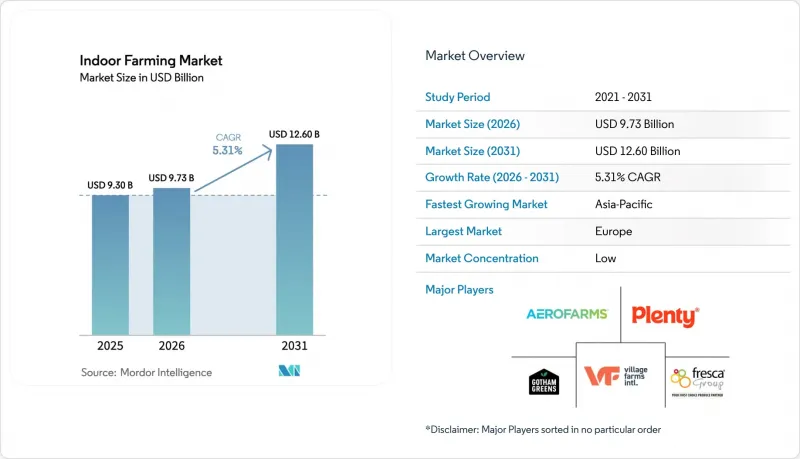
Mordor Intelligence에 의하면, 실내 농업 시장 규모는 2025년에 93억 달러로 평가되었고, 2026년에는 97억 3,000만 달러에 이를 것으로 추정되고 있습니다.
또한, 2031년까지 126억 달러로 성장할 것으로 예측 기간(2026년-2031년) 동안 연평균 성장률(CAGR) 5.31%를 기록하며 확대될 것으로 전망됩니다.
본 보고서는 재배 시스템별(에어로포닉스, 하이드로포닉스,아쿠아포닉스 등), 시설 유형별(유리 또는 폴리카보네이트 온실, 실내 수직 농업, 컨테이너 농업 등), 작물 유형별(과일 및 채소, 허브·마이크로그린 등), 지역별(북미, 유럽, 남미, 아시아태평양 등)로 분류되어 있습니다. 시장 전망은 금액(달러) 기준으로 제시되어 있습니다.
전 세계 실내 농업 시장 동향 및 인사이트
도시 지역의 신선하고 무농약 농산물에 대한 수요
대도시권의 건강 지향적인 소비자들은 지역에서 재배된 무농약 잎채소에 대해 20%에서 30%의 프리미엄을 지불할 의사가 있습니다. 이로 인해 가격적 우위가 발생하며, 실내 농장은 이를 활용하여 높은 생산 비용을 상쇄하고 있습니다. 홀푸드(Whole Foods)와 클로거(Kroger)와 같은 소매업체들은 2024년에 고담 그린스(Gotham Greens) 및 브라이트 팜스(Bright Farms)와 다년간공급 계약을 체결하고, 진열 공간과 공급량을 확보함으로써 수요의 불확실성을 줄이고 있습니다. 이러한 추세는 대장균이나 리스테리아에 오염된 노지 재배 상추와 관련된 식품 안전 리콜로 인해 더욱 가속화되고 있으며, 기존공급망에 대한 소비자의 신뢰를 훼손하고 있습니다. 도시와의 근접성으로 인해 라스트 마일 물류 비용이 40%에서 50%까지 절감되어, HelloFresh나 Blue Apron과 같은 밀키트 서비스가 추구하는 당일 배송 모델의 실현이 가능해집니다. 또한, 미국 농무부(USDA)의 ‘지역 식품 진흥 프로그램’은 2025년에 5,000만 달러를 배정하여, GAP(적정 농업 관행) 인증 기준을 준수하는 환경 제어 시설에 대한 보조금을 포함하여 도시 농업 인프라를 지원했습니다.
LED 효율 향상 및 냉난방·환기(HVAC) 비용 절감
2025년에는 LED 조명 기구의 광속 효율이 1줄당 3.0 마이크로몰을 초과하여 2020년 수준보다 25% 향상되었으며, 상추 1kg당 전력 소비량을 약 18% 절감했습니다. Signify 및 Osram과 같은 제조업체들은 2024년에 스펙트럼 조절이 가능한 시스템을 도입하여 다양한 생육 단계에서 광합성 효율을 최적화하는 동시에, 영양 생장기 및 개화기 동안의 에너지 낭비를 최소화했습니다. 제습제식 제습기나 열회수 환기 시스템 등 난방·환기·공조(HVAC) 분야의 기술 혁신을 통해 2025년에는 기후 제어 비용이 15%에서 20%까지 절감되었습니다. 이러한 발전 덕분에 UAE나 사우디아라비아와 같은 고온 기후 지역에서도 연중 생산이 경제적으로 가능해졌습니다. 국제에너지기구(IEA)는 2027년까지 고체 조명의 효율이 1줄당 3.5마이크로몰에 도달하여, 실내 농업과 노지 농업 간의 에너지 집약도 격차가 더욱 좁혀질 것으로 예측했습니다.
높은 설비 투자액과 에너지 집약도
1에이커 규모의 수직 농장의 초기 설비 투자액은 자동화 수준과 기후 제어 요건에 따라 1,000만 달러에서 2,500만 달러 사이입니다. 이 높은 비용은 큰 진입 장벽이 되어, 자금력이 있는 기업이나 보조금이 지원되는 대출을 받을 수 있는 기업으로 진입이 제한되고 있습니다. 에너지 비용은 운영 비용의 25%에서 35%를 차지하며, 캘리포니아주나 독일 등 전력 비용이 높은 지역에 위치한 시설의 경우 손익분기점에 도달하는 데 7년 이상 걸리기 때문에 투자에 걸림돌이 되고 있습니다. 2023년에 발생한 AppHarvest의 파산은 비용 초과와 생산량 감소가 원인이었으며, 이로 인해 대출 기관과 주식 투자자들의 우려가 더욱 고조되어 2024년 및 2025년에는 신규 프로젝트에 대한 대출 조건이 엄격해졌습니다. 2025년, 미국 에너지부의 ‘베터 빌딩 이니셔티브(Better Buildings Initiative)’는 전력 소비를 비피크 시간대로 전환하여 수요 요금을 20%에서 30%까지 절감하는 것을 목표로 하는 에너지 저장 시스템 시범 사업에 3,000만 달러의 보조금을 지급했습니다. 이 이니셔티브의 도입은 배터리 설치를 위한 충분한 지붕 공간이나 인접한 부지를 보유한 시설로 제한됩니다.
부문별 분석
2025년, 수경 재배는 실내 농업 시장 규모의 59.0%를 차지했습니다. 이는 수십 년에 걸친 농업학 연구와 펌프, 저수조, 영양액에 대한 확립된 공급망에 힘입은 결과입니다. AeroFarms의 2024년 지속가능성 공개 보고서에 따르면, 에어로포닉스 시스템은 토양 재배 방식에 비해 물 사용량을 95% 절감하고, 수경 재배에 비해 40% 절감하며,탈염수 비용이 1입방미터당 1.50-2달러에 달하는 중동 등 지역에서는 이는 큰 장점이 됩니다. 재배 시스템 선정에는 기술적 선호도보다 작물의 경제성이 점점 더 큰 영향을 미치고 있습니다. 예를 들어, 얕은 뿌리 영역과 신속한 물 교환이 필요한 잎채소는 영양막 재배법에 매우 적합합니다. 반면, 베리류와 같은 고수익 작물의 경우, 에어로포닉스의 복잡성이 정당화됩니다. 이는 공기 흐름이 개선됨으로써 과일의 경도와 색상이 향상되어 프리미엄 가격으로 판매할 수 있기 때문입니다.
에어로포닉스는 가뭄이 발생하기 쉬운 지역의 물 절약 수요와, 안개 형태로 뿌리 영역에 직접 영양분을 공급하여 작물의 생육 주기를 가속화해야 할 필요성에 힘입어 2031년까지 연평균 성장률(CAGR) 15.0%로 확대될 것으로 예측되며, 이는 실내 농업 시스템 중 가장 높은 성장률입니다. 양어와 채소 재배를 결합한 아쿠아포닉스는 양식 허가와 관련된 규제상의 과제와 원예학 및 수생생물학에 대한 전문 지식이 모두 요구되기 때문에 여전히 틈새 기술에 그치고 있습니다. 토양을 이용한 실내 시스템은 합성 영양소를 사용할 수 없는 유기농 인증을 획득한 사업자들에게 선호됩니다. 이러한 시스템에서는 더 깊은 재배 침대와 긴 재배 주기가 필요하기 때문에 생산량이 감소합니다.
지역별 분석
2025년, 유럽은 실내 농업 시장에서 33.9%의 점유율을 차지하며 시장을 주도했습니다. 이는 네덜란드의 선진적인 첨단 온실 클러스터, 기후 제어에 능숙한 인력, 그리고 저탄소 농업을 촉진하는 탄소세 우대 조치에 힘입은 결과입니다. 독일과 스페인의 소매업체들은 조달 계약 대상을 중규모 수직 농장으로까지 확대되고 있습니다. 이를 통해 운송 거리가 단축되고, 연중 안정적인 재고 확보가 가능해집니다. 에너지 가격 변동은 과제로 남아 있지만, 광범위한 지역 난방 네트워크의 존재와 재생에너지 구매 계약(PPA)의 활용 확대를 통해 비용 위험을 완화하고 있습니다.
아시아태평양은 토지 부족과 안전하며 추적 가능한 농산물을 요구하는 도시 중산층의 확대에 힘입어, 2031년까지 9.0%라는 가장 높은 연평균 성장률(CAGR)을 나타낼 전망입니다. 싱가포르에서는 정부의 보조금 및 연면적 우대 조치로 옥상 농업 사업이 지원되고 있지만, 몇 가지 주목할 만한 폐쇄 사례가 보여주듯이, 설비 투자와 지역 수요 간의 균형을 맞추는 데 있어 과제는 여전히 남아 있습니다. 중국에서는 연안 지역의 각 성이 새로운 ‘애그리테크 파크’ 내에 환경 제어형 허브를 구축하고 있으며, 대학과 벤처 투자자 간의 협력을 촉진함으로써 선진적인 기법의 도입을 가속화하고 있습니다. 일본에서는 지방 자치단체의 유틸리티체가 야간 전력 계통 부하를 안정화하기 위해 LED 조명 사용을 보조하고 있으며, 이는 간접적으로 생산 비용 절감으로 이어지고 있습니다.
북미는 성숙한 시장이지만, 온실 면적은 계속 확대되고 있습니다. 예를 들어, 텍사스주에 위치한 브라이트팜스(Bright Farms)의 150만 평방피트 규모 복합 시설에서는 증발 냉각을 이용하여 여름철 잎의 온도를 화씨 77도 이하로 유지하고 있으며, 이를 통해 지역 식료품점과 연중 공급 계약을 체결할 수 있게 되었습니다. 멕시코에서는 양호한 일조 조건과 저렴한 인건비를 활용하여 국경 인근 주로의 수출을 목적으로 차광 하우스에서의 채소 생산이 확대되고 있습니다. 중동에서는 식량 안보 강화와 해수 담수화 수요 감소를 목적으로, 국부펀드를 통해 수직 농업 프로젝트에 대한 대규모 투자가 이루어지고 있습니다. 아프리카에서는 실내 농업이 아직 초기 단계에 있지만, 케냐와 남아프리카공화국에서는 불안정한 전력 공급에 대응하기 위해 태양광 발전을 이용한 컨테이너 농장이 도입되어 주목을 받고 있습니다. 이러한 동향은 해당 지역의 실내 농업 시장 성장 가능성을 여실히 보여주고 있습니다.
기타 혜택:
- 엑셀 형식 시장 예측(ME) 시트
- 3개월간의 애널리스트 지원
자주 묻는 질문
목차
제1장 서론
제2장 조사 방법
제3장 주요 요약
제4장 시장 구도
제5장 시장 규모와 성장 예측
제6장 경쟁 구도
제7장 시장 기회와 향후 전망
LSH 26.09.03According to Mordor Intelligence, the indoor farming market size was valued at USD 9.30 billion in 2025 and is estimated to reach USD 9.73 billion in 2026, further projected to grow to USD 12.60 billion by 2031, advancing at a CAGR of 5.31% during the forecast period (2026-2031).
This report is Segmented by Growing System (Aeroponics, Hydroponics, Aquaponics, and More), by Facility Type (Glass or Poly Greenhouses, Indoor Vertical Farms, Container Farms, and More), by Crop Type (Fruits and Vegetables, Herbs and Microgreens, and More), and by Geography (North America, Europe, South America, Asia-Pacific, and More). The Market Forecasts are Provided in Terms of Value (USD).
Global Indoor Farming Market Trends and Insights
Urban Demand for Fresh, Pesticide-Free Produce
Health-conscious consumers in metropolitan areas are willing to pay 20% to 30% premiums for locally grown, pesticide-free greens. This creates a price advantage that indoor farms leverage to offset higher production costs. Retailers such as Whole Foods and Kroger secured multi-year supply agreements with Gotham Greens and BrightFarms in 2024, ensuring shelf space and volume commitments, which help reduce demand uncertainty. This trend is further driven by food-safety recalls linked to field-grown lettuce contaminated with E. coli and Listeria, eroding consumer confidence in conventional supply chains. Urban proximity reduces last-mile logistics costs by 40% to 50%, enabling same-day delivery models required by meal-kit services like HelloFresh and Blue Apron. Additionally, the USDA's Local Food Promotion Program allocated USD 50 million in 2025 to support urban agriculture infrastructure, including grants for controlled-environment facilities adhering to Good Agricultural Practices certification standards.
Light-Emitting Diode (LED) Efficiency and Heating, Ventilation, and Air Conditioning (HVAC) Cost Declines
LED fixture efficacy surpassed 3.0 micromoles per joule in 2025, marking a 25% improvement over 2020 levels and reducing electricity consumption per kilogram of lettuce by approximately 18%. Manufacturers such as Signify and Osram introduced tunable spectrum systems in 2024, optimizing photosynthetic efficiency across various growth stages and minimizing energy waste during vegetative and flowering phases. Innovations in Heating, Ventilation, and Air Conditioning (HVAC), including desiccant dehumidifiers and heat-recovery ventilation, reduced climate-control costs by 15% to 20% in 2025. These advancements have made year-round production economically viable in hot climates such as the UAE and Saudi Arabia. The International Energy Agency projects that solid-state lighting efficiency will reach 3.5 micromoles per joule by 2027, further narrowing the energy-intensity gap between indoor and field agriculture.
High CAPEX and Energy Intensity
The initial capital investment for a 1-acre vertical farm ranges between USD 10 million and USD 25 million, depending on the level of automation and climate-control requirements. This high cost creates a significant entry barrier, restricting participation to well-funded entities or those with access to subsidized financing. Energy expenses constitute 25% to 35% of operating costs, with facilities in regions such as California and Germany, where electricity costs are high, facing break-even periods exceeding seven years, which discourages investment. The bankruptcy of AppHarvest in 2023, caused by cost overruns and lower yields, further alarmed lenders and equity investors, leading to tighter credit availability for new projects in 2024 and 2025. In 2025, the United States Department of Energy's Better Buildings Initiative allocated USD 30 million in grants to pilot energy-storage systems aimed at shifting power consumption to off-peak hours, reducing demand charges by 20% to 30%. Adoption has been limited to facilities with adequate roof space or adjacent land for battery installations.
Other drivers and restraints analyzed in the detailed report include:
- Shrinking Arable Land and Extreme Weather Volatility
- Year-Round Production Ensuring Resilient Supply Chains
- Scarcity of Skilled Horticultural Workforce
For complete list of drivers and restraints, kindly check the Table Of Contents.
Segment Analysis
Hydroponics commanded a 59.0% share of the indoor farming market size in 2025, supported by decades of agronomic research and a well-established supplier network for pumps, reservoirs, and nutrient solutions. According to AeroFarms' 2024 sustainability disclosure, aeroponic systems use 95% less water than soil-based methods and 40% less than hydroponics, a significant advantage in regions like the Middle East, where desalinated water costs range from USD 1.50 to USD 2.00 per cubic meter. Crop economics rather than technical preferences increasingly influence the selection of growing systems. For instance, leafy greens, which require shallow root zones and rapid turnover, are well-suited to nutrient-film techniques. Conversely, high-margin crops like berries justify the complexity of aeroponics, as enhanced airflow improves fruit firmness and color, enabling premium pricing.
Aeroponics is forecast to accelerate at a 15.0% CAGR to 2031, the highest growth rate among indoor farming systems, driven by the need to conserve water in drought-prone areas and to accelerate crop cycles by delivering nutrients directly to root zones in mist form. Aquaponics, which combines fish farming with vegetable cultivation, remains a niche approach due to regulatory challenges related to aquaculture permits and the requirement for expertise in both horticulture and aquatic biology. Soil-based indoor systems are preferred by organic-certified operations that cannot use synthetic nutrients. These systems require deeper grow beds and longer crop cycles, which reduce throughput.
Complete Report Scope:
- By Growing System
- Aeroponics
- Hydroponics
- Aquaponics
- Soil-based
- Hybrid
- By Facility Type
- Glass or Poly Greenhouses
- Indoor Vertical Farms
- Container Farms
- Indoor Deep-Water Culture Systems
- Other Facility Types
- By Crop Type
- Fruits and Vegetables
- Leafy Vegetables
- Tomato
- Strawberry
- Eggplant
- Other Fruits and Vegetables
- Herbs and Microgreens
- Basil
- Tarragon
- Wheatgrass
- Other Herbs and Microgreens
- Flowers and Ornamentals
- Perennials
- Annuals
- Ornamentals
- Other Flowers and Ornamentals
- Other Crop Types
- Fruits and Vegetables
- By Geography
- North America
- United States
- Canada
- Mexico
- Rest of North America
- Europe
- Germany
- United Kingdom
- France
- Spain
- Italy
- Russia
- Rest of Europe
- Asia-Pacific
- China
- Japan
- India
- Australia
- Singapore
- South Korea
- Rest of Asia-Pacific
- Middle East
- Saudi Arabia
- United Arab Emirates
- Turkey
- Rest of Middle East
- Africa
- South Africa
- Kenya
- Nigeria
- Rest of Africa
- North America
Geography Analysis
Europe led the indoor farming market with a 33.9% share in 2025, supported by the Netherlands' advanced cluster of high-tech greenhouses, a skilled workforce in climate control, and carbon-tax incentives that promote low-emission agriculture. German and Spanish retailers are expanding their sourcing contracts to include mid-sized vertical farms, which reduce transportation distances and ensure consistent year-round inventory. While energy price volatility poses a challenge, the presence of widespread district heating networks and the increasing availability of renewable power purchase agreements help mitigate cost risks.
The Asia-Pacific region is projected to post the highest CAGR of 9.0% through 2031, driven by land scarcity and a growing urban middle class demanding safe and traceable produce. In Singapore, government grants and floor-area concessions support rooftop farming initiatives, though challenges remain in balancing capital investment with local demand, as evidenced by several high-profile closures. In China, coastal provinces are developing controlled-environment hubs within new "agri-tech parks," which foster collaboration between universities and venture investors, accelerating the adoption of advanced practices. In Japan, municipal utilities subsidize the use of Light-Emitting Diode (LED) lights to stabilize nighttime grid loads, indirectly reducing production costs.
North America, while a mature market, continues to expand its greenhouse acreage. For instance, BrightFarms' 1.5 million square foot complex in Texas utilizes evaporative cooling to maintain summer leaf temperatures below 77 degrees Fahrenheit, enabling year-round supply contracts with regional grocers. In Mexico, shade-house vegetable production is being scaled for export to border states, leveraging favorable sunlight and lower labor costs. The Middle East is heavily investing in vertical farming projects through sovereign funds, aiming to enhance food security and reduce desalination demands. In Africa, indoor farming is in its early stages, with notable adoption in Kenya and South Africa, where solar-powered container farms address unreliable grid supply. These developments highlight the region's potential for growth in the indoor farming market.
- AeroFarms, Inc.
- Plenty Unlimited Inc.
- Gotham Greens Holdings LLC
- Village Farms International Inc.
- Fresca Group (Thanet Earth)
- BrightFarms Inc. (Cox Enterprises Inc.)
- Pure Harvest Smart Farms Ltd.
- Fresca Group Limited
- Revol Greens LLC
- Windset Farms Inc.
- Sky Urban Solutions Holdings Pte Ltd.
- 80 Acres Urban Agriculture Inc.
- Spread Co., Ltd.
- Local Bounti Corporation
- Intelligent Growth Solutions Ltd.
Additional Benefits:
- The market estimate (ME) sheet in Excel format
- 3 months of analyst support
TABLE OF CONTENTS
1 Introduction
- 1.1 Study Assumptions and Market Definition
- 1.2 Scope of the Study
2 Research Methodology
3 Executive Summary
4 Market Landscape
- 4.1 Market Overview
- 4.2 Market Drivers
- 4.2.1 Urban demand for fresh, pesticide-free produce
- 4.2.2 LED efficiency and HVAC (Heating, Ventilation, and Air Conditioning) cost declines
- 4.2.3 Shrinking arable land and extreme weather volatility
- 4.2.4 Year-round production ensuring resilient supply chains
- 4.2.5 Surplus vacant retail/warehouse real estate repurposed
- 4.2.6 Carbon-credit monetization for low-footprint produce
- 4.3 Market Restraints
- 4.3.1 High CAPEX and energy intensity
- 4.3.2 Scarcity of skilled horticultural workforce
- 4.3.3 Venture Capital funding pull-back after high-profile bankruptcies
- 4.3.4 Urban grid-congestion and power-availability limits
- 4.4 Regulatory Landscape
- 4.5 Technological Outlook
- 4.6 Porter's Five Forces Analysis
- 4.6.1 Threat of New Entrants
- 4.6.2 Bargaining Power of Buyers/Consumers
- 4.6.3 Bargaining Power of Suppliers
- 4.6.4 Threat of Substitute Products
- 4.6.5 Intensity of Competitive Rivalry
5 Market Size and Growth Forecasts (Value)
- 5.1 By Growing System
- 5.1.1 Aeroponics
- 5.1.2 Hydroponics
- 5.1.3 Aquaponics
- 5.1.4 Soil-based
- 5.1.5 Hybrid
- 5.2 By Facility Type
- 5.2.1 Glass or Poly Greenhouses
- 5.2.2 Indoor Vertical Farms
- 5.2.3 Container Farms
- 5.2.4 Indoor Deep-Water Culture Systems
- 5.2.5 Other Facility Types
- 5.3 By Crop Type
- 5.3.1 Fruits and Vegetables
- 5.3.1.1 Leafy Vegetables
- 5.3.1.2 Tomato
- 5.3.1.3 Strawberry
- 5.3.1.4 Eggplant
- 5.3.1.5 Other Fruits and Vegetables
- 5.3.2 Herbs and Microgreens
- 5.3.2.1 Basil
- 5.3.2.2 Tarragon
- 5.3.2.3 Wheatgrass
- 5.3.2.4 Other Herbs and Microgreens
- 5.3.3 Flowers and Ornamentals
- 5.3.3.1 Perennials
- 5.3.3.2 Annuals
- 5.3.3.3 Ornamentals
- 5.3.3.4 Other Flowers and Ornamentals
- 5.3.4 Other Crop Types
- 5.3.1 Fruits and Vegetables
- 5.4 By Geography
- 5.4.1 North America
- 5.4.1.1 United States
- 5.4.1.2 Canada
- 5.4.1.3 Mexico
- 5.4.1.4 Rest of North America
- 5.4.2 Europe
- 5.4.2.1 Germany
- 5.4.2.2 United Kingdom
- 5.4.2.3 France
- 5.4.2.4 Spain
- 5.4.2.5 Italy
- 5.4.2.6 Russia
- 5.4.2.7 Rest of Europe
- 5.4.3 Asia-Pacific
- 5.4.3.1 China
- 5.4.3.2 Japan
- 5.4.3.3 India
- 5.4.3.4 Australia
- 5.4.3.5 Singapore
- 5.4.3.6 South Korea
- 5.4.3.7 Rest of Asia-Pacific
- 5.4.4 Middle East
- 5.4.4.1 Saudi Arabia
- 5.4.4.2 United Arab Emirates
- 5.4.4.3 Turkey
- 5.4.4.4 Rest of Middle East
- 5.4.5 Africa
- 5.4.5.1 South Africa
- 5.4.5.2 Kenya
- 5.4.5.3 Nigeria
- 5.4.5.4 Rest of Africa
- 5.4.1 North America
6 Competitive Landscape
- 6.1 Market Concentration
- 6.2 Strategic Moves
- 6.3 Market Share Analysis
- 6.4 Company Profiles (Includes Global Level Overview, Market Level Overview, Core Segments, Financials as Available, Strategic Information, Market Rank/Share, Products and Services, Recent Developments)
- 6.4.1 AeroFarms, Inc.
- 6.4.2 Plenty Unlimited Inc.
- 6.4.3 Gotham Greens Holdings LLC
- 6.4.4 Village Farms International Inc.
- 6.4.5 Fresca Group (Thanet Earth)
- 6.4.6 BrightFarms Inc. (Cox Enterprises Inc.)
- 6.4.7 Pure Harvest Smart Farms Ltd.
- 6.4.8 Fresca Group Limited
- 6.4.9 Revol Greens LLC
- 6.4.10 Windset Farms Inc.
- 6.4.11 Sky Urban Solutions Holdings Pte Ltd.
- 6.4.12 80 Acres Urban Agriculture Inc.
- 6.4.13 Spread Co., Ltd.
- 6.4.14 Local Bounti Corporation
- 6.4.15 Intelligent Growth Solutions Ltd.


