

|
시장보고서
상품코드
2122717
혈관성형술용 풍선 시장 : 시장 점유율 분석, 업계 동향 및 통계, 성장 예측(2026-2031년)Angioplasty Balloons - Market Share Analysis, Industry Trends & Statistics, Growth Forecasts (2026 - 2031) |
||||||
 Mordor Intelligence
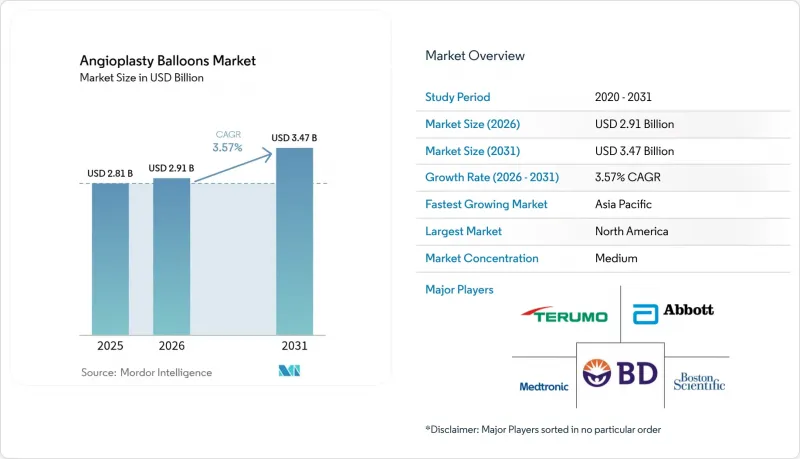
에 의하면, 혈관성형용 풍선 시장 규모는 2025년 28억 1,000만 달러로 평가되었고, 2026년에는 29억 1,000만 달러로 추정되고, 2026-2031년 CAGR 3.57%로 성장을 지속할 전망이며, 2031년까지 34억 7,000만 달러에 이를 것으로 예측됩니다.
본 보고서에서는 업계를 제품 유형별(일반 풍선, 커팅 풍선, 스코어링 풍선, 약물 방출형 풍선), 용도별(관상동맥 성형술, 말초혈관 성형술), 최종 사용자별(병원, 외래수술센터(ASC), 기타), 지역별(북미, 유럽, 아시아태평양, 중동 및 아프리카 등)로 분류하고 있습니다. 시장 예측은 금액(달러) 기준으로 제시되어 있습니다.
세계의 혈관성형술용 풍선 시장 동향 및 인사이트
심혈관 질환 유병률 증가
임상적 심혈관 질환을 앓고 있는 성인의 수는 2050년까지 미국에서만 4,500만 명을 넘어설 것으로 예측됩니다. 고혈압, 당뇨병, 비만의 유병률은 모두 계속 증가하고 있으며, 이는 카테터를 이용한 혈관 재건술에 대한 장기적인 수요를 뒷받침하고 있습니다. 관상동맥 질환으로 인한 사망률은 2000년부터 2020년 사이에 현저히 감소했으나, 최근에는 정체 상태를 보이고 있어 풍선 혈관 성형술에 대한 수요는 안정적인 양상을 보이고 있습니다. 2021년, 심장병 관련 입원 비용은 1,080억 달러에 달했으며, 2030년까지 1,313억 달러에 이를 것으로 예측됩니다. 이는 비용 대비 효과가 높은 저침습적 솔루션이 경제적으로 필수적임을 여실히 보여줍니다.
저침습 PCI로의 전환과 기술 발전
현재 임상 현장에서는 회복 기간을 단축하고 시설 비용을 절감할 수 있는 경피적 카테터 접근법이 선호되고 있습니다. 2025년에 발표된 관상동맥 DCB 임상시험의 표준화된 평가 지표에 따라 약물 코팅 풍선의 유효성이 입증되었습니다. 이 풍선을 사용한 경우 1년 후 표적 병변의 실패율이 17.9%였던 반면, 비약물 코팅 풍선을 사용한 경우 28.6%였습니다. 혈관 내 결석 분쇄술도 그 세를 넓혀가고 있으며, 풍선 내부의 음향 압력파를 이용하여 석회화를 분쇄하고 관강 회복을 촉진합니다. 이러한 기술들은 영구적인 금속을 남기지 않으면서 치료 성과를 향상시킴으로써, 혈관성형술용 풍선 시장 전망을 전반적으로 강화하고 있습니다.
스텐트 치료 패키지에 대한 높은 시술 및 기기 비용
풍선 단독 치료법이 추적 영상 진단 및 투약 계획을 포함하는 스텐트 패키지보다 비용이 더 높게 보일 경우, 의료 보험사는 여전히 신중한 태도를 유지하고 있습니다. 메디케어의 승인에도 불구하고, 미국에서는 외래 PCI 중 ASC(외래수술센터(ASC))에서 시행되는 비율이 여전히 1.8%에 그치고 있어, 경제적 주저함이 여전히 뿌리 깊게 남아 있음을 보여줍니다. 약물 코팅 풍선의 높은 가격 책정은 특히 공급망 인플레이션으로 인해 원자재비가 기기 매출의 20%까지 치솟은 상황에서 구매 결정을 더욱 신중하게 만들고 있습니다.
부문 분석
스코어링용 풍선은 2031년까지 연평균 성장률(CAGR) 4.26%라는 가장 빠른 성장 궤도를 보이고 있으며, 이러한 속도는 석회화 또는 섬유화 병변에 대한 플라크 수정 전략에서 이 풍선이 차지하는 역할을 반영합니다. Naviscore사의 첫 인체 시험 시리즈와 같은 연구에서 중등도 내지 중증 석회화에서 94%의 시술 성공률이 보고됨에 따라, 스코어링 시스템용 혈관 성형술용 풍선 시장 규모는 확대되고 있습니다. 일반 풍선은 여전히 일상적인 확장 전·후 처치에서 필수적이기 때문에 2025년 시장 점유율은 41.02%를 차지하며 일상적인 PCI에서 여전히 주류를 이루고 있습니다.
약물 코팅 풍선은 보스턴 사이언티피크(Boston Scientific)사의 ‘AGENT’가 승인된 후 결정적인 탄력을 받았습니다. 이 임상시험에서는 기존 혈관성형술에 비해 재혈관재건률이 50% 감소한 것으로 나타났습니다. 커팅 풍선은 스텐트 내 재협착 및 소혈관 치료 분야에서 틈새 시장을 유지하고 있으며, 메타분석에 따르면 표적 병변의 재혈관 재건 위험이 33% 감소하는 것으로 나타났습니다. 현재 40기압을 초과하는 초고압형은 경화된 섬유성 석회화 플라크에 대한 경피적 치료를 가능하게 하여, 시술적 및 기술적 측면 모두에서 혈관성형용 풍선 시장을 확대되고 있습니다.
지역별 분석
2025년, 북미는 39.25%의 혈관성형술용 풍선 시장 점유율로 1위를 차지했습니다. 이는 광범위한 보험 적용 범위, 확립된 카테터실 네트워크, 그리고 프리미엄 기기의 조기 도입에 힘입은 결과입니다. 이 지역의 규제 환경은 혁신을 촉진하고 있으며, 2024년에 AGENT 관상동맥 DCB가 승인된 것이 그 증거입니다. ASC(외래수술센터(ASC))에서 PCI를 허용하는 CMS(미국 의료보험의료서비스센터)의 정책 변경으로 시술 건수 분포에 변화가 나타나기 시작했지만, 복잡한 시술의 대부분은 여전히 병원에서 담당하고 있습니다. 공급망 혼란이 장기화되면서 현지 제조업체들은 물류비 및 원자재비의 두 자릿수 인플레이션을 감당할 수밖에 없게 되었고, 이에 따라 디지털 재고 관리에 대한 관심이 높아지고 있습니다. 업계 재편도 활발히 진행되고 있으며, 특히 텔레플렉스(Teleflex)가 바이오트로닉(BIOTRONIK)의 혈관 사업 부문을 7억 6,000만 유로에 인수한 사례가 주목을 받았습니다. 이를 통해 해당 기업은 약물 코팅 풍선 및 스텐트 제품 라인업을 강화했습니다.
아시아태평양은 연평균 성장률(CAGR) 4.45%로 가장 빠른 성장세를 기록하고 있습니다. 인구 고령화, 도시화, 인프라 구축이 진행되면서 카테터실 수요가 확대되고 있습니다. 의료기기 승인 기준의 통일 및 국내 제조 촉진을 위한 정부의 이니셔티브으로 인해, 새로운 풍선이 시장에 출시되기까지의 기간은 계속해서 단축되고 있습니다. 지역 임상 지침에서는 현재 소혈관 질환이나 스텐트 내 재협착에 대해 DCB의 사용이 권장되고 있어, 치료법 선택이 세계적 기준과 일치해 가고 있습니다. 그러나 가격에 대한 민감성이 성장의 걸림돌이 되고 있으며, 고급 스코어링 기능을 갖춘 약물 방출형 풍선에 대한 수요가 증가하는 한편, 구매자들은 비용 대비 효과가 높은 플랫폼으로 기울면서 기본형 풍선의 현지 생산이 가속화되고 있습니다.
유럽에서는 경제적 압박으로 인해 일부 공적 의료 제도에서 프리미엄 의료기기의 도입이 제한되고 있어, 꾸준하기는 하지만 완만한 성장에 그치고 있습니다. 의료기기 규정(MDR)의 틀은 엄격하지만, 그 명확성 덕분에 테르모는 2024년에 여러 혈관 폐쇄 솔루션에 대해 CE 마크를 획득하여 치료 생태계를 유지할 수 있었습니다. 코디스의 시롤리무스 방출형 풍선 ‘SELUTION SLR’은 일본에서 3년 개존율 81.5%, 유럽 임상시험에서 표적 병변 재개통율 91.1%를 기록하며, 약물 방출형 플랫폼으로서의 입지를 확고히 했습니다. ‘약물 방출형 풍선 학술 연구 컨소시엄’ 등의 단체를 통한 임상 협력을 통해 유럽 전역에서 근거 기반의 도입이 촉진되었으며, 차세대 풍선의 선도 시장으로서 유럽의 역할이 유지되고 있습니다.
기타 혜택 :
- 엑셀 형식 시장 예측(ME) 시트
- 3개월간의 애널리스트 지원
자주 묻는 질문
목차
제1장 서론
제2장 조사 방법
제3장 주요 요약
제4장 시장 구도
제5장 시장 규모 및 성장 예측
제6장 경쟁 구도
제7장 시장 기회 및 향후 전망
AJY 26.09.07According to Mordor Intelligence, the angioplasty balloons market size is expected to grow from USD 2.81 billion in 2025 to USD 2.91 billion in 2026 and is forecast to reach USD 3.47 billion by 2031 at 3.57% CAGR over 2026-2031.

This report Segments the Industry Into by Product Type (Normal Balloons, Cutting Balloons, Scoring Balloons, and Drug-Eluting Balloons), by Application (Coronary Angioplasty, Peripheral Angioplasty), by End User (Hospitals, Ambulatory Surgical Centers, Others), and Geography (North America, Europe, Asia-Pacific, Middle East and Africa, and More). The Market Forecasts are Provided in Terms of Value (USD).
Global Angioplasty Balloons Market Trends and Insights
Rising Cardiovascular Disease Prevalence
The number of adults living with clinical cardiovascular disease is projected to top 45 million in the United States alone by 2050. Hypertension, diabetes, and obesity rates all continue to climb, reinforcing a long-run need for catheter-based revascularization. Although coronary mortality dropped markedly between 2000 and 2020, it has plateaued in recent years, keeping demand for balloon angioplasty stable. Hospitalizations linked to heart disease cost USD 108 billion in 2021, and forecasts point to USD 131.3 billion by 2030, highlighting the economic imperative for cost-effective minimally invasive solutions.
Shift toward Minimally-invasive PCI & Technology Advances
Clinical practice now favors percutaneous catheter approaches that shorten recovery and curb facility costs. Standardized endpoints for coronary DCB trials released in 2025 have legitimized drug-coated balloons, which posted 17.9% target-lesion failure at 1 year versus 28.6% with plain balloons. Intravascular lithotripsy is gaining momentum, using acoustic pressure waves inside the balloon to fracture calcium and improve luminal gain. These technologies collectively strengthen the angioplasty balloons market outlook by enhancing outcomes without leaving permanent metal behind.
High Procedure & Device Cost versus Stenting Bundles
Healthcare payers remain cautious when balloon-only strategies appear more expensive than bundled stent packages that include follow-up imaging and medication plans. Despite Medicare approval, ASCs still perform only 1.8% of outpatient PCIs in the United States, signaling persistent economic hesitation. Premium pricing on drug-coated balloons tightens purchasing decisions, especially where supply-chain inflation has lifted input costs to 20% of device revenues.
Other drivers and restraints analyzed in the detailed report include:
- Expanding Geriatric PAD Pool in Emerging Economies
- Breakthroughs in Bio-resorbable & Ultra-high-pressure Polymers
- Regulatory Scrutiny on Paclitaxel DCB Safety Signals
For complete list of drivers and restraints, kindly check the Table Of Contents.
Segment Analysis
Scoring balloons held the fastest growth trajectory at 4.26% CAGR through 2031, a pace that reflects their role in plaque-modification strategies for calcified or fibrotic lesions. The angioplasty balloons market size for scoring systems is rising as studies such as Naviscore's first-in-man series reported 94% procedural success in moderate-to-severe calcification. Normal balloons still dominate everyday PCI with 41.02% 2025 share because they remain indispensable for routine pre- and post-dilation steps.
Drug-coated balloons gained decisive momentum after Boston Scientific's AGENT approval, which showed a 50% reduction in repeat revascularization compared with conventional angioplasty. Cutting balloons preserve a niche for in-stent restenosis and small-vessel work, with meta-analysis indicating a 33% reduction in target-lesion revascularization risk. Ultra-high-pressure variants, now exceeding 40 atm, extend percutaneous treatment to hard fibro-calcific plaques, expanding the angioplasty balloons market both procedurally and technologically.
Complete Report Scope:
- By Product Type
- Normal Balloons
- Cutting Balloons
- Scoring Balloons
- Drug-Eluting Balloons
- By Application
- Coronary Angioplasty
- Peripheral Angioplasty
- By End User
- Hospitals
- Ambulatory Surgical Centers
- Others
- Geography
- North America
- United States
- Canada
- Mexico
- Europe
- Germany
- United Kingdom
- France
- Italy
- Spain
- Rest of Europe
- Asia-Pacific
- China
- Japan
- India
- South Korea
- Australia
- Rest of Asia-Pacific
- Middle East and Africa
- GCC
- Turkey
- South Africa
- Rest of Middle East and Africa
- South America
- Brazil
- Argentina
- Rest of South America
- North America
Geography Analysis
North America led with 39.25% angioplasty balloons market share in 2025, supported by broad insurance coverage, established cath-lab networks, and early adoption of premium devices. The region's regulatory environment favors innovation, evidenced by the 2024 clearance of the AGENT coronary DCB. CMS policy changes permitting ASC-based PCI have begun to reshape volume distribution, yet hospitals keep the bulk of complex procedures. Persistent supply-chain turbulence has forced local manufacturers to absorb double-digit logistics and raw-material inflation, heightening focus on digital inventory control. Consolidation remained active, highlighted by Teleflex's EUR 760 million acquisition of BIOTRONIK's vascular unit, which enriched its drug-coated balloon and stent offerings.
Asia-Pacific registers the swiftest expansion at 4.45% CAGR. Population aging, urbanization, and infrastructure build-out are unlocking cath-lab demand. Government moves to harmonize device approvals and encourage domestic manufacturing continue to reduce time-to-market for new balloons. Regional clinical guidelines now recommend DCBs for small-vessel disease and in-stent restenosis, aligning therapy choices with global standards. Growth, however, is tempered by price sensitivity, which pushes buyers toward cost-effective platforms and accelerates local production of basic balloons even as demand for high-end scoring and drug-coated variants climbs.
Europe delivers steady but measured gains as economic pressures constrain premium device uptake in some public-health systems. The Medical Device Regulation (MDR) framework, while rigorous, provides clarity that helped Terumo secure CE marks for several vascular-closure solutions in 2024, sustaining procedural ecosystems. Cordis's SELUTION SLR sirolimus-eluting balloon posted 81.5% three-year patency in Japan and 91.1% freedom from target-lesion revascularization in European trials, reinforcing drug-coated platforms. Clinical collaboration through groups such as the Drug-Coated Balloon Academic Research Consortium promotes evidence-based adoption across the continent, maintaining Europe's role as a bellwether market for next-generation balloons.
- Abbott Laboratories
- AngioDynamics
- Beckton Dickinson
- BIOTRONIK
- Boston Scientific
- B. Braun
- Cook Group
- Terumo Corp.
- INFINITY Angioplasty Balloon
- Johnson & Johnson
- Koninklijke Philips
- Medtronic
- Merit Medical Systems
- Integer Holdings Corp.
- Shockwave Medical Inc.
- Teleflex
- Cardionovum
- Biosensors International
- LEPU Medical Technology
Additional Benefits:
- The market estimate (ME) sheet in Excel format
- 3 months of analyst support
TABLE OF CONTENTS
1 Introduction
- 1.1 Study Assumptions & Market Definition
- 1.2 Scope of the Study
2 Research Methodology
3 Executive Summary
4 Market Landscape
- 4.1 Market Overview
- 4.2 Market Drivers
- 4.2.1 Rising Cardiovascular Disease Prevalence
- 4.2.2 Shift toward Minimally-invasive PCI & Tech Advances
- 4.2.3 Expanding Geriatric PAD Pool in Emerging Economies
- 4.2.4 Normal-pressure Balloons Remain Hospital Workhorse
- 4.2.5 Breakthroughs in Bio-resorbable & Ultra-high-pressure Polymers
- 4.2.6 Migration of Angioplasty to Outpatient Cath-lab Settings
- 4.3 Market Restraints
- 4.3.1 High Procedure & Device Cost vs. Stenting Bundles
- 4.3.2 Periprocedural Complications
- 4.3.3 Supply-chain Tightness for High-grade Nylon & PET Films
- 4.3.4 Regulatory Scrutiny on Paclitaxel DCB Safety Signals
- 4.4 Value / Supply-Chain Analysis
- 4.5 Regulatory Landscape
- 4.6 Technological Outlook
- 4.7 Porter's Five Forces Analysis
- 4.7.1 Threat of New Entrants
- 4.7.2 Bargaining Power of Buyers
- 4.7.3 Bargaining Power of Suppliers
- 4.7.4 Threat of Substitute Products
- 4.7.5 Intensity of Competitive Rivalry
5 Market Size & Growth Forecasts (Value in USD)
- 5.1 By Product Type
- 5.1.1 Normal Balloons
- 5.1.2 Cutting Balloons
- 5.1.3 Scoring Balloons
- 5.1.4 Drug-Eluting Balloons
- 5.2 By Application
- 5.2.1 Coronary Angioplasty
- 5.2.2 Peripheral Angioplasty
- 5.3 By End User
- 5.3.1 Hospitals
- 5.3.2 Ambulatory Surgical Centers
- 5.3.3 Others
- 5.4 Geography
- 5.4.1 North America
- 5.4.1.1 United States
- 5.4.1.2 Canada
- 5.4.1.3 Mexico
- 5.4.2 Europe
- 5.4.2.1 Germany
- 5.4.2.2 United Kingdom
- 5.4.2.3 France
- 5.4.2.4 Italy
- 5.4.2.5 Spain
- 5.4.2.6 Rest of Europe
- 5.4.3 Asia-Pacific
- 5.4.3.1 China
- 5.4.3.2 Japan
- 5.4.3.3 India
- 5.4.3.4 South Korea
- 5.4.3.5 Australia
- 5.4.3.6 Rest of Asia-Pacific
- 5.4.4 Middle East and Africa
- 5.4.4.1 GCC
- 5.4.4.2 Turkey
- 5.4.4.3 South Africa
- 5.4.4.4 Rest of Middle East and Africa
- 5.4.5 South America
- 5.4.5.1 Brazil
- 5.4.5.2 Argentina
- 5.4.5.3 Rest of South America
- 5.4.1 North America
6 Competitive Landscape
- 6.1 Market Concentration
- 6.2 Market Share Analysis
- 6.3 Company Profiles
- 6.3.1 Abbott Laboratories
- 6.3.2 AngioDynamics
- 6.3.3 Becton, Dickinson & Co.
- 6.3.4 BIOTRONIK
- 6.3.5 Boston Scientific Corp.
- 6.3.6 B. Braun Melsungen AG
- 6.3.7 Cook Medical
- 6.3.8 Terumo Corp.
- 6.3.9 INFINITY Angioplasty Balloon
- 6.3.10 Johnson & Johnson
- 6.3.11 Koninklijke Philips N.V.
- 6.3.12 Medtronic plc
- 6.3.13 Merit Medical Systems
- 6.3.14 Integer Holdings Corp.
- 6.3.15 Shockwave Medical Inc.
- 6.3.16 Teleflex Inc.
- 6.3.17 Cardionovum GmbH
- 6.3.18 Biosensors International
- 6.3.19 LEPU Medical Technology
7 Market Opportunities & Future Outlook
- 7.1 White-space & Unmet-Need Assessment


