

|
시장보고서
상품코드
2122759
계측 소프트웨어 시장 : 시장 점유율 분석, 업계 동향 및 통계, 성장 예측(2026-2031년)Metrology Software - Market Share Analysis, Industry Trends & Statistics, Growth Forecasts (2026 - 2031) |
||||||
 Mordor Intelligence
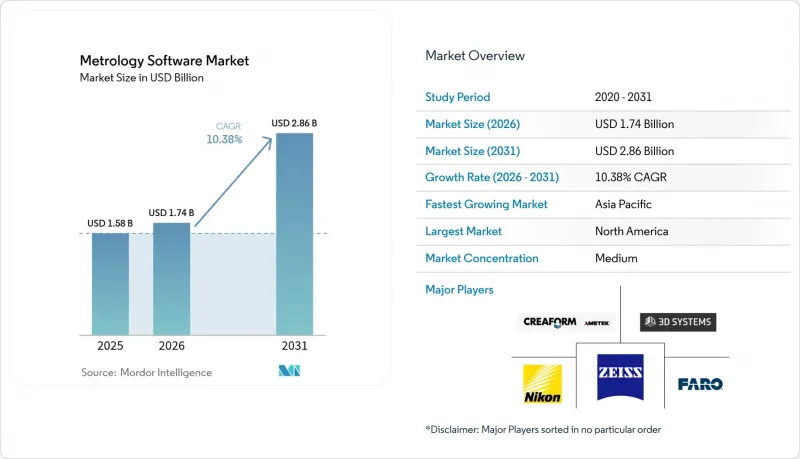
Mordor Intelligence에 의하면, 2026년 계측 소프트웨어 시장 규모는 17억 4,000만 달러로 추정되고, 2025년 15억 8,000만 달러에서 확대해, 2031년에는 28억 6,000만 달러에 이를 것으로 예측됩니다.
2026-2031년 연평균 성장률(CAGR) 10.38%로 성장할 것으로 전망됩니다.

본 보고서는 최종 사용자 산업별(자동차, 항공우주 등), 도입 모델별(온프레미스, 클라우드 기반), 용도별(리버스 엔지니어링, 금형 제조 등), 측정 기기 유형별(광학식 디지타이저 및 스캐너, 휴대용 암, 레이저 트래커, 구조화된 광 스캐너 등), 그리고 지역별로 분류되어 있습니다. 시장 예측은 금액(달러) 기준으로 제시되어 있습니다.
세계의 계측 소프트웨어 시장 동향 및 인사이트
이산형 및 공정 제조업 분야의 자동화 발전
제조업체들은 프로그래머블 로직 컨트롤러(PLC)와 계측 소프트웨어를 통합한 자동 검사 셀에 투자하고 있으며, 이를 통해 폐쇄 루프 품질 관리가 실현되어 자동차 차체 패널의 불량품을 최대 25%까지 줄이고 있습니다. 좌표 측정기, 광학 스캐너, 산업용 로봇은 표준화된 프로토콜을 통해 통신하며 24시간 가동을 가능하게 하고 있습니다. 전자기기 조립 제조업체는 라이트아웃 생산으로 전환하고 있으며, 자동 편차 경보를 활용하여 결함이 확대되기 전에 공구의 오프셋을 보정하고 있습니다. 반도체 제조업체는 치수 데이터를 정교한 공정 제어에 통합하여 지속적인 파라미터 조정을 추진하고 있습니다. 소프트웨어 공급업체는 하드웨어 통합을 간소화하고 도입 기간을 단축하는 모듈식 애플리케이션 프로그래밍 인터페이스(API)를 제공함으로써 이러한 요구에 대응하고 있습니다.
고품질이면서 결함이 없는 제품에 대한 수요
의료기기 및 항공우주 산업공급업체들은 계측 플랫폼에 통계적 공정 관리를 통합하여, 부품이 최종 조립 단계에 들어가기 전에 마이크로미터 수준의 편차를 감지함으로써 비용이 많이 드는 리콜을 미연에 방지하고 있습니다. 전기차용 배터리 공장에서는 모든 전극 치수를 셀 바코드까지 거슬러 올라가 추적함으로써 기능 안전 규정을 준수하는 동시에 재작업에 드는 비용을 최소화하고 있습니다. 식스 시그마 기법의 도입으로 측정 데이터 분석은 단순한 선택적 부가 기능에서 제조의 핵심 요건으로 격상되었습니다. 자동차 업계의 1차 공급업체들은 수동 측정기 검사를 소프트웨어 기반 검사로 대체한 결과, 보증 비용을 절감했다고 보고하고 있습니다. 엄격한 공급업체 평가 기준이 다운스트림 공정에서의 도입을 촉진함에 따라, 계측 소프트웨어는 프레스 가공, 주조, 성형 분야의 하위 공급업체로 확대되고 있습니다.
높은 초기 비용과 통합의 복잡성
라이선스, 교정 지그, 프로젝트 엔지니어링을 세트로 도입하면 중소 제조업체의 예산이 급격히 불어나, 생산성 향상에도 불구하고 도입을 주저하게 만드는 요인이 됩니다. 기존 측정기에 맞춤형 드라이버가 필요한 경우, 통합 프로젝트는 당초 일정을 크게 초과하는 경우가 많습니다. 데이터 형식을 통일하기 위해 컨설턴트가 추가 작업 시간을 청구함에 따라 총 소유 비용(TCO)이 상승합니다. 또한 기업은 가동 기간 중 운영자 교육과 관련된 간접 비용도 부담하게 됩니다. 수동 검사로 이미 고객의 공차 목표를 충족하고 있는 경우, 투자 수익률(ROI) 평가가 여전히 어려워 조달 주기의 정체로 이어지고 있습니다.
부문 분석
의료 분야는 2031년까지 연평균 성장률(CAGR) 10.55%를 나타낼 것으로 예측되는 반면, 자동차 분야는 2025년에도 계측 소프트웨어 시장의 39.25% 점유율을 유지할 것으로 예측됩니다. 엄격한 규제 감독으로 인해 검증된 감사 추적이 요구되고 있지만, 이를 실현할 수 있는 것은 전문 플랫폼뿐입니다. 임플란트의 소형화에 따라, 서브 마이크로미터급 정밀도를 실현하기 위한 3차원 측정기의 업그레이드가 진행되고 있습니다. 항공우주 분야에서는 기체의 접합부를 현장에서 매핑하는 대용량 레이저 트래커의 설치가 여전히 주류를 이루고 있습니다. 에너지 프로젝트에서는 풍력 발전용 블레이드의 공기역학적 특성 평가에 계측 소프트웨어를 활용하고, 엣지 분석을 통해 진동 데이터를 분석했습니다.
도로용 차량의 성장은 안정화되고 있지만, 배터리 셀 생산 라인에서는 부피 팽창이나 전극의 어긋남을 예측하는 새로운 분석 기법이 요구되고 있습니다. 전자기기 조립 제조업체는 자동 광학 검사(AOI)에 광학 디지타이저를 통합하여 표면 실장 부품의 평면도를 대규모로 검증하고 있습니다. 브랜드 보호 전략이 점점 더 엄격해지는 가운데, 소비재 제조업체들은 샘플 기반 검사에서 100% 인라인 검사로의 전환을 시작하고 있습니다. 예측 기간 동안 맞춤형 임플란트 분야의 의료 혁신이 프리미엄 라이선싱 수요를 뒷받침할 것으로 예상되며, 지속적인 검증을 지원하는 소프트웨어로의 전환이 더욱 가속화될 것입니다.
클라우드 도입은 연평균 성장률(CAGR) 11.35%를 기록하며, 2025년 계측 소프트웨어 시장 규모의 68.60%를 차지했던 온프레미스 방식의 우위를 잠식하고 있습니다. 다국적 기업들은 기밀성이 높은 데이터 세트를 사내에 보유하면서, 기밀이 아닌 분석은 관리형 환경으로 이전하는 하이브리드 전략을 채택하고 있습니다. 구독형 가격 책정 방식 덕분에 자본 지출이 운영비로 전환되므로, 서버 예산이 제한적인 중소기업에게 매력적입니다. 벤더가 운영하는 인프라 덕분에 패치 관리 부담이 줄어들고, 취약점이 존재하는 기간이 단축됩니다. 그렇지만 국방 및 원자력 분야에서는 여전히 에어갭 방식의 도입이 선호되고 있어, 온프레미스 판매에 대한 틈새 수요가 확보되고 있습니다.
엣지 노드는 현재 생산 라인 바로 옆에서 시간적 제약이 있는 계산을 수행하고, 동향 분석을 위해 결과만 클라우드로 전송하고 있습니다. 이 아키텍처는 중앙에서의 가시성을 저해하지 않으면서 지연 시간 임계값을 충족합니다. 클라우드에서 학습된 머신러닝 모델은 최적화된 샘플링 패턴을 엣지 디바이스로 되돌려 보내, 하드웨어 업그레이드 없이도 처리량을 향상시킵니다. 사이버 보안 인증이 성숙해짐에 따라 감사 부서도 분산형 아키텍처에 대해 더 큰 신뢰를 갖게 되었으며, 이는 규제 대상 산업 분야에서의 도입을 촉진하고 있습니다.
지역별 분석
북미는 2025년 계측 소프트웨어 시장에서 33.10%의 시장 점유율을 차지했습니다. 이는 검증된 측정 워크플로가 필요한 성숙한 항공우주, 자동차, 의료 제조 클러스터가 존재하기 때문입니다. 국내 복귀를 장려하는 연방 정부의 이니셔티브으로 스마트 품질 시스템에 대한 설비 투자가 촉진되는 한편, 진행 중인 인공지능 연구가 예측 분석의 도입을 가속화하고 있습니다. 이 지역에 본사를 둔 클라우드 공급업체는 규정 준수 환경이 갖춰진 환경을 제공하여, 여러 거점을 보유한 제조업체의 전환 과정을 원활하게 하고 있습니다. 수출 지향적인 공급업체들은 계측 데이터를 활용하여 전 세계 고객 감사를 지원하고, 소프트웨어 업데이트 주기를 유지하고 있습니다.
아시아태평양은 중국의 고부가가치 생산으로의 전환과 인도의 정밀 공학 제품 수출 확대에 힘입어 연평균 성장률(CAGR) 10.62%를 기록하며 가장 빠른 성장을 이루었습니다. 대만 및 중국 본토의 반도체 팹에서는 10nm 미만의 공정에서 자동 광학 계측이 도입되어 실시간 분석이 필수적입니다. 일본의 첨단 로봇 산업에서는 가동 시간을 향상시키기 위해 조립 셀에 계측 피드백을 통합하고 있습니다. 한국의 조선사에서는 대형 레이저 트래커를 활용하여 선체 블록의 정렬을 수행함으로써, 결합 정밀도를 향상시키고 드라이독에서의 지연을 줄이고 있습니다. 각 지역 정부는 인더스트리 4.0 시범 사업에 보조금을 지원하며, 베트남, 태국, 말레이시아의 중소 제조업체에서 인더스트리 4.0 도입을 촉진하고 있습니다.
유럽에서는 자동차의 전동화와 수명 주기 전반에 걸친 측정 추적성을 의무화하는 엄격한 환경 기준이 원동력이 되어 꾸준한 성장이 이어지고 있습니다. 독일의 공작기계 제조업체들은 제어 루프 내에 계측 소프트웨어를 통합하여 턴키 방식의 정밀 생산 라인을 전 세계로 수출하고 있습니다. 영국의 항공우주용 복합재료 분야에서는 복잡한 곡면에 대한 비접촉 검사가 요구되고 있으며, 이것이 스캐너의 기술 혁신을 촉진하고 있습니다. 데이터 보호 규제가 클라우드 아키텍처에 영향을 미치면서, 공급업체들은 엄격한 접근 제어 기능을 갖춘 유럽의 데이터센터로의 이전을 추진하고 있습니다. 순환형 경제의 목표에 따라, 재사용 가능한 부품을 인증하는 재생산용 검사 모듈에 대한 2차 수요가 발생하고 있습니다.
기타 혜택 :
- 엑셀 형식 시장 예측(ME) 시트
- 3개월간의 애널리스트 지원
자주 묻는 질문
목차
제1장 서론
제2장 조사 방법
제3장 주요 요약
제4장 시장 구도
제5장 시장 규모 및 성장 예측
제6장 경쟁 구도
제7장 시장 기회 및 향후 전망
AJY 26.09.07According to Mordor Intelligence, the metrology software market size in 2026 is estimated at USD 1.74 billion, growing from 2025 value of USD 1.58 billion with 2031 projections showing USD 2.86 billion, growing at 10.38% CAGR over 2026-2031.
This report is Segmented by End-User Vertical (Automotive, Aerospace, and More), Deployment Model (On-Premise, and Cloud-Based), Application (Reverse Engineering, Tool and Die Manufacturing, and More), Measurement Device Type (Optical Digitizers and Scanners, Portable Arms, Laser Trackers, Structured Light Scanners, and More), and Geography. The Market Forecasts are Provided in Terms of Value (USD).
Global Metrology Software Market Trends and Insights
Rising Automation in Discrete and Process Manufacturing
Manufacturers invest in automated inspection cells that merge programmable logic controllers with metrology software, creating closed-loop quality control that cuts scrap by up to 25% in automotive body panels. Coordinate measuring machines, optical scanners, and industrial robots communicate through standardized protocols, enabling round-the-clock operations. Electronics assemblers transition to lights-out production, relying on automated deviation alerts to correct tool offsets before defects propagate. Semiconductor producers embed dimensional data into advanced process control, driving continuous parametric tuning. Software vendors respond with modular application programming interfaces that simplify hardware integration and shorten installation timelines.
Demand for High Quality and Zero-Defect Products
Medical device and aerospace suppliers embed statistical process control within metrology platforms to detect micrometer-level drift before components enter final assembly, averting costly recalls. Electric vehicle battery plants trace every electrode dimension back to the cell barcode, ensuring compliance with functional safety rules while minimizing rework budgets. The adoption of Six Sigma disciplines elevates measurement data analytics from an optional add-on to a core manufacturing requirement. Tier-one automotive suppliers report warranty cost reductions when software-driven inspections replace manual gauges. Strict supplier scorecards encourage downstream adoption, spreading metrology software into stamping, casting, and molding sub-tiers.
High Initial Cost and Integration Complexity
Bundling licenses, calibration fixtures, and project engineering quickly escalates budgets for small manufacturers, deterring adoption despite productivity gains. Integration projects often exceed original timelines when legacy gauges require custom drivers. Consultants bill additional hours to harmonize data formats, elevating the total cost of ownership. Companies also incur indirect costs associated with training operators during the ramp-up period. Return on investment assessments remain challenging when manual inspection already meets customer tolerance targets, leading to hesitant procurement cycles.
Other drivers and restraints analyzed in the detailed report include:
- Shift Toward Cloud-Based Metrology Platforms
- Integration With Industry 4.0 Digital Twins
- Shortage of Skilled Metrology Software Professionals
For complete list of drivers and restraints, kindly check the Table Of Contents.
Segment Analysis
The medical category is expected to account for a 10.55% CAGR through 2031, while the automotive domain is projected to retain a 39.25% market share of metrology software in 2025. Acute regulatory oversight requires validated audit trails, which only specialized platforms can deliver. Implant miniaturization drives upgrades to coordinate measuring machines for sub-micrometer accuracy. Aerospace continues to rely on large-volume laser tracker setups that map fuselage joins in situ. Energy projects utilize metrology software for wind blade aerodynamics, leveraging edge analytics to analyze vibration data.
Growth in road vehicles stabilizes, yet battery cell lines demand new analytics that predict volume expansion and electrode misalignment. Electronics assemblers integrate optical digitizers within automated optical inspection to verify surface-mount component coplanarity at scale. Consumer goods producers are starting to migrate from sample-based checks to 100% in-line inspection as brand protection strategies become increasingly stringent. Over the forecast horizon, medical innovation in personalized implants is expected to sustain premium licensing, reinforcing the shift toward software that supports continuous validation.
Cloud deployments reached an 11.35% CAGR, eroding on-premise dominance that represented 68.60% of the metrology software market size in 2025. Multinationals employ hybrid strategies that retain sensitive datasets on-site while moving non-classified analyses to managed environments. Subscription pricing converts capital expenditures into operating expenses, appealing to small enterprises that lack server budgets. Vendor-operated infrastructure offloads patch management, shortening vulnerability windows. Nevertheless, defense and nuclear segments still favor air-gapped installations, ensuring niche demand for on-premise sales.
Edge nodes now perform time-critical calculations adjacent to production lines, forwarding only the results to the cloud for trend analysis. This architecture satisfies latency thresholds without compromising central visibility. Machine learning models trained in the cloud return optimized sampling patterns to edge devices, boosting throughput without hardware upgrades. As cybersecurity certifications mature, audit departments become more comfortable with distributed architectures, bolstering expansion across regulated verticals.
Complete Report Scope:
- By End-User Vertical
- Automotive
- Aerospace
- Electronics Manufacturing
- Energy and Power
- Medical Devices
- Other End-User Verticals
- By Deployment Model
- On-Premise
- Cloud-Based
- By Application
- Quality Control and Inspection
- Reverse Engineering
- Tool and Die Manufacturing
- Virtual Simulation and Digital Twin
- Large-Volume Metrology
- By Measurement Device Type
- Coordinate Measuring Machines (CMM)
- Optical Digitizers and Scanners
- Portable Arms
- Laser Trackers
- Structured Light Scanners
- Other Measurement Device Types
- By Geography
- North America
- United States
- Canada
- Mexico
- Europe
- Germany
- United Kingdom
- France
- Russia
- Rest of Europe
- Asia-Pacific
- China
- Japan
- India
- South Korea
- Australia
- Rest of Asia-Pacific
- Middle East and Africa
- Middle East
- Saudi Arabia
- United Arab Emirates
- Rest of Middle East
- Africa
- South Africa
- Egypt
- Rest of Africa
- Middle East
- South America
- Brazil
- Argentina
- Rest of South America
- North America
Geography Analysis
North America held a 33.10% market share of the metrology software market in 2025, owing to its mature aerospace, automotive, and medical manufacturing clusters that demand validated measurement workflows. Federal initiatives encouraging reshoring promote capital investment in smart quality systems, while ongoing artificial intelligence research accelerates the adoption of predictive analytics. Cloud providers headquartered in the region offer compliance-ready environments, easing the migration process for multi-site manufacturers. Export-oriented suppliers leverage metrology data to support global customer audits, sustaining software update cycles.
Asia Pacific grew fastest at 10.62% CAGR, propelled by China's shift toward high-value production and India's escalating precision engineering exports. Semiconductor fabs across Taiwan and mainland China deploy automated optical metrology in sub-10 nm processes, mandating real-time analytics. Japan's advanced robotics sector embeds measurement feedback within assembly cells to enhance uptime. South Korean shipbuilders utilize large-volume laser trackers to align hull blocks, thereby improving fit accuracy and reducing dry-dock delays. Regional governments subsidize Industry 4.0 pilots, catalyzing the adoption of Industry 4.0 among small manufacturers in Vietnam, Thailand, and Malaysia.
Europe sustains steady growth, anchored by automotive electrification and stringent environmental standards that require lifecycle measurement traceability. German machine tool builders integrate metrology software inside control loops, exporting turnkey precision lines worldwide. The United Kingdom's aerospace composites sector demands non-contact inspection for complex curves, spurring scanner innovation. Data protection regulations influence cloud architecture, prompting vendors to shift toward European data centers with stringent access controls. Circular economy targets create secondary demand for remanufacturing inspection modules that certify reusable components.
- Nikon Metrology NV
- 3D Systems Corporation
- Creaform Inc. (AMETEK Inc.)
- FARO Technologies Inc.
- Carl Zeiss AG
- Hexagon AB
- LK Metrology Ltd.
- Renishaw plc
- Perceptron Inc. (Atlas Copco AB)
- InnovMetric Software Inc.
- Fluke Corporation
- Metrologic Group SA (Sandvik AB)
- Autodesk Inc.
- Dassault Systemes SE
- Verisurf Software Inc.
- Mapvision Ltd.
- GOM GmbH (Carl Zeiss AG)
- Capture 3D LLC
- Stratasys Ltd. (Control Software)
- Software Point Oy
Additional Benefits:
- The market estimate (ME) sheet in Excel format
- 3 months of analyst support
TABLE OF CONTENTS
1 INTRODUCTION
- 1.1 Study Assumptions and Market Definition
- 1.2 Scope of the Study
2 RESEARCH METHODOLOGY
3 EXECUTIVE SUMMARY
4 MARKET LANDSCAPE
- 4.1 Market Overview
- 4.2 Market Drivers
- 4.2.1 Rising Automation in Discrete and Process Manufacturing
- 4.2.2 Demand for High Quality and Zero-Defect Products
- 4.2.3 Shift Toward Cloud-Based Metrology Platforms
- 4.2.4 Integration With Industry 4.0 Digital Twins
- 4.2.5 Adoption in Additive Manufacturing Quality Assurance
- 4.2.6 LiDAR and Radar Calibration Needs in Autonomous Vehicles
- 4.3 Market Restraints
- 4.3.1 High Initial Cost and Integration Complexity
- 4.3.2 Shortage of Skilled Metrology Software Professionals
- 4.3.3 Limited Interoperability With Legacy Measurement Hardware
- 4.3.4 Cybersecurity Concerns in Cloud Deployments
- 4.4 Industry Value Chain Analysis
- 4.5 Regulatory Landscape
- 4.6 Technological Outlook
- 4.7 Impact of Macroeconomic Factors
- 4.8 Assessment of the Impact of COVID-19 on the Industry
- 4.9 Porter's Five Forces Analysis
- 4.9.1 Threat of New Entrants
- 4.9.2 Bargaining Power of Buyers
- 4.9.3 Bargaining Power of Suppliers
- 4.9.4 Threat of Substitute Products
- 4.9.5 Intensity of Competitive Rivalry
5 MARKET SIZE AND GROWTH FORECASTS (VALUE)
- 5.1 By End-User Vertical
- 5.1.1 Automotive
- 5.1.2 Aerospace
- 5.1.3 Electronics Manufacturing
- 5.1.4 Energy and Power
- 5.1.5 Medical Devices
- 5.1.6 Other End-User Verticals
- 5.2 By Deployment Model
- 5.2.1 On-Premise
- 5.2.2 Cloud-Based
- 5.3 By Application
- 5.3.1 Quality Control and Inspection
- 5.3.2 Reverse Engineering
- 5.3.3 Tool and Die Manufacturing
- 5.3.4 Virtual Simulation and Digital Twin
- 5.3.5 Large-Volume Metrology
- 5.4 By Measurement Device Type
- 5.4.1 Coordinate Measuring Machines (CMM)
- 5.4.2 Optical Digitizers and Scanners
- 5.4.3 Portable Arms
- 5.4.4 Laser Trackers
- 5.4.5 Structured Light Scanners
- 5.4.6 Other Measurement Device Types
- 5.5 By Geography
- 5.5.1 North America
- 5.5.1.1 United States
- 5.5.1.2 Canada
- 5.5.1.3 Mexico
- 5.5.2 Europe
- 5.5.2.1 Germany
- 5.5.2.2 United Kingdom
- 5.5.2.3 France
- 5.5.2.4 Russia
- 5.5.2.5 Rest of Europe
- 5.5.3 Asia-Pacific
- 5.5.3.1 China
- 5.5.3.2 Japan
- 5.5.3.3 India
- 5.5.3.4 South Korea
- 5.5.3.5 Australia
- 5.5.3.6 Rest of Asia-Pacific
- 5.5.4 Middle East and Africa
- 5.5.4.1 Middle East
- 5.5.4.1.1 Saudi Arabia
- 5.5.4.1.2 United Arab Emirates
- 5.5.4.1.3 Rest of Middle East
- 5.5.4.2 Africa
- 5.5.4.2.1 South Africa
- 5.5.4.2.2 Egypt
- 5.5.4.2.3 Rest of Africa
- 5.5.4.1 Middle East
- 5.5.5 South America
- 5.5.5.1 Brazil
- 5.5.5.2 Argentina
- 5.5.5.3 Rest of South America
- 5.5.1 North America
6 COMPETITIVE LANDSCAPE
- 6.1 Market Concentration
- 6.2 Strategic Moves
- 6.3 Market Share Analysis
- 6.4 Company Profiles (includes Global Level Overview, Market Level Overview, Core Segments, Financials as Available, Strategic Information, Market Rank/Share, Products and Services, and Recent Developments)
- 6.4.1 Nikon Metrology NV
- 6.4.2 3D Systems Corporation
- 6.4.3 Creaform Inc. (AMETEK Inc.)
- 6.4.4 FARO Technologies Inc.
- 6.4.5 Carl Zeiss AG
- 6.4.6 Hexagon AB
- 6.4.7 LK Metrology Ltd.
- 6.4.8 Renishaw plc
- 6.4.9 Perceptron Inc. (Atlas Copco AB)
- 6.4.10 InnovMetric Software Inc.
- 6.4.11 Fluke Corporation
- 6.4.12 Metrologic Group SA (Sandvik AB)
- 6.4.13 Autodesk Inc.
- 6.4.14 Dassault Systemes SE
- 6.4.15 Verisurf Software Inc.
- 6.4.16 Mapvision Ltd.
- 6.4.17 GOM GmbH (Carl Zeiss AG)
- 6.4.18 Capture 3D LLC
- 6.4.19 Stratasys Ltd. (Control Software)
- 6.4.20 Software Point Oy
7 MARKET OPPORTUNITIES AND FUTURE OUTLOOK
- 7.1 White-Space and Unmet-Need Assessment


