

|
시장보고서
상품코드
2122836
가상화 소프트웨어 시장 : 시장 점유율 분석, 업계 동향 및 통계, 성장 예측(2026-2031년)Virtualization Software - Market Share Analysis, Industry Trends & Statistics, Growth Forecasts (2026 - 2031) |
||||||
 Mordor Intelligence
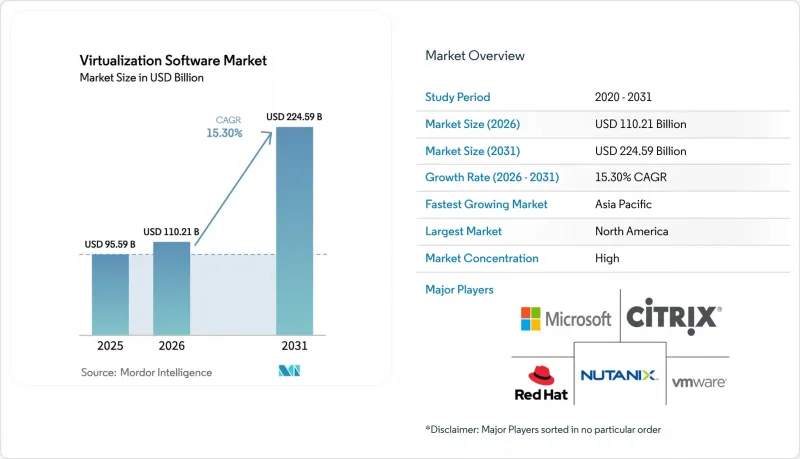
Mordor Intelligence에 의하면, 가상화 소프트웨어 시장 규모는 2025년 955억 9,000만 달러로 평가되었고, 2026년 1,102억 1,000만 달러에서 2031년까지 2,245억 9,000만 달러로 확대될 것으로 예측되며, 2026-2031년 연평균 복합 성장률(CAGR)은 15.30%를 나타낼 전망입니다.
본 보고서는 플랫폼별(PC/서버 가상화, 모바일/엔드포인트 가상화), 가상화 카테고리별(용도 가상화 등), 도입 모델별(온프레미스, 클라우드/SaaS 호스팅형 등), 조직 규모별(대기업 등), 최종 사용자 산업별(IT 및 통신 등) 및 지역별로 분류되어 있습니다. 시장 전망은 금액(달러) 기준으로 제시되어 있습니다.
세계의 가상화 소프트웨어 시장 동향 및 인사이트
서버 통합을 통한 비용 절감
수백 대의 물리적 호스트를 운영하는 기업의 경우, 데이터센터 운영 예산의 3분의 1 이상을 전력, 냉각 및 시설 관련 제반 경비에 충당하는 것이 일반화되어 있습니다. 각 소켓에 수십 대의 가상 머신을 통합함으로써 이용률은 60%를 초과하고, 하드웨어 교체 주기가 장기화되며, 처리량을 저하시키지 않고 가동률이 낮은 랙을 철거할 수 있게 됩니다. 유럽의 사업자들은 에너지 효율 지침에 따라 1메가와트를 초과하는 시설이 연간 전력 사용 효율(PUE) 수치를 공표해야 할 의무가 있어 더욱 큰 압박에 직면하고 있으며, 워크로드 밀도 지표는 이사회 수준의 핵심 성과 지표(KPI)가 되었습니다. 엣지 배포는 비용 절감 효과를 더욱 확대합니다. 제조 현장의 게이트웨이에 탑재된 경량 하이퍼바이저가 센서 트래픽을 로컬에서 필터링함으로써, 제조 기업의 광역 네트워크(WAN)로 전송되는 데이터 요금을 최대 절반까지 절감할 수 있습니다.
클라우드 우선 기업 IT 전략
최고정보책임자(CIO)는 현재 워크로드의 이동성을 직접 염두에 두고 아키텍처를 설계하고 있으며, 온프레미스 클러스터와 하이퍼스케일 리전을 결합함으로써 레거시 용도를 리팩토링하지 않고도 지연 시간 및 데이터 상주성 목표를 달성하고 있습니다. 금융 서비스 기관들은 거래 데이터를 국내에 보관하면서 기밀성이 낮은 분석에 대해서는 퍼블릭 클라우드 사용을 허용하는 바젤 III의 업무 회복력 관련 규정을 근거로 제시하고 있으며, 이것이 Google Cloud VMware Engine이나 Azure VMware Solution과 같은 프로젝트를 뒷받침하고 있습니다. 이들 모두 2024년에 과금 대상 시간 기준으로 3자리 수의 성장을 기록했습니다. 미국 국방부의 ‘Joint Warfighting Cloud Capability’ 계약도 COBOL 및 Ada 워크로드가 여전히 미션 크리티컬하다는 점을 인식하고, 벤더에게 마이크로서비스 외에도 모놀리식 가상 머신 지원을 의무화함으로써 이러한 추세를 뒷받침하고 있습니다.
구축 및 라이프사이클 관리의 복잡성
고가용성 클러스터 관리, 메모리 벌루닝 튜닝, 롤링 업그레이드 오케스트레이션에는 여전히 전문적인 기술이 요구됩니다. 인증 프로그램은 엔지니어 1인당 수천 달러의 비용이 들고 2년마다 갱신이 필요하기 때문에 전담 플랫폼 팀을 거의 유지하지 않는 중소기업에게는 장벽이 되고 있습니다. 신흥 시장에서는 매니지드 서비스 요금이 소프트웨어 구독 비용에 필적하는 경우가 많아 총 소유 비용(TCO)을 상승시키고 있습니다. 규정 준수 문제도 장벽이 됩니다. 생명과학 기업은 FDA 21 CFR Part 11에 따라 모든 구성 변경 사항을 문서화해야 하므로, 하이퍼바이저 API와 통합되는 추가 도구를 도입할 수밖에 없습니다.
부문 분석
가상화 소프트웨어 시장의 서버 부문은 2025년 매출의 62.46%를 차지했습니다. 이는 미션 크리티컬한 가동 시간을 확보하기 위해 유형 1 하이퍼바이저에 의존하는 금융 서비스 사업자와 통신 사업자에 의해 뒷받침된 결과입니다. 서브 밀리초 단위의 장애 조치, 하드웨어 지원 메모리 암호화 및 결정론적 I/O 스케줄링은 이러한 워크로드에 여전히 필수적인 요구 사항입니다. 한편, 가상화 소프트웨어 시장에서는 저전력 엣지 게이트웨이에서 구동되며, 압축된 페이로드를 지역 클라우드로 전송하기 전에 센서 데이터를 로컬에서 처리할 수 있는 경량 스택에 대한 수요가 급속히 증가하고 있습니다.
모바일 및 엔드포인트 가상화는 연평균 성장률(CAGR) 16.32%로 성장할 전망이며, 이는 가상화 소프트웨어 시장에서 가장 빠른 성장 궤도에 있습니다. 기업에서는 완전히 구성된 노트북에 대한 설비 투자를 피하기 위해, 고해상도 데스크톱을 브라우저로 스트리밍하는 사례가 증가하고 있습니다. 온프레미스 Citrix 팜을 폐지한 병원에서는 클라우드 호스팅형 씬 클라이언트로 전환한 후, 엔드포인트 관리 비용을 40% 가까이 절감할 수 있었다고 보고되고 있습니다. 비밀번호 없는 인증이 표준화되는 가운데, 가상 데스크톱 인스턴스는 자동으로 시작 및 종료될 수 있으며, 수동 패치 적용 주기 없이도 상황에 맞는 보안을 유지할 수 있습니다.
서버 및 컴퓨팅 계층은 여전히 카테고리 매출의 42.72%를 차지하고 있습니다. 이는 분산된 x86 환경을 통합하고, 유지보수 기간 중 워크로드를 실시간으로 마이그레이션할 수 있게 하기 위함입니다. 금융 트레이더들은 지연 시간에 민감한 엔진을 전용 코어 쌍으로 분할하고, 배치 분석을 공유 풀에 할당함으로써 속도와 비용의 균형을 맞추고 있습니다. 한편, 네트워크에 초점을 맞춘 가상화는 연평균 성장률(CAGR) 15.96%로 성장을 지속하고, 있습니다. 이는 통신 사업자들이 5G 코어 기능을 가상화하여 사이트당 자본 지출을 전용 어플라이언스의 약 50만 달러에서 범용 서버의 경우 10만 달러 미만으로 줄이고 있는 것이 뒷받침되고 있습니다.
가상화 소프트웨어 시장에서는 SD-WAN 오버레이가 MPLS(다중 프로토콜 라벨 스위칭) 회선을 대체하여 분산된 지사의 민첩성을 높이고 있습니다. ETSI의 NFV 청사진을 통해 분산된 네트워크 기능의 상호 운용성이 보장되며, ISO/IEC 27001 프레임워크에 따라 일관된 보안 기준이 적용되고 있습니다. 스토리지 및 용도 가상화는 모놀리식 워크로드의 ‘리프트 앤 시프트’를 지속적으로 촉진하고 있으며, 정책 기반 데이터 배치를 통해 관리자는 기밀성이 높은 데이터 세트를 암호화된 미디어에 고정할 수 있습니다.
지역별 분석
북미는 메트로 지역 고객에게 10밀리초 미만의 근접성을 제공하는 하이퍼스케일러 리전이 풍부하기 때문에 2025년 매출의 42.42%를 차지했습니다. 규제 대상 기업들은 유럽의 ‘디지털 운영 복원력 법(Digital Operational Resilience Act)’ 및 4시간 미만의 복구 시간 목표(RTO)를 달성하기 위해 중요한 데이터를 국경 내에 보관하도록 의무화하는 다른 지역의 유사한 규정을 준수하기 위해 하이브리드 구성을 채택하고 있습니다.
아시아태평양은 중국이 개인정보의 국내 보관을 의무화하는 사이버 보안 규제를 시행하고 있어 연평균 성장률(CAGR) 17.26%로 성장하고 있으며, 이로 인해 Huawei FusionSphere 및 국산 KVM 배포판에 대한 수요가 증가하고 있습니다. (3) 인도의 국가 클라우드 이니셔티브 역시 해외 공급자에 대한 의존도를 낮추면서 디지털 공공 인프라의 신속한 구축을 지원하기 위해 오픈소스 하이퍼바이저를 권장하고 있습니다. 일본, 한국, 호주에서는 재해 복구 복원력을 확보하기 위해 온프레미스 클러스터와 지역 퍼블릭 클라우드를 결합하는 움직임이 계속되고 있으며, 이는 해당 지역의 규제 산업에서 가상화 소프트웨어 시장의 침투가 확대되고 있음을 반영합니다.
유럽에서는 일반 데이터 보호 규정(GDPR(EU 개인정보보호규정))에 따라 기업이 개인 데이터의 흐름을 정량적으로 관리할 의무가 있기 때문에 여전히 중요한 역할을 하고 있습니다. 독일, 프랑스, 영국의 은행 및 보험 업계에서는 하이브리드형 규정 준수 아키텍처가 주류를 이루고 있으며, 명시적인 동의가 없는 한 기밀성이 높은 워크로드가 국경을 넘지 않도록 보장되고 있습니다. 남미, 중동 및 아프리카는 전반적인 도입 규모에서는 뒤처져 있지만, 통신 인프라 현대화 및 디지털 정부 프로그램이 본격화됨에 따라 두 자릿수 성장률을 기록하고 있습니다.
기타 혜택 :
- 엑셀 형식 시장 예측(ME) 시트
- 3개월간의 애널리스트 지원
자주 묻는 질문
목차
제1장 서론
제2장 조사 방법
제3장 주요 요약
제4장 시장 구도
제5장 시장 규모 및 성장 예측
제6장 경쟁 구도
제7장 시장 기회 및 향후 전망
AJY 26.09.07According to Mordor Intelligence, the virtualization software market size is projected to expand from USD 95.59 billion in 2025 and USD 110.21 billion in 2026 to USD 224.59 billion by 2031, registering a CAGR of 15.30% between 2026 to 2031.
This report is Segmented by Platform (PC/Server Virtualization, and Mobile/Endpoint Virtualization), Virtualization Category (Application Virtualization, and More), Deployment Model (On-Premises, Cloud/SaaS-hosted, and More), Organization Size (Large Enterprises, and More), End-User Industry (IT and Telecommunications, and More), and Geography. The Market Forecasts are Provided in Terms of Value (USD).
Global Virtualization Software Market Trends and Insights
Cost-Reduction From Server Consolidation
Enterprises running hundreds of physical hosts routinely devote more than one-third of data-center operating budgets to power, cooling, and real-estate overhead. Packing dozens of virtual machines onto each socket pushes utilisation above 60%, lengthens hardware refresh cycles, and allows factories to drop under-utilised racks without jeopardising throughput. European operators face additional pressure as the Energy Efficiency Directive obliges sites above 1 megawatt to publish annual power-usage-effectiveness figures, making workload density metrics a board-level key performance indicator. Edge deployments magnify savings; lightweight hypervisors on shop-floor gateways locally filter sensor traffic, cutting wide-area-network egress fees for manufacturing firms by up to half.
Cloud-First Enterprise IT Strategies
Chief information officers now architect directly for workload mobility, pairing on-premise clusters with hyperscale regions to meet latency and data-residency targets without refactoring legacy applications. Financial-services institutions cite Basel III operational-resilience rules that keep transactional data on domestic soil yet permit non-sensitive analytics in public cloud, fueling projects such as Google Cloud VMware Engine and Azure VMware Solution, both of which logged triple-digit growth in billable hours during 2024. The United States Department of Defense's Joint Warfighting Cloud Capability contract reinforces the pattern by requiring vendors to support monolithic virtual machines alongside microservices, acknowledging that COBOL and Ada workloads remain mission-critical.
Deployment and Lifecycle-Management Complexity
Administering high-availability clusters, tuning memory ballooning, and orchestrating rolling upgrades still demand specialized skills. Certification programs can cost several thousand United States dollars per engineer and must be renewed biennially, a barrier for small enterprises that seldom maintain dedicated platform teams. In emerging markets, managed-service fees often rival software subscription costs, raising total cost of ownership. Compliance adds friction: life-sciences firms must document every configuration change under FDA 21 CFR Part 11, forcing additional tooling that integrates with hypervisor APIs.
Other drivers and restraints analyzed in the detailed report include:
- Remote-Work and Edge-Compute Proliferation
- Vendor Diversification Away From vSphere
- Escalating Hypervisor Licence Costs
For complete list of drivers and restraints, kindly check the Table Of Contents.
Segment Analysis
The server side of the virtualization software market accounted for 62.46% of 2025 revenue, underpinned by financial-services and telecommunications operators that rely on Type-1 hypervisors for mission-critical uptime. Sub-millisecond failover, hardware-assisted memory encryption, and deterministic I/O scheduling remain non-negotiable for these workloads. Conversely, the virtualization software market is witnessing rapid demand for lightweight stacks that can run on low-power edge gateways, enabling local processing of sensor data before sending compressed payloads to regional clouds.
Mobile and endpoint virtualization is poised to grow at a 16.32% CAGR, the fastest track inside the virtualization software market. Employers increasingly stream high-resolution desktops to browsers, avoiding capital outlays for fully provisioned laptops. Hospitals retiring on-premise Citrix farms report endpoint management savings near 40% after pivoting to cloud-hosted thin clients. As password-less authentication becomes table stakes, virtual desktop instances can be spun up or torn down automatically, maintaining contextual security without manual patching cycles.
Server and compute layers still command 42.72% of category revenue because they consolidate sprawling x86 estates and enable live workload migration during maintenance windows. Financial traders segment latency-sensitive engines onto dedicated core pairs while relegating batch analytics to shared pools, balancing speed with cost. Network-focused virtualization, however, is pacing at 15.96% CAGR, aided by telecom providers that are virtualizing 5G core functions to trim per-site capital spend from roughly USD 500,000 for proprietary appliances to sub-USD 100,000 on commodity servers.
Within the virtualization software market, SD-WAN overlays replace multiprotocol label switching circuits, boosting agility for distributed branch offices. ETSI NFV blueprints ensure that disaggregated network functions remain interoperable, and ISO/IEC 27001 frameworks impose consistent security baselines. Storage and application virtualization continue to facilitate lift-and-shift of monolithic workloads, with policy-based data placement allowing administrators to pin sensitive datasets to encrypted media.
Complete Report Scope:
- By Platform
- PC / Server Virtualization
- Mobile / Endpoint Virtualization
- By Virtualisation Category
- Application Virtualization
- Network / SD-Network Virtualization
- Server / Compute Virtualization
- Storage Virtualization
- By Deployment Model
- On-Premise
- Cloud / SaaS-Hosted
- Hybrid
- By Organization Size
- Large Enterprises
- Small and Medium Enterprises (SMEs)
- By End-User Industry
- IT and Telecommunications
- BFSI
- Healthcare and Life Sciences
- Manufacturing
- Government and Defence
- Media and Entertainment
- Other End-User Industries
- By Geography
- North America
- United States
- Canada
- Mexico
- South America
- Brazil
- Argentina
- Chile
- Rest of South America
- Europe
- Germany
- United Kingdom
- France
- Italy
- Spain
- Russia
- Rest of Europe
- Asia Pacific
- China
- India
- Japan
- South Korea
- Singapore
- Malaysia
- Australia
- Rest of Asia Pacific
- Middle East
- United Arab Emirates
- Saudi Arabia
- Turkey
- Rest of Middle East
- Africa
- South Africa
- Nigeria
- Egypt
- Rest of Africa
- North America
Geography Analysis
North America contributed 42.42% of 2025 revenue thanks to abundant hyperscaler regions that provide sub-ten-millisecond proximity to metro customers. Regulated enterprises adopt hybrid setups to satisfy the Digital Operational Resilience Act in Europe and similar regulations elsewhere that require critical data to remain within national borders for recovery-time objectives below four hours.
Asia Pacific is growing at 17.26% CAGR as China enforces cybersecurity rules that mandate domestic storage of personal information, bolstering demand for Huawei FusionSphere and indigenous KVM distributions.[3] India's national cloud initiative likewise favors open-source hypervisors to reduce dependency on foreign providers while supporting rapid rollout of digital public infrastructure. Japan, South Korea, and Australia continue to pair on-premise clusters with regional public clouds for disaster-recovery resilience, reflecting the broadening reach of the virtualization software market into regulated industries across the region.
Europe remains pivotal as the General Data Protection Regulation obliges firms to quantifiably govern personal data flows. Hybrid compliance architectures dominate banking and insurance deployments in Germany, France, and the United Kingdom, assuring that sensitive workloads never traverse borders without explicit consent. South America and the Middle East and Africa trail in overall volumes but post double-digit growth as telecom modernisation and digital-government programs ramp.
- VMware Inc.
- Microsoft Corporation
- Citrix Systems Inc.
- Red Hat Inc. (IBM Corporation)
- Nutanix Inc.
- Oracle Corporation
- Amazon Web Services Inc.
- Google LLC (Google Cloud)
- Huawei Technologies Co. Ltd.
- Parallels International GmbH
- NComputing Co. Ltd.
- Lynx Software Technologies
- TenAsys Corporation
- Proxmox Server Solutions GmbH
- SUSE LLC (Harvester)
- Virtuozzo International GmbH
- Xen Project
- KVM (Open-Source)
- QEMU Project
- Scale Computing Inc.
- Dell Technologies Inc.
- Cisco Systems Inc.
- Hewlett Packard Enterprise (SimpliVity)
- IBM PowerVM (IBM Corporation)
- TuxCare (KernelCare)
Additional Benefits:
- The market estimate (ME) sheet in Excel format
- 3 months of analyst support
TABLE OF CONTENTS
1 INTRODUCTION
- 1.1 Study Assumptions and Market Definition
- 1.2 Scope of the Study
2 RESEARCH METHODOLOGY
3 EXECUTIVE SUMMARY
4 MARKET LANDSCAPE
- 4.1 Market Overview
- 4.2 Market Drivers
- 4.2.1 Cost-Reduction from Server Consolidation
- 4.2.2 Cloud-First Enterprise IT Strategies
- 4.2.3 Remote-Work and Edge-Compute Proliferation
- 4.2.4 Vendor-Diversification Away from vSphere
- 4.2.5 Confidential-Computing Enabled Virtualization Boost
- 4.2.6 AI-Optimised Workload Placement
- 4.3 Market Restraints
- 4.3.1 Deployment and Lifecycle-Management Complexity
- 4.3.2 Escalating Hypervisor Licence Costs
- 4.3.3 Rising VM-Specific Security Attack Surface
- 4.3.4 Container-First Cultural Shift Dampening VM Uptake
- 4.4 Industry Value Chain Analysis
- 4.5 Regulatory Landscape
- 4.6 Technological Outlook
- 4.7 Porter's Five Forces Analysis
- 4.7.1 Threat of New Entrants
- 4.7.2 Bargaining Power of Suppliers
- 4.7.3 Bargaining Power of Buyers
- 4.7.4 Threat of Substitutes
- 4.7.5 Intensity of Competitive Rivalry
- 4.8 Impact of Macroeconomic Factors on the Market
5 MARKET SIZE AND GROWTH FORECASTS (VALUES)
- 5.1 By Platform
- 5.1.1 PC / Server Virtualization
- 5.1.2 Mobile / Endpoint Virtualization
- 5.2 By Virtualisation Category
- 5.2.1 Application Virtualization
- 5.2.2 Network / SD-Network Virtualization
- 5.2.3 Server / Compute Virtualization
- 5.2.4 Storage Virtualization
- 5.3 By Deployment Model
- 5.3.1 On-Premise
- 5.3.2 Cloud / SaaS-Hosted
- 5.3.3 Hybrid
- 5.4 By Organization Size
- 5.4.1 Large Enterprises
- 5.4.2 Small and Medium Enterprises (SMEs)
- 5.5 By End-User Industry
- 5.5.1 IT and Telecommunications
- 5.5.2 BFSI
- 5.5.3 Healthcare and Life Sciences
- 5.5.4 Manufacturing
- 5.5.5 Government and Defence
- 5.5.6 Media and Entertainment
- 5.5.7 Other End-User Industries
- 5.6 By Geography
- 5.6.1 North America
- 5.6.1.1 United States
- 5.6.1.2 Canada
- 5.6.1.3 Mexico
- 5.6.2 South America
- 5.6.2.1 Brazil
- 5.6.2.2 Argentina
- 5.6.2.3 Chile
- 5.6.2.4 Rest of South America
- 5.6.3 Europe
- 5.6.3.1 Germany
- 5.6.3.2 United Kingdom
- 5.6.3.3 France
- 5.6.3.4 Italy
- 5.6.3.5 Spain
- 5.6.3.6 Russia
- 5.6.3.7 Rest of Europe
- 5.6.4 Asia Pacific
- 5.6.4.1 China
- 5.6.4.2 India
- 5.6.4.3 Japan
- 5.6.4.4 South Korea
- 5.6.4.5 Singapore
- 5.6.4.6 Malaysia
- 5.6.4.7 Australia
- 5.6.4.8 Rest of Asia Pacific
- 5.6.5 Middle East
- 5.6.5.1 United Arab Emirates
- 5.6.5.2 Saudi Arabia
- 5.6.5.3 Turkey
- 5.6.5.4 Rest of Middle East
- 5.6.6 Africa
- 5.6.6.1 South Africa
- 5.6.6.2 Nigeria
- 5.6.6.3 Egypt
- 5.6.6.4 Rest of Africa
- 5.6.1 North America
6 COMPETITIVE LANDSCAPE
- 6.1 Market Concentration
- 6.2 Strategic Moves
- 6.3 Market Share Analysis
- 6.4 Company Profiles (includes Global level Overview, Market level overview, Core Segments, Financials as available, Strategic Information, Market Rank / Share for key companies, Products and Services, and Recent Developments)
- 6.4.1 VMware Inc.
- 6.4.2 Microsoft Corporation
- 6.4.3 Citrix Systems Inc.
- 6.4.4 Red Hat Inc. (IBM Corporation)
- 6.4.5 Nutanix Inc.
- 6.4.6 Oracle Corporation
- 6.4.7 Amazon Web Services Inc.
- 6.4.8 Google LLC (Google Cloud)
- 6.4.9 Huawei Technologies Co. Ltd.
- 6.4.10 Parallels International GmbH
- 6.4.11 NComputing Co. Ltd.
- 6.4.12 Lynx Software Technologies
- 6.4.13 TenAsys Corporation
- 6.4.14 Proxmox Server Solutions GmbH
- 6.4.15 SUSE LLC (Harvester)
- 6.4.16 Virtuozzo International GmbH
- 6.4.17 Xen Project
- 6.4.18 KVM (Open-Source)
- 6.4.19 QEMU Project
- 6.4.20 Scale Computing Inc.
- 6.4.21 Dell Technologies Inc.
- 6.4.22 Cisco Systems Inc.
- 6.4.23 Hewlett Packard Enterprise (SimpliVity)
- 6.4.24 IBM PowerVM (IBM Corporation)
- 6.4.25 TuxCare (KernelCare)
7 MARKET OPPORTUNITIES AND FUTURE OUTLOOK
- 7.1 White-Space and Unmet-Need Assessment


