

|
시장보고서
상품코드
2122859
자동차용 전기 드라이브 액슬 시장 : 시장 점유율 분석, 업계 동향 및 통계, 성장 예측(2026-2031년)Automotive Electric Drive Axle - Market Share Analysis, Industry Trends & Statistics, Growth Forecasts (2026 - 2031) |
||||||
 Mordor Intelligence
Mordor Intelligence에 의하면, 2026년 자동차용 전기 드라이브 액슬 시장 규모는 143억 7,000만 달러로 추정되고, 2025년 130억 5,000만 달러에서 확대해, 2031년에는 232억 6,000만 달러에 이를 것으로 예측됩니다.
2026-2031년 연평균 성장률(CAGR)은 10.12%가 될 것으로 전망됩니다.
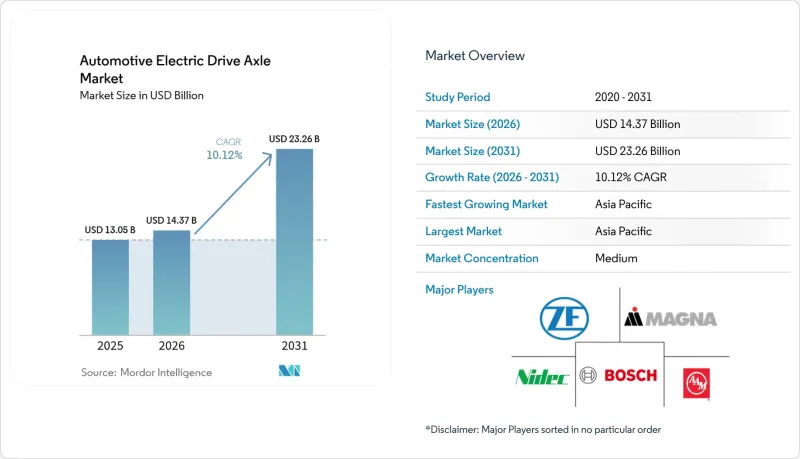
본 보고서는 구동 방식별(배터리식 전기 액슬, 하이브리드 액슬 등), 통합 수준별(2-in-1(모터 및 기어), 3-in-1(모터, 기어, 인버터) 등), 차종별(승용차, 소형 상용차 등), 판매 채널별(OEM 순정 및 애프터마켓용 개조 키트), 지역별로 분류되어 있습니다. 시장 예측은 금액(달러) 기준으로 제시되어 있습니다.
세계의 자동차용 전기 드라이브 액슬 시장 동향 및 인사이트
OEM의 전동화 로드맵이 E-액슬 수요를 가속화
세계 자동차 제조업체들의 확고한 다년간 생산 목표에 힘입어, Tier 1 공급업체들은 수주량에 대해 이례적으로 명확한 전망을 확보하고 있으며, 전용 E-액슬 생산 라인에 대한 대규모 설비 투자와 현지 부품 조달이 진행되고 있습니다. BMW의 ‘노이에 클라세’용 6세대 eDrive는 구동계 효율을 20% 향상시키는 동시에 세단, SUV, 소형 크로스오버 차량에서 후륜구동 및 사륜구동 레이아웃 모두를 지원합니다. ZF는 이미 고전압 e-모빌리티 관련 수주액 310억 유로를 확보했으며, 이는 확고한 로드맵이 공급업체에게 구속력이 있고 자금 조달이 가능한 계약으로 직접 이어진다는 것을 보여줍니다.
정부의 제로 배출 규제와 구매 인센티브
구속력 있는 판매 할당량과 위반 시 부과되는 고액의 벌금으로 인해, e-액슬의 채택은 선택 사항에서 규제 요건으로 변화하고 있습니다. 영국의 ZEV 규정은 2024년에 전기차 판매 비율을 22%로 설정하였고, 2035년까지 100%로 끌어올리는 것을 목표로 하고 있으며, 위반 차량 1대당 1만 5,000파운드의 벌금이 부과됩니다. 이 벌금액은 구동계의 추가 비용을 크게 상회하는 수준입니다. 캘리포니아주의 ‘Advanced Clean Cars II’ 규정은 2035년까지 경차의 판매를 100% 제로 에미션으로 전환하고, 2036년까지 중형·대형 차량의 차량군을 완전히 전환할 것을 의무화하고 있어, 단기적인 연료 가격 변동과 관계없이 수요를 확고히 하고 있습니다.
희토류 자석의 가격 변동
네오디뮴 및 디스프로슘 가격의 급격한 변동은 이익률의 예측 가능성을 저해하며, 제조업체들이 대체 자석의 화학 조성 및 자화 기술로 전환하도록 압박하고 있습니다. 닛산은 사마륨-철 자석으로 대체하여 모터 비용을 30% 절감하는 것을 목표로 하고 있으며, 특정 지역에 집중된 공급망에 대한 의존도를 낮추고 있습니다. GE 에어로스페이스의 23kW 2상 자기 모터는 디스프로슘을 사용하지 않고도 전력 밀도를 향상시켰으며, 희토류 소재에서 벗어나더라도 더 이상 성능 저하를 감수해야만 하는 것은 아니라는 점을 입증하고 있습니다.
부문 분석
2025년 판매 대수의 73.45%를 배터리식 전동 액슬이 차지했으며, 자동차용 전동 드라이브 액슬 시장에서 그 중심적인 위상을 부각시키고 있습니다. 양산 규모의 확대, 급속 충전기의 보급, 그리고 제로 테일파이프 배출을 장려하는 정책이 이러한 우위를 뒷받침하고 있습니다. 하이브리드식 e-액슬은 과도기의 운영 주기에 대응하고 있으며, 연료전지식 액슬은 아직 발전 단계에 있지만 대형 트럭 시범 사업 및 버스 실증 실험을 배경으로 연평균 성장률(CAGR) 11.08%로 성장하고 있습니다. 연료전지 플랫폼용 자동차 전동 구동 액슬 시장 규모는 수소 인프라 구축에 따라 확대될 것으로 예상되며, Symbio사의 클래스 8 트럭용 400kW ‘StackPack’ 등의 프로젝트가 이를 뒷받침하고 있습니다. 캘리포니아주의 버스 도입 지원은 장거리 운송에서의 그 가능성을 입증하고 있습니다.
연료전지식 레인지 익스텐더에 대한 OEM의 관심 증가와 각국의 수소 전략은 파워트레인의 다양성이 점차 확대될 것임을 시사합니다. 배터리 방식이나 연료전지 스택 중 어느 쪽에도 대응할 수 있도록 모듈식 하우징을 맞춤 제작할 수 있는 공급업체는 차량 운영사가 두 기술을 시험적으로 도입하는 과정에서 생산량에 대한 리스크를 헤지할 수 있을 것입니다.
모터, 기어, 인버터를 통합한 ‘3-in-1’ 유닛은 여전히 42.45%의 점유율을 차지했으며, 현재의 냉각 범위 내에서 비용 효율적인 패키징을 실현하고 있습니다. 그러나 고객의 견적 요청(RFQ)에서는 열 루프까지 통합한 ‘4-in-1’ 레이아웃이 선호되는 추세이며, 이 부문은 연평균 성장률(CAGR) 11.21%로 확대되고 있습니다. 와이드 밴드갭 반도체로 인해 방열량이 감소하고 더 소형화된 냉각 회로가 가능해짐에 따라, 4-in-1 설계와 관련된 자동차용 전동 구동축 시장 규모는 확대될 것으로 예측됩니다. 셰플러(Schaeffler)의 솔루션은 모든 요소를 70kg 모듈에 통합하여 소형 C부문 차량에 적합합니다.
고성능 전기차의 경우, 지속적인 전력 부하로 인해 별도의 냉각기가 필요하기 때문에 열 설계의 복잡성이 여전히 보급의 장벽으로 작용하고 있습니다. 각 공급업체들은 중량을 늘리지 않으면서 피크 출력의 허용 범위를 확대하기 위해 상변화 소재 및 스플릿 루프 구조에 대한 투자를 진행하고 있습니다.
지역별 분석
아시아태평양은 2025년 매출의 44.70%를 차지했으며, 연평균 성장률(CAGR) 11.94%로 성장하고 있어, 자동차용 전동 구동축 시장의 중심지로 자리 잡고 있습니다. 2024년, 중국은 전 세계 전기차 생산 대수의 70% 이상을 차지했으며, 현지 전동 액슬 제조업체들에게 타의 추종을 불허하는 규모의 우위를 제공합니다. 정부 보조금, 배터리 재료의 국내 채굴, 그리고 적극적인 할당 목표 덕분에 공장 가동률은 높은 수준을 유지하고 있습니다. HSBC의 예측에 따르면, 2030년까지 이 지역은 신규 전기차 판매 대수의 60% 이상을 차지할 전망입니다. 일본의 1차 공급업체들은 신속하게 사업 전환을 추진하고 있습니다. 니덱은 저비용 마이크로 EV에 최적화된 소형 전동 모터 개발을 추진하는 한편, 중견 공급업체들은 기술 격차를 해소하기 위해 연구 개발(R&D)을 공동으로 진행하고 있습니다.
북미에서는 전기 픽업트럭과 정책 주도형 현지 조달 규정이 탄력을 받고 있습니다. ‘인플레이션 감축법(Inflation Reduction Act)’은 소비자에 대한 환급금을 지역산 구동계 조달과 연계하고 있으며, 이를 통해 차축 조립 라인에 대한 새로운 투자가 유도되고 있습니다. 보그워너는 2025년 1분기 전동 제품 매출이 전년 동기 대비 47% 증가했다고 보고했으며, 이는 미국 OEM 공장의 생산 확대가 순조롭게 진행되고 있음을 반영합니다. 아메리칸 액슬(American Axle)의 ‘e-Beam’은 바디 온 프레임(BOD) 플랫폼용으로 150 kW의 출력을 갖추고 있으며, 이러한 트럭 붐을 겨냥하고 있습니다.
유럽은 엄격한 자동차 차량 CO2 배출 규제의 뒷받침을 받아 프리미엄 EV 엔지니어링 분야에서 계속해서 선두를 유지하고 있습니다. 2024년에 22%, 2035년까지 100%에 달하는 전기차 판매 의무화로 인해 거시경제 환경이 부진함에도 불구하고 차축에 대한 안정적인 수요가 확보되고 있습니다. ZF는 통합형 드라이브트레인 솔루션 제공을 위해 IVECO BUS와 제휴하는 한편, 디지털 섀시 시스템 분야에서는 Foxconn과의 제휴를 모색하고 있습니다. 각 브랜드가 독일 고속도로에서의 주행 거리 연장을 목표로 하는 가운데, 열 관리 기술의 혁신과 800V 채택이 입찰의 향방을 좌우하고 있습니다. 한편, 신흥 ASEAN 시장에서는 2035년까지 전기차(EV)의 연평균 성장률(CAGR)이 16-39%를 나타낼 것으로 전망되지만, 차축 어셈블리의 대규모 남하가 진행되기 위해서는 자금 조달 및 충전 인프라 구축이 성숙해져야 합니다.
기타 혜택 :
- 엑셀 형식 시장 예측(ME) 시트
- 3개월간의 애널리스트 지원
자주 묻는 질문
목차
제1장 서론
제2장 조사 방법
제3장 주요 요약
제4장 시장 구도
제5장 시장 규모 및 성장 예측
제6장 경쟁 구도
제7장 시장 기회 및 향후 전망
AJY 26.09.07According to Mordor Intelligence, the automotive electric drive axle market size in 2026 is estimated at USD 14.37 billion, growing from 2025 value of USD 13.05 billion with 2031 projections showing USD 23.26 billion, growing at 10.12% CAGR over 2026-2031.
This report is Segmented by Propulsion Type (Battery-Electric Axle, Hybrid Axle, and More), Integration Level (2-In-1 (Motor, and Gear), 3-In-1 (Motor, Gear, and Inverter), and More), Vehicle Type (Passenger Cars, Light Commercial Vehicles, and More), Sales Channel (OEM-Fitted and Aftermarket Retrofit Kits), and Geography. The Market Forecasts are Provided in Terms of Value (USD).
Global Automotive Electric Drive Axle Market Trends and Insights
OEM Electrification Road-maps Accelerate E-axle Demand
Firm multi-year production targets from global automakers are giving Tier-1 suppliers unusually clear visibility into order volumes, encouraging larger capital outlays for dedicated e-axle lines and localized component sourcing. BMW's sixth-generation eDrive for the Neue Klasse raises drivetrain efficiency by 20% while supporting both rear- and all-wheel layouts across sedans, SUVs, and compact crossovers. ZF has already booked EUR 31 billion in high-voltage e-mobility orders, demonstrating how locked-in road maps convert directly into binding, bankable contracts for suppliers.
Government Zero-emission Mandates and Purchase Incentives
Binding sales quotas and steep non-compliance penalties are turning e-axle adoption from a discretionary choice into a regulatory requirement. The UK ZEV mandate starts with 22% electric sales in 2024 and climbs to 100% by 2035, backed by GBP 15,000 fines per non-compliant vehicle that materially exceed drivetrain cost premiums. California's Advanced Clean Cars II rule compels 100% zero-emission light-duty sales by 2035 and full medium- and heavy-duty fleet conversion by 2036, cementing demand irrespective of short-term fuel-price swings .
Rare-earth Magnet Price Volatility
Sharp swings in neodymium and dysprosium pricing are eroding margin predictability and pushing manufacturers toward alternative magnet chemistries or excitation technologies. Nissan targets a 30% motor-cost cut by substituting samarium-iron magnets, reducing exposure to supply chains concentrated in one geography. GE Aerospace's 23 kW dual-phase magnetic motor eliminates dysprosium yet improves power density, proving that performance compromises are no longer inevitable when moving away from rare-earth materials .
Other drivers and restraints analyzed in the detailed report include:
- Battery-pack Cost Falls Below USD 80/kWh, Widening E-axle Affordability
- Surge in Battery-electric SUV and Pickup Launches
- Up-front Cost Gap vs. Conventional Drivelines
For complete list of drivers and restraints, kindly check the Table Of Contents.
Segment Analysis
Battery-electric axles delivered 73.45% of 2025 volumes, underscoring their centrality in the automotive electric drive axle market. Mass-production scale, rapid charger rollouts, and policy preference for zero-tailpipe emissions anchor this lead. Hybrid e-axles address transitional duty cycles, while fuel-cell axles, though nascent, are pacing at an 11.08% CAGR on the back of heavy-duty truck pilots and bus trials. The automotive electric drive axle market size for fuel-cell platforms is projected to rise alongside hydrogen infrastructure, aided by projects such as Symbio's 400 kW StackPack for Class 8 trucks. California's support for bus deployments validates long-haul promise.
Growing OEM interest in fuel-cell range extenders and national hydrogen strategies suggests a gradual broadening of powertrain diversity. Suppliers that can tailor modular housings to either battery-electric or fuel-cell stacks will hedge volume risk as fleet operators experiment with both technologies.
A 42.45% share still resides with 3-in-1 units that merge motor, gear, and inverter, offering cost-effective packaging within current cooling envelopes. Yet customer RFQs now favor 4-in-1 layouts that also integrate thermal loops, lifting that segment at an 11.21% CAGR. The automotive electric drive axle market size attached to 4-in-1 designs is forecast to compound as wide-bandgap semiconductors reduce heat rejection and enable smaller cooling circuits. Schaeffler's solution combines all elements into a 70 kg module that fits compact C-segment vehicles.
Thermal complexity still caps adoption in high-performance EVs where sustained power loads demand separate chillers. Suppliers are investing in phase-change materials and split-loop architectures to extend peak-power windows without raising mass.
Complete Report Scope:
- By Propulsion Type
- Battery-Electric Axle
- Hybrid Axle
- Fuel-Cell Electric Axle
- By Integration Level
- 2-in-1 (Motor, and Gear)
- 3-in-1 (Motor, Gear, and Inverter)
- 4-in-1 (Motor, Gear, Inverter, and Thermal)
- By Vehicle Type
- Passenger Cars
- Light Commercial Vehicles
- Medium and Heavy Commercial Vehicles
- Off-Highway and Specialty (Construction and Agriculture)
- By Sales Channel
- OEM-Fitted
- Aftermarket Retrofit Kits
- By Geography
- North America
- United States
- Canada
- Rest of North America
- South America
- Brazil
- Argentina
- Rest of South America
- Europe
- Germany
- United Kingdom
- France
- Spain
- Italy
- Rest of Europe
- Asia-Pacific
- China
- Japan
- India
- South Korea
- Rest of Asia-Pacific
- Middle East and Africa
- United Arab Emirates
- Saudi Arabia
- South Africa
- Rest of Middle East and Africa
- North America
Geography Analysis
Asia-Pacific captured 44.70% of 2025 revenue and is expanding at a 11.94% CAGR, making it the gravitational center of the automotive electric drive axle market. China produced more than 70% of global EVs in 2024, giving local e-axle makers unmatched scale advantages. State subsidies, domestic mining of battery materials, and aggressive quota targets sustain high plant-utilization rates. HSBC forecasts the region will represent over 60% of new EV sales by 2030. Japanese Tier-1s are pivoting quickly: Nidec is optimizing smaller e-motors tailored to low-cost micro EVs, while midsize suppliers are pooling R&D to close technology gaps.
North America is building momentum around electric pickups and policy-driven local content rules. The Inflation Reduction Act ties consumer rebates to regionally sourced drivetrains, steering fresh investment into axle assembly lines. BorgWarner reported a 47% year-on-year rise in e-product sales for Q1 2025, reflecting strong ramp-ups at US OEM plants. American Axle's e-Beam targets this truck wave with 150 kW output for body-on-frame platforms.
Europe maintains a lead in premium EV engineering underpinned by stringent fleet CO2 rules. The 22% electric sales mandate in 2024, moving to 100% by 2035, ensures steady axle demand despite a softer macro backdrop. ZF is partnering with IVECO BUS for integrated driveline solutions while courting Foxconn for digital chassis systems. Thermal-management innovation and 800 V adoption shape tenders as brands strive for extended range on high-speed German motorways. Meanwhile, emerging ASEAN markets eye a 16-39% EV CAGR through 2035, though financing and charging infrastructure must mature before large-scale axle assembly shifts south.
- ZF Friedrichshafen AG
- Robert Bosch GmbH
- Magna International Inc.
- Nidec Corporation
- American Axle & Manufacturing
- Dana Inc.
- GKN Automotive
- Schaeffler AG
- BorgWarner Inc.
- Aisin Corporation
- Cummins Inc.
- Valeo SA
- Hitachi Astemo
- BYD Co. Ltd.
- Hyundai Mobis
Additional Benefits:
- The market estimate (ME) sheet in Excel format
- 3 months of analyst support
TABLE OF CONTENTS
1 Introduction
- 1.1 Study Assumptions & Market Definition
- 1.2 Scope of the Study
2 Research Methodology
3 Executive Summary
4 Market Landscape
- 4.1 Market Overview
- 4.2 Market Drivers
- 4.2.1 OEM electrification road-maps accelerate e-axle demand
- 4.2.2 Government zero-emission mandates and purchase incentives
- 4.2.3 Battery-pack cost falls below USD 80/kWh, widening e-axle affordability
- 4.2.4 Surge in battery-electric SUV and pickup launches
- 4.2.5 Shift to 800 V architectures requiring next-gen axle designs
- 4.2.6 Monetization of software-defined torque-vectoring via e-axle data services
- 4.3 Market Restraints
- 4.3.1 Rare-earth magnet price volatility
- 4.3.2 Up-front cost gap vs. conventional drivelines
- 4.3.3 OEM insourcing squeezing Tier-1 addressable market
- 4.3.4 Thermal-management limits at 4-in-1 integration level
- 4.4 Value/Supply-Chain Analysis
- 4.5 Regulatory Landscape
- 4.6 Technological Outlook
- 4.7 Porter's Five Forces
- 4.7.1 Threat of New Entrants
- 4.7.2 Bargaining Power of Buyers/Consumers
- 4.7.3 Bargaining Power of Suppliers
- 4.7.4 Threat of Substitutes
- 4.7.5 Intensity of Competitive Rivalry
5 Market Size & Growth Forecasts (Value (USD))
- 5.1 By Propulsion Type
- 5.1.1 Battery-Electric Axle
- 5.1.2 Hybrid Axle
- 5.1.3 Fuel-Cell Electric Axle
- 5.2 By Integration Level
- 5.2.1 2-in-1 (Motor, and Gear)
- 5.2.2 3-in-1 (Motor, Gear, and Inverter)
- 5.2.3 4-in-1 (Motor, Gear, Inverter, and Thermal)
- 5.3 By Vehicle Type
- 5.3.1 Passenger Cars
- 5.3.2 Light Commercial Vehicles
- 5.3.3 Medium and Heavy Commercial Vehicles
- 5.3.4 Off-Highway and Specialty (Construction and Agriculture)
- 5.4 By Sales Channel
- 5.4.1 OEM-Fitted
- 5.4.2 Aftermarket Retrofit Kits
- 5.5 By Geography
- 5.5.1 North America
- 5.5.1.1 United States
- 5.5.1.2 Canada
- 5.5.1.3 Rest of North America
- 5.5.2 South America
- 5.5.2.1 Brazil
- 5.5.2.2 Argentina
- 5.5.2.3 Rest of South America
- 5.5.3 Europe
- 5.5.3.1 Germany
- 5.5.3.2 United Kingdom
- 5.5.3.3 France
- 5.5.3.4 Spain
- 5.5.3.5 Italy
- 5.5.3.6 Rest of Europe
- 5.5.4 Asia-Pacific
- 5.5.4.1 China
- 5.5.4.2 Japan
- 5.5.4.3 India
- 5.5.4.4 South Korea
- 5.5.4.5 Rest of Asia-Pacific
- 5.5.5 Middle East and Africa
- 5.5.5.1 United Arab Emirates
- 5.5.5.2 Saudi Arabia
- 5.5.5.3 South Africa
- 5.5.5.4 Rest of Middle East and Africa
- 5.5.1 North America
6 Competitive Landscape
- 6.1 Market Concentration
- 6.2 Strategic Moves
- 6.3 Market Share Analysis
- 6.4 Company Profiles (Includes Global Level Overview, Market Level Overview, Core Segments, Financials, Strategic Information, Market Rank/Share, Products & Services, Recent Developments)
- 6.4.1 ZF Friedrichshafen AG
- 6.4.2 Robert Bosch GmbH
- 6.4.3 Magna International Inc.
- 6.4.4 Nidec Corporation
- 6.4.5 American Axle & Manufacturing
- 6.4.6 Dana Inc.
- 6.4.7 GKN Automotive
- 6.4.8 Schaeffler AG
- 6.4.9 BorgWarner Inc.
- 6.4.10 Aisin Corporation
- 6.4.11 Cummins Inc.
- 6.4.12 Valeo SA
- 6.4.13 Hitachi Astemo
- 6.4.14 BYD Co. Ltd.
- 6.4.15 Hyundai Mobis
7 Market Opportunities & Future Outlook
- 7.1 White-Space & Unmet-Need Assessment


