

|
시장보고서
상품코드
2122905
클라우드 마이크로서비스 시장 : 시장 점유율 분석, 업계 동향 및 통계, 성장 예측(2026-2031년)Cloud Microservices - Market Share Analysis, Industry Trends & Statistics, Growth Forecasts (2026 - 2031) |
||||||
 Mordor Intelligence
Mordor Intelligence에 의하면, 클라우드 마이크로서비스 시장 규모는 2026년에 23억 1,000만 달러로 추정되고, 2031년까지 53억 8,000만 달러까지 확대될 것으로 예측되며, CAGR은 18.42%로 성장이 전망됩니다.
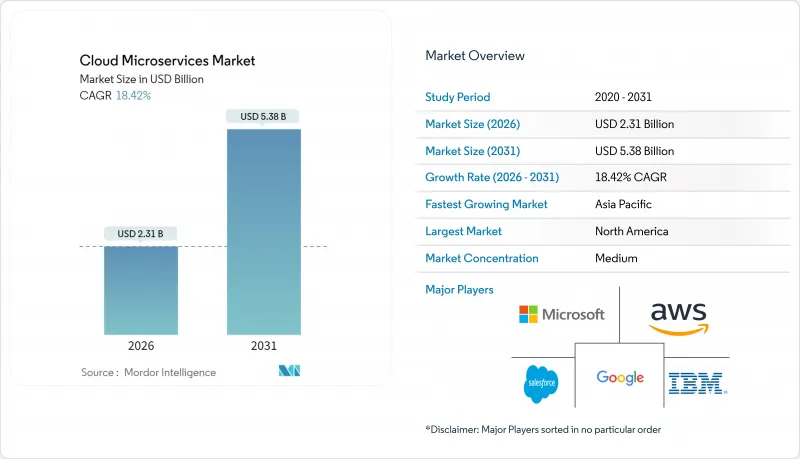
본 보고서는 구성 요소별(플랫폼 및 서비스), 기업 규모별(중소기업 및 대기업), 최종 사용자 산업별(은행, 금융서비스 및 보험(BFSI), 소매 및 전자상거래, 제조, IT 및 통신, 헬스케어 및 생명과학, 기타), 클라우드 유형별(퍼블릭 클라우드, 프라이빗 클라우드, 하이브리드 및 멀티 클라우드), 그리고 지역별로 분류되어 있습니다. 시장 예측은 금액(달러) 기준으로 제시되어 있습니다.
세계의 클라우드 마이크로서비스 시장 동향 및 인사이트
릴리스 주기 단축을 위해 모놀리식 아키텍처에서 도메인 주도 설계로의 전환이 진행되고 있습니다.
대기업에서는 모놀리식 코드베이스를 비즈니스 기능을 반영한 ‘바운드 컨텍스트’로 분할하고 있으며, 이를 통해 조정에 소요되는 오버헤드가 감소하고 독립적인 릴리스가 가능해졌습니다. 한 유럽 소매 은행은 마이크로서비스로의 전환을 통해 배포 리드 타임이 6주에서 3일로 단축되어, 금리 변동에 맞춘 신속한 제품 출시가 가능해졌습니다고 밝혔습니다. 제조 기업들도 생산 스케줄링에 유사한 패턴을 적용하여, 현장 변경 시 부서 간 조정이 더 이상 필요하지 않게 되었습니다. 레드햇의 2025년 조사에 따르면, IT 리더의 68%가 마이크로서비스를 지속적 배포에 필수적인 요소로 간주하고 있으며, 이는 2024년의 54%에서 증가한 수치입니다. 다만, 팀이 서비스 경계에 대해 합의하고 일관된 API 계약을 철저히 준수해야 하므로 이러한 성과에는 초기 비용이 수반됩니다.
쿠버네티스 기반 서비스 메시 액셀러레이터의 주류화
서비스 메시(Service Mesh)는 현재 mTLS, 트래픽 셰이핑, 트레이싱을 재사용 가능한 컨트롤 플레인에 통합하여 개발자의 운영 부담을 줄이고 있습니다. Google Cloud는 2025년 3월, Traffic Director에 자동 사이드카 주입 기능을 추가하여, 과거 도입의 걸림돌이었던 수동 YAML 편집 작업을 불필요하게 만들었습니다. 금융 기관들은 ‘디지털 운영 복원력 법(Digital Operational Resilience Act)’에 포함된 제로 트러스트 요건을 충족하기 위해 서비스 메시를 활용하고 있습니다. Linux Foundation의 조사에 따르면, 50개 이상의 서비스를 운영하는 기업 중 2025년에는 58%가 프로덕션 환경에서 서비스 메시를 도입하고 있으며, 이는 전년의 41%에서 증가한 수치입니다. 정책 적용을 중앙 집중화함으로써 구성 드리프트가 완화되고, 사고 대응이 개선됩니다. 이는 클라우드 및 마이크로서비스 시장의 추가적인 성장을 뒷받침합니다.
서비스 간 보안, 가시성 및 데이터 확산의 복잡성
각 마이크로서비스는 인증, 권한 부여, 암호화가 필요한 새로운 이스트-웨스트 트래픽 경로를 생성합니다. 클라우드 보안 연합(Cloud Security Alliance)의 조사에 따르면, 2025년에는 조직의 64%가 서비스 간 인증 설정 오류로 인한 사고를 적어도 한 건 경험했습니다. 도구의 난립은 가시성을 저해합니다. 서로 다른 플랫폼이 로그, 메트릭, 트레이스를 수집하기 때문에 근본 원인 분석이 방해받기 때문입니다. OpenTelemetry의 2025년 조사에 따르면, 모든 서비스에 걸쳐 통합된 관측 가능성을 실현한 기업은 고작 38%에 그쳤습니다. 지연 시간 대책으로 캐시된 데이터의 복제본은 특히 의료나 금융 등 규제 대상 부문에 서비스를 제공하는 클라우드 마이크로서비스 시장의 벤더들에게 데이터 저장 위치에 관한 규제 준수를 더욱 복잡하게 만들고 있습니다.
부문 분석
플랫폼 제품은 2025년 매출의 55.46%를 차지했으며, 클라우드 마이크로서비스 시장에서 컨테이너 오케스트레이션, API 관리, 서버리스 실행의 제어 평면으로서의 역할을 강조하고 있습니다. Red Hat, VMware, Rancher의 Kubernetes 배포판은 워크로드 스케줄링과 리소스 할당량을 관리하며, Kong, MuleSoft, Apigee의 게이트웨이는 라우팅과 스로틀링을 관리합니다. 플랫폼 분야의 클라우드 및 마이크로서비스 시장 규모는 높은 충성도 기반의 지속적인 수익과 높은 전환 비용을 가져다주는 구독 모델에 의해 뒷받침되고 있습니다. 컨설팅, 도입, 관리형 운영을 아우르는 서비스 분야는 조직이 모놀리식 시스템을 분해하고 새로운 서비스 경계를 관리하기 위한 지원을 요청함에 따라 2031년까지 연평균 성장률(CAGR) 18.88%로 확대될 것으로 예측됩니다.
서비스 분야는 성과 기반 가격 책정 및 일상적인사이트 신뢰성 관리 업무를 담당하는 공급업체의 부상으로 혜택을 보고 있습니다. 타타 컨설팅 서비스(Tata Consultancy Services)는 2025 회계연도에 클라우드 네이티브 애플리케이션 관련 계약 건수가 전년 대비 34% 증가했다고 보고했습니다. 플랫폼 벤더들은 자문 및 지원 서비스를 번들로 제공함에 따라 라이선스 수익과 서비스 수익의 경계가 모호해지고 있습니다. 성장 속도는 빠르지만, 서비스는 플랫폼에 비해 경기 순환의 영향을 더 쉽게 받는 상황이 지속되고 있습니다. 그러나 가동률 및 서비스 수준 목표와 연계된 장기 계약 덕분에 수익의 예측 가능성은 향상되고 있습니다. 이 두 부문은 소프트웨어 기능과 실무 전문 지식을 결합함으로써 클라우드 마이크로서비스 시장의 구조적 확장을 상호 보완하고 있습니다.
2025년에는 대기업이 61.73%의 점유율을 차지했습니다. 이는 여러 클라우드에 걸쳐 수백 개의 서비스를 운영하기 위해 필요한 넉넉한 예산과 전문 엔지니어링 인력에 대한 접근성을 반영한 것입니다. 이 기업들은 고급 가시성과 정책 기반 보안을 도입하고 있으며, 이는 클라우드 마이크로서비스 시장의 추가적인 확대로 이어지고 있습니다. 중소기업의 경우, 매니지드 쿠버네티스(Managed Kubernetes) 및 서버리스 서비스를 통해 사내 클러스터 운영이 불필요해짐에 따라, 2031년까지 연평균 성장률(CAGR) 20.53%를 나타낼 것으로 예측됩니다.
AWS Elastic Container Service나 Google Cloud Run과 같은 서비스는 스케일링 및 패치 적용을 자동화하여, 중소기업이 대규모 경쟁사와 동등한 배포 빈도를 실현할 수 있게 해줍니다. 미국 중소기업청(SBA)의 조사에 따르면, 클라우드 네이티브를 도입한 중소기업은 기존 호스팅을 이용하는 동종 업계 경쟁사에 비해 신기능 출시 속도가 40% 더 빠른 것으로 나타났습니다. 여전히 장벽은 존재합니다. 구체적으로는 가시성에 할당되는 예산이 제한적이라는 점과, 멀티 리전 구성에서 클라우드 총 지출의 15%에 달할 수 있는 아웃바운드 요금 부담 증가 등을 들 수 있습니다. K3s와 같은 오픈소스 경량 배포판은 비용 효율성을 중시하는 기업에게 매력적이지만, 보다 고도의 실무 기술이 필요하기 때문에 클라우드 마이크로서비스 시장의 도입 패턴을 계속해서 형성하고 있는 다양한 상충 관계가 부각되고 있습니다.
지역별 분석
북미는 하이퍼스케일러의 밀집된 전개와 경험 많은 DevOps 인재 풀을 배경으로 2025년 매출의 41.33%를 차지했습니다. 연방 정부 기관이 클라우드 현대화에 82억 달러를 배정하고, 신규 디지털 프로젝트에서 마이크로서비스 아키텍처를 의무화함에 따라 이 지역 수요는 더욱 강화되었습니다. 캐나다에서는 디지털 뱅킹 업그레이드가 추진력을 얻었고, 멕시코에서는 공급망 가시화를 위한 니어쇼어링에 마이크로서비스를 활용했습니다. 벤더 본사와의 근접성은 과거에는 새로운 기능에 대한 조기 접근을 가능하게 했으나, 전 세계 시장이 성숙해짐에 따라 그 우위는 점차 약화되고 있습니다.
아시아태평양은 2031년까지 연평균 성장률(CAGR) 22.12%를 나타낼 것으로 예측되며, 이는 클라우드 마이크로서비스 시장에서 지역별 가장 높은 성장 속도입니다. 인도의 ‘통합 결제 인터페이스(UPI)’는 마이크로서비스 기반 위에서 월간 100억 건 이상의 거래를 처리하고 있는 반면, 중국은 데이터 현지화법에 대응하기 위해 국산 쿠버네티스(Kubernetes) 배포판의 보급을 추진하고 있습니다. 인도네시아와 베트남의 스타트업 기업들은 레거시 시스템의 제약을 피하기 위해 창업 초기부터 마이크로서비스를 도입하고 있습니다. 인력 부족과 규제 불일치가 역풍으로 작용하고 있지만, 소버린 클라우드 의무화와 5G 확산이 장기적인 성장을 뒷받침하고 있습니다.
유럽에서는 일반 데이터 보호 규정(GDPR(EU 개인정보보호규정)) 및 디지털 운영 복원력 법(DORA)의 엄격한 요건 하에 마이크로서비스가 채택되고 있으며, Gaia-X 프레임워크와 연동된 프라이빗 클라우드 및 하이브리드 클라우드에 대한 관심이 높아지고 있습니다. 독일, 영국, 프랑스가 특히 자동차 및 은행 업계에서 투자를 주도하고 있습니다. 남미는 출발이 늦었지만, 브라질 은행들이 오픈 뱅킹 준수를 위해 코어 시스템을 분리하고, 아르헨티나가 디지털 지갑에 마이크로서비스를 시범 도입하고 있어 기세를 얻고 있습니다. 중동 및 아프리카에서는 사우디아라비아와 아랍에미리트가 경제 다각화를 도모하기 위해 ‘클라우드 퍼스트’ 정책을 추진하고 있으며, 나이지리아의 핀테크 기업들은 대역폭 제약이 있음에도 불구하고 마이크로서비스를 활용하여 모바일 머니의 이용 범위를 확대되고 있습니다. 각 지역이 고유한 규제 및 인프라 환경을 결합함으로써 전 세계 클라우드 마이크로서비스 시장 전체가 확대되고 있습니다.
기타 혜택 :
- 엑셀 형식 시장 예측(ME) 시트
- 3개월간의 애널리스트 지원
자주 묻는 질문
목차
제1장 서론
제2장 조사 방법
제3장 주요 요약
제4장 시장 구도
제5장 시장 규모 및 성장 예측
제6장 경쟁 구도
제7장 시장 기회 및 향후 전망
AJY 26.09.07According to Mordor Intelligence, the cloud microservices market size reached USD 2.31 billion in 2026 and is projected to climb to USD 5.38 billion by 2031, reflecting an 18.42% CAGR.
This report is Segmented by Component (Platform, and Services), Enterprise Size (Small and Medium Enterprises, and Large Enterprises), End-User Industry (BFSI, Retail and E-Commerce, Manufacturing, IT and Telecom, Healthcare and Life Sciences, and More), Cloud Type (Public Cloud, Private Cloud, and Hybrid and Multi-Cloud), and Geography. The Market Forecasts are Provided in Terms of Value (USD).
Global Cloud Microservices Market Trends and Insights
Rising Enterprise Transition From Monolith To Domain-Driven Design For Faster Release Cycles
Large organizations are segmenting monolithic codebases into bounded contexts that mirror business capabilities, which reduces coordination overhead and permits independent releases. A European retail bank disclosed that microservices migration cut deployment lead time from six weeks to three days, allowing rapid product launches tied to interest-rate shifts. Manufacturing firms have applied the same pattern to production scheduling so shop-floor changes no longer require multi-department coordination. Red Hat's 2025 survey showed 68% of IT leaders viewing microservices as critical for continuous delivery, up from 54% in 2024. These gains come with upfront costs, because teams must agree on service boundaries and enforce consistent API contracts.
Mainstream Adoption Of Kubernetes-Based Service Mesh Accelerators
Service meshes now package mTLS, traffic shaping and tracing into a reusable control plane that lifts operational burdens from developers. Google Cloud added automatic sidecar injection to Traffic Director in March 2025, removing manual YAML edits that once deterred adoption. Financial institutions are relying on meshes to meet zero-trust mandates embedded in the Digital Operational Resilience Act. The Linux Foundation found that 58% of enterprises running more than 50 services had a mesh in production in 2025, versus 41% a year earlier. Centralizing policy enforcement reduces configuration drift and improves incident response, which supports the broader growth of the cloud microservices market.
Service-To-Service Security, Observability And Data Sprawl Complexities
Each microservice introduces new east-west traffic paths that must be authenticated, authorized and encrypted. The Cloud Security Alliance found that 64% of organizations suffered at least one incident tied to misconfigured inter-service authentication in 2025. Tool sprawl worsens visibility because separate platforms collect logs, metrics and traces, hindering root-cause analysis. Only 38% of firms achieved unified observability across all services, according to the OpenTelemetry 2025 survey. Data replicas cached for latency reasons further complicate compliance with residency rules, especially for cloud microservices market vendors serving regulated sectors such as healthcare and finance.
Other drivers and restraints analyzed in the detailed report include:
- Cloud-Provider Managed Microservices Platforms Lowering Total Cost Of Ownership
- Rapid Proliferation Of Microservices-First Application Design Among Digital-Native Firms
- Skills Gap In Distributed Systems Engineering
For complete list of drivers and restraints, kindly check the Table Of Contents.
Segment Analysis
Platform products accounted for 55.46% of 2025 revenue, underscoring their role as the control plane for container orchestration, API management and serverless execution within the cloud microservices market. Kubernetes distributions from Red Hat, VMware and Rancher enforce workload scheduling and resource quotas, while gateways from Kong, MuleSoft and Apigee manage routing and throttling. The cloud microservices market size for platforms is anchored by subscription models that produce sticky recurring revenue and high switching costs. Services, which cover consulting, implementation and managed operations, are projected to rise at an 18.88% CAGR to 2031 as organizations seek help in decomposing monoliths and governing new service boundaries.
The services line benefits from outcome-based pricing and from the emergence of providers that shoulder day-to-day site-reliability tasks. Tata Consultancy Services reported 34% year-over-year growth in cloud-native application engagements during fiscal 2025. Platform vendors are bundling advisory and support offerings, blurring the divide between license and services income. Despite faster growth, services remain more exposed to economic cycles than platforms, yet long-term contracts tied to uptime and service-level objectives are improving predictability. Together, the two segments reinforce the structural expansion of the cloud microservices market by matching software capabilities with hands-on expertise.
Large organizations held 61.73% share in 2025, reflecting deep budgets and access to specialized engineering talent needed to run hundreds of services across multiple clouds. They deploy advanced observability and policy-driven security, which further enlarges the cloud microservices market. Small and medium enterprises are forecast to expand at a 20.53% CAGR through 2031 because managed Kubernetes and serverless offerings remove the need for in-house cluster operations.
Services such as AWS Elastic Container Service and Google Cloud Run automate scaling and patching, giving SMEs parity with larger rivals on deployment cadence. A study by the U.S. Small Business Administration found that cloud-native SMEs launched new features 40% faster than peers on traditional hosting. Barriers persist, including limited budgets for observability and higher exposure to egress fees, which can reach 15% of total cloud spend for multi-region designs. Open-source lightweight distributions like K3s appeal to cost-conscious firms but require more hands-on skills, revealing a spectrum of trade-offs that continue to shape cloud microservices market adoption patterns.
Complete Report Scope:
- By Component
- Platform
- Services
- By Enterprise Size
- Small and Medium Enterprises (SMEs)
- Large Enterprises
- By End-User Industry
- Banking, Financial Services and Insurance (BFSI)
- Retail and E-commerce
- Manufacturing
- IT and Telecom
- Healthcare and Life Sciences
- Government and Public Sector
- Other End-User Industries
- By Cloud Type
- Public Cloud
- Private Cloud
- Hybrid and Multi-Cloud
- By Geography
- North America
- United States
- Canada
- Mexico
- South America
- Brazil
- Argentina
- Rest of South America
- Europe
- Germany
- United Kingdom
- France
- Italy
- Spain
- Rest of Europe
- Asia-Pacific
- China
- Japan
- India
- South Korea
- ASEAN
- Rest of Asia-Pacific
- Middle East
- Saudi Arabia
- United Arab Emirates
- Rest of Middle East
- Africa
- South Africa
- Nigeria
- Rest of Africa
- North America
Geography Analysis
North America generated 41.33% of 2025 revenue, supported by dense hyperscaler footprints and experienced DevOps labor pools. Federal agencies allotted USD 8.2 billion to cloud modernization and required microservices architectures in new digital projects, which fortified regional demand. Canada saw momentum from digital banking upgrades, and Mexico leveraged microservices for near-shoring supply-chain visibility. Close proximity to vendor headquarters once gave early access to emerging features, yet that advantage is narrowing as global regions mature.
Asia-Pacific is projected to advance at a 22.12% CAGR through 2031, the highest regional pace in the cloud microservices market. India's Unified Payments Interface handles more than 10 billion monthly transactions on a microservices foundation, while China promotes indigenous Kubernetes distributions to meet data-localization law. Start-ups in Indonesia and Vietnam deploy microservices from inception, bypassing legacy constraints. Talent shortages and fragmented regulations pose headwinds, but sovereign-cloud mandates and 5G rollouts sustain long-run growth.
Europe adopts microservices under the rigor of the General Data Protection Regulation and the Digital Operational Resilience Act, driving interest in private and hybrid clouds tied to the Gaia-X framework. Germany, the United Kingdom and France spearhead spending, especially across automotive and banking. South America lags but gains traction as Brazilian banks unbundle cores for open-banking compliance, while Argentina pilots microservices in digital wallets. In the Middle East and Africa, Saudi Arabia and the United Arab Emirates enforce cloud-first policies to diversify economies, and Nigerian fintech firms leverage microservices to extend mobile money reach despite bandwidth constraints. Each region contributes distinct regulations and infrastructure profiles that collectively enlarge the global cloud microservices market.
- Amazon Web Services, Inc.
- Microsoft Corporation
- International Business Machines Corporation
- Google LLC
- Salesforce, Inc.
- Oracle Corporation
- Broadcom Inc. (incl. CA Technologies)
- VMware, Inc.
- Red Hat, Inc.
- Tata Consultancy Services Limited
- Infosys Limited
- NGINX, Inc. (F5 Networks)
- Docker, Inc.
- Kong Inc.
- MuleSoft LLC
- Accenture PLC
- DXC Technology
- RapidValue Solutions Private Limited
- HashiCorp, Inc.
- Wipro Limited
- Capgemini SE
- Cognizant Technology Solutions Corporation
- Progress Software Corporation
- Akamai Technologies, Inc.
Additional Benefits:
- The market estimate (ME) sheet in Excel format
- 3 months of analyst support
TABLE OF CONTENTS
1 INTRODUCTION
- 1.1 Study Assumptions and Market Definition
- 1.2 Scope of the Study
2 RESEARCH METHODOLOGY
3 EXECUTIVE SUMMARY
4 MARKET LANDSCAPE
- 4.1 Market Overview
- 4.2 Market Drivers
- 4.2.1 Rapid Proliferation of Microservices-first Application Design Among Digital-native Firms
- 4.2.2 Rising Enterprise Transition from Monolith to Domain-driven Design for Faster Release Cycles
- 4.2.3 Mainstream Adoption of Kubernetes-based Service Mesh Accelerators
- 4.2.4 Cloud-provider Managed Microservices Platforms Lowering Total Cost of Ownership
- 4.2.5 Edge-native Microservices for Low-latency IoT Workloads
- 4.2.6 Industry-specific Microservices Blueprints (e.g., banking cores) Driving Vertical Uptake
- 4.3 Market Restraints
- 4.3.1 Service-to-service Security, Observability and Data Sprawl Complexities
- 4.3.2 Skills Gap in Distributed Systems Engineering
- 4.3.3 Rising Egress Costs in Multi-cloud Service Meshes
- 4.3.4 Regulatory Uncertainty Over Cross-border Micro-transactions APIs
- 4.4 Industry Value Chain Analysis
- 4.5 Regulatory Landscape
- 4.6 Technological Outlook
- 4.7 Porter's Five Forces Analysis
- 4.7.1 Bargaining Power of Suppliers
- 4.7.2 Bargaining Power of Buyers
- 4.7.3 Threat of New Entrants
- 4.7.4 Threat of Substitutes
- 4.7.5 Intensity of Competitive Rivalry
5 MARKET SIZE AND GROWTH FORECASTS (VALUE)
- 5.1 By Component
- 5.1.1 Platform
- 5.1.2 Services
- 5.2 By Enterprise Size
- 5.2.1 Small and Medium Enterprises (SMEs)
- 5.2.2 Large Enterprises
- 5.3 By End-User Industry
- 5.3.1 Banking, Financial Services and Insurance (BFSI)
- 5.3.2 Retail and E-commerce
- 5.3.3 Manufacturing
- 5.3.4 IT and Telecom
- 5.3.5 Healthcare and Life Sciences
- 5.3.6 Government and Public Sector
- 5.3.7 Other End-User Industries
- 5.4 By Cloud Type
- 5.4.1 Public Cloud
- 5.4.2 Private Cloud
- 5.4.3 Hybrid and Multi-Cloud
- 5.5 By Geography
- 5.5.1 North America
- 5.5.1.1 United States
- 5.5.1.2 Canada
- 5.5.1.3 Mexico
- 5.5.2 South America
- 5.5.2.1 Brazil
- 5.5.2.2 Argentina
- 5.5.2.3 Rest of South America
- 5.5.3 Europe
- 5.5.3.1 Germany
- 5.5.3.2 United Kingdom
- 5.5.3.3 France
- 5.5.3.4 Italy
- 5.5.3.5 Spain
- 5.5.3.6 Rest of Europe
- 5.5.4 Asia-Pacific
- 5.5.4.1 China
- 5.5.4.2 Japan
- 5.5.4.3 India
- 5.5.4.4 South Korea
- 5.5.4.5 ASEAN
- 5.5.4.6 Rest of Asia-Pacific
- 5.5.5 Middle East
- 5.5.5.1 Saudi Arabia
- 5.5.5.2 United Arab Emirates
- 5.5.5.3 Rest of Middle East
- 5.5.6 Africa
- 5.5.6.1 South Africa
- 5.5.6.2 Nigeria
- 5.5.6.3 Rest of Africa
- 5.5.1 North America
6 COMPETITIVE LANDSCAPE
- 6.1 Market Concentration
- 6.2 Strategic Moves
- 6.3 Market Share Analysis
- 6.4 Company Profiles (includes Global level Overview, Market Level Overview, Core Segments, Financials as Available, Strategic Information, Market Rank/Share for Key Companies, Products and Services, and Recent Developments)
- 6.4.1 Amazon Web Services, Inc.
- 6.4.2 Microsoft Corporation
- 6.4.3 International Business Machines Corporation
- 6.4.4 Google LLC
- 6.4.5 Salesforce, Inc.
- 6.4.6 Oracle Corporation
- 6.4.7 Broadcom Inc. (incl. CA Technologies)
- 6.4.8 VMware, Inc.
- 6.4.9 Red Hat, Inc.
- 6.4.10 Tata Consultancy Services Limited
- 6.4.11 Infosys Limited
- 6.4.12 NGINX, Inc. (F5 Networks)
- 6.4.13 Docker, Inc.
- 6.4.14 Kong Inc.
- 6.4.15 MuleSoft LLC
- 6.4.16 Accenture PLC
- 6.4.17 DXC Technology
- 6.4.18 RapidValue Solutions Private Limited
- 6.4.19 HashiCorp, Inc.
- 6.4.20 Wipro Limited
- 6.4.21 Capgemini SE
- 6.4.22 Cognizant Technology Solutions Corporation
- 6.4.23 Progress Software Corporation
- 6.4.24 Akamai Technologies, Inc.
7 MARKET OPPORTUNITIES AND FUTURE OUTLOOK
- 7.1 White-space and Unmet-Need Assessment


