

|
시장보고서
상품코드
2122956
저밀도 폴리에틸렌(LDPE) 시장 : 시장 점유율 분석, 업계 동향 및 통계, 성장 예측(2026-2031년)Low Density Polyethylene - Market Share Analysis, Industry Trends & Statistics, Growth Forecasts (2026 - 2031) |
||||||
 Mordor Intelligence
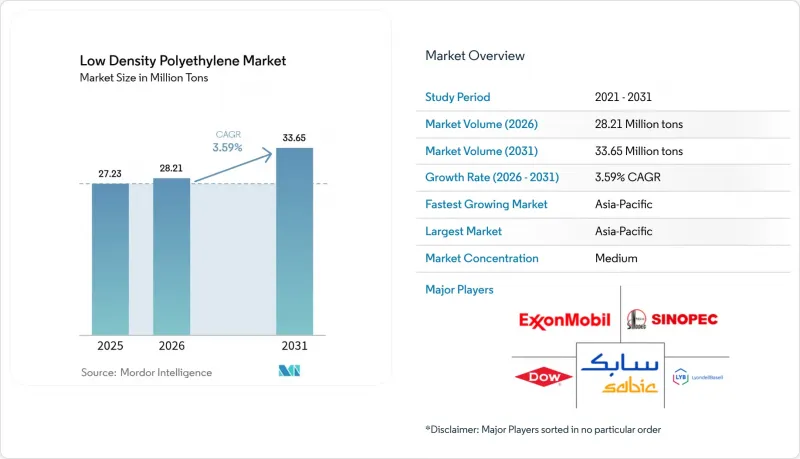
Mordor Intelligence에 의하면, 저밀도 폴리에틸렌(LDPE) 시장 규모는 2025년 2,723만 톤으로 평가되었고, 2026년 2,821만 톤으로 추정되고, 2031년까지 3,365만 톤으로 확대될 것응로 예측되며, 2026-2031년 연평균 복합 성장률(CAGR)은 3.59%를 기록할 전망입니다.
본 보고서는 제품 유형별(블로우 성형, 필름, 사출 성형, 시트, 발포체, 전선 및 케이블 절연체), 최종 사용자 산업별(농업, 전기 및 전자기기, 포장, 건설, 자동차, 기타), 지역별(아시아태평양, 북미, 유럽, 남미, 중동 및 아프리카)로 분류되어 있습니다. 시장 예측은 수량(톤) 기준으로 제시되어 있습니다.
세계의 저밀도 폴리에틸렌(LDPE) 시장 동향 및 인사이트
전자상거래용 연질 포장의 성장
2025년에는 아마존, 알리바바, 지역 플랫폼들이 캘리포니아주, 프랑스, 독일의 확대 생산자 책임(EPR) 규정을 충족하는 단일 소재 LDPE 우편 봉투를 채택함에 따라 소포 처리량이 18% 증가했습니다. LDPE는 105-115°C에서 밀봉이 가능하며, 코로나 처리가 필요한 폴리프로필렌 라미네이트보다 25% 더 빠른, 200m/min을 초과하는 파우치 생산 라인을 실현합니다. 인도와 베트남의 각 컨버터 기업들은 2024년 7월 플라스틱 폐기물 규제에 대응하기 위해 30-40마이크로미터 블로우 필름에 15%의 소비 후 수지를 배합하여, 인증된 원료에 대해 톤당 150달러의 프리미엄을 창출했습니다. 2025년 2분기에 출시된 다우(Dow)사의 ‘INNATE’ 수지를 통해 각 브랜드는 필름 두께를 20% 얇게 하면서도 400g의 낙하 충격 강도를 유지할 수 있게 되어, 스코프 3 배출량을 감축할 수 있게 되었습니다. 그 결과, 가정용 쓰레기로 재활용이 가능한 구조를 가진 제품이 적절한 폐기 처리 채널이 없는 다층 라미네이트 소재 시장 점유율을 잠식하는 형태로 LDPE 시장을 확대되고 있습니다.
농업용 필름 수요 증가
2024-2025년 인도에서는 12%, 베트남에서는 9%로 보호 재배 면적이 증가했습니다. 이는 수명이 3-5년인 자외선 안정화 LDPE의 사용을 의무화하는 보조금 제도가 뒷받침한 결과입니다. LDPE는 400-600nm의 빛을 투과하므로 토마토와 파프리카의 광합성 유효 복사를 최적화하는 동시에, 40°C를 넘는 열대 지역의 급격한 온도 변화 속에서도 유연성을 유지합니다. 중국에서는 2025년에 약 140만 톤의 멀칭 필름이 소비되었으며, 그 중 60%를 LDPE가 차지했습니다. 이는 리니어 등급의 인열 강도가 25N/mm²이기 때문입니다. 브라스켐(Bruskem)사가 2025년 10월에 출시한 바이오 등급은 유럽의 유기농 농장을 대상으로 하며, 퇴비화 조건에서 18개월 이내에 98%가 생분해됩니다. 뉴질랜드, 아일랜드, 아르헨티나에서는 낙농가들이 베일 형태의 건초에서 혐기성 저장 건초로 전환하고, LDPE의 산소 차단성을 활용하여 부패를 방지하게 됨에 따라 저장 건초용 랩 수요가 7% 증가했습니다.
LLDPE·HDPE와의 경쟁
2020-2025년 LLDPE는 천공 저항성을 저해하지 않으면서 컨버터가 필름 두께를 23마이크로미터에서 17마이크로미터로 얇게 만들 수 있게 함으로써, 스트레치 필름 수량 기준 12%의 시장 점유율을 확보했습니다. LDPE는 여전히 냉동 식품 용도로 400-500g의 드롭 충격 강도를 제공하고 있지만, 2025년 4분기 톤당 150달러의 프리미엄 가격이 비용에 민감한 구매자들을 LLDPE로 돌리게 했습니다. HDPE로의 대체는 블로우 성형 병 분야에서 가속화되고 있으며, 이 부문에서 HDPE의 내스트레스 균열성은 LDPE보다 50% 더 우수합니다. Chevron Phillips Chemical이 2024년에 출시한 ‘MARLEX’ 바이모달 HDPE는 LDPE와 동등한 가공성을 갖추고 있어, 팔레트 제조업체들은 LDPE로 만든 캡과 크레이트의 사용을 단계적으로 폐지할 수 있게 되었습니다. 그 결과, 2025년에는 고압 LDPE 반응 설비의 가동률이 70% 미만으로 떨어진 반면, LLDPE 라인의 가동률은 80%를 넘어섰습니다.
부문 분석
필름은 2025년 시장 규모의 56.71%를 차지했으나, LLDPE와 HDPE가 스트레치 필름 및 경질 용기 틈새 시장에 진입함에 따라 비교적 낮은 성장률로 확대될 것으로 전망됩니다. 전선 및 케이블용 저밀도 폴리에틸렌(LDPE) 시장 규모는 2026년부터 2031년까지 연평균 성장률(CAGR) 4.14%로 확대될 것으로 예측되지만, 필름 부문은 여전히 지배적인 위치를 차지하고 있음에도 불구하고 시장은 성숙기에 접어들었습니다. 보레알리스(Borealis)는 2025년 3월, 400kV 케이블용 LDPE 2426H를 출시하여 1만 시간 이상의 워터트리 발생 억제 성능을 제공합니다.
사출 성형(캡 및 마개)은 USP 클래스 VI 준수가 요구되는 의약품 바이알 수요에 힘입어 성장을 이루고 있습니다. 블로우 성형 용기는 HDPE의 강성이 전자상거래 물류를 뒷받침하고 있어 시장이 확대되고 있습니다. 신흥 해저 케이블, 데이터센터, 고전압 용도가 성숙한 필름 수요를 상쇄하고 있어 LDPE 시장은 여전히 견조한 모습을 유지하고 있습니다.
지역별 분석
아시아태평양은 2025년 생산량의 47.36%를 차지했으며, 2031년까지 연평균 4.47%의 성장률을 보일 것으로 전망됩니다. 이는 온실용 필름 및 압출 코팅 수요에 대응하기 위해 2025-2026년 중국에서 820만 톤 규모의 LDPE 신규 생산 능력이 가동에 들어가는 데 힘입은 결과입니다. 2025년 말, 동남아시아 공장의 가동률은 91%였습니다. 이는 전 세계 생산 능력 확충이 리니어 등급에 편중되면서, 중국 이외 지역에서는 기존 LDPE가 공급 부족에 빠졌기 때문입니다. 인도의 LDPE 시장은 원가보다 저렴한 중국산 수입품에 직면하여, 2024년 11월에 반덤핑 조사가 시작되었습니다. 일본과 한국은 2028년까지 20만 톤의 처리 능력을 목표로 화학 재활용에 막대한 투자를 단행했습니다. 베트남에서는 국가 보조금에 힘입어 전자기기 조립 및 온실 재배 면적이 확대되면서 2025년 수입량이 14% 증가했습니다.
북미 시장 수요는 셰일 에탄에 의한 비용 우위에 힘입고 있습니다. 셰브론 Philips 케미칼(Chevron Phillips Chemical)의 85억 달러 규모 ‘골든 트라이앵글 폴리머스(Golden Triangle Polymers)’ 복합 시설에서는 새로운 LDPE 생산 설비 건설 계획이 없어, 이로 인해 지역 내 공급이 핍박되어 프리미엄 가격을 지탱하고 있습니다. 캐나다에서는 온실용 필름 수요 증가로 인해 2025년 국내 LDPE 사용량이 4.2% 증가했습니다. 멕시코 시장은 와이어 하네스 및 의료기기 제조 분야의 니어쇼어링이 주도하고 있습니다. 캘리포니아주가 2030년까지 도입할 예정인 30%의 PCR(소비 후 재활용) 의무화 규정에 따라, 기계적 재활용 LDPE의 프리미엄은 이미 톤당 180달러까지 상승했습니다.
유럽은 2025년 생산량에서 큰 시장 점유율을 차지했으나, 베르살리스(Versalis)사가 400kt의 생산 능력을 폐쇄한 점과 2028년 이후 재활용이 불가능한 단층 필름을 금지하는 엄격한 PPWR 규제가 도입됨에 따라 연평균 성장률(CAGR)은 완만한 증가에 그치고 있습니다. 독일에서는 자동차 생산이 6% 감소하고, 가공업체들이 VerpackG 목표 달성을 위해 PET 기반 라미네이트 소재로 전환함에 따라 2025년 수요가 감소했습니다. 레프솔(Repsol)의 시네스(Cines)에 위치한 300kt 규모의 LLDPE 생산 라인은 업계가 고비용의 고압 LDPE 설비에 대한 투자에 소극적임을 여실히 보여주고 있습니다. 북유럽의 성장은 EU 농촌 개발 기금의 자금을 지원받는 데이터센터용 광섬유와 온실용 필름에 의해 뒷받침되고 있습니다. 튀르키예는 리라화 약세에도 불구하고 MENA 시장을 위한 재수출 거점으로서의 역할을 수행하고 있습니다.
남미와 중동 및 아프리카에서는 급속한 산업화의 진전에 따라 LDPE 수요가 모두 증가하고 있습니다. 브라질의 농업용 필름 수요와 사우디아라비아의 에탄 기반 생산 확대에 힘입어 LDPE 시장의 모멘텀이 유지되고 있습니다.
기타 혜택
- 엑셀 형식 시장 예측(ME) 시트
- 3개월간의 애널리스트 지원
자주 묻는 질문
목차
제1장 서론
제2장 조사 방법
제3장 주요 요약
제4장 시장 구도
제5장 시장 규모 및 성장 예측
제6장 경쟁 구도
제7장 시장 기회 및 향후 전망
AJY 26.09.09According to Mordor Intelligence, the low density polyethylene market size is projected to expand from 27.23 million tons in 2025 and 28.21 million tons in 2026 to 33.65 million tons by 2031, registering a CAGR of 3.59% between 2026 to 2031.
This report is Segmented by Product Type (Blow Molded, Films, Injection Molded, Sheets, Foams, Wire and Cable Insulation), End-User Industry (Agriculture, Electrical and Electronics, Packaging, Construction, Automotive, and More), and Geography (Asia-Pacific, North America, Europe, South America, Middle East and Africa). Market Forecasts are Provided in Terms of Volume (Tons).
Global Low Density Polyethylene Market Trends and Insights
Growth in E-Commerce Flexible Packaging
Parcel volumes rose 18% in 2025 as Amazon, Alibaba, and regional platforms adopted mono-material LDPE mailers that satisfy extended-producer-responsibility rules in California, France, and Germany. LDPE seals at 105-115 °C, enabling pouch lines above 200 m/min-25% faster than polypropylene laminates that require corona treatment. Converters in India and Vietnam merged 15% post-consumer resin into 30-40 µm blown films to meet July 2024 plastic-waste mandates, generating a USD 150/ton premium for certified feedstock. Dow's INNATE resin, launched Q2 2025, lets brands down-gauge films by 20% yet keep 400 g dart-drop impact, cutting scope-3 emissions. Curbside-recyclable structures are therefore expanding the low density polyethylene market at the expense of multi-layer laminates lacking viable end-of-life pathways.
Rising Demand for Agricultural Films
Protected-agriculture acreage climbed 12% in India and 9% in Vietnam during 2024-2025, incentivized by subsidies that require UV-stabilized LDPE with a 3-5 year service life. LDPE transmits 400-600 nm light, optimizing photosynthetically active radiation for tomatoes and capsicums while flexing under 40 °C tropical swings. China consumed nearly 1.4 million tons of mulch film in 2025, 60% of it LDPE, because linear grades tear at 25 N/mm2. Braskem's October 2025 bio-based grade targets European organic farms and biodegrades 98% within 18 months under composting conditions. Silage-wrap demand grew 7% in New Zealand, Ireland, and Argentina as dairies shifted from baled hay to anaerobic ensiling, relying on LDPE's oxygen-barrier to curb spoilage.
Competition from LLDPE and HDPE
Between 2020 and 2025, LLDPE captured 12 percentage points of stretch-film volume by enabling converters to down-gauge from 23 µm to 17 µm without puncture-resistance loss. LDPE still offers 400-500 g dart-drop impact for frozen-food applications, yet its USD 150/ton Q4 2025 premium pushed cost-sensitive buyers toward LLDPE. HDPE substitution accelerated in blow-molded bottles, where stress-crack resistance outperforms LDPE by 50%. Chevron Phillips Chemical's 2024 MARLEX bimodal HDPE mimics LDPE processability, allowing pallet makers to phase out LDPE caps and crates. Consequently, high-pressure LDPE reactors operated below 70% utilization in 2025 versus greater than 80% for LLDPE lines.
Other drivers and restraints analyzed in the detailed report include:
- Preference for Extrusion-Coated Applications
- Solar-Panel Encapsulant Film Uptake
- Ethylene Feedstock Price Volatility
For complete list of drivers and restraints, kindly check the Table Of Contents.
Segment Analysis
Films kept 56.71% of the 2025 volume but anticipated grow with a relatively low growth rate as LLDPE and HDPE encroached on stretch-film and rigid-container niches. The low density polyethylene market size for wire and cable is projected to expand at 4.14% CAGR between 2026-2031, while films hold a dominant yet maturing footprint. Borealis debuted LDPE 2426H in March 2025 for 400 kV cables, offering water-tree retardance greater than 10,000 h.
Injection molding (caps and closures) is witnessing growth propelled by pharmaceutical vial demand needing USP Class VI compliance. Blow-molded containers are growing as HDPE's rigidity supports e-commerce logistics. Nevertheless, the low density polyethylene market remains resilient because emerging subsea-cable, data-center, and high-voltage applications offset mature film demand.
Complete Report Scope:
- By Product Type
- Blow Molded
- Films
- Injection Molded
- Sheets
- Foams
- Wire and Cable Insulation
- By End-user Industry
- Agriculture
- Electrical and Electronics
- Packaging
- Construction
- Automotive
- Consumer Goods
- Healthcare and Pharma
- By Geography
- Asia-Pacific
- China
- India
- Japan
- South Korea
- Malaysia
- Thailand
- Indonesia
- Vietnam
- Rest of Asia-Pacific
- North America
- United States
- Canada
- Mexico
- Europe
- Germany
- United Kingdom
- France
- Italy
- Spain
- Nordic Countries
- Turkey
- Russia
- Rest of Europe
- South America
- Brazil
- Argentina
- Colombia
- Rest of South America
- Middle-East and Africa
- Saudi Arabia
- Qatar
- United Arab Emirates
- Nigeria
- Egypt
- South Africa
- Rest of Middle-East and Africa
- Asia-Pacific
Geography Analysis
Asia-Pacific captured 47.36% of 2025 volume and will grow at 4.47% through 2031, propelled by China's 8.2 million tons of new LDPE capacity commissioned 2025-2026 for greenhouse film and extrusion-coating demand. Southeast Asian plants ran at 91% utilization in late 2025 because global additions skewed to linear grades, leaving conventional LDPE in deficit outside China. India's low density polyethylene market confronted below-cost Chinese imports, triggering an anti-dumping probe in November 2024. Japan and South Korea invested heavily in chemical recycling, targeting 200 kt capacity by 2028. Vietnam boosted imports 14% in 2025 as electronics assembly and greenhouse acreage expanded under state subsidies.
North America market demand is supported by shale-ethane cost advantages. No new LDPE units are slated in Chevron Phillips Chemical's USD 8.5 billion Golden Triangle Polymers complex, tightening regional supply and underpinning premiums. Canada's greenhouse-film demand lifted national LDPE use 4.2% in 2025. Mexico 's market is driven by near-shoring of wire-harness and medical-device manufacturing. California's 30% PCR rule for 2030 has already raised mechanically recycled LDPE premiums to USD 180/ton.
Europe accounted for a significant market share in 2025 volume, but growing with modest CAGR because Versalis shuttered 400 kt of capacity and stringent PPWR rules ban non-recyclable mono-layer films from 2028. German demand slipped in 2025 as automotive output dropped 6% and converters pivoted to PET-based laminates to meet VerpackG targets. Repsol's 300 kt LLDPE line at Sines underscores industry reluctance to invest in costly high-pressure LDPE units. Nordic growth is tied to data-center fiber and greenhouse films financed under EU rural-development funds. Turkey is acting as re-export hub for MENA markets despite lira depreciation.
South America and the Middle East-Africa together are witnessing a rising demand for low-density polyethylene due to rapidly growing industrialization in the regions. Brazil's agricultural-film demand and Saudi ethane-based expansions keep the low density polyethylene market momentum intact.
- Borealis AG
- Braskem S.A.
- Chevron Phillips Chemical Company LLC
- China Petrochemical Corporation
- Dow
- ExxonMobil Corporation
- Formosa Plastics Corporation
- Hanwha Solutions Chemical Division Corporation
- INEOS Group
- LG Chem
- LyondellBasell Industries Holdings BV
- Mitsui Chemicals, Inc.
- NOVA Chemicals Corporation
- PetroChina
- PTT Global Chemical PLC
- Qatar Chemical Company Ltd
- Reliance Industries Limited
- Repsol S.A.
- SABIC
- Sumitomo Chemical Co., Ltd.
- TotalEnergies SE
- Versalis S.p.A. (Eni)
- Westlake Corporation
Additional Benefits:
- The market estimate (ME) sheet in Excel format
- 3 months of analyst support
TABLE OF CONTENTS
1 Introduction
- 1.1 Study Assumptions and Market Definition
- 1.2 Scope of the Study
2 Research Methodology
3 Executive Summary
4 Market Landscape
- 4.1 Market Overview
- 4.2 Market Drivers
- 4.2.1 Growth in e-commerce flexible packaging
- 4.2.2 Rising demand for agricultural films
- 4.2.3 Preference for extrusion-coated applications
- 4.2.4 Solar-panel encapsulant film uptake
- 4.2.5 Advanced recycling enabling premium LDPE grades
- 4.3 Market Restraints
- 4.3.1 Competition from LLDPE and HDPE
- 4.3.2 Ethylene feedstock price volatility
- 4.3.3 European Union bans on mono-layer polyolefin films
- 4.4 Value Chain Analysis
- 4.5 Regulatory Landscape
- 4.6 Technological Outlook
- 4.7 Porter's Five Forces Analysis
- 4.7.1 Bargaining Power of Suppliers
- 4.7.2 Bargaining Power of Buyers
- 4.7.3 Threat of New Entrants
- 4.7.4 Threat of Substitutes
- 4.7.5 Degree of Competition
5 Market Size and Growth Forecasts (Volume)
- 5.1 By Product Type
- 5.1.1 Blow Molded
- 5.1.2 Films
- 5.1.3 Injection Molded
- 5.1.4 Sheets
- 5.1.5 Foams
- 5.1.6 Wire and Cable Insulation
- 5.2 By End-user Industry
- 5.2.1 Agriculture
- 5.2.2 Electrical and Electronics
- 5.2.3 Packaging
- 5.2.4 Construction
- 5.2.5 Automotive
- 5.2.6 Consumer Goods
- 5.2.7 Healthcare and Pharma
- 5.3 By Geography
- 5.3.1 Asia-Pacific
- 5.3.1.1 China
- 5.3.1.2 India
- 5.3.1.3 Japan
- 5.3.1.4 South Korea
- 5.3.1.5 Malaysia
- 5.3.1.6 Thailand
- 5.3.1.7 Indonesia
- 5.3.1.8 Vietnam
- 5.3.1.9 Rest of Asia-Pacific
- 5.3.2 North America
- 5.3.2.1 United States
- 5.3.2.2 Canada
- 5.3.2.3 Mexico
- 5.3.3 Europe
- 5.3.3.1 Germany
- 5.3.3.2 United Kingdom
- 5.3.3.3 France
- 5.3.3.4 Italy
- 5.3.3.5 Spain
- 5.3.3.6 Nordic Countries
- 5.3.3.7 Turkey
- 5.3.3.8 Russia
- 5.3.3.9 Rest of Europe
- 5.3.4 South America
- 5.3.4.1 Brazil
- 5.3.4.2 Argentina
- 5.3.4.3 Colombia
- 5.3.4.4 Rest of South America
- 5.3.5 Middle-East and Africa
- 5.3.5.1 Saudi Arabia
- 5.3.5.2 Qatar
- 5.3.5.3 United Arab Emirates
- 5.3.5.4 Nigeria
- 5.3.5.5 Egypt
- 5.3.5.6 South Africa
- 5.3.5.7 Rest of Middle-East and Africa
- 5.3.1 Asia-Pacific
6 Competitive Landscape
- 6.1 Market Concentration
- 6.2 Strategic Moves
- 6.3 Market Share(%)/Ranking Analysis
- 6.4 Company Profiles (includes Global Overview, Market Overview, Core Segments, Financials, Strategic Information, Products and Services, Recent Developments)
- 6.4.1 Borealis AG
- 6.4.2 Braskem S.A.
- 6.4.3 Chevron Phillips Chemical Company LLC
- 6.4.4 China Petrochemical Corporation
- 6.4.5 Dow
- 6.4.6 ExxonMobil Corporation
- 6.4.7 Formosa Plastics Corporation
- 6.4.8 Hanwha Solutions Chemical Division Corporation
- 6.4.9 INEOS Group
- 6.4.10 LG Chem
- 6.4.11 LyondellBasell Industries Holdings BV
- 6.4.12 Mitsui Chemicals, Inc.
- 6.4.13 NOVA Chemicals Corporation
- 6.4.14 PetroChina
- 6.4.15 PTT Global Chemical PLC
- 6.4.16 Qatar Chemical Company Ltd
- 6.4.17 Reliance Industries Limited
- 6.4.18 Repsol S.A.
- 6.4.19 SABIC
- 6.4.20 Sumitomo Chemical Co., Ltd.
- 6.4.21 TotalEnergies SE
- 6.4.22 Versalis S.p.A. (Eni)
- 6.4.23 Westlake Corporation
7 Market Opportunities and Future Outlook
- 7.1 White-space and Unmet-need Assessment


