

|
시장보고서
상품코드
2122985
아크릴 에멀전 시장 : 시장 점유율 분석, 업계 동향 및 통계, 성장 예측(2026-2031년)Acrylic Emulsions - Market Share Analysis, Industry Trends & Statistics, Growth Forecasts (2026 - 2031) |
||||||
 Mordor Intelligence
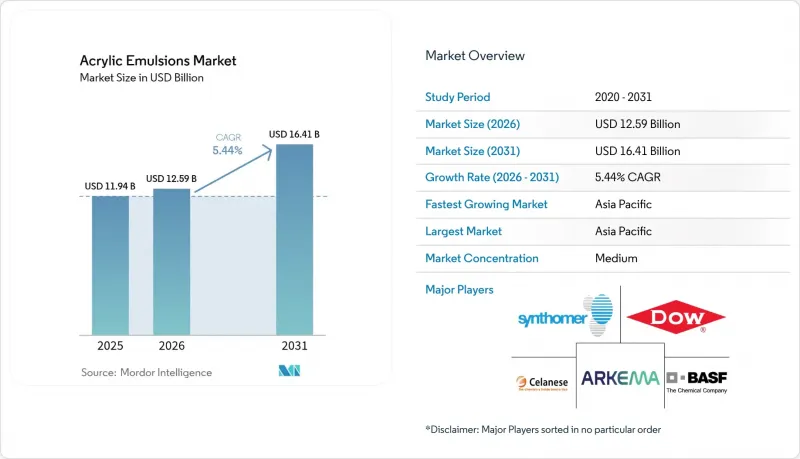
Mordor Intelligence에 의하면, 아크릴 에멀전 시장 규모는 2025년 119억 4,000만 달러로 평가되었고, 2026년에는 125억 9,000만 달러로 추정되고, 2026-2031년 CAGR 5.44%로 성장을 지속할 전망이며, 2031년까지 164억 1,000만 달러에 이를 것으로 예측됩니다.
본 보고서는 유형별(순 아크릴 에멀젼, 스티렌·아크릴 에멀젼, 비닐·아크릴 에멀젼), 용도별(페인트 및 코팅, 건축자재용 첨가제 등), 지역별(아시아태평양, 북미, 유럽, 남미, 중동 및 아프리카)로 분류되어 있습니다. 시장 예측은 금액(달러) 기준으로 제시되어 있습니다.
세계의 아크릴 에멀전 시장 동향 및 인사이트
저VOC화를 통한 수성 페인트 및 코팅에 대한 수요 증가
캘리포니아주에서는 건축용 무광 도료의 VOC 함량을 50 g/L로 계속 제한하고 있으며, 이로 인해 배합 제조업체는 용제를 많이 사용하는 화학 조성을 단계적으로 폐지할 수밖에 없게 되었습니다. 미국 환경보호청(EPA)은 에어로졸 도료의 규제 준수 기한을 2027년 1월까지 연장하여, 제조업체가 용제형 도료와 동등한 성능을 가진 수성 블렌드를 완성할 수 있는 시간을 확보했습니다. 캐나다는 2024년 1월, 130개 소비자 제품 범주에 걸쳐 VOC 제한을 시행함으로써, 수요를 아크릴 에멀젼으로 유도하는 전 세계적인 규제 전환을 뒷받침했습니다. 이에 따라 각 제조업체는 외부 가교제를 사용하지 않고 필름 경도를 높이는 자가 가교 시스템 개발을 확대하고 있으며, 대상 시장을 넓혀가고 있습니다. 이러한 정책적 움직임으로 인해 아크릴 에멀젼 시장은 향후 몇 년간의 전망이 뚜렷해졌으며, 이는 모노머 가격 변동을 상쇄하는 데 도움이 되고 있습니다.
개발도상국의 건설 지출 급증
중국의 2025년도 예산에서는 1조 1,100억 달러 규모의 인프라 지출에 힘입어 GDP 성장률 5%라는 목표가 유지되었습니다. 한편, 인도는 2025-26년도 자본 지출을 11.1% 증가한 11.11락 크롤로 상향 조정했습니다. 새로운 고속도로, 지하철, 산업단지의 건설로 인해 아크릴 분산액을 사용한 건축용 도료, 콘크리트 혼화제, 연포장용 접착제의 소비가 확대되고 있습니다. 동남아시아 전역에서는 제조업의 이전이 공장 건설을 견인하며 수요량을 확대시키고 있습니다. 아크릴 에멀전은 내구성, 밀착성, 저취성이라는 특징을 갖추고 있어, 점점 엄격해지는 환경 기준을 충족해야 하는 건설업체에게 여전히 최적의 바인더로 자리 잡고 있습니다. 또한 중산층의 소득 수준 상승도 주택 도장 주기 교체를 촉진하고 있어, 기초적인 수요는 견조한 추세를 보이고 있습니다.
폴리우레탄 분산액에 대한 선호
수성 폴리우레탄 분산액은 내화학성 및 내마모성 측면에서 아크릴계를 능가하는 경우가 많아, 자동차 트림, 목재 마루, 그리고 고내구성 금속용 도료 분야에서 시장 점유율을 확대되고 있습니다. 2K UV 경화형 폴리우레탄 화학에 관한 최근 조사에서는 저배출 성능 면에서 획기적인 진전이 주목받고 있습니다. 아크릴계는 하이브리드 설계나 자가 가교 네트워크를 통해 이에 대응하고 있지만, 극도로 높은 응력이 가해지는 환경에서는 여전히 성능 차이가 있어 일부 프리미엄 틈새 시장에서 시장 점유율을 확대하는 데에는 한계가 있습니다. 그러나 아크릴계는 중간 수준의 성능에서 비용 및 가공 면에서의 우위를 유지하고 있어, 완전히 대체되지는 않고 균형 잡힌 경쟁이 유지되고 있습니다.
부문 분석
2025년, 스티렌·아크릴계 등급은 전 세계 매출의 44.78%를 차지했습니다. 경도, 내수성, 가격의 균형 덕분에 실내용 건축 도료 및 종이 함침 라인에서 주력 제품으로서의 입지를 확고히 하고 있습니다. 2031년까지 스티렌·아크릴 계열의 판매량은 꾸준히 증가할 전망이지만, 사용자들이 비닐 계열을 많이 사용하는 시스템으로 전환함에 따라 해당 부문의 점유율은 서서히 하락할 것입니다. 비닐·아크릴 계열 에멀전은 유연한 건축용 접착제, 실란트,및 저온 코팅 보드에 대한 수요에 힘입어 연평균 6.14%의 성장이 예상됩니다. 순 아크릴계는 프리미엄 시장을 주도하고 있으며, 색상 유지력과 자외선 내성이 가장 중요시되는 고광택 외벽 및 쿨루프용 엘라스토머 도료에서 선호되고 있습니다.
첨단 자가 가교 기술이 이러한 계층 구조를 더욱 공고히 하고 있습니다. 연구에 따르면, 스티렌·아크릴계 도로용 실란트의 DAAM-ADH 네트워크는 기존 등급에 비해 접착 강도를 50% 이상 향상시키는 것으로 나타났습니다. 각 제조업체는 실험실에서의 재조제를 최소화하면서, 고객이 Tg(유리 전이 온도)와 경도를 미세 조정할 수 있는 모듈형 플랫폼을 판매함으로써 시장 출시 시간을 단축하고 있습니다. 한편, 비닐·아크릴계 공급업체들은 라미네이트 바닥재나 내후성 배리어 필름에서 열 사이클을 견디는 가소제가 포함되지 않은 유연성을 강조하고 있습니다. 순수 아크릴계 제품은 바이오 유래 단량체를 활용하고, 지속가능성을 중시하는 건축가를 타겟으로 삼음으로써 저가 화학제품과의 가치 격차를 확대되고 있습니다.
지역별 분석
아시아태평양은 2025년에 전 세계 매출의 46.05%를 차지한 것으로 평가되었으며, 2031년까지 연평균 성장률(CAGR) 5.98%를 기록할 전망입니다. 중국에서는 베르분트(통합 생산 거점)의 확장을 통해 급증하는 유틸리티용 도료 수요에 대응하는 현지 바인더가 공급되고 있습니다. 한편, 인도에서는 설비 투자 계획의 확대가 상업용 및 주거용 신규 바닥 면적 증가로 직결되고 있습니다. 베트남이나 인도네시아 등 아세안(ASEAN) 회원국에는 OECD 구매자 기준을 충족하기 위해 수성 도료에 의존하는 수출 지향형 가구 및 포장 산업 클러스터가 존재합니다. 또한, 이 지역에는 세계적 규모의 원료 공장이 입지해 있어, 통합형 기업은 비용 압박과의 균형을 맞추면서 규모의 경제를 추진할 수 있게 되었습니다.
북미는 여전히 규제 측면의 동향 주도자입니다. 미국 환경보호청(EPA)의 에어로졸 규제 개정과 캘리포니아주 대기자원국(CARB)의 저VOC 상한 규제는 지속적인 연구개발 투자를 요구하는 한편, 규정 준수 실적이 입증된 기존 기업을 보호하는 역할도 하고 있습니다. 미국의 ‘인프라 투자 및 고용법’에 따른 인프라 현대화로 인해 교량, 교통 허브, 공공 건축물에 대한 지출이 확대되고 있으며, 이 모든 분야에서 내구성이 높고 냄새가 적은 도료가 선호되고 있습니다. 2024년에 시행될 캐나다의 전국적인 VOC 규제는 요건을 통일하고 국경을 초월한 제품 포트폴리오를 간소화할 것입니다. 멕시코의 마키라도라(수출가공구) 네트워크는 수출 승인을 확보하기 위해 수성 도료를 지정하는 가전 및 자동차 제조업체들을 유치하고 있습니다.
유럽에서는 지속가능성 분야의 리더십이 중시되고 있습니다. BASF의 바이오 유래 에틸아크릴레이트로의 전환과 네덜란드에서의 분산제 사업 확대는 해당 지역이 화학 물질 밸류체인의 탈탄소화를 추진하고 있음을 보여줍니다. 독일에서는 건축물의 에너지 효율 향상을 위한 보조금을 통해 ‘쿨 루프(Cool Roof)’ 개조를 지원하고 있으며, 이로 인해 반사형 아크릴 필름 시장이 확대되고 있습니다. 프랑스와 영국에서는 공공 조달에서 순환 경제 기준을 추진하고 있으며, 생애주기 평가(LCA)에 기반한 평가로 입증된 수지가 우선적으로 채택되고 있습니다. 남미, 중동 및 아프리카의 합계는 전 세계 소비량의 10% 미만이지만, 도시화의 진전과 주택담보대출 이용 확대로 인해 주택 도색 및 인프라 프로젝트가 촉진되고 있어 장기적인 성장이 예상됩니다.
기타 혜택 :
- 엑셀 형식 시장 예측(ME) 시트
- 3개월간의 애널리스트 지원
자주 묻는 질문
목차
제1장 서론
제2장 조사 방법
제3장 주요 요약
제4장 시장 구도
제5장 시장 규모 및 성장 예측
제6장 경쟁 구도
제7장 시장 기회 및 향후 전망
AJY 26.09.07According to Mordor Intelligence, the acrylic emulsions market size is expected to grow from USD 11.94 billion in 2025 to USD 12.59 billion in 2026 and is forecast to reach USD 16.41 billion by 2031 at 5.44% CAGR over 2026-2031.
This report is Segmented by Type (Pure Acrylic Emulsion, Styrene Acrylic Emulsion, and Vinyl Acrylic Emulsion), Application (Paints and Coatings, Construction Material Additives, and More), and Geography (Asia-Pacific, North America, Europe, South America, and Middle-East and Africa). The Market Forecasts are Provided in Terms of Value (USD).
Global Acrylic Emulsions Market Trends and Insights
Low-VOC Push for Water-Borne Paints and Coatings
California continues to cap VOC content for flat architectural paint at 50 g/L, compelling formulators to phase out solvent-rich chemistries. The United States Environmental Protection Agency extended aerosol coating compliance dates to January 2027, granting producers time to perfect water-based blends that match solvent-borne performance. Canada enforced VOC limits across 130 consumer product categories in January 2024, reinforcing a global regulatory shift that channels demand toward acrylic emulsions. Producers are therefore scaling self-crosslinking systems that raise film hardness without external crosslinkers, widening the addressable market. These policy moves give the acrylic emulsions market multi-year visibility and help offset monomer-cost swings.
Booming Construction Spending in Developing Countries
China's 2025 budget maintains a 5% GDP growth target, supported by USD 1.11 trillion in infrastructure outlays, while India increased 2025-26 capital expenditure by 11.1% to INR 11.11 lakh crore. New highways, metros, and industrial parks lift consumption of architectural coatings, concrete additives, and flexible packaging adhesives that employ acrylic dispersions. Across Southeast Asia, manufacturing relocations drive factory construction, magnifying volumes. Because acrylic emulsions provide durability, adhesion, and low odor, they remain the binder of choice for builders that must meet tightening environmental standards. Rising middle-class income levels also spur residential repaint cycles, keeping baseline demand resilient.
Preference for Polyurethane Dispersions
Water-borne polyurethane dispersions often outclass acrylics in chemical and abrasion resistance, allowing them to gain ground in automotive trim, wood flooring, and heavy-duty metal coatings. Recent research on 2K UV-curable polyurethane chemistries highlights breakthroughs in low-emission performance. While acrylics answer with hybrid designs and self-crosslinking networks, the gap in very high-stress environments remains, capping share growth in select premium niches. Yet acrylics retain cost and process advantages in the mid-performance tier, ensuring balanced competition rather than outright displacement.
Other drivers and restraints analyzed in the detailed report include:
- Digital Ink-Jet Printing Inks Adoption
- Shift to Food-Grade Flexible-Pack Adhesives
- Acrylic Monomer Price Volatility
For complete list of drivers and restraints, kindly check the Table Of Contents.
Segment Analysis
Styrene-acrylic grades held 44.78% of global revenue in 2025. Their balanced hardness, water resistance, and price position them as the workhorse for interior architectural paint and paper saturation lines. Through 2031, styrene-acrylic volumes will climb steadily, but the segment's share will edge downward as users diversify into vinyl-rich systems. Vinyl-acrylic emulsions are set to grow 6.14% annually, riding demand for flexible construction adhesives, sealants, and low-temperature coated boards. Pure acrylics command the premium tier, favored in high-gloss exterior walls and cool-roof elastomeric where colour retention and UV durability are paramount.
Advanced self-crosslinking technologies reinforce this hierarchy. Studies show DAAM-ADH networks in styrene-acrylic road sealants boost bond strength by more than 50% over conventional grades. Producers market modular platforms that let customers fine-tune Tg and hardness with minimal lab reformulation, saving time to market. Meanwhile, vinyl-acrylic suppliers stress plasticizer-free flexibility that withstands thermal cycling in laminate flooring and weather-barrier membranes. Pure acrylics leverage bio-based monomer options to target sustainability-conscious architects, widening the value gap versus lower-priced chemistries.
Complete Report Scope:
- By Type
- Pure Acrylic Emulsion
- Styrene-Acrylic Emulsion
- Vinyl-Acrylic Emulsion
- By Application
- Paints and Coatings
- Construction Material Additives
- Paper Coating
- Adhesives
- Other Applications (Textile and Non-woven Finishes, etc.)
- By Geography
- Asia-Pacific
- China
- Japan
- India
- South Korea
- ASEAN Countries
- Rest of Asia-Pacific
- North America
- United States
- Canada
- Mexico
- Europe
- Germany
- United Kingdom
- France
- Italy
- Spain
- Russia
- NORDIC Countries
- Rest of Europe
- South America
- Brazil
- Argentina
- Rest of South America
- Middle-East and Africa
- Saudi Arabia
- South Africa
- Rest of Middle-East and Africa
- Asia-Pacific
Geography Analysis
Asia-Pacific contributed 46.05% of global revenue in 2025 and will post a 5.98% CAGR to 2031. China's Verbund site expansions supply local binders for booming public-works paint consumption, while India's elevated capex pipeline translates directly into fresh commercial and residential floor space. ASEAN members such as Vietnam and Indonesia host export-oriented furniture and packaging clusters that rely on water-borne coatings to meet OECD buyer standards. The region also houses world-scale feedstock plants, enabling integrated players to balance cost pressure and drive economies of scale.
North America remains a regulatory trendsetter. The EPA's revised aerosol rules and CARB's low-VOC caps force continuous R&D investment, yet they simultaneously defend incumbents with proven compliance credentials. Infrastructure renewal under the U.S. Infrastructure Investment and Jobs Act pumps spending into bridges, transit hubs, and public buildings, all of which favor durable, low-odor coatings. Canada's country-wide VOC regulations, effective 2024, harmonize requirements and simplify cross-border product portfolios. Mexico's maquiladora network attracts appliance and automotive manufacturers that specify water-borne finishes to secure export approvals.
Europe emphasizes sustainability leadership. BASF's shift to bio-based ethyl acrylate and the Dutch dispersion expansion illustrate the region's drive to decarbonize the chemicals value chain. Germany supports cool-roof retrofits through building-efficiency subsidies, widening the market for reflective acrylic membranes. France and the United Kingdom promote circular-economy criteria in public procurement, favoring resins with life-cycle-assessment backing. Although South America and the Middle-East and Africa together represent less than 10% of global consumption, rising urbanization and increased access to mortgage financing encourage residential repainting and infrastructure projects, providing long-run upside.
- AICA Kogyo Co.Ltd.
- AkzoNobel N.V.
- Allnex GMBH
- Anhui Sinograce Chemical Co., Ltd.
- Arkema
- Asian Paints Ltd.
- Axalta Coating Systems LLC
- BASF
- Celanese Corporation
- DIC Corporation
- Dow
- Gellner Industrial, LLC.
- H.B. Fuller Company
- Lubrizol
- Mallard Creek Polymers
- Nippon Paint Holdings Co., Ltd.
- Osaka Organic Chemical
- PPG Industries, Inc.
- Synthomer plc
- The Cary Company
Additional Benefits:
- The market estimate (ME) sheet in Excel format
- 3 months of analyst support
TABLE OF CONTENTS
1 Introduction
- 1.1 Study Assumptions and Market Definition
- 1.2 Scope of the Study
2 Research Methodology
3 Executive Summary
4 Market Landscape
- 4.1 Market Overview
- 4.2 Market Drivers
- 4.2.1 Low-VOC Push for Water-Borne Paints and Coatings
- 4.2.2 Booming Construction Spending in Developing Countries
- 4.2.3 Digital Ink-Jet Printing Inks Adoption
- 4.2.4 Shift to Food-Grade Flexible-Pack Adhesives
- 4.2.5 Cool-Roof and Reflective Coatings Demand
- 4.3 Market Restraints
- 4.3.1 Preference For Polyurethane Dispersions
- 4.3.2 Acrylic Monomer Price Volatility
- 4.3.3 UV-Yellowing of Styrene-Rich Emulsions
- 4.4 Value Chain Analysis
- 4.5 Porter's Five Forces
- 4.5.1 Bargaining Power of Suppliers
- 4.5.2 Bargaining Power of Consumers
- 4.5.3 Threat of New Entrants
- 4.5.4 Threat of Substitutes
- 4.5.5 Degree of Competition
5 Market Size and Growth Forecasts (Value)
- 5.1 By Type
- 5.1.1 Pure Acrylic Emulsion
- 5.1.2 Styrene-Acrylic Emulsion
- 5.1.3 Vinyl-Acrylic Emulsion
- 5.2 By Application
- 5.2.1 Paints and Coatings
- 5.2.2 Construction Material Additives
- 5.2.3 Paper Coating
- 5.2.4 Adhesives
- 5.2.5 Other Applications (Textile and Non-woven Finishes, etc.)
- 5.3 By Geography
- 5.3.1 Asia-Pacific
- 5.3.1.1 China
- 5.3.1.2 Japan
- 5.3.1.3 India
- 5.3.1.4 South Korea
- 5.3.1.5 ASEAN Countries
- 5.3.1.6 Rest of Asia-Pacific
- 5.3.2 North America
- 5.3.2.1 United States
- 5.3.2.2 Canada
- 5.3.2.3 Mexico
- 5.3.3 Europe
- 5.3.3.1 Germany
- 5.3.3.2 United Kingdom
- 5.3.3.3 France
- 5.3.3.4 Italy
- 5.3.3.5 Spain
- 5.3.3.6 Russia
- 5.3.3.7 NORDIC Countries
- 5.3.3.8 Rest of Europe
- 5.3.4 South America
- 5.3.4.1 Brazil
- 5.3.4.2 Argentina
- 5.3.4.3 Rest of South America
- 5.3.5 Middle-East and Africa
- 5.3.5.1 Saudi Arabia
- 5.3.5.2 South Africa
- 5.3.5.3 Rest of Middle-East and Africa
- 5.3.1 Asia-Pacific
6 Competitive Landscape
- 6.1 Market Concentration
- 6.2 Strategic Moves
- 6.3 Market Share(%)/Ranking Analysis
- 6.4 Company Profiles (includes Global level Overview, Market level overview, Core Segments, Financials as available, Strategic Information, Market Rank/Share, Products and Services, Recent Developments)
- 6.4.1 AICA Kogyo Co.Ltd.
- 6.4.2 AkzoNobel N.V.
- 6.4.3 Allnex GMBH
- 6.4.4 Anhui Sinograce Chemical Co., Ltd.
- 6.4.5 Arkema
- 6.4.6 Asian Paints Ltd.
- 6.4.7 Axalta Coating Systems LLC
- 6.4.8 BASF
- 6.4.9 Celanese Corporation
- 6.4.10 DIC Corporation
- 6.4.11 Dow
- 6.4.12 Gellner Industrial, LLC.
- 6.4.13 H.B. Fuller Company
- 6.4.14 Lubrizol
- 6.4.15 Mallard Creek Polymers
- 6.4.16 Nippon Paint Holdings Co., Ltd.
- 6.4.17 Osaka Organic Chemical
- 6.4.18 PPG Industries, Inc.
- 6.4.19 Synthomer plc
- 6.4.20 The Cary Company
7 Market Opportunities and Future Outlook
- 7.1 White-space and Unmet-need Assessment
- 7.2 Advancements in Self-crosslinking Technology of Acrylic Emulsion


