

|
시장보고서
상품코드
2123034
군용 무인지상차량(UGV) 시장 : 점유율 분석, 업계 동향과 통계, 성장 예측(2026-2031년)Military Unmanned Ground Vehicle - Market Share Analysis, Industry Trends & Statistics, Growth Forecasts (2026 - 2031) |
||||||
 Mordor Intelligence
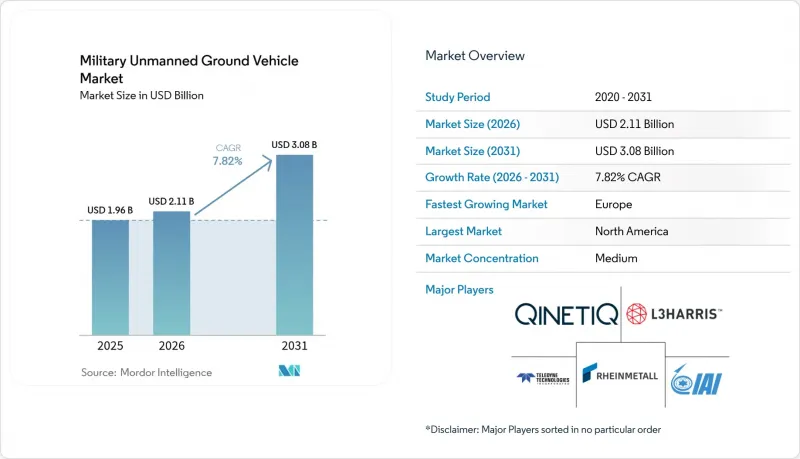
Mordor Intelligence에 의하면, 군용 무인지상차량(UGV) 시장 규모는 2025년 19억 6,000만 달러에서 2026년에는 21억 1,000만 달러로 확대되어 2026-2031년까지 CAGR 7.82%로 성장을 지속하여, 2031년에는 30억 8,000만 달러에 이를 것으로 예측됩니다.
본 보고서는 용도(전투, 정보·감시·정찰(ISR), 폭발물 처리(EOD), 물류·보급, 기타), 이동 방식(바퀴식, 트랙식, 다리식, 하이브리드식), 운용 모드(원격 조종형, 자율형),중량 등급(마이크로, 소형, 중형, 대형), 지역(북미, 유럽, 아시아태평양, 기타)별로 분류되어 있습니다. 시장 예측은 금액(달러) 기준으로 제시되어 있습니다.
전 세계 군용 무인지상차량 시장 동향 및 인사이트
북대서양조약기구(NATO) 및 인도-태평양 국가들의 국방 예산 확대
GDP의 최소 2%를 국방비로 충당하겠다는 동맹국들의 공약에 따라, 자율형 지상 플랫폼에 전례 없는 규모의 자금이 투입되고 있습니다. NATO의 ‘국방 혁신 가속기(Defence Innovation Accelerator)’는 센서, 파워트레인, 보안 통신 분야에서 규모의 경제를 가져올 것으로 기대되는 공동 로봇 프로젝트에 12억 달러를 투자하고 있습니다. 호주는 지상군 전체에 무인 자산을 통합하기 위해 부대 구성 계획에서 1,800억 달러를 배정하고 있으며, 일본은 도서 방어를 강화하기 위해 2024년도 로봇 관련 예산을 40% 증액했습니다. 이러한 예산 연계로 인해 생산 리드타임이 단축되고, 공급업체의 금형 설비가 안정화됩니다. 이를 통해 기존 제조업체는 예측 가능한 생산량을 확보하는 한편, 소프트웨어를 핵심으로 하는 신규 진출기업도 유치되고 있습니다.
병사의 안전에 중점을 둔 자율형 전투·병참 플랫폼 추진
현재 분쟁에서의 전사·부상자 분석에 따르면, 지상 차량 손실의 60%는 물자 수송 중에 발생하고 있으며, 간접 사격으로부터 인원을 보호하는 무인 보급 차량 행렬의 도입이 타당하다는 사실이 입증되었습니다. 미 육군은 사람의 개입 없이 화학·방사능 오염 지역에서 운용 가능한 플랫폼을 개발하는 ‘로봇 전투 차량(RCV) 프로그램’에 18억 달러를 투자하고 있습니다. 이스라엘은 적의 포화에 노출되는 병사의 위험을 70% 줄여주는 자율형 국경 순찰 차량의 실증 시험을 진행 중이며, 영국과 프랑스에서도 유사한 시범 프로젝트가 확대되고 있습니다. 이러한 설득력 있는 안전 실적을 바탕으로, 예산이 제한된 군종에서도 교리상의 수용이 빨라지고 조달도 가속화되고 있습니다.
지휘통제(C2) 링크의 사이버 공격 및 방해에 대한 취약성
우크라이나의 작전 보고에 따르면, 고도의 전파 방해로 인해 무인지상차량(UGV)은 배치 후 몇 분 이내에 제어 불능 상태에 빠지며, 임무를 조기에 중단할 수밖에 없는 것으로 밝혀졌습니다. 암호화 강화나 주파수 호핑을 통한 대책으로 위험의 일부는 완화되지만, 적대 세력은 신속하게 적응합니다. 전술적 메쉬 네트워크는 중복성을 제공하지만, 복잡성과 비용을 증가시킵니다. 이러한 지속적인 취약성은 조작자의 신뢰를 저해하고 지속적인 모니터링을 불가피하게 만들어, 완전한 자율화로의 전환을 지연시키고 있습니다.
부문 분석
2025년에는 비대칭 전투에서 군이 즉석 폭발 장치(IED)의 원격 무력화를 우선시한 결과, 폭발물 처리(EOD) 플랫폼이 매출의 44.12%를 차지했습니다. 이러한 우위가 지속되고 있는 이유는 소형 트랙식 로봇이 잔해 속을 안정적으로 이동하며, 참호망이나 도시 폐허에서 기술자의 생명을 구할 수 있는 정밀한 파괴용 폭약을 정확하게 투하할 수 있기 때문입니다. 한편, 정보(ISR) 부문은 10.05%의 연평균 성장률(CAGR)로 가장 빠르게 확대되고 있습니다. 이는 지휘관들이 단독 병사로는 유지할 수 없는 지속적인 영상 및 전자 모니터링을 요구하고 있기 때문입니다. 마스트에 장착된 광학 장비와 도청이 어려운 무전기를 갖춘 ISR 로봇은 지속적인 영상과 데이터를 광범위한 지휘 네트워크에 통합하여 예기치 않은 교전을 줄여줍니다.
보병을 호위하는 전투 로봇에 대한 수요는 유인 부대가 부대가 요지에 진입하기 전에 매복을 펼치는 ‘로봇 선봉병’과 같은 전술을 시험적으로 도입함에 따라 증가하고 있습니다. 또한, 자율 주행 트레일러와 팔레트 운반기를 통해 장거리 차량 행렬 이동 중 운전자의 취약한 입장이 해소되기 때문에 병참·보급용 모델도 주목을 받고 있습니다. 공병·경로 개척용 모델에는 견고하게 강화된 블레이드와 롤러 키트가 채택되어 있어, 지뢰밭으로 의심되는 장소에서도 공병을 보호합니다. 훈련 및 미끼 용도는 규모는 작지만, 현실적인 위협 시뮬레이션을 가능하게 하고, 병사의 즉각적인 대응 능력을 높이며, 전자전(EW) 대책의 유효성을 검증합니다.
2025년에는 정책 입안자들이 치명적인 결정은 인간의 직접적인 판단 하에 이루어져야 한다고 주장함에 따라, 원격 조종 차량이 시장 점유율의 68.10%를 차지했습니다. 실시간 영상, 햅틱 피드백, 저지연 위성 중계를 통해 폭탄 처리 및 순찰 임무 중 지휘관의 확신을 유지할 수 있습니다. 한편, 반자율형 시스템은 알고리즘이 웨이포인트 내비게이션 및 장애물 회피를 처리함으로써 조작자가 임무 목표에 집중할 수 있게 해 주어 연평균 성장률(CAGR) 8.25%로 성장을 지속하고, 있습니다.
통신이 차단된 경우, 군용 UGV 시장에서는 대열 추종이나 부상자 이송과 같은 완전 자율형 동작의 단계적 통합이 진행되고 있습니다. 개발자들은 정책적 저항을 완화하기 위해 미국 국방부(DoD)의 AI 원칙에 부합하는 윤리적 안전 조치를 도입하고 있습니다. 소프트웨어의 단계적 업그레이드마다 승무원의 업무 부담이 줄어들고 저격수의 공격에 노출될 위험이 감소함에 따라, 지속적인 도입 모멘텀이 형성되고 있습니다.
지역별 분석
북미는 2025년 매출의 38.10%를 차지했습니다. 이는 미국 국방부가 여러 군종을 아우르는 로봇 포트폴리오를 지원하고 있으며, 제너럴 다이내믹스나 텍스트론과 같은 주요 기업들이 성숙한 생산 라인을 유지하고 있기 때문입니다. 아프가니스탄과 이라크에서의 실전 운용, 유럽에서의 순환 배치를 통해 얻은 전장 데이터가 반복적인 업그레이드에 활용되어, 이 지역의 리더십이 확고해지고 있습니다.
유럽은 각국 정부가 대등에 가까운 적에 대한 억지력 요건을 충족하고 있기 때문에 2031년 연평균 성장률(CAGR)이 8.29%로 가장 빠르게 성장하고 있는 지역입니다. 유럽 방위 기금은 자율형 프로젝트에 80억 유로(93억 2,000만 달러)를 거출하고 있으며, 독일의 자동차용 로봇 기술과 프랑스의 센서 페이로드를 상호 운용 가능한 차량군에 통합하는 컨소시엄을 활성화하고 있습니다. 영국의 ‘퓨처 솔저(Future Soldier)’ 프로그램은 로봇 윙맨을 포함한 차세대 전투 시스템에 66억 파운드(88억 5,000만 달러)를 투자하고 있으며, 이것이 장기적인 수요의 기반이 되고 있습니다.
아시아태평양 국가들은 지역 안보 긴장이 고조되는 가운데 조달을 가속화하고 있습니다. 중국은 군민융합을 활용하여 상용 로봇 기술의 획기적인 진보를 국경 전초기지를 순찰하는 장갑 정찰 드론으로 전환하고 있습니다. 인도의 ‘메이크 인 인디아(Make in India)’ 정책은 산악 지대용 국산 크롤러형 차량 개발에 자금을 지원하고 있는 반면, 호주는 AUKUS 파트너십을 활용하여 무인 물류 운반차의 자체 생산을 신속하게 추진하고 있습니다. 이러한 움직임들이 맞물려 군용 UGV 시장에서 해당 지역의 점유율을 높이는 동시에, 공급망을 단일 지역에 집중된 상태에서 벗어나 다각화시키고 있습니다.
기타 혜택
- 엑셀 형식 시장 예측(ME) 시트
- 3개월간의 애널리스트 지원
자주 묻는 질문
목차
제1장 서론
제2장 조사 방법
제3장 주요 요약
제4장 시장 구도
제5장 시장 규모와 성장 예측
제6장 경쟁 구도
제7장 시장 기회와 향후 전망
JHS 26.09.09According to Mordor Intelligence, the military UGV market size is expected to grow from USD 1.96 billion in 2025 to USD 2.11 billion in 2026 and is forecast to reach USD 3.08 billion by 2031 at 7.82% CAGR over 2026-2031.
This report is Segmented by Application (Combat, ISR, Explosive Ordnance Disposal, Logistics and Resupply, and More), Mobility (Wheeled, Tracked, Legged, and Hybrid), Mode of Operation (Tele-Operated and Autonomous), Weight Class (Micro, Small, Medium, and Heavy), and Geography (North America, Europe, Asia-Pacific, and More). The Market Forecasts are Provided in Terms of Value (USD).
Global Military Unmanned Ground Vehicle Market Trends and Insights
Expanding defence budgets among NATO and Indo-Pacific nations
Allied commitment to spending at least 2% of GDP on defense funnels unprecedented capital toward autonomous ground platforms. NATO's Defence Innovation Accelerator directs USD 1.2 billion to cooperative robotics projects that promise economies of scale for sensors, powertrains, and secure communications. Australia allocates USD 180 billion within its force-structure plan to embed unmanned assets across land formations, and Japan raises its robotics appropriation by 40% in fiscal 2024 to fortify island defense. These synchronized budgets shorten production lead times and stabilize supplier tooling, giving established manufacturers predictable volume while inviting new software-centric entrants.
Soldier-Safety Focus Driving Autonomous Combat and Logistics Platforms
Casualty reviews from current conflicts report that 60% of ground vehicle losses occur during supply runs, reinforcing the logic for unmanned resupply convoys that shield personnel from indirect fire.The US Army invests USD 1.8 billion in its Robotic Combat Vehicle program for platforms capable of operating in chemical or radiological zones without human presence. Israel demonstrates autonomous border patrol vehicles that reduce troop exposure to hostile fire by 70%, while similar pilot projects expand in the UK and France. The persuasive safety record hastens doctrinal acceptance and accelerates procurement even in budget-constrained services.
Cyber-/jamming vulnerability of Command and Control (C2) links
Operational reports from Ukraine reveal that sophisticated jamming can disrupt UGV control within minutes after deployment, forcing premature mission aborts. Encryption upgrades and frequency-hopping solutions mitigate part of the risk, yet adversaries adapt quickly. Tactical mesh networks offer redundancy, though they raise complexity and cost. Persistent vulnerability erodes operator confidence and compels continued oversight, slowing the shift toward full autonomy.
Other drivers and restraints analyzed in the detailed report include:
- AI-Enabled Sensor Fusion and Autonomous Navigation Breakthroughs
- Manned-Unmanned Teaming Doctrine in Multi-Domain Operations
- High acquisition and life-cycle cost vs manned vehicles
For complete list of drivers and restraints, kindly check the Table Of Contents.
Segment Analysis
Explosive ordnance disposal (EOD) platforms generated 44.12% revenue in 2025 as militaries prioritized remote neutralization of improvised explosives during asymmetric engagements. This dominance persists because small tracked robots consistently navigate rubble and deliver precise disruptor charges that save technicians' lives in trench networks and urban ruins. Meanwhile, the intelligence segment expands fastest at a 10.05% CAGR as commanders request persistent video and electronic surveillance that a single soldier cannot sustain. ISR robots equipped with mast-mounted optics and low-probability-of-intercept radios provide continuous feeds that fuse into broader command networks, reducing surprise contacts.
Demand for combat robots accompanying infantry grows as manned formations test tactics such as robotic point men that trigger ambushes before troops enter chokepoints. Logistics and resupply variants also gain traction because autonomous trailers and pallet movers eliminate vulnerable driver positions during long convoys. Engineering and route-clearance models benefit from ruggedized blades and roller kits that protect sappers from suspected minefields. Training and decoy applications, though smaller, enable realistic threat emulation that hones soldier readiness and validates EW countermeasures.
Tele-operated vehicles held 68.10% market presence in 2025 because policymakers insist that lethal decisions remain under direct human judgment. Real-time video, haptic feedback, and low-latency satellite relays maintain commander confidence during bomb disposal or sentry roles. Semi-autonomous suites, however, record an 8.25% CAGR as algorithms handle waypoint navigation and obstacle avoidance, freeing operators to focus on mission objectives.
When communication is denied, the military UGV market welcomes the gradual integration of fully autonomous behaviors such as convoy following and casualty evacuation. Developers embed ethical guardrails consistent with Department of Defense (DoD) AI principles to mitigate policy resistance. Each incremental software upgrade lifts crew workload and lowers exposure to sniper fire, nurturing enduring adoption momentum.
Complete Report Scope:
- By Application
- Combat
- Intelligence, Surveillance, and Reconnaissance (ISR)
- Explosive Ordnance Disposal (EOD)
- Logistics and Resupply
- Engineering and Route Clearance
- Training and Decoy
- By Mobility Platform
- Wheeled
- Tracked
- Legged
- Hybrid
- By Mode of Operation
- Tele-operated
- Autonomous
- Semi-Autonomous
- Fully Autonomous
- By Weight Class
- Micro (Less than 25 kg)
- Small (25 to 200 kg)
- Medium (200 to 1000 kg)
- Heavy (More than 1000 kg)
- By Geography
- North America
- United States
- Canada
- Europe
- United Kingdom
- France
- Germany
- Italy
- Russia
- Rest of Europe
- Asia-Pacific
- China
- India
- Japan
- South Korea
- Australia
- Rest of Asia-Pacific
- South America
- Brazil
- Rest of South America
- Middle East and Africa
- Middle East
- Israel
- Saudi Arabia
- United Arab Emirates
- Rest of Middle East
- Africa
- South Africa
- Rest of Africa
- Middle East
- North America
Geography Analysis
North America generated 38.10% of 2025 revenue because the Pentagon underwrites multi-service robotics portfolios and primes such as General Dynamics and Textron maintain mature production lines. Operational use in Afghanistan, Iraq, and rotational deployments in Europe yields battlefield data that feeds iterative upgrades, consolidating regional leadership.
Europe is the fastest-expanding theater with an 8.29% CAGR through 2031 as governments react to near-peer deterrence requirements. The European Defence Fund has committed EUR 8 billion (USD 9.32 billion) to autonomous projects, stimulating consortia that integrate German automotive robotics and French sensor payloads into interoperable fleets. The UK's Future Soldier program dedicates GBP 6.6 billion (USD 8.85 billion) to next-generation combat systems, including robotic wingmen, anchoring long-term demand.
Asia-Pacific nations accelerate procurement under regional security tensions. China leverages military-civil fusion to convert commercial robotics breakthroughs into armored reconnaissance drones that patrol border outposts. India's Make in India policy funds indigenous crawler designs aimed at mountainous terrain, while Australia applies AUKUS partnerships to fast-track sovereign production of unmanned logistics carriers. Collectively, these dynamics elevate regional share in the military UGV market and diversify supply chains away from single-region concentration.
- General Dynamics Land Systems
- Rheinmetall AG
- KNDS N.V.
- Oshkosh Corporation
- L3Harris Technologies, Inc.
- ASELSAN A.S.
- QinetiQ Group plc
- Milrem Robotics (Milrem AS)
- Roboteam Holdings Ltd.
- Teledyne FLIR LLC (Teledyne Technologies Incorporated)
- Israel Aerospace Industries Ltd.
- BAE Systems plc
- Textron Inc.
- HDT Global
- Elbit Systems Ltd.
- Peraton Corp.
- Hanwha Aerospace (Hanwha Corporation)
- Singapore Technologies Engineering Ltd
- FNSS Savunma Sistemleri A.S.
- Hyundai Rotem Company
- Iveco Defence Vehicles (Iveco Group N.V.)
Additional Benefits:
- The market estimate (ME) sheet in Excel format
- 3 months of analyst support
TABLE OF CONTENTS
1 INTRODUCTION
- 1.1 Study Assumptions and Market Definition
- 1.2 Scope of the Study
2 RESEARCH METHODOLOGY
3 EXECUTIVE SUMMARY
4 MARKET LANDSCAPE
- 4.1 Market Overview
- 4.2 Market Drivers
- 4.2.1 Expanding defence budgets among the North Atlantic Treaty Organization (NATO) and Indo-Pacific nations
- 4.2.2 Soldier-safety focus driving autonomous combat/logistics platforms
- 4.2.3 AI-enabled sensor-fusion and autonomous navigation breakthroughs
- 4.2.4 Manned-unmanned teaming doctrine in multi-domain operations
- 4.2.5 Electronic warfare (EW)-resilient ground relay nodes demand
- 4.2.6 Climate-disaster engineering missions creating dual-use demand
- 4.3 Market Restraints
- 4.3.1 Cyber-/jamming vulnerability of Command and Control (C2) links
- 4.3.2 High acquisition and life-cycle cost vs manned vehicles
- 4.3.3 Arms-control ambiguity over lethal autonomy
- 4.3.4 Lack of cross-allied interoperability standards
- 4.4 Value Chain Analysis
- 4.5 Regulatory Landscape
- 4.6 Technological Outlook
- 4.7 Porter's Five Forces
- 4.7.1 Bargaining Power of Suppliers
- 4.7.2 Bargaining Power of Buyers
- 4.7.3 Threat of New Entrants
- 4.7.4 Threat of Substitutes
- 4.7.5 Intensity of Competitive Rivalry
5 MARKET SIZE AND GROWTH FORECASTS (VALUE)
- 5.1 By Application
- 5.1.1 Combat
- 5.1.2 Intelligence, Surveillance, and Reconnaissance (ISR)
- 5.1.3 Explosive Ordnance Disposal (EOD)
- 5.1.4 Logistics and Resupply
- 5.1.5 Engineering and Route Clearance
- 5.1.6 Training and Decoy
- 5.2 By Mobility Platform
- 5.2.1 Wheeled
- 5.2.2 Tracked
- 5.2.3 Legged
- 5.2.4 Hybrid
- 5.3 By Mode of Operation
- 5.3.1 Tele-operated
- 5.3.2 Autonomous
- 5.3.2.1 Semi-Autonomous
- 5.3.2.2 Fully Autonomous
- 5.4 By Weight Class
- 5.4.1 Micro (Less than 25 kg)
- 5.4.2 Small (25 to 200 kg)
- 5.4.3 Medium (200 to 1000 kg)
- 5.4.4 Heavy (More than 1000 kg)
- 5.5 By Geography
- 5.5.1 North America
- 5.5.1.1 United States
- 5.5.1.2 Canada
- 5.5.2 Europe
- 5.5.2.1 United Kingdom
- 5.5.2.2 France
- 5.5.2.3 Germany
- 5.5.2.4 Italy
- 5.5.2.5 Russia
- 5.5.2.6 Rest of Europe
- 5.5.3 Asia-Pacific
- 5.5.3.1 China
- 5.5.3.2 India
- 5.5.3.3 Japan
- 5.5.3.4 South Korea
- 5.5.3.5 Australia
- 5.5.3.6 Rest of Asia-Pacific
- 5.5.4 South America
- 5.5.4.1 Brazil
- 5.5.4.2 Rest of South America
- 5.5.5 Middle East and Africa
- 5.5.5.1 Middle East
- 5.5.5.1.1 Israel
- 5.5.5.1.2 Saudi Arabia
- 5.5.5.1.3 United Arab Emirates
- 5.5.5.1.4 Rest of Middle East
- 5.5.5.2 Africa
- 5.5.5.2.1 South Africa
- 5.5.5.2.2 Rest of Africa
- 5.5.5.1 Middle East
- 5.5.1 North America
6 COMPETITIVE LANDSCAPE
- 6.1 Market Concentration
- 6.2 Strategic Moves
- 6.3 Market Share Analysis
- 6.4 Company Profiles (includes Global level Overview, Market level overview, Core Segments, Financials as available, Strategic Information, Market Rank/Share for key companies, Products & Services, and Recent Developments)
- 6.4.1 General Dynamics Land Systems
- 6.4.2 Rheinmetall AG
- 6.4.3 KNDS N.V.
- 6.4.4 Oshkosh Corporation
- 6.4.5 L3Harris Technologies, Inc.
- 6.4.6 ASELSAN A.S.
- 6.4.7 QinetiQ Group plc
- 6.4.8 Milrem Robotics (Milrem AS)
- 6.4.9 Roboteam Holdings Ltd.
- 6.4.10 Teledyne FLIR LLC (Teledyne Technologies Incorporated)
- 6.4.11 Israel Aerospace Industries Ltd.
- 6.4.12 BAE Systems plc
- 6.4.13 Textron Inc.
- 6.4.14 HDT Global
- 6.4.15 Elbit Systems Ltd.
- 6.4.16 Peraton Corp.
- 6.4.17 Hanwha Aerospace (Hanwha Corporation)
- 6.4.18 Singapore Technologies Engineering Ltd
- 6.4.19 FNSS Savunma Sistemleri A.S.
- 6.4.20 Hyundai Rotem Company
- 6.4.21 Iveco Defence Vehicles (Iveco Group N.V.)
7 MARKET OPPORTUNITIES AND FUTURE OUTLOOK
- 7.1 White-space and Unmet-Need Assessment


