

|
시장보고서
상품코드
2123118
미디어, 광고 및 엔터테인먼트용 블록체인 시장 : 점유율 분석, 산업 동향 및 통계 데이터, 성장 예측(2026-2031년)Blockchain In Media, Advertising, And Entertainment - Market Share Analysis, Industry Trends & Statistics, Growth Forecasts (2026 - 2031) |
||||||
 Mordor Intelligence
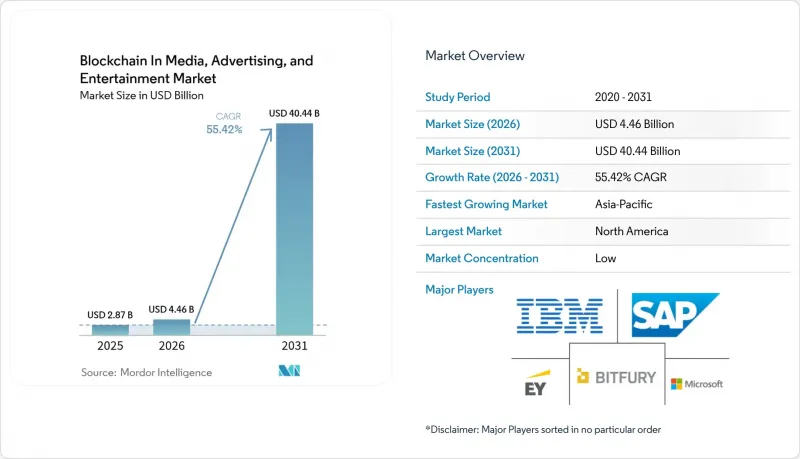
Mordor Intelligence에 의하면, 미디어, 광고 및 엔터테인먼트용 블록체인 시장 규모는 2026년에 44억 6,000만 달러에 이를 것으로 추정되고 있습니다.
이는 2025년의 28억 7,000만 달러에서 확대된 것으로, 2031년에는 404억 4,000만 달러에 달할 것으로 예측되며, 2026년부터 2031년까지 연평균 성장률(CAGR) 55.42%로 성장할 것으로 전망됩니다.
본 보고서는 블록체인의 유형(퍼블릭, 프라이빗, 컨소시엄/하이브리드), 기업 규모(중소기업, 대기업), 용도(라이선싱·권리 관리, 디지털 광고 등), 미디어 분야(음악, 영화·TV, 광고 컨텐츠 등), 지역별로 분류되어 있습니다. 시장 전망은 금액(달러) 단위로 제시되어 있습니다.
전 세계 미디어, 광고 및 엔터테인먼트용 블록체인 시장 동향 및 고찰
로열티 수익의 토큰화
로열티를 토큰화함으로써, 컨텐츠가 스트리밍되거나 상영될 때 즉시 실행되는 스마트 계약에 지급 로직이 내장되어, 결제 주기가 2년 가까이 걸리던 것에서 거의 실시간으로 단축됩니다. 인디 뮤지션은 스트리밍 수익의 85-95%를 받을 수 있어, 기존의 배분 비율에 비해 극적인 변화가 나타납니다. 한편, 팬들은 음원 카탈로그의 지분을 취득함으로써 로열티와 유동성이 강화됩니다. 백 카탈로그 자산을 분할 소유화하는 스타트업에 대한 벤처 자금 조달은 2024년에 5,500만 달러에 달하며, 미디어, 광고 및 엔터테인먼트용 블록체인 시장에 대한 투자자들의 강한 신뢰를 보여주고 있습니다. 영화 스튜디오도 유사한 모델을 시범적으로 도입하고 있으며, 온체인 박스오피스 Oracle을 활용해 잔여 수익 지급을 촉발함으로써 회계상의 분쟁을 해소하고 있습니다. 이러한 계약은 대조 작업의 마찰을 해소함으로써 미디어, 광고 및 엔터테인먼트 분야에서의 블록체인 채택 확대에 기여하고, 음악 및 영상 미디어 전반에 걸친 보급률을 높이고 있습니다.
크리에이터와 시청자 간의 중개자 배제
블록체인 동영상 네트워크를 통해 크리에이터는 플랫폼 수수료의 30-50%를 지불하지 않고도 시청자에게 직접 컨텐츠를 배포할 수 있게 되어, 그 결과 수익률 향상과 자금 회수 주기 단축이 실현됩니다. Theta의 엣지 노드 인센티브를 통해 전송 비용은 약 60% 절감되는 한편, NFT 프리세일을 통해 촬영 시작 전부터 독립 영화의 자금 조달이 가능해졌습니다. 스테이블코인을 통한 국경을 초월한 소액 결제는 외환 규제를 회피하며, 전 세계에 흩어져 있는 팬 커뮤니티를 즉각적인 자금 제공업체로 변화시킵니다. 2024년 파일럿 데이터에 따르면, 40건 이상의 프로젝트가 NFT 판매를 통해 자금 조달에 성공했으며, 이는 미디어, 광고 및 엔터테인먼트 분야에서 블록체인의 확실한 성장세를 보여줍니다. 은행 인프라가 부족한 지역에서도 크리에이터는 몇 주가 아닌 몇 분 만에 자금을 회수할 수 있으며, 이는 블록체인이 기존 중개자를 능가하는 능력을 입증합니다.
표준화 및 상호 운용성의 부재
이더리움에서 발행된 디지털 자산이 폴리곤의 권리 계약과 기본적으로 상호 운용되는 경우는 거의 없어, 권리자는 병행적인 자산 관리를 할 수밖에 없습니다. 미디어 프로젝트 중 새로운 토큰 분류 프레임워크를 도입한 곳은 5분의 1에 불과하여, 자산의 이식성과 유동성이 제한되고 있습니다. CCIP나 LayerZero와 같은 브리지 프로토콜은 전송을 용이하게 하지만, 가스 비용이 발생하고 공격 표면도 확대됩니다. 이는 동기화나 기계적 라이선스에 관한 공통 메타데이터 스키마가 부재하고, 로열티 자동 집계가 지체되고 있기 때문입니다. 그 결과, 기업들은 투자를 미루고, 표준이 통일될 때까지 미디어, 광고 및 엔터테인먼트 분야에서 블록체인 도입을 주저할 가능성이 있습니다.
부문 분석
2025년에는 미디어, 광고 및 엔터테인먼트용 블록체인 시장의 46.85%를 퍼블릭 블록체인이 차지하지만, 컨소시엄·하이브리드 네트워크는 60.02%라는 급속한 연평균 성장률(CAGR)로 성장할 것으로 예측되어,퍼블릭 체인의 성장세를 훨씬 능가할 것으로 전망됩니다. 허가형 거버넌스는 공개 전 컨텐츠를 보호해야 하는 스튜디오에 필수적인 선택적 데이터 공개를 가능하게 합니다. 하이브리드 모델에서는 계약의 지문(fingerprint)을 이더리움 상에서 해시화함으로써, 거래 조건을 비공개로 유지하면서도 공개적인 감사 가능성을 확보하고 정보 유출 위험을 줄입니다. 할리우드에서 진행된 파일럿 프로젝트에서 프라이빗 하이퍼레저 인스턴스는 5,000 TPS를 달성하며 포스트 프로덕션 워크플로우에서 성능상의 우위를 재확인했습니다. 그렇지만 전 세계 NFT의 유동성을 추구하는 크리에이터들에게는 퍼블릭 체인의 가치도 여전히 남아 있어, 미디어, 광고 및 엔터테인먼트용 블록체인 시장 전망은 듀얼 스택 형태가 될 것임이 부각되고 있습니다.
하이브리드 모델의 도입은 제로 지식 증명(Zero-Knowledge Proof)과 같은 온체인 프라이버시 도구로부터도 혜택을 받고 있습니다. 이러한 도구들은 기밀성이 높은 정보를 숨기면서도 로열티 분배에 대해 공개적으로 확인할 수 있게 해줍니다. 스튜디오 컨소시엄은 경쟁사에 정확한 금액을 공개하지 않으면서도 지급이 이루어졌음을 검증할 수 있게 되었습니다. 오픈소스 프레임워크가 성숙해짐에 따라 통합에 따른 마찰이 완화되어, 더 많은 중견 방송사들이 전환하도록 장려되고 있습니다. 예측 기간 동안 하이브리드 아키텍처는 신규 도입의 40%를 차지하며, 미디어, 광고 및 엔터테인먼트용 블록체인 시장의 표준 기업 모델로서의 입지를 공고히할 것입니다.
2025년에는 대기업이 거래액의 63.10%를 차지했으나, 중소기업도 2031년까지 연평균 성장률(CAGR) 59.85%로 빠르게 추격하고 있습니다. Thirdweb이나 Alchemy가 제공하는 기성 계약 템플릿 덕분에 개발 주기가 수개월에서 수주로 단축되었습니다. AWS 및 Azure의 관리형 노드 서비스를 통해 비용이 더욱 절감되어, 스튜디오는 과거 6자리 수의 비용이 들었던 맞춤형 구축과 비교해 5만 달러 미만으로 환경을 구축할 수 있게 되었습니다. 아티스트를 대상으로 한 조사에 따르면, 블록체인 이용률은 2024년까지 3배인 38%를 나타낼 것으로 예측되며, 미디어, 광고 및 엔터테인먼트용 블록체인 시장에서 풀뿌리적인 성장세가 두드러지고 있습니다.
특히 남미와 동남아시아에서는 크리에이터들이 확고한 배포 파트너를 보유하고 있지 않은 반면, 대규모 온라인 시청자층을 확보하고 있어 중소기업의 블록체인 도입이 현저히 진전되고 있습니다. 브라질에서 진행된 토큰 게이트 방식의 스트리밍 콘서트에는 6개월 동안 5,000명의 아티스트가 참여했습니다. 이는 웹3 인프라를 구축하면 소규모 참여자라도 규모 이상의 성과를 낼 수 있음을 보여줍니다. 노코드 도구의 보급에 따라 2028년까지 중소기업이 신규 프로젝트 수에서 대기업을 앞지를 가능성이 있으며, 이는 미디어, 광고 및 엔터테인먼트용 블록체인 분야경쟁 구도에 변화를 가져올 것입니다.
지역별 분석
2025년에는 북미가 수익의 38.40%를 차지했으며, 견조한 벤처 자금 지원을 배경으로 캘리포니아주의 스튜디오가 해당 지역 지출의 60% 이상을 차지했습니다. 캐나다의 세제 혜택 덕분에 토론토와 밴쿠버에서는 블록체인 게임이 자리를 잡은 반면, 멕시코에서는 도입이 늦어지고 있지만 송금에 기인한 스테이블코인의 유입으로 인해 성장세가 가속화되고 있습니다. 이 지역은 초기 단계에서 선두를 달렸기 때문에 현재는 확장성 문제, 크로스체인 연동, 규제 준수 플랫폼으로 초점이 이동하고 있습니다. 그러나 현재 성장률은 새롭게 주목받는 지역들에 뒤처지고 있으며, 이는 미디어, 광고 및 엔터테인먼트 분야 블록체인 산업 시장 성숙도를 반영하고 있습니다.
아시아태평양은 연평균 성장률(CAGR) 60.35%로 급성장할 것으로 예측되며, 이는 세계에서 가장 빠른 속도입니다. 중국의 국영 ‘블록체인 서비스 네트워크(BSSN)’는 암호화폐 거래 금지 조치를 회피하면서도 규제를 준수하는 NFT와 같은 ‘디지털 수집품’의 구현을 가능하게 하고 있습니다. 일본의 Web3 로드맵에는 세제상 우대 조치가 포함되어 있으며, 이는 소니와 반다이남코의 블록체인 게임 출시를 뒷받침하고 있습니다. 인도의 볼리우드 NFT는 방대한 디아스포라를 타겟으로 하고 있으며, 한국의 K-POP 토큰은 순식간에 매진되어 팬 주도형 자금 조달의 모범 사례를 만들어내고 있습니다. 호주와 동남아시아는 현재 시장 점유율이 낮지만, 미디어, 광고 및 엔터테인먼트 시장을 연결하는 지역적 컨텐츠 수출 전략에 블록체인 기술을 통합함으로써 개선된 결제 인프라를 활용하고 있습니다.
기타 지역은 유럽, 남미, 중동 및 아프리카가 차지하고 있습니다. MiCA(암호자산 시장 규제)는 법적 확실성을 제공하며, 독일과 영국에서 권리 등록 기관의 개발을 가속화하고 있습니다. 프랑스의 명품 브랜드들은 오트쿠튀르와 영화 NFT를 융합하여 체험형 마케팅을 강화하고 있습니다. 브라질과 아르헨티나에서는 인플레이션으로 인한 악영향을 완화하기 위해 스테이블코인이 활용되고 있으나, 인프라 부족으로 인해 그 보급은 더딘 상황입니다. 두바이와 리야드는 자유무역지대의 우대 조치를 활용해 웹3 스튜디오를 유치하고 있는 반면, 나이지리아에서는 해외 거주자의 다운로드를 타겟으로 한 블록체인 기반 음악 스트리밍 시범 운영을 진행하고 있습니다. 이러한 다양한 노력은 미디어, 광고 및 엔터테인먼트 분야에서 블록체인의 국제적인 확산을 여실히 보여주고 있습니다.
기타 혜택:
- Excel 형식 시장 예측(ME) 시트
- 3개월간의 애널리스트 지원
자주 묻는 질문
목차
제1장 서론
제2장 분석 방법
제3장 주요 요약
제4장 시장 구도
제5장 시장 규모 및 성장률 예측
제6장 경쟁 구도
제7장 시장 기회와 향후 전망
JHS 26.09.09According to Mordor Intelligence, the blockchain in media, advertising, and entertainment market size in 2026 is estimated at USD 4.46 billion, growing from 2025 value of USD 2.87 billion with 2031 projections showing USD 40.44 billion, growing at 55.42% CAGR over 2026-2031.
This report is Segmented by Type of Blockchain (Public, Private, and Consortium/Hybrid), Enterprise Size (Small and Medium Enterprises and Large Enterprises), Application (Licensing and Rights Management, Digital Advertising, and More), Media Segment (Music, Film and TV, Advertising Content, and More), and Geography. The Market Forecasts are Provided in Terms of Value (USD).
Global Blockchain In Media, Advertising, And Entertainment Market Trends and Insights
Tokenization of Royalty Streams
Tokenizing royalties embeds payout logic into smart contracts that execute instantly when content is streamed or screened, compressing settlement cycles from close to two years to near real-time. Independent musicians receive 85-95% of streaming income, a sharp reversal of legacy splits, while fans obtain fractional ownership in song catalogs, deepening loyalty and liquidity. Venture funding reached USD 55 million in 2024 for startups that fractionalize back-catalog assets, signalling strong investor confidence in the blockchain in the media, advertising, and entertainment market. Film studios are piloting similar models, using on-chain box-office oracles to trigger residuals and eliminate accounting disputes. As these contracts eliminate reconciliation friction, they help expand blockchain adoption in the media, advertising, and entertainment markets, with increased penetration across music and visual media.
Disintermediation between Creators and Audience
Blockchain video networks enable creators to stream content directly to viewers without surrendering 30-50% of their platform fees, thereby securing higher margins and reducing cash-collection cycles. Theta's edge-node incentives drop delivery costs by roughly 60%, while NFT pre-sales now bankroll independent films before cameras roll. Cross-border micro-payments in stablecoins circumvent currency controls, turning globally scattered fan communities into instant financiers. Pilot data from 2024 indicate that over 40 projects have been funded through NFT sales, demonstrating tangible momentum behind the blockchain in the media, advertising, and entertainment sectors. In regions with patchy banking rails, creators collect funds in minutes rather than weeks, underscoring blockchain's ability to undercut entrenched intermediaries.
Lack of Standardization and Interoperability
Digital assets minted on Ethereum seldom interoperate natively with rights contracts on Polygon, forcing right-holders to juggle parallel inventories. Only a fifth of media projects have implemented emerging token-taxonomy frameworks, limiting asset portability and liquidity. Bridge protocols like CCIP and LayerZero facilitate transfers while incurring gas costs and introducing additional attack surfaces, as they lack shared metadata schemas for sync and mechanical licenses, and automated royalty aggregation stalls. Consequently, enterprises may delay investment, tempering their adoption of blockchain in media, advertising, and entertainment markets until standards converge.
Other drivers and restraints analyzed in the detailed report include:
- Need to Curb Programmatic Advertising Fraud
- Demand for Secure and Faster Transactions
- Regulatory Uncertainty for Tokenized Revenue
For complete list of drivers and restraints, kindly check the Table Of Contents.
Segment Analysis
Consortium and hybrid networks are projected to grow at a rapid 60.02% CAGR, far outstripping public-chain momentum, despite public blockchains holding 46.85% of the blockchain in media, advertising, and entertainment market in 2025. Permissioned governance offers selective data disclosure, a must for studios guarding prerelease content. Hybrid models hash contract fingerprints onto Ethereum, preserving public auditability while keeping deal terms private, thereby mitigating the risk of leaks. Private Hyperledger instances reached 5,000 TPS during a Hollywood pilot, reaffirming the performance edge for post-production workflows. Yet, public chains retain value for creators chasing global NFT liquidity, underscoring a dual-stack future across the blockchain in the media, advertising, and entertainment market.
Hybrid adoption also benefits from on-chain privacy tools, such as zero-knowledge proofs, which mask sensitive fields while allowing public confirmation of royalty splits. Studio consortia can now validate that payments occurred without exposing exact amounts to rivals. As open-source frameworks mature, integration friction falls, encouraging more mid-tier broadcasters to migrate. Over the forecast horizon, hybrid architectures are expected to anchor 40% of new deployments, solidifying their status as the default enterprise pattern for the blockchain in the media, advertising, and entertainment market.
Although large enterprises controlled 63.10% of transactional value in 2025, SMEs are closing fast with a 59.85% CAGR through 2031. Ready-made contract templates from Thirdweb and Alchemy shrink development cycles from months to weeks. Managed node services on AWS and Azure, further lower cost, letting studios spin up environments for under USD 50,000, compared with six-figure custom builds earlier. An artist survey revealed that blockchain usage is expected to triple to 38% by 2024, highlighting grassroots momentum across the blockchain in media, advertising, and entertainment market.
SME traction is especially acute in South America and Southeast Asia, where creators lack entrenched distribution partners yet boast large online audiences. Token-gated streaming concerts in Brazil attracted 5,000 artists within six months, demonstrating that small players can punch above their weight when equipped with Web3 infrastructure. As no-code tooling proliferates, SMEs could surpass large enterprises in new project count by 2028, tilting the competitive balance within the blockchain in the media, advertising, and entertainment market.
Complete Report Scope:
- By Type of Blockchain
- Public
- Private
- Consortium / Hybrid
- By Enterprise Size
- Small and Medium Enterprises
- Large Enterprises
- By Appliaction
- Licensing and Rights Management
- Digital Advertising
- Smart Contracts
- Payments
- Online Gaming
- Live Streaming
- Other Applications
- By Media Segment
- Music
- Film and TV
- Advertising Content
- Gaming
- Sports
- News and Publishing
- Other Media Segments
- By Geography
- North America
- United States
- Canada
- Mexico
- South America
- Brazil
- Argentina
- Rest of South America
- Europe
- Germany
- United Kingdom
- France
- Italy
- Spain
- Rest of Europe
- Asia-Pacific
- China
- Japan
- India
- South Korea
- Australia
- Rest of Asia-Pacific
- Middle East and Africa
- Middle East
- Saudi Arabia
- United Arab Emirates
- Turkey
- Rest of Middle East
- Africa
- South Africa
- Nigeria
- Egypt
- Rest of Africa
- Middle East
- North America
Geography Analysis
North America contributed 38.40% of the revenue in 2025, with California studios accounting for over 60% of the regional spend amid robust venture backing. Canada's tax incentives anchor blockchain gaming in Toronto and Vancouver, whereas Mexico's adoption lags but gains impetus from remittance-driven stablecoin flows. The region's early lead shifts focus toward scaling concerns, cross-chain orchestration, and regulatory compliance platforms; yet, its growth rate now trails emerging hotspots, reflecting market maturity within the blockchain industry in media, advertising, and entertainment.
Asia-Pacific is forecast to soar at 60.35% CAGR, the fastest worldwide. China's state-run Blockchain-based Service Network enables compliant NFT-like "digital collectibles," circumventing crypto trading bans. Japan's Web3 roadmap supplies tax carve-outs that spur Sony and Bandai Namco to launch blockchain games. India's Bollywood NFTs target a vast diaspora, and South Korea's K-pop tokens sell out instantly, generating templates for fan-sourced financing. Australia and Southeast Asia contribute modest shares today but capitalize on improved payment rails by integrating blockchain technology into regional content-export strategies that stitch together the media, advertising, and entertainment market.
Europe, South America, the Middle East, and Africa fill the remainder. MiCA provides legal certainty that accelerates the development of German and U.K. rights registries. France's luxury houses merge couture with film NFTs, enhancing experiential marketing. Brazil and Argentina utilize stablecoins to mitigate the drag of inflation, although infrastructure deficits slow their adoption. Dubai and Riyadh leverage free-zone perks to magnetize Web3 studios, while Nigeria pilots blockchain music streams targeting diaspora downloads. Collectively, these diverse initiatives underscore the global reach of blockchain in the media, advertising, and entertainment sectors.
- IBM Corporation
- Microsoft Corporation
- Ernst and Young Global Limited
- The Bitfury Group Limited
- SAP SE
- Accenture plc
- Amazon Web Services Inc.
- Oracle Corporation
- Infosys Limited
- ConsenSys Software Inc.
- R3 HoldCo LLC
- Dapper Labs Inc.
- Livepeer Inc.
- Theta Labs Inc.
- VeChain Foundation
- Animoca Brands Corporation Limited
- Chainalysis Inc.
- Mattereum Limited
- Rally Network PBC
- Braintrust Holdings LLC
Additional Benefits:
- The market estimate (ME) sheet in Excel format
- 3 months of analyst support
TABLE OF CONTENTS
1 INTRODUCTION
- 1.1 Study Assumptions and Market Definition
- 1.2 Scope of the Study
2 RESEARCH METHODOLOGY
3 EXECUTIVE SUMMARY
4 MARKET LANDSCAPE
- 4.1 Market Overview
- 4.2 Market Drivers
- 4.2.1 Commoditization of Content and Piracy
- 4.2.2 Disintermediation between Creators and Audience
- 4.2.3 Demand for Secure and Faster Transactions
- 4.2.4 Need to Curb Programmatic Advertising Fraud
- 4.2.5 Decentralized Autonomous Production Studios
- 4.2.6 Tokenization of Royalty Streams
- 4.3 Market Restraints
- 4.3.1 Lack of Standardization and Interoperability
- 4.3.2 Expensive and Time-Consuming Deployment
- 4.3.3 Regulatory Uncertainty for Tokenized Revenue
- 4.3.4 Carbon Footprint Concerns of Energy-Intensive Chains
- 4.4 Industry Value Chain Analysis
- 4.5 Impact of Macroeconomic Factors
- 4.6 Regulatory Landscape
- 4.7 Technological Outlook
- 4.8 Porter's Five Forces Analysis
- 4.8.1 Bargaining Power of Suppliers
- 4.8.2 Bargaining Power of Buyers
- 4.8.3 Threat of New Entrants
- 4.8.4 Threat of Substitute Products
- 4.8.5 Intensity of Competitive Rivalry
- 4.9 Investment Analysis
5 MARKET SIZE AND GROWTH FORECASTS (VALUE)
- 5.1 By Type of Blockchain
- 5.1.1 Public
- 5.1.2 Private
- 5.1.3 Consortium / Hybrid
- 5.2 By Enterprise Size
- 5.2.1 Small and Medium Enterprises
- 5.2.2 Large Enterprises
- 5.3 By Appliaction
- 5.3.1 Licensing and Rights Management
- 5.3.2 Digital Advertising
- 5.3.3 Smart Contracts
- 5.3.4 Payments
- 5.3.5 Online Gaming
- 5.3.6 Live Streaming
- 5.3.7 Other Applications
- 5.4 By Media Segment
- 5.4.1 Music
- 5.4.2 Film and TV
- 5.4.3 Advertising Content
- 5.4.4 Gaming
- 5.4.5 Sports
- 5.4.6 News and Publishing
- 5.4.7 Other Media Segments
- 5.5 By Geography
- 5.5.1 North America
- 5.5.1.1 United States
- 5.5.1.2 Canada
- 5.5.1.3 Mexico
- 5.5.2 South America
- 5.5.2.1 Brazil
- 5.5.2.2 Argentina
- 5.5.2.3 Rest of South America
- 5.5.3 Europe
- 5.5.3.1 Germany
- 5.5.3.2 United Kingdom
- 5.5.3.3 France
- 5.5.3.4 Italy
- 5.5.3.5 Spain
- 5.5.3.6 Rest of Europe
- 5.5.4 Asia-Pacific
- 5.5.4.1 China
- 5.5.4.2 Japan
- 5.5.4.3 India
- 5.5.4.4 South Korea
- 5.5.4.5 Australia
- 5.5.4.6 Rest of Asia-Pacific
- 5.5.5 Middle East and Africa
- 5.5.5.1 Middle East
- 5.5.5.1.1 Saudi Arabia
- 5.5.5.1.2 United Arab Emirates
- 5.5.5.1.3 Turkey
- 5.5.5.1.4 Rest of Middle East
- 5.5.5.2 Africa
- 5.5.5.2.1 South Africa
- 5.5.5.2.2 Nigeria
- 5.5.5.2.3 Egypt
- 5.5.5.2.4 Rest of Africa
- 5.5.5.1 Middle East
- 5.5.1 North America
6 COMPETITIVE LANDSCAPE
- 6.1 Market Concentration
- 6.2 Strategic Moves
- 6.3 Market Share Analysis
- 6.4 Company Profiles (includes Global level Overview, Market level overview, Core Segments, Financials as available, Strategic Information, Market Rank/Share for key companies, Products and Services, and Recent Developments)
- 6.4.1 IBM Corporation
- 6.4.2 Microsoft Corporation
- 6.4.3 Ernst and Young Global Limited
- 6.4.4 The Bitfury Group Limited
- 6.4.5 SAP SE
- 6.4.6 Accenture plc
- 6.4.7 Amazon Web Services Inc.
- 6.4.8 Oracle Corporation
- 6.4.9 Infosys Limited
- 6.4.10 ConsenSys Software Inc.
- 6.4.11 R3 HoldCo LLC
- 6.4.12 Dapper Labs Inc.
- 6.4.13 Livepeer Inc.
- 6.4.14 Theta Labs Inc.
- 6.4.15 VeChain Foundation
- 6.4.16 Animoca Brands Corporation Limited
- 6.4.17 Chainalysis Inc.
- 6.4.18 Mattereum Limited
- 6.4.19 Rally Network PBC
- 6.4.20 Braintrust Holdings LLC
7 MARKET OPPORTUNITIES AND FUTURE OUTLOOK
- 7.1 White-Space and Unmet-Need Assessment


