

|
시장보고서
상품코드
2123158
전동 공구용 배터리 시장 : 점유율 분석, 산업 동향 및 통계 데이터, 성장 예측(2026-2031년)Power Tool Batteries - Market Share Analysis, Industry Trends & Statistics, Growth Forecasts (2026 - 2031) |
||||||
 Mordor Intelligence
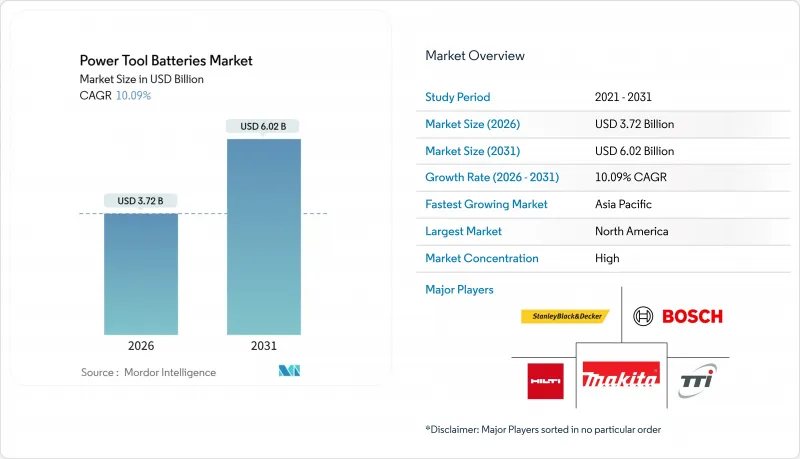
Mordor Intelligence에 의하면, 전동 공구용 배터리 시장 규모는 2026년에 37억 2,000만 달러로 추정되며, 예측 기간(2026-2031년)에서 CAGR 10.09%로 성장을 지속하여, 2031년까지 60억 2,000만 달러에 이를 전망입니다.
본 보고서는 배터리의 화학 조성(리튬 이온, 니켈 카드뮴, 니켈 수소 및 신기술), 셀 형태(원통형, 각형, 파우치형), 전압 등급(12V 이하, 12-18V, 18V 이상),용도(업무용/산업용 공구, 야외용 전동 장치 등), 지역(북미, 유럽, 아시아태평양, 남미, 중동 및 아프리카)별로 분류되어 있습니다.
전 세계 전동 공구용 배터리 시장 동향 및 인사이트
유선 공구에서 무선 공구로의 전환 가속화
2025년, OSHA(미국 직업안전보건청)의 전도 위험에 관한 지침 도입과 리튬 이온 배터리 비용의 하락으로 인해 총 소유 비용(TCO)의 경제성이 결정적으로 무선 쪽으로 기울어진 결과, 북미의 전문 건설 업계에서 무선 공구의 보급률은 78%를 넘어섰습니다. Techtronic Industries사는 2024년 상반기 무선 제품 매출이 전년 동기 대비 14% 증가한 반면, 유선 제품 매출은 6% 감소했다고 보고했으며, 이는 수요 구조의 재편을 뒷받침하는 것입니다. 유럽에서는 5만 유로를 초과하는 공공 공사 계약에서 제로 에미션 공구의 사용이 의무화되면서, 지자체들이 배터리식 공구로의 전환을 서두르고 있습니다. 동남아시아 시장에서는 무선 공구의 점유율이 40%에 그쳐 뒤처지고 있지만, 인도네시아와 필리핀에서는 Off-grid 태양광 발전 및 에너지 저장 프로젝트가 도입을 뒷받침하고 있습니다. 이러한 변화들이 맞물려 전동 공구용 배터리 시장의 두 자릿수 성장을 지탱하고 있습니다.
리튬 이온 배터리의 에너지 밀도와 작동 시간의 급속한 향상
니켈·망간·코발트 배터리의 에너지 밀도는 실리콘 음극과 전해액의 조정을 통해 2025년에는 285 Wh/kg에 달하고,, 2022년 대비 12% 증가했습니다. 삼성SDI의 5세대 원통형 셀은 동일한 21700 사이즈의 실적에서 작동 시간을 20% 연장하여, 마키타의 더 가벼운 18볼트, 6Ah 팩을 실현할 수 있게 했습니다. LG 에너지 솔루션은 방전 깊이 80%에서 1,800사이클의 내구성을 입증하여, 건설업자의 연간 배터리 교체 비용을 30% 절감했습니다. 인산철 리튬 배터리는 에너지 밀도가 15% 낮아지더라도 3,000 사이클의 수명을 실현함으로써, 비용을 중시하는 소비자층에서 지지를 얻고 있습니다. QuantumScape사와 Solid Power사의 고체 배터리 파일럿 라인은 부피 기준 40%의 향상을 약속하고 있지만, 2028년 이전의 양산화 가능성은 희박해 보입니다.
리튬이온 팩의 높은 초기 비용
상업용 배터리 팩의 소매 가격은 120-250달러로, 무선 공구 세트 가격의 30-50%에 해당합니다. 이 때문에 인도와 동남아시아의 소규모 계약업체들 사이에서 보급이 더딘 상황입니다. 이 지역에서는 그 가격 차이가 2주 치 임금을 상회하기 때문입니다. 2025년에는 팩 단위 비용이 kWh당 110달러 미만으로 떨어질 전망이지만, OEM에 의한 2.5-3배의 가격 가산은 여전히 지속되고 있습니다. 인도 내 무선 공구의 보급률은 생산성 향상보다 가격 부담이 우선시되기 때문에 여전히 35% 미만을 기록하고 있습니다. 소매업체가 도입한 무이자 융자 덕분에 2024년에는 무선 공구를 처음 구매하는 고객 사이에서 어태치먼트 구매율이 18% 상승했습니다. CATL의 ‘셀-투-팩(Cell-to-Pack)’ 아키텍처 덕분에 2027년까지 팩 가격을 15% 절감할 수 있을 것으로 보이며, 이는 전동 공구용 배터리 업계에 반가운 소식이 될 것입니다.
부문 분석
2025년, 리튬 이온 배터리는 40A의 방전 전류와 285Wh/kg의 에너지 밀도를 유지하는 니켈-망간-코발트 및 니켈-코발트-알루미늄 혼합 소재의 강점을 바탕으로 전동 공구용 배터리 시장에서 62.9%의 점유율을 유지했습니다. 니켈-카드뮴 배터리는 EU의 카드뮴 금지 조치 이후 점유율이 한 자릿수까지 떨어졌으며, 니켈-금속 수소화물 배터리는 틈새 시장인 조명 분야에서만 생존하고 있습니다. 신기술군인 전고체 배터리, 나트륨 이온 배터리, 리튬-황 배터리는 각 OEM 업체들이 니켈 공급 변동 위험을 회피하고 본질적으로 열적 안정성을 지닌 화학 계통을 모색하는 가운데, 2031년까지 연평균 성장률(CAGR) 21.5%로 성장할 전망입니다.
전고체 배터리의 시제품은 2025년 파일럿 라인에서 800 Wh/L를 기록했으나, 수율이 60% 미만에 그치고 있어 상용화는 적어도 2028년까지 연기될 전망입니다. CATL의 나트륨 이온 배터리는 리튬 이온 배터리의 3분의 1 비용으로 160 Wh/kg을 실현하고 있어, 무게가 부차적인 요소가 되는 보급형 소비자 가전제품에 적합합니다. 인산철 리튬 배터리는 에너지 밀도가 15% 낮지만, 3,000회 사이클의 내구성과 안정적인 열 거동 덕분에 현재 야외용 기기의 동력원으로 채택되고 있습니다. 미국 에너지부가 국내 전고체 배터리 공장에 총 2억 달러의 보조금을 지급한 것은 공급망 다각화를 도모하는 배터리 기술에 대한 정책적 지원을 보여줍니다. 이러한 변화로 인해 배터리 기술 포트폴리오가 다양화되는 동시에 전동 공구용 배터리 시장 전체가 유지되고 있습니다.
2025년에는 원통형 셀이 전동 공구용 배터리 시장 규모의 42.5%를 차지했습니다. 이는 kWh당 100달러 미만으로 비용을 낮춘 고속 18650 및 21700 생산 라인의 혜택을 받은 결과입니다. 파우치형 셀은 15%의 부피 효율과 뛰어난 방열성을 실현하여 연평균 성장률(CAGR) 22.2%로 확대되고 있습니다. 이에 따라 스탠리 블랙앤데커(Stanley Black & Decker)사의 ‘POWERSTACK’ 팩은 2Ah 용량으로 4Ah에 상당하는 작동 시간을 실현하고 있습니다.
LG 에너지 솔루션은 고소 작업용으로 경량 팩을 우선시하는 밀워키(Milwaukee) 및 료비(Ryobi)로부터의 수주를 통해 2025년에 파우치형 셀 생산량을 38% 증가시켰습니다. 프리즘형 셀은 견고한 케이스가 방열을 돕는 고전압 용도에서 15%의 틈새 시장 점유율을 유지하고 있습니다. 제조의 복잡성이 파우치형 배터리의 보급을 제한하고 있으며,유연한 라미네이트 소재에는 보강된 외피와 신중한 자동 처리가 필요하지만, 2024년에 시행된 IEC 62133-2의 못 관통 관련 규정에 따라 안전 기준이 표준화되면서 금형 투자가 가속화될 가능성이 있습니다. 2024년 파나소닉이 도입한 원통형 에너지 셀과 파우치형 파워 셀을 결합한 하이브리드 팩은 전동 공구용 배터리 업계에서 포맷의 다양화를 보여주고 있습니다.
지역별 분석
2025년, 북미는 매출의 39.3%를 차지했습니다. 이는 전문가용 무선 공구의 보급률이 78%에 달하고, 브러쉬리스화로의 전환에 따른 높은 교체 주기가 뒷받침된 결과입니다. 전기 기술자의 시간당 임금은 62달러로, 높은 가격임에도 불구하고 생산성을 향상시키는 배터리 플랫폼을 도입하려는 의지를 높이고 있습니다. 캐나다의 인프라 확충 추진으로 인해 전문가용 공구 수요가 9% 증가했고, 멕시코의 니어쇼어링으로 인해 산업용 배터리 매출이 14% 증가하여 이 지역의 전동 공구용 배터리 시장 규모를 확대시켰습니다. 고전압 제품의 보급은 미국에서 가장 진전되어 있으며, 2025년에는 60볼트 및 80볼트 배터리 팩이 상업용 판매의 22%를 차지했습니다.
아시아태평양은 2031년까지 연평균 성장률(CAGR)이 15.9%로 가장 빠르게 성장하고 있으며, 타밀나두주에 위치한 삼성SDI의 15GWh 규모 공장과 공급망 리스크를 줄이기 위한 CATL의 인도네시아 니켈 기반 확장이 주요 견인차 역할을 하고 있습니다. 중국 시장은 2025년에 18% 급증했으며, 도시 지역의 신축 건설과 3급 도시로의 전자상거래 유통이 이를 뒷받침했습니다. 인도의 무선 제품 보급률은 35%에 그치고 있지만, 2024년부터 시행되는 배터리 PLI(생산 연계형 인센티브) 정책의 호재를 타고 LG에너지솔루션 및 BYD의 투자를 유치하고 있습니다. 호주 및 뉴질랜드에서는 야외 기기의 전동화가 가속화되고 있으며, 현지 배출 규제로 인해 2025년 소매 매출의 40%를 배터리식 잔디깎기가 차지할 것으로 전망됩니다.
유럽은 2025년에 24%를 차지할 것으로 보이며, 2030년까지 70%의 회수와 95%의 리튬 회수를 의무화하는 EU 배터리 규제의 영향을 받고 있습니다. 독일에서는 무공해 건설에 대한 보조금으로 인해 상업용 배터리 시장이 7% 성장한 반면, 영국에서는 노동력 부족으로 인해 3%의 위축이 나타났습니다. 북유럽 국가들의 가솔린식 잔디깎기 사용 금지 조치로 인해 해당 지역의 배터리식 야외용 공구는 16% 증가했으나, 러시아는 제재의 영향으로 시장 규모가 제한적인 상태를 유지하고 있으며, 니켈-카드뮴 배터리가 현지 시장 점유율의 30%를 계속 차지하고 있습니다. 남미와 중동을 합친 매출액은 브라질 건설 업계의 회복과 UAE의 메가 프로젝트에 힘입어 전 세계 매출의 8%를 차지했으나, 가격 격차와 유통상의 문제로 인해 성장세는 제한되었습니다.
기타 혜택:
- Excel 형식 시장 예측(ME) 시트
- 3개월간의 애널리스트 지원
자주 묻는 질문
목차
제1장 서론
제2장 분석 방법
제3장 주요 요약
제4장 시장 구도
제5장 시장 규모·성장률 예측
제6장 경쟁 구도
제7장 시장 기회와 향후 전망
JHS 26.09.11According to Mordor Intelligence, the power tool batteries market size is estimated at USD 3.72 billion in 2026, and is expected to reach USD 6.02 billion by 2031, at a CAGR of 10.09% during the forecast period (2026-2031).
This report is Segmented by Battery Chemistry (Lithium-Ion, Nickel-Cadmium, Nickel-Metal Hydride, and Emerging Technologies), Cell Format (Cylindrical, Prismatic, and Pouch), Voltage Class (Up To 12 V, 12 To 18 V, and Above 18 V), Application (Professional/Industrial Tools, Outdoor Power Equipment, and More), and Geography (North America, Europe, Asia-Pacific, South America, and Middle East and Africa).
Global Power Tool Batteries Market Trends and Insights
Accelerating Shift from Corded to Cordless Tools
Cordless penetration crossed 78% in North American professional construction during 2025 after OSHA trip-hazard guidelines and falling lithium-ion costs tipped total cost-of-ownership economics decisively toward cordless. Techtronic Industries reported 14% year-over-year cordless revenue growth in H1 2024 while corded sales fell 6%, confirming structural demand realignment. European public-works contracts above EUR 50,000 now specify zero-emission tools, pushing municipalities to battery platforms. Southeast Asian markets lag at 40% cordless share, but off-grid solar-plus-storage projects are spurring adoption in Indonesia and the Philippines. Collectively, these shifts underpin the double-digit expansion of the power tool battery market.
Rapid Gains in Li-ion Energy Density and Runtime
Nickel-manganese-cobalt energy density reached 285 Wh/kg in 2025, a 12% jump since 2022, due to silicon-anode and electrolyte tuning. Samsung SDI's fifth-generation cylindrical cells extend runtime by 20% in the same 21700 footprint, enabling Makita's lighter 18-volt, 6 Ah packs. LG Energy Solution disclosed 1,800-cycle durability at 80% depth-of-discharge, trimming annual battery replacement cost by 30% for contractors. Lithium-iron-phosphate is winning cost-sensitive consumer segments by offering a 3,000-cycle life despite a 15% density penalty. Solid-state pilot lines at QuantumScape and Solid Power promise 40% volumetric gains, but mass production before 2028 is unlikely.
High Upfront Cost of Li-ion Packs
Professional packs retail between USD 120 and USD 250, equal to 30-50% of a cordless kit price, slowing uptake among small contractors in India and Southeast Asia, where the premium exceeds two weeks' wages. OEM mark-ups of 2.5-3X persist despite pack-level costs falling below USD 110 per kWh in 2025. India's cordless penetration remains under 35% because affordability outweighs productivity gains. Retailers introduced zero-interest financing that lifted attachment rates 18% among first-time cordless buyers in 2024. CATL's cell-to-pack architecture could shave 15% from pack prices by 2027, offering relief to the power tool battery industry.
Other drivers and restraints analyzed in the detailed report include:
- OEM 18-Volt and 20-Volt Platform Expansion
- Emergence of 60-Volt and Above Heavy-Duty Cordless Category
- Thermal-Runaway Recalls Denting Consumer Trust
For complete list of drivers and restraints, kindly check the Table Of Contents.
Segment Analysis
Lithium-ion retained 62.9% power tool battery market share in 2025 on the strength of nickel-manganese-cobalt and nickel-cobalt-aluminum blends that sustain 40 A discharge and 285 Wh/kg energy density. Nickel-cadmium receded to a single-digit share after EU cadmium bans, and nickel-metal-hydride persists only in niche lighting. The emerging-technologies cluster, solid-state, sodium-ion, and lithium-sulfur, will expand at 21.5% CAGR through 2031 as OEMs hedge against nickel supply shocks and seek chemistries with intrinsic thermal stability.
Solid-state prototypes recorded 800 Wh/L in 2025 pilot lines yet suffer sub-60% yields, delaying commercialization until at least 2028. CATL's sodium-ion cells deliver 160 Wh/kg at one-third lithium-ion cost, suiting entry-level consumer tools where weight is secondary. Lithium-iron-phosphate now powers outdoor equipment thanks to 3,000-cycle durability and benign thermal behavior, despite 15% energy-density sacrifice. U.S. Department of Energy grants totaling USD 200 million to domestic solid-state plants illustrate policy backing for chemistries that diversify supply chains. These shifts diversify chemistry portfolios while sustaining the broader power tool battery market.
Cylindrical cells accounted for 42.5% of the power tool battery market size in 2025, benefiting from high-speed 18650 and 21700 manufacturing lines that drive costs below USD 100 per kWh. Pouch cells are expanding at 22.2% CAGR because they deliver 15% volumetric efficiency and superior heat dissipation, enabling Stanley Black & Decker's POWERSTACK packs to match 4 Ah runtime in a 2 Ah footprint.
LG Energy Solution grew pouch output 38% in 2025 on orders from Milwaukee and Ryobi, which prioritize lighter packs for overhead work. Prismatic cells maintain a 15% niche share in high-voltage applications where rigid enclosures aid heat sinking. Manufacturing complexity limits pouch adoption, flexible laminates need reinforced casings and careful automated handling, yet IEC 62133-2 nail-penetration rules enacted in 2024 standardize safety benchmarks and may accelerate tooling investments. Hybrid packs mixing cylindrical energy cells with pouch power cells, introduced by Panasonic in 2024, indicate format pluralism in the power tool battery industry.
Complete Report Scope:
- By Battery Chemistry
- Lithium-ion
- Nickel-Cadmium
- Nickel-Metal Hydride
- Emerging Technologies
- By Cell Format
- Cylindrical
- Prismatic
- Pouch
- By Voltage Class
- Up to 12 V
- 12 to 18 V
- Above 18 V (incl. 60 V high-power)
- By Application
- Professional/Industrial Tools
- Consumer DIY Tools
- Outdoor Power Equipment
- Specialty Cordless Systems
- By Geography
- North America
- United States
- Canada
- Mexico
- Europe
- Germany
- United Kingdom
- France
- Italy
- Spain
- NORDIC Countries
- Russia
- Rest of Europe
- Asia-Pacific
- China
- India
- Japan
- South Korea
- ASEAN Countries
- Australia and New Zealand
- Rest of Asia-Pacific
- South America
- Brazil
- Argentina
- Chile
- Rest of South America
- Middle East and Africa
- Saudi Arabia
- United Arab Emirates
- South Africa
- Egypt
- Rest of Middle East and Africa
- North America
Geography Analysis
North America held 39.3% of revenue in 2025, anchored by 78% professional cordless penetration and high replacement cycles fueled by brushless upgrades. Electricians earn USD 62 per hour, incentivizing productivity-enhancing battery platforms despite premium prices. Canada's infrastructure push lifted professional tool demand 9%, and Mexico's nearshoring lifted industrial battery sales 14%, expanding the regional power tool battery market size. High-voltage adoption is deepest in the U.S., where 60-volt and 80-volt packs formed 22% of professional sales in 2025.
Asia-Pacific is the fastest-growing region at 15.9% CAGR through 2031, driven by Samsung SDI's 15 GWh Tamil Nadu plant and CATL's Indonesian nickel-backed expansion that lowers supply-chain risk. China's market soared 18% in 2025, pushed by urban new-builds and e-commerce distribution into tier-3 cities. India lags at 35% cordless penetration, but gains policy tailwinds from 2024 battery PLI incentives, attracting LG Energy Solution and BYD investments. Australia and New Zealand accelerated outdoor equipment electrification, with battery mowers reaching 40% of 2025 retail sales due to local emissions ordinances.
Europe accounted for 24% in 2025, shaped by the EU Battery Regulation mandating 70% collection and 95% lithium recovery by 2030. Germany posted 7% professional battery growth on zero-emission construction subsidies, while the U.K. contracted 3% amid labor shortages. Nordic bans on gasoline lawn equipment pushed battery outdoor tools up 16% regionally, whereas Russia remained subscale due to sanctions, with nickel-cadmium retaining 30% local share. South America and the Middle East combined for 8% of global revenue, buoyed by Brazil's construction rebound and UAE mega-projects, yet constrained by affordability gaps and distribution challenges.
- Robert Bosch GmbH
- Stanley Black & Decker Inc.
- Techtronic Industries Co. Ltd.
- Makita Corporation
- Hilti Corporation
- Hitachi Koki Holdings Co. Ltd. (Hikoki)
- Panasonic Corporation
- Samsung SDI Co. Ltd.
- LG Energy Solution
- Sony Group Corp. / Murata Mfg.
- Atlas Copco AB
- Snap-on Incorporated
- CATL
- BYD Company Ltd.
- EVE Energy Co. Ltd.
- Metabo (HPT)
- Festool GmbH
- Skil Power Tools
- Positec Group (Worx)
- Chervon Holdings (eg Ego Power+)
Additional Benefits:
- The market estimate (ME) sheet in Excel format
- 3 months of analyst support
TABLE OF CONTENTS
1 Introduction
- 1.1 Study Assumptions & Market Definition
- 1.2 Scope of the Study
2 Research Methodology
3 Executive Summary
4 Market Landscape
- 4.1 Market Overview
- 4.2 Market Drivers
- 4.2.1 Accelerating shift from corded to cordless tools
- 4.2.2 Rapid gains in Li-ion energy density & runtime
- 4.2.3 OEM 18-V/20-V platform expansion
- 4.2.4 Brushless-motor penetration raising discharge demand
- 4.2.5 Emergence of 60-V+ heavy-duty cordless category
- 4.2.6 Right-to-repair laws lifting aftermarket battery sales
- 4.3 Market Restraints
- 4.3.1 High upfront cost of Li-ion packs
- 4.3.2 Thermal-runaway recalls denting consumer trust
- 4.3.3 Nickel & graphite supply volatility squeezing margins
- 4.3.4 Brand-locked battery ecosystems limiting cross-compatibility
- 4.4 Supply-Chain Analysis
- 4.5 Regulatory Landscape
- 4.6 Technological Outlook (advanced chemistries, BMS)
- 4.7 Porter's Five Forces
- 4.7.1 Bargaining Power of Suppliers
- 4.7.2 Bargaining Power of Buyers
- 4.7.3 Threat of New Entrants
- 4.7.4 Threat of Substitutes
- 4.7.5 Competitive Rivalry
5 Market Size & Growth Forecasts
- 5.1 By Battery Chemistry
- 5.1.1 Lithium-ion
- 5.1.2 Nickel-Cadmium
- 5.1.3 Nickel-Metal Hydride
- 5.1.4 Emerging Technologies
- 5.2 By Cell Format
- 5.2.1 Cylindrical
- 5.2.2 Prismatic
- 5.2.3 Pouch
- 5.3 By Voltage Class
- 5.3.1 Up to 12 V
- 5.3.2 12 to 18 V
- 5.3.3 Above 18 V (incl. 60 V high-power)
- 5.4 By Application
- 5.4.1 Professional/Industrial Tools
- 5.4.2 Consumer DIY Tools
- 5.4.3 Outdoor Power Equipment
- 5.4.4 Specialty Cordless Systems
- 5.5 By Geography
- 5.5.1 North America
- 5.5.1.1 United States
- 5.5.1.2 Canada
- 5.5.1.3 Mexico
- 5.5.2 Europe
- 5.5.2.1 Germany
- 5.5.2.2 United Kingdom
- 5.5.2.3 France
- 5.5.2.4 Italy
- 5.5.2.5 Spain
- 5.5.2.6 NORDIC Countries
- 5.5.2.7 Russia
- 5.5.2.8 Rest of Europe
- 5.5.3 Asia-Pacific
- 5.5.3.1 China
- 5.5.3.2 India
- 5.5.3.3 Japan
- 5.5.3.4 South Korea
- 5.5.3.5 ASEAN Countries
- 5.5.3.6 Australia and New Zealand
- 5.5.3.7 Rest of Asia-Pacific
- 5.5.4 South America
- 5.5.4.1 Brazil
- 5.5.4.2 Argentina
- 5.5.4.3 Chile
- 5.5.4.4 Rest of South America
- 5.5.5 Middle East and Africa
- 5.5.5.1 Saudi Arabia
- 5.5.5.2 United Arab Emirates
- 5.5.5.3 South Africa
- 5.5.5.4 Egypt
- 5.5.5.5 Rest of Middle East and Africa
- 5.5.1 North America
6 Competitive Landscape
- 6.1 Market Concentration
- 6.2 Strategic Moves (M&A, Partnerships, PPAs)
- 6.3 Market Share Analysis (Market Rank/Share for key companies)
- 6.4 Company Profiles (includes Global level Overview, Market level overview, Core Segments, Financials as available, Strategic Information, Products & Services, and Recent Developments)
- 6.4.1 Robert Bosch GmbH
- 6.4.2 Stanley Black & Decker Inc.
- 6.4.3 Techtronic Industries Co. Ltd.
- 6.4.4 Makita Corporation
- 6.4.5 Hilti Corporation
- 6.4.6 Hitachi Koki Holdings Co. Ltd. (Hikoki)
- 6.4.7 Panasonic Corporation
- 6.4.8 Samsung SDI Co. Ltd.
- 6.4.9 LG Energy Solution
- 6.4.10 Sony Group Corp. / Murata Mfg.
- 6.4.11 Atlas Copco AB
- 6.4.12 Snap-on Incorporated
- 6.4.13 CATL
- 6.4.14 BYD Company Ltd.
- 6.4.15 EVE Energy Co. Ltd.
- 6.4.16 Metabo (HPT)
- 6.4.17 Festool GmbH
- 6.4.18 Skil Power Tools
- 6.4.19 Positec Group (Worx)
- 6.4.20 Chervon Holdings (eg Ego Power+)
7 Market Opportunities & Future Outlook
- 7.1 White-space & Unmet-need Assessment


