

|
시장보고서
상품코드
2123254
자동차용 알루미늄 압출 성형 시장 : 점유율 분석, 업계 동향과 통계, 성장 예측(2026-2031년)Automotive Aluminium Extrusion - Market Share Analysis, Industry Trends & Statistics, Growth Forecasts (2026 - 2031) |
||||||
 Mordor Intelligence
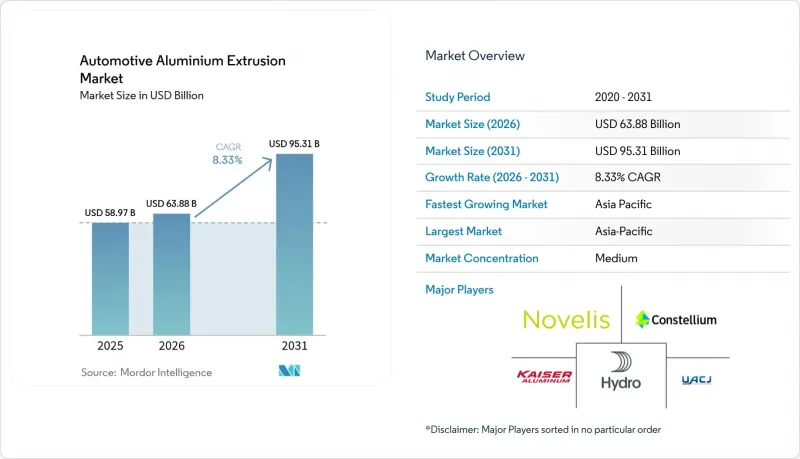
자동차용 알루미늄 압출 성형 시장 규모는 2025년 589억 7,000만 달러에서 2026년에는 638억 8,000만 달러로 확대되어 2026년부터 2031년까지 CAGR 8.33%로 성장을 지속하여, 2031년에는 953억 1,000만 달러에 이를 것으로 예측됩니다.
본 보고서는 부품의 유형(차체 구조, 충돌 관리 시스템 등),차종(승용차, 소형 상용차 등), 합금 시리즈(6xxx계 열처리 가능 합금 등), 프레스 용량(15 MN 이하, 16-25 MN, 26-35 MN, 35 MN 초과) 및 지역별로 분류되어 있습니다. 시장 예측은 금액(달러) 기준으로 제시되어 있습니다.
전 세계 자동차용 알루미늄 압출 성형 시장 동향 및 인사이트
EV 보급률 상승이 경량 바디-인-화이트의 채택을 가속화
전기자동차의 구동계는 배터리 무게로 인해 수백 Kg이 추가되므로, 자동차 제조업체들은 크래시 레일과 장착 보스를 일체화한 중공 알루미늄 압출 성형품을 사용하여 구조를 재설계하고 있습니다. 아시아태평양의 주요 브랜드가 실시한 실증 실험에서는 안전 성능을 유지한 채 20% 이상의 경량화가 확인되었습니다. 알루미늄 협회는 2030년까지 차량 1대당 알루미늄 사용량이 최대 550 PPV에 달할 것으로 예측하고 있으며, 그 증가분의 대부분은 압출 성형품이 차지할 것으로 전망됩니다. 현재 주류인 해치백 차량에서도 고급 SUV와 마찬가지로 압출 성형된 로커 레일 및 루프 레일이 채택되고 있어, 금형 상각 비용이 수백만 대 규모로 분산되고 있습니다. 주행 거리에 대한 불안, 원자재비 급등, 보증 리스크가 맞물려 이러한 대량 생산으로의 전환이 촉진되고 있습니다.
미국, 유럽연합(EU), 중국의 차량 함대 CO₂ 배출량 및 연비 규제
유럽연합(EU)은 2025년까지 승용차 차량군의 배출 상한선을 93.6 g/km로 낮추고, 2030년까지 거의 절반으로 줄일 예정입니다. 1g을 초과할 때마다 차량 1대당 막대한 벌금이 부과됩니다. 이와 유사한 단계적 인하 조치는 2026년까지 미국 차량군의 평균 연비를 40.4 mpg로 규정하는 미국 CAFE 기준 개정에서도 확인할 수 있습니다. 중국의 이중 크레딧 제도 또한 경량 소재 사용을 장려하고, 기준 미달 시 벌칙을 부과한다는 점에서 이러한 목표를 반영하고 있습니다. 알루미늄 압출 성형을 사용함으로써 제조업체는 차량 중량을 줄여 배터리 중량을 상쇄할 수 있을 뿐만 아니라, 차량당 수천 달러에 달할 수 있는 벌금을 피할 수 있습니다. 명확한 규제 로드맵이 마련됨에 따라 공급업체들도 새로운 금형 및 생산 능력에 대한 투자에 자신감을 가질 수 있습니다. 확립된 충돌 시험 데이터, 입증된 재활용성, 그리고 확장성이 뛰어난 생산 체제는 마그네슘이나 탄소섬유보다 알루미늄 압출 성형을 더욱 유리한 선택지로 만들고 있습니다.
LME 알루미늄 가격 변동성과 공급망에 대한 추측
런던 금속 거래소(LME)의 알루미늄 기준 가격은 중국 제련소의 생산 감축과 에너지 비용 급등에 따라 2024년 4분기에는 톤당 2,500달러 가까이 상승하며 2021년 이후 최고 수준을 기록했습니다. 1년 또는 그 이상의 장기적인 차량 가격 주기에 묶여 있는 자동차 제조업체들은 이러한 가격 급등을 신속하게 전가할 수 없어, 이미 원자재비가 급등한 배터리 전기차 모델의 매출 총이익률을 압박하게 되었습니다. 현재 창고 재고는 러시아산 알루미늄이 대부분을 차지하고 있기 때문에 갑작스럽게 제재나 수출 할당이 부과될 경우 이용 가능한 공급량에서 수백만 톤이 사라져 추가적인 가격 급등을 초래할 우려가 있습니다. 헤지 거래를 통해 어느 정도 완화되기는 하지만, 현물 금속과 부가가치가 있는 빌렛 간의 베이시스 리스크로 인해 프리미엄이 확대될 경우, 압출 성형 제조업체는 여전히 위험에 노출될 수밖에 없습니다. 현물 계약에 의존하는 중소 OEM 제조업체들은 수직 통합형 빌렛 생산자와 고정 가격의 인수 계약을 협상할 만한 규모를 갖추지 못했기 때문에 여전히 가장 취약한 입장에 놓여 있습니다.
부문 분석
2025년 자동차용 알루미늄 압출 성형 시장에서 차체 구조 부품이 37.83%를 차지하고 있으며, 이는 해당 분야가 경량 차량 설계로 빠르게 전환되고 있음을 여실히 보여줍니다. 자동차 제조업체들은 강성을 높이는 동시에 경량화를 도모하고, 연비를 개선하며, 더욱 엄격해진 배기가스 규제를 충족하기 위해 기존의 강철 부재를 알루미늄 압출 성형품으로 대체하고 있습니다. 또한, 이러한 부품들은 충돌 에너지를 효과적으로 흡수하여 탑승자의 안전성을 높입니다. 다중 소재 방식의 화이트 바디 설계가 대두됨에 따라, 알루미늄은 선호되는 구조 재료로서의 입지를 확고히 하고 있습니다. 그 결과, 차체 구조 부품은 현대 자동차에서 압출 수요의 기반을 계속해서 형성하고 있습니다.
배터리 인클로저와 열 관리 모듈은 가장 빠르게 성장하는 부품 카테고리이며, 전기차 보급이 가속화됨에 따라 2031년까지 연평균 성장률(CAGR) 9.87%로 확대될 것으로 전망됩니다. 알루미늄 압출 성형품의 내식성과 치수 정밀도는 민감한 배터리 팩을 보호하는 데 이상적입니다. 자동차 제조업체들이 고밀도 배터리 및 모듈식 EV 플랫폼으로 전환함에 따라, 첨단 열 관리 하우징에 대한 수요는 계속해서 증가하고 있습니다. 경량 하우징은 구매자에게 중요한 성능 지표인 주행 거리 연장에도 기여하고 있으며, 이러한 성장 추세에 힘입어 배터리 시스템은 향후 알루미늄 압출 성형 수요의 중심을 차지하게 될 것입니다.
2025년에는 승용차가 자동차용 알루미늄 압출 성형 시장의 52.38%를 차지할 것이며, BEV(배터리 전기자동차)의 보급률 상승에 따라 시장 전체의 연평균 성장률(CAGR) 9.88%와 유사한 성장률을 보일 것으로 예측됩니다. 소형 상용차는 라스트 마일 배송용 택배 차량이 전동화됨에 따라 주행 거리와 적재량을 우선시하며 그 뒤를 따르고 있습니다. 중형·대형 트럭의 경우, 초기 비용 제약으로 인해 압출 성형된 캡 프레임의 도입은 보다 신중하게 진행되고 있습니다. 버스 및 장거리 버스는 안정적인 교체 시장을 형성하고 있으며, 차량 운영사는 긴 수명과 경량화의 이점을 저울질하며 검토하고 있습니다.
승용차용 자동차 알루미늄 압출 성형 시장은 플랫폼에 따른 규모의 경제 효과로 인해 금형 비용이 대량 생산에 분산되므로 성장하고 있습니다. 배송용 밴은 비용에 민감하기는 하지만, 바닥 아래에 탑재되는 배터리 팩의 무게를 상쇄하기 위해 압출 성형된 루프 보우의 채택이 점점 늘어나고 있습니다. 드레지용 트랙터나 지역 운송용 트럭의 경우, 손실된 적재량을 보충하기 위해 알루미늄 데이캡 구조의 도입이 검토되고 있지만, 비틀림 강성 문제로 인해 프레임 레일은 여전히 강재로 유지되는 경우가 많습니다. 노선버스는 이미 알루미늄 합금 사용률이 높기 때문에 향후 채택 확대는 재활용률이 높은 차세대 합금에 초점이 맞추어져 있습니다.
지역별 분석
아시아태평양은 2025년 자동차용 알루미늄 압출 성형 시장의 39.92% 점유율을 차지하고 있으며, 2031년까지 연평균 성장률(CAGR) 9.91%로 성장할 전망입니다. 중국의 듀얼 크레딧 제도는 신에너지차의 대량 생산을 장려하고 있는 반면, 인도의 압출 성형 이용률은 40% 전후로 유지되고 있어, 국내 전기차 생산이 확대됨에 따라 현지 공급업체에게는 추가적인 성장 여지가 남아 있습니다(PIB.GOV.IN). 일본과 한국의 밸류체인은 아세안(ASEAN) 지역까지 확장되어 있으며, 지역 조립 거점에 공급하기 위해 태국에 프레스 라인이 추가되었습니다. 중국의 1차 금속 공급 제약으로 인해 중국은 순수출국에서 무역수지 균형국으로 전환되고 있으며, 이는 아세안 전역의 빌렛 공급 상황에 영향을 미치고 있습니다.
북미는 3개국 내에서 조달 및 가공된 알루미늄을 우대하는 USMCA의 지역 가치 기준의 혜택을 받고 있습니다. 미국, 미국 남동부 및 멕시코 북부 지역의 최근 생산 능력 확충으로 인해 디트로이트와 온타리오주 공장으로공급 경로가 단축되었습니다. 캐나다는 수력발전을 이용한 제련소를 통해 저탄소 1차 알루미늄을 공급하고 있으며, 이는 유럽의 탈탄소화 기준과 부합하기 때문에 그린 메탈 인증을 추구하는 압출 제조업체들의 관심을 끌고 있습니다.
유럽은 자동차 CO₂ 배출량 상한에 대해 가장 엄격한 규제를 적용하고 있으며, 2026년에는 탄소국경조정메커니즘(CBAM)에 따른 관세를 도입할 예정입니다. 노르웨이와 아이슬란드의 수력 발전 제련소에서 공급되는 현지 빌렛은 자동차 제조업체들이 이러한 부과금을 회피하는 데 도움이 되고 있습니다. 독일, 프랑스, 스페인이 수요의 주축을 이루고 있지만, 2025년 하반기 보조금 감축으로 인해 BEV 보급이 둔화되면서 압출 제조업체들은 생산 능력의 균형을 맞추는 데 어려움을 겪고 있습니다. 인접국인 튀르키예는 니어쇼어(근해) 대체 거점으로 자리 잡고 있지만, 저탄소 제련에 투자하지 않으면 유사한 CBAM 과세 대상이 될 것입니다.
기타 혜택:
- 엑셀 형식 시장 예측(ME) 시트
- 3개월간의 애널리스트 지원
자주 묻는 질문
목차
제1장 서론
제2장 조사 방법
제3장 주요 요약
제4장 시장 구도
제5장 시장 규모와 성장 예측
제6장 경쟁 구도
제7장 시장 기회와 향후 전망
JHS 26.09.09According to Mordor Intelligence, the automotive aluminum extrusion market size is expected to grow from USD 58.97 billion in 2025 to USD 63.88 billion in 2026 and is forecast to reach USD 95.31 billion by 2031 at an 8.33% CAGR over 2026-2031.
This report is Segmented by Component Type (Body Structure, Crash-Management Systems, and More), Vehicle Type (Passenger Cars, Light Commercial Vehicles, and More), Alloy Series (6xxx Heat-Treatable and More), Press Capacity (Less Than or Equal To15 MN, 16 To 25 MN, 26 To 35 MN, and More Than 35 MN), and Geography. The Market Forecasts are Provided in Terms of Value (USD).
Global Automotive Aluminium Extrusion Market Trends and Insights
Rising EV Penetration Accelerates Lightweight Body-In-White Adoption
Electric-vehicle drivetrains add hundreds of kilograms in battery mass, so automakers redesign structures with hollow aluminum extrusions that merge crash rails and mounting bosses. Demonstrations from leading Asian-Pacific brands show 20-plus percent weight cuts at constant safety ratings. The Aluminum Association projects per-vehicle aluminum content reaching up to 550 PPV by 2030, with extrusions accounting for most of that growth. Mainstream hatchbacks now mirror premium SUVs in specifying extruded rocker and roof rails, spreading tooling amortization across millions of units. Range anxiety, raw-material costs, and warranty exposure jointly motivate this high-volume shift.
Fleet CO2 and Fuel-Economy Mandates in the United States, European Union, and China
The European Union lowered its passenger-car fleet cap to 93.6 g/km in 2025 and will almost halve it by 2030; each excess gram triggers a hefty per-vehicle fine. Similar step-downs appear in United States CAFE updates that require 40.4 mpg United States fleet averages by 2026. China's dual-credit program mirrors these goals by rewarding lightweight materials and levying penalties for non-compliance. Extruded aluminum lets manufacturers trim vehicle mass, offset battery weight, and avoid fines that can reach several thousand USD per car. Clear regulatory roadmaps also give suppliers the confidence to invest in new tooling and capacity. Mature crash data, proven recyclability, and scalable production further tilt the balance toward aluminum extrusions over magnesium or carbon fiber.
LME Aluminum Price Volatility & Supply-Chain Speculation
Aluminum base case price on the London Metal Exchange climbed close to USD 2,500 per ton in Q4-2024, the loftiest level since 2021, after Chinese smelters curtailed output and energy costs surged. Automakers locked into annual or longer vehicle-pricing cycles could not pass through those jumps quickly enough, eroding gross margins on battery-electric models that already carry higher bill-of-materials costs. Warehouse stocks are now dominated by Russian metal, so any sudden sanctions or export quotas could strip several million tonnes from accessible supply and trigger another spike. Hedging offers partial relief, yet the basis risk between cash metal and value-added billet still leaves extruders exposed when premiums widen. Smaller original-equipment manufacturers that rely on spot contracts remain the most vulnerable because they lack the scale to negotiate fixed-price offtake agreements with vertically integrated billet producers.
Other drivers and restraints analyzed in the detailed report include:
- Battery Thermal-Management Enclosures Require Complex Hollow Extrusions
- Near-Shoring of Tier-1 Extrusion Capacity (USMCA, EU-CBAM)
- Scarcity of More than 35 MN Press Lines for Large EV Profiles
For complete list of drivers and restraints, kindly check the Table Of Contents.
Segment Analysis
Body structures accounted for 37.83% of the 2025 automotive aluminum extrusion market, underscoring the sector's rapid shift toward lightweight vehicle designs. Carmakers replace conventional steel members with extruded aluminum to boost rigidity while reducing weight, improving fuel economy, and meeting tighter emissions regulations. These components also absorb crash energy effectively, enhancing passenger safety. The rise of multi-material body-in-white designs cements aluminum's role as the preferred structural material. Consequently, body structures remain the cornerstone of extrusion demand in modern vehicles.
Battery enclosures and thermal modules form the fastest-growing component class, expanding at a 9.87% CAGR through 2031 as electric-vehicle adoption accelerates. The corrosion resistance and dimensional precision of aluminum extrusions make them ideal for safeguarding sensitive battery packs. As automakers shift to higher-density batteries and modular EV platforms, the need for advanced thermal-management housings continues to rise. Lightweight enclosures also extend driving range, a key performance metric for buyers-this growth trajectory positions battery systems at the center of future aluminum extrusion demand.
Passenger Cars commanded 52.38% of the Automotive Aluminum Extrusion market in 2025 and mirror the overall market's 9.88% CAGR as BEV penetration climbs. Light commercial vehicles follow as parcel fleets electrify for last-mile delivery, prioritizing range and payload. Medium & heavy-duty trucks adopt extruded cab frames more cautiously, constrained by up-front costs. Buses and coaches present a steady replacement market, with fleet operators weighing long life cycles against lightweight benefits.
The automotive aluminum extrusion market for passenger cars is growing because platform economies of scale spread tooling costs across high unit volumes. Delivery vans, though cost-sensitive, increasingly favor extruded roof bows to offset the weight of battery packs under the floor. Drayage tractors and regional haul trucks investigate aluminum day-cab structures to recoup lost payload, yet frame rails often stay steel for torsional reasons. Transit buses are already alloy-intensive, so incremental adoption centers on next-generation alloys with higher recycled content.
Complete Report Scope:
- By Component Type
- Body Structure
- Crash-Management Systems
- Battery Enclosures and Thermal Modules
- Exterior Trim and Roof Rails
- Interior Modules
- Other Components
- By Vehicle Type
- Passenger Cars
- Light Commercial Vehicles
- Medium and Heavy-Duty Trucks
- Buses and Coaches
- By Alloy Series
- 6xxx Heat-Treatable
- 7xxx High-Strength
- 5xxx Non-Heat-Treatable
- Scandium & Novel Alloys
- By Press Capacity
- Less than or equal to 15 MN
- 16 to 25 MN
- 26 to 35 MN
- More than 35 MN
- By Geography
- North America
- United States
- Canada
- Rest of North America
- South America
- Brazil
- Argentina
- Rest of South America
- Europe
- Germany
- United Kingdom
- France
- Spain
- Russia
- Rest of Europe
- Asia-Pacific
- China
- Japan
- India
- South Korea
- Rest of Asia-Pacific
- Middle-East and Africa
- United Arab Emirates
- Saudi Arabia
- Turkey
- Egypt
- South Africa
- Rest of Middle-East and Africa
- North America
Geography Analysis
Asia-Pacific held 39.92% of the Automotive Aluminum Extrusion market share in 2025 and is set to grow at a 9.91% CAGR to 2031. China's dual-credit regime rewards high new-energy-vehicle output, while India's extrusion utilization hovers near 40%, leaving headroom for local suppliers as domestic EV production climbs PIB.GOV.IN. Japanese and South Korean value chains stretch into ASEAN, adding press lines in Thailand to serve regional assembly hubs. Tight primary-metal caps in China are pivoting the nation from a net exporter to balanced trade, influencing billet availability across the bloc.
North America benefits from USMCA regional-value rules that favor aluminum sourced and fabricated within the tri-nation zone. Recent capacity additions in the United States, Southeast, and northern Mexico shorten supply lanes to Detroit and Ontario plants. Canada supplies low-carbon primary aluminum via hydropower smelters, aligning with European decarbonization benchmarks and drawing interest from extruders seeking green-metal credentials.
Europe operates under the strictest fleet CO2 ceilings and will implement the Carbon Border Adjustment Mechanism tariff in 2026. Local billet stemming from hydropower smelters in Norway and Iceland helps automakers sidestep these charges. Germany, France, and Spain anchor demand, yet subsidy reductions in late 2025 slowed BEV uptake, challenging extruders to balance capacity. Neighboring Turkey positions itself as a near-shore alternative but must invest in low-carbon smelting or face the same CBAM levy.
- Constellium SE
- Novelis Inc.
- Norsk Hydro ASA
- Kaiser Aluminum Corp.
- UACJ Corp.
- Arconic Corp.
- Kobe Steel Ltd.
- Benteler International
- Bonnell Aluminum
- Hindalco Industries Ltd.
- Guangdong Hongtu
- ETEM Automotive
- Talco Aluminium Company
- Granges AB
- Press-Metal Aluminium
- Sapa Extrusions
- Exlabesa
- Walter Klein GmbH
- Omnimax International
- Innoval Technology
Additional Benefits:
- The market estimate (ME) sheet in Excel format
- 3 months of analyst support
TABLE OF CONTENTS
1 Introduction
- 1.1 Study Assumptions & Market Definition
- 1.2 Scope of the Study
2 Research Methodology
3 Executive Summary
4 Market Landscape
- 4.1 Market Overview
- 4.2 Market Drivers
- 4.2.1 Rising EV Penetration Accelerates Lightweight Body-In-White Adoption
- 4.2.2 Fleet CO2 and Fuel-Economy Mandates in the United States, European Union, and China
- 4.2.3 Battery Thermal-Management Enclosures Require Complex Hollow Extrusions
- 4.2.4 Near-Shoring of Tier-1 Extrusion Capacity (USMCA, EU-CBAM)
- 4.2.5 Gigacasting-Extrusion Hybrid Chassis Architectures in Premium EVs
- 4.2.6 Cost-Out & Scrap-Recycling Gains from Closed-Loop Extrusion Lines
- 4.3 Market Restraints
- 4.3.1 LME Aluminum Price Volatility & Supply-Chain Speculation
- 4.3.2 Scarcity of More than 35 MN Press Lines for Large EV Profiles
- 4.3.3 EU-CBAM & Regional Carbon-Tax Pass-Through Risk
- 4.3.4 Engineering Plastics & CFRP Alternatives for Interiors
- 4.4 Value / Supply-Chain Analysis
- 4.5 Regulatory Landscape
- 4.6 Technological Outlook
- 4.7 Porter's Five Forces
- 4.7.1 Bargaining Power of Suppliers
- 4.7.2 Bargaining Power of Buyers
- 4.7.3 Threat of New Entrants
- 4.7.4 Threat of Substitutes
- 4.7.5 Competitive Rivalry
5 Market Size & Growth Forecasts (Value (USD))
- 5.1 By Component Type
- 5.1.1 Body Structure
- 5.1.2 Crash-Management Systems
- 5.1.3 Battery Enclosures and Thermal Modules
- 5.1.4 Exterior Trim and Roof Rails
- 5.1.5 Interior Modules
- 5.1.6 Other Components
- 5.2 By Vehicle Type
- 5.2.1 Passenger Cars
- 5.2.2 Light Commercial Vehicles
- 5.2.3 Medium and Heavy-Duty Trucks
- 5.2.4 Buses and Coaches
- 5.3 By Alloy Series
- 5.3.1 6xxx Heat-Treatable
- 5.3.2 7xxx High-Strength
- 5.3.3 5xxx Non-Heat-Treatable
- 5.3.4 Scandium & Novel Alloys
- 5.4 By Press Capacity
- 5.4.1 Less than or equal to 15 MN
- 5.4.2 16 to 25 MN
- 5.4.3 26 to 35 MN
- 5.4.4 More than 35 MN
- 5.5 By Geography
- 5.5.1 North America
- 5.5.1.1 United States
- 5.5.1.2 Canada
- 5.5.1.3 Rest of North America
- 5.5.2 South America
- 5.5.2.1 Brazil
- 5.5.2.2 Argentina
- 5.5.2.3 Rest of South America
- 5.5.3 Europe
- 5.5.3.1 Germany
- 5.5.3.2 United Kingdom
- 5.5.3.3 France
- 5.5.3.4 Spain
- 5.5.3.5 Russia
- 5.5.3.6 Rest of Europe
- 5.5.4 Asia-Pacific
- 5.5.4.1 China
- 5.5.4.2 Japan
- 5.5.4.3 India
- 5.5.4.4 South Korea
- 5.5.4.5 Rest of Asia-Pacific
- 5.5.5 Middle-East and Africa
- 5.5.5.1 United Arab Emirates
- 5.5.5.2 Saudi Arabia
- 5.5.5.3 Turkey
- 5.5.5.4 Egypt
- 5.5.5.5 South Africa
- 5.5.5.6 Rest of Middle-East and Africa
- 5.5.1 North America
6 Competitive Landscape
- 6.1 Market Concentration
- 6.2 Strategic Moves
- 6.3 Market Share Analysis
- 6.4 Company Profiles (includes Global Level Overview, Market Level Overview, Core Segments, Financials as Available, Strategic Information, Market Rank/Share for Key Companies, Products and Services, SWOT Analysis, and Recent Developments)
- 6.4.1 Constellium SE
- 6.4.2 Novelis Inc.
- 6.4.3 Norsk Hydro ASA
- 6.4.4 Kaiser Aluminum Corp.
- 6.4.5 UACJ Corp.
- 6.4.6 Arconic Corp.
- 6.4.7 Kobe Steel Ltd.
- 6.4.8 Benteler International
- 6.4.9 Bonnell Aluminum
- 6.4.10 Hindalco Industries Ltd.
- 6.4.11 Guangdong Hongtu
- 6.4.12 ETEM Automotive
- 6.4.13 Talco Aluminium Company
- 6.4.14 Granges AB
- 6.4.15 Press-Metal Aluminium
- 6.4.16 Sapa Extrusions
- 6.4.17 Exlabesa
- 6.4.18 Walter Klein GmbH
- 6.4.19 Omnimax International
- 6.4.20 Innoval Technology
7 Market Opportunities & Future Outlook
- 7.1 White-space & Unmet-Need Assessment


