

|
시장보고서
상품코드
2123287
고정 무선 액세스 시장 : 시장 점유율 분석, 업계 동향 및 통계, 성장 예측(2026-2031년)Fixed Wireless Access - Market Share Analysis, Industry Trends & Statistics, Growth Forecasts (2026 - 2031) |
||||||
 Mordor Intelligence
Mordor Intelligence에 의하면, 고정 무선 액세스 시장 규모는 2025년 373억 달러로 평가되었고, 2026년에는 434억 7,000만 달러로 추정되고, 2031년까지 843억 7,000만 달러에 이를 것으로 예상되며, 2026-2031년 CAGR 14.18%로 성장할 전망입니다.
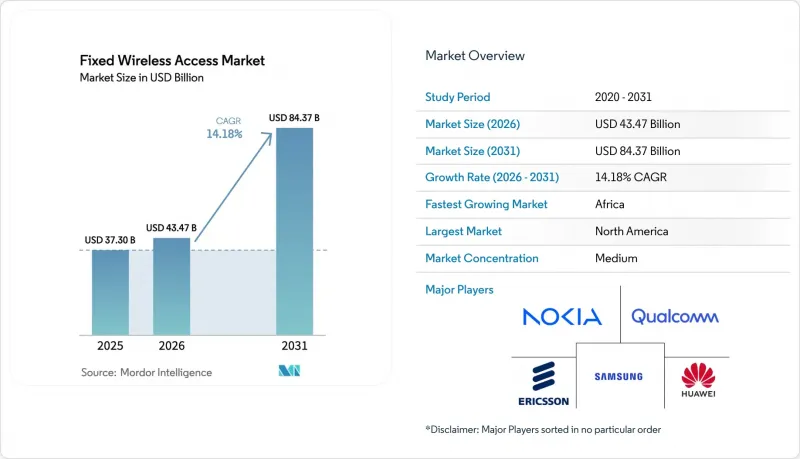
본 보고서는 유형별(하드웨어, 서비스), 용도별(주거, 상업, 산업, 정부·공공 안전), 주파수 대역별(6GHz 미만, mm파, 면허 불필요/공유 CBRS), 도입 형태별(실내 CPE, 실외 CPE, 자가 설치형 창문 장착 CPE) 및 지역별로 분류되어 있습니다. 시장 전망은 금액(달러) 기준으로 제시되어 있습니다.
세계의 고정 무선 액세스 시장 동향 및 인사이트
5G 확산이 기가비트급 FWA를 가속화
3.3GHz-4.2GHz의 중대역 5G는 커버리지와 용량을 모두 충족시켜 기가비트급 FWA를 상업적으로 실현 가능하게 하고 있습니다. 미국의 통신 사업자들은 2024년 중 70개 이상의 대도시권에서 5G 가정용 인터넷 서비스를 시작하여, 다운로드 속도의 중앙값은 300 Mbps 이상, 피크 시에는 1 Gbps 이상을 달성했습니다. 일본, 한국, 인도의 통신 사업자들도 유사한 움직임을 보이며, 장거리 광섬유 설치 비용을 절감하기 위해 기존 모바일 기지국을 활용했습니다. 통신 사업자가 LTE에서 5G New Radio로 전환하면 1비트당 전송 비용이 약 40% 감소하여, 케이블 업계의 기존 사업자들과 경쟁할 수 있는 가격 책정이 가능해집니다. 업계 예측에 따르면, 2029년까지 전 세계 FWA 연결 건수는 3억 3,000만 건을 넘어설 것이며, 2026년 이후의 순증분 거의 전부를 5G가 차지할 전망입니다.
지방 광대역 진흥 프로그램
미국의 BEAD 이니셔티브는 2024년에 서비스가 제공되지 않는 지역을 위해 424억 5,000만 달러를 배정하고, FWA를 허용되는 해결책으로 명시적으로 규정했습니다. 텍사스주나 몬태나주 등에서는 광섬유 건설 비용이 가구당 1만 달러를 초과하는 지역에 대해 무선 네트워크 구축에 자금을 지원하고 있습니다. 유럽의 ‘디지털 디케이드(Digital Decade)’ 정책도 유사한 입장을 취하고 있으며, 광섬유 경제성이 불리한 지역에서 대칭형 100 Mbps가 보장된다는 조건 하에 FWA를 허용하고 있습니다. 인도의 ‘BharatNet 3단계’와 호주의 ‘지역 광대역 계획’도 FWA를 적격 대상에 포함하고 있어, 이를 통해 수년에 걸친 수요 파이프라인이 확보되고 있습니다.
광섬유 가격 하락이 FWA의 ARPU를 압박
케이블 및 광섬유 기존 사업자들은 2024-2025년 기가비트 회선 요금을 최대 20% 인하했으며, 이로 인해 무선 통신 사업자의 사용자당 평균 수익(ARPU)이 압박받고 있습니다. 일부 통신 사업자는 현재 FWA를 모바일 무제한 요금제와 묶어, 가입자 수 증가를 유지하기 위해 세트 요금을 10-25달러 할인하고 있습니다. 이러한 전략적 전환에 따라 경쟁의 초점은 단순한 가격에서 신속한 자가 설치,월단위 계약, 신속한 고객 지원과 같은 경험적 요소로 이동하고 있습니다.
부문 분석
2025년 매출 중 하드웨어가 64.68%를 차지했으며, 이는 실내 게이트웨이, 실외 장치, 스몰 셀 무선 기기의 도입 대수를 반영한 것입니다. 이러한 선두에도 불구하고, 통신 사업자들이 안정적인 현금 흐름을 확보하기 위해 구독 모델에 주력하고 있기 때문에 서비스 매출은 2031년까지 연평균 성장률(CAGR) 15.36%로 하드웨어를 능가하는 속도로 성장할 것으로 예측됩니다. 고정 무선 액세스(FWA) 시장의 서비스 규모는 2026년 154억 달러에서 2031년까지 약 320억 달러로 확대될 것으로 예측됩니다. CPE(고객 단말 장비)에 대한 보조금 지급이나 무상 제공과 같은 전략을 통해 가입자 확보가 가속화되며, 통신 사업자는 24개월 또는 36개월 계약 플랜을 통해 단말기 비용을 회수할 수 있게 됩니다.
관리형 서비스의 제공 범위는 네트워크 모니터링, 클라우드 호스팅형 보안, 실시간 품질 분석에 이릅니다. 도이치 텔레콤의 머신러닝 엔진은 단말기 고장을 예측하고, 서비스 중단이 발생하기 전에 교체용 단말기를 발송함으로써 해지율과 서비스 콜 건수를 줄이고 있습니다. 또한, 액세스 유닛의 출하 동향도 메쉬 노드 기능을 겸하는 다기능 단말기로 전환되고 있으며, 이를 통해 백홀 비용 절감과 실내 영역 확대가 도모되고 있습니다.
2025년 연결 건수의 71.91%를 주거용 수요가 차지했으며, 케이블 및 DSL의 대체 수단으로서 FWA의 본래 가치 제안을 뒷받침하고 있습니다. 그러나 현재는 정부 및 공공 안전 기관 사용자가 가장 빠르게 성장하는 부문으로, 내결함성 관련 요건을 배경으로 연평균 성장률(CAGR) 14.77%로 확대되고 있습니다. 미국의 긴급 대응 기관은 2024년에 이동식 지휘소를 위해 5G 인증을 받은 FWA 장비를 도입했습니다. 한편, 일본의 도도부현은 2026년까지 백업용 무선 회선을 구축해야 할 의무가 있습니다.
소매 체인은 단기간 동안 전용 회선을 이용할 수 없는 경우, 매장을 신속하게 개설하기 위해 FWA를 선호하여 채택하고 있습니다. 커피숍, 물류 창고, 호텔·리조트 시설에서는 기존 DSL에 비해 총 접속 비용이 낮고 서비스 제공까지 걸리는 시간이 짧다는 점이 보고되고 있습니다. 산업 단지에서는 로봇 공학 및 저지연 자동화를 지원하는 프라이빗 5G 슬라이스의 가치가 인정받고 있으며, 고정 무선 액세스 시장은 단순한 광대역의 범위를 넘어 확장되고 있습니다.
지역별 분석
북미는 최근 경매를 통해 확보된 중파 대역 주파수를 활용한 미국과 캐나다의 적극적인 전개에 힘입어 2025년 매출의 33.56%를 차지했습니다. 이 지역의 고정 무선 액세스 시장 점유율은 가구 보급률이 15%를 넘어섬에 따라 안정화되었으며, 통신 사업자들은 지방 마을에서의 점진적인 성장을 추구하고 있습니다. 할인된 가격의 광섬유와의 경쟁은 치열해지고 있지만, 연방 정부 프로그램을 통한 설비 투자 비용 상환은 계속되고 있습니다.
아프리카는 2031년까지 연평균 성장률(CAGR) 15.06%로 가장 빠른 성장이 예상됩니다. 남아프리카공화국, 케냐, 나이지리아, 이집트의 통신 사업자들은 기존 LTE 기지국을 활용하여 구리선이나 제한된 광섬유망을 뛰어넘는 형태로 서비스를 전개하고 있습니다. 가격대는 유선 통신의 대체 수단보다 30%-40% 저렴한 경우가 많아, ‘모바일 퍼스트’ 가구 사이에서 가입자가 급속히 증가하고 있습니다.
아시아태평양은 여전히 성장의 원동력이며, 인도, 중국, 일본에서는 외딴 지역의 디지털 격차를 해소하기 위해 FWA가 도입되고 있습니다. 인도의 주력 5G FWA 서비스는 케이블보다 약 4,000만 가구를 대상으로 하며, 가격은 케이블보다 약 40% 저렴합니다. 중동에서는 정부의 주파수 대역 할당을 통해 사우디아라비아와 아랍에미리트의 통신 사업자들이 멀티 기가비트급 가정용 및 기업용 요금제를 제공할 수 있게 되었으나, 유럽에서는 여전히 광섬유 구축을 우선시하는 국가 지원 규제로 인해 성장이 둔화되고 있습니다.
기타 혜택 :
- 엑셀 형식 시장 예측(ME) 시트
- 3개월간의 애널리스트 지원
자주 묻는 질문
목차
제1장 서론
제2장 조사 방법
제3장 주요 요약
제4장 시장 구도
제5장 시장 규모 및 성장 예측
제6장 경쟁 구도
제7장 시장 기회 및 향후 전망
AJY 26.09.07According to Mordor Intelligence, the fixed wireless access market size is expected to increase from USD 37.30 billion in 2025 to USD 43.47 billion in 2026 and reach USD 84.37 billion by 2031, growing at a CAGR of 14.18% over 2026-2031.
This report is Segmented by Type (Hardware, Services), Application (Residential, Commercial, Industrial, Government and Public Safety), Frequency Band (Sub-6 GHz, Mmwave, Unlicensed/Shared CBRS), Deployment Mode (Indoor CPE, Outdoor CPE, Self-Install Window-Mount CPE), and Geography. The Market Forecasts are Provided in Terms of Value (USD).
Global Fixed Wireless Access Market Trends and Insights
5G Rollout Accelerating Gigabit-Class FWA
Mid-band 5G between 3.3 GHz and 4.2 GHz combines coverage and capacity, making gigabit-class FWA commercially viable. U.S. operators launched 5G home internet in more than 70 metropolitan areas during 2024, delivering median download speeds above 300 Mbps and peaks above 1 Gbps. Carriers in Japan, South Korea, and India mirrored this push, using existing mobile sites to avoid long fiber build-outs. Per-bit delivery cost falls by roughly 40% when operators shift from LTE to 5G New Radio, allowing competitive pricing against cable incumbents. Industry forecasts show global FWA connections exceeding 330 million by 2029, with 5G accounting for nearly all net additions after 2026.
Rural Broadband Stimulus Programmes
The United States BEAD initiative earmarked USD 42.45 billion in 2024 for unserved locations and explicitly labeled FWA as an acceptable solution. States such as Texas and Montana are directing funds toward wireless builds where fiber costs exceed USD 10,000 per passing. Europe's Digital Decade policy takes a similar stance, permitting FWA in areas where fiber economics are unfavorable, provided symmetrical 100 Mbps is guaranteed. India's BharatNet Phase III and Australia's Regional Broadband Scheme also include FWA eligibility, anchoring multi-year demand pipelines.
Fiber Price Erosion Compressing FWA ARPU
Cable and fiber incumbents lowered gigabit tariffs by up to 20% during 2024-2025, squeezing average revenue per user for wireless competitors. Some carriers now bundle FWA with mobile unlimited plans, discounting combined service by USD 10-USD 25 to sustain subscriber growth. The strategic pivot shifts competition from pure price to experiential factors such as rapid self-installation, month-to-month contracts, and responsive customer support.
Other drivers and restraints analyzed in the detailed report include:
- FWA as Cost-Effective Last-Mile Alternative to Fiber
- Enterprise SD-WAN Backup Connectivity Demand
- Weather-Induced Signal Degradation in mmWave Bands
For complete list of drivers and restraints, kindly check the Table Of Contents.
Segment Analysis
Hardware accounted for 64.68% of 2025 revenue, mirroring the installed base of indoor gateways, outdoor units, and small-cell radios. Despite this lead, services revenue is set to outpace hardware at 15.36% CAGR through 2031, as operators lean on subscription models for stable cash flow. The Fixed Wireless Access market size for services is projected to rise from USD 15.4 billion in 2026 to nearly USD 32 billion by 2031. Subsidized or zero-cost CPE tactics accelerate subscriber onboarding, letting carriers recoup device spend over 24- or 36-month plans.
Managed-service offerings span network monitoring, cloud-hosted security, and real-time quality analytics. Deutsche Telekom's machine-learning engine predicts device failure and dispatches replacements before outages occur, cutting churn and service calls. Access-unit shipments are also shifting toward multi-role devices that double as mesh nodes, reducing backhaul costs and expanding indoor reach.
Residential demand captured 71.91% of 2025 connections, underpinning FWA's original value proposition as a cable and DSL substitute. Yet government and public-safety users now represent the fastest-growing slice, advancing at 14.77% CAGR on resilience mandates. First responder agencies in the United States gained 5G-certified FWA gear for mobile command posts in 2024, while Japan's prefectural governments must equip backup wireless links by 2026.
Commercial chains favor FWA for rapid store openings when leased lines are unavailable on short notice. Coffee shops, logistics warehouses, and hospitality venues report lower total connectivity cost and faster provisioning than legacy DSL. Industrial campuses see value in private 5G slices that support robotics and low-latency automation, expanding the Fixed Wireless Access market beyond pure broadband.
Complete Report Scope:
- By Type
- Hardware
- Consumer Premise Equipment (CPE)
- Access Units (Femto and Picocells)
- Services
- Hardware
- By Application
- Residential
- Commercial
- Industrial
- Government and Public Safety
- By Frequency Band
- Sub-6 GHz
- mmWave (Above 24 GHz)
- Unlicensed / Shared CBRS
- By Deployment Mode
- Indoor CPE
- Outdoor CPE
- Self-Install Window-Mount CPE
- By Geography
- North America
- United States
- Canada
- Mexico
- South America
- Brazil
- Argentina
- Rest of South America
- Europe
- United Kingdom
- Germany
- France
- Italy
- Rest of Europe
- Asia-Pacific
- China
- Japan
- India
- South Korea
- Rest of Asia
- Middle East and Africa
- Middle East
- Israel
- Saudi Arabia
- United Arab Emirates
- Turkey
- Rest of Middle East
- Africa
- South Africa
- Egypt
- Rest of Africa
- Middle East
- North America
Geography Analysis
North America generated 33.56% of 2025 revenue, buoyed by aggressive U.S. and Canadian rollouts that leverage mid-band spectrum cleared in recent auctions. The Fixed Wireless Access market share in the region is stabilizing as household penetration tops 15%, prompting carriers to chase incremental growth in rural clusters. Federal programs continue to reimburse capital spend, although competition from discounted fiber is intensifying.
Africa is set to deliver the fastest growth at 15.06% CAGR through 2031. Operators in South Africa, Kenya, Nigeria, and Egypt build on existing LTE towers, vaulting over copper and limited fiber grids. Price points often undercut wired alternatives by 30%-40%, prompting rapid subscriber adoption among mobile-first households.
Asia-Pacific remains a scale engine where India, China, and Japan deploy FWA to close digital gaps in remote regions. India's flagship 5G FWA service targets 100 million households at pricing roughly 40% below cable. In the Middle East, sovereign spectrum allocations allow carriers in Saudi Arabia and the United Arab Emirates to ship multi-gigabit residential and enterprise packages, while Europe's growth trails due to state-aid rules that still prioritize fiber builds.
- Huawei Technologies Co. Ltd.
- Nokia Corporation
- Ericsson AB
- Qualcomm Technologies Inc.
- Samsung Electronics Co. Ltd.
- Verizon Communications Inc.
- AT&T Inc.
- T-Mobile US Inc.
- United States Cellular Corporation
- ZTE Corporation
- Deutsche Telekom AG
- Vodafone Group Plc
- Orange S.A.
- Telstra Corporation Limited
- Globe Telecom Inc.
- Inseego Corp.
- Airspan Networks Holdings Inc.
- Siklu Communication Ltd.
- Starry Group Holdings Inc.
- Tarana Wireless Inc.
- Cambium Networks Corporation
- Casa Systems Inc.
- NETGEAR Inc.
Additional Benefits:
- The market estimate (ME) sheet in Excel format
- 3 months of analyst support
TABLE OF CONTENTS
1 INTRODUCTION
- 1.1 Study Assumptions and Market Definition
- 1.2 Scope of the Study
2 RESEARCH METHODOLOGY
3 EXECUTIVE SUMMARY
4 MARKET LANDSCAPE
- 4.1 Market Overview
- 4.2 Market Drivers
- 4.2.1 5G Roll-Out Accelerating Gigabit-Class FWA
- 4.2.2 Rural Broadband Stimulus Programmes
- 4.2.3 FWA as Cost-Effective Last-Mile Alternative to Fibre
- 4.2.4 Enterprise SD-WAN Back-Up Connectivity Demand
- 4.2.5 Spectrum Auction Design Favouring Mid-Band Sharing
- 4.2.6 AI-Optimised CPE Self-Install Reducing Truck Rolls
- 4.2.7 Rise of Corporate Net-Zero Targets Driving Wireless Power-Efficient Access
- 4.3 Market Restraints
- 4.3.1 Spectrum Scarcity and Regulatory Uncertainty
- 4.3.2 High mmWave Densification CAPEX
- 4.3.3 Fibre Price Erosion Compressing FWA ARPU
- 4.3.4 Weather-Induced Signal Degradation in mmWave Bands
- 4.3.5 State-Aid Rules Limiting Subsidised FWA Deployments
- 4.4 Industry Value-Chain Analysis
- 4.5 Regulatory Landscape
- 4.6 Technological Outlook
- 4.6.1 Key Enablers for FWA Adoption
- 4.6.2 Vendor Initiatives and Partnerships
- 4.6.3 Business Considerations and Prerequisites
- 4.6.4 FWA vs FTTH / FTTdp Comparison
- 4.6.5 Rural, Semi-Urban and Urban Use-Case Models
- 4.7 Impact of Macroeconomic Factors on the Market
- 4.8 Porter's Five Forces Analysis
- 4.8.1 Bargaining Power of Suppliers
- 4.8.2 Bargaining Power of Buyers
- 4.8.3 Threat of New Entrants
- 4.8.4 Threat of Substitutes
- 4.8.5 Competitive Rivalry
5 MARKET SIZE AND GROWTH FORECASTS (VALUE)
- 5.1 By Type
- 5.1.1 Hardware
- 5.1.1.1 Consumer Premise Equipment (CPE)
- 5.1.1.2 Access Units (Femto and Picocells)
- 5.1.2 Services
- 5.1.1 Hardware
- 5.2 By Application
- 5.2.1 Residential
- 5.2.2 Commercial
- 5.2.3 Industrial
- 5.2.4 Government and Public Safety
- 5.3 By Frequency Band
- 5.3.1 Sub-6 GHz
- 5.3.2 mmWave (Above 24 GHz)
- 5.3.3 Unlicensed / Shared CBRS
- 5.4 By Deployment Mode
- 5.4.1 Indoor CPE
- 5.4.2 Outdoor CPE
- 5.4.3 Self-Install Window-Mount CPE
- 5.5 By Geography
- 5.5.1 North America
- 5.5.1.1 United States
- 5.5.1.2 Canada
- 5.5.1.3 Mexico
- 5.5.2 South America
- 5.5.2.1 Brazil
- 5.5.2.2 Argentina
- 5.5.2.3 Rest of South America
- 5.5.3 Europe
- 5.5.3.1 United Kingdom
- 5.5.3.2 Germany
- 5.5.3.3 France
- 5.5.3.4 Italy
- 5.5.3.5 Rest of Europe
- 5.5.4 Asia-Pacific
- 5.5.4.1 China
- 5.5.4.2 Japan
- 5.5.4.3 India
- 5.5.4.4 South Korea
- 5.5.4.5 Rest of Asia
- 5.5.5 Middle East and Africa
- 5.5.5.1 Middle East
- 5.5.5.1.1 Israel
- 5.5.5.1.2 Saudi Arabia
- 5.5.5.1.3 United Arab Emirates
- 5.5.5.1.4 Turkey
- 5.5.5.1.5 Rest of Middle East
- 5.5.5.2 Africa
- 5.5.5.2.1 South Africa
- 5.5.5.2.2 Egypt
- 5.5.5.2.3 Rest of Africa
- 5.5.5.1 Middle East
- 5.5.1 North America
6 COMPETITIVE LANDSCAPE
- 6.1 Market Concentration
- 6.2 Strategic Moves
- 6.3 Market Share Analysis
- 6.4 Company Profiles (includes Global Level Overview, Market Level Overview, Core Segments, Financials as Available, Strategic Information, Market Rank/Share for Key Companies, Products and Services, and Recent Developments)
- 6.4.1 Huawei Technologies Co. Ltd.
- 6.4.2 Nokia Corporation
- 6.4.3 Ericsson AB
- 6.4.4 Qualcomm Technologies Inc.
- 6.4.5 Samsung Electronics Co. Ltd.
- 6.4.6 Verizon Communications Inc.
- 6.4.7 AT&T Inc.
- 6.4.8 T-Mobile US Inc.
- 6.4.9 United States Cellular Corporation
- 6.4.10 ZTE Corporation
- 6.4.11 Deutsche Telekom AG
- 6.4.12 Vodafone Group Plc
- 6.4.13 Orange S.A.
- 6.4.14 Telstra Corporation Limited
- 6.4.15 Globe Telecom Inc.
- 6.4.16 Inseego Corp.
- 6.4.17 Airspan Networks Holdings Inc.
- 6.4.18 Siklu Communication Ltd.
- 6.4.19 Starry Group Holdings Inc.
- 6.4.20 Tarana Wireless Inc.
- 6.4.21 Cambium Networks Corporation
- 6.4.22 Casa Systems Inc.
- 6.4.23 NETGEAR Inc.
7 MARKET OPPORTUNITIES AND FUTURE OUTLOOK
- 7.1 White-Space and Unmet-Need Assessment


